Questions

3 Marks Question

Take a timed test

5 questions · self-marked practice — reveal the answer and mark yourself.

Question 13 Marks
A cricket bowler releases the ball in two different ways.
  1. Giving it only horizontal velocity, and
  2. Giving it horizontal velocity and a small downward velocity. The speed $v_s$ at the time of release is the same. Both are released at a height $H$ from the ground. Which one will have greater speed when the ball hits the ground? Neglect air resistance.
Answer
For $(a) \frac{1}{2}\text{v}_\text{z}^2=\text{gH}$
$\Rightarrow\text{v}_\text{z}\sqrt{2\text{gH}}$ Speed at ground $=\sqrt{\text{v}_\text{s}^2+\text{v}_\text{z}^2}=\sqrt{\text{v}_\text{s}^2+2\text{gH}}$ For $(b)$ also$[\frac{1}{2}\text{mv}_\text{s}^2+\text{mg}\text{H}]$ is the total energy of the ball when it hits the ground So the speed would be the same for both $(a)$ and $(b).$
View full question & answer
Question 23 Marks
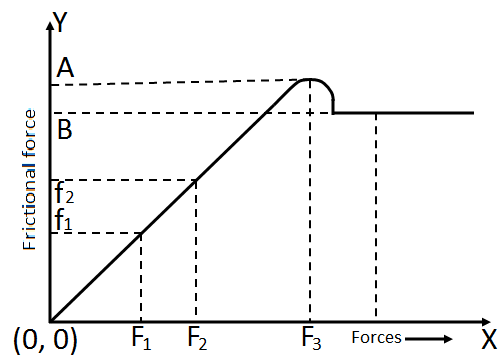
A block placed on a rough horizontal surface is pulled by a horizontal force F. Let f be the force applied by the rough surface on the block. Plot a graph of f versus F.
Answer
When a small force $F_1$ is applied on a heavier box, it does not move At this state force of friction $f_1$ is equal to $F_1$. On increasing force box does not move till $F=F_S$ the maximum static frictional or limiting force. Its corresponding frictional force $f_S$ on $Y$-axis.
 
After force $F_s$, the frictional force decrease i.e., less force $\text{F}_\text{k}<\text{F}_\text{s}$ is applied on body and it starts to move with less friction $\text{f}_\text{k}<\text{f}_\text{s}$A = limiting frictional force and at $B =$ kinetic frictional force.
View full question & answer
Question 33 Marks
 A person in an elevator accelerating upwards with an acceleration of $2 m s ^{-2}$, tosses a coin vertically upwards with a speed of 20 m $s ^1$. After how much time will the coin fall back into his hand? $\left( g =10 m s ^{-2}\right)$
Answer
Upward acceleration of elevator $( a )=2 m / s ^2$ Acceleration due to gravity $( g )=10 ms^{-2}$
$\therefore$ Net effective acceleration $a^{\prime}=(a+g)=(2+10)$
$a^{\prime}=12 ms$ Consider the effective motion of coin $v=0 t=$ time of coin to achieve maximum height $U=20 ms^{-1} a^{\prime}=$ $12 ms^{-2}$
$\therefore v = u +$ at here $a = a ^{\prime}$
$0 = 20 – 12t$ (upward motion)$\text{t}=\frac{20}{12}\text{s}=\frac{5}{3}\text{s}$
Time of ascent is equal to the time of decent.$\therefore$ Total time to return in hand after achieving maximum height
$\frac{5}{3}+\frac{5}{3}=\frac{10}{3}=3\frac{1}{3}\sec.$
View full question & answer
Question 43 Marks
 A woman throws an object of mass $500$ g with a speed of $25 m s ^1$. If the object hits a wall and rebounds with half the original speed, what is the change in momentum of the object?
Answer
$\text{m}=0.5\text{kg}\ \ \text{u}=+25\text{ms}^{-1}\text{(Forword)}$$\text{v}=\frac{-25}{2}\text{ms}^{-1}$ (as backward)
$\therefore\Delta\text{p}=\text{m}(\text{v}-\text{u})=0.5\Big[\frac{-25}{2}-25\Big]$
$=0.5[-12.5-25] = 0.5\times(-37.5)$
$\Delta\text{p}=-18.75\text{kg}\ \text{ms}^{-1}$ or N-s
Hence, the $\Delta\text{p}$ or $\frac{\Delta\text{p}}{\Delta\text{t}}$ or force is opposite to the initial velocity of ball.
View full question & answer
Question 53 Marks
The displacement vector of a particle of mass m is given by $\text{r}\text{(t})=\hat{\text{i}}\text{A}\cos\omega\text{t}+\hat{\text{j}}\text{B}\sin\omega\text{t}.$Show that the trajectory is an ellipse.
Answer
The Main concept used: To plot the graph ( r - t ) or trajectory we relate x and y coordinates.$\vec{\text{r}}\text{(t)}=\hat{\text{i}}\text{A}\cos\omega\text{t}+\hat{\text{j}}\text{B}\sin\omega\text{t}$
$\text{x}=\text{A}\cos\omega\text{t}$ and $\text{y}=\sin\omega\text{t}$
$\frac{\text{x}}{\text{A}}=\cos\omega\text{t}\ ...(\text{i})\ \frac{\text{y}}{\text{}B}=\sin\omega\text{t}\ ...(\text{ii})$
Squaring and adding (i), (ii)$\frac{\text{x}^2}{\text{A}^2}+\frac{\text{y}^2}{\text{B}^2}=\cos^2\omega\text{t}+\sin^2\omega\text{t}$
$\frac{\text{x}^2}{\text{A}^2}+\frac{\text{y}^2}{\text{B}^2}=1$ it is the equation of an ellipse. So the trajectory is an ellipse.
View full question & answer