Questions

M.C.Q (1 Marks)

Take a timed test

19 questions · auto-graded multiple-choice test.

MCQ 11 Mark
Two parallel, long wires carry currents $i_1$ and $i_2$ with $i_1 > i_2$. When the currents are in the same direction, the magnetic field at a point midway between the wires is $10 \mu\text{T}.$ If the direction of $i_2$ is reversed, the field becomes $30 \mu\text{T}.$ The ratio $\frac{\text{i}_1}{\text{i}_2}$ is:
  • A
    $4$
  • B
    $3$
  • $2$
  • D
    $1$
Answer
Correct option: C.
$2$
The magnetic field due to the current$-$carrying long, straight wire at point a is given by,
$\text{B}=\frac{\mu_0\text{i}}{2\pi\text{d}}$
When both the wires carry currents $i_1$ and $i_2$ in the same direction, they produce magnetic fields in opposite directions at any point in between the wires.
$\text{B}'=\frac{\mu_0\text{i}_1}{2\pi\text{a}}-\frac{\mu_0\text{i}_2}{2\pi\text{a}}=10\mu\text{T}\ ...(1)$
Here, $a$ is the distance of the midpoint from both the wires.
When both the wires carry currents in opposite directions, they produce fields in the same direction at the midpoint of the two wires.
$\text{B}''=\frac{\mu_0\text{i}_1}{2\pi\text{a}}+\frac{\mu_0\text{i}_2}{2\pi\text{a}}=30\mu\text{T}\ ...(2)$
On solving eqs. $(1)$ and $(2)$, we get
$\text{i}_1-\text{i}_2=10$
$\text{i}_1+\text{i}_2=30$
$\Rightarrow\text{i}_1=20$
$ \text{i}_2=10$
$\frac{\text{i}_1}{\text{i}_2}=\frac{20}{10}$
$\frac{\text{i}_1}{\text{1}_2}=\frac{2}{1}$
$\Rightarrow\frac{\text{i}_1}{\text{i}_2}=2$
View full question & answer
MCQ 21 Mark
A moving charge produces:
  • A
    Electric field only.
  • B
    Magnetic field only.
  • Both of them.
  • D
    None of them.
Answer
Correct option: C.
Both of them.
Because of the presence of a charge, a particle produces an electric field. Also, because of its motion, that is, the flow of charge or current, there is generation of a magnetic field.
View full question & answer
MCQ 31 Mark
A long, straight wire of radius $R$ carries a current distributed uniformly over its cross section. $T$ he magnitude of the magnetic field is:
  • A
    Maximum at the axis of the wire.
  • B
    Minimum at the axis of the wire.
  • C
    Maximum at the surface of the wire.
  •  Both $B$ and $C$
Answer
Correct option: D.
 Both $B$ and $C$
A long, straight wire of radius $R$ is carrying current $i,$ which is uniformly distributed over its cross section. According to Ampere's law,
$\oint\overrightarrow{\text{B}}.\text{d}\overrightarrow{\text{l}}=\mu_0\text{i}_\text{inside}$
At surface,
$\text{B}\times2\pi\text{R}=\mu_0\text{i}$
$\Rightarrow\text{B}_\text{surface}=\frac{\mu_0\text{i}}{2\pi\text{R}}$
Inside, $\text{B}\times2\pi\text{r}=\mu_0\text{i}$ for $\text{r}<\text{R}$
Here $i$, is the current enclosed by the amperian loop drawn inside the wire.
$B_{inside}$ will be proportional to the distance from the axis.
On the axis
$B = 0$
The magnetic fields from points on the cross section will point in opposite directions and will cancel each other at the centre.
Outside, $\text{B}\times2\pi\text{r}=\mu_0\text{i}$
$\Rightarrow\text{B}_\text{outside}=\frac{\mu_0\text{i}}{2\pi\text{r}},\ \text{r}>\text{R}$
Therefore, the magnitude of the magnetic field is maximum at the surface of the wire and minimum at the axis of the wire.
View full question & answer
MCQ 41 Mark
Consider three quantities $\text{x}=\frac{\text{E}}{\text{B}},\ \text{y}=\sqrt{\frac{1}{\mu_0\in_0}}$ and $\text{z}=\frac{1}{\text{CR}}.$ Here, $l$ is the length of a wire, $C$ is a capacitance and $R$ is a resistance. All other symbols have standard meanings.
  • A
    $x, y$ have the same dimensions.
  • B
    $y, z$ have the same dimensions.
  • C
    $z, x$ have the same dimensions.
  • All of the above
Answer
Correct option: D.
All of the above
Lorentz Force:
$\text{qvB}=\text{qE}$
$\Rightarrow$ Dimensions of $\text{x}=[\text{v}]=\Big[\frac{\text{E}}{\text{B}}\Big]=\big[\text{LT}^{-1}\big]$
$\text{y}=\frac{1}{\sqrt{\mu_0\in_0}}$
$=\sqrt{\frac{4\pi}{\mu_0}\times\frac{1}{4\pi\in_0}}$
$=\sqrt{\frac{9\times10^9}{10^{-7}}}$
$=3\times10^8$
$=\text{c}$
$\Rightarrow$ Dimensions of $\text{y}=[\text{c}]=\big[\text{LT}^{-1}\big]$
Time constant of $RC$ circuit $= RC$ so dimensionally $[RC] = [T]$
$\Rightarrow\text{z}=\Big[\frac{\text{l}}{\text{RC}}$
$\Rightarrow[\text{z}]=[\text{LT}^{-1}]$
Therefore, $x, y$ and $z$ have the same dimensions.
View full question & answer
MCQ 51 Mark
In a coaxial, straight cable, the central conductor and the outer conductor carry equal currents in opposite directions. The magnetic field is zero:
  1. Outside the cable.
  2. Inside the inner conductor.
  3. Inside the outer conductor.
  4. In between the tow conductors.
  • $A$ and $B$
  • B
    $B$ and $D$
  • C
    $A$ and $D$
  • D
    Only $D$
Answer
Correct option: A.
$A$ and $B$
According to Ampere's law, in a coaxial, straight cable carrying currents $i$ in the inner conductor and $-i$ $($equally in the opposite direction$)$ in the outside conductor.
Inside the inner conductor
$\oint\overrightarrow{\text{B}}.\text{d}\overrightarrow{\text{l}}=\mu_0\text{i}_\text{inside}$
$\oint\overrightarrow{\text{B}}.\text{d}\overrightarrow{\text{l}}=0$
$\Rightarrow\text{b.l}=0$
$\Rightarrow\text{B}=0$
In between the $2$ conductors
$\oint\overrightarrow{\text{B}}.\text{d}\overrightarrow{\text{l}}=\mu_0\text{i}$
$\Rightarrow\text{B}=\frac{\mu_0\text{i}}{2\pi\text{r}}$
Outside the outer conductor
$\oint\overrightarrow{\text{B}}.\text{d}\overrightarrow{\text{l}}=\mu_0\text{i}$
$\Rightarrow\text{B}=0$
Therefore, the magnetic field is zero outside the cable.
View full question & answer
MCQ 61 Mark
Two particles $X$ and $Y$ having equal charge, after being accelerated through the same potential difference enter a region of uniform magnetic field and describe circular paths of radii $R_1$ and $R_2$ respectively. The ratio of the mass of $X$ to that of $Y$ is:
  • A
    $\Big(\frac{\text{R}_1}{\text{R}_2}\Big)^{\frac{1}{2}}$
  • B
    $\frac{\text{R}_1}{\text{R}_2}$
  • $\Big(\frac{\text{R}_1}{\text{R}_2}\Big)^2$
  • D
    $\text{R}_1\text{R}_2.$
Answer
Correct option: C.
$\Big(\frac{\text{R}_1}{\text{R}_2}\Big)^2$
Particles $X$ and $Y$ of respective masses $m_1$ and $m_2$ are carrying charge $q$ describing circular paths with respective radii $R_1$ and $R_2$ such that,
$\text{R}_1=\frac{\text{m}_1\text{v}_1}{\text{qB}}$
$\text{R}_1=\frac{\text{m}_2\text{v}_2}{\text{qB}}$
Since both the particles are accelerated through the same potential difference, both will have the same kinetic energy.
$\therefore\frac{1}{2}\text{m}_1\text{v}_1^2=\frac{1}{2}\text{m}_2\text{v}_2^2$
$\because\text{R}_1=\frac{\text{m}_1\text{v}_1}{\text{qB}}\Rightarrow\text{v}_1=\frac{\text{R}_1\text{qB}}{\text{m}_1}$
And,
$\text{R}_2=\frac{\text{m}_2\text{v}_2}{\text{qB}}\Rightarrow\text{v}_2=\frac{\text{R}_2\text{qB}}{\text{m}_2}$
$\therefore\text{m}_1\Big(\frac{\text{R}_1\text{qB}}{\text{m}_1}\Big)^2=\text{m}_2\Big(\frac{\text{R}_2\text{qB}}{\text{m}_2}\Big)^2$
$\Rightarrow\frac{\text{m}_1}{\text{m}_2}=\frac{\text{R}_1^2}{\text{R}_2^2}=\Big(\frac{\text{R}_1}{\text{R}_2}\Big)^2$
View full question & answer
MCQ 71 Mark
A vertical wire carries a current in upward direction. An electron beam sent horizontally towards the wire will be deflected:
  • A
    Towards right.
  • B
    Towards left.
  • Upwards.
  • D
    Downwards.
Answer
Correct option: C.
Upwards.
A vertical wire is carrying current in upward direction, so the magnetic field produced will be anticlockwise (according to the right-hand thumb rule). As the electron beam is sent horizontally towards the wire, the direction of the current will be horizontally away from the wire (direction of conventional current is opposite to the direction of the negative charge). According to Fleming's left-hand rule, the force will act in upward direction, deflecting the beam in the same direction.
View full question & answer
MCQ 81 Mark
The magnetic field at the origin due to a current element $\text{i}\text{d}\ \vec{\text{l}}$ placed at a position $\overrightarrow{\text{r}}$ is:
  1. $\frac{\mu_0\text{i}}{4\pi}\frac{\text{d}\overrightarrow{\text{l}}\times\overrightarrow{\text{r}}}{\text{r}^3}$
  2. $-\frac{\mu_0\text{i}}{4\pi}\frac{\overrightarrow{\text{r}}\times​​\text{d}\overrightarrow{\text{l}}}{\text{r}^3}$
  3. $\frac{\mu_0\text{i}}{4\pi}\frac{\overrightarrow{\text{r}}\times​​\text{d}\overrightarrow{\text{l}}}{\text{r}^3}$
  4. $-\frac{\mu_0\text{i}}{4\pi}\frac{\text{d}\overrightarrow{\text{l}}\times\overrightarrow{\text{r}}}{\text{r}^3}$
  • A
    Only $A$
  • $A$ and $B$
  • C
    Only $C$
  • D
    $B$ and $D$
Answer
Correct option: B.
$A$ and $B$
The magnetic field at the origin due to current element $\text{i}\text{d}\ \vec{\text{l}}$ placed at a position $\overrightarrow{\text{r}}$ is given by,
$\text{d}\overrightarrow{\text{B}}=\frac{\mu_0\text{i}}{4\pi}\frac{\overrightarrow{\text{r}}\times\text{d}\overrightarrow{\text{l}}}{\text{r}^3}$
According to the cross product property,
$\overrightarrow{\text{A}}\times\overrightarrow{\text{B}}=-\overrightarrow{\text{B}}\times\overrightarrow{\text{A}}$
$\Rightarrow\text{d}\overrightarrow{\text{B}}=-\frac{\mu_0\text{i}}{4\pi}\frac{\overrightarrow{\text{r}}\times\text{d}\overrightarrow{\text{l}}}{\text{r}^3}$
View full question & answer
MCQ 91 Mark
A hollow tube is carrying an electric current along its length distributed uniformly over its surface. The magnetic field:
  1. Increases linearly from the axis to the surface.
  2. Is constant inside the tube.
  3. Is zero at the axis.
  4. Is zero just outside the tube.
  • A
    $A$ and $B$
  • B
    Only $B$
  • $B$ and $C$
  • D
    All of the above
Answer
Correct option: C.
$B$ and $C$
A hollow tube is carrying uniform electric current along its length, so the current enclosed inside the tube is zero.
According to Ampere's law,
$\oint\overrightarrow{\text{B}}.\text{d}\overrightarrow{\text{l}}=\mu_0\text{i}_\text{inside}$
Inside the tube,
$\oint\overrightarrow{\text{B}}.\text{d}=0,\ \text{r}<\text{R}$
$\Rightarrow\text{B}_\text{inside}=\text{Constant}$
$\Rightarrow\text{B}_\text{axis}=0$
The magnetic fields from points on the circular surface will point in opposite directions and cancel each other.
Outside the tube,
$\text{B}\times2\pi\text{r}=\mu_0\text{i}$
$\Rightarrow\text{B}_\text{outside}=\frac{\mu_0\text{i}}{2\pi\text{r}},\ \text{r}<\text{R}$
View full question & answer
MCQ 101 Mark
A circular loop is kept in that vertical plane which contains the north-south direction. It carries a current that is towards north at the topmost point. Let A be a point on the axis of the circle to the east of it and B a point on this axis to the west of it. The magnetic field due to the loop
  • A
    Is towards east at A and towards west at B.
  • B
    Is towards west at A and towards east at B.
  • C
    Is towards east at both A and B.
  • Is towards west at both A and B.
Answer
Correct option: D.
Is towards west at both A and B.
According to the right-hand thumb rule, if we curl the fingers of our right hand in the direction of the current flowing, then the stretching of the thumb will show the direction of the magnetic field developed due to it and vice versa.
Let north-south is along x axis and east-west is along y axis. Circular wire is in xz plane. Then point A will lie on positive y axis and B on negative y axis. On looking from point B, current is flowing in anticlockwise direction so the magnetic field will point from right to left. Hence, the magnetic field due to the loop will be towards west at both A and B.
View full question & answer
MCQ 111 Mark
A long, straight wire carries a current along the $z-$axis, One can find two points in the $x−$yplane such that:
  • A
    The field at one point is opposite to that at the other point.
  • B
    The directions of the magnetic fields are the same.
  • C
    The magnitudes of the magnetic fields are equal.
  • All of the above
Answer
Correct option: D.
All of the above
Consider a current carrying wire lying along $x$ axis.
At any two points on $z$ axis which are at equal distance from the wire,one above the wire and one below the wire, the magnitude of magnetic field will be same and their directions will be opposite to each other.
At any two points on $z$ axis which are at different distances from the wire,one above the wire and other also above the wire,the magnitude of magnetic field will be different and their directions will be same to each other.
View full question & answer
MCQ 121 Mark
A charged particle is moved along a magnetic field line. The magnetic force on the particle is:
  • A
    Along its velocity.
  • B
    Opposite to its velocity.
  • C
    Perpendicular to its velocity.
  • Zero.
Answer
Correct option: D.
Zero.
The force on a charged particle q moving with velocity v in a magnetic field B is given by,
$\overrightarrow{\text{F}}=\text{q}\big(\overrightarrow{\text{v}}\times\overrightarrow{\text{B}}\big)=0$
As the charge is moving along the magnetic line of force, the velocity and magnetic field vectors will point in the same direction, making a cross product.
$\big(\overrightarrow{\text{v}}\times\overrightarrow{\text{B}}\big)=0$
$\Rightarrow\overrightarrow{\text{F}}=0$
So, the magnetic force on the particle will be zero.
View full question & answer
MCQ 131 Mark
A steady electric current is flowing through a cylindrical conductor.
  1. The electric field at the axis of the conductor is zero.
  2. The magnetic field at the axis of the conductor is zero.
  3. The electric field in the vicinity of the conductor is zero.
  4. The magnetic field in the vicinity of the conductor is zero.
  • A
    $A$ and $B$
  • $B$ and $C$
  • C
    $B$ and $D$
  • D
    $A$ and $D$
Answer
Correct option: B.
$B$ and $C$
As the current is flowing through a conductor so it it is distributed only on the surface of the conductor not in the volume of the cylindrical conductor. It is equivalent to charge distribution on a cylindrical sheet for which electric field inside a conducting cylindrical sheet is always zero.
Magnetic fields at any point inside the conducting cylinder is proportional to the distance from the axis of the cylinder.
At the axis, $r = 0.$
This implies that field will be zero at the axis.
View full question & answer
MCQ 141 Mark
Consider a long, straight wire of cross-sectional area A carrying a current i. Let there be n free electrons per unit volume. An observer places himself on a trolley moving in the direction opposite to the current with a speed $\text{v}=\frac{\text{i}}{\text{nAe}}$ and separated from the wire by a distance r. The magnetic field seen by the observer is very nearly:
  • $\frac{\mu_0\text{i}}{2\pi\text{r}}$
  • B
    $\text{Zero}$
  • C
    $\frac{\mu_0\text{i}}{\pi\text{r}}$
  • D
    $\frac{2\mu_0\text{i}}{\pi\text{r}}.$
Answer
Correct option: A.
$\frac{\mu_0\text{i}}{2\pi\text{r}}$
Magnetic field will be independent of the motion of the observer because the velocity with which the observer is moving is comparable to drift velocity of electron which is very small as compared to the speed of flow of current from one end of wire to other end. So it can be neglected and hence, magnetic field due to the wire w.r.t the observer will be $\text{B}=\frac{\mu_0\text{i}}{2\pi\text{r}}$
View full question & answer
MCQ 151 Mark
A current-carrying, straight wire is kept along the axis of a circular loop carrying a current. The straight wire:
  • A
    Will exert an inward force on the circular loop.
  • B
    Will exert an outward force on the circular loop.
  • Will not exert any force on the circular loop.
  • D
    Will exert a force on the circular loop parallel to itself.
Answer
Correct option: C.
Will not exert any force on the circular loop.
The magnetic force on a wire carrying an electric current i is given as​ $\vec{\text{F}}=\text{i}.\big(\vec{\text{l}}\times\vec{\text{B}}\big),$ where l is the length of the wire and B is the magnetic field acting on it. If a current-carrying straight wire is kept along the axis of a circular loop carrying current, then according to the right-hand thumb rule, the magnetic field due to the wire on the current-carrying loop will be along its circumference, which contains a current element $\text{i}\text{d}\vec{\text{l}}.$
So, the cross product will be
$\Rightarrow\vec{\text{F}}=0$
Thus, the straight wire will not exert any force on the loop.
View full question & answer
MCQ 161 Mark
A proton beam is going from north to south and an electron beam is going from south to north. Neglecting the earth's magnetic field, the electron beam will be deflected
  • Towards the proton beam.
  • B
    Away from the proton beam.
  • C
    Upwards.
  • D
    Downwards.
Answer
Correct option: A.
Towards the proton beam.
A proton beam is going from north to south, so the direction of the current due to the beam will also be from north to south. Also, an electron beam is going from south to north, so the direction of the current due to the beam will also be from north to south. The direction of conventional current is along the direction of the flow of the positive charge and opposite to the flow of the negative charge. The magnetic field generated due to them will enter the plane of paper in the west and come out of the plane of paper in the east, according to the right-hand thumb rule. Since both the beams have currents in the same direction, they will apply equal and opposite forces on each other and, hence, will attract each other.
Thus, the electron beam will be deflected towards the proton beam.
View full question & answer
MCQ 171 Mark
A particle is projected in a plane perpendicular to a uniform magnetic field. The area bounded by the path described by the particle is proportional to:
  • A
    The velocity.
  • B
    The momentum.
  • The kinetic energy.
  • D
    None of these.
Answer
Correct option: C.
The kinetic energy.
When a particle of mass m carrying charge q is projected with speed v in a plane perpendicular to a uniform magnetic field B, the field tends to deflect the particle in a circular path of radius r.
$\therefore\frac{\text{mv}^2}{\text{r}^2}=\text{qvB}$
$\Rightarrow\text{r}=\frac{\text{mv}}{\text{qB}}$
Now,
Area, $\text{A}=\pi\text{r}^2$
$\Rightarrow\text{A}=\pi\Big(\frac{\text{mv}}{\text{qB}}\Big)^2$
$\Rightarrow\text{A}=\text{kv}^2$
Here,
$\text{k}=\pi\Big(\frac{\text{m}}{\text{qB}}\Big)^2$
Kinetic energy of the particle, $\text{E}=\frac{1}{2}\text{mv}^2$
Therefore, the area bounded is proportional to the kinetic energy.
View full question & answer
MCQ 181 Mark
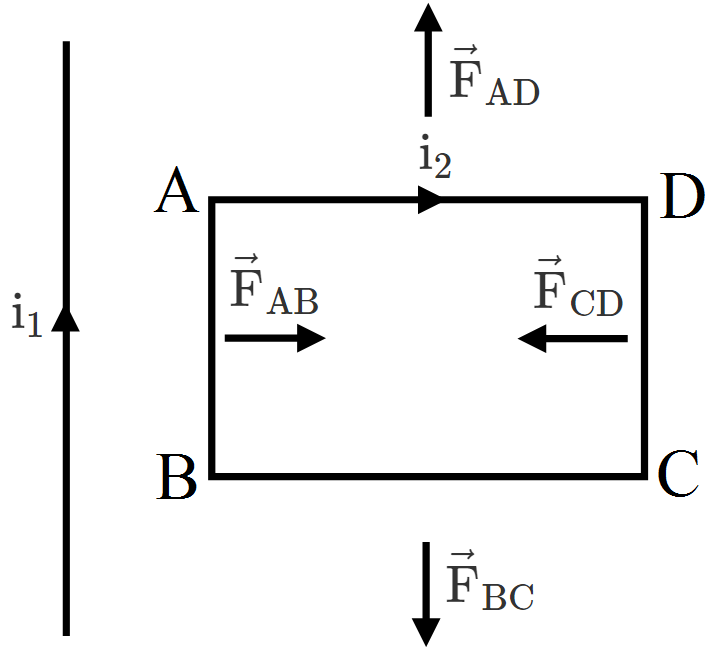
Consider the situation shown in figure. The straight wire is fixed but the loop can move under magnetic force. The loop will:
  • A
    Remain stationary.
  • Move towards the wire.
  • C
    Move away from the wire.
  • D
    Rotate about the wire.
Answer
Correct option: B.
Move towards the wire.

$\overrightarrow{\text{F}}_\text{AD}+\overrightarrow{\text{F}}_\text{BC}=0$
$\overrightarrow{\text{F}}_\text{AB}>\overrightarrow{\text{F}}_\text{CD}$
Force acting on the wire per unit length carrying current $i_2$ due to the wire carrying current $i_1$ placed at a distance $d$ is given by,
$\text{F}=\frac{\mu_0\text{i}_1\text{i}_2}{2\pi\text{d}}$
So, forces per unit length acting on sides $AB$ and $CD$ are as follows:
$\text{F}_\text{AB}=\frac{\mu_0\text{i}_1\text{i}_2}{2\pi\text{d}} ($Towards the wire$)$
$\text{F}_\text{CD}=\frac{\mu_0\text{i}_1\text{i}_2}{2\pi(\text{d}+\text{a})} ($Away from the wire$)$
Here, $F_{AB} > F_{CD}$ because force is inversly proportional to the distance from the wire and wire $AB$ is closer to the wire carrying current $i_1$.
The forces per unit length acting on sides $BC$ and $DA$ will be equal and opposite, as they are equally away from the wire carrying current $i_1$, with current $i_2$ flowing in the opposite direction.
$\therefore\text{F}_\text{BC}=-\text{F}_\text{DA}$
Now,
Net force:
$\text{F} = \text{F}_\text{AB}+\text{F}_\text{BC}+\text{F}_\text{CD}+\text{F}_\text{DA}$
$\Rightarrow\text{F}=\frac{\mu_0\text{i}_1\text{i}_2}{2\pi\text{d}}+\text{F}_\text{BC}-\frac{\mu_0\text{i}_1\text{i}_2}{2\pi(\text{d+a})}-\text{F}_\text{BC}$
$\Rightarrow\text{F}=\frac{\mu_0\text{i}_1\text{i}_2}{2\pi}\Big(\frac{1}{\text{d}}-\frac{1}{\text{d+a}}\Big)$
$\Rightarrow\text{F}=\frac{\mu_0\text{i}_1\text{i}_2\text{a}}{2\pi\text{d}(\text{d+a})}$
$($Towards the wire$)$
Therefore, the loop will move towards the wire.
View full question & answer
MCQ 191 Mark
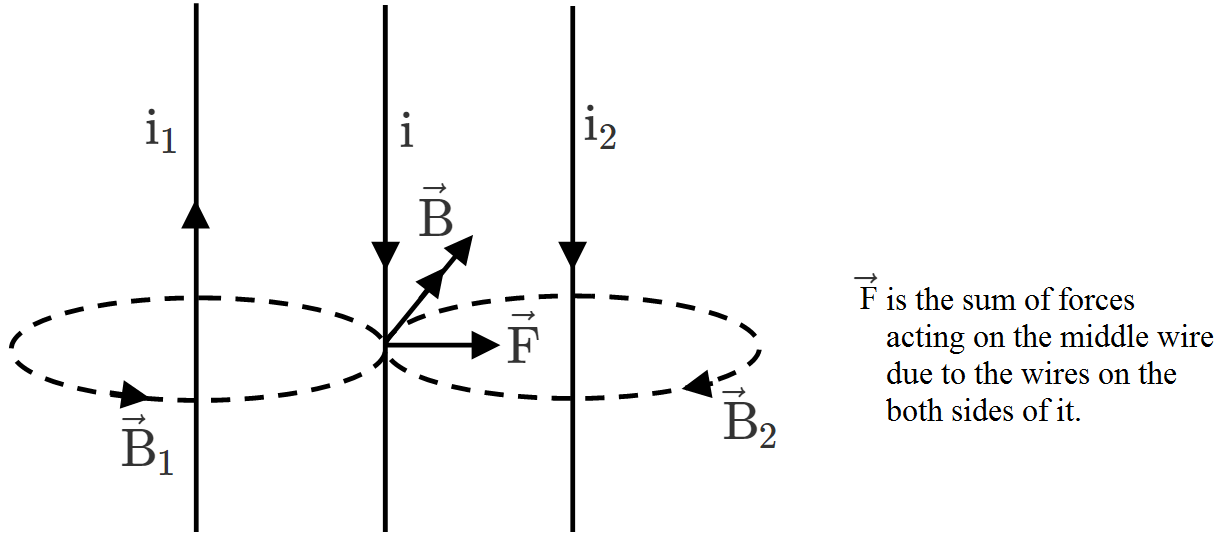
Two parallel wires carry currents of 20A and 40A in opposite directions. Another wire carying a current anti parallel to 20A is placed midway between the two wires. T he magnetic force on it will be:
  • A
    Towards 20A.
  • Towards 40A.
  • C
    Zero.
  • D
    Perpendicular to the plane of the currents.
Answer
Correct option: B.
Towards 40A.
According to Fleming's left-hand rule, if the forefinger and middle finger of our left hand point towards the magnetic field acting on a wire and the current flowing in the wire, respectively, then the thumb will point towards the direction in which the force will act (keeping all three perpendicular). Direction of force can be determined using Fleming's left-hand rule.

$\text{i}_1=20\text{A},\ \text{i}_2=40\text{A}$
$\overrightarrow{\text{B}}=\overrightarrow{\text{B}_1}+\overrightarrow{\text{B}_2}$
In the figure, dotted circle shows the magnetic filed lines due to both the wires. Magnetic field at any point on the middle wire will be acting along the tangent to the masgnetic field lines at that point.
Therefore, the wire will experience a magnetic field pointing ​towards the 40A wire. Due to AB, the force will be towards right and due to CD, the force on the wire will be towards right. So, both the forces will add to give a resultant force, which will be towards right, that is, towards the 40A current-carrying wire.
View full question & answer