Questions

5 Marks Questions

Take a timed test

11 questions · self-marked practice — reveal the answer and mark yourself.

Question 15 Marks
What is the ratio between the distance travelled by the oscillator in one time period and amplitude?
Answer
In the diagram shown a particle is executing SHM between P and Q. The particle starts from mean position ‘O’ moves to amplitude position ‘P’, then particle turn back and moves from ‘P’ to iQ Finally the particle turns back again and return to mean position ‘O’. In this way the particle completes one oscillation in one time period.
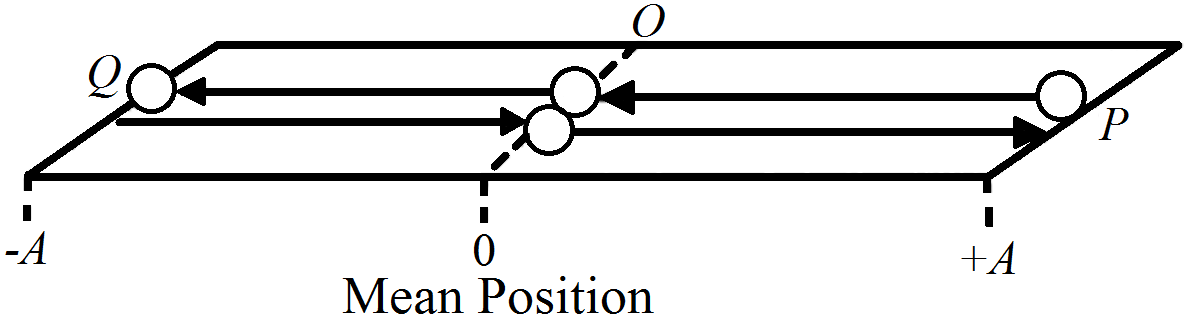
Total distance travelled while it goes from O → P → O → Q → O
= OP + PO + OQ + QO = A + A + A + A = 4A
Amplitude = OP = A
Hence, ratio of distance and amplitude = 4A/ A = 4.
View full question & answer
Question 25 Marks
The length of a second’s pendulum on the surface of Earth is 1m. What will be the length of a second’s pendulum on the moon?
Answer
A pendulam of time period (T) of 2sec is called secound penduluam.

$\text{T}_\text{e}=2\pi\sqrt{\frac{\text{l}_\text{e}}{\text{g}_\text{e}}}\Rightarrow\text{T}_\text{e}^2=4\pi^2\frac{\text{l}_\text{e}}{\text{g}_\text{e}}\ ...(1)$

$\text{T}_\text{m}=2\pi\sqrt{\frac{\text{l}_\text{m}}{\text{g}_\text{m}}}\because\text{g}_\text{m}=\frac{\text{g}_\text{e}}{6}$

$\therefore\text{T}_\text{m}^2=4\pi^2\frac{\text{i}_\text{m}\times6}{\text{g}_\text{e}}\ ...(2)$

For secound pendulum $\text{T}_\text{e}=\text{T}_\text{m}=2\text{sec}$

$4\pi^26\text{l}_\text{m}$

$\frac{\text{T}_\text{m}^2}{\text{T}^2_\text{e}}=\frac{\text{g}_\text{e}}{4\pi^2\frac{\text{l}_\text{e}}{\text{g}_\text{e}}}\ \text{or}\ \frac{(2)^2}{(2)^2}=\frac{6\text{l}_\text{m}}{\text{l}_\text{e}}\text{l}_\text{e}=1\text{m}$

$\frac{1}{1}=\frac{6\text{l}_\text{m}}{1\text{m}}\Rightarrow\text{l}_\text{m}=\frac{1}{6}\text{m}$
View full question & answer
Question 35 Marks
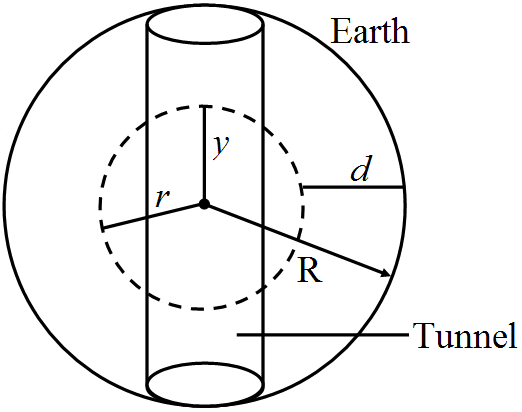
A tunnel is dug through the centre of the Earth. Show that a body of mass ‘m’ when dropped from rest from one end of the tunnel will execute simple harmonic motion.
Answer
As the acceleration due to gravity of earth inside the earth is g'$\text{g}'=\text{g}\Big(1-\frac{\text{d}}{\text{R}}\Big)=\text{g}\Big[\frac{\text{R}-\text{d}}{\text{R}}\Big]$
R - d = y$\therefore\text{g}'=\text{g}\frac{\text{y}}{\text{R}}$
Force on both at depth is$\text{F}=-\text{mg}'=-\text{mg}\frac{\text{y}}{\text{R}}$
$\text{F}\propto(-\text{y})$
So motion of body in tunnel is SHM. for a period we can write ma = - mg'$\text{a}=\frac{-\text{g}}{\text{R}}\text{y}$
$-\omega^2\text{y}=\frac{-\text{g}}{\text{R}}\text{y}(\because\text{a}=-\omega^2\text{y})$
$\frac{2\pi}{\text{T}}=\sqrt{\frac{\text{g}}{\text{R}}}\ \text{or}\ \text{T}=2\pi\sqrt{\frac{\text{R}}{\text{G}}}$
View full question & answer
Question 45 Marks
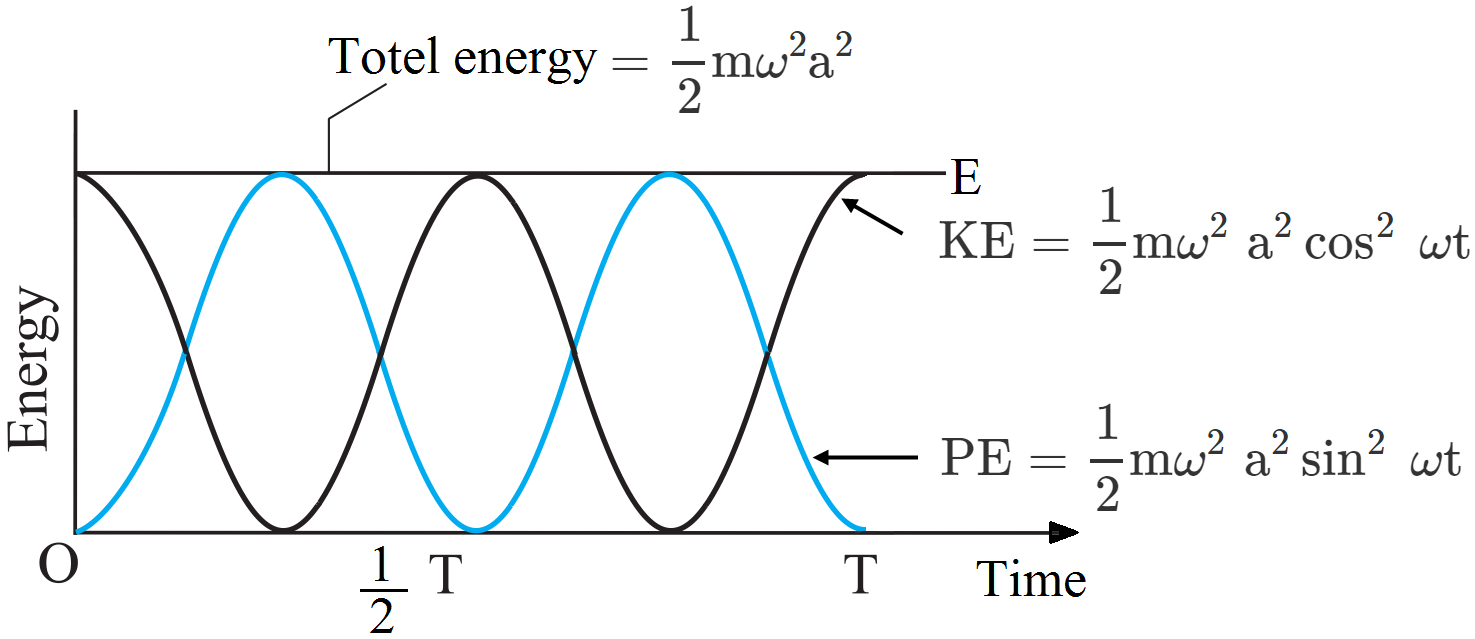
Draw a graph to show the variation of P.E., K.E. and total energy of a simple harmonic oscillator with displacement.
Answer
The potential energy (PE) of a simple harmonic oscillator is

$\text{PE}=\frac{1}{2}\ \text{kx}^2=\frac{1}{2}\text{m}\omega^2\text{x}^2$

When, PE is plotted against displacement x, we will obtain a parabola.

When x = 0, PE = 0.

When $\text{x}=\pm\text{A},\text{PE}=\text{maximum}$

$=\frac{1}{2}\text{m}\omega^2\text{A}^2$

The kinetic energy (KE) of a simple harmonic oscillator $\text{KE}=\frac{1}{2}\text{mv}^2$

But velocity of oscillator $\text{v}=\omega\sqrt{\text{A}^2-\text{x}^2}$

$\Rightarrow\text{KE}=\frac{1}{2}\text{m}[\omega\sqrt{\text{A}^2-\text{x}^2]^2}$

Or $\text{KE}=\frac{1}{2}\text{m}\omega^2(\text{A}^2-\text{x}^2)$

This is also parabola, if we plot KE against displacement x.

I.e, $\text{KE}=0\ \text{at}\ \text{x}=\pm\text{A}$

and $\text{KE}=\frac{1}{2}\text{m}\omega^2\text{A}^2\ \text{at}\text{x}=0$

Now, total energy of the simple harmonic oscillator = PE + KE [using Eqs. (i) and (ii)]

$=\frac{1}{2}\text{m}\omega^2\text{x}^2+\frac{1}{2}\text{m}\omega^2(\text{A}^2-\text{x}^2)$

$=\frac{1}{2}\text{m}\omega^2\text{x}^2+\frac{1}{2}\text{m}\omega^2\text{A}^2-\frac{1}{2}\text{m}\omega^2\text{x}^2$

$\text{TE}=\frac{1}{2}\text{m}\omega^2\text{A}^2=\text{constant}$

which is a constant and independent of x.

Plotting under the above guidlines KE, PE and TE verus displacement x-fraph as follows:


Important point: From the graph we note that potential energy or kinetic energy completes two vibrations in a time during which S.H.M. completes one vibration. Thus the frequency of potential energy or kinetic energy is double than that of S.H.M.
View full question & answer
Question 55 Marks
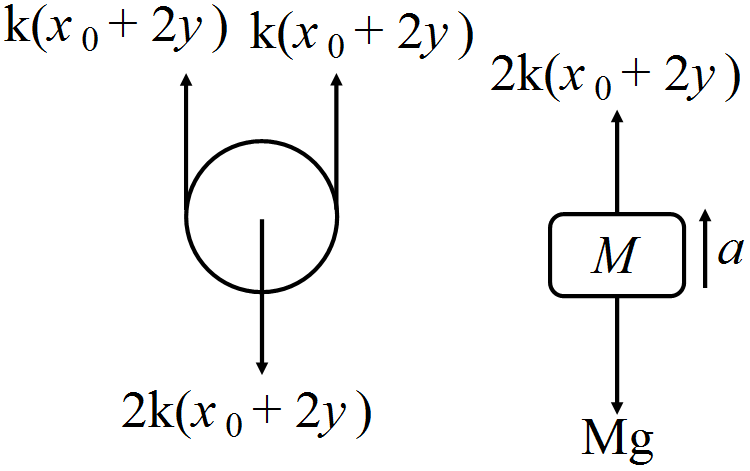
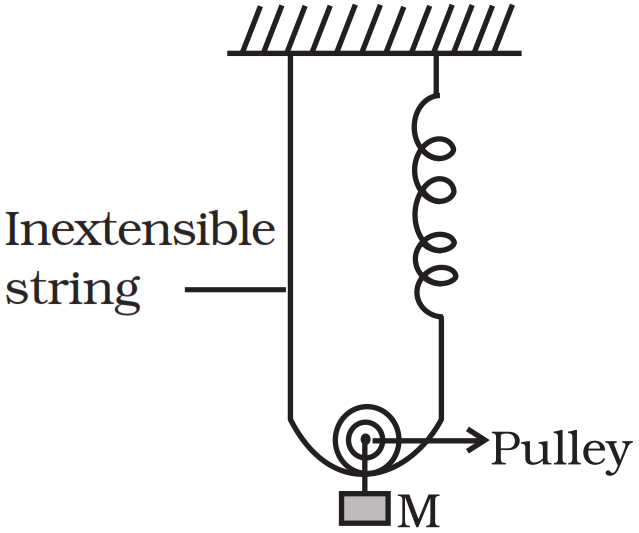
Find the time period of mass M when displaced from its equilibrium positon and then released for the system shown in figure.
Answer
Key concept: For observing oscillation, we have to displace the block slightly beyond equilibrium position and find the acceleration due to the restoring force. Let in the equilibrium position, the spring has extended by an amount $x_0$. Tension in the spring = $kx_0$ For equilibrium of the mass $M, Mg = 2kx_0$

Let the mass be pulled through a distance y and then released. But, string is inextensible, hence the spring alone will contribute the total extension y + y = 2y, to lower the mass down by y from initial equilibrium mean position $x_0$. So, net extension in the spring $(x_0 + 2y)$. From F.B.D of the block,

$2\text{K}(\text{x}_0+2\text{y})-\text{Mg}=\text{Ma}$
$2\text{Kx}_0+4\text{ky}-\text{Mg}=\text{Ma}\Rightarrow\text{Ma}=4\text{ky}$
$\overline{\text{a}}=-\Big(\frac{4\text{k}}{\text{M}}\Big)\overline{\text{y}}$
k and M being constant.$\therefore\text{a}\propto-\text{x}.$ Hence, motion is SHM.
Comparing the above acceleration expression with standard SHM equation.$\text{a}=-\omega^2\text{x},$ we get
$\omega^2=\frac{4\text{k}}{\text{M}}\Rightarrow\omega=\sqrt{\frac{4\text{k}}{\text{M}}}$
View full question & answer
Question 65 Marks
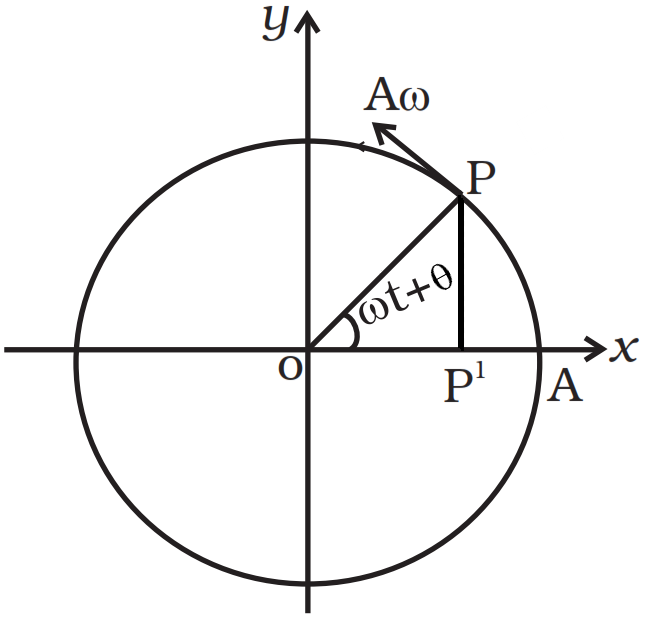
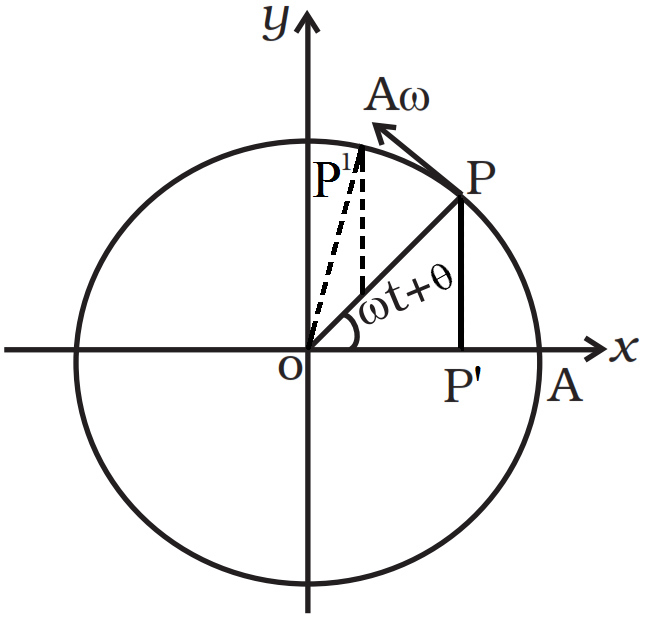
In Fig. 14.9, what will be the sign of the velocity of the point, which is the projection of the velocity of the P′ reference particle P .P is moving in a circle of radius R in anticlockwise direction.
Answer
P' is foot perpendicular of velocity vector of particle p at any time t.

Now particle moves from p to $p_1$ then its foot shifts from p' to Q i.e, towards negatives axis.
Hence the sign of $\theta$ motion of P' is negative.
View full question & answer
Question 75 Marks
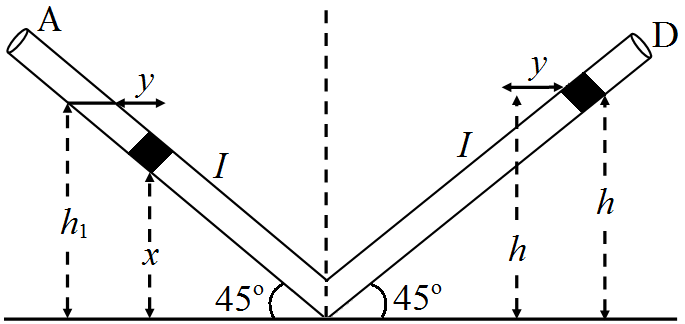
One end of a V-tube containing mercury is connected to a suction pump and the other end to atmosphere. The two arms of the tube are inclined to horizontal at an angle of 45 PHA° each. A small pressure difference is created between two columns when the suction pump is removed. Will the column of mercury in V-tube execute simple harmonic motion? Neglect capillary and viscous forces.Find the time period of oscillation.
Answer
Let the liquid column in both columns are at heights initial. Now due to pressure difference the liquid columns in A arm pressed by and in arm B lifts by (so difference in vertical height between two levels = Consider an element of liquid of height (in tube). Then iy's mass $\text{dm}=\text{A}.\text{dx}\rho.$A = area of cross section of tube. P.E. of the left dm element column = (dm)g h P.E. of dm element in left column $\text{A}\rho\text{g x dx}$ Total P.E. in left column $=\int_{0}^{\text{h}}\text{A}\rho\text{gx dx}=\text{A}\rho\text{g}\Big[\frac{\text{x}^2}{2}\Big]^\text{h}_0$$=\text{A}\rho\text{g}\frac{\text{h}_1^2}{2}$
from figure $\sin45^\circ=\frac{\text{h}_1}{\text{l}}$$\text{h}_1=\text{h}_2=\text{l}\sin45^\circ=\frac{\text{l}}{\sqrt{2}}$
$\therefore\text{h}_1^2=\text{h}_2^2=\frac{\text{l}^2}{2}$
$\therefore$ P.E. in left column $=\text{A}\rho\text{g}\frac{\text{l}^2}{4}$
Similarly P.E. in right column $=\text{A}\rho\text{g}\frac{\text{l}^2}{4}$$\therefore$ total potential energy $=\text{A}\rho\text{g}\ \frac{\text{l}^2}{4}+\text{A}\rho\text{g}\frac{\text{l}^2}{4}=\frac{\text{A}\rho\text{gl}^2}{2}$
Due to pressure difference, let element moves towards right side y is unit. Then the liquid column is left arm = (l - y) And the liquid column is right arm = (l + y) P.E. of liquid column in left arm $=\text{A}\rho\text{g}(\text{l}-\text{y})^2\sin^245^\circ$ P.E. of liquid column in right arm $=\text{A}\rho\text{g}(\text{l}+\text{y})^2\sin45^\circ$ $\therefore$ Total P.E. due liquid column $=\text{A}\rho\text{g}\Big(\frac{1}{\sqrt{2}}\Big)^2[(\text{l}-\text{y})^2+(\text{l}+\text{y})^2]$ Final P.E. due to different in liquid columns$=\frac{\text{A}\rho\text{g}}{2}[\text{l}^2+\text{y}^2-2\text{ly}+\text{l}^2+\text{y}^2+2\text{ly}]$
Final P.E. $=\frac{\text{A}\rho\text{g}}{2}(2\text{l}^2+2\text{y}^2)$ Change P.E. = final P.E. - Initial P.E.$=\frac{\text{A}\rho\text{g}}{2}(2\text{l}^2+2\text{y}^2)-\frac{\text{A}\rho\text{gl}^2}{2}$
$=\frac{\text{A}\rho\text{g}}{2}\ [2\text{l}^2+2\text{y}^2-\text{l}^2]$
Change in P.E. $=\frac{\text{A}\rho\text{g}}{2}\ (\text{l}^2+2\text{y}^2)$ If change in velocity (v) of total liquid column$\Delta\text{KE}=\frac{1}{2}\text{mv}^2$
$\text{m}=(A.2\text{l})\rho$
$\Delta\text{kE}=\frac{1}{2}\ (\text{A}2\ \text{l}\rho)\text{v}^2=\text{A}\rho\text{lv}^2$
$\therefore$ Change in total energy $=\frac{\text{A}\rho\text{g}}{2}(\text{l}^2+2\text{y}^2)+-\text{A}\rho\text{lv}^2$
Total change in energy $\Delta\text{PE}+\Delta\text{KE}=0$$\therefore\frac{\text{A}\rho\text{g}}{2}\ [\text{l}^2+2\text{y}^2]+\text{A}\rho\text{lv}^2=0$
$\frac{\text{A}\rho}{2}[\text{g}(\text{l}^2+2\text{y}^2)+2\text{lv}^2]=0$
$\frac{\text{A}\rho}{2}\neq0$
$\therefore\text{g}(\text{l}^2+2\text{y}^2)+2\text{lv}^2=0$
Differentiating W.R.T, $\text{g}\Big[0+2\times2\text{y}\ \frac{\text{dy}}{\text{dt}}\Big]+2\text{l}.2\text{v}.\frac{\text{dv}}{\text{dt}}=0$$4\text{gy}\ \frac{\text{dy}}{\text{dt}}+4\text{vl}\ \frac{\text{d}^2\text{y}}{\text{dt}^2}=0$ $\Big[\because\text{A}=\frac{\text{dv}}{\text{dt}}=\frac{\text{d}^2\text{y}}{\text{dt}^2}\Big]$
$4\text{gy}.\text{v}+4\text{vl}\frac{\text{d}^2\text{y}}{\text{dt}^2}=0\Rightarrow4\text{v}\Big[\text{gy}+\text{l}.\frac{\text{d}^2\text{y}}{\text{dt}^2}\Big]=0$
$\frac{\text{d}^2\text{y}}{\text{dt}^2}+\frac{\text{g}}{\text{l}}\ \text{y}=0\ \because4\text{v}\neq0$
It is the equation of SHM oscillator and standard equation of SHM is $\frac{\text{d}^2\text{y}}{\text{dt}^2}+\omega^2\text{y}=0$$\frac{2\pi}{\text{T}}=\sqrt{\frac{\text{g}}{\text{l}}}\Rightarrow\text{T}=2\pi\sqrt{\frac{\text{l}}{\text{g}}}$
View full question & answer
Question 85 Marks
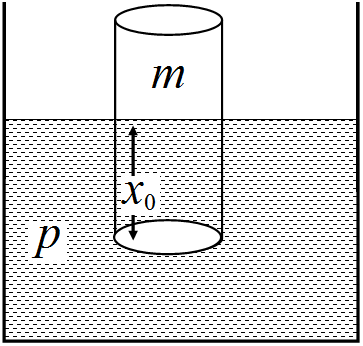
A cylindrical log of wood of height h and area of cross-section A floats in water. It is pressed and then released. Show that the log would execute S.H.M. with a time period.$\text{T}=2\pi\sqrt{\frac{\text{m}}{\text{A}\rho\text{g}}}$
where m is mass of the body and ρ is density of the liquid.
Answer
when log is pressed downward into the liquid then and upward Buoyant force (B.F.) action it which oves the block upward and due to inertia it moves upward from its mean position due to inertia and then again come down due to gravity. So net restoring force on block = Buoyant force – mg V = volume of liquid displaced by blocks Let when floats then $\text{mg}=\text{B.f}\ \text{or}\ \text{mg}=\text{V}\rho\text{g}$ A = area of cross section x = Height of blocks liquid Let x height again dip in liquid when pressed into water total height of block in water$=(\text{x}+\text{x}_0)$
So net restoring force $[\text{A}(\text{x}+\text{x}_0)]\rho\text{g}-\text{mg}$$\text{F}_\text{restoring}=\text{A}\text{x}_0\rho\text{g}+\text{Ax}\rho\text{g}-\text{A}\text{x}_0\rho\text{g}$
$\text{F}_\text{Restoring}=-\text{Ax}\rho\text{g}$
(as Buoyant force is upward and x is downward)$\text{F}_\text{restoring}\propto-\text{x}$
So motion is SHM here k $\text{A}\rho\text{g}$$\text{a}=-\omega^2\text{x}\omega^2=\frac{\text{k}}{\text{m}}\Rightarrow\text{T}=2\pi\sqrt{\frac{\text{m}}{\text{k}}}$
$\text{F}_\text{restoring}=-\text{A}\rho\text{gx}$
$\text{ma}=-\text{A}\rho\text{gx}$
$\text{a}=\frac{-\text{A}\rho\text{gx}}{\text{m}}\Rightarrow-\omega^2\text{x}=\frac{-\text{A}\rho\text{gx}}{\text{m}}$
$\omega^2=\frac{\text{A}\rho\text{g}}{\text{m}}$
$\text{k}=\text{A}\rho\text{g}$
$\Big(\frac{2\pi}{\text{T}}\Big)^2=\frac{\text{A}\rho\text{g}}{\text{m}}\Rightarrow\frac{\text{T}}{2\pi}=\sqrt{\frac{\text{m}}{\text{A}\rho\text{g}}}\Rightarrow\text{T}=2\pi\sqrt{\frac{\text{m}}{\text{A}\rho\text{g}}}$
View full question & answer
Question 95 Marks
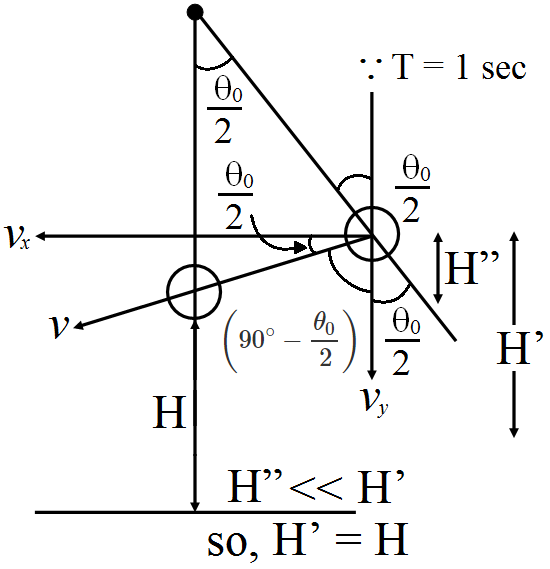
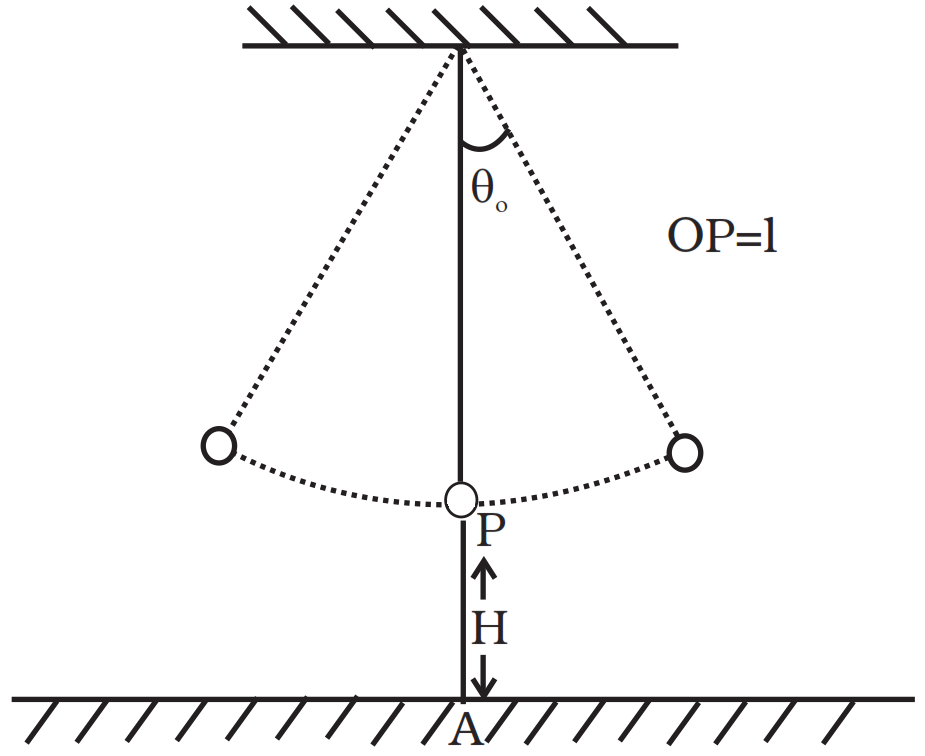
A simple pendulum of time period $1s$ and length l is hung from a fixed support at O, such that the bob is at adistance H vertically above A on the ground The amplitude is $\theta$ The string snaps at $\theta=\frac{\theta_0}{2}$ Find the time taken by the bob to hit the ground. Also find distance from A where bob hits the ground. Assume θ to be small so that $\sin\theta_0\ \text{and}\ \cos\theta_0=1.$
Answer
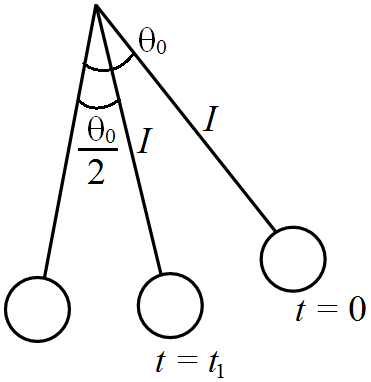
Consider the diagram at $\text{t}=0,\theta=\frac{\theta}{2}$At $\text{t}=\text{t}_1\ \ \ \ \ \theta=\frac{\theta_0}{2}$
$\theta=\theta_0\cos\omega\text{t}$

$\text{t}=\text{t}_1,\theta=\frac{\theta_0}{2}$
$\therefore\frac{\theta_0}{2}=\theta_0\cos\frac{2\pi}{\text{T}}\text{t}_1$
$\text{T}=1\text{Sec}(\text{given})$
$\therefore\cos2\pi\text{t}_1=\frac{1}{2}=\cos\frac{\pi}{3}$
$2\pi\text{t}_1=\frac{\pi}{3}\ \text{or}\ \text{t}_1=\frac{1}{6}$
$\theta=\theta_0\cos2\pi\text{r}$
$\frac{\text{d}\theta}{\text{dt}}=-\theta_02\pi\sin2\pi\text{t}$

At $\text{t}=\frac{1}{6}\text{i.e,}\ \text{at}\ \theta=\frac{\theta_0}{2}$
$\frac{\text{d}\theta}{\text{dt}}=-\theta_02\pi\sin2\pi\frac{1}{6}$
$\frac{\text{d}\theta}{\text{dt}}=-\theta_02\pi\sin\frac{\pi}{3}$
$=-\theta_02\pi\frac{\sqrt{3}}{2}$
$\frac{\text{d}\theta}{\text{dt}}=-\theta_0\pi\sqrt{3}$
$\omega=-\theta_0\pi\sqrt{3}\Big(\because\frac{\text{d}\theta}{\text{dt}}=\omega\Big)$
$\frac{\text{v}}{\text{t}}=-\theta_0\pi\sqrt{3}$
$\text{v}=-\sqrt{3}\pi\theta_0\text{l}$
(-) ve shows that bob’s motion is towards left.
$\text{v}_\text{x}=\text{v}\cos\frac{\theta_0}{2}=-\sqrt{3\pi}\theta_0\text{l}\cos\frac{\theta_0}{2}$
$\text{v}_\text{y}=\text{v}\sin\frac{\theta_0}{2}=-\sqrt{3}\pi\theta_0\text{l}\sin\frac{\theta_0}{2}$
Let vertical distance covered by is H’ (downward)
$\text{s}=\text{ut}+\frac{1}{2}\text{gt}^2$
$\text{H}'=\text{v}_\text{y}\text{t}+\frac{1}{2}\text{gt}^2$
$\frac{1}{2}\text{gt}^2+\sqrt{3}\pi\theta_0\text{l}\sin\frac{\theta_0}{2}\times\text{t}-\text{H}'=0$
$\sin\frac{\theta_0}{2}=\frac{\theta_2}{2}$ (given)
$\therefore\frac{1}{2}\text{gt}^2+\sqrt{3}\pi\theta_0\text{l}\frac{\theta_0}{2}\text{t}-\text{H}=0$
By Quadratic formula $\text{t}=\frac{-\text{B}\pm\sqrt{\text{B}^2-4\text{Ac}}}{2\text{A}}$
$\text{t}=\frac{(-\sqrt{3}\pi\theta_0^2\text{l})/4\pm\sqrt{(3\pi^2\theta^4_0\text{l}^2)/4+4\frac{1}{2}\text{gH}}}{\text{2g/2}}$
As $\theta_0$ is very small so by neglecting $\theta^4_0$ and $\theta^2_0$
$\text{t}=\frac{+\sqrt{2\text{gH}'}}{\text{g}}\text{H}'=\text{H}+\text{H}''$
$\therefore\text{t}=\sqrt{\frac{2\text{H}}{\text{g}}}\text{H}''<<\text{H}$ as $\frac{\theta_0}{2}$ is very small
$\therefore\text{H}=\text{H}'$
Distance covered in horizontal = $v_xt$
$\text{x}=\sqrt{3}\pi\theta_0\text{l}\cos\frac{\theta_0}{2}\sqrt{\frac{2\text{H}}{\text{g}}}$
$\therefore\text{x}=\sqrt{3}\pi\theta_0\text{l}\sqrt{\frac{2\text{H}}{\text{g}}}\cos\frac{\theta_0}{2}=1$
$\text{x}=\theta_0\text{l}\pi\sqrt{\frac{6\text{H}}{\text{g}}}$
At the time snapping, the bob was at distance $\text{l}\sin\frac{\theta_0}{2}=\text{l}\frac{\theta_0}{2}$ from A
Thus the distance of bob From A where it meet the ground is
$=\frac{\text{l}\theta_0}{2}-\text{x}=\frac{\text{l}\theta_0}{2}-\theta_0\text{l}\pi\sqrt{\frac{6\text{H}}{\text{g}}}$
$=\theta_0\text{l}\Big[\frac{1}{2}-\pi\sqrt{\frac{6\text{H}}{\text{g}}}\Big]$
View full question & answer
Question 105 Marks
A person normally weighing $50kg$ stands on a massless platform which oscillates up and down harmonically at a frequency of $2.0s^{–1}$ and an amplitude $5.0cm$. A weighing machine on the platform gives the persons weight against time.
  1. Will there be any change in weight of the body, during the oscillation?
  2. If answer to part (a) is yes, what will be the maximum and minimum reading in the machine and at which position?
Answer
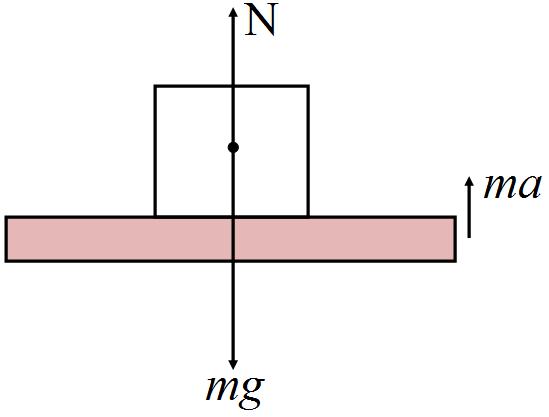
Weight in weight machine will be due to the normal reaction (N) by platform. Consider the top position of platform, two forces due to weight of person and oscillator acts both downward.

So motion is downward. Let with acceleration a then ma = mg - N ...(i) When platform lifts form its lowest position to upward ma = N - mg ...(ii)$\text{a}\omega^2\text{A}$ acceleration of oscillator
  1. Form (i) equation
$\text{N}=\text{mg}-\text{m}\omega^2\text{A}$
Where A is amplitude, $\omega$ angular frequency, m mass of oscillator.
$\omega=2\pi\text{v}=2\pi\times2=4\pi\ \text{rad}/\text{sec}.$
$\text{A}=5\text{cm}=5\times10^{-2}\text{m}_2\text{m}=50\text{kg}$
$\text{N}=50\times9.8-50\times4\pi\times4\pi\times5\times10^{-2}$
$=50[9.8-16\pi^2\times5\times10^{-2}$
$=50[9.8-80\times3.14\times3.14\times10^{-2}]$
$\text{N}=50[9.8-7.89]=50\times1.91=95.50\text{N}$
So minimum weight is 95.50N.
  1. form (ii) N – mg = ma
For upward motion form lowest point of oscillator.
$\text{N}=\text{mg}+\text{ma}=\text{m}(\text{a}+\text{g})$
$=\text{m}[9.81+\omega^2\text{A}]\text{a}=\omega^2\text{A}$
$=50[9.81+16\pi^2\times5\times10^{-2}$
$=50[9.81+7.89]=50[17.70]$
$\text{N}=885.00\text{N}$
  1. Hence, there is a change in weight of the body during oscillation.
  2. The maximum weight is 885N, when platform moves from lowest to up direction.
And the minimum is 95.5N, when platform moves from highest point to downward direction.
View full question & answer
Question 115 Marks
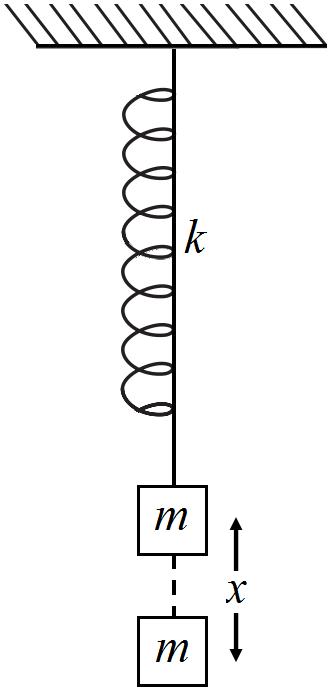
A body of mass m is attached to one end of a massless spring which is suspended vertically from a fixed point. The mass is held in hand so that the spring is neither stretched nor compressed. Suddenly the support of the hand is removed. The lowest position attained by the mass during oscillation is 4cm below the point, where it was held in hand.
  1. What is the amplitude of oscillation?
  2. Find the frequency of oscillation?
Answer
When mass m is held in support by hand the extension in spring will be zero as no deforming force acts on spring. Let the mass reaches at its new position unit displacement from previous. Then P.E. of spring or mass = gravitational P.E. lost by man. P.E = mg x But P.E. due to spring is $\frac{1}{2}\text{kx}^2\text{k}=\omega^2\text{A}$$\therefore\frac{1}{2}\text{kx}^2=\text{mg x}$
Mean position of spring by block will be when let extension is then$\text{F}=-\text{kx}_0$
$\text{F}=\text{mg}\therefore\text{mg}=+\text{kx}_0\ \text{or}\ \text{x}_0=\frac{\text{mg}}{\text{k}}\ ...(\text{ii})$
From (i) and (ii)$\text{x}=2\Big(\frac{\text{mg}}{\text{k}}\Big)=2\text{x}_0$
$\text{x}=4\text{cm}\therefore4=2\text{x}_0$
$\text{x}_0=2\text{cm}$
The amplitude of oscillator is the maximum distance from mean position.$\text{x}-\text{x}_0=4-2=2\text{cm}$
Time Period $\text{T}=2\pi\sqrt{\frac{\text{m}}{\text{k}}}$ which does not depend on amplitude.$\frac{2\text{mg}}{\text{k}}=\text{x}$ from (1)
$\frac{\text{m}}{\text{k}}=\frac{\text{x}}{2\text{g}}=\frac{4\times10^{-2}}{2\times9.8}\ \text{or}\ \frac{\text{k}}{\text{m}}=\frac{2\times9.8}{4\times10^{-2}}$
$\text{v}=\frac{1}{2\pi}\sqrt{\frac{\text{k}}{\text{m}}}=\frac{1}{2\times3.14}\sqrt{\frac{2\times9.8}{4\times10^{-2}}}=\frac{4.9\times10^{-2}}{6.28}$
$\text{v}=\frac{10\times2.21}{6.28}=3.52\text{Hz}.$
Oscillator will not rise above the positive from where it was released because total extension in spring is 4cm when released and amplitude is 2cm. So it oscillates below the released position.
View full question & answer