Question
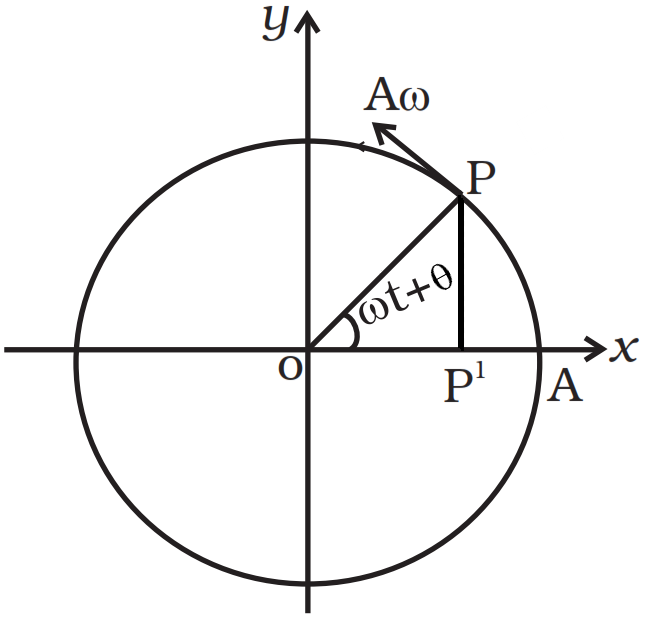
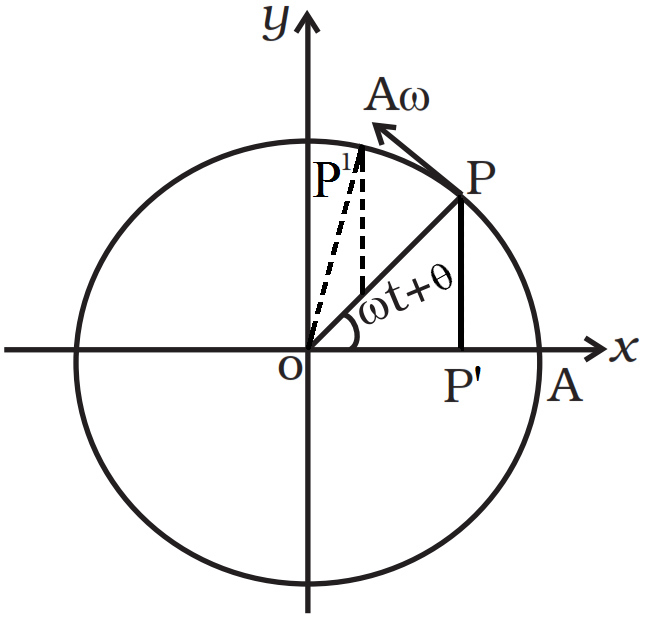
In Fig. 14.9, what will be the sign of the velocity of the point, which is the projection of the velocity of the P′ reference particle P .P is moving in a circle of radius R in anticlockwise direction.
Answer

P' is foot perpendicular of velocity vector of particle p at any time t.

Now particle moves from p to $p_1$ then its foot shifts from p' to Q i.e, towards negatives axis.
Hence the sign of $\theta$ motion of P' is negative.

Need a full question paper?

Generate a complete, print-ready paper with questions like this in minutes — across 16+ boards, with answer keys.
Start Generating Free

Similar questions

Explain the laws of transverse vibrations.
Show that in case of one dimensional elastic collision of two bodies, the relative velocity of separation after the collision is equal to the relative velocity of approach before the collision.
Calculate the angular momentum and rotational kinetic energy of earth about its own axis. How long could this amount of energy supply one kilowatt power to each of the $3.5 \times 10^9$ persons on earth? (Mass of earth = $6.0 \times 1024kg$ and radius = $6.4 \times 10^{24}km)$.
Explain Doppler effect in sound. Obtain an expression for apparent frequency of sound when source moves and listener is at rest.
An object may be regarded to be at rest or in motion depending on the frame of reference chosen to view the object. Because of length contraction it would mean that the same rod may have two different lengths depending on the state of the observer. Is this true?
A rocket accelerates straight up by ejecting gas downwards. In a small time interval $\Delta\text{t},$ it ejects a gas of mass $\Delta\text{m}$ at a relative speed u. Calculate KE of the entire system at $\text{t}+\Delta\text{t}$ and t and show that the device that gas does work $=\Big(\frac{1}{2}\Big)\Delta\text{mu}^2$ in this time interval (neglect gravity).
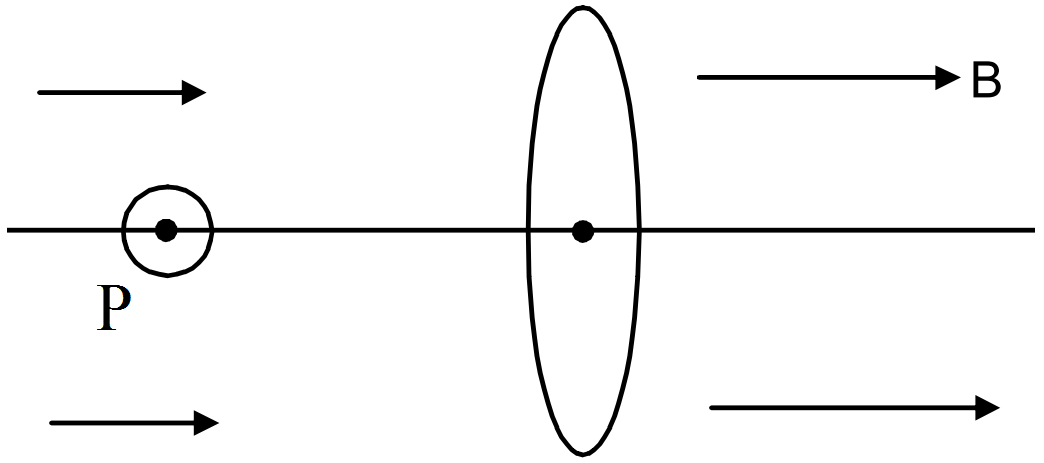
Shows a convex lens of focal length $12cm$ lying in a uniform magnetic field B of magnitude $1.2T$ parallel to its principal axis. A particle with charge $2.0 \times 10^{-3}C$ and mass $2.0 \times 10^{-5} kg$ is projected perpendicular to the plane of the diagram with a speed of $4.8 ms^{-1}$​​​​​​​. The particle moves along a circle with its centre on the principal axis at a distance of $18cm$ from the lens. Show that the image of the particle moves along a circle and find the radius of that circle.
A gas mixture consists of $2.0$ moles of oxygen and $4.0$ moles of neon at temperature T. Neglecting all vibrational modes, calculate the total internal energy of the system. (Oxygen has two rotational modes.)
A thin rod having length $L_0$ at $0°C$ and coefficient of linear expansion $\alpha$ has its two ends maintained at temperatures $\theta_1$ and $\theta_2,$ respectively. Find its new length.
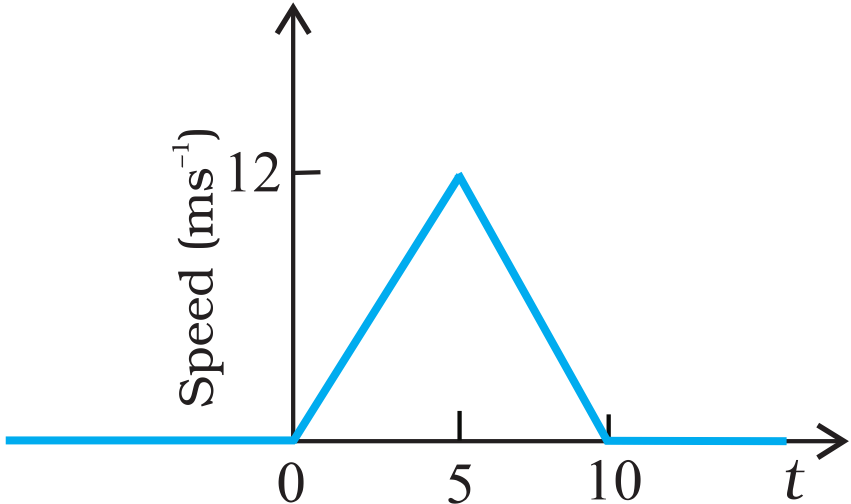
The speed-time graph of a particle moving along a fixed direction is shown in. Obtain the distance traversed by the particle between.
  1. $t = 0s$ to $10s,$
  2. $t = 2s$ to $6s.$

What is the average speed of the particle over the intervals in $(a)$ and $(b)$?