Questions

3 Marks Question

Take a timed test

7 questions · self-marked practice — reveal the answer and mark yourself.

Question 13 Marks
When you hold a pen and write on your notebook, what kind of force is exerted by you on the pen? By the pen on the notebook? By you on the notebook?
Answer
Yes, In case of moving frame of reference a uniformly moving particle can undergo curved path.
For example if you roll a ball out of marry go round while it is rotating the ball as viewed from marry go round would be going in straight direction outward of Mary go round. but as seen from ground the ball will be undergoing semicircle like shape.
View full question & answer
Question 23 Marks
At what distance should two charges, each equal to $1C$, be placed so that the force between them equals your weight?
Answer
Given: $q_1 = q_2 = 1C$ By Coulomb's law, the force of attraction between the two charges is given by $\text{F}=\frac{1}{4\pi\in_0}\frac{\text{q}_1\text{q}_2}{\text{r}^2}$
$=\frac{9\times10^9\times1\times1}{\text{r}^2}$
However, the force of attraction is equal to the weight (F = mg).$\therefore\text{mg}=\frac{9\times10^9}{\text{r}^2}$
$\Rightarrow\text{r}^2=\frac{9\times10^9}{\text{m}\times10}=\frac{9\times10^8}{\text{m}}$ (Taking $g = 10m/s^2$)
$\Rightarrow\text{r}^2=\frac{9\times10^8}{\text{m}}$
$\Rightarrow\text{r}=\frac{3\times10^4}{\sqrt{\text{m}}}$
Assuming that m = 81kg, we have:$\text{r}=\frac{3\times10^4}{\sqrt{81}}$
$=\frac{3}{9}\times10^4\text{m}$
$=3333.3\text{m}$
$\therefore$ The distance r is 3333.3m.
View full question & answer
Question 33 Marks
A lawyer alleges in court that the police has forced his client to issue a statement of confession. What kind of force is this?
Answer
  1. In car the coin would fall directly downward in case viewed from car. in case viewed from outside the coin would be under projectile trajectory as if coin was projected horizontally with the speed of car.
  2. In case of freely falling elevator the coin would retain its position where it was left as it will not feel any gravity.
View full question & answer
Question 43 Marks
The average separation between the proton and the electron in a hydrogen atom in ground state is $5.3 \times 10^{-11} m$.
  1. Calculate the Coulomb force between them at this separation.
  2. When the atom goes into its first excited state the average separation between the proton and the electron increases to four times its value in the ground state.What is the Coulomb force in this state?
Answer
Average separation between the proton and the electron of a Hydrogen atom in ground state, $r = 5.3 \times 10^{−11}m$
  1. Coulomb force when the proton and the electron in a hydrogen atom in ground state
$\text{F}=9\times10^9\times\frac{\text{q}_1\text{q}_2}{\text{r}_2}$
$=\frac{9\times10^9\times(1.6\times10^{-19})^2}{(5.3\times10^{-11})^2}=8.2\times10^{-8}\text{N}$
  1. Coulomb force when the average distance between the proton and the electron becomes $4$ times that of its ground state
Coulomb force, $\text{F}=\frac{1}{4\pi\in_0}=\frac{\text{q}_1\text{q}_2}{(4\text{r})^2}$
$=\frac{9\times10^9\times(1.6\times10^{-19})^2}{16\times(5.3)^2\times10^{-22}}$
$=\frac{9\times(1.6)^2}{10\times(5.3)^2}\times10^{-7}$
$=0.0512\times10^{-7}$
$=5.1\times10^{-9}\text{N}$
View full question & answer
Question 53 Marks
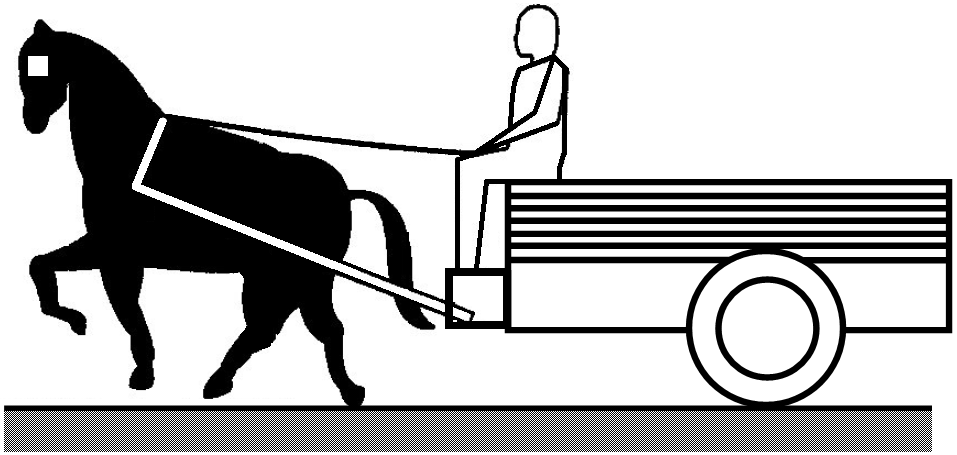
Figure shows a cart. Complete the table shown.
Answer
Force on Force by Nature Direction
cart gravity(weight) gravitational downward
friction(road) mechanical backward
pull (horse) mechanical forward
horse cart(weight) gravitational downward
pull(cart) mechanical backward
driver pull (cart) mechanical forward
View full question & answer
Question 63 Marks
The geostationary orbit of the earth is at a distance of about $36000km$ from the earth's surface. Find the weight of a $120kg$ equipment placed in a geostationary satellite. The radius of the earth is $6400km$.
Answer
The geostationary orbit of the Earth is at a distance of about 36000km. We know that the value acceleration due to gravity above the surface of the Earth is given by$\text{g}'=\frac{\text{Gm}}{(\text{R + h})^2}.$
At h = 36000km, we have:$\text{g}'=\frac{\text{Gm}}{(36000+6400)^2}$
At the surface, we have:$\text{g}=\frac{\text{Gm}}{(6400)^2}$
$\therefore\frac{\text{g}'}{\text{g}}=\frac{6400\times6400}{42400\times42400}$
$=\frac{256}{106\times106}=0.0228$
$\Rightarrow\text{g}'=0.0227\times9.8=0.223$ [Taking $g = 9.8m/s^2$ at the surface of the earth]
For a 120kg equipment placed in a geostationary satellite, its weight will be mg' = 120 × 0.233$\Rightarrow26.76\approx27\text{N}$
View full question & answer
Question 73 Marks
The gravitational force acting on a particle of $1g$ due to a similar particle is equal to $6.67 \times 10^{-17}N$. Calculate the separation between the particles.
Answer
Mass of the particle m = 1 $\text{gm}=\frac{1}{1000}\text{kg}$ Let the distance between the two particles be r. Gravitational force between the particle, $F = 6.67 \times 10^{-17}N$ Also, $\text{F}=\frac{\text{Gm}_1\text{m}_2}{\text{r}^2}$ Substituting the respective values in the above formula, we get:$6.67\times10^{-17}=\frac{6.67\times10^{-11}\times\big(\frac{1}{10000}\big)\times\big(\frac{1}{10000}\big)}{\text{r}^2}$
$\Rightarrow\text{r}^2=\frac{6.67\times10^{-6}\times10^{-11}}{6.67\times10^{-17}}$
$\Rightarrow\frac{10^{-17}}{10^{-17}}=1$
$\Rightarrow\text{r}=\sqrt{1}=1\text{m}$
View full question & answer