Questions

M.C.Q (1 Marks)

Take a timed test

11 questions · auto-graded multiple-choice test.

MCQ 11 Mark
When Neils Bohr shook hand with Werner Heisenberg, what kind of force they exerted?
  • A
    Gravitational.
  • Electromagnetic.
  • C
    Nuclear.
  • D
    Weak.
Answer
Correct option: B.
Electromagnetic.
When Neils Bohr shook hand with Werner Heisenberg, electromagnetic force is exerted on each other. This is because when their hands made contact with each other, the atoms at the two surfaces come close to each other. The charged constituents of the atoms in the hands exert forces on each other and, as a result, a measurable force is produced.
View full question & answer
MCQ 21 Mark
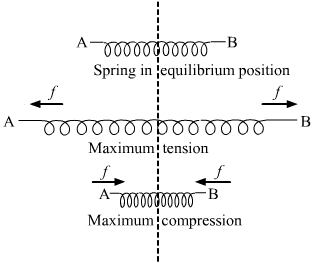
The two ends of a spring are displaced along the length of the spring. All displacement have equal magnitudes. In which case or cases the tension or compression in the spring will have a maximum magnitude?
  1. The right end is displaced towards right and the left end towards left.
  2. Both ends are displaced towards right.
  3. Both ends are displaced towards left.
  4. The right end is displaced towards left and the left end towards right.
  • A
    $A$ and $B$
  • $A$ and $D$
  • C
    $B$ and $C$
  • D
    $A$ and $D$
Answer
Correct option: B.
$A$ and $D$
When the right end is displaced towards the right and the left end towards the left, then this is the case of tension $($expansion$)$ and the spring will have maximum displacement.
When the right end is displaced towards the left and the left end towards the right, then this is the case of compression and, again, the spring will have maximum displacem.
View full question & answer
MCQ 31 Mark
The sum of all electromagnetic forces between different particles of a system of charged particles is zero:
  • A
    Only if all the particles are positively charged.
  • B
    Only if all the particles are negatively charged.
  • C
    Only if half the particles are positively charged and half are negatively charged.
  • Irrespective of the signs of the charges.
Answer
Correct option: D.
Irrespective of the signs of the charges.
The sum of all electromagnetic forces between different particles of a system of charged particles is zero irrespective of the sign of the charges, because electromagnetic force is a vector quantity that depends upon the direction. So, we consider the directions while adding vector quantities.
View full question & answer
MCQ 41 Mark
A proton exerts a force on a proton which is:
  • A
    Gravitational.
  • B
    Electromagnetic.
  • C
    Nuclear and Weak.
  • All of the above
Answer
Correct option: D.
All of the above
A proton exerts gravitational, electromagnetic and nuclear forces on a proton.
The gravitational force can easily be seen everywhere; it the weakest among all the forces. It is negligible in elementary particles like protons.
The electromagnetic force can be seen between charged particles. Since proton is a charged particle, it can exert this force on other protons.
The nuclear force is present only if the interacting particles are protons or neutrons or both. So, this force can exist between two protons.
View full question & answer
MCQ 51 Mark
Which of the following systems may be adequately described by classical physics?
  • A
    Motion of a cricket ball.
  • B
    Motion of a dust particle.
  • $A$ and $B$
  • D
    A neutron changing to a proton.
Answer
Correct option: C.
$A$ and $B$
Classical physics adequately describes the motion of a ball and the motion of dust particles. It also describes Newton's law of motion, Newton's law of gravitation, Laws of thermodynamics, Maxwell's electromagnetism and Lorentz force. Classical physics easily describes the system of heavenly bodies like the Sun, the Earth and the Moon. However, it is inadequate for describing systems of particles which have sizes much smaller than $10^{-6}m ($e.g., atom, nuclei and other elementary particles$).$
View full question & answer
MCQ 61 Mark
Let E, G and N represent the magnitudes of electromagnetic gravitational and nuclear forces between two electrons at a given separation. Then:
  • A
    N > E > G
  • B
    E > N > G
  • C
    G > N > E
  • E > G > N
Answer
Correct option: D.
E > G > N
Between two electrons at a given separation, the strongest acting force is the electromagnetic force. The gravitational force is the weakest force between any two particles. There is no nuclear force acting between them, because it exists only in the nucleus (between proton-proton or neutron-neutron or both).
View full question & answer
MCQ 71 Mark
A 60kg man pushes a 40kg man by a force of 60N. The 40kg man has pushed the other man with a force of:
  • A
    40N
  • B
    0N
  • 60N
  • D
    20N
Answer
Correct option: C.
60N
According to Newton's third law, which states that an action-reaction pair of forces are equal in magnitude, the man who weighs 40kg will push the other man with the same force of 60N.
View full question & answer
MCQ 81 Mark
Mark the correct statements:
  • A
    Electromagnetic force between two protons may be greater than the nuclear force acting between them..
  • B
    The electromagnetic force between two protons is always greater than the gravitational force between them.
  • C
    The gravitational force between two protons may be greater than the nuclear force between them.
  • All of the above
Answer
Correct option: D.
All of the above
The electromagnetic force between two protons is always greater than the gravitational force between them, because gravitational force is the weakest force in nature.
We know that nuclear force is the strongest force in nature when the distance between two particles is less than $10^{-14}m$. However, the gravitational as well as electromagnetic forces between two protons may be greater than the nuclear force acting between them when the distance between them is more than $10^{-14}m$.
View full question & answer
MCQ 91 Mark
Action and reaction:
  1. Act on two different objects.
  2. Have equal magnitude.
  3. Have opposite directions.
  4. Have resultant zero.
  • A
    Only $A$
  • B
    $A$ and $B$
  • C
    $B$ and $D$
  • All of the above
Answer
Correct option: D.
All of the above

The two forces $\overrightarrow{\text{F}}$ and $-\overrightarrow{\text{F}}$ connected by Newton's third law are known as action-reaction pair.
For example, when a man jumps out from a ferry, he applied some force on the ferry. So, the action force in this case is the force applied by the man and the reaction is the force exerted by the ferry on the man. Both the forces act upon different objects $($the man and the ferry$)$ but have equal magnitudes and opposite directions. As a result, their resultant is zero.

View full question & answer
MCQ 101 Mark
A neutron exerts a force on a proton which is:
  1. Gravitational.
  2. Electromagnetic.
  3. Nuclear.
  4. Weak.
  • A
    $A$ and $B$
  • B
    $A$ and $D$
  • $A$ and $C$
  • D
    $C$ and $D$
Answer
Correct option: C.
$A$ and $C$
A neutron exerts both the gravitational and nuclear forces on a proton.
The gravitational force can be seen between a neutron and a proton. However, its strength is negligible. The nuclear force is exerted only if the interacting particles are neutrons or protons or both.
A neutron cannot exert electromagnetic force, because it is a neutral particle.
View full question & answer
MCQ 111 Mark
If all matters were made of electrically neutral particles such as neutrons:
  • A
    There would be no force of friction.
  • B
    There would be no tension in the string.
  • C
    It would not be possible to sit on a chair.
  • All of the above
Answer
Correct option: D.
All of the above
For the existence of friction between two bodies and tension in a string, electromagnetic force is needed. Electromagnetic force exists only between charged particles. For sitting on a chair, we need fractional force. A neutral particle can exert gravitational force on other neutral particles. So, even if all the matters were made up of electrically neutral particles, the earth will still move around the sun.
View full question & answer