MCQ 11 Mark
Convert $0.25$ into fraction.
- A
$ \frac{3}{4}$
- B
$ \frac{1}{2}$
- ✓
$ \frac{1}{4}$
- D
AnswerCorrect option: C. $ \frac{1}{4}$
$ 0.25=\frac{25}{100}=\frac{1}{4}$
View full question & answer→MCQ 21 Mark
Improper fraction of $ \text{12}\frac{1}{6}$ is:
- A
$ \frac{72}{6}$
- ✓
$ \frac{73}{6}$
- C
$ \frac{108}{6}$
- D
$ \frac{85}{6}$
AnswerCorrect option: B. $ \frac{73}{6}$
$\frac{\text{WN}\times\text{D+N}}{\text{D}}$
$ \frac{12\times 6+1}{6}$
$=\frac{72+1}{6}$
$=\frac{73}{6}$
View full question & answer→MCQ 31 Mark
Mark $(\checkmark)$ against the correct answer in the following: Wich of the following is an improper fraction?
- A
$\frac{7}{10}$
- B
$\frac{7}{9}$
- ✓
$\frac{9}{7}$
- D
AnswerCorrect option: C. $\frac{9}{7}$
$\frac{7}{10}$ and $\frac{7}{9}$ are proper fractions as each of these have numerator less than its denominator $\frac{9}{7}$ is improper fraction.
View full question & answer→MCQ 41 Mark
Mark $(\checkmark)$ against the correct answer in the following:
$(1.007 - 0.7) = ?$
AnswerCorrect option: C. $0.307$
$1.007 - 0.7 = 1.007 - 0.700 = 0.307$
View full question & answer→MCQ 51 Mark
Mark $(\checkmark)$ against the correct answer in the following: $\Big(\frac{3}{10}+\frac{8}{15}\Big)=?$
- A
$\frac{11}{10}$
- B
$\frac{11}{15}$
- ✓
$\frac{5}{6}$
- D
AnswerCorrect option: C. $\frac{5}{6}$
$\frac{3}{10}+\frac{8}{15}$
$=\frac{9+16}{30}$
$=\frac{25}{30}$
$=\frac{5}{6}$
View full question & answer→MCQ 61 Mark
Which of the following is correct$?$
- A
$\frac{2}{3}<\frac{3}{5}<\frac{11}{5}$
- ✓
$\frac{3}{5}<\frac{2}{3}<\frac{11}{15}$
- C
$\frac{11}{15}<\frac{3}{5}<\frac{2}{3}$
- D
$\frac{3}{5}<\frac{11}{15}<\frac{2}{3}$
AnswerCorrect option: B. $\frac{3}{5}<\frac{2}{3}<\frac{11}{15}$
Consider the fractions $\frac{2}{3},\frac{3}{5}$ and $\frac{11}{15}$
$LCM$ of $3, 5$ and $15 = 15$
Firstly, convert the fractions into equivalent fractions with denominator $15$
$\Rightarrow\frac{2}{3}=\frac{2\times5}{3\times5}=\frac{10}{15}$
$\Rightarrow\frac{3}{5}=\frac{3\times3}{5\times3}=\frac{9}{15}$
Now,
$9<10<11$
$\therefore\ \frac{9}{15}<\frac{10}{15}<\frac{11}{15}$
$\frac{3}{5}<\frac{2}{3}<\frac{11}{15}$
View full question & answer→MCQ 71 Mark
Decimal expansion of a rational number cannot be $..........$
AnswerCorrect option: A. Non$-$terminating and non$-$recrring
The decimal expansion of a rational number always either terminates after a finite number of digits or begins to repeat the same finite sequence of digits over and over. Moreover, any repeating or terminating decimal represents a rational number.
View full question & answer→MCQ 81 Mark
Which of the following statements is true$?$
- A
$\frac{7}{12}<\frac{4}{21}$
- B
$\frac{7}{12}=\frac{4}{21}$
- ✓
$\frac{7}{12}>\frac{4}{21}$
- D
$\text{None of these.}$
AnswerCorrect option: C. $\frac{7}{12}>\frac{4}{21}$
Consider the fractions $\frac{7}{12}$ and $\frac{4}{21}$
Prime factorisation of $12 = 2 \times 2 \times 3$
Prime factorisation of $21 = 3 \times 7$
$\therefore LCM$ of $12$ and $21 = 2 \times 2 \times 3 \times 7 = 84$
Firstly, convert the fractions to equivalent fractions with denominator 84
$\Rightarrow\frac{7}{12}=\frac{7\times7}{12\times7}=\frac{49}{84}$
$\Rightarrow\frac{4}{21}=\frac{4\times4}{21\times4}=\frac{16}{84}$
Now,
$49>16$
$\therefore\ \frac{49}{84}>\frac{16}{84}$
$\frac{7}{12}>\frac{4}{21}$
View full question & answer→MCQ 91 Mark
$\frac{5}{7}\div6$ is equal to:
- A
$\frac{30}{7}$
- ✓
$\frac{5}{42}$
- C
$\frac{30}{42}$
- D
$\frac{6}{7}$
AnswerCorrect option: B. $\frac{5}{42}$
Given, $\frac{5}{7}+6=\frac{5}{7}\times\frac{1}{6}=\frac{5}{42}$
$\big[\because$ reciprocal of $6$ or $\frac{6}{1}=\frac{1}{6}\big]$
View full question & answer→MCQ 101 Mark
The picture

interprets
- A
$\frac{1}{4}\div3$
- ✓
$3\times\frac{1}{4}$
- C
$\frac{3}{4}\times3$
- D
$3\div\frac{1}{4}$
View full question & answer→MCQ 111 Mark
The value of $0.234$ is:
- ✓
$ \frac{232}{990}$
- B
$ \frac{232}{9990}$
- C
$ \frac{232}{900}$
- D
$ \frac{232}{9909}$
AnswerCorrect option: A. $ \frac{232}{990}$
$ \frac{232}{990}$ is equal to $0.234$
View full question & answer→MCQ 121 Mark
$0.02 \times 0.05 =$
- A
$0.1$
- B
$0.01$
- ✓
$0.001$
- D
$0.0001$
AnswerCorrect option: C. $0.001$
In order to find the product, we first multiply $2$ by $5$
We have, $2 \times 5 = 10$
Now, $0.02$ has $2$ decimal places is $ 2+ 2 = 4$
So, the product must contain $4$ places of decimals.
$\therefore 0.02 \times 0.05= 0.0010$
$= 0.001$
View full question & answer→MCQ 131 Mark
Decimal form of $\frac{48}{1000}$ is:
- A
$0.48$
- B
$4.8$
- ✓
$0.048$
- D
$48.000$
AnswerCorrect option: C. $0.048$
To find the decimal value of a fraction we just divide the numerator of the fraction by the denominator.
Here, numerator $= 48$ And denominator $= \frac{100048}{1000}=48;0.048$
View full question & answer→MCQ 141 Mark
Use the digits $11, 9, 7$ to form the smallest and the largest mixed number. Then find their sum giving your answer as a mixed number.
AnswerCorrect option: B. $ \text{20}\frac{8}{77}$
Largest mixed number using these digits will be $ \text{11}\frac{9}{7}$
Smallest mixed number will be $ \text{7}\frac{9}{11}$
Their sum $= \text{11}\frac{9}{7} +\text{7}\frac{9}{11}$
$=\frac{86}{7} +\frac{86}{11}$
$ =\frac{11\times86+7\times86}{77}$
$ =\frac{1548}{77}$
$ =\text{20}\frac{8}{77}$
View full question & answer→MCQ 151 Mark
Write down $9275$ meters in $km,$ as a decimal fraction.
- A
$927.5\ km$
- B
$92.75\ km$
- C
$10.275\ km$
- ✓
$9.275\ km$
AnswerCorrect option: D. $9.275\ km$
$9275$ meters in $km,$ as decimal fraction $\frac{9275}{1000}\text{km}=\text{9.275 km}$
View full question & answer→MCQ 161 Mark
Mark $(\checkmark)$ against the correct answer in the following: $1\frac{3}{5}\div\frac{2}{3}=?$
- A
$1\frac{9}{10}$
- B
$1\frac{1}{15}$
- ✓
$2\frac{2}{5}$
- D
AnswerCorrect option: C. $2\frac{2}{5}$
$1\frac{3}{5}\div\frac{2}{3}$
$=\frac{8}{5}\div\frac{2}{3}$
$=\frac{8}{5}\times\frac{3}{2}$
$\Big[\because$ Reciprocal of $\frac{2}{3}=\frac{3}{2}\Big]$
$=\Big(\frac{4\times3}{5}\Big)$
$=\frac{12}{5}$
$=2\frac{2}{5}$
View full question & answer→MCQ 171 Mark
$\frac{4}{5}$ of $5\ kg$ apples were used on Monday. The next day $\frac{1}{3}$ of what was left was used. Weight (in kg) of apples left now is:
- A
$\frac{8}{15}$
- B
$\frac{40}{3}$
- ✓
$\frac{40}{5}$
- D
$\frac{8}{3}$
AnswerCorrect option: C. $\frac{40}{5}$
Apples used on monady $=\frac{4}{5}\ \text{of}\ 5=\frac{4}{5}\times5=4\text{kg}$
Remaining apples $= 5 - 4 = 1\ kg$
Apples used next day $=\frac{1}{3}$ of remaining apples
$=\frac{1}{3}\times1\text{kg}=\frac{1}{3}\text{kg}$
So, weight of aplles left now
= Total apples-Apples use monday-Apples used next day
$=\big(-4-\frac{1}{3}\big)$
$=\frac{15-12-1}{3}$ $\big[\text{taking LCM}\big]$
$=\frac{2}{3}\text{kg}$
View full question & answer→MCQ 181 Mark
Mark $(\checkmark)$ against the correct answer in the following: Reciprocal of $1\frac{3}{4}$ is:
- A
$1\frac{4}{3}$
- B
$4\frac{1}{3}$
- C
$3\frac{1}{4}$
- ✓
AnswerReciprocal of $1\frac{3}{4}$ or $1\frac{7}{4} $ is $\frac{4}{7}$
But none of these $1\frac{3}{4},4\frac{1}{3}$ is $3\frac{1}{4}$ is equal to $\frac{4}{7}$
$\therefore$ None of these is reciprocal of $1\frac{3}{4}$
View full question & answer→MCQ 191 Mark
Example for an improper fraction is
- A
$ \frac{25}{26}$
- B
$ \frac{12}{13}$
- ✓
$ \frac{15}{14}$
- D
$ \frac{19}{20}$
AnswerCorrect option: C. $ \frac{15}{14}$
Improper fraction is a fraction in which the numerator is greater than the denominator, such as $ \frac{3}{2}$
Hence, $ \frac{15}{14}$ is an improper fraction.
View full question & answer→MCQ 201 Mark
Mark $(\checkmark)$ against the correct answer in the following: $36\div\frac{1}{4}= ?$
- A
$9$
- B
$\frac{1}{9}$
- C
$\frac{1}{144}$
- ✓
$144$
Answer$36\div\frac{1}{4}$
$=36\times\frac{4}{1}$
$=144$
View full question & answer→MCQ 211 Mark
- A
$ \frac{4}{10000}$
- ✓
$ \frac{4}{1000}$
- C
$ \frac{4}{100}$
- D
$ \frac{4}{10}$
AnswerCorrect option: B. $ \frac{4}{1000}$
Since, $ 0.004=\frac{0.004}{1}$
Now, Multiply both numerator and denominator by $1000.$
$ \frac{0.004\times1000}{1\times1000}$$= \frac{4}{1000}$
View full question & answer→MCQ 221 Mark
The place value of $5$ in the number $25.369$ is
- A
$ \frac{5}{10}$
- B
$ \frac{5}{100}$
- ✓
$5$
- D
$50$
Answer$ 25.369$
In this, $5$ lies on ones place.
$ \therefore$ Place value of $ 5=5\times{1}=5$
View full question & answer→MCQ 231 Mark
Rename the following percents as decimals.$62.9\%$
- A
$6.29$
- ✓
$0.629$
- C
$0.0629$
- D
$0.00629$
AnswerCorrect option: B. $0.629$
To find the percent of a given number, we will multiply it with $100$.
Let the number in decimal be $x$ When converted to percent, the number becomes $ \text{x}\times 100=62.9\Rightarrow\text{x}=\frac{62.9}{100}$
$ \Rightarrow\text{x}=0.629$
View full question & answer→MCQ 241 Mark
$3 \times 0.3 \times 0.03 \times 0.003 \times 30 =$
- A
$0.0000243$
- B
$0.000243$
- ✓
$0.00243$
- D
$0.0243$
AnswerCorrect option: C. $0.00243$
$=3 \times 0.3 \times 0.03 \times 0.003 \times 30$
$=3\times\frac{3}{10}\times\frac{3}{100}\times\frac{3}{1000}\times3\times10$
$=\frac{3\times3\times3\times3\times3}{100\times1000}$
$=\frac{243}{100000}$
$=0.00243 ($Decimal point is shifted to left by $5$ places$)$
View full question & answer→MCQ 251 Mark
The simplified value of $ \Big(1-\frac{1}{3}\Big)\Big(1-\frac{1}{4}\Big) \Big(1 - \frac{1}{5}\Big)....\Big(1 - \frac{1}{99}\Big) \Big(1 - \frac{1}{100}\Big)$ is:
- A
$\frac{2}{99}$
- B
$\frac{1}{25}$
- ✓
$\frac{1}{50}$
- D
$\frac{1}{100}$
AnswerCorrect option: C. $\frac{1}{50}$
$ \frac{2}{3}\times\frac{3}{4}\times\frac{4}{5}\times.....\times\frac{98}{99}\times\frac{99}{100}$
$=\frac{2}{100}$
$=\frac{1}{50}$
View full question & answer→MCQ 261 Mark
Fraction for $0.012$ is:
- A
$ \frac{12}{100}$
- B
$ \frac{12}{10}$
- C
$ \frac{2}{1000}$
- ✓
$ \frac{12}{1000}$
AnswerCorrect option: D. $ \frac{12}{1000}$
Since, $ 0.012=\frac{0.012}{1}$
Now, Multiply both numerator and denominator by $1000$
$ \frac{0.012\times1000}{1\times1000}$ $= \frac{12}{1000}$
View full question & answer→MCQ 271 Mark
Mark $(\checkmark)$ against the correct answer in the following:
$2\frac{2}{25}=?$
AnswerCorrect option: B. $2.08$
$2\frac{2}{25}=\frac{52}{25}=\frac{52\times4}{25\times4}$
$=\frac{208}{100}=2.08$
View full question & answer→MCQ 281 Mark
Mark $(\checkmark)$ against the correct answer in the following:
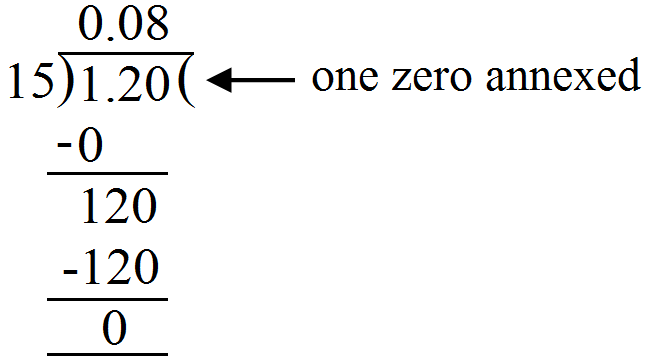
$0.12 ÷ 0.15 = ?$
AnswerCorrect option: C. $0.008$
We have
$0.012\div0.15=\frac{0.012}{0.15}=\frac{0.012\times100}{0.15\times100}$
$=\frac{1.2}{15}=0.08$
View full question & answer→MCQ 291 Mark
Mark $(\checkmark)$ against the correct answer in the following: $1\frac{3}{5}\div\frac{2}{3}=?$
- A
$1\frac{1}{15}$
- B
$1\frac{9}{10}$
- ✓
$2\frac{2}{5}$
- D
AnswerCorrect option: C. $2\frac{2}{5}$
$\frac{8}{5}\div\frac{2}{3}$
$=\frac{8}{5}\times\frac{3}{2}\times\frac{12}{5}$
$=2\frac{2}{5}$
View full question & answer→MCQ 301 Mark
$ \frac{0.25}{0.4}$ is equal to
- ✓
$ \frac{5}{8}$
- B
$ \frac{25}{40}$
- C
$ \frac{16}{19}$
- D
AnswerCorrect option: A. $ \frac{5}{8}$
$=\frac{0.25}{0.4} $
$= \dfrac{\frac{25}{100}}{\frac{4}{10}}$
$ =\frac{25\times10}{4\times100}$
$=\frac{25}{40}$
View full question & answer→MCQ 311 Mark
$5\ kg\ 5\ g$ written in decimal notation is:
- A
$5.5$
- B
$5.05$
- ✓
$5.005$
- D
$5.005$
AnswerCorrect option: C. $5.005$
We know that,
$1\text{g}=\frac{1}{1000}\text{kg}$
Now,
$5\text{kg }5\text{g}=5\text{kg}+5\text{g}$
$=5\text{kg}+\frac{5}{1000}\text{kg}$
$=5\text{kg}+0.005\text{kg}$
$=5.005\text{kg}$
$\therefore\ 5\text{kg }5\text{g}$
$=5.005\text{kg}$
View full question & answer→MCQ 321 Mark
Mark $(\checkmark)$ against the correct answer in the following:
$0.4 \times 0.4 \times 0.4$
AnswerCorrect option: C. $0.064$
$0.4 \times 0.4 \times 0.4 = 0.064$
View full question & answer→MCQ 331 Mark
Mark $(\checkmark)$ against the correct answer in the following: $\frac{2}{3},\frac{4}{6},\frac{6}{9},\frac{8}{12}$ are
Answer$\because\frac{4}{6}=\frac{4\div2}{6\div2}$
$=\frac{2}{3},\frac{6}{9}$
$=\frac{6\div3}{9\div3}$
$=\frac{2}{3}$
and $\frac{8}{12}=\frac{8\div4}{12\div4}=\frac{2}{3}$
$\therefore$ Each of these fractions $=\frac{2}{3}$
View full question & answer→MCQ 341 Mark
If a fraction $\frac{\text{a}}{\text{b}}$ is a lowest terms, then $HCF$ of $a$ and $b$ is:
AnswerWe know that a fraction is in its lowest terms if its numerator and denominator have no common factor other than $1.$
Thus, if the fraction $\frac{\text{a}}{\text{b}}$ is in its lowest terms, then the $HCF$ of a and b is $1.$
View full question & answer→MCQ 351 Mark
Mark $(\checkmark)$ against the correct answer in the following:
Which of the following is a reducible fraction?
- ✓
$\frac{105}{112}$
- B
$\frac{104}{212}$
- C
$\frac{77}{72}$
- D
$\frac{46}{63}$
AnswerCorrect option: A. $\frac{105}{112}$
$\frac{105}{112}$ is reducible fraction because $HCF$ $112$ of $105$ and $112$ is $7$
View full question & answer→MCQ 361 Mark
$0.08 =$ ___________
- A
$0.80$
- B
$0.800$
- ✓
$0.080$
- D
$0.8$
AnswerCorrect option: C. $0.080$
$0.080$
View full question & answer→MCQ 371 Mark
$\Big(5\frac{1}{4}-3\frac{1}{3}\Big)=$
- A
$\frac{12}{23}$
- B
$2$
- ✓
$1\frac{11}{12}$
- D
$\frac{11}{12}$
AnswerCorrect option: C. $1\frac{11}{12}$
$\Big(5\frac{1}{4}-3\frac{1}{3}\Big)$
$=\frac{21}{4}-\frac{10}{3}$
$=\frac{21\times3}{4\times3}-\frac{10\times4}{3\times4} (LCM$ of $3$ and $4$ is $12)$
$=\frac{63}{12}-\frac{40}{12}$
$=\frac{63-40}{12}$
$=\frac{23}{12}$
$=1\frac{11}{12}$
View full question & answer→MCQ 381 Mark
A number with decimal point followed by $1$ or more digits is called:
AnswerIn decimal system, the number after the decimal point is called the decimal number.
View full question & answer→MCQ 391 Mark
Decimal form of $\frac{4999}{1000}$ is:
- A
$4.99$
- B
$0.4999$
- ✓
$4.999$
- D
$49.99$
AnswerCorrect option: C. $4.999$
Decimal means divide the numerator by the denominator.
Here, Numerator $= 4999$ and
Denominator $= 1000\Rightarrow \frac{4999}{1000}=4.999$
View full question & answer→MCQ 401 Mark
Which fraction is equal to $4.4?$
- A
$\frac{4}{10}$
- ✓
$\frac{44}{10}$
- C
$ \frac{4}{100}$
- D
$ \frac{44}{100}$
AnswerCorrect option: B. $\frac{44}{10}$
The first decimal digit from the decimal point is the tenth.
$4.4$ has $4$ on the ones, after decimal point on the tenths is $4$ tenths.
$4.4$ is the sum of $4$ and $\frac{4}{10}$ or $\frac{44}{10}.$
View full question & answer→MCQ 411 Mark
Mark $(\checkmark)$ against the correct answer in the following:
$0.5 \times 0.05 = ?$
AnswerCorrect option: C. $0.025$
$0.5\times0.05=\frac{5}{10}\times\frac{05}{100}=\frac{25}{1000}$
$=0.025$
View full question & answer→MCQ 421 Mark
$ \text{4}\frac{7}{11} = \frac{?}{11}$
Answer$ \text{4}\frac{7}{11} = \frac{4\times11 + 7}{11} = \frac{51}{11}$
View full question & answer→MCQ 431 Mark
Mark $(\checkmark)$ against the correct answer in the following: Reciprocal of $1\frac{3}{5}$ is.
- A
$1\frac{5}{3}$
- B
$5\frac{1}{3}$
- C
$3\frac{1}{5}$
- ✓
AnswerReciprocal of $1\frac{3}{5}=$ Reciprocal of $\frac{8}{5}=\frac{5}{8}$
View full question & answer→MCQ 441 Mark
Mark $(\checkmark)$ against the correct answer in the following:
$2kg\ 5g = ?$
- A
$2.5\ kg$
- B
$2.05\ kg$
- ✓
$2.005\ kg$
- D
AnswerCorrect option: C. $2.005\ kg$
$2\text{kg} 5\text{g} = (2 \times 1000)\text{g} + 5\text{g} = (2005)\text{g}$
$=\Big(\frac{2005}{1000}\Big)\text{kg}=2.005\text{kg}$
View full question & answer→MCQ 451 Mark
The reciprocal of the fraction $2\frac{3}{5}$ is:
- A
$2\frac{5}{3}$
- B
$\frac{13}{5}$
- ✓
$\frac{5}{13}$
- D
$2\frac{2}{5}$
AnswerCorrect option: C. $\frac{5}{13}$
The reciprocal of a non$-$zero fraction $\frac{\text{a}}{\text{b}}$ is the fraction $\frac{\text{b}}{\text{a}}$
$2\frac{3}{5}=\frac{2\times5+3}{5}=\frac{13}{5}$
Now, Reciprocal of the fraction $\frac{13}{5}=\frac{5}{13}$
$\therefore$ Reciprocal of the fraction $2\frac{3}{5}=\frac{5}{13}$
View full question & answer→MCQ 461 Mark
$5$ thousandths is
- A
$0.05$
- ✓
$0.005$
- C
$5.000$
- D
$0.056$
AnswerCorrect option: B. $0.005$
A decimal is a fractional number and is indicated by digits after a period which is called a decimal point. Tenths have one digit after the decimal point. The decimal $0.8$ is pronounced as eight tenths. Hundredths have two digits after the decimal point. The decimal $0.06$ is pronounced as six hundredths. Thousandths follow a similar pattern. They have three digits after the decimal point. The decimal $0.005$ is pronounced as five thousandths. Hence, five thousandths is $0.005.$
View full question & answer→MCQ 471 Mark
Mark $(\checkmark)$ against the correct answer in the following:
$2.73 ÷ 1.3 = ?$
Answer$2.73\div1.3=\frac{2.73}{1.3}$
$=\frac{273\times10}{13\times100}=\frac{273}{130}=\frac{21}{10}=2.1$
View full question & answer→MCQ 481 Mark
If $24.125=24+\frac{\text{A}}{10}+\frac{\text{B}}{100}+\frac{\text{C}}{1000},$ then $A + B + C =$
Answer$=24.125$
$=24+0.125$
$=24+0.1+0.02+0.005$
$=24+\frac{1}{10}+\frac{2}{100}+\frac{5}{1000}$
Comparing this the given expression, we get
$\text{A}=1,\text{B}=2$ and $\text{C}=5$
$\therefore\ \text{A}+\text{B}+\text{C}=1+2+5$
$\text{A}+\text{B}+\text{C}=8$
View full question & answer→MCQ 491 Mark
To express a terminating decimal as a common fraction, we express the decimal as a common fraction with a power of $10$ in the ............
AnswerWhen the prime factorization of the denominator of a fraction has only factors of $2$ and factors of $5,$ then the number is a terminating decimal.
If there are prime factors in the denominator other than $2$ or $5,$ then the decimals repeat.
View full question & answer→MCQ 501 Mark
Rename the following percents as decimals.
$0.002\%$
- A
$0.02$
- B
$0.002$
- C
$0.0002$
- ✓
$0.00002$
AnswerCorrect option: D. $0.00002$
To find the percent of a given number, we will multiply it with $100$ Let the number in decimal be $x$
When converted to percent,
the number becomes $ \text{x} \times100=0.002,$
which gives $ \text{x}=0.00002.$
View full question & answer→