Question 13 Marks
carpet of size $5m \times 2m$ has 25cm wide red border. The inner part of the carpet is blue in colour Fig. Find the area of blue portion. What is the ratio of areas of red portion to blue portion?
AnswerGiven, Size of carpet $= 5m \times 2m$ and width of border $ = 25 \text{cm}=\frac{25}{100}\times\text{m}=0.25\text{m}$
$\therefore$ Aare of carpet $A B C D=A B \times B C=5 \times 2=10 \mathrm{~m}^2[\because$ area of rectangle $=$ length $\times$ breadth $]$
So, length of inner blue portion, $E F=A B-(2 \times 0.25 \mathrm{~cm})=5-0.50=4.5 \mathrm{~m}$
And breadth of inner blue portion $\mathrm{FG}=\mathrm{BC}-(2 \times 0.25)=2-0.50=1.5 \mathrm{~m}$
Area, of blue portion $=$ Area of ractangle $\mathrm{EFGH}=\mathrm{EF} \times \mathrm{FG}=4.5 \times 1.5=6.75 \mathrm{~m}^2$
Now, area of red portion $=$ Area of $\mathrm{ABCD}-$ Area of $\mathrm{EFGH}=10-6.75=3.25 \mathrm{~m}^2$
$\therefore$ Ratio of areas of red portion to blue portion $=3.25: 6.75=13: 27$
View full question & answer→Question 23 Marks
Find the area enclosed by the following figure:

AnswerThe given shape contains a rectangle and a triangle.
For rectangle, $\mathrm{I}=15 \mathrm{~cm}$ and $\mathrm{b}=3 \mathrm{~cm}$
$\therefore$ Area of rectangle $=1 \times \mathrm{b}=15 \times 3=45 \mathrm{~cm}^2$
Accoriding to the figuer, $\mathrm{BE}=\mathrm{AB}-\mathrm{AE}=15-10=5 \mathrm{~cm}$
For triangle, base $(b)=B E=5 \mathrm{~cm}$ and height $(h)=4 \mathrm{~cm}$
$\therefore$ Area of $\triangle \mathrm{BEG}=\frac{1}{2} \times \mathrm{b} \times \mathrm{h}=\frac{1}{2} \times 5 \times 4=10 \mathrm{~cm}^2$
$\therefore$ Total area enclosed by the shape $=(45+10) \mathrm{cm}^2=55 \mathrm{~cm}^2$
View full question & answer→Question 33 Marks
A $10m$ long and $4m$ wide rectangular lawn is in front of a house. Along its three sides a $50\ cm$ wide flower bed is there as shown in Fig. Find the area of the remaining portion.
AnswerGiven, dimensios of rectangular lawn $= 10m × 4m$ and width of flower bed $= 50\ cm $
Length of remaining portion, $\mathrm{EF}=\mathrm{AB}-(50 \times 2 \mathrm{~cm})$
$=10 \mathrm{~m}-100 \mathrm{~cm}=10 \mathrm{~m}-1 \mathrm{~m}=9 \mathrm{~m}\left[\because 1 \mathrm{~cm}=\frac{1}{100} \mathrm{~m}\right]$
Breadth of remaining portion, $\mathrm{EH}=\mathrm{AD}-50 \mathrm{~cm}=4 \mathrm{~m}-0.5 \mathrm{~m}=3.5 \mathrm{~m}$
$\therefore$ Required area $=$ Area of portion $\mathrm{EFGH}=\mathrm{EF} \times \mathrm{EH}=9 \times 3.5=31.5 \mathrm{~m}^2$
View full question & answer→Question 43 Marks
Find the areas of the shaded region:
AnswerLet radius of smiler circle be r and bigger circle be $R.$
From the figure, $\mathrm{r}=\frac{7}{2} \mathrm{~cm}$ and $\mathrm{R}=\frac{7}{2}+7=\frac{21}{2} \mathrm{~cm}$
$\therefore \text { Area of shaded region }=\text { Area of bigger circle }- \text { Area of smaller circle }$
$=\pi \mathrm{R}^2-\pi \mathrm{r}^2$
$=\pi\left(\mathrm{R}^2-\mathrm{r}^2\right)=\pi\left(\frac{21}{2} \times \frac{21}{2}-\frac{7}{2} \times \frac{7}{2}\right)$
$=\pi\left(\frac{441}{4}-\frac{49}{4}\right)=\frac{22}{7} \times \frac{392}{4}=308 \mathrm{~cm}^2$
Hence, the area of shaded region is $308 \mathrm{~cm}^2$
View full question & answer→Question 53 Marks
A wall of a room is of dimensions $5m \times 4m.$ It has a window of dimensions $1.5m \times 1m$ and a door of dimensions $2.25m \times 1m.$ Find the area of the wall which is to be painted.
AnswerGiven, a wall of a room is of dimensions $5m \times m.$
$\therefore$ Length of the room $=5 \mathrm{~m}$ and breadth of the room $=4 \mathrm{~m}$
$\therefore$ Area of the room $=l \times b=5 \times 4=20 \mathrm{~m}^2$
Also, length of the window $=1.5 \mathrm{~m}$ and breadth of the window $=1 \mathrm{~m}$ [given]
$\therefore$ Area of the window $=l \times \mathrm{b}=1.5 \times 1=1.5 \mathrm{~m}^2$
Now, length of the door $=2.25 \mathrm{~m}$ and breadth of the door $=1 \mathrm{~m}$
$\therefore$ Area of the door $=l \times \mathrm{b}=2.25 \times 1=2.25 \mathrm{~m}^2$
Now, area of the wall to be painted $=$ Area of the room $- ($Area of the window + Area of the door $)$
$=20-(1.5+2.25)=20-3.75=16.25 \mathrm{~m}^2$
View full question & answer→Question 63 Marks
Find the area enclosed by the following figure:

AnswerThe given shape contains a semi-coulam and a rectains. 
Area of rectangle $=1 \times 13 \times 4=52 \mathrm{~cm}^2$
$\therefore$ Area of semi-coulam $=\frac{1}{2} \pi \mathrm{r}^2=\frac{1}{2} \times \frac{22}{7} \times 10 \times 10=\frac{1100}{7} \mathrm{~cm}^2$
$\therefore$ Total area of triangle $=\frac{1}{2} \times$ Base $\times$ Height $=\frac{1}{2} \times 20 \times 7=70 \mathrm{~cm}^2$
Hence, total area encloudsed by the shap $\frac{1100}{7}+70=\frac{1100+490}{7}=\frac{1560}{7}=227 \mathrm{~cm}^2$ (approx.) View full question & answer→Question 73 Marks
The perimeter of a rectangle is $40m.$ Its length is four metres less than five times its breadth. Find the area of the rectangle.
AnswerLet breadth of the rectangle $= x$
Then, length of the rectangle $= 5x - 4$
we know that,
perimeter of rectangle $= 2(l + b) $
$\Rightarrow 40 = 2(l + b)$
$\Rightarrow 40=2(l+b)[\because \text { paramiter }=40 m, \text { given }]$
$\Rightarrow 40=2(5 x-4+x)$
$\Rightarrow 40=2(6 x-4)$
$\Rightarrow 12 x-8=40$
$\Rightarrow 12 x=40+8$
$\Rightarrow 12 x=48$
$\Rightarrow x=\frac{48}{12}=4$
So, breadth $=x=4 \mathrm{~m}$ and length $=5 \mathrm{x}-4=5 \times 4-4=16 \mathrm{~m}$
$\because$ Area of rectangle $=l \times b=4 \times 16=64 \mathrm{~m}^2$
Hence, the area of rectengle is $64 \mathrm{~m}^2$
View full question & answer→Question 83 Marks
$ABCD$ is a given rectangle with length as $80\ cm$ and breadth as $60\ cm. P, Q, R, S$ are the mid points of sides $AB, BC, CD, DA$ respectively. A circular rangoli of radius $10\ cm$ is drawn at the centre as shown in Fig. Find the area of shaded portion.
AnswerHere, $\mathrm{AP}=\frac{1}{2} \mathrm{AB}=\frac{1}{2} \times 80=40 \mathrm{~cm}$
Also, $\mathrm{AS}=\frac{1}{2} \mathrm{AD}=\frac{1}{2} \times 60=30 \mathrm{~cm}$
Area of $\triangle \mathrm{APS}=\frac{1}{2} \times \mathrm{AP} \times \mathrm{AS}=\frac{1}{2} \times 40 \times 30=600 \mathrm{~cm}^2$
Area of portion $\mathrm{PQRS}=$ Area of rectangle $\mathrm{ABCD}-4 \times$ Area of $\triangle \mathrm{APS}=80 \times 6-4 \times 600$ $=4800-2400=2400 \mathrm{~cm}^2$
Area of cicular rangoli $=\pi \times(10)^2=\frac{22}{7} \times 100=314 \mathrm{~cm}^2[\because$ radius of circle $=10 \mathrm{~cm}]$
$\therefore$ Area of shaded region $=2400-314=2086 \mathrm{~cm}^2$
View full question & answer→Question 93 Marks
$4$ squares each of side $10\ cm$ have been cut from each corner of a rectangular sheet of paper of size $100\ cm × 80\ cm.$ From the remaining piece of paper, an isosceles right triangle is removed whose equal sides are each of $10\ cm$ length. Find the area of the remaining part of the paper.
AnswerArea of each square $=(10)^2 \mathrm{~cm}^2=100 \mathrm{~cm}^2\left[\because\right.$ area of square $\left.=(\text { side })^2\right]$
Area of rectangular sheet $=100 \times 80 \mathrm{~cm}^2[\because$ area of rectangle $=$ length $\times$ breadth $]$
$=8000 \mathrm{~cm}^2$
Area of an isosceeles right triangle $=\frac{1}{2} \times 10 \times 10=50 \mathrm{~cm}^2\left[\because\right.$ area of an isosceles righta triangle $=\frac{1}{2} \times$ base $\times$ height $]$
$\therefore$ Area of remaining part of paper $=8000-4 \times 100-50=7550 \mathrm{~cm}^2$
View full question & answer→Question 103 Marks
A square tile of length $20\ cm$ has four quarter circles at each corner as shown in Fig.Find the area of shaded portion. Another tile with same dimensions has a circle in the centre of the tile Fig.
AnswerArea of shaded portion
$=\text { Area of square }-4 \times \text { Area of circle }$
$=20 \times 20-4 \times \frac{\pi \pi^2}{4}\left[\because \text { area of square }=(\text { side })^2 \text { and are of quarter circle }=\frac{1}{4} \text { area of a circle }\right]$
$=400-4 \times \frac{22}{7} \times \frac{1}{4} \times 10 \times 10\left[\because \text { radius of quarter circle }=\frac{1}{2} \text { side of square }=10 \mathrm{~cm}\right] $
$400-\frac{2200}{7}=\frac{600}{7}=85.71 \mathrm{~cm}^2=\mathrm{cm}^2$
View full question & answer→Question 113 Marks
Dimensions of a painting are $60\ cm \times 38\ cm.$ Find the area of the wooden frame of width $6\ cm$ around the painting as shown in Fig.
AnswerWe have,
And lenght and breadth of inner rectangle is $ 60\ cm$ and $38\ cm,$ respectively.
$\therefore$ Area if inner rectabgle $=60 \times 38=2280 \mathrm{~cm}^2[\because$ area of rectangle $=$ length $\times$ breadth $]$
$\therefore$ Breadth of inner rectangle $=38+6+6=50 \mathrm{~cm}$
Length of outer rectangle $=60+6+6=72 \mathrm{~cm}[\because$ Width of frame $=6 \mathrm{~cm}$, given $]$
$\therefore$ Area of outer rectangle $=50 \times 72=3600 \mathrm{~cm}^2$
Now, area of wooden frame $=3600-2280=1320 \mathrm{~cm}^2$
View full question & answer→Question 123 Marks
In Fig. find the area of parallelogram $ABCD$ if the area of shaded triangle is $9\ cm^2$.
AnswerGiven, area of shaded triangle $=9 \mathrm{~cm}^2$
And base of the triangle $=3 \mathrm{~cm}$
$\because$ Area of a triangle $=\frac{1}{2} \times$ Base $\times$ Height
$\Rightarrow 9 \frac{1}{2} \times 3 \times \mathrm{h} \Rightarrow \frac{18}{3}=\mathrm{h}$
$\Rightarrow \mathrm{~h}=6 \mathrm{~cm}$
$\therefore$ Area of parallelogram $=$ Height of parallelgram $=6 \times(3+4)=6 \times 7=42 \mathrm{~cm}^2$
View full question & answer→Question 133 Marks
Find the area enclosed by the following figure:
AnswerThe given shape contains a triangle and a rectains.
For rectangle, $l = 13\ cm$ and $b = 4\ cm$
$\therefore$ Area of rectangle $=l \times 13 \times 4=52 \mathrm{~cm}^2$
For tringle, base $(b)=5 \mathrm{~cm}$ and height $(h)=(16-4) \mathrm{cm}=12 \mathrm{~cm}$
$\therefore$ Area of triangle $\frac{1}{2} \times \mathrm{b} \times \mathrm{h}=\frac{1}{2} \times 5 \times 12=30 \mathrm{~cm}^2$
$\therefore$ Total area enclosed by the shape $=(52+30) \mathrm{cm}^2=82 \mathrm{~cm}^2$
View full question & answer→Question 143 Marks
Rectangle $MNOP$ is made up of four congruent rectangles Fig. If the area of one of the rectangles is $8m^2$ and breadth is $2m,$ then find the perimeter of $MNOP. $
AnswerWe have, area of one rectangle $=8 \mathrm{~m}^2$
And breadth $=2 m$
we know that,
Area of rectangle $=l \times b$
$\Rightarrow l \times b=8$
$\Rightarrow l \times 2=8$
$\Rightarrow l=4 \mathrm{~m}$
Now, we have to find the perimeter of $MNOP,$
which contains four congruent rectangle, it means they have same length and breadth.
$\therefore \text { Perimeter of rectangle } \mathrm{MNOP}=\mathrm{MN}+\mathrm{NC}+\mathrm{CD}+\mathrm{DO}+\mathrm{PO}+\mathrm{PF}+\mathrm{FA}+\mathrm{MA}$
$=4+2+4+2+4+2+4+2$
$=24 \mathrm{~m}$
Hence, the perimeter of $MNOP$ is $24 m .$
View full question & answer→Question 153 Marks
In the given triangles of Fig. perimeter of $\triangle\text{ABC}$ = perimeter of $\triangle\text{PQR}.$ Find the area of $\triangle\text{ABC}.$
AnswerGiven, perimeter of $\triangle\text{ABC}$ = perimeter of $\triangle\text{PQR}$
$\therefore$ perimeter of $\triangle\text{PQR} = 14 + 6 + 10 = 30cm [\because$ perimeter of triangle $=$ sum of all sides$]$
Now, perimeter of $\triangle\text{ABC}= \text{AB} + \text{BC} + \text{CA}$
$\Rightarrow30 = \text{AB} + \text{BC} + \text{AC}$
$\Rightarrow30 = \text{AB} + 5 + 13$
$\Rightarrow30 = \text{AB} + 18$
$\Rightarrow30 - 18 = 12\text{cm}$
$\therefore\text{Area of }\triangle\text{ABC}=\frac{1}{2}\times\text{Base}\times\text{Height}$
$=\frac{1}{2}\times5\times12=5\times6=30\text{cm}^2$
View full question & answer→Question 163 Marks
Ramesh grew wheat in a rectangular field that measured $32$ metres long and $26$ metres wide. This year he increased the area for wheat by increasing the length but not the width. He increased the area of the wheat field by $650$ square metres. What is the length of the expanded wheat field$?$
AnswerGiven, dimenstion of a rectangluler filed $32m \times 26m.$ and area incressed = $650m^2$
$\therefore$ Increased area of wheat field $=$ Area of $EFGH\ -$ Area of $ABCD$ wheat filed
$\Rightarrow 650 = EF \times EH - AB \times AD [\because$ area of rectangle $=$ length $\times $ breadth$]$
$\Rightarrow 650 = EF \times 26 - 32 \times 26$
$\Rightarrow 650 = 26EF - 832$
$\Rightarrow 1482 = 26EF$
$\Rightarrow EF = 57\ cm$
Hence, the lenght of the expanded what filed is $57m.$
View full question & answer→Question 173 Marks
Ishika has designed a small oval race track for her remote control car. Her design is shown in the fig. What is the total distance around the track? Round your answer to the nearest whole cm.
AnswerTotal distance around the track $=$ lenght of $2$ parallel strips $+$ Lenght of $2$ semi-circles
$= 2 \times 52 + 2 \times \pi \times 16 [\therefore\text{r}= 16\text{cm}] $
$= 104 + 2 \times 3.14 \times 16 = 104 + 100.5009 = 205\ cm$ (approx.)
View full question & answer→Question 183 Marks
Find the area of a square inscribed in a circle whose radius is $7\ cm$ Fig.
Hint: [Four right-angled triangles joined at right angles to form a square]
AnswerGiven that $ABCD$ is a square.
According to the question,
Area of square $ABCD = 4\ \times $ Area of a right angle triangle
$\therefore$ Area of square $ABCD = 4\ \times $ Area of $\triangle\text{AOB} $
$4\times\big(\frac{1}{2}\times\text{AO}\times\text{BO}\big)$
$[\because \text{area of a right angled triangle }=\frac{1}{2}\times\text{Base}\times\text{height}]$
$= 2 \times 7 \times 7 = 98\ cm^2$
$[\because AO = BO =$ radiuse of circle $= 7\ cm, $ given$]$
Hence, the area of inscribed is $98\ cm^2$
View full question & answer→Question 193 Marks
A square tile of length $20\ cm$ has four quarter circles at each corner as shown in Fig.If the circle touches all the four sides of the square tile, find the area of the shaded portion. In which tile, area of shaded portion will be more$? ($Take $\pi = 3.14)$
AnswerArea of shaded portion
$=\text { Area of square - Area of circle }$
$20 \times 20-\frac{22}{7} \times 10 \times 10\left[\because \text { radius of circle }=\frac{1}{2} \text { side of square }=10 \mathrm{~cm}\right]$
$400-\frac{2200}{7}=\frac{600}{7}=86 \mathrm{~cm}^2$
Hence, area in both cases is equal i.e $86 \mathrm{~cm}^2$.
View full question & answer→Question 203 Marks
Priyanka took a wire and bent it to form a circle of radius $14\ cm.$ Then she bent it into a rectangle with one side $24\ cm$ long. What is the length of the wire? Which figure encloses more area, the circle or the rectangle?
AnswerGiven that, rasiuse of circle $(r)=14 \mathrm{~cm}$ and
lenght of rectangle $(I)=24 \mathrm{~cm}$
$\therefore$ lenghth of the wire $=$ Circumference of the circle $=2 \pi \mathrm{r}=2 \times \frac{22}{7} \times 14=88 \mathrm{~cm}$
Let $b$ be the width of rectangle.
$\therefore$ Perimeter of rectangle $=$ Circumference of circle
$\Rightarrow 2(24+b)=88$
$\Rightarrow 24+b ~44$
$\Rightarrow b=44-24$
$\Rightarrow b=20 \mathrm{~cm}$
Area of circle $=\pi \mathrm{r}^2=\frac{22}{7} \times(14)^2=616 \mathrm{~cm}^2$
$\because$ Area of rectangle $=l \times b=24 \times 20=480 \mathrm{~cm}^2$
Hence, the circle encloses more area then ractangle.
View full question & answer→Question 213 Marks
Find the area enclosed by the following figure:

AnswerThe given shape contains a rectains and a semi-circle.
$\therefore$ Area of rectangle $=1 \times \mathrm{b}=(10.2 \times 1.5) \mathrm{cm}^2=15.3 \mathrm{~cm}^2$
Here, diameter of semi-circle $=(10.2-3.9) \mathrm{cm}=6.3 \mathrm{~cm}$
So, radius $=\frac{\text { diameter }}{2}=\frac{6.3}{2}=3.15 \mathrm{~cm}$
$\therefore$ Area of semi-circle $\frac{1}{2} \pi \mathrm{r}^2=\frac{22}{7} \times \frac{1}{2} \times 3.15 \times 3.15=15.59 \mathrm{~cm}^2$
$\therefore$ Total area $=$ area of rectengle + area of semi-circle $=15.3+3.15=30.89 \mathrm{~cm}^2$
View full question & answer→Question 223 Marks
A school playground is divided by a $2m$ wide path which is parallel to the width of the playground, and a $3m$ wide path which is parallel to the length of the ground Fig. If the length and width of the playground are $120m$ and $80m$ respectively, find the area of the remaining playground.
AnswerGiven, dimensions of playground $= 12m \times 80m$
$\because \text { Area of rectangle } A B C D=120 \times 80=9600 \mathrm{~m}^2$
$\text { Area of rectangle } A B F E=\mathrm{AB} \times \mathrm{BF}$
$=120 \times 3=360 \mathrm{~m}^2[\because \text { area of rectangle }=\text { length } \times \text { breadth }]$
$\text { Area of rectangle GHIJ }=\mathrm{JI} \times \mathrm{IH}=2 \times 77=154 \mathrm{~m}^2$
$\therefore \text { Area of a remaining ground rectangle. }$
$\text { GHIJ }=\text { Area of rectangle } \mathrm{ABCD}-\text { Area of reactangle ABFE }- \text { Area of } \mathrm{GHI}]$
$=9600-360-154=9086 \mathrm{~m}^2$
View full question & answer→Question 233 Marks
In a park of dimensions $20m \times 15m,$ there is a $L$ shaped $1m$ wide flower bed as shown in Fig. Find the total cost of manuring for the flower bed at the rate of $Rs. 45$ per $\mathrm{m}^2$.
AnswerGiven, dimensions of a park $= 20m \times 15m$ and with of a flower bed $= 1m $
From the figure, $F G=B C 1 m=(15-1)=14 \mathrm{~m}$
$E F=D C-1 m=(20-1)=19 m$
$\therefore$ Area flower bed $=$ Area of $ABCD\ -$ Area of $EFGD$
$=20 \times 15-19 \times 14=300-266=34 \mathrm{~m}^2[\because$ area of rectangle $=$ length $\times$ breadth $]$
$\therefore$ Cost of manuring $1 \mathrm{~m}^2$ of flower bed $= Rs. 45$
$\therefore$ Cost of manuring $34 \mathrm{~m}^2$ the flower bed of $=$ Rs. $34 \times 45=Rs. 1530$
View full question & answer→Question 243 Marks
A photograph of Billiard/Snooker table has dimensions as $\frac{1}{10}\text{th}$ of its actual size as shown in Fig.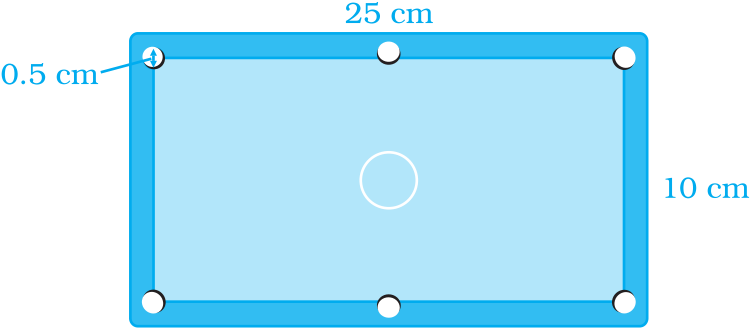
The portion excluding six holes each of diameter $0.5\ cm$ needs to be polished at rate of $Rs. 200$ per $m^2$. Find the cost of polishing. AnswerThe portion excluding six holes each of diameter $0.5\ cm$ needs to be polished at rate of $Rs. 200$ per $\mathrm{m}^2$. Find the cost of polishing.
Actual langth $=25 \times 10=250 \mathrm{~cm}$
Actual breadth $=10 \times 10=100 \mathrm{~cm}$
Area of table $=250 \times 100=25000 \mathrm{~cm}^2$
Radius of a hole $=\frac{0.5}{2}=0.25 \mathrm{~cm}$
Area of 6 holes $=6 \times \pi \mathrm{r}^2=6 \times \frac{22}{7} \times 0.25 \times 0.25=1.18 \mathrm{~cm}^2$
Area of portion excluding hole $=25000-1.18=24998.8 \mathrm{~cm}^2$
$\therefore$ Cost of polising $=$ Rs. $\frac{24999}{10000} \times 200= Rs. 500 ($approx$.)$
View full question & answer→Question 253 Marks
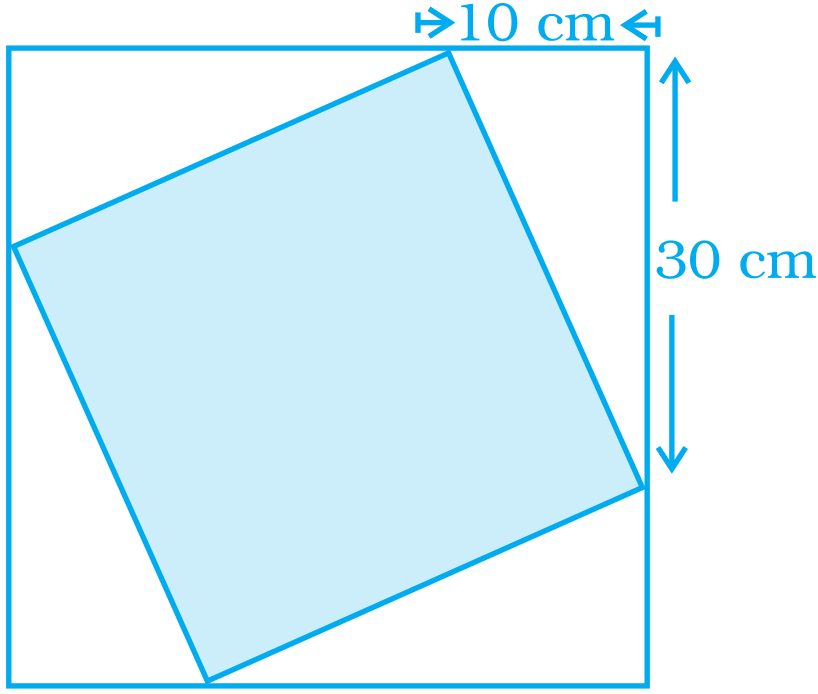
A design is made up of four congruent right triangles as shown in Fig. Find the area of the shaded portion.
Answer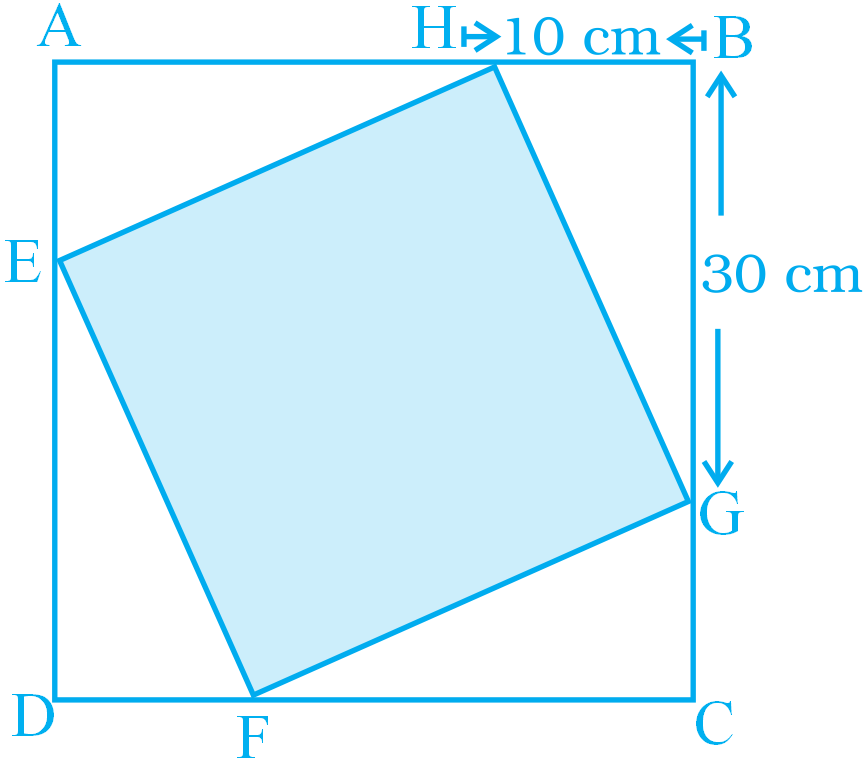
Area of one right angled triangle $=\frac{1}{2} \times \mathrm{BH} \times \mathrm{BG}=\frac{1}{2} \times 10 \times 30=150 \mathrm{~cm}^2$
So, area of 4 right angled triangles $=4 \times 150=600 \mathrm{~cm}[\because$ all the right angled triangles are congruent $]$
$\because$ Area of square $=(\text { Side })^2[G C=10 \mathrm{~cm}$, because all triangles are congruent $]$
Area of portion $\mathrm{ABCD}=(30+10)^2=40^2=1600 \mathrm{~cm}^2$
$\therefore$ Area of shaded portion $=1600=1000 \mathrm{~cm}^2$ View full question & answer→Question 263 Marks
Area of a triangle $PQR$ right-angled at $Q$ is $60\ cm^2$ If the smallest side is $8\ cm$ long, find the length of the other two sides.
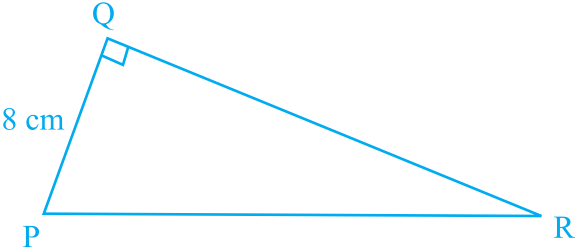
AnswerGiven, area of $\triangle\text{PQR}=60\text{cm}^2 $ and side $\text{PQ} = 8\text{cm}$
$\therefore\text{ Area of }\triangle\text{PQR}=\frac{1}{2}\times\text{PQ}\times\text{QR}$
$[\because$ area of triangle $=$ base $\times $ height$]$
$\Rightarrow60=\frac{1}{2}\times8\times\text{QR}\Rightarrow\text{QR}=\frac{60\times2}{8}$
$\Rightarrow\text{QR}=15\text{cm}$
In rigta angled $\triangle\text{PQR},$
$\text{PR}^2 = \text{PQ}^2 + \text{QR}^2$ [by pythagoras theorem]
$\Rightarrow \text{PR}^2 = 8^2 + 15^2 = 64 + \text{225}$
$\Rightarrow \text{PR}^2 = 289 \Rightarrow \text{PR} = \sqrt{289}=17\text{cm}$
Hence, the lenght of two sides are $15\ cm$ and $17\ cm.$
View full question & answer→Question 273 Marks
People of Khejadli village take good care of plants, trees and animals. They say that plants and animals can survive without us, but we can not survive without them. Inspired by her elders Amrita marked some land for her pets (camel and ox ) and plants. Find the ratio of the areas kept for animals and plants to the living area.
AnswerWe know that,
Area of rectangle $=l \times \mathrm{b}$ and area of circle $=\pi \mathrm{r}^2$
From the given figure,
Area of total rectangular land $=15 \mathrm{~m} \times 10 \mathrm{~m}=150 \mathrm{~m}^2$
Area of land covered by plants $=9 \mathrm{~m} \times 1 \mathrm{~m}=9 \mathrm{~m}^2$
Area of land covered by camel $=5 \mathrm{~m} \times 3 \mathrm{~m}=15 \mathrm{~m}^2$
$\therefore$ Region of land covered by ox is circular area.
So, diameter, $d=2.8 \mathrm{~m}$
$\therefore \text { Radius }=\frac{\mathrm{d}}{2}=\frac{2.8}{2}=1.4 \mathrm{~m}\left[\because \text { radius }=\frac{\text { diameter }}{2}\right]$
$\therefore$ Area of land coverd by ox $=\pi \mathrm{r}^2=\frac{22}{7} \times 1.4 \times 1.4=6.16 \mathrm{~m}^2$
Total area coverd by plants, camel and $o x=9+15+6.16=30.16 \mathrm{~m}^2$
Remaining land for living $=$ Totale are - Area coverd by plants and animals
$=(150-30.16) \mathrm{m}^2=119.84 \mathrm{~m}^2$
$\therefore$ Retio of areas keat for animals and plants to the living area
$=30.16: 119.84=30.16: 11984=377: 1498$
The valu depicted here is taht, we should save our environment and balance the environment.
View full question & answer→Question 283 Marks
A dinner plate is in the form of a circle. A circular region encloses a beautiful design as shown in Fig. The inner circumference ism $352\ mm$ and outer is $396\ mm.$ Find the width of circular design.
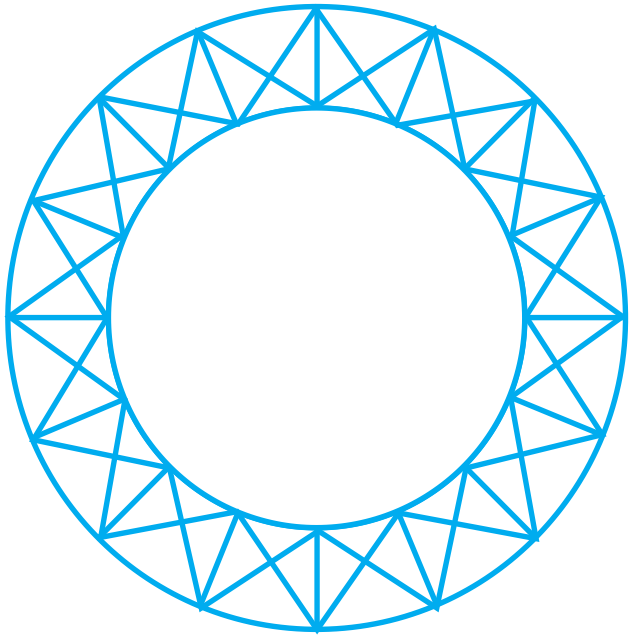
AnswerLet the radius of inner and outer cirle be $r$ and $R$ respectliy,
Given, inner circumference $= 352\ mm$
$\Rightarrow2\pi\text{r}=352 [\because$ circumference $=2\pi\text{r}]$
$\Rightarrow2\times\frac{22}{7}\times\text{r}=352$
$\Rightarrow\text{r}=\frac{352\times7}{2\times22}=\frac{2464}{44}=56\text{mm}$ And
outer circumference $= 396mm [$given$]$
$\Rightarrow2\pi\text{R}=369$
$\Rightarrow2\times\frac{22}{7}\times\text{R}=369$
$\Rightarrow\text{R}=\frac{396\times7}{2\times22}=63\text{mm}$
$\therefore$ Width of circular desing $= R - r = 63 - 56 = 7mm$
View full question & answer→Question 293 Marks
Pizza factory has come out with two kinds of pizzas. A square pizza of side $45\ cm$ costs $Rs. 150$ and a circular pizza of diameter $50\ cm$ costs $Rs. 160$ Fig. Which pizza is a better deal$?$
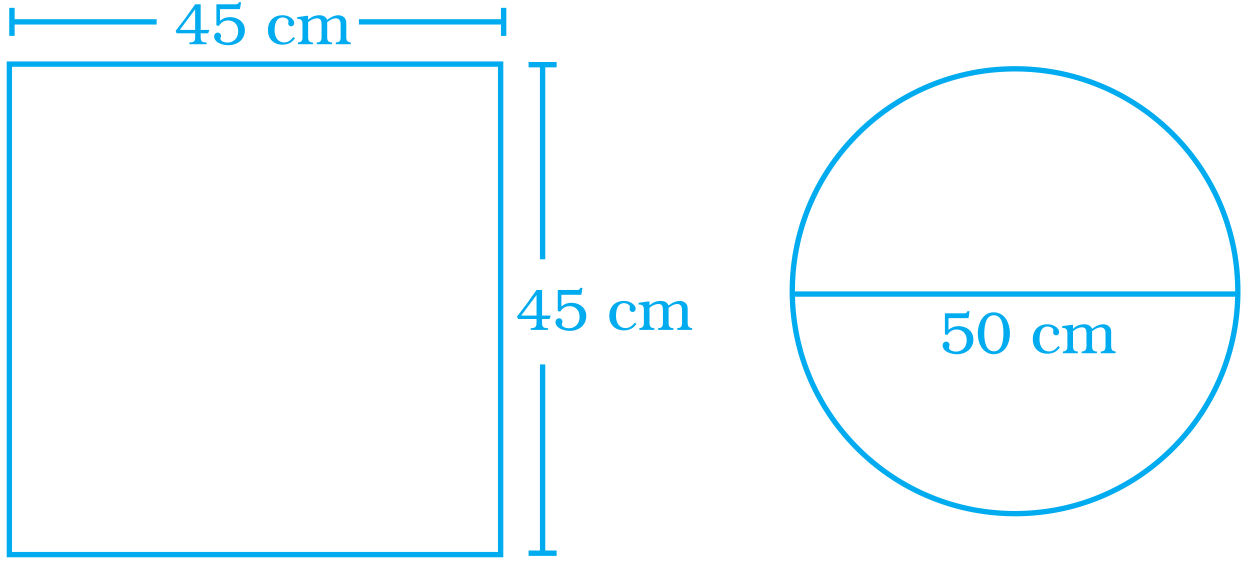
AnswerGiven, side of square pizza $= 45\ cm$
$\therefore$ Area of a square pizza $=(\text { side })^2=(45)^2=2025 \mathrm{~cm}^2$
Diameter of circular pizza $= 50\ cm$
$\therefore\text{Radius}=\frac{50}{2}=25\text{cm}$ $\bigg[\because\text{radius}=\frac{\text{diamiter}}{2}\bigg]$
Now, are of the ciculer pizza $=\frac{22}{7}\times25\times25$
$=\frac{22}{7}\times625$
$=\frac{13750}{7}=1964.28\text{cm}^2$ $[\because \text{area of circle}=\pi\text{r}^2]$
$\therefore$ Price of 1cm square pizza $=\frac{2025}{150}=\text{Rs.}13.5$
And price of 1cm circular pizza $=\frac{1964.28}{160}=\text{Rs.}12.27$
Hence, the circuler pizza is a better deal.
View full question & answer→Question 303 Marks
Area of an isosceles triangle is $48\ cm^2$. If the altitudes corresponding to the base of the triangle is $8\ cm,$ find the perimeter of the triangle.
AnswerGiven, area of $\triangle\text{ABC}=48\text{cm}^2$ and altitude $= 8\ cm$
$\because\triangle\text{ABC}$ is an isosceles triangle, where $AB = AC$
$\therefore\text{ Area of }\triangle\text{ABC}=\frac{1}{2}\times\text{BC}\times\text{AD}=48[\because$ area of triangle $=$ base $\times $ height$]$
$\Rightarrow48=\frac{1}{2}\times\text{BC}\times\text{AD}$
$\Rightarrow\frac{1}{2}\times\text{BC}\times8=48\Rightarrow\text{BC}=\frac{48\times32}{8}$
$\text{BC}=12\text{cm}$
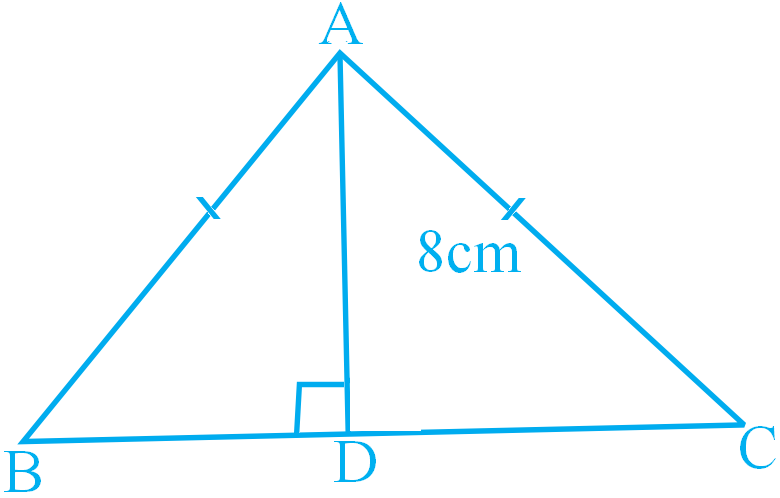
Now, in an isosceles triangle, $B D=D C=6 \mathrm{~cm}[\because \mathrm{AD} \perp \mathrm{BC}]$
Applying pythagoras theorem in right angle $\triangle \mathrm{ADB}$,
$A B^2=B D^2+A D^2$
$\Rightarrow A B^2=6^2+8^2=36+64$
$\Rightarrow A B^2=100$
$\Rightarrow A B=10 \mathrm{~cm}$
Now, perimeter of triangle $=A B+A C+B C=A B+A B+B C[\because A B=A C]$
$=10+10+12$
$=32 \mathrm{~cm}$ View full question & answer→Question 313 Marks
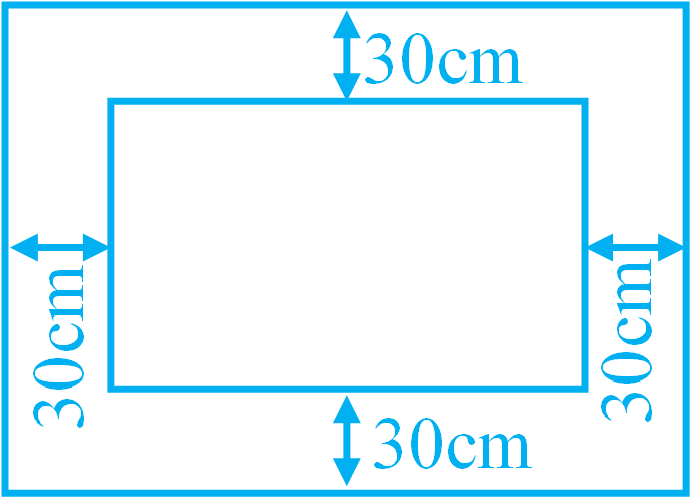
A table cover of dimensions $3\ m\ 25\ cm \times 2\ m\ 30\ cm$ is spread on a table. If $30\ cm$ of the table cover is hanging all around the table, find the area of the table cover which is hanging outside the top of the table. Also find the cost of polishing the table top at $Rs. 16$ per square metre.
AnswerTo find cost of polising the table top, we have to find its area for wich we require its length and breadth.
Given, length of cover $=3 \mathrm{~m}=25 \mathrm{~m}=3.25 \mathrm{~m}$ and breadth of cover $=2 \mathrm{~m}, 30 \mathrm{~cm}=2.30 \mathrm{~m}$
$\therefore$ Length of the table $=3.25-2 \times 0.30=2.65 \mathrm{~m}$
And breadth of the table $=2030-2 \times 0.30=1.70 \mathrm{~m}$
$\therefore$ Area of the top the table $(2.65 \times 1.70) \mathrm{m}^2$
$=1.505 \mathrm{~m}^2$
Area of the hanging table cover $=$ area of table cover $-$ Area of the top the table $=(7.475-4 . .505) \mathrm{m}^2$
$=2.97 \mathrm{~m}^2$
It is given that, the cost of polishing the table top is at the rate of $Rs. 16$ per square metre.
Therefore, cost of polishing the top $=$ area $\times$ Rate par square metre $=4.505 \times 16$
$=\text { Rs. } 7.208$ View full question & answer→Question 323 Marks
In Fig. a rectangle with perimeter $264\ cm$ is divided into five congruent rectangles. Find the perimeter of one of the rectangles.
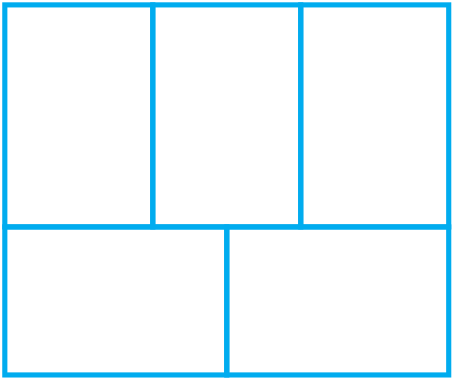
AnswerLet $l$ and $b$ be the length and breadth of each reatangle, respectively.
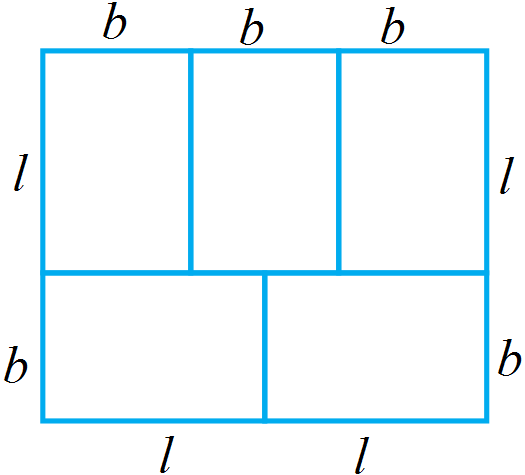
Given, perimeter of a rectangle $= 264\ cm$
According to the figure, $4l + 5b = 264$ And $2l = 3b$
Put the value of $3b$ from Eq.$(ii)$ in Eq.$(i), 2(2l) + 5b = 264$
$\Rightarrow 2 \times 3\text{b} + 5\text{b} = 264$
$\Rightarrow 6\text{b} + 5\text{b} = 264$
$\Rightarrow11\text{b}=264\Rightarrow\text{b}=\frac{264}{11}$
$\Rightarrow \text{b}= 24\text{cm}$
$\therefore\text{l}=\frac{3\text{b}}{2}=\frac{3\times24}{2}=36\text{cm}$
Hence, perimeter of the rectangle $= 2(l + b) = 2(36 + 24) =12\ cm$ View full question & answer→Question 333 Marks
Find the areas of the shaded region:
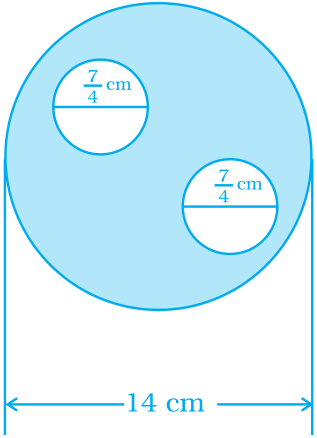
Answer$\because$ Diameter of complete circle $= 14cm$
$\therefore$ Radius $=\frac{14}{2}=7\text{cm}$
$\big[\because\text{radius}=\frac{\text{diameter}}{2}\big]$
So, area of complete circle $=\pi\text{r}^2=\frac{22}{7}\times7\times7=154\text{cm}^2$
$\because$ Diameter of small circle $=\frac{7}{4}\text{cm}$
$\therefore$ Radius $=\frac{7}{4\times2}=\frac{7}{8}\text{cm}$
$\therefore$ Area of two small circles $=2\pi\text{r}^2=2\times\frac{22}{7}\times\frac{7}{8}\times\frac{7}{8}=\frac{77}{16}\text{cm}^2$
$\therefore$ Area of shaded region $=$ Area of complete circle - Area of small circles $=154-\frac{77}{16}=\frac{154\times16-77}{16}$
$=\frac{2464-77}{16}=\frac{2387}{16}=149\frac{3}{16}\text{cm}^2$
Hence, the area of shaded region is $149\frac{3}{16}\text{cm}^2.$
View full question & answer→Question 343 Marks
circular pond is surrounded by a $2m$ wide circular path. If outer circumference of circular path is $44m,$ find the inner circumference of the circular path. Also find area of the path.
AnswerLet $R$ and $r$ be the radius outer circle and inner circle, respectively.
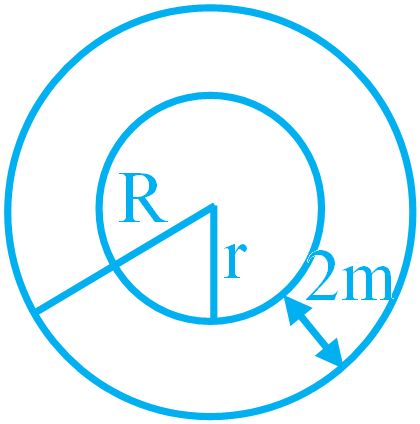
It is given that, circumference of outer circle is $44m.$
$\therefore2\pi\text{R}=44$
$ [\because$ circumference of circle of circle $=2\pi\text{r}]$
$\Rightarrow2\times\frac{44}{2\times\frac{22}{7}}=\frac{7\times44}{2\times22}=7\text{m}$
Since, $r = (R - 2)m = (7 - 2)m = 5m$
$\therefore$ Area circumference of the circlar path $2\pi\text{r}=2\times\frac{22}{7}\times5=31.43\text{m}$ (approx.)
$\because$ Area of path $=$ Area of outer circle $-$ Area of inner circle $=\pi(\text{R}^2-r^2)$
$=\frac{22}{7}(7^2 - 5^2)=\frac{22}{7}\times24=75.43\text{m}^2$ (approx.) View full question & answer→Question 353 Marks
In Fig. area of $\triangle P Q R$ is $20 \mathrm{~cm}^2$ and area of $\triangle P Q S$ is $44 \mathrm{~cm}^2$. Find the length $R S$, if $P Q$ is perpendicular to $QS$ and $QR$ is $5\ cm.$
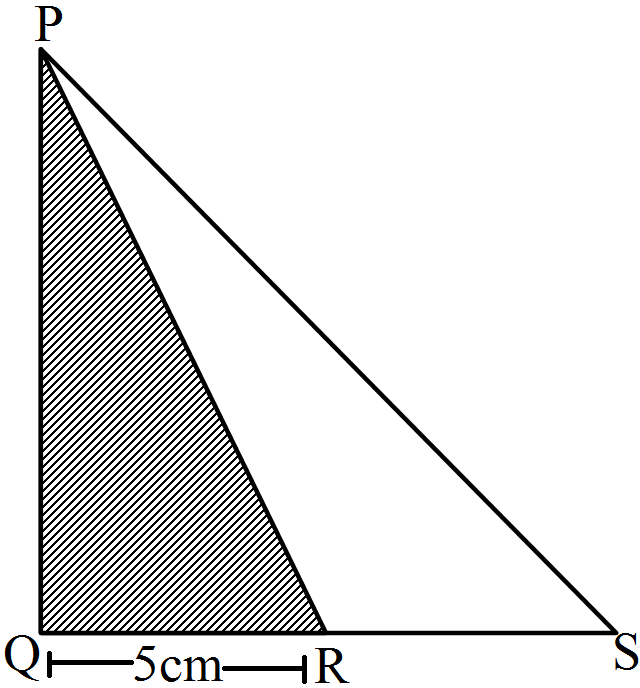
AnswerGiven, area of $\triangle\text{PQR}=20\text{cm}^2$ and of $\triangle\text{PQS}=44\text{cm}^2$
We know that,
Area of triangle $= \frac{1}{2}\times\text{Base}\times\text{Height}$
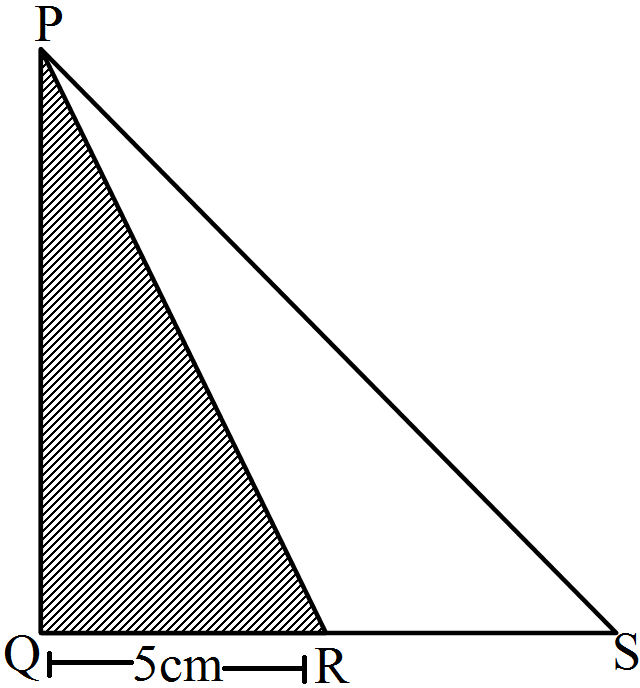
$\therefore\text{ Area of }\triangle\text{PQR}= \frac{1}{2}\times\text{PQ}\times\text{QR}$$[\because\text{PQ }\bot\text{ QR}]$
$\Rightarrow20=\frac{1}{2}\times\text{PQ}\times5$ $\Rightarrow\frac{20\times2}{5}=\text{PQ}$ $[\because\text{QR}=5\text{cm},\text{given}]$
$\Rightarrow\text{PQ}=8\text{cm}$
$\therefore\text{Area of }\triangle\text{PQS}=\frac{1}{2}\times\text{PQ}\times\text{QS}$
$\Rightarrow44=\frac{1}{2}\times8\times\text{QS}\Rightarrow\text{QS}=\frac{44\times2}{8}$$[\because\text{PQ}=8\text{cm}]$
$\Rightarrow\text{QS}=11\text{cm}$
Now, $\text{RS} = \text{QS} - \text{QR} = 11 - 5 = 6\text{cm}$ View full question & answer→Question 363 Marks
Altitudes $MN$ and $MO$ of parallelogram $MGHK$ are $8\ cm$ and $4\ cm$ long respectively Fig. One side $GH$ is $6\ cm$ long. Find the perimeter of $MGHK.$
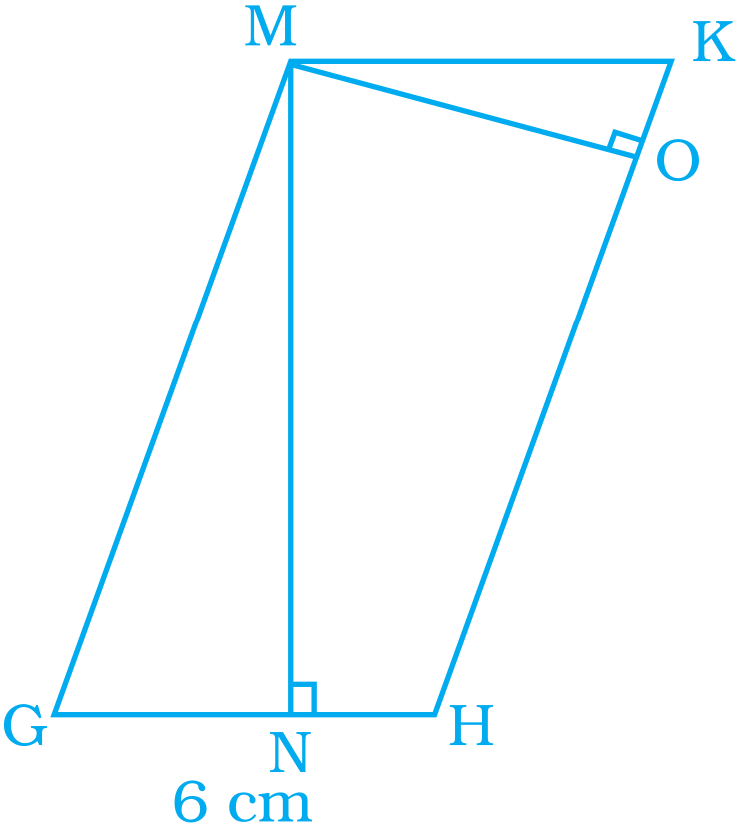
AnswerGiven, $MGHK$ is a parallelogram, where $\mathrm{MN}=8 \mathrm{~cm}, \mathrm{MO}=4 \mathrm{~cm}$ and $\mathrm{GH}=6 \mathrm{~cm}$.
$\therefore$ Area of parallelogram $MGHK,$ when base is $GH$ $[\because$ Area of parallelogram $=$ base $\times$ height $]$
$=\mathrm{GH} \times \mathrm{MN}$
$=6 \times 8 \mathrm{~cm}^2=48 \mathrm{~cm}^2 \ldots(\mathrm{i})$
Area of parallelogram $MGHK,$ when base is $HK$
$=\mathrm{HK} \times \mathrm{MO}$
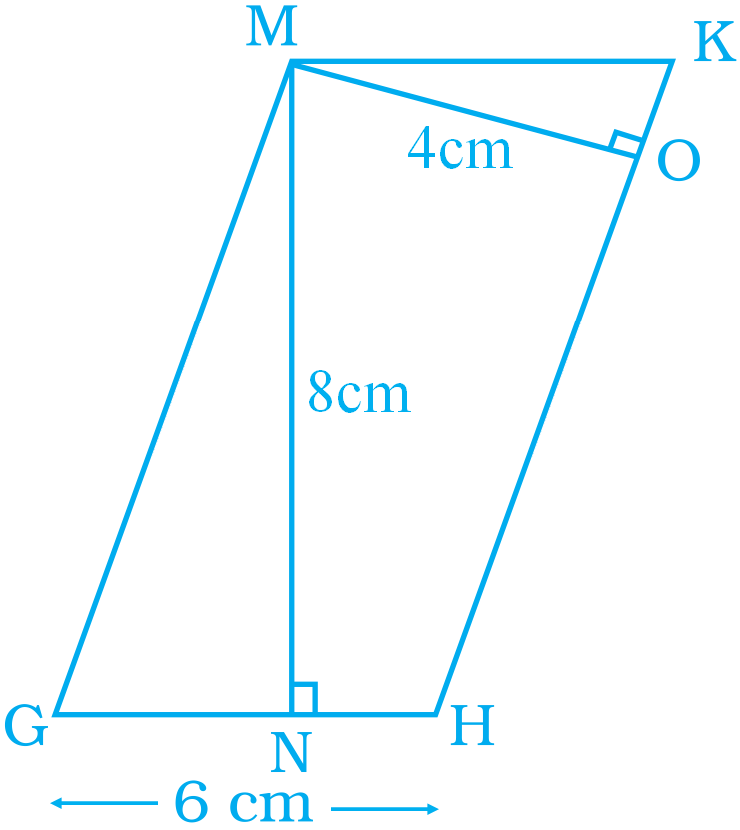
$\Rightarrow 48=\mathrm{HK} \times 4$
$\Rightarrow \mathrm{HK}=\frac{48}{4}$
$\Rightarrow \mathrm{HK}=12 \mathrm{~cm}$
In parallelogram, opposite sides are equal.
So, $G H=M K=6 \mathrm{~cm}$ and $M G=H K=12 \mathrm{~cm}$
$\therefore$ Perimeter of parallelogram MGHK $=(6+6+12+12) \mathrm{cm}=36 \mathrm{~cm}$ View full question & answer→Question 373 Marks
$ABCD$ is a parallelogram in which $AE$ is perpendicular to $CD$ Fig. Also $AC = 5\ cm, DE = 4\ cm,$ and the area of $\triangle\text{AED} = 6 \text{cm}^2.$ Find the perimeter and area of $ABCD.$
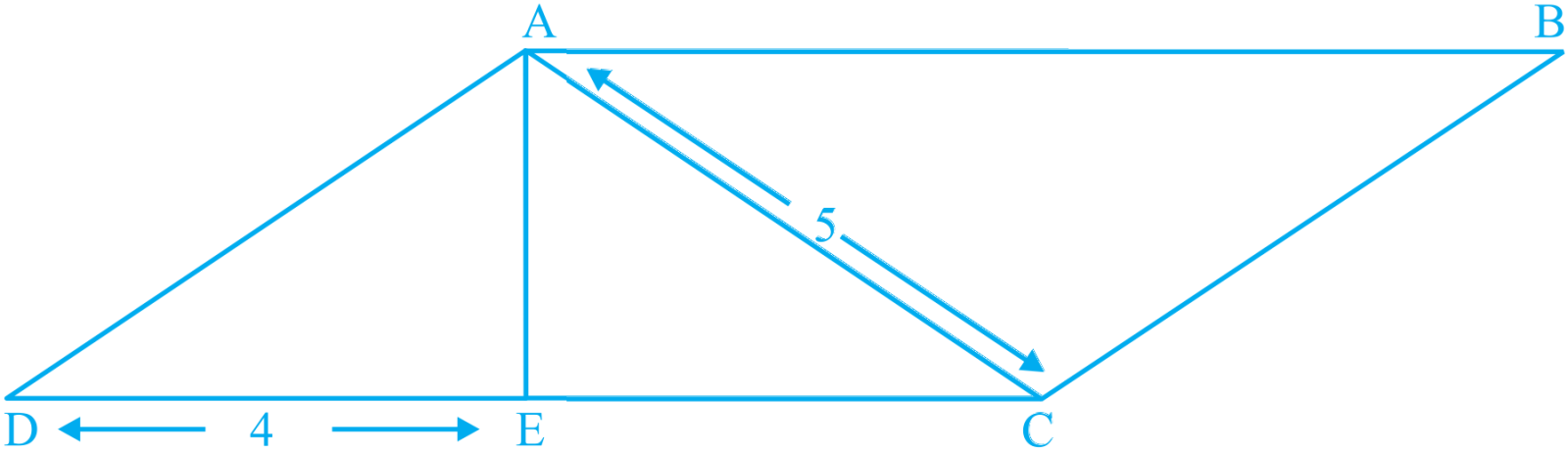
Answer$\text { Given, area of } \triangle \mathrm{AED}=6 \mathrm{~cm}^2 \text { and } \mathrm{AC}=5 \mathrm{~cm} \text { and } \mathrm{DE}=4 \mathrm{~cm}$
$\therefore \text { Area of } \triangle \mathrm{AED}=\frac{1}{2} \times \mathrm{DE} \times \mathrm{AE}[\because \text { area of triangle }=\text { base } \times \text { height }]$
$\Rightarrow \frac{1}{2} \times 4 \times \mathrm{AE}=6$
$\Rightarrow \mathrm{AE}=\frac{6 \times 2}{4}$
$\Rightarrow \mathrm{AE}=3 \mathrm{~cm}$
Now, in righta angle $\triangle \mathrm{AEC}, \mathrm{AE}=3 \mathrm{~cm}$ and $\mathrm{AC}=5 \mathrm{~cm}$
$\text { So, }(E C)^2=(A C)^2-(A E)^2 \text { [by pythagores theorem] }$
$\Rightarrow(E C)^2=5^2-3^2=25-9$
$\Rightarrow E C=\sqrt{16}$
$\Rightarrow E C=4 \mathrm{~cm}$
$\because D E+E C=D C$
$\Rightarrow D C=4+4=8 \mathrm{~cm}$
$\because \mathrm{ABCD}$ is a parallelogram.
So, $A D=B C=8 \mathrm{~cm}$
Now, in righta angled $\triangle \mathrm{AED}, \mathrm{AD}^2=\mathrm{AE}^2+\mathrm{ED}^2$ [by pythagoras theorem]
$\Rightarrow \mathrm{AD}^2=3^2+4^2=9+16$
$\Rightarrow \mathrm{AD}=\sqrt{25}$
$\Rightarrow \mathrm{AD}=5 \mathrm{~cm}$
SO, $A D=B C=5 \mathrm{~cm}[\because A B C D$ ia a paralelogram $]$
$\therefore$ perimeter of parallelogram $A B C D=2(1+b)=2(D C+A D)=2(8+5)=2 \times 13=26 \mathrm{~cm}$
Area of parallelogram $A B C D=$ Base $\times$ Height $=D C \times A E=8 \times 3=24 \mathrm{~cm}^2$
View full question & answer→