Questions · Page 1 of 3

MCQ (1 Marks)

🎯

Test yourself on this topic

50 questions · timed · auto-graded

MCQ 11 Mark
The rear view mirror of a car is a plane mirror. A driver is reversing his car at a speed of $2\ m/s.$ The driver sees in his rear view mirror the image of truck parked behind his car. The speed at which the image of the truck appears to approach the driver will be
  • A
    $1\ m/s$
  • B
    $2\ m/s$
  • $4\ m/s$
  • D
    $8\ m/s$
Answer
Correct option: C.
$4\ m/s$
$4\ m/s$The speed of the car is $2\ m/s$ which means the car is approaching the truck with a speed of $2\ m$ per second. The distance between the car and truck will decrease at a double rate. This is because the image of the truck will travel a distance twice the distance travelled by the car in equal time. Hence, the image of the truck will appear to approach the driver with the speed of $2 \times 2 = 4\ m/s$
View full question & answer
MCQ 21 Mark
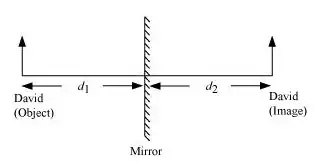
David is observing his image in a plane mirror. The distance between the mirror and his image is $4 m.$ If he moves $1 m$ towards the mirror, then the distance between David and his image will be.
  • A
    $3 m$
  • B
    $5 m$
  • $6 m$
  • D
    $8 m$
Answer
Correct option: C.
$6 m$
$6$ mIn the case of a plane mirror, the distance between the object and the mirror $(d_1)$ is same as the distance between the image and the mirror $(d_2).$
Image
Given,
Distance between the mirror and David’s image, $d_2 = 4 m$
Therefore, $d_1 = d_2 = 4 m$
If David moves $1 m$ towards the mirror, then $d_1 = 4 − 1 = 3 m$
Again, $d_1 = d_2 = 3 m$
$\therefore$, the distance between David and his image is $d_1 + d_2 = 3 + 3 = 6 m$
View full question & answer
MCQ 31 Mark
A virtual image larger than the object can be produced by a
  • A
    concave lens
  • concave mirror
  • C
    convex mirror
  • D
    plane mirror
Answer
Correct option: B.
concave mirror
Concave mirror can form virtual and magnified image of the object.

Concave lens and convex mirror forms virtual but diminished image of the object. Plane mirror forms virtual and same size image of the object.

View full question & answer
MCQ 41 Mark
Nature of the image formed by a plane mirror is:
  • A
    Virtual and erect
  • B
    Of the same size as the object
  • C
    Laterally inverted
  • All of these
Answer
Correct option: D.
All of these
Image formed by a plane mirror is always virtual, laterally inverted, and erect.
It has always a magnification of unity and hence, the image is of the same size that of object.
View full question & answer
MCQ 51 Mark
What will be the condition of image when you stand in front of a plane flat mirror and look at yourself and you raise your right hand?
  • A
    Erect and enlarged
  • B
    Erect and reduced
  • Erect and reversed
  • D
    Inverted and reversed
Answer
Correct option: C.
Erect and reversed
The image formed will be an erect image of same height as that of the person $($object$)$ but laterally reversed $i.e.$
his right hand will appear to be his left hand of his mirror image and vice $-$ versa.
View full question & answer
MCQ 61 Mark
What are the components of sunlight:
  • A
    Violet, red, yellow, white, magenta, purple, silver.
  • Violet, indigo, blue, green, yellow, orange, red.
  • C
    Red, yellow, black, orange, silver, violet, blue.
  • D
    Can't be determined.
Answer
Correct option: B.
Violet, indigo, blue, green, yellow, orange, red.

Sunlight is reffered as white light.It consist of seven colours,i.e $VIBGYOR.$

View full question & answer
MCQ 71 Mark
If the object is shifted by a distance towards the mirror, the image will shift by $........$ towards the mirror.
  • A
    Double the distance
  • Same distance
  • C
    Half the distance
  • D
    None of these
Answer
Correct option: B.
Same distance
If the object is shifted by a distance towards the mirror, the image will shift by the same distance towards the mirror.
View full question & answer
MCQ 81 Mark
Which of the following most appropriately defines a spectrum?
  • The band of seven colours is known as spectrum.
  • B
    The process of splitting of white light into seven colours is known as spectrum.
  • C
    The different wavelengths of light are termed as spectrum.
  • D
    All of the above.
Answer
Correct option: A.
The band of seven colours is known as spectrum.

Visible range consists of seven different colours i.e, $VIBGYOR.$
The band of these seven colours is known as spectrum.

View full question & answer
MCQ 91 Mark
Splitting of white light into seven colours is called:
  • A
    Reflection of light.
  • B
    Rectilinear propagation of light.
  • C
    Lateral inversion.
  • Dispersion.
Answer
Correct option: D.
Dispersion.
Dispersion.
View full question & answer
MCQ 101 Mark
The object in which seven colours spread over it appears to be white in colour when rotated is Called:
  • A
    Galileo's disc.
  • Newton's disc.
  • C
    Rutherford's disc.
  • D
    Faraday's disc.
Answer
Correct option: B.
Newton's disc.
Newton's disc.
View full question & answer
MCQ 111 Mark
You are provided with a concave mirror, a convex mirror, a concave lens and a convex lens. To obtain an enlarged image of an object you can use either:
  • A
    Concave mirror or convex mirror.
  • Concave mirror or convex lens.
  • C
    Concave mirror or concave lens.
  • D
    Concave lens or convex lens.
Answer
Correct option: B.
Concave mirror or convex lens.
Concave mirror and convex lens can only form enlarged image of an object. As convex mirror and concave lens always form a diminished image of an object.
View full question & answer
MCQ 121 Mark
The image which can be obtained on a screen is called:
  • A
    A virtual image.
  • A real image.
  • C
    Either a real or a virtual image.
  • D
    Neither a real nor a virtual image.
Answer
Correct option: B.
A real image.
The image which can be obtained on a screen is called a real image.
View full question & answer
MCQ 131 Mark
If reflecting surface is convex, then it is a:
  • Concave mirror
  • B
    Erect
  • C
    Virtual
  • D
    Convex mirror
Answer
Correct option: A.
Concave mirror
If reflecting surface is convex, then it is a convex mirror.
View full question & answer
MCQ 141 Mark
The image formed by a plane mirror is called:
  • Virtual
  • B
    Real
  • C
    Erect
  • D
    Concave
Answer
Correct option: A.
Virtual
An image formed by a plane mirror is virtual.
View full question & answer
MCQ 151 Mark
The phenomenon that leads to the bouncing back of light rays is called-
  • A
    Diffraction
  • Reflection
  • C
    Dispersion
  • D
    Refraction
Answer
Correct option: B.
Reflection
Diffraction is the phenomenon of bending of light waves around the corners of an obstacle or aperture, placed in the path of light beam.
Reflection is the phenomenon in which light rays on striking a polished surface(such as a mirror) bounce back or are sent back into the same medium.
Dispersion is the phenomenon of splitting of white light into its component colours $(VIBGYOR)$ on passing through a glass prism.
Refraction of light is the phenomenon of bending of light or change in the direction of light, when it passes obliquely from one transparent medium to another.
View full question & answer
MCQ 161 Mark
The image of a real object in a plane mirror is always:
  • A
    Virtual
  • B
    Erect
  • C
    Laterally inverted with respect to the object
  • All of these
Answer
Correct option: D.
All of these
It should be remembered that plane mirror always forms virtual, erect and laterally inverted image.
The image distance and object distance are equal from the plane mirror.
The shape and size of the image is same as the object.
View full question & answer
MCQ 171 Mark
Which of the following would you prefer to use while reading small letters found in a dictionary?
  • A convex lens.
  • B
    A convex mirror.
  • C
    A concave lens.
  • D
    Either $(a)$ or $(b).$
Answer
Correct option: A.
A convex lens.
A convex lens.
View full question & answer
MCQ 181 Mark
My image is erect and is of the same size. What type of mirror I am looking at?
  • A
    Concave mirror.
  • B
    Convex Mirror.
  • Plane Mirror.
  • D
    All of these.
Answer
Correct option: C.
Plane Mirror.
Plane Mirror.
View full question & answer
MCQ 191 Mark
No matter how far you stand from a mirror, your image always appears erect. The mirror is likely to be:
  • Plane
  • B
    Concave
  • C
    Both $A$ and $B$
  • D
    None
Answer
Correct option: A.
Plane

Plane Mirrors always produce a virtual and erect image having the same size as that of the object irrespective of the position of object.
Concave mirrors produce real and virtual, erect and inverted, diminished, same - sized and magnified image depending upon the position of the object on the principal axis.
But the concave mirror forms a virtual, erect and enlarged image only when the object is placed between the Focus and the pole of the mirror.

View full question & answer
MCQ 201 Mark
Image formed by a plane mirror is:
  • A
    Virtual, behind the mirror and enlarged.
  • Virtual, behind the mirror and of the same size as the object.
  • C
    Real at the surface of the mirror and enlarged.
  • D
    Real, behind the mirror and of the same size as the object.
Answer
Correct option: B.
Virtual, behind the mirror and of the same size as the object.
The image formed by a plane mirror is always virtual $($meaning that the light rays do not actually come from the image$),$ upright, and of the same shape and size as the object it is reflecting.
A virtual image is a copy of an object formed at the location from which the light rays appear to come.
To summarize, the image formed by plane mirrors are,
  1. Virtual
  2. Behind the mirror
  3. Erect $($means not inverted$)$
  4. Same size as the object
  5. At same distance from the mirror as the object is from the mirror.
View full question & answer
MCQ 211 Mark
When the reflecting or refracting rays do not actually intersect but appear to intersect when produced backwards,
  • A
    A real image is formed.
  • A virtual image is formed.
  • C
    Either a real or a virtual image is formed.
  • D
    Neither a real nor a virtual image is formed.
Answer
Correct option: B.
A virtual image is formed.
A virtual image is formed when the refracting or reflecting rays do not actually intersect but appear to intersect when they are produced backwards.
View full question & answer
MCQ 221 Mark
A real image is formed by:
  • Actual intersection of the refracting or reflecting rays.
  • B
    Imaginary intersection of the refracting or reflecting rays produced backwards.
  • C
    Either actual or imaginary intersection of the reflecting or refracting rays.
  • D
    Neither actual nor imaginary intersection of the reflecting or refracting rays.
Answer
Correct option: A.
Actual intersection of the refracting or reflecting rays.
When the refracting or reflecting rays actually intersect, rather than pretending to be meeting at a point, a real image is formed.
A real image hence can be obtained on a screen.
View full question & answer
MCQ 231 Mark
When is the real image formed?
  • A
    When the rays of light after reflection or refraction actually go away from some point.
  • When the rays of light after reflection or refraction actually meet at some point.
  • C
    When the sun rays after reflection or refraction actually meet at some point.
  • D
    When the rays of light after deflection actually meet at some point.
Answer
Correct option: B.
When the rays of light after reflection or refraction actually meet at some point.
Real image formed when the rays of light after reflection or refraction actually converge at some point and when objects are placed outside the focal length of a converging lens or outside the focal length of a converging mirror.
View full question & answer
MCQ 241 Mark
Image of objects spread over a large area form in:
  • Concave mirror
  • B
    Virtual mirror
  • C
    Spherical mirror
  • D
    Convex miri’or
Answer
Correct option: A.
Concave mirror
Image of objects spread over a large area form in convex mirror.
View full question & answer
MCQ 251 Mark
An image formed on a screen is called:
  • Virtual image
  • B
    Concave image
  • C
    Real image
  • D
    Convex image
Answer
Correct option: A.
Virtual image
An image formed on a screen is called real image.
View full question & answer
MCQ 261 Mark
An image formed by a lens is erect. Such an image could be formed by a:
  • A
    Convex lens provided the image is smaller than object.
  • Concave lens provided the image is smaller than object.
  • C
    Concave lens provided the image is larger than object.
  • D
    Concave lens provided the image is of the same size.
Answer
Correct option: B.
Concave lens provided the image is smaller than object.
A concave lens can only form virtual, erect and diminished image of an object. As virtual and erect image formed by a convex lens is always magnified.
View full question & answer
MCQ 271 Mark
When the Newton's disc is rotated what happens:
  • A
    The colours fade to white
  • The colours fade to black
  • C
    Rutherford’s disc
  • D
    Faraday’s disc
Answer
Correct option: B.
The colours fade to black
Concave mirror or convex lens.
Enlarged images are formed by only concave mirror or convex lens.
View full question & answer
MCQ 281 Mark
Choose the correct option in questions?
The rear view mirror of a car is a plane mirror. A driver is reversing his car at a speed of $2\ m/s.$ The driver sees in his rear view mirror the image of a truck parked behind his car. The speed at which the image of the truck appears to approach the driver will be.
  • A
    $1\ m/s.$
  • B
    $2\ m/s.$
  • $4\ m/s.$
  • D
    $8\ m/s.$
Answer
Correct option: C.
$4\ m/s.$
The speed of the car is$ 2\ m/s$ which means the car is approaching the truck with a speed of $2m$ per second. The distance between the car and truck will decrease at a double rate. This is because the image of the truck will travel a distance twice the distance travelled by the car in equal time. Hence, the image of the truck will appear to approach the driver with the speed of $2 \times 2 = 4\ m/s.$
View full question & answer
MCQ 291 Mark
The image formed by a concave lens is always virtual, erect and:
  • Bigger in size
  • B
    Smaller in size
  • C
    Medium in size
  • D
    All of these
Answer
Correct option: A.
Bigger in size
The image formed by a concave lens is always virtual, erect and small in size.
View full question & answer
MCQ 301 Mark
Primary colours of light are:
  • A
    Red, yellow, blue.
  • B
    Blue, orange, green.
  • Red, blue, green.
  • D
    All colours.
Answer
Correct option: C.
Red, blue, green.
Red, blue and green are known as the three primary colours.
Those are often regarded as basic colours in nature.
By mixing these colours in different proportions, all other colours may be obtained.
View full question & answer
MCQ 311 Mark
Choose the correct option in questions? A virtual image larger than the object can be produced by a:
  • A
    Concave lens.
  • Concave mirror.
  • C
    Convex mirror.
  • D
    Plane mirror.
Answer
Correct option: B.
Concave mirror.
Concave mirror can form virtual and magnified image of the object.
Concave lens and convex mirror forms virtual but diminished image of the object. Plane mirror forms virtual and same size image of the object.
View full question & answer
MCQ 321 Mark
A plane mirror gives a real image when the incident beam is:
  • A
    Wide
  • B
    Narrow
  • Convergent
  • D
    Divergent
Answer
Correct option: C.
Convergent
A plane mirror can produce a real image if and only if the incident rays are convergent in nature.
View full question & answer
MCQ 331 Mark
Which of the following can be used to form a real image?
  • Only concave mirror.
  • B
    Only plane mirror.
  • C
    Only convex mirror.
  • D
    Both concave and convex mirrors.
Answer
Correct option: A.
Only concave mirror.
View full question & answer
MCQ 341 Mark
The silvering on the back surface of a mirror can be done by:
  • A
    Silver
  • B
    Mercury
  • None
  • D
    All kind of shiny materials.
Answer
Correct option: C.
None
A plane mirror is made from a few mm thick glass plate.
one surface of glass plate is polished to a high degree of smoothness which forms the front part of the mirror and the other $($back$)$ surface is silvered $(I.e.$ painted with silver,mercury or some other material$.)$
View full question & answer
MCQ 351 Mark
When a beam of light from an object actually meets at a point after reflection from a mirror then the image formed is known as:
  • A
    Either real or virtual image
  • Real image
  • C
    Virtual image
  • D
    Neither real nor virtual image
Answer
Correct option: B.
Real image
According to definition,when a beam of light from an object meets actually at a point after reflection from a mirror then the image formed is real.
Real images can be obtained on a screen.
View full question & answer
MCQ 361 Mark
Which of the following always diverge light rays?
  • A
    Convex mirror and plane mirror.
  • Concave lens and convex mirror.
  • C
    Concave mirror and convex lens.
  • D
    Concave lens and convex mirror.
Answer
Correct option: B.
Concave lens and convex mirror.
View full question & answer
MCQ 371 Mark
An object is kept at $60\ cm$ in front of a plane mirror. If the mirror is now moved $25\ cm$ away from the object, how is the image shifted from its previous position$?$
  • A
    $25\ cm$ away
  • B
    $25\ cm$ towards
  • $50\ cm$ away
  • D
    $50\ cm$ towards
Answer
Correct option: C.
$50\ cm$ away
In this case, the mirror is moved $25\ cm$ away from its initial position.
Therefore, if the mirror is moved with distance $x,$ then image in the mirror will move by distance $2x.$
That is, $2x = 50\ cm.$
So, the image will shift by $50\ cm$ away from its previous position.
View full question & answer
MCQ 381 Mark
Lens are widely used in:
  • Spectacles
  • B
    Telescopes
  • C
    Microscope
  • D
    All of these
Answer
Correct option: A.
Spectacles
Lens are widely used in spectacles, telescopes and microscopes.
View full question & answer
MCQ 391 Mark
You are provided with a concave mirror, a convex mirror, a concave lens and a convex lens. To obtain an enlarged image of an object, you can use either:
  • A
    Concave mirror or convex mirror.
  • Concave mirror or convex lens.
  • C
    Concave mirror or concave lens.
  • D
    Concave lens or convex lens.
Answer
Correct option: B.
Concave mirror or convex lens.
View full question & answer
MCQ 401 Mark
A spherical mirror is a part of:
  • Sphere
  • B
    Rectangle
  • C
    Circle
  • D
    Square
Answer
Correct option: A.
Sphere
Spherical mirror is a part of sphere.
View full question & answer
MCQ 411 Mark
Sunlight is made up of ____ colors.
  • $7$
  • B
    $6$
  • C
    $5$
  • D
    $4$
Answer
Correct option: A.
$7$

Isaac Newton was the first person to split sunlight into seven colors using a glass prism.
When he tried to split the band of colors further using a second prism placed in the inverted position as compared to that of the first, he observed that the emergent ray was white colored.
This gave him an idea that sunlight is made up of $7$ colors and any other light that gives a spectrum similar to that of sunlight is often referred to as white light.

View full question & answer
MCQ 421 Mark
The path of the light is:
  • Always a straight line.
  • B
    A curved line.
  • C
    A zig $-$ zag line.
  • D
    Depends on the medium.
Answer
Correct option: A.
Always a straight line.
The path of light is always a straight line.
About pathway of light the rectilinear propagation of light is the process of light traveling in a straight line without encountering any obstacles.
View full question & answer
MCQ 431 Mark
Image formed is same as the object in which of the following mirror:
  • Plane
  • B
    Convex
  • C
    Concave
  • D
    Spherical
Answer
Correct option: A.
Plane
Image formed is same as the object is in plane mirror.
View full question & answer
MCQ 441 Mark
Type of mirror that is used as a rear view mirror in case of vehicles is:
  • A
    Concave mirror.
  • Convex mirror.
  • C
    Plane mirror.
  • D
    None of these.
Answer
Correct option: B.
Convex mirror.
Convex mirror.
View full question & answer
MCQ 451 Mark
Boojho and Paheli were given one mirror each by their teacher. Boojho found his image to be erect and of the same size whereas Paheli found her image erect and smaller in size. This means that the mirrors of Boojho and Paheli are, respectively:
  • A
    Plane mirror and concave mirror.
  • B
    Concave mirror and convex mirror.
  • Plane mirror and convex mirror.
  • D
    Convex mirror and plane mirror.
Answer
Correct option: C.
Plane mirror and convex mirror.
As in case of plane mirror, image formed is virtual, erect and of same size and in case of convex mirror, image is virtual, erect and smaller in size.
View full question & answer
MCQ 461 Mark
A virtual image larger than the object can be produced by a:
  • A
    Plane Mirror.
  • Concave mirror.
  • C
    Convex mirror.
  • D
    All of the above.
Answer
Correct option: B.
Concave mirror.
Concave mirror.
View full question & answer
MCQ 471 Mark
The image of a real object in a plane mirror is always:
  • A
    Virtual
  • B
    Erect
  • C
    Laterally inverted with respect to the object
  • All of these
Answer
Correct option: D.
All of these
It should be remembered that plane mirror always forms virtual, erect and laterally inverted image.
The image distance and object distance are equal from the plane mirror.
The shape and size of the image is same as the object.
View full question & answer
MCQ 481 Mark
Rainbow has:
  • Five colours
  • B
    Seventeen colours
  • C
    Six colours
  • D
    Seven colours
Answer
Correct option: A.
Five colours
Rainbow has seven colours.
View full question & answer
MCQ 491 Mark
A refracting telescope uses a concave and $a.$
  • A
    Concave mirror.
  • B
    Convex lens.
  • Both $a$ and $c.$
  • D
    Convex mirror.
Answer
Correct option: C.
Both $a$ and $c.$
Both $a$ and $c.$
View full question & answer
MCQ 501 Mark
Latha is observing her image in a plane mirror. The distance between the mirror and her image is $6m.$ If she moves $2m$ towards the mirror, then the distance between Latha and her image will be:
  • $8m.$
  • B
    $4m.$
  • C
    $10m.$
  • D
    $5m.$
Answer
Correct option: A.
$8m.$
$8m.$
View full question & answer
MCQ (1 Marks) - Science STD 7 Questions - Vidyadip