Questions

3 Marks Question

🎯

Test yourself on this topic

24 questions · timed · auto-graded

Question 13 Marks
Is it a good practice to remove grass and small plants that are growing in an open, unused field? Give reason to support your answer.
Answer
No, it is not a good practice to remove grass and small plants growing in an open, unused field because the plants cover the soil surface. Their roots bind the soil particles, holding and adhering them in place. It helps in preventing the topsoil from being washed off during heavy rain, floods and winds. In this way, soil erosion is prevented and top soil layer is preserved for growing more plants.
View full question & answer
Question 23 Marks
How is clayey soil useful for crops?
Answer
Due to the very small size of the particles of clayey soil, particles are packed tightly and therefore can retain water. Clayey soil is also rich in organic matter. For growing crops such as wheat, gram, and paddy, the soil that is good at retaining water and rich in organic matter is suitable. Therefore, clayey soils having these characteristics are useful for such kind of crops.
View full question & answer
Question 33 Marks
Describe the different type of soil.
Answer
There are three different types of soil:
  1. Sandy soil containing sand particles in them.
  2. Clayey soil contains clay particles with small amount of humus in it. It is a fertile soil.
  3. Loamy soil is a mixture of sand, clay silt and humus. It is a fertile soil.
View full question & answer
Question 43 Marks
A man digging a pit found that he could dig with ease initially but digging became difficult as he went deeper. He could not dig beyond a depth of $5$ feet. Provide a suitable scientific explanation.
Answer
The man digging a pit could dig with ease initially because of the presence of topsoil and subsoil (mainly comprising cl humus and nutrients). But as he digs deeper, he finds it difficult to dig beyond a depth of $5$ feet as lower layers are made up of small partially weathered rocks with cracks, crevices and with bedrock which make it hard to dig.
View full question & answer
Question 53 Marks
Explain how soil is formed.
Answer
Soil is formed through the process of weathering. Weathering is a process of physical breakdown and chemical decomposition of rocks and minerals near or at the surface of the earth. This physical and chemical decomposition is primarily done by wind, water, and climate. As a result of these processes, large rock pieces are converted into smaller pieces and eventually to soil.
View full question & answer
Question 73 Marks
Classify soil on the basis of the proportion of particles of various sizes.
Answer
  • If soil contains greater proportion of big particles it is called sandy soil.
  • If the proportion of fine particles is relatively higher, then it is called clayey soil.
  • If the amount of large and fine particles is about the same, then the soil is called loamy.
Thus, the soil can be classified as sandy, clayey and loamy.
View full question & answer
Question 83 Marks
Why is soil erosion relatively less in dense forests as compared to barren, open fields?
Answer
In dense forests, the tree cover (canopy) prevents rainwater from, directly falling on the ground/soil. Also, the roots of vegetation bind the soil particles and hold them together. As a result, soil erosion is minimised. But in barren open fields, the soil is exposed to the failing rain. The soil particles become loose due to the impact of raindrops and the flow of water carries them away. The flowing water further erodes the soil surface aggravating erosion.
View full question & answer
Question 93 Marks
During a field trip, some students visited an agricultural farm and saw a few birds eating earthworms. They enjoyed the scene and then they also started picking and killing the earthworms for pleasure. Seeing the crowd of students in a corner, the teacher rushed to them to see the matter and objected to their action. Anshul, one of the student asked the reason. Teacher smiled and explained him that an earthworm living in the soil is very beneficial for farmers. Anshul wondered whether there were other organisms also in the soil. The teacher appreciated him and explained.
  1. Mention the importance of earthworm.
  2. List some organisms living in soil.
  3. What are the values shown by Anshul?
Answer
  1. An earthworm helps in making the rich humus in soil.
  2. Ant, earthworm, termites, milipede, centipede, etc.
  3. Curiosity to learn and scientific attitude.
View full question & answer
Question 103 Marks
Explain how soil pollution and soil erosion could be prevented.
Answer
Prevention of soil pollution: The persistent build-up of toxic compounds in the soil is defined as soil pollution. To prevent soil pollution, its causes must be controlled.
  • Plastics and polythene bags destroy the fertility of soil. Hence, they should be disposed properly and if possible, their use should be avoided.
  • Some waste products from industries and homes pollute soil. These pollutants should be treated chemically to make them harmless before they are disposed.
  • Other pollutants of soil include pesticides and insecticides. Therefore, excessive use of these substances should be avoided.
Prevention of soil erosion: Removal of the upper fertile layer of the soil (top soil) by strong wind and flowing water is known as soil erosion. Roots of plants bind the soil firmly and prevent soil erosion. Absence of plants leads to soil erosion. Therefore, soil erosion can be prevented by planting trees and checking indiscriminate cutting of trees.
View full question & answer
Question 113 Marks
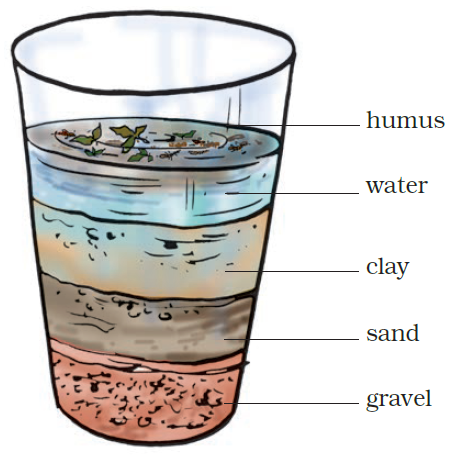
Observe the following figure and answer the following Questions.
  1. Which is the heaviest rock material?
  2. Which is the lightest soil component?
  3. Why different layers of soil component are formed?
Answer
  1. Gravel is the heaviest rock material.
  2. Humus is the lightest soil component which floats on the water surface.
  3. The soil component forms various layer one above the other according to the size of soil particle.
View full question & answer
Question 123 Marks
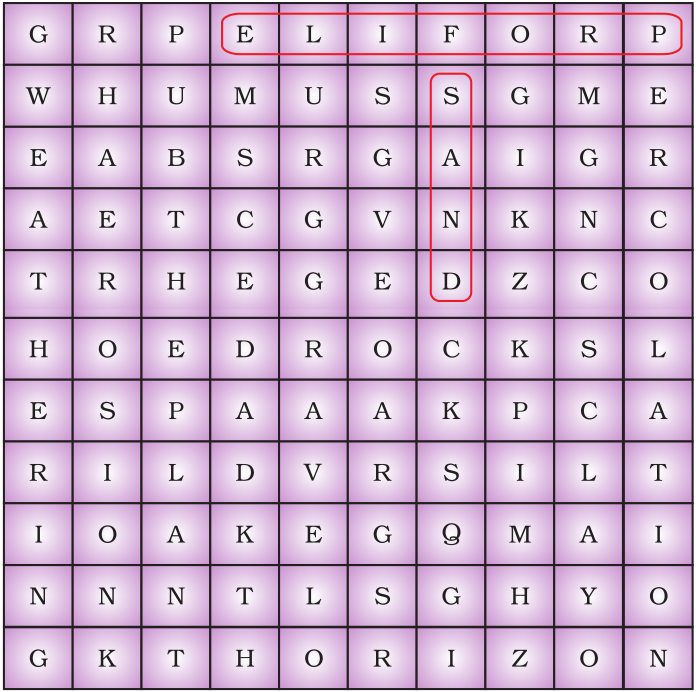
Several terms related to soil are hidden in the squares given as Figure Spot them and make a list. Two examples are given for you.

View full question & answer
Question 133 Marks
Soil erosion does not occur easily where the land is covered by vegetation. Do you agree? Explain.
Answer
Yes, soil erosion does not occur easily where the land is covered by vegetation (trees and other plants). It occurs easily in those areas of land which are not covered by vegetation (trees and other plants) or have very little vegetation. If there is vegetation on land,
  • Then the roots of vegetation growing in the soil bind the particles of topsoil firmly. Due to this, the blowing wind and flowing rainwater are not able to carry away topsoil and hence soil erosion does not occur.
  • Then much of the falling rain hits the trees and plants before it hits the soil. In this way, the cover of vegetation softens the effect of heavy rains on the soil.
View full question & answer
Question 143 Marks
Continuously water-logged soils are disadvantageous for plant growth. Why?
Answer
Roots although underground possesses living cells that require oxygen for respiration and production of energy. They absorb oxygen that is present in the spaces between soil particles. But in water-logged soils, water occupies spaces between soil particles and pushes the oxygen out into the atmosphere. Thus, roots are deprived of oxygen and this affects the plant growth.
View full question & answer
Question 153 Marks
The raw and baked soil differs from each other. How they are different? How can you prepare matkas from soil?
Answer
Raw soil differs from baked soil. The raw soil is white or dull blackish coloured soil. It contains water and air in it and can be moulded. Baked soil is the heated raw soil which lost its water molecule due to heating and becomes red. Once the soil gets heated, it cannot be moulded into other form. Clay soil is used for making matkas, toys, pots, etc. The soil is kneaded along with horse dung to make best quality of raw clay soil. This kneaded soil is then placed on the wheel and appropriate shape is given. The final shape of the material is given with hands. The pots and matkas are then kept for drying for three days. These items are baked at high temperature after drying in air and then coloured.
View full question & answer
Question 163 Marks
Soil particles size is an important factor to determine the property of soil. Explain?
Answer
Different particles of soil have different sizes which affect its properties like:
  • Sand particles are quite large and having large spaces between them. These spaces are filled with air. Water can drain quickly through these spaces. So, sandy soils tend to be light, well aerated and rather dry.
  • Clay particles, being much smaller, pack tightly together, leaving little space for air. So, clay soils have little air. But they are heavy as they hold more water than the sandy soils.
  • Loamy soil is a mixture of sand, clay and another type of soil particle known as silt. The size of the silt particles is between those of sand and clay. The loamy soil also has humus in it. It has the good water holding capacity for the growth of plants.
View full question & answer
Question 173 Marks
How can you calculate the absorption of water by soil?
Answer
The absorption of water by soil can be calculated by Percentage of water absorbed
$=\frac{(\text{U}-\text{V})\text{mL}}{\text{weight of soil}}\times100$
where $UmL$ = Initial Volume of water in the measuring cylinder
$V$ $mL$ = Final volume of water in the measuring cylinder.
View full question & answer
Question 183 Marks
  1. Soil has various important component. Write them.
  2. Arrange the following rock particles which occur in soil in the increasing order. Silt, clay, gravel, sand.
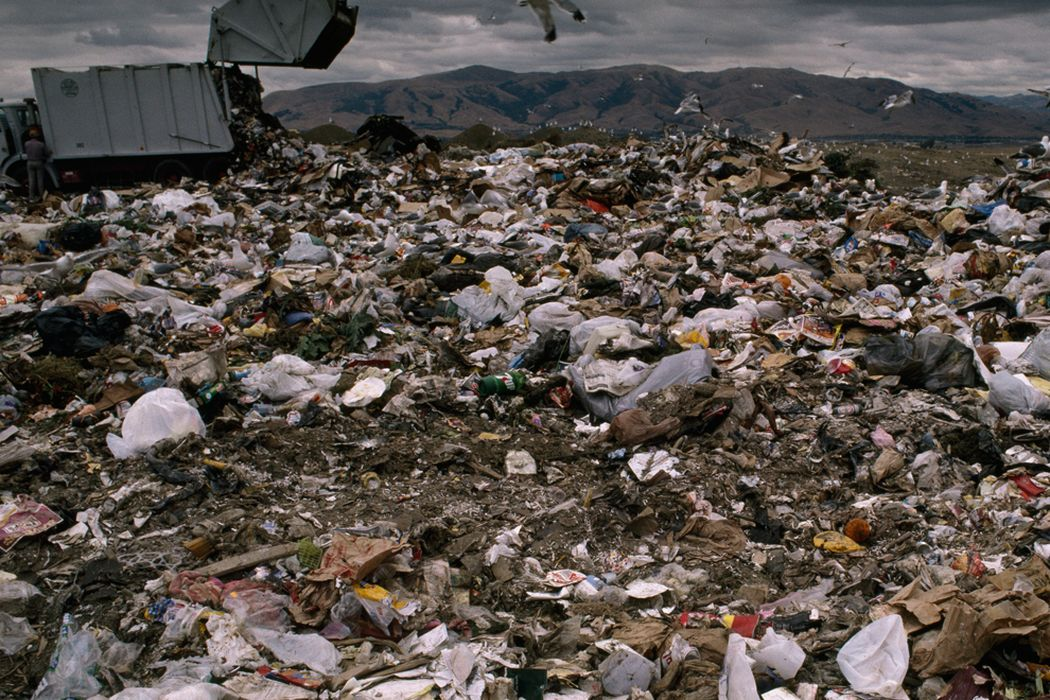
  3. Observe the following figure. What does this figure show?
Answer
  1. The various important component of soil are air, water, rock particles, minerals, humus and living organisms like bacteria, fungi, worms (earthworm), rodents, insects (ant and beetle), etc.
  2. The increasing order of rock particles are,
Clay → Silt → Sand → Gravel
  1. The figure shows waste material like polythene bags, plastics, glass and metal objects are dumped which causes soil pollution.
View full question & answer
Question 193 Marks
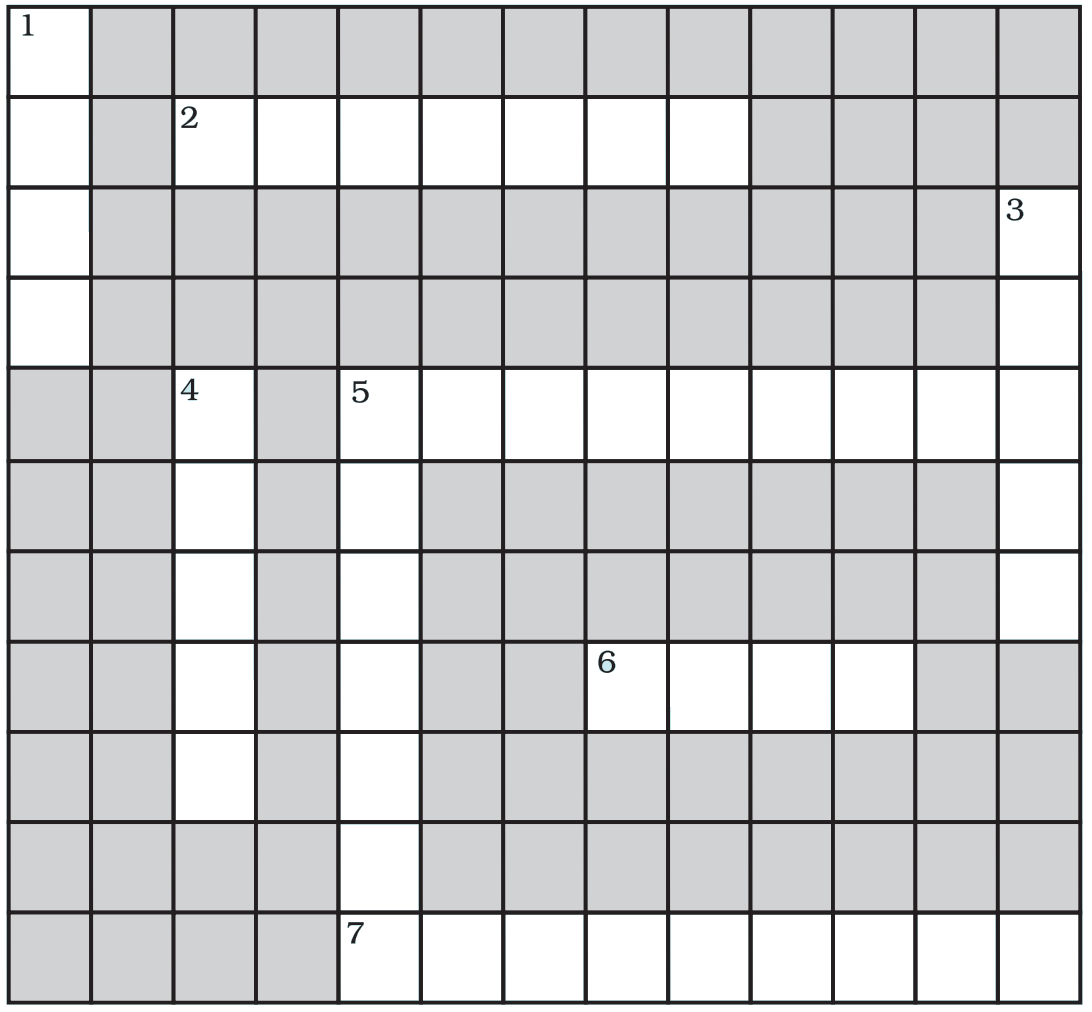
Solve the following crossword puzzle with the clues given:

Across:
  1. Plantation prevents it.
  1. Use should be banned to avoid soil pollution.
  2. Type of soil used for making pottery.
  3. Living organism in the soil.
Down:
  1. In desert soil erosion occurs through.
  1. Clay and loam are suitable for cereals like.
  2. This type of soil can hold very little water.
  3. Collective name for layers of soil.
View full question & answer
Question 203 Marks
During the summer vacations, Gaurav visited his native village. He observed that farmers were using pesticides in their field. He contacted the village head and explained him the effects of such substances in causing soil pollution. Next day, the village head called a meeting of all the villagers and convinced the villagers not to use chemicals and pesticides.
  1. Why is there a ban to demand the polythene bags and plastics.
  2. List some substances which pollute the soil.
  3. What are the values shown by Gaurav?
Answer
  1. It is because these substances pollute the soil. They also kill the organisms living in the soil.
  2. Substances which pollute the soil are a number of waste products, chemicals, pesticides, polythene bags and plastics.
  3. Alertness, responsibility and ecofriendly nature.
View full question & answer
Question 213 Marks
Define.
  1. Loamy soil.
  2. Sandy soil.
Answer
  1. Loamy soil is a mixture of sand, clay and another type of soil particle known as silt. The size of the silt particles is between those of sand and clay. The loamy soil also has humus in it. It has the good water holding capacity for the growth of plants.
  2. If soil contains greater proportion of big particles it is called sandy soil.in sandy soil Sand particles are quite large and having large spaces between them. These spaces are filled with air. Water can drain quickly through these spaces. So, sandy soils tend to be light, well aerated and rather dry.
View full question & answer
Question 223 Marks
Write the difference between rate of percolation and the amount of water retained.
Answer
Percolation property of any material is linked to its porosity. Different soils have different porosity. Therefore, water percolates differently through different soil. Percolation rate of water in the soil $=\frac{\text{Volume of water percolated}}{\text{Time taken for percolation}}$ Whereas water retaining capacity of a soil is described in terms of the amount of water absorbed by a particular type of soil. High water retaining capacity means higer water absorption.
View full question & answer
Question 233 Marks
A soil sample was taken from an agricultural land and was weighed. The mass of the soil was found to be $50g$. $100\ mL$ of water was taken in a measuring cylinder and added into the soil sample. The soil absorbed $80\ mL$ of water and rest left in the measuring cylinder. Calculate the absorption rate of water by the soil.
Answer
The absorption rate of water by soil can be calculated by the formula as follows:
Absorption rate = -$(V_1)$ initial volume of water $(V_2)$ final $=\frac{\text{volume of water}}{\text{mass of soil (w)}}\times100$ $=\frac{\text{V}_1-\text{V}_2}{\text{w}}\times100$
Given, initial volume of water $= 100\ mL$
Final volume of water $= 80\ mL$
Mass of the soil from agricultural land $= 50g$
Therefore, the percentage absorbed $=\frac{(\text{V}_1-\text{V}_2)}{\text{w}}\times100$
$=\frac{100-80}{50}\times100$
$=\frac{20}{50}\times100=40\%$
$40\%$ of the water has been absorbed by the soil.
View full question & answer
Question 243 Marks
The contamination of soil with waste materials causes soil pollution. Does the use of pesticides in agriculture also contribute to the soil pollution? Explain.
Answer
The contamination of soil with waste materials especially used polythene bags and plastics, pesticides, fertilisers, acid rain industrial chemical wastes, etc., is called soil pollution. Pesticides are the poisonous chemical substances which are sprayed on standing crops to save them from the harmful insects and diseases. Some of these pesticides also mix up with the soil in the fields and pollute it. The grains, fruits and vegetables grown in this polluted soil contain pesticides. When we eat such contaminated grains, fruits or vegetables, the pesticides present in them damage our health also.
View full question & answer