Question 12 Marks
The cost of $\frac{19}{4}$ metres of wire is $\text{Rs}.\frac{171}{2}.$ Find the cost of one metre of the wire.
AnswerThe cost of $\frac{19}{4}\text{m}$ of wire $=\text{Rs}.\frac{171}{2}.$
$\therefore\ $Cost of $1\ m$ of wire $=\frac{171}{2}+\frac{19}{4}$
$=\frac{171}{2}\times\frac{4}{19}$
$=9\times2$
$=\text{Rs}.18$
View full question & answer→Question 22 Marks
Use the distributivity of multiplication of rational numbers over addition to simplify. $\frac{3}{5}\times\Big[\frac{35}{24}+\frac{10}{1}\Big]$
AnswerGiven, $\frac{3}{5}\times\Big[\frac{35}{24}+\frac{10}{1}\Big]$$=\frac{3}{5}\times\frac{35}{24}+\frac{3}{5}\times\frac{10}{1}$ [By using distributive property over addition]
$=\frac{7}{8}+\frac{6}{1}$
$=\frac{7+48}{8}$
$=\frac{55}{8}$
View full question & answer→Question 32 Marks
The product of two rational numbers is $-7$. If one of the number is $-5$, find the other?
AnswerGiven, one number= $-5$ Suppose, the other number be $x$.
According to hte question, $-5\text{x}=-7$ $\text{x}=\frac{-7}{-5}$
$\Rightarrow\text{x}=\frac{7}{5}$
Hence, the other number is $\frac{7}{5}.$
View full question & answer→Question 42 Marks
By what numbers should we multiply $\frac{-15}{20}$ so that the product may be $\frac{-5}{7}?$
AnswerLet the required number be $x$. According to the question,
$\text{x}\times\frac{-15}{20}=\frac{-5}{7}$
$\text{x}=\frac{-5}{7}\times\frac{20}{-15}=\frac{20}{21}$
Hence, the required number is $\frac{20}{21}.$
View full question & answer→Question 52 Marks
Verify the property $x × y = y × z$ of rational numbers by using: $\text{x}=\frac{2}{3}$ and $\text{y}=\frac{9}{4}$
AnswerGiven, $\text{x}=\frac{2}{3}$ and $\text{y}=\frac{9}{4}$Then, $\text{LHS}=\text{x}\times\text{y}$
$=\frac{2}{3}\times\frac{9}{4}$
$=\frac{18}{12}$
$=\frac{3}{2}$
$\text{RHS}=\text{y}\times\text{x}$
$=\frac{9}{4}\times\frac{2}{3}$
$=\frac{18}{12}$
$=\frac{3}{2}$
$\therefore\ \text{LHS}=\text{RHS}$
Hence, $\text{xy}=\text{yx}$
View full question & answer→Question 62 Marks
A skirt that is $35\frac{7}{8}\text{cm}$ long has a hem of $3\frac{1}{8}\text{cm}.$ How long will the skirt be if the hem is let down?
AnswerLength of the skirt $=35\frac{7}{8}\text{cm}$ $=\frac{287}{8}\text{cm}$
Dimenaion of hem $=3\frac{1}{8}\text{cm}$
$=\frac{25}{8}\text{cm}$ Length of skirt,
if hem is let down $=\Big(\frac{287}{8}+\frac{25}{8}\Big)\text{cm}$
$=\frac{312}{8}\text{cm}$
$=39\text{cm}$
Hence, the length of the skirt, if the hem is let down, is $39\ cm$.
View full question & answer→Question 72 Marks
A train travels $\frac{1445}{2}\text{km}$ in $\frac{17}{2}\text{h}.$ Fine the speed of the train in $km/h$.
AnswerHere, distance travelled by train $=\frac{1445}{2}\text{km}$
Time taken by train $=\frac{17}{2}\text{h}$
$\because\text{Speed of train}=\frac{\text{Distance travelled by train}}{\text{Time taken by train}}$
$=\frac{\frac{1445}{2}}{\frac{17}{2}}$
$=\frac{1445}{2}\times\frac{2}{17}\text{km/h}$
$=85\text{km/h}$
Hence, the speed of the train is $85\ km/h$.
View full question & answer→Question 82 Marks
Verify the property $x \times (y \times z) = (x \times y) \times z$ of rational numbers by using:
$\text{x}=\frac{2}{3},\ \text{y}=\frac{-3}{7}$ and $\text{z}=\frac{1}{2}$
AnswerGiven, $\text{x}=\frac{2}{3},\ \text{y}=\frac{-3}{7}$ and $\text{z}=\frac{1}{2}$Now, $\text{LHS}=\text{x}\times(\text{y}\times\text{z})$
$=\frac{2}{3}\times\Big(\frac{-3}{7}\times\frac{1}{2}\Big)$
$=\frac{2}{3}\times\Big(\frac{-3}{14}\Big)$
$=\frac{-2}{14}$
$=\frac{-1}{7}$
and $\text{RHS}=(\text{x}\times\text{y})\times\text{z}$
$=\Big(\frac{2}{3}\times\frac{-3}{7}\Big)\times\frac{1}{2}$
$=\frac{-2}{7}\times\frac{1}{2}$
$=\frac{-1}{7}$
$\text{LHS}=\text{RHS}$
Hence, $\text{x}\times(\text{y}\times\text{z})=(\text{x}\times\text{y})\times\text{z}$
View full question & answer→Question 92 Marks
Find two rational numbers whose absolute value is $\frac{1}{5}.$
AnswerGiven, absolute value of two rational numbers is $\frac{1}{5}.$
One rational number is $\frac{1}{5},$ so $\Big|\frac{1}{5}\Big|=\frac{1}{5}$ and other rational number is $-\frac{1}{5},$ so $\Big|\frac{-1}{5}\Big|=\frac{1}{5}$
View full question & answer→Question 102 Marks
he product of two rational numbers is $\frac{-14}{27}.$ If one of the numbers be $\frac{7}{9}.$ find the other.
AnswerLet other number be $x$.
Given, one number $=\frac{7}{9}$
According to the question, One number $\times$ Other number = Product of two numbers
$\frac{7\text{x}}{9}=\frac{-14}{27}$
$\text{x}=\frac{-14}{27}\times\frac{9}{7}$
$\text{x}=\frac{-2}{3}$
Hence, the other number is $\frac{-2}{3}.$
View full question & answer→Question 112 Marks
$\frac{7}{11}$ of all the money in Hamid’s bank account is $Rs.\ 77,000$. How much money does Hamid have in his bank account?
AnswerLet money in Hamid's bank account be Rs. $x$ Given,
$\frac{7}{11}$ of all the money in Hamid’s bank account Rs. $77,000$.
$\Rightarrow\frac{7}{11}\times\text{x}=77,000$
$\Rightarrow\text{x}=\frac{77000\times11}{7}$
$\Rightarrow\text{x}=11000\times11$
$\Rightarrow\text{x}=121000$
Hence, Hamid has Rs. $121000$ in his bank account.
View full question & answer→Question 122 Marks
Use the distributivity of multiplication of rational numbers over addition to simplify. $\frac{-5}{4}\times\Big[\frac{8}{5}+\frac{16}{15}\Big]$
AnswerGiven, $\frac{3}{5}\times\Big[\frac{35}{24}+\frac{10}{1}\Big]$$=\frac{-5}{4}\times\frac{8}{5}+\Big(\frac{-5}{4}\Big)\times\Big(\frac{16}{15}\Big)$ [By using distributive property over addition]
$=-2-\frac{4}{3}$
$=\frac{-6-4}{3}$
$=\frac{-10}{3}$
View full question & answer→Question 132 Marks
On a winter day the temperature at a place in Himachal Pradesh was $-16^\circ C$. Convert it in degree Fahrenheit $(^\circ F)$ by using the formula, $\frac{\text{C}}{5}=\frac{\text{F}-32}{9}$
AnswerGiven, temperature of Himachal pradesh $=-16^\circ\text{C}$
$\because\frac{\text{C}}{5}=\frac{\text{F}-32}{9}$
$\Rightarrow\frac{-16}{5}=\frac{\text{F}-32}{9}$
$\Rightarrow\text{F}-32=-\frac{144}{5}$
$\Rightarrow\text{F}=32-\frac{144}{5}$
$\Rightarrow\text{F}=\frac{160-144}{5}$
$=\frac{16}{5}$
$=3.2^\circ\text{F}$
View full question & answer→Question 142 Marks
Verify the property $x \times (y \times z) = (x \times y) \times z$ of rational numbers by using: $\text{x}=1,\ \text{y}=\frac{-1}{2}$ and $\text{z}=\frac{1}{4}$
AnswerGiven, $\text{x}=1,\ \text{y}=\frac{-1}{2}$ and $\text{z}=\frac{1}{4}$Now, $\text{LHS}=\text{x}\times(\text{y}\times\text{z})$
$=1\times\Big(\frac{-1}{2}\times\frac{1}{4}\Big)$
$=1\times\frac{-1}{8}$
$=\frac{-1}{8}$
and $\text{RHS}=(\text{x}\times\text{y})\times\text{z}$
$=\Big(1\times\frac{-1}{2}\Big)\times\frac{1}{4}$
$=\frac{-1}{2}\times\frac{1}{4}$
$=\frac{-1}{8}$
$\text{LHS}=\text{RHS}$
Hence, $\text{x}\times(\text{y}\times\text{z})=(\text{x}\times\text{y})\times\text{z}$
View full question & answer→Question 152 Marks
$5\frac{1}{2}\text{m}$ long rope is cut into $12$ equal pieces. What is the length of each piece?
AnswerTotal length of the rope $5\frac{1}{2}\text{m}=\frac{11}{2}\text{m}$
Total number of pieces $=12$
Let the number of each pieces be $x \times m$.
Then, according to the question, $12\text{x}=\frac{11}{2}$
$\text{x}=\frac{11}{2\times12}$
$\text{x}=\frac{11}{24}\text{m}$
Hence, the length of each piece is $\frac{11}{24}\text{m}.$
View full question & answer→Question 162 Marks
Use the distributivity of multiplication of rational numbers over addition to simplify. $\frac{2}{7}\times\Big[\frac{7}{16}+\frac{21}{4}\Big]$
AnswerGiven, $\frac{2}{7}\times\Big[\frac{7}{16}+\frac{21}{4}\Big]$$=\frac{2}{7}\times\frac{7}{16}-\frac{2}{7}\times\frac{21}{4}$ [By using distributive property over addition]
$=\frac{1}{8}-\frac{3}{2}$
$=\frac{1-12}{8}$
$=\frac{-11}{8}$
View full question & answer→Question 172 Marks
Find the sum of additive inverse and multiplicative inverse of $7$.
AnswerThe additive inverse of $7$ $=-7$
The multiplicative inverse of $7$ $=\frac{1}{7}$
$\therefore\ $Required sum $=-7+\frac{1}{7}$
$=\frac{-49+1}{7}$ $=\frac{-48}{7}$
$-6\frac{6}{7}$
View full question & answer→Question 182 Marks
The diagram shows the wingspans of different species of birds. Use the diagram to answer the question given below:
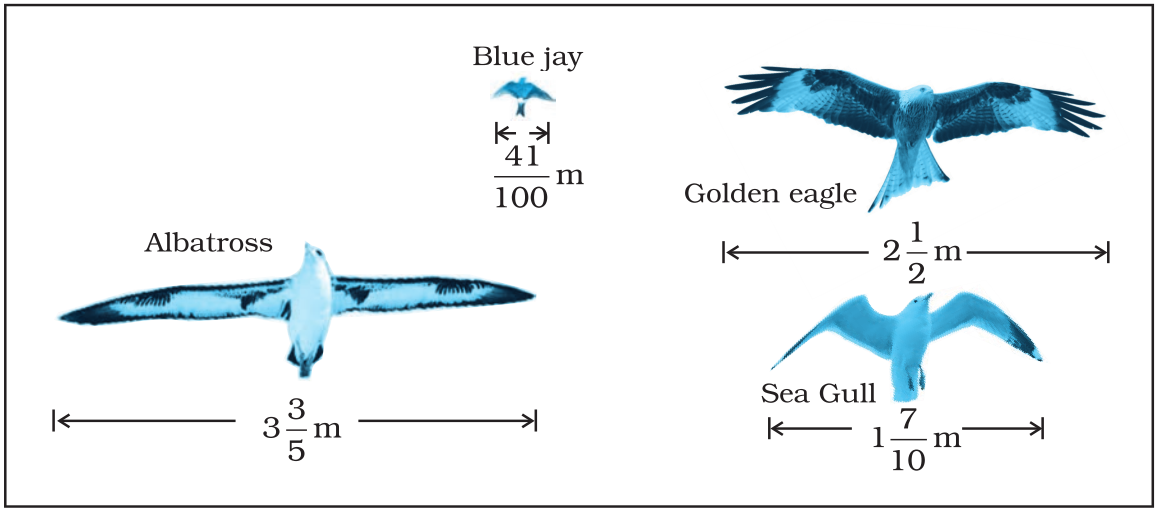
$a.$ How much longer is the wingspan of an Albatross than the wingspan of a Sea gull?
$b.$ How much longer is the wingspan of a Golden eagle than the wingspan of a Blue jay? Answer$a.$ We have, length of the wingspan of Albatross $=3\frac{3}{5}\text{m}$
And length of the wingspan of a sea gull $=1\frac{7}{10}\text{m}$
$\therefore\ $Difference $=3\frac{3}{5}-1\frac{7}{10}$
$=\frac{18}{5}-\frac{17}{10}$
$=\frac{36-17}{10}$
$=\frac{19}{10}\text{m}$
Hence, the wingspan of an Albatross is $\frac{19}{10}\text{m}$ longer than the wingspan of a Sea gull.
$b.$ We have, length of the wingaspan of Golden eagle $=2\frac{1}{2}\text{m}$
And the length the wingspan of a Blue jay $=\frac{41}{100}\text{m}$
Difference $=2\frac{1}{2}-\frac{41}{100}$
$=\frac{5}{2}-\frac{41}{100}$
$=\frac{250-41}{100}$
$=\frac{209}{100}\text{m}$
Hence, the wingspan of a Golden eagle is $\frac{209}{100}\text{m}$ longer than the wingspan of a Blue jay.
View full question & answer→Question 192 Marks
Verify the property $x \times (y \times z) = (x \times y) \times z$ of rational numbers by using: $\text{x}=\frac{-2}{7},\ \text{y}=\frac{-5}{6}$ and $\text{z}=\frac{1}{4}$
AnswerGiven, $\text{x}=\frac{-2}{7},\ \text{y}=\frac{-5}{6}$ and $\text{z}=\frac{1}{4}$Now, $\text{LHS}=\text{x}\times(\text{y}\times\text{z})$
$=\frac{-2}{7}\times\Big(\frac{-5}{6}\times\frac{1}{4}\Big)$
$=\frac{-2}{7}\times\frac{-5}{24}$
$=\frac{5}{84}$
$=\frac{-1}{7}$
and $\text{RHS}=(\text{x}\times\text{y})\times\text{z}$
$=\Big(\frac{-2}{7}\times\frac{-5}{6}\Big)\times\frac{1}{4}$
$=\frac{5}{21}\times\frac{1}{4}$
$=\frac{5}{84}$
$\text{LHS}=\text{RHS}$
Hence, $\text{x}\times(\text{y}\times\text{z})=(\text{x}\times\text{y})\times\text{z}$
View full question & answer→Question 202 Marks
Arrange the numbers $\frac{1}{4},\frac{13}{16},\frac{5}{8}$ in the descending order.
AnswerGiven number are $\frac{1}{4},\frac{13}{16},\frac{5}{8}$
First, we convert the number as like denominator.
Taking $LCM$ of $4, 16, 8 = 2 \times 2 \times 2 \times 2 = 16$
$\begin{array}{c|c}2&4,\ 16,\ 8\ \\ \hline2&2,\ 8,\ 4 \\ \hline2&1, \ 4,\ 2\\\hline5&1,\ 2,\ 1\\ \hline&1,\ 1.\ 1 \end{array}$
Now, $\frac{1}{4}=\frac{1}{4}\times\frac{4}{4}=\frac{4}{16}$
$\frac{5}{8}=\frac{5}{8}\times\frac{2}{2}=\frac{10}{16}$ $\frac{13}{16}>\frac{10}{16}>\frac{4}{16}$
i.e. $\frac{13}{16}>\frac{5}{8}>\frac{1}{4}$
View full question & answer→Question 212 Marks
By what number should we multiply $\frac{-8}{13}$ so that the product may be $24$?
AnswerLet the required number be $x$.
According to the question, $\frac{-8\text{x}}{13}=24$
$\text{x}=-\frac{13\times24}{8}$
$\text{x}=-13\times3$
$=-39$
Hence, $\frac{-8}{13}$ should be multiplied by $-39$ to get the product $24$.
View full question & answer→Question 222 Marks
Verify the property $x \times y = y \times z$ of rational numbers by using: $\text{x}=\frac{-5}{7}$ and $\text{y}=\frac{14}{15}$
AnswerGiven, $\text{x}=\frac{-5}{7}$ and $\text{y}=\frac{14}{15}$Then, $\text{LHS}=\text{x}\times\text{y}$
$=\frac{-5}{7}\times\frac{14}{15}$
$=\frac{-2}{3}$
$\text{RHS}=\text{y}\times\text{x}$
$=\frac{14}{15}\times\frac{-5}{7}$
$=\frac{-2}{3}$
$\therefore\ \text{LHS}=\text{RHS}$
Hence, $\text{xy}=\text{yx}$
View full question & answer→Question 232 Marks
Find the product of additive inverse and multiplicative inverse of $-\frac{1}{3}.$
AnswerThe additive inverse of $\frac{-1}{3}=\frac{1}{3}$
The multiplicative inverse of $\frac{-1}{3}=-3$
$\therefore\ $Required product $=\frac{1}{3}\times-3$ $=-1$
View full question & answer→Question 242 Marks
Verify the property $x + y = y + x$ of rational numbers by taking. $\text{x}=\frac{-3}{7},\text{y}=\frac{20}{21}$
AnswerGiven, $\text{x}=\frac{-3}{7}$ and $\text{y}=\frac{20}{21}$
Then, $\text{LHS}=\text{x}+\text{y}$
$=\frac{-3}{7}+\frac{20}{21}$
$=\frac{-9+20}{21}$
$=\frac{11}{21}$ and $\text{RHS}=\text{y}+\text{x}$
$=\frac{20}{21}-\frac{3}{7}$
$=\frac{20-9}{21}$
$=\frac{11}{21}$
$\therefore\ \text{LHS}=\text{RHS}$
Hence, $\text{x}+\text{y}=\text{y}+\text{x}$
View full question & answer→Question 252 Marks
Solve the following: Select the rational numbers from the list which are also the integers. $\frac{9}{4},\frac{8}{4},\frac{7}{4},\frac{6}{4},\frac{9}{3},\frac{8}{3},\frac{7}{3},\frac{6}{3},\frac{5}{2},\frac{4}{2},\frac{3}{2},\frac{1}{1},\frac{0}{1},\frac{-1}{1},\frac{-2}{1},\frac{-3}{2},\frac{-4}{2},\frac{-5}{2},\frac{-6}{2}.$
AnswerFrom the given rational numbers, the numbers whose denominator is $1$ and the numbers whose numerator is the multiple of denominator are the integers. Hence, $\frac{8}{4},\frac{9}{3},\frac{6}{3},\frac{4}{2},\frac{3}{1},\frac{1}{1},\frac{-1}{1},\frac{-2}{2},\frac{-4}{2},\frac{-6}{2}$ are the integers.
View full question & answer→Question 262 Marks
From a rope $40$ metres long, pieces of equal size are cut. If the length of one piece is $\frac{10}{3}\text{m}$ find the number of such pieces.
AnswerTotal length of rope $= 40m$
Length of one pieces $=\frac{10}{3}\text{m}$
Let the number of pieces be $x$.
Then, according to the question, $\frac{10\text{x}}{3}=40$
$\Rightarrow\text{x}=\frac{40\times3}{10}$
$\Rightarrow\text{x}=12$
Hence, number of pieces cut from the rope are $12$.
View full question & answer→Question 272 Marks
Using suitable rearrangement and find the sum: $-5+\frac{7}{10}+\frac{3}{7}+(-3)+\frac{5}{14}+\frac{-4}{5}$
AnswerHere, $-5+\frac{7}{10}+\frac{3}{7}+(-3)+\frac{5}{14}+\frac{-4}{5}$
$=-5+(-3)+\frac{7}{10}+\Big(\frac{-4}{5}\Big)+\frac{3}{7}+\frac{5}{14}$
$=-8+\frac{7-8}{10}+\frac{6+5}{14}$
$=-8-\frac{1}{10}+\frac{11}{14}$
$=\frac{-560-7+55}{70}$
$=\frac{-512}{70}$
$=\frac{-256}{35}$
View full question & answer→Question 282 Marks
If $16$ shirts of equal size can be made out of $24\ m$ of cloth, how much cloth is needed for making one shirt?
AnswerIf $16$ shirts are to be made by cloth of $24\ m$ Then, $1$ shirt is to be made by cloth of $=\frac{24}{16}\text{m}=\frac{3}{2}\text{m}$ $=1.5\text{m}$Hence, $1.5m$ cloth is needed for making one shirt.
View full question & answer→Question 292 Marks
Verify the property $x + y = y + x$ of rational numbers by taking.
$\text{x}=\frac{-2}{3},\text{y}=\frac{-5}{6}$
AnswerGiven, $\text{x}=\frac{-2}{3}$ and $\text{y}=\frac{-5}{6}$
Then,
$\text{LHS}=\text{x}+\text{y}$
$=\frac{-2}{3}+\frac{-5}{6}$
$=\frac{-2}{3}-\frac{5}{6}$
$=\frac{-4-5}{6}$
$=\frac{-9}{6}$
and
$\text{RHS}=\text{y}+\text{x}$
$=\frac{-5}{6}+\frac{-2}{3}$
$=\frac{-5}{6}-\frac{2}{3}$
$=\frac{-5-4}{6}$
$=\frac{-9}{6}$
$\therefore\ \text{LHS}=\text{RHS}$
Hence, $\text{x}+\text{y}=\text{y}+\text{x}$
View full question & answer→Question 302 Marks
Verify the property $x × (y + z) = x × y + x × z$ of rational numbers by taking. $\text{x}=\frac{-1}{2},\ \text{y}=\frac{3}{4},\ \text{z}=\frac{1}{4}$
AnswerGiven, $\text{x}=\frac{-1}{2},\ \text{y}=\frac{3}{4},\ \text{z}=\frac{1}{4}$
Now, $\text{LHS}=\text{x}\times(\text{y}+\text{z})$
$=\frac{-1}{2}\times\Big(\frac{3}{4}+\frac{1}{4}\Big)$
$=\frac{-1}{2}\times\frac{4}{4}$
$=\frac{-1}{2}$ and $\text{RHS}=\text{x}\times\text{y}+\text{x}\times\text{z}$
$=\frac{-1}{2}\times\frac{3}{4}+\Big(\frac{-1}{4}\Big)\times\frac{1}{4}$
$=\frac{-3}{8}-\frac{1}{8}$
$=\frac{-3-1}{8}$
$=\frac{-4}{8}$
$=\frac{-1}{2}$
$\text{LHS}=\text{RHS}$
Hence, $\text{x}\times(\text{y}+\text{z})=\text{x}\times\text{y}+\text{x}\times\text{z}$
View full question & answer→Question 312 Marks
$\frac{1}{6}$ of the class students are above average, $\frac{1}{4}$ are average and rest are below average. If there are $48$ students in all, how many students are below average in the class?
AnswerNumber of above average students $=\frac{1}{6}$ of the class students Number of average students $=\frac{1}{4}$ of the class students,
$\therefore\ $Number of below average students $=1-\Big[\frac{1}{6}+\frac{1}{4}\Big]$ of the class students $=1-\Big[\frac{2+3}{12}\Big]$
$=1-\frac{5}{12}$
$=\frac{7}{12}$ of the class students.
Since, number of students in the class $= 48$
$\therefore\ $Number of below average students $=\frac{7}{12}\times48$
$=28$
So, number of below average students are $28$.
View full question & answer→Question 322 Marks
Find five rational numbers between $0$ and $1$.
Answer$\because\ 0<1<2<3<4<5<6$
$\Rightarrow0<\frac{1}{6}<\frac{2}{6}<\frac{3}{6}<\frac{4}{6}<\frac{5}{6}<\frac{6}{6}$
Hence, $\frac{1}{6},\frac{2}{6},\frac{3}{6},\frac{4}{6},\frac{5}{6}$ are the rational numbers lying between between $0$ and $1$.
View full question & answer→Question 332 Marks
Use the distributivity of multiplication of rational numbers over addition to simplify. $\frac{3}{4}\times\Big[\frac{8}{9}-40\Big]$
AnswerGiven, $\frac{3}{4}\times\Big[\frac{8}{9}-40\Big]$$=\frac{3}{4}\times\frac{8}{9}+\Big(\frac{3}{4}\Big)\times(-40)$ [By using distributive property over addition]
$=\frac{2}{3}-30$
$=\frac{2-90}{3}$
$=\frac{-88}{3}$
View full question & answer→Question 342 Marks
Verify the property $x \times y = y \times z$ of rational numbers by using: $\text{x}=7$ and $\text{y}=\frac{1}{2}$
AnswerGiven, $\text{x}=7$ and $\text{y}=\frac{1}{2}$Then, $\text{LHS}=\text{x}\times\text{y}$
$=7\times\frac{1}{2}$
$=\frac{7}{2}$
$\text{RHS}=\text{y}\times\text{x}$
$=\frac{1}{2}\times7$
$=\frac{7}{2}$
$\therefore\ \text{LHS}=\text{RHS}$
Hence, $\text{xy}=\text{yx}$
View full question & answer→Question 352 Marks
Verify the property $x + y = y + x$ of rational numbers by taking. $\text{x}=\frac{1}{2},\text{y}=\frac{1}{2}$
AnswerGiven, $\text{x}=\frac{1}{2}$ and $\text{y}=\frac{1}{2}$
Then, $\text{LHS}=\text{x}+\text{y}$
$=\frac{1}{2}+\frac{1}{2}$
$=1$ $\text{RHS}=\text{y}+\text{x}$
$=\frac{1}{2}+\frac{1}{2}$ $=1$
$\therefore\ \text{LHS}=\text{RHS}$
Hence, $\text{x}+\text{y}=\text{y}+\text{x}$
View full question & answer→Question 362 Marks
Verify the property $x + y = y + x$ of rational numbers by taking. $\text{x}=\frac{-2}{5},\text{y}=\frac{-9}{10}$
AnswerGiven, $\text{x}=\frac{-2}{5}$ and $\text{y}=\frac{-9}{10}$ Then, $\text{LHS}=\text{x}+\text{y}$
$=\frac{-2}{5}+\frac{-9}{10}$
$=\frac{-2}{5}-\frac{9}{10}$
$=\frac{-4-9}{10}$
$=\frac{-13}{10}$ and $\text{RHS}=\text{y}+\text{x}$
$=\frac{-9}{10}+\frac{-2}{5}$
$=\frac{-9}{10}-\frac{2}{5}$
$=\frac{-9-4}{10}$
$=\frac{-13}{10}$
$\therefore\ \text{LHS}=\text{RHS}$
Hence, $\text{x}+\text{y}=\text{y}+\text{x}$
View full question & answer→Question 372 Marks
Verify the property $x × y = y × z$ of rational numbers by using: $\text{x}=\frac{-3}{8}$ and $\text{y}=\frac{-4}{9}$
AnswerGiven, $\text{x}=\frac{-3}{8}$ and $\text{y}=\frac{-4}{9}$Then, $\text{LHS}=\text{x}\times\text{y}$
$=\frac{-3}{8}\times\frac{-4}{9}$
$=\frac{1}{3\times2}$
$=\frac{1}{6}$
$\text{RHS}=\text{y}\times\text{x}$
$=\frac{-4}{9}\times\frac{-3}{8}$
$=\frac{1}{6}$
$\therefore\ \text{LHS}=\text{RHS}$
Hence, $\text{xy}=\text{yx}$
View full question & answer→