MCQ 1011 Mark
Which of the following is the square root of $7056?$
View full question & answer→MCQ 1021 Mark
The square of which of the following numbers will be odd?
Answer$\therefore 81$ is odd
$\therefore$ Its square will be odd.
View full question & answer→MCQ 1031 Mark
The unit digit number $132$ is in the square of the:
View full question & answer→MCQ 1041 Mark
Without adding, find the sum. $1 + 3 + 5 + 7 + 9.$
View full question & answer→MCQ 1051 Mark
Which of the following is the difference between the squares of two consecutive natural number is:
- ✓
- B
Difference of the numbers.
- C
Twice the sum of the two numbers.
- D
Twice the difference between the two numbers.
AnswerA. Sum of the two numbers.
Solution:
Let the number be (a) and $(a-1)$
Difference between the square.
$= a^2 – (a + b)^2$
= inserting the formula... ${a^2 – b^2 = (a + b)(a - b)}$
$= (a - a + 1)(a + a- 1)$
$= (1)(2a - 1)$
$= 2a - 1$
View full question & answer→MCQ 1061 Mark
Mark $(\checkmark)$ against the correct answer Which of the following numbers is not a perfect square?
- A
$529$
- B
$961$
- C
$1024$
- ✓
$1222$
AnswerCorrect option: D. $1222$
A number ending in $2, 3, 7$ or $8$ is not a perfect square.
View full question & answer→MCQ 1071 Mark
The smallest number by which $1000$ should be divided so as to get a perfect square is:
AnswerB. $10$
Solution:
$1000 \div 10 = 100 = 10^2$
View full question & answer→MCQ 1081 Mark
What is the sum of the first four odd natural numbers?
AnswerThe sum of the first odd natural numbers $= 1 + 3 + 5 + 7 = 16$
View full question & answer→MCQ 1091 Mark
Express the square number $5^2$ as the sum of two consecutive integers.
- ✓
$12 + 13$
- B
$10 + 15$
- C
$9 + 16$
- D
$20 + 5$
AnswerCorrect option: A. $12 + 13$
A. $12 + 13$
Solution:
$\frac{5^2-1}{2} = 12, \frac{5^2+1}{2} = 13$
View full question & answer→MCQ 1101 Mark
The sum of first $n$ odd natural numbers is:
- A
$2n + 1$
- ✓
$n^2$
- C
$n^2 - 1$
- D
$n^2 + 1$
AnswerB. $n^2$
Solution:
Sum of frist n odd natural numbers $=\sum(2\text{n}-1)=2\sum\text{n}-\text{n}$
$=\frac{2\times\text{n}(\text{n}+1)}{2}-\text{n}=\text{n}(\text{n}+1)-\text{n}$
$=\text{n}^2+\text{n}-\text{n}=\text{n}^2$
View full question & answer→MCQ 1111 Mark
A number added to its square gives $56$. The number is:
View full question & answer→MCQ 1121 Mark
If a number of n-digits is perfect square and $‘n’$ is an odd number, then which of the following is the number of digits of its square root?
- A
$\frac{\text{n-1}}{2}$
- B
$\frac{\text{n}}{2}$
- ✓
$\frac{\text{n+1}}{2}$
- D
$\text{2n}$
AnswerCorrect option: C. $\frac{\text{n+1}}{2}$
No of digits in a perfect square is n
If n is odd then no of digits in its square roots is $\frac{\text{n+1}}{2}$
View full question & answer→MCQ 1131 Mark
A perfect square number having $n$ digits where $n$ is even will have square root with:
- A
$\text{n}+1\text{ digit}$
- ✓
$\frac{\text{n}}{2}\text{ digit}$
- C
$\frac{\text{n}}{3}\text{ digit}$
- D
$\frac{\text{n}+1}{2}\text{ digit}$
AnswerCorrect option: B. $\frac{\text{n}}{2}\text{ digit}$
A perfect square number having $n$ digits, where $n$ is even, will have square root with $\frac{\text{n}}{2}\text{ digit}.$
View full question & answer→MCQ 1141 Mark
Which of the following cannot be a perfect square?
AnswerWe know that, a number ending with digits $2, 3, 7$ or $8$ can never be a perfect square. So, $198$ cannot be written in the form of a perfect square.
View full question & answer→MCQ 1151 Mark
Which of the following will have $4$ at the units place?
- A
$14^2$
- ✓
$62^2$
- C
$27^2$
- D
$35^2$
AnswerCorrect option: B. $62^2$
B. $62^2$
Solution:
The unit place of the square of $14=4^2=16=6$
The unit place of the square of $62-2^2=4\left[\because 2^2=4\right]$
The unit place of square of $27=7^2=49=9$
The unit place of the square of $35=5^2=52=5$
Clearly, $62^2$ has 4 at the unit's place.
View full question & answer→MCQ 1161 Mark
The least number which must be subtracted from $6156$ to make its perfect square is:
View full question & answer→MCQ 1171 Mark
Which of the following is a Pythagorean-triplet?
- A
$n, (n^2 - 1)$ and $(n^2+ 1)$
- B
$(n - 1), (n^2 - 1)$ and $(n^2 + 1)$
- C
$(n + 1), (n^2 - 1)$ and $(n^2 + 1)$
- ✓
$2n, (n^2 - 1)$ and $(n^2 + 1)$
AnswerCorrect option: D. $2n, (n^2 - 1)$ and $(n^2 + 1)$
D. $2n, (n^2 - 1)$ and $(n^2 + 1)$
Solution:
$2n, (n^2 - 1)$ and $(n^2 + 1)$ is a Pythagorean - triplet.
Example: Let $2n = 6$
$\therefore$ $n = 3$
Now, $n^2 - 1 = 32 - 1 = 8$
And $n^2 + 1 = 32 + 1 = 10$
Thus the required Pythagorean triplet is $6,8,10.$
View full question & answer→MCQ 1181 Mark
The smallest number by which $48$ should be divided so as to get a perfect square is:
AnswerB. $3$
Solution:
$48 \div 3 = 16 = 4^2$
View full question & answer→MCQ 1191 Mark
A perfect square that lies between $40$ and $50$ is:
AnswerC. $49$
Solution:
$49$ is a perfect square.
$49 = 7 \times 7 = 7^2$
View full question & answer→MCQ 1201 Mark
Which of the following numbers would have digit $6$ at unit place?
- A
$19^2$
- B
$25^2$
- C
$28^2$
- ✓
$26^2$
AnswerCorrect option: D. $26^2$
D. $26^2$
Solution:
$19^2 = 361. $So, the unit digit is $1.$
$25^2 = 625. $So, the unit digit is$ 5.$
$28^2 = 784.$ So, the unit digit is $4.$
$26^2 = 676.$ So, the unit digit is$ 6.$
The unit place of $262$ have $6$ at the unit place.
View full question & answer→MCQ 1211 Mark
Which of the following is the number of zeros in the square of $900\ ?$
AnswerB. $4$
Solution:
To find:
The number of zeros in the square of $900$
We know that,
The number of zeros of a numnber gets double when the number is squared.
Consider,
Number of zeros in $900$ is $2$
Then, the number of zeros in square of $900$ is $4$
Verification, $900^2 = 810000$
View full question & answer→MCQ 1221 Mark
What is the length of the side of a square whose area is $441\ cm^2\ ?$
View full question & answer→MCQ 1231 Mark
Which of the following numbers is a perfect cube?
- A
$243$
- ✓
$216$
- C
$392$
- D
$8640$
Answer$a. (b)$ For option $(a)$ We have, $243$
Resolving $243$ into prime factors, we have
$243 = 3 \times 3 \times 3 \times 3 \times 3$
Grouping the factors in triplets of equal factors, we get,
$243 = (3 \times 3 \times 3) \times 3 \times 3$
Clearly, in grouping, the factors in triplets of equal factors, we are left with two factors $3 \times 3.$
Therefore, $243$ is not a perfect cube.
$b.$ For option $(b)$ We have, $216$ Resolving $216$ into prime factors, we have
$216 = 2 \times 2 \times 2 \times 3 \times 3 \times 3$
Grouping the factors in triplets of equal factors, we get $216 = (2 \times 2 \times 2) \times (3 \times 3 \times 3)$
Clearly, in grouping, the factors of triplets of equal factors, no factor is left over.
So, $216$ is a perfect cube.
$c.$ or option $(c)$ We have, $392$
Resolving $392$ into prime factors, we get
$392 = 2 \times 2 \times 2 \times 7 \times 7$
Grouping the factors in triplets of equal factors, we get
$392 = (2 \times 2 \times 2) \times 7 \times 7$
Clearly, in grouping, the factors in triplets of equal factors, we are left with two factors $7 \times 7.$
Therefore, $392$ is not a perfect cube.
$d.$ For option $(d)$ We have, $8640$
Resolving $8640$ into prime factors, we get,
$8640 = 2 \times 2 \times 2 \times 2 \times 2 \times 2 \times 3 \times 3 \times 3 \times 5$
Grouping the factors in triplets of equal factors, we get, $8640 = (2 \times 2 \times 2) \times (2 \times 2 \times 2) \times (3 \times 3 \times 3) \times 5$
Clearly, in grouping, the factors in triplets of equal factors, we are left with one factor $5.$
Therefore, $8640$ in not a perfect cube.
After solving, it is clear that option $(b)$ is correct.
View full question & answer→MCQ 1241 Mark
Express $7^2$ as the sum of two consecutive integers.
- A
$40 + 9$
- ✓
$24 + 25$
- C
$36 + 13$
- D
$32 + 17$
AnswerCorrect option: B. $24 + 25$
B. $24 + 25$
Solution:
$\frac{7^2-1}{2}=24, \frac{5^2+1}{2}=25$
View full question & answer→MCQ 1251 Mark
Tick $(\checkmark)$ the correct answer of the following: $\frac{\sqrt{288}}{\sqrt{128}}=\ ?$
- A
$\frac{\sqrt3}{2}$
- B
$\frac{3}{\sqrt2}$
- ✓
$\frac{3}{2}$
- D
$1.49$
AnswerCorrect option: C. $\frac{3}{2}$
$\frac{\sqrt{288}}{\sqrt{128}}$
$=\sqrt{\frac{288}{128}}$
$=\sqrt{\frac{9}{4}}$
$=\frac{3}{2}$
View full question & answer→MCQ 1261 Mark
What is the length of side of a square, if the area of square is $441\ cm^2\ ?$
- A
$29\ cm$
- ✓
$21\ cm$
- C
$39\ cm$
- D
$31\ cm$
AnswerCorrect option: B. $21\ cm$
B. $21\ cm$
Solution:
Area of a square $= 441\ cm^2$
By the formula, we know that;
Area of a square $=$ side$^2$
$441 = $ side$^2$
Side $=\sqrt{441}=21$
Therefore, length of side of square is $21\ cm.$
View full question & answer→MCQ 1271 Mark
If m is the square of a natural number n, then n is:
AnswerCorrect option: D. $\sqrt{\text{m}}.$
D. $\sqrt{\text{m}}.$
Given, m is the square of n, i,. $m = n^2$
Taking square root both sides, we get
$\text{n}=\sqrt{\text{m}}$
View full question & answer→MCQ 1281 Mark
Mark $(\checkmark)$ against the correct answerWhat least number must be subtracted from $178$ to make it a perfect square?
Answer$178-9=169$
$\sqrt{169}=13$
View full question & answer→MCQ 1291 Mark
$\sqrt{\frac{1}{16}+\frac{1}{9}}=$
- ✓
$\frac{5}{12}$
- B
$\frac{7}{12}$
- C
$\frac{25}{44}$
- D
AnswerCorrect option: A. $\frac{5}{12}$
$\frac{5}{12}$
View full question & answer→MCQ 1301 Mark
The sum of $1 + 3 + 5 + 7 + 9 + 11 + 13 + 15 + 17 + 19$ is:
AnswerSum of n odd numbers $= 1 + 3 + 5 + 7 + 9 + 11 + 13 + 15 + 17 + 19 = 100$
View full question & answer→MCQ 1311 Mark
Which of the following is a perfect square?
- A
$7928$
- B
$64000$
- ✓
$625$
- D
$1057$
AnswerThe natural numbers which end with $0, 2, 3, 7$ and $8$ are not perfect squares.
Hence, $625$ is a perfect square.
$25 × 25 = 625$
View full question & answer→MCQ 1321 Mark
Tick $(\checkmark)$ the correct answer of the following: $\sqrt{0.9}=\ ?$
- A
$0.3$
- B
$0.03$
- C
$0.33$
- ✓
$0.94$
AnswerCorrect option: D. $0.94$
$\begin{array}{c|c}&0.94\\\hline9&0.\overline{90}\ \overline{00}\\&\ \ \ \ 81\ \ \ \ \ \\\hline184&\ \ \ \ \ \ 900\\&\ \ \ \ \ \ \ 736\\\hline&\ \ \ \ \ \ \ \ 164\\\end{array}$
View full question & answer→MCQ 1331 Mark
Tick $(\checkmark)$ the correct answer of the following: What least number must be added to $15370$ to make it a perfect square?
Answer(B) $6$
Solution:
Finding the square root of $15370$ by division method
We get Remainder $= 261$
Now $(123)^2 = 15129$
and $(124)^2 = 15379$
The least number to be added
$= 15129 - 15379 = 6$
View full question & answer→MCQ 1341 Mark
The smallest number by which $32$ should be multiplied so as to get a perfect square is:
Answer$32 \times 2 = 64 = 8^2$
View full question & answer→MCQ 1351 Mark
The number of digits in the square root of $62500$ is:
Answer$\text{n}=5,\frac{\text{n}+1}{2} = 3$
View full question & answer→MCQ 1361 Mark
Express $9^2$ as the sum of two consecutive integers.
- ✓
$40 + 41$
- B
$50 + 31$
- C
$36 + 45$
- D
$72 + 9$
AnswerCorrect option: A. $40 + 41$
$\frac{9^2-1}{2}=40, \frac{5^2+1}{2}=41$
View full question & answer→MCQ 1371 Mark
What could be the possible one’s digit of the square root of $625$?
View full question & answer→MCQ 1381 Mark
If a number of n-digits is a perfect square and $‘n’$ is an even number, then which of the following is the number of digits of its square root?
- A
$\frac{\text{n-1}}{2}$
- ✓
$\frac{\text{n}}{2}$
- C
$\frac{\text{n+1}}{2}$
- D
$\text{2n}$
AnswerCorrect option: B. $\frac{\text{n}}{2}$
Number of digit of the perfect square $(n)$
Number of digits of the square root $\frac{\text{n}}{2}$ (when $'n'$ is even)
Example:
$1296$ (is perfect square) and $n = 4$ (even number)
$\therefore $ Number of digits of its square root $=\frac{\text{n}}{2}$
$=\frac{4}{2}=2$
Now $ \sqrt{1296} =36$ ($2$ - digits).
View full question & answer→MCQ 1391 Mark
Find the perfect square numbers between $30$ and $40$.
View full question & answer→MCQ 1401 Mark
Which of the following is a perfect square number?
- A
$1067$
- B
$7828$
- C
$4333$
- ✓
$625$
AnswerPerfect square numbers end with
$0, 1, 4, 5, 6$ or $9$ at unit’s place.
View full question & answer→MCQ 1411 Mark
Which of the following arc the factors of $1 – x^2\ ?$
- A
$(x + l)(x – I)$
- ✓
$(1 – x)(1 + x)$
- C
$(1 – x)(1 – x)$
- D
$(1 + x)(1 + x)$
AnswerCorrect option: B. $(1 – x)(1 + x)$
$(1 – x)(1 + x)$
View full question & answer→MCQ 1421 Mark
The number of digits in the square root of $441$ is:
Answer$\text{n}=3, \frac{\text{n+1}}{2}=2$
View full question & answer→MCQ 1431 Mark
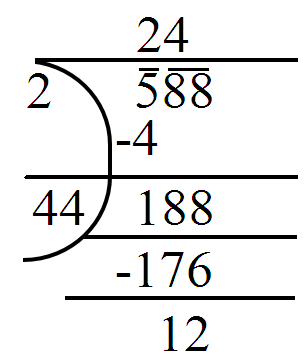
There are $588$ students in a school. For a mock drill they have to stand in such a manner that the number of rows is equal to number of columns. How many children would be left out in this arrangement?
AnswerHere, Number of children $= 588$
By getting the square root of this number, we get,
In each row, the number of students is $24$.
And left out children are $12$.
View full question & answer→MCQ 1441 Mark
Find the length of the side of a square whose area is $100\ cm^2.$
- A
$5\ cm$
- ✓
$10\ cm$
- C
$100\ cm$
- D
$4\ cm$
AnswerCorrect option: B. $10\ cm$
$\sqrt{100}=10\text{cm}$
View full question & answer→MCQ 1451 Mark
Which of the following Pythagorean triplet has the smallest member $‘8’$.
- ✓
$8, 15, 17$
- B
$8, 10, 12$
- C
$8, 9, 10$
- D
$8, 11, 14$
AnswerCorrect option: A. $8, 15, 17$
$8, 15, 17$
View full question & answer→MCQ 1461 Mark
Tick $(\checkmark)$ the correct answer of the following: Which of the following numbers is not a perfect square?
- ✓
$1843$
- B
$3721$
- C
$1024$
- D
$1296$
AnswerCorrect option: A. $1843$
$1843$ as it has $3$ in the end.
View full question & answer→MCQ 1471 Mark
Which of the following is the number of non-perfect square number between $17^2$ and $18^2\ ?$
AnswerQuestion should be read as:
Non perfect square nunbers between $17^2$ and $18^2$
$17 = n$
$18 = n + 1$
(question for finding, non perfect square nunbers between $17^2$ and $18^2 = 2n$)
$\therefore $ non perfect square nunbers between $17^2$ and $18^2 = 2n$
$= 2 \times 17$
$= 34$
View full question & answer→MCQ 1481 Mark
The Pythagorean triples whose smallest number is $8:$
- A
$8, 17, 18$
- B
$8, 16 17$
- C
$8, 15, 16$
- ✓
$8, 15, 17$
AnswerCorrect option: D. $8, 15, 17$
The general form of Pythagorean triplets is $2m, m^2- 1, m^2+ 1$
Given, $2m = 8$
So $, m = 4$
$m^2 - 1 = 4^2- 1 = 16 - 1 = 15$
$m^2+ 1 = 4^2+ 1 = 16 + 1 = 17$
View full question & answer→MCQ 1491 Mark
The value of $(501)^2 - (500)^2$ is:
AnswerCorrect option: C. $1001$
$1001$
View full question & answer→MCQ 1501 Mark
Which of the following can be a perfect square?
AnswerCorrect option: C. A number ending with even number of zeros
The number of zeros at the end of a perfect square are always even in number.
Let's the see the ending numbers of perfect squares:
$1, 4, 9, 16, 25, 36, 49, 64, 81, ....$
So, the ending digits are $1, 4, 5, 6, 9$
In the case $(i)$ and $(iv)$
From the above digits we can see that there are no perfect squares with $3,7$ or $2$ as ending digits.
In the case $(ii)$
A perfect square always has even number of ending zeroes:
eg. $10^2 = 100$
$100^2 = 10,000$
$1000^2 = 10,00,000$
So, the answer is $(iii)$.
View full question & answer→