MCQ 1511 Mark
Which of the following numbers is not a perfect cube?
Answer$216 = 6 \times 6 \times 6, 567 = 3 \times 3 \times 3 \times 3 \times 7$
$125 = 5 \times 5 \times 5, 343 = 7 \times 7 \times 7$
Clearly, $567$ is not a perfect cube, because in grouping, the factors in triplets of equal factors, we are left with two factors $3 \times 7$.
View full question & answer→MCQ 1521 Mark
If a square number ends in $6$, the preceding figure is:
View full question & answer→MCQ 1531 Mark
The smallest number by which $150$ should be divided so as to get a perfect square is:
Answer$150 \div 6 = 25 = 5^2$
View full question & answer→MCQ 1541 Mark
$\sqrt[3]{1000}$ is equal to:
AnswerWe have, $\sqrt[3]{1000}=\sqrt[3]{10\times10\times10}$
$=\sqrt[3]{(10)^3}=(10)^\frac{3}{3}=10$
View full question & answer→MCQ 1551 Mark
If $\sqrt{1+\frac{27}{169}}=1+\frac{\text{x}}{13}$ then $x =$
View full question & answer→MCQ 1561 Mark
Which of the following is the difference between the squares of $21$ and $22\ ?$
AnswerWe know:
$(21)^2 = 441$
$(22)^2 = 484$
Difference between the squares of
$= (484 - 441)$
$= 43$
View full question & answer→MCQ 1571 Mark
What will be the number of zeros in the square of the number $9000$?
AnswerNumber of zeros at the end of the number $9000 = 3$
$\therefore$ Number of zeros at the end of the square of the number $9000 = 2 \times 3 = 6$
View full question & answer→MCQ 1581 Mark
The value of $1 + 3 + 5 + 7 + 9 +.....+ 25$ is:
View full question & answer→MCQ 1591 Mark
The unit digit in the square of the number $125$ is:
View full question & answer→MCQ 1601 Mark
Which of the following will have $6$ at unit place?
- ✓
$24^2$
- B
$11^2$
- C
$13^2$
- D
$19^2$
AnswerCorrect option: A. $24^2$
$24^2 = 24 \times 24 = 576$
View full question & answer→MCQ 1611 Mark
Which of the following is a perfect square? $32, 66, 81, 101.$
Answer$81 = 9 \times 9 = 9^2$
View full question & answer→MCQ 1621 Mark
What will be the number of zeros in the square of the number $9000$?
View full question & answer→MCQ 1631 Mark
Find the smallest whole number by which $2025$ should be divided so as to get a perfect square:
Answer$2025 = 3 \times 3 \times 5 \times 5 \times 9$
Here, prime factor $9$ has no pair. Therefore $2025$ must be divided by $9$ to make it a perfect square.
$\therefore\frac{2025}{9}=225$ which is the square.
View full question & answer→MCQ 1641 Mark
Tick $(\checkmark)$ the correct answer of the following: What least number must be subtracted from $176$ to make it a perfect square?
Answer$\begin{array}{c|c}&13\\\hline1&\bar{1}\ \overline{76}\\&1\ \ \ \ \ \\\hline23&\ \ \ 76\\&\ \ \ \ 69\\\hline&\ \ \ \ \ \ 7\\\end{array}$
$\therefore$ Remainder $= 7$
$7$ must be subtracted
View full question & answer→MCQ 1651 Mark
Evaluate $\sqrt{41-\sqrt{21+\sqrt{19-\sqrt{9}}}}$
View full question & answer→MCQ 1661 Mark
The smallest number by which $1000$ should be multiplied so as to get a perfect square is:
Answer$1000 \times 10 = 10000 = 100^2$
View full question & answer→MCQ 1671 Mark
Tick $(\checkmark)$ the correct answer of the following: What least number must be added to $526$ to make it a perfect square?
AnswerFinding the square root of $526$ by division method
$\begin{array}{c|c}&22\\\hline2&{5}\ {26}\\&4\ \ \ \ \ \\\hline42&\ 126\\&\ \ \ \ 84\\\hline&\ \ \ \ \ \ 42\\\end{array}$
$\therefore$ We get Remainder $= 42$
Now $(22)^2 = 484$ and $(23)^2 = 529$
The least number to be added $= 529 - 526 = 3$
View full question & answer→MCQ 1681 Mark
The smallest number by which $28$ should be multiplied so as to get a perfect square is:
Answer$28 \times 7 = 196 = 14^2$
View full question & answer→MCQ 1691 Mark
Tick $(\checkmark)$ the correct answer of the following: Which of the following numbers is not a perfect square?
- A
$7056$
- B
$3969$
- ✓
$5478$
- D
$4624$
AnswerCorrect option: C. $5478$
$5478$ as it has $8$ at in the end.
View full question & answer→MCQ 1701 Mark
Which of the following numbers must be subtracted from $5607$ to get a perfect square?
View full question & answer→MCQ 1711 Mark
Given that, $\sqrt{33964}=58$, the value of $\sqrt{3364}+\sqrt{33\cdot64}$ is:
- A
$60$
- B
$53.8$
- C
$63.4$
- ✓
$63.8$
AnswerCorrect option: D. $63.8$
From question, $\sqrt{3365}=58$
Now, $\sqrt{3364}+\sqrt{33\cdot64}=58+\sqrt{3364\times10^-2}=58+58\times10^-1$
$= 58 + 5.8 = 63.8$
View full question & answer→MCQ 1721 Mark
Given that $\sqrt{4096}=64,$ the value of $\sqrt{4096}+\sqrt{40.96}$ is:
- A
$74$
- B
$60.4$
- C
$64.4$
- ✓
$70.4$
AnswerCorrect option: D. $70.4$
Given, $\sqrt{4096}=64$
So, $\sqrt{4096}+\sqrt{40.96}$
$=64+\sqrt{4096\times10^{-2}}$
$=64+\sqrt{4096}\sqrt{10^{-2}}$
$=64+64\times10^{-2}$
$=64+6.4=70.4$
View full question & answer→MCQ 1731 Mark
How many natural numbers lie between $9^2$ and $10^2?$
AnswerThe natural numbers lying between $9^2$ and $10^2$, i.e. between $81$ and $100$ are $82, 83, 84, 85, 86, 87, 88, 89, 90, 91, 92, 93, 94, 95, 96, 97, 98,$ and $99.$ So, $18$ natural numbers lie between $9^2$ and $10^2$
View full question & answer→MCQ 1741 Mark
Tick $(\checkmark)$ the correct answer of the following: Which of the following numbers is not a perfect square?
- A
$1156$
- ✓
$4787$
- C
$2704$
- D
$3969$
AnswerCorrect option: B. $4787$
$4787$ as it has $7$ in the end.
View full question & answer→MCQ 1751 Mark
A number ending in $9$ will have the units place of its square as:
AnswerWe know that, it a number is ending in $1$ or $9$ in the unit's place, then its square ends in $1$.
The number ending in $9$, will have the unit's place of its square as $1$. $[\because$ $9 \times 9 = 81$$]$
View full question & answer→MCQ 1761 Mark
How many digits are there in the square root of $35344$?
AnswerIn $35344$ the number of digits are $S$ which is odd.
Therefore the number of digits in its square root $=\frac{\text{n}+1}{2}=\frac{5 +1}{2}=3$
View full question & answer→MCQ 1771 Mark
Tick $(\checkmark)$ the correct answer of the following: If n is odd, then ($1 + 3 + 5 + 7 + ...$ to n terms) is equal to:
- A
$(n^2 + 1)$
- B
$(n^2 - 1)$
- ✓
$n^2$
- D
$(2n^2 + 1)$
Answer$1 + 3 + 5 + 7 + ...$ to n terms when n is an odd is equal to $n^2.$
Sum of first n odd natural number is $n^2.$
View full question & answer→MCQ 1781 Mark
The hypotenuse of a right triangle with its legs of lengths $5x \times 12x$ is:
AnswerFrom question, lengths of the legs at right angled triangle are $3x$ and $4x$.
So, So, hypotenuse $=\sqrt{(\text{5x})^2+(\text{12x})^2}$ [by Pythagoras theorem]
$\sqrt{25\text{x}^2+144\text{x}^2}$
$=\sqrt{169\text{x}^2}$
$=13\text{x}$
View full question & answer→MCQ 1791 Mark
The sum of first $'n'$ odd natural numbers is given by:
- A
$2n$
- ✓
$n^2$
- C
$(n + 1)$
- D
$n^2 + 1$
View full question & answer→MCQ 1801 Mark
What will be the number of digits in the square root of $25600$?
View full question & answer→MCQ 1811 Mark
By what least number should we multiply $1008$ to make it a perfect square?
View full question & answer→MCQ 1821 Mark
How many natural numbers lie between $52$ and $6^2?$
AnswerThe natural numbers lying between $5^2$ and $6^2$, i.e. between $25$ and $36$ are $26, 27, 28, 29, 30, 31, 32, 33, 34$ and $35.$
Hence, $10$ natural numbers lie between $5^2$ and $6^2.$
View full question & answer→MCQ 1831 Mark
Find the least number which must be added to $3675$ to get a perfect square.
Answer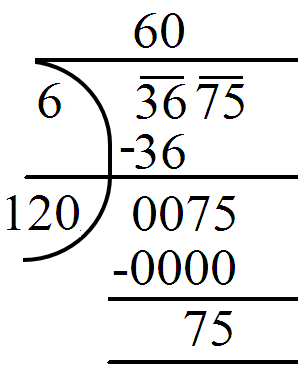
Since remainder is $75.$ Therefore
$60^2 < 3675$
Next perfect square number $61^2 = 3721$
Hence, number to be added $= 3721 - 3675 = 46$
$\therefore$ $3675 + 46 = 3721$ View full question & answer→MCQ 1841 Mark
If $M$ is a square number, then the next immediate square number is:
AnswerCorrect option: C. $\text{M}+2\sqrt{\text{M}}+1$
$\text{M}+2\sqrt{\text{M}}+1$
View full question & answer→MCQ 1851 Mark
The square root of $\frac{441}{961}$ is:
- ✓
$\frac{21}{31}$
- B
$\frac{21}{39}$
- C
$\frac{37}{21}$
- D
$\frac{11}{13}$
AnswerCorrect option: A. $\frac{21}{31}$
$\frac{21}{31}$
View full question & answer→MCQ 1861 Mark
The square of which of the following would be odd number?
- ✓
$431$
- B
$272$
- C
$1234$
- D
$7928$
View full question & answer→MCQ 1871 Mark
$49$ can be expressed as the sum of how many same odd numbers?
Answer$7 + 7 + 7 + 7 + 7 + 7 + 7 = 49$
This proves $7$ times of $7$ is equal to $49$
Or $7^2 = 49$
View full question & answer→MCQ 1881 Mark
The unit digit in the square of the number $78$ is:
View full question & answer→MCQ 1891 Mark
If a number has $‘1’$ or $‘9’$ in the unit’s place, then its square roor ends in which of the following numbers.
View full question & answer→MCQ 1901 Mark
Write a pythagorean triplet whose one member is $17.$
- A
$17, 12, 13$
- ✓
$8, 15, 17$
- C
$17, 24, 32$
- D
$16, 17, 34$
AnswerCorrect option: B. $8, 15, 17$
If we take $x^2 + 1 = 17$
So, $x^2 = 16$
$\Rightarrow$ $x = 4$
Therefore, $2x = 8$ and $x^2 - 1 = (4)^2 - 1 = 16 - 1 = 15$
Therefore, the required triplet is $8, 15$ and $17.$
View full question & answer→MCQ 1911 Mark
Mark $(\checkmark)$ against the correct answer What least number must be added to $521$ to make it a perfect square?
Answer$521+8=259$
$\sqrt{529}=23$
View full question & answer→MCQ 1921 Mark
Mark $(\checkmark)$ against the correct answer Which of the following is the square of an even number?
- A
$529$
- B
$961$
- ✓
$1764$
- D
$2809$
AnswerCorrect option: C. $1764$
The square of an even number is always even.
View full question & answer→MCQ 1931 Mark
Which of $1052, 2162, 3332$ and $1112$ would end with digit $1$?
- A
$1052$
- B
$2162$
- C
$3332$
- ✓
$1112$
AnswerCorrect option: D. $1112$
$1112$
View full question & answer→MCQ 1941 Mark
The sum of successive odd numbers $1, 3, 5, 7, 9, 11, 13$ and $15$ is:
AnswerWe know that, the sum of first n odd natural numbers is $n^2.$
Given odd numbers are $1, 3, 5, 7, 9, 11, 13$ and $15.$
So, number of odd numbers, $n = 8$
The sum of given odd numbers $= n^2 = (8)^2 = 64$
View full question & answer→MCQ 1951 Mark
Which is the greatest three-digit perfect square?
MCQ 1961 Mark
Tick $(\checkmark)$ the correct answer of the following: $\sqrt{2\frac{1}{4}}=\ ?$
- A
$2\frac{1}{2}$
- ✓
$1\frac{1}{2}$
- C
$1\frac{1}{4}$
- D
AnswerCorrect option: B. $1\frac{1}{2}$
$\sqrt{2\frac{1}{4}}$
$=\sqrt{\frac{9}{4}}$
$=\frac{3}{2}$
$=1\frac{1}{2}$
View full question & answer→MCQ 1971 Mark
The square of $42$ is:
- A
$1664$
- ✓
$1764$
- C
$1504$
- D
$1564$
AnswerCorrect option: B. $1764$
$42^2 = (40 + 2)^2$
$= (40 + 2)(40 + 2)$
$= 40(40 + 2) + 2(40 + 2)$
$= 40^2 + 40 × 2 + 2 × 40 + 2^2$
$= 1600 + 80 + 80 + 4$
$= 1764$
View full question & answer→MCQ 1981 Mark
The unit digit in the square of the number $166$ is:
View full question & answer→MCQ 1991 Mark
What will be the number of zeros in the square of the number $50$?
AnswerNumber of zeros at the end of the number $50 = 1$
$\therefore$ Number of zeros at the end of the square of the number $50 = 2 \times 1 = 2$
View full question & answer→MCQ 2001 Mark
How many natural numbers lie between $9^2$ and $10^2?$
AnswerThe number of natural numbers between $n^2$ and $(n + 1)^2$ is equal to $2n.$
Here, $n = 9$
Therefore,$ 2n = 2 \times 9 = 18$
View full question & answer→