Questions

4 Marks Questions

🎯

Test yourself on this topic

18 questions · timed · auto-graded

Question 14 Marks
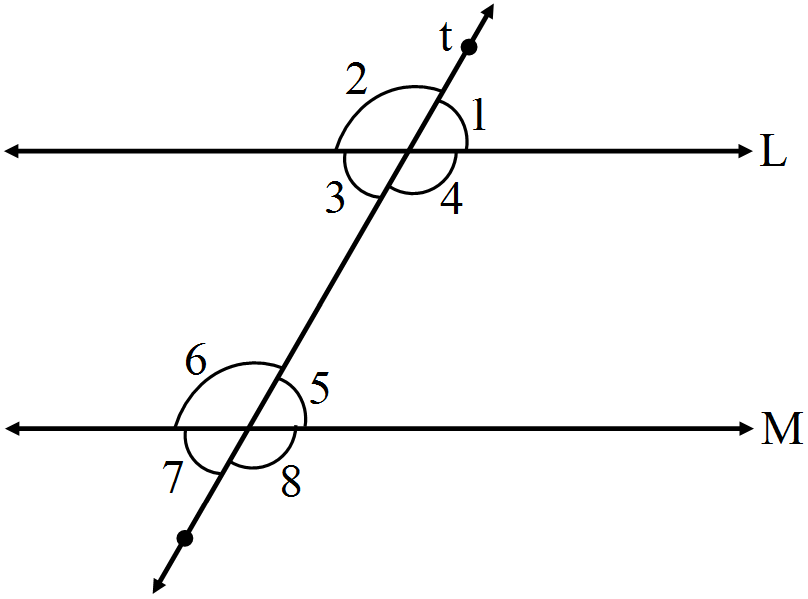
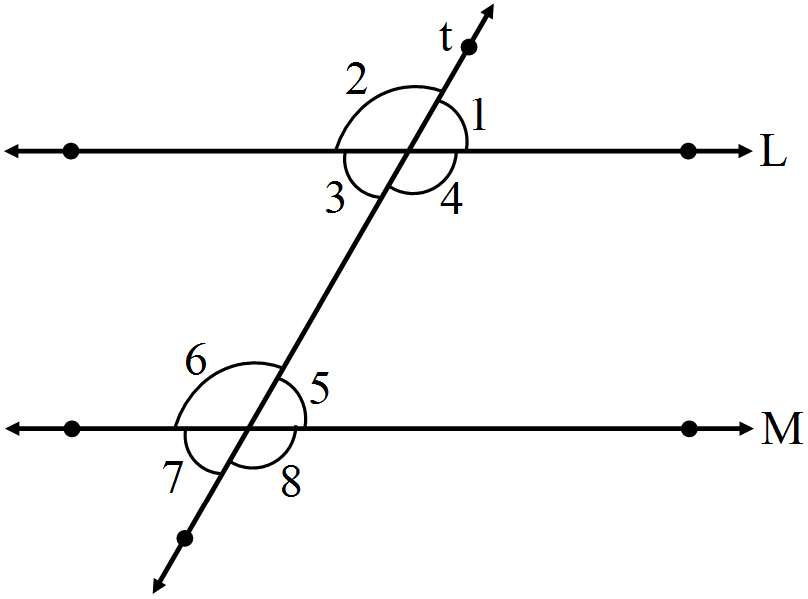
In the given figure, $l || m$ and a transversal $t$ cuts them, If $\angle7=80^\circ,$ find the measure of each of the remaining marked angles.
Answer
Given, $\angle7=80^\circ$Now, $\angle7+\angle8=180 ^\circ$ (linear pair)
$\Rightarrow80^\circ+\angle8=180^\circ$
$\Rightarrow\angle8 =100^\circ$
$\angle7=\angle5$ (vertically opposite angles)
$\Rightarrow\angle5=80^\circ$
Also, $\angle6=\angle8$ (vertically opposite angles)
$\Rightarrow\angle6=100^\circ$
Line $l$ || line $m$ and line $t$ is a transversal.
$\Rightarrow\angle1=\angle5=80^\circ$ (corresponding angles)
$\angle2=\angle6=100^\circ$ (corresponding angles)
$\angle3=\angle7=80^\circ$ (corresponding angles)
$\angle4=\angle8=100^\circ$ (corresponding angles)
View full question & answer
Question 24 Marks
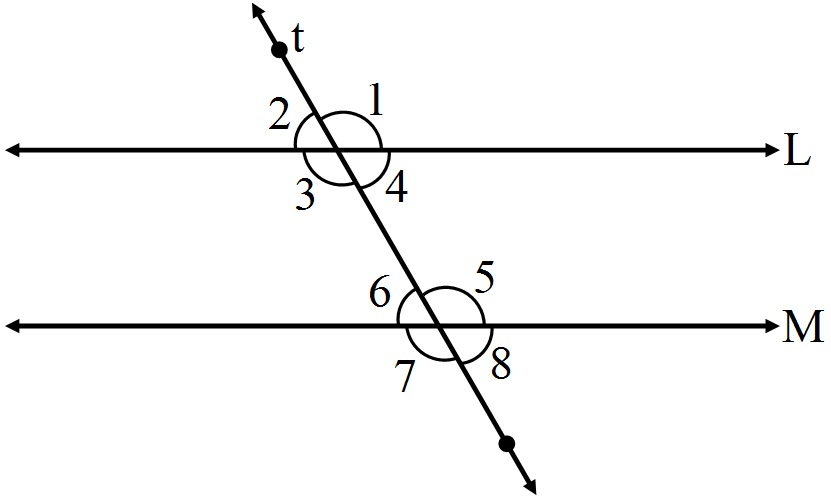
In the given figure, $l || m$ and a transversal $t$ cuts them, If $\angle1=120^\circ,$ find the measure of each of the remaining marked angles.
Answer
Given, $\angle1=120^\circ$
Now, $\angle1+\angle2=180 ^\circ$ (linear pair)
$\Rightarrow120^\circ+\angle2=180^\circ$
$\Rightarrow\angle2 =60^\circ$
$\angle1=\angle3$ (vertically opposite angles)
$\Rightarrow\angle3=120^\circ$
Also, $\angle2=\angle4$ (vertically opposite angles)
$\Rightarrow\angle4=60^\circ$
Line $l ||$ line $m$ and line $t$ is a transversal.
$\Rightarrow\angle5=\angle1=120^\circ$ (corresponding angles)
$\angle6=\angle2=60^\circ$ (corresponding angles)
$\angle7=\angle3=120^\circ$ (corresponding angles)
$\angle8=\angle4=60^\circ$ (corresponding angles)
View full question & answer
Question 34 Marks
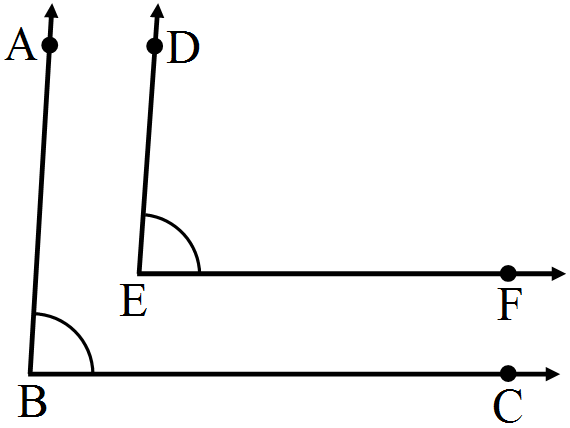
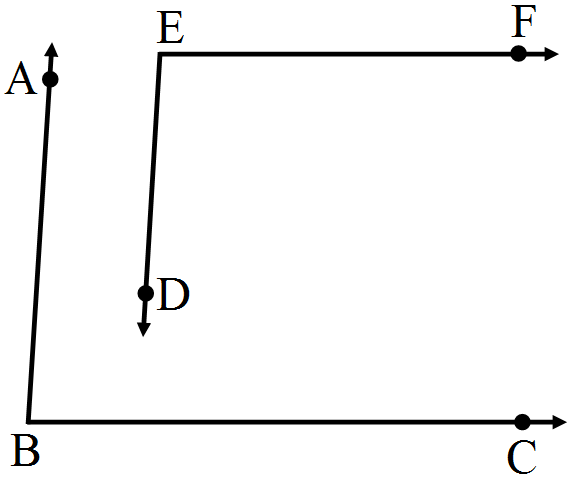
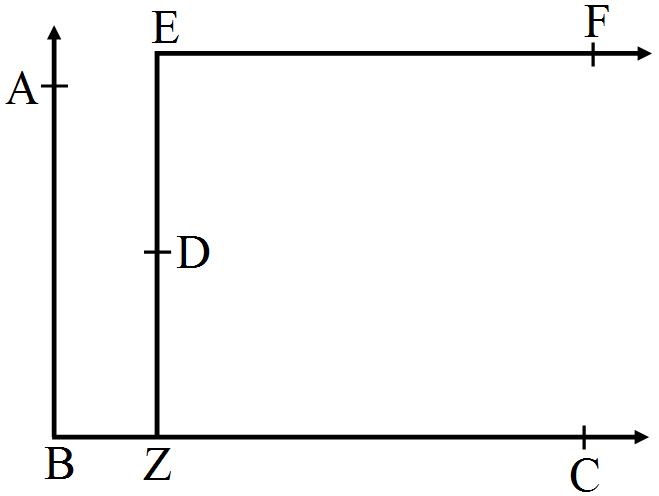
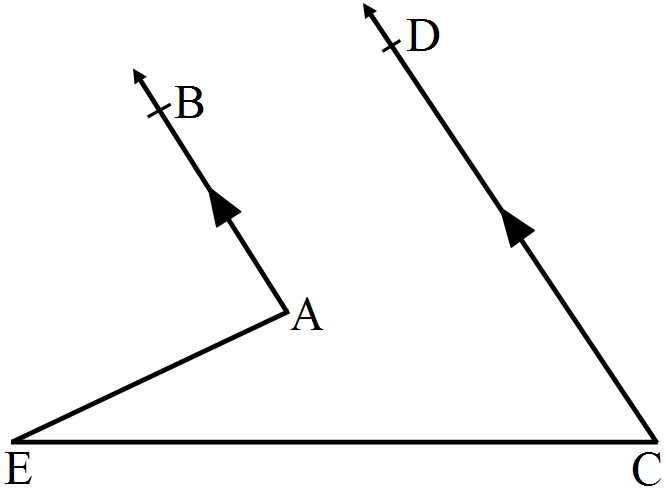
In the given figure, $BA || ED$ and $BC || EF$. Show that $\angle\text{ABC}=\angle\text{DEF}.$
Answer
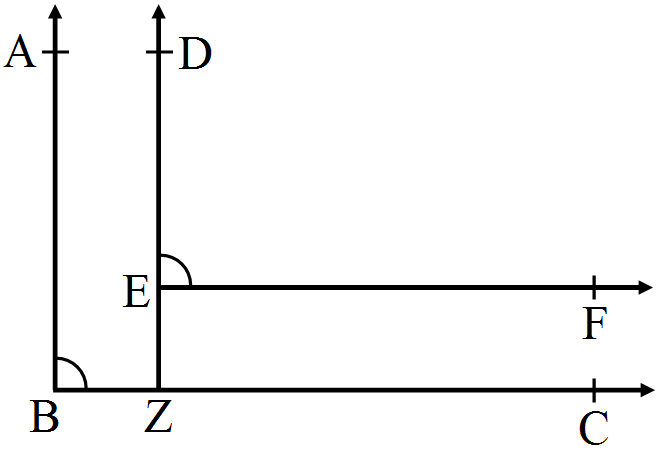
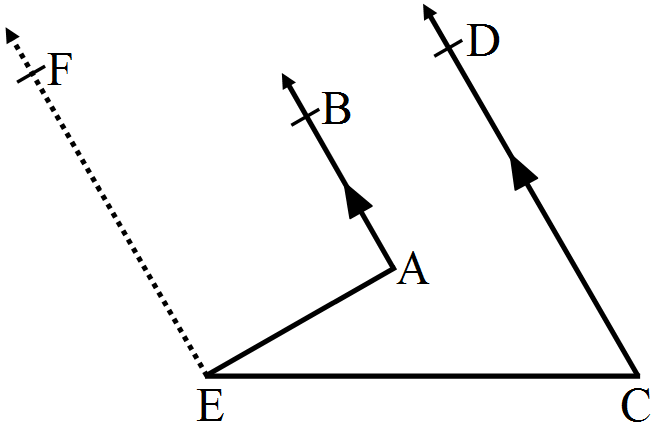
Construction: Produce $DE$ to meet $BC$ at $Z$.

Now, $AB || DZ$ and $BC$ is the transversal.
$\Rightarrow\angle\text{ABC}=\angle\text{DZC}$ $($corresponding angles$) ….(i)$
Also, $EF || BC$ and $DZ$ is the transversal.
$\Rightarrow\angle\text{DZC}=\angle\text{DEF}$ $($corresponding angles$) ….(ii)$
From $(i)$ and $(ii)$, we have
$\angle\text{ABC}=\angle\text{DEF}$
View full question & answer
Question 44 Marks
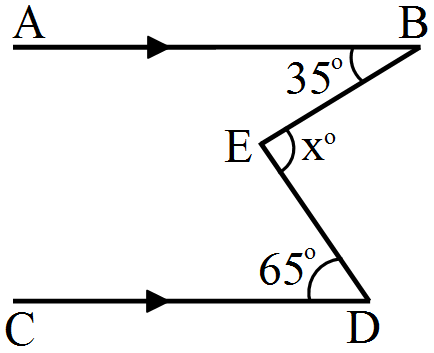
In the figure given below, $AB || CD$. Find the value of $x$ in each case.
Answer
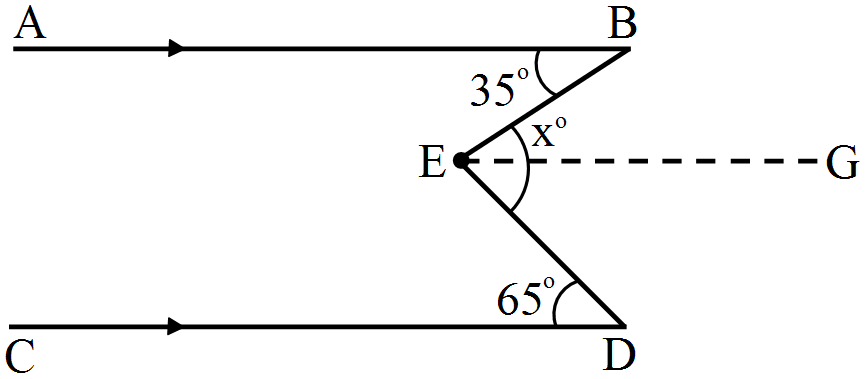
Through $E$ draw $EG || CD$. Now since $EG || CD$ and $ED$ is a transversal.

So, $\angle\text{GED}=\angle\text{EDC}=65^\circ$ [Alternate interior angles] Since $EG || CD$ and $AB || CD, EG || AB$ and $EB$ is transversal. So, $\angle\text{BEG}=\angle\text{ABE}=35^\circ$ [Alternate interior angles] So, $\angle\text{DEB}=\text{x}^\circ$ $\Rightarrow\angle\text{BEG}+\angle\text{GED}=35^\circ+65^\circ=100^\circ.$
Hence, $x = 100$.
View full question & answer
Question 54 Marks
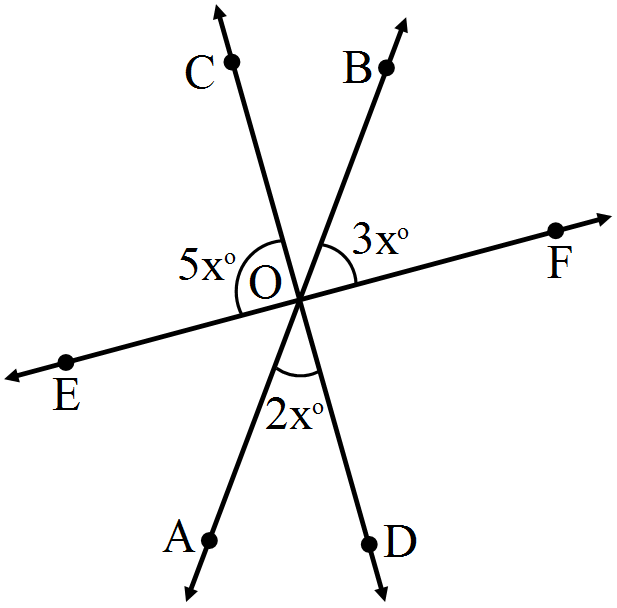
In the adjoining figure, three coplanar lines $AB, CD$ and $EF$ intersect at a point $O$. Find the value of $x$. Also, find $\angle\text{AOD},\angle\text{COE}$ and $\angle\text{AOE}.$
Answer
We know that if two lines intersect, then the vertically-opposite angles are equal.
$\therefore\angle\text{DOF}=\angle\text{COE}=5\text{x}^\circ$ $\angle\text{AOD}=\angle\text{BOC}=2\text{x}^\circ\text{ and}$ $\angle\text{AOE}=\angle\text{BOF}=3\text{x}^\circ$
Since, AOB is a straight line, we have: $\angle\text{AOE}+\angle\text{COE}+\angle\text{BOC}=180^\circ$
$\Rightarrow 3x + 5x + 2x = 180^\circ$
$\Rightarrow 10x = 180^\circ$
$\Rightarrow x = 18^\circ$
Therefore, $\angle\text{AOD}=2\times18^\circ=36^\circ$
$\angle\text{COE}=5\times18^\circ=90^\circ$
$\angle\text{AOE}=3\times18^\circ=54^\circ$
View full question & answer
Question 64 Marks
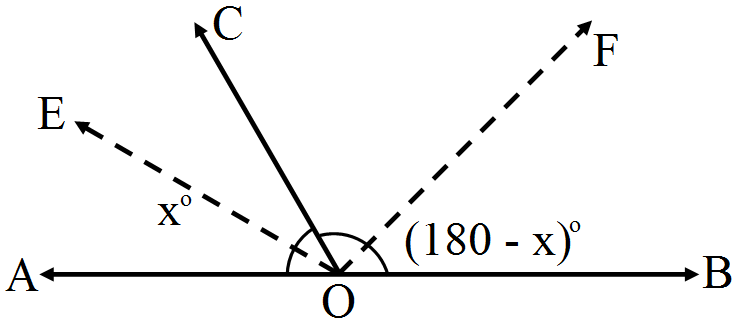
Prove that the bisectors of two adjacent supplementary angles include a right angle.
Answer
Let $AOB$ denote a straight line and let $\angle\text{AOC}$ and $\angle\text{BOC}$

be the supplementary angles.
Then, we have: $\angle\text{AOE}=\angle\text{COE}=\frac{1}{2}\text{x}^\circ\text{ and}$
$\angle\text{BOF}=\angle\text{FOC}=\frac{1}{2}(180-\text{x})^\circ$
Therefore, $\angle\text{COE}+\angle\text{FOC}=\frac{1}{2}\text{x}+\frac{1}{2}(180^\circ-\text{x})$
$=\frac{1}{2}(\text{x}+180^\circ-\text{x})$
$=\frac{1}{2}(180^\circ)$
$=90^\circ$
View full question & answer
Question 74 Marks
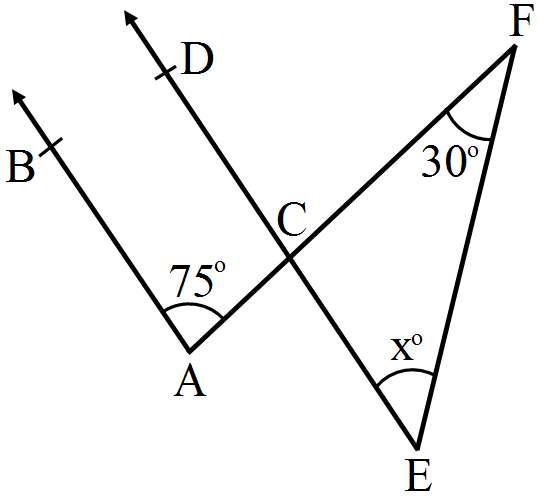
In the given figure, $AB || CD$. Find the value of $x$.
Answer
Since $AB || CD$ and $AC$ is a transversal.
So, $\angle\text{BAC}+\angle\text{ACD}=180^\circ$ [sum of consecutive interior angles is $180^o$]
$\Rightarrow\angle\text{ACD}=180^\circ-\angle\text{BAC}$
$=180^\circ-75^\circ=105^\circ$
$\angle\text{ECF}=\angle\text{ACD}$ [Vertically opposite angles]
$\Rightarrow\angle\text{ECF}=105^\circ$ Now in $\triangle\text{CEF},$
$\angle\text{ECF}+\angle\text{CEF}+\angle\text{EFC}=180^\circ$
$\Rightarrow105^\circ+\text{x}^\circ+30^\circ=180^\circ$
$\Rightarrow\text{x}=180-30-105=45$
Hence, $x = 45$.
View full question & answer
Question 84 Marks
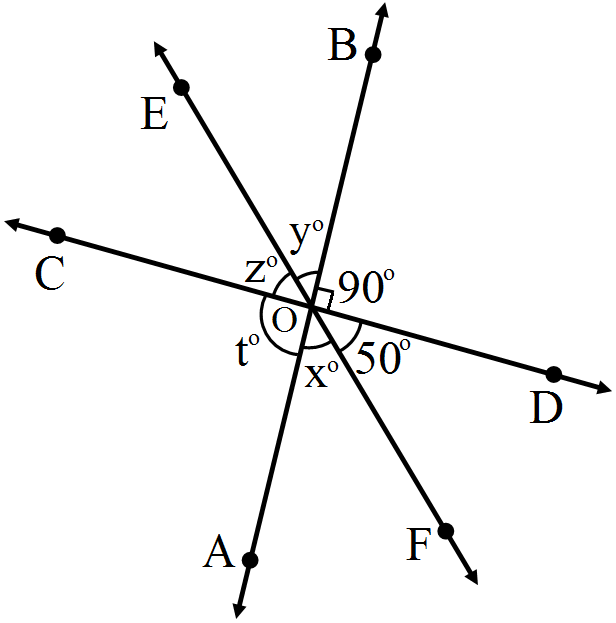
In the adjoining figure, three coplanar lines $AB, CD$ and $EF$ intersect at a point $O$, forming angles as shown. Find the values of $x, y, z$ and $t$.
Answer
We know that if two lines intersect, then the vertically opposite angles are equal.
$\therefore\angle\text{BOD}=\angle\text{AOC}=90^\circ$
Hence, $t = 90^\circ$ Also, $\angle\text{DOF}=\angle\text{COE}=50^\circ$
Hence, $z = 50^\circ$ Since, $AOB$ is a straight line,
we have: $\angle\text{AOC}+\angle\text{COE}+\angle\text{BOE}=180^\circ$
$\Rightarrow 90 + 50 + y = 180^\circ $
$\Rightarrow 140 + y = 180^\circ $
$\Rightarrow y = 40^\circ $
Also, $\angle\text{BOE}=\angle\text{AOF}=40^\circ$
Hence, $x = 40^\circ $ $\therefore$ $x = 40^\circ , y = 40^\circ , z = 50^\circ $ and $t = 90^\circ$
View full question & answer
Question 94 Marks
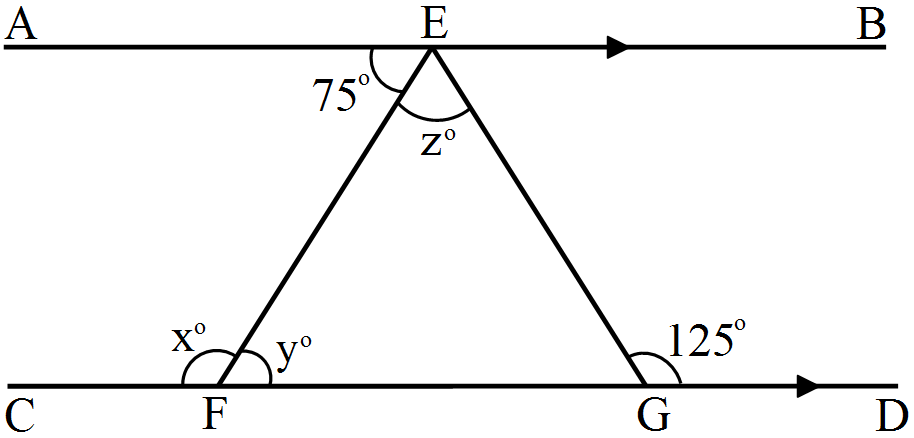
In the given figure, $AB || CD$. Find the value of $x, y$ and z.
Answer
$AB || CD$ and $EF$ is transversal.
$\Rightarrow\angle\text{AEF}=\angle\text{EFG}$ (alternate angles) Given, $\angle\text{AEF}=75^\circ$
$\Rightarrow\angle\text{EFG}=\text{y}=75^\circ$
Now, $\angle\text{EFC}+\angle\text{EFG}=180^\circ$ (linear pair)
$\Rightarrow\text{x}+\text{y}=180^\circ$
$\Rightarrow\text{x}+75^\circ=180^\circ$
$\Rightarrow\text{x}=105^\circ$
$\angle\text{EGD}=\angle\text{EFG}+\angle\text{FEG}$ (Exterior angle property)
$\Rightarrow125^\circ=\text{y}+\text{z}$
$\Rightarrow125^\circ=75^\circ+\text{z}$
$\Rightarrow\text{z}=50^\circ$
Thus, $x = 105^\circ , y = 75^\circ$ and $z = 50^\circ$ .
View full question & answer
Question 104 Marks
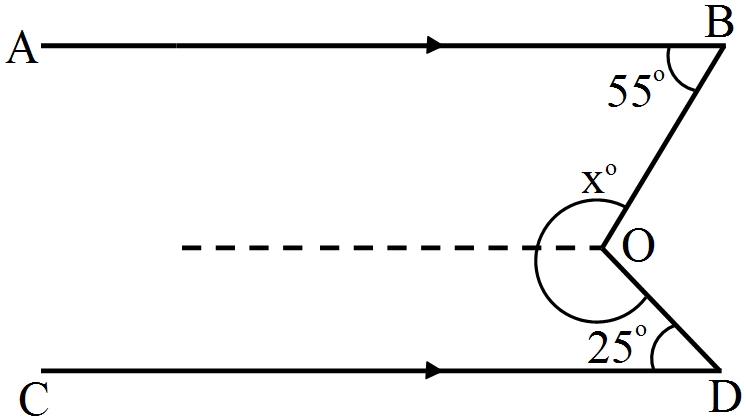
In the figure given below, $AB || CD$. Find the value of $x$ in each case.
Answer
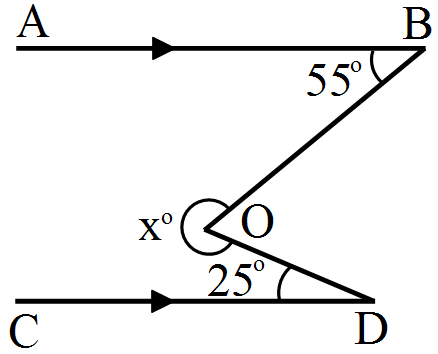
Through $O$ draw $OF || CD$.

 Now since $OF || CD$ and $OD$ is transversal.
$\angle\text{CDO}+\angle\text{FOD}=180^\circ$ [sum of consecutive interior angles is $180^o$]
$\Rightarrow25^\circ+\angle\text{FOD}=180^\circ$
$\Rightarrow\angle\text{FOD}=180^\circ-25^\circ=155^\circ$ As $OF || CD$ and $AB || CD$ [Given]
Thus, $OF || AB$ and $OB$ is a transversal.
So, $\angle\text{ABO}+\angle\text{FOB}=180^\circ$ [sum of consecutive interior angles is $180^o$]
$\Rightarrow55^\circ+\angle\text{FOB}=180^\circ $
$\Rightarrow\angle\text{FOB}=180^\circ-55^\circ=125^\circ$
Now, $\text{x}^\circ=\angle\text{FOB}+\angle\text{FOD}=125^\circ+155^\circ=280^\circ.$
Hence, $x = 280.$
View full question & answer
Question 114 Marks
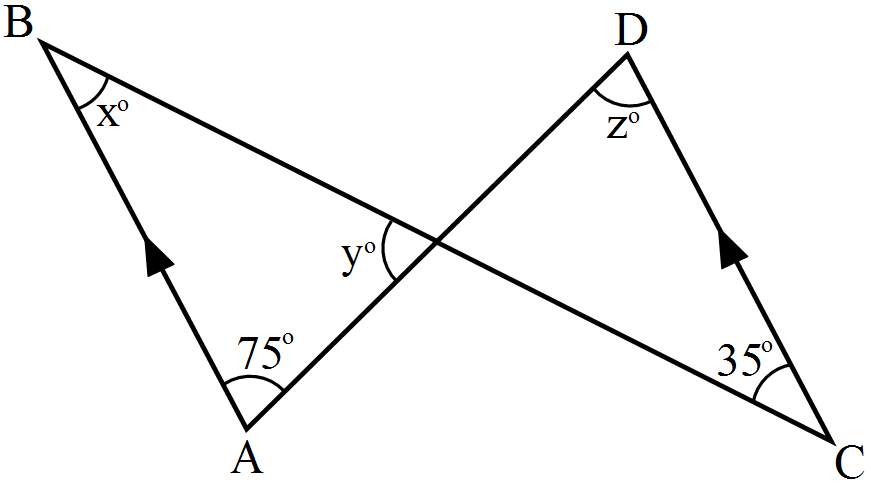
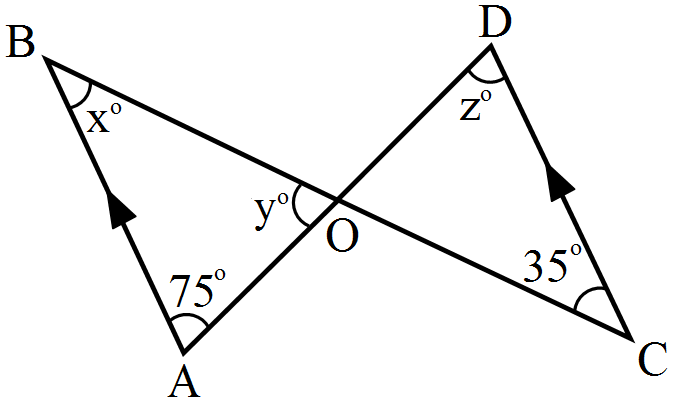
In the given figure, $AB || CD$ Find the value of $x, y$ and $z$.
Answer

Since $AB || CD$ and $BC$ is a transversal.
So, $\angle\text{ABC}=\angle\text{BCD}$
$\Rightarrow\text{x}=35$
Also, $AB || CD$ and $AD$ is a transversal.
So, $\angle\text{BAD}=\angle\text{ADC}$
$\Rightarrow\text{x}=75$ In $\triangle\text{ABO},$
we have, $\angle\text{ABO}+\angle\text{BAO}+\angle\text{BOA}=180^\circ$
$\Rightarrow\text{x}^\circ+75^\circ+\text{y}^\circ=180^\circ$
$\Rightarrow35+75+\text{y}=180$
$\Rightarrow\text{y}=180-110=70$
$\therefore\text{x}=35,\text{y}=70$ and $\text{z}=75.$
View full question & answer
Question 124 Marks
In the given figure, $AB || CD$. Prove that $\angle\text{BAE}-\angle\text{ECD}=\angle\text{AEC}.$
Answer

Draw $\text{EF}||\text{AB}||\text{CD}$ through $E$.
Now, $\text{EF}||\text{AB}$ and $AE$ is the transversal.
Then, $\angle\text{BAE}+\angle\text{AEF}=180^\circ$ [Angles on the same side of a transversal line are supplementary]
Again, $\text{EF}||\text{CD}$ and $CE$ is the transversal.Then,
$\angle\text{DCE}+\angle\text{CEF}=180^\circ$ [Angles on the same side of a transversal line are supplementary]
$\Rightarrow\angle\text{DCE}+(\angle\text{AEC}+\angle\text{AEF})=180^\circ$
$\Rightarrow\angle\text{DCE}+\angle\text{AEC}+180^\circ-\angle\text{BAE}=180^\circ$
 $\Rightarrow\angle\text{BAE}-\angle\text{DCE}=\angle\text{AEC}$
View full question & answer
Question 134 Marks
In the given figure, $BA || ED$ and $BC || EF$. Show that $\angle\text{ABC}+\angle\text{DEF}=180^\circ.$
Answer
Construction: Produce $ED$ to meet $BC$ at $Z$.

Now, $AB || EZ$ and $BC$ is the transversal.
 $\Rightarrow\angle\text{ABZ}+\angle\text{EZB}=180^\circ$ (interior angles)
$\Rightarrow\angle\text{ABC}+\angle\text{EZB}=180^\circ\ .....(\text{i)}$
Also, $EF || BC$ and $EZ$ is the transversal.
$\Rightarrow\angle\text{BZE}=\angle\text{ZEF}$ (alternate angles)
$\Rightarrow\text{BZE}=\angle\text{DEF}\ .....(\text{ii)}$ From $(i)$ and $(ii)$,
 we have $\angle\text{ABC}+\angle\text{DEF}=180^\circ$
View full question & answer
Question 144 Marks
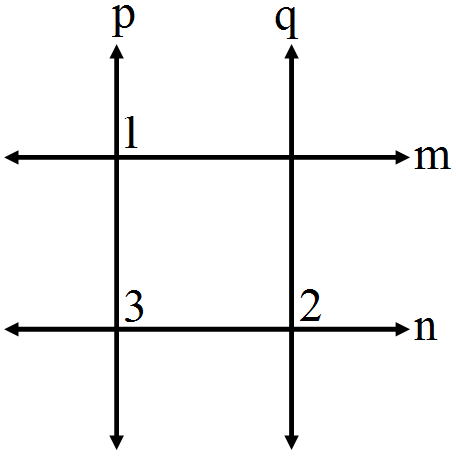
Two lines are respectively perpendicular to two parallel lines. Show that they are parallel to each other.
Answer

Let the two parallel lines be $m$ and $n$.
Let $p ⊥ m$. $\Rightarrow\angle1=90^\circ$
Let q ⊥ n. $\Rightarrow\angle2=90^\circ$
Now, m || n and p is a transversal.
$\Rightarrow\angle1=\angle3$ (corresponding angles)
$\Rightarrow\angle3=90^\circ$ $\Rightarrow\angle3=\angle2$ $($each $90^\circ)$
But, these are corresponding angles, when transversal $n$ cuts lines $p$ and $q$.
$\therefore$ $p || q$.
Hence, two lines which are perpendicular to two parallel lines, are parallel to each other.
View full question & answer
Question 154 Marks
In the given figure, $l || m$ and a transversal t cuts them, If $\angle1:\angle2=2:3,$ find the measure of each of the remaining marked angles.
Answer
Given, $\angle1:\angle2=2:3$
Now, $\angle1+\angle2=180^\circ$ (linear pair)
$\Rightarrow2\text{x}+3\text{x}=180^\circ$
$\Rightarrow5\text{x}=180^\circ$
$\text{x}=36^\circ$
$\Rightarrow\angle1=2\text{x}=72^\circ$ and
$\angle2=3\text{x}=108^\circ$
$\angle1=\angle3$ (vertically opposite angles)
$\Rightarrow\angle3=72^\circ$
Also, $\angle2=\angle4$ (vertically opposite angles)
$\Rightarrow\angle4=108^\circ$ Line $l ||$ line $m$ and line $t$ is a transversal.
$\Rightarrow\angle5=\angle1=72^\circ$ (corresponding angles)
$\angle6=\angle2=108^\circ$ (corresponding angles)
$\angle4=\angle3=72^\circ$ (corresponding angles)
 $\angle8=\angle4=108^\circ$ (corresponding angles)
View full question & answer
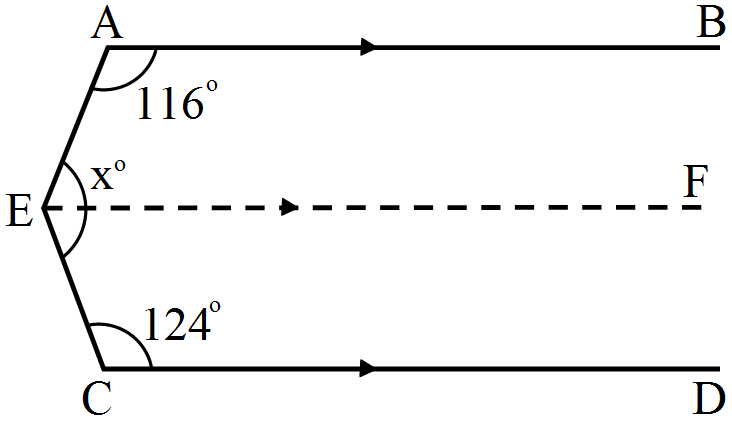
Question 164 Marks
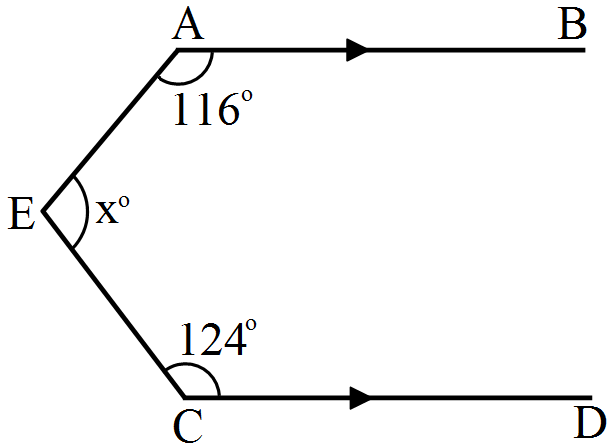
In the figure given below, $AB || CD$. Find the value of $x$ in each case.
Answer
Through $E$, draw $EF || CD$.

 Now since $EF || CD$ and $EC$ is transversal.
$\angle\text{FEC}+\angle\text{ECD}=180^\circ$
[sum of consecutive interior angles is $180^o$]
$\Rightarrow\angle\text{FEC}+124^\circ=180^\circ$
$\Rightarrow\angle\text{FEC}=180^\circ-124^\circ=56^\circ$
Since $EF || CD$ and $AB || CD$
So, $EF || AB$ and $AE$ is a trasveral.
So, $\angle\text{BAE}+\angle\text{FEA}=180^\circ$ $[$sum of consecutive interior angles is $180^o]$
$\therefore116^\circ+\angle\text{FEA}=180^\circ$
$\Rightarrow\angle\text{FEA}=180^\circ-116^\circ=64^\circ$
Thus, $\text{x}^\circ=\angle\text{FEA}+\angle\text{FEC}$
$=64^\circ+56^\circ=120^\circ.$
View full question & answer
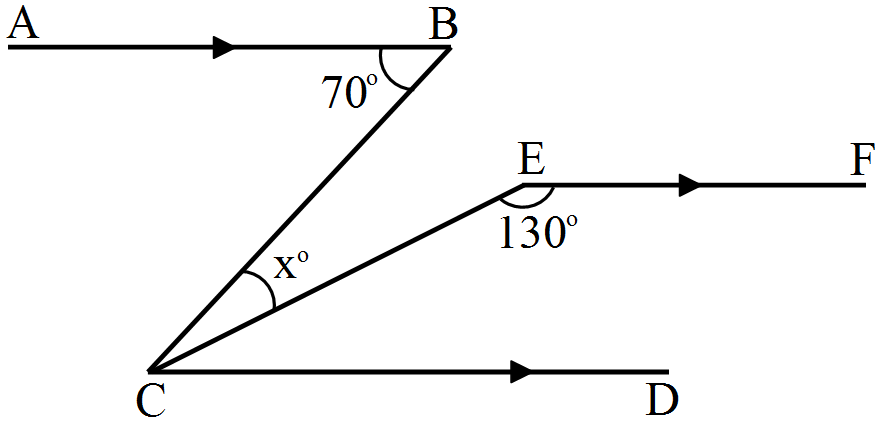
Question 174 Marks
In the given figure, $AB || CD || EF$. Find the value of $x$.
Answer
Since $AB || CD$ and $BC$ is a transversal.
So, $\angle\text{ABC}=\angle\text{BCD}$ [atternate interior angles]
$\Rightarrow70^\circ=\text{x}+\angle\text{ECD}\ ....(\text{i)}$
Now, $CD || EF$ and $CE$ is transversal.
So, $\angle\text{ECD}+\angle\text{CEF}=180^\circ$ [sum of consecutive interior angles is $180^\circ]$
$\therefore\angle\text{}\text{ECD}+130^\circ=180^\circ$
$\Rightarrow\angle\text{ECD}=180^\circ-130^\circ=50^\circ$
Putting $\angle\text{ECD}=50^\circ $ in $(i)$
we get, $70^\circ=\text{x}^\circ+50^\circ$
$\Rightarrow\text{x}=70-50=20$
View full question & answer
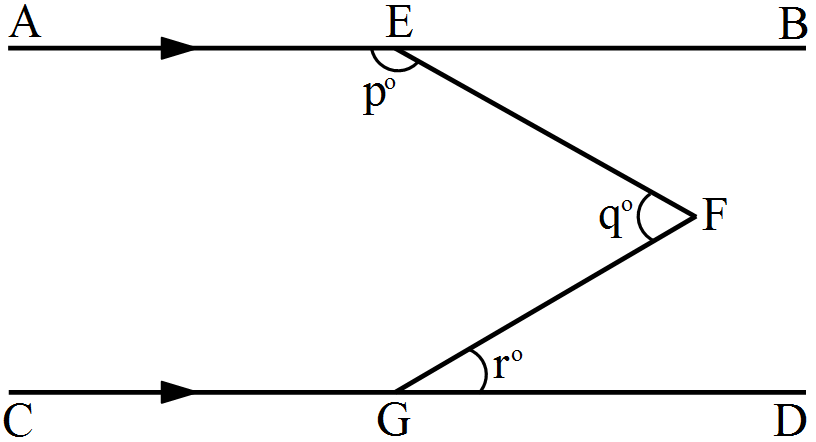
Question 184 Marks
In the given figure, $AB || CD$. Prove that $P + q - r = 180.$
Answer
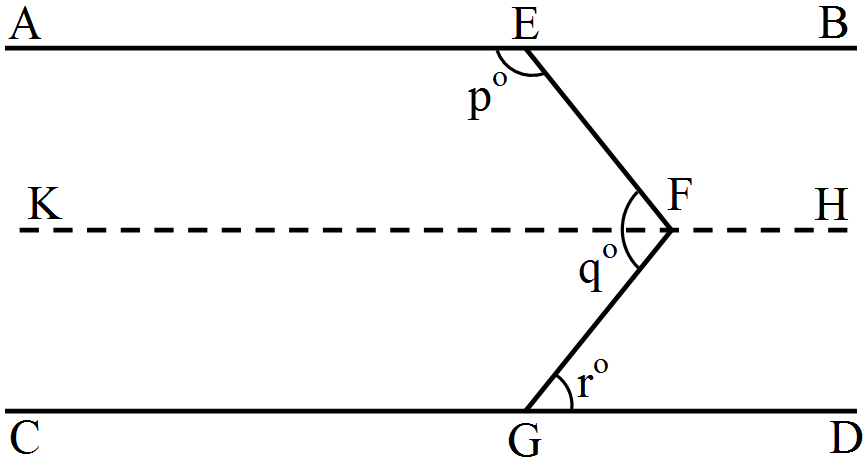
Through $F$, draw $KH || AB || CD$

Now, $KF || CD$ and $FG$ is a transversal.
$\Rightarrow\angle\text{KFG}=\angle\text{FGD}=\text{r}^\circ (\text{i})$ [alternate angles]
Again $AE || KF$, and $EF$ is a transversal.
So, $\angle\text{AEF}+\angle\text{KFE}=180^\circ$
$\Rightarrow\angle\text{KFE}=180^\circ-\text{p}^\circ(\text{ii)}$
​​​​​​​Adding $(i)$ and $(ii)$ we get,
$\angle\text{KFG}+\angle\text{KFE}=180-\text{p}+\text{r}$
$\Rightarrow\angle\text{EFG}=180-\text{p}+\text{r}$
$\Rightarrow\text{q}=180-\text{p}+\text{r}$ $\text{i}.\text{e}.,\ \text{p}+\text{q}-\text{r}=180$
View full question & answer
4 Marks Questions - MATHS STD 9 Questions - Vidyadip