Sample QuestionsStructure of the Atom questions
One sample from each question group in this chapter. Select any group above to see the full set with answer keys.
In a sample of ethyl ethanoate $\left(CH _3 COOC _2 H \right)$ the two oxygen atoms have the same number of electrons but different number of neutrons. Which of the following is the correct reason for it?
- A
One of the oxygen atoms has gained electrons.
- B
One of the oxygen atoms has gained two neutrons.
- ✓
The two oxygen atoms are isotopes.
- D
The two oxygen atoms are isobars.
Answer: C.
View full solution →Rutherford's scattering experiment estimated the size of:
Answer: D.
View full solution →In the Thomson’s model of the atom, which of the following statements are correct?
- The mass of the atom is assumed to be uniformly distributed over the atom.
- The positive charge is assumed to be uniformly distributed over the atom.
- The electrons are uniformly distributed in the positively charged sphere.
- The electrons attract each other to stabilize the atom.
- ✓
$(i), (ii)$ and $(iii)$
- B
$(i)$ and $(iii)$
- C
$(i)$ and $(iv)$
- D
$(i), (iii)$ and $(iv)$
Answer: A.
View full solution →The atomic number of an element $X$ is $8$ and that of element $Y$ is $4$. Both these elements can exhibit a valency of:
Answer: B.
View full solution →Atomic number of atoms represents:
Answer: C.
View full solution →In the following questions, a statement of Assertion $(A)$ is followed by a statement of Reason $(R)$.
Mark the correct choice as:
Assertion: The valency of an atom of flourine is $7$.
Reason: The number of electrons present in the outermost shell of an atom are known as the valence electrons.
- A
If both Assertion and Reason are true and Reason is the correct explanation of Assertion.
- B
If both Assertion and Reason are true but Reason is not the correct explanationi of Assertion.
- C
If Assertion is true but Reason is false.
- ✓
If Assertion is false but Reason is true.
Answer: D.
View full solution →In the following Questions, the Assertion and Reason have been put forward. Read the statements carefully and choose the correct alternative from the following:
Assertion: $Na, K, Ca, Mg$ are metals because they can lose electrons to form positive ions (cations).
Reason: $F, CI, N, P$ are non-metals because they can gain electrons to form anions $(-)$.
- ✓
Both the Assertion and the Reason are correct and the Reason is the correct explanation of the Assertion.
- B
The Assertion and the Reason are correct but the Reason is not the correct explanation of the Assertion.
- C
Assertion is true but the Reason is false.
- D
The statement of the Assertion is false but the Reason is true.
Answer: A.
View full solution →In the following questions, a statement of Assertion $(A)$ is followed by a statement of Reason $(R)$. Mark the correct choice as:
Assertion: Bohr's orbits are called stationary orbits.
Reason: Electrons remain stationary in these orbits for some time.
- A
If both Assertion and Reason are true and Reason is the correct explanation of Assertion.
- B
If both Assertion and Reason are true but Reason is not the correct explanationi of Assertion.
- ✓
If Assertion is true but Reason is false.
- D
If Assertion is false but Reason is true.
Answer: C.
View full solution →In the following Questions, the Assertion and Reason have been put forward. Read the statements carefully and choose the correct alternative from the following:
Assertion: Atomic number is equal to number of protons only in case of ions.
Reason: Atomic number is equal to number of protons or electrons even in an ion.
- A
Both the Assertion and the Reason are correct and the Reason is the correct explanation of the Assertion.
- ✓
The Assertion and the Reason are correct but the Reason is not the correct explanation of the Assertion.
- C
Assertion is true but the Reason is false.
- D
The statement of the Assertion is false but the Reason is true.
Answer: B.
View full solution →In the following questions, a statement of Assertion $(A)$ is followed by a statement of Reason $(R)$. Mark the correct choice as:
Assertion: According to Bohr's model, the orbits of an atom are also called energy levels.
Reason: Orbits are the spheres containing definite value of energy.
- ✓
If both Assertion and Reason are true and Reason is the correct explanation of Assertion.
- B
If both Assertion and Reason are true but Reason is not the correct explanationi of Assertion.
- C
If Assertion is true but Reason is false.
- D
If Assertion is false but Reason is true.
Answer: A.
View full solution →State whether the following statement is true or false: Radioactive isotope of iodine is used for making the medicine called tincture iodine.
State whether the following statements are true or false: The cathode rays obtained from all the gases consist of negatively charged particles called electrons.
For the following statements, write $T$ for True and F for False. $J.J$. Thomson proposed that the nucleus of an atom contains only nucleons.
View full solution →Most part of the atom is hollow.
For the following statements, write $T$ for True and $F$ for False. The mass of an electron is about $\frac{1}{2000}$ times that of proton.
View full solution →Complete the following statements: Isotopes have different mass numbers because their nuclei contain different number of _________.
Fill in the following blanks:
| Atomic number |
Mass number |
Protons |
Neutrons |
Electrons |
Symbol |
| $10$ |
$22$ |
............ |
............ |
............ |
............ |
View full solution →Fill in the following blanks in respect of an atom of an element:
|
No. of Protons
|
No. of Neutrons
|
Mass number
|
Atomic number
|
No. of electrons
|
Symbol
|
|
$11$
|
$12$
|
............
|
............
|
............
|
............
|
View full solution →Fill in the blanks in the following statements: The total number of protons and neutrons in the nucleus of an atom is called its __________.
Fill in the blanks in the following statements: The subatomic particle not present in a hydrogen atom is _________.
What is the number of valence electrons in the chlorine atom$?$
View full solution →The total number of electrons in a nitrogen atom is $7.$ Find the number of valence electrons in it.
View full solution →All the gases form cathode rays and anode rays when electricity is passed through them: What does the formation of anode rays tell us about the atoms?
What are isotopes? Explain by giving an example.
What is a neutron? State its relative mass and charge.
The composition of two atomic particles is given below:
|
|
X
|
Y
|
|
Protons
|
$8$
|
$8$
|
|
Neutrons
|
$8$
|
$9$
|
|
Electrons
|
$8$
|
$8$
|
- What is the mass number of $X$?
- What is the mass number of $Y$?
- What is the relation between $X$ and $Y$?
- Which element/ elements do they represent?
View full solution →On the basis of Thomson’s model of an atom, explain how the atom is neutral as a whole.
What important information is furnished about the nucleus of an atom by the alpha particle scattering experiment of Rutherford?
Write the electronic configuration of any one pair of isotopes and isobars.
List three steps of an experiment performed by Rutherford for his model of an atom.
If $K$ and $L$-shells of an atom are full and in $M$-shell, there is only one electron, then what would be the total number of electrons in the atom? Name the element. Write the symbol and draw the Bohr model.
View full solution →Why do Helium, Neon and Argon have a zero valency?
Three different atoms of oxygen are represented as:
$^{16}_{\ 8}\text{O},\ ^{17}_{\ 8}\text{O}\text{ and }^{18}_{\ 8}\text{O}$
- What do the subscripts (lower figures) and superscripts (upper figures) represent?
- What factor is responsible for the change in the superscripts $16, 17$ and $18$, though the element is the same?
- What is the usual name for such atoms of an element?
- Give the nuclear composition of $^{18}_{\ 8}\text{O}$
View full solution →Nucleus of an atom is positively charged and electrons around it are negatively charged. Then why do electrons not just fall to the nucleus out of attraction?
Define valency by taking examples of silicon and oxygen.
Describe the Rutherford’s model of an atom. State one drawback of Rutherford’s model of the atom.
Describe Bohr’s model of the atom. How did Neils Bohr explain the stability of atom?
What are the features and drawbacks of Rutherford’s nuclear model of an atom?
Explain with examples
- Atomic number,
- Mass number,
- Isotopes,
- Isobars.
Give any two uses of isotopes.
In what way is the Rutherford’s atomic model different from that of Thomson’s atomic model?
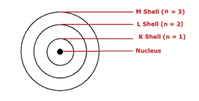
Neils Bohr got the Nobel Prize for his work on the structure of atom in $1922$. Among Professor Bohr’s numerous writings, three appearing as books are: $(i)$ The Theory of Spectra and Atomic Constitution, $(ii)$ Atomic Theory and, $(iii)$ The Description of Nature.
In order to overcome the objections raised against Rutherford’s model of the atom, Neil’s Bohr put forward the following postulates about the model of an atom:
- Only certain special orbits known as discrete orbits of electrons, are allowed inside the atom.
- While revolving in discrete orbits the electrons do not radiate energy. These orbits or shells are called energy levels. Energy levels in an atom are shown in Fig. A few energy levels in an atom These orbits or shells are represented by the letters $K,L,M,N,…$ or the numbers, $n=1,2,3,4,….$
$(1)$ The orbits or shells are represented by
$(a)$ Letters
$(b)$ Numbers
$(c)$ Both a & b
$(d)$ Special symbols
$(2)$ These orbits or shells are called
$(a)$ Energy levels
$(b)$ Discrete orbit
$(c)$ Atomic levels
$(d)$ None of the above
$(3)$ Which of the following book is written by Professor Bohr’s
$(a)$ The Theory of Spectra and Atomic Constitution
$(b)$ Atomic Theory
$(c)$ The Description of Nature
$(d)$ All of the above
$(4)$ Identify the correct statement
Statement $1 –$ The orbits or shells are represented by letters only.
Statement $2 –$ The orbits or shells are represented by numbers only.
Statement $3 –$ While revolving in discrete orbits the electrons do not radiate energy.
Statement $4 –$ Certain special orbits known as discrete orbits of electrons.
$(a)$ Both $1 \& 2$
$(b)$ Both $3 \& 4$
$(c)$ Only $3$
$(d)$ All of the above
$(5)$ Write the postulate of Neil’s Bohr model of an atom?A number of atoms of some elements have the same atomic number but different mass numbers. For example, hydrogen atom, it has three atomic species, namely Protium, Deuterium and Tritium. The atomic number of each one is $1$, but the mass number is $1, 2$ and $3,$ respectively. On the basis of these examples, isotopes are defined as the atoms of the same element, having the same atomic number but different mass numbers. Therefore, we can say that there are three isotopes of hydrogen atom, namely protium, deuterium and tritium.Many elements consist of a mixture of isotopes. Each isotope of an element is a pure substance. The chemical properties of isotopes are similar but their physical properties are different.
The mass of an atom of any natural element is taken as the average mass of all the naturally occurring atoms of that element. If an element has no isotopes, then the mass of its atom would be the same as the sum of protons and neutrons in it. But if an element occurs in isotopic forms, then we have to know the percentage of each isotopic form and then the average mass is calculated.
Chemical properties of all the isotopes of an element are the same. Some isotopes have special properties which find them useful in various fields. Such as, an isotope of uranium is used as a fuel in nuclear reactors, isotope of cobalt is used in the treatment of cancer, iodine is used in the treatment of goitre.
$(1)$ The atoms of the same element, having the same atomic number but different mass numbers are termed as __________
$(a)$ Isotopes
$(b)$ Protium
$(c)$ Deuterium
$(d)$ Tritium
$(2)$ Which of the following are the isotopes of hydrogen atom.
$(a)$ Protium
$(b)$ Deuterium
$(c)$ Tritium
$(d)$ All of the above
$(3)$ Identify the correct statement
Statement $1 –$ Chemical properties of all the isotopes of an element are the same.
Statement $2 –$ Physical properties are different.
Statement $3 –$ Chemical properties of all the isotopes of an element are different.
Statement $4 –$ Physical properties are same.
$(a)$ Only $2$
$(b)$Both $3 \& 4$
$(c)$ Both $1 \& 2$
$(d)$ All of the above
$(4)$ Give any two uses of isotopes.
$(5)$ Define isotopes.
View full solution →Protons are present in the nucleus of an atom. It is the number of protons of an atom, which determines its atomic number. It is denoted by$ ‘Z’.$ All atoms of an element have the same atomic number, $Z.$ In fact, elements are defined by the number of protons they possess. For hydrogen, $Z = 1$, because in hydrogen atom have only one proton is present in the nucleus. Therefore, the atomic number is defined as the total number of protons present in the nucleus of an atom.The mass of an atom is practically due to protons and neutrons alone. These are present in the nucleus of an atom. Hence protons and neutrons are also called nucleons. Therefore, the mass of an atom resides in its nucleus. For example, mass of carbon is $12$ u because it has $6$ protons and $6$ neutrons, $6 u + 6 u = 12 u$. Similarly, the mass of aluminium is $27$ u $(13$ protons $+14$ neutrons$)$. The mass number is defined as the sum of the total number of protons and neutrons present in the nucleus of an atom. It is denoted by $‘A’$.
$(1)$ Atomic number is denoted by
$(a) X$
$(b) Y$
$(c) Z$
$(d) z$
$(2)$ The sum of the total number of protons and neutrons present in the nucleus of an atom.
$(a)$ Atomic number
$(b)$ Mass number
$(c)$ Atomic weight
$(d)$ None of the above
$(3)$ Mass number is denoted by
$(a) A$
$(b) a$
$(c) Z$
$(d) z$
$(4)$ Identify the correct statement
Statement $1 –$ Protons are present in the nucleus of an atom.
Statement $2 –$ Atomic number is the number of protons of an atom.
Statement $3 –$ Atomic number is denoted by $‘Z’.$
Statement $4 –$ The mass of an atom is due to protons and neutrons alone.
$(a)$ Only $2$
$(b)$ Both $3 \& 4$
$(c)$ Both $1 \& 2$
$(d)$ All of the above
$(5)$ Why mass of carbon is $12u$ give the reason?
View full solution →Rutherford $(1871-1937)$ was known as the ‘Father’ of nuclear physics. He is famous for his work on radioactivity and the discovery of the nucleus of an atom with the gold foil experiment. Ernest Rutherford was interested in knowing how the electrons are arranged within an atom. Rutherford designed an experiment for this. In this experiment, fast moving alpha $(\alpha )$-particles were made to fall on a thin gold foil. On the basis of his experiment, Rutherford put forward the nuclear model of an atom, which had the following features:
- There is a positively charged centre in an atom called the nucleus. Nearly all the mass of an atom resides in the nucleus.
- The electrons revolve around the nucleus in circular paths.
- The size of the nucleus is very small as compared to the size of the atom.
Drawbacks of Rutherford’s model of the atom: The revolution of the electron in a circular orbit is not expected to be stable. Any particle in a circular orbit would undergo acceleration. During acceleration, charged particles would radiate energy. Thus, the revolving electron would lose energy and finally fall into the nucleus. If this were so, the atom should be highly unstable and hence matter would not exist in the form that we know. We know that atoms are quite stable.
(1) Which of the following scientist was known as the ‘Father of nuclear physics?
$(a)$ $J.J.$ Thomson
$(b)$ John Dalton
$(c)$ $E.$ Rutherford
$(d)$ Neilsbhore
(2) Positively charged centre in an atom is termed as
$(a)$ Nucleus
$(b)$ Molecule
$(c)$ Atom
$(d)$ Protons
(3) Identify the correct statement
Statement $1$ – Positively charged centre in an atom called the nucleus.
Statement $2$ – The electrons revolve around the nucleus in circular paths.
Statement $3$ – Nearly all the mass of an atom resides in the nucleus.
Statement $4$ – The size of the nucleus is very small as compared to the size of the atom.
$(a)$ Only $2$
$(b)$ Both $3$ & $4$
$(c)$ Both $1$ & $2$
$(d)$ All of the above
(4) Write the features of Rutherford’s nuclear model of an atom?
(5) Define Nucleus. View full solution →Dalton’s atomic theory suggested that the atom was indivisible and indestructible. But the discovery of two fundamental particles (electrons and protons) inside the atom, led to the failure of this aspect of Dalton’s atomic theory. It was then considered necessary to know how electrons and protons are arranged within an atom. For explaining this, many scientists proposed various atomic models. $J.J.$ Thomson was the first one to propose a model for the structure of an atom.$J.J.$ Thomson $(1856- 1940)$ was a British physicist, He was awarded the Nobel Prize in Physics for his work on the discovery of electrons. Thomson proposed the model of an atom to be similar to that of a Christmas pudding. The electrons, in a sphere of positive charge. We can also think of a watermelon, the positive charge in the atom is spread all over like the red edible part of the watermelon, while the electrons are studded in the positively charged sphere, like the seeds in the watermelon. Thomson proposed that: An atom consists of a positively charged sphere and the electrons are embedded in it. The negative and positive charges are equal in magnitude. So, the atom as a whole is electrically neutral.
(1) Identify the correct statement
Statement $1$ – Dalton’s atomic theory suggested that the atom was indivisible and indestructible.
Statement $2$ – Electrons and protons are present inside the atom.
Statement $3$ – $J.J.$ Thomson was the first one to propose a model for the structure of an atom.
Statement $4$ – Protons are positively charged particle.
$(a)$ Only $2$
$(b)$ Both $3$ & $4$
$(c)$ Both $1$ & $2$
$(d)$ All of the above
(2) According to Dalton’s Atomic Theory, matter consists of indivisible _______
$(a)$ Molecules
$(b)$ Atoms
$(c)$ Ions
$(d)$ Mixtures
(3) Who was the first to propose atomic theory?
$(a)$ $J.J.$ Thomson
$(b)$ John Dalton
$(c)$ $E.$ Rutherford
$(d)$ Neilsbhore
(4) “Atom is indivisible and indestructible” why this aspect of Dalton’s atomic theory leds to the failure?
(5) Explain the J.J. Thomson’s model for the structure of an atom?
View full solution →