Questions

3 Marks Question

Take a timed test

41 questions · self-marked practice — reveal the answer and mark yourself.

Question 13 Marks
What is the importance of plasma proteins?
Answer
Plasma is the colourless fluid of blood which helps in the transport of food, $CO _2$, waste products, and salts. It constitutes about 55% of blood. About 6.8% of the plasma is constituted by proteins such as fibrinogens, globulins, and albumins. Fibrinogen is a plasma glycoprotein synthesised by the liver. It plays a role in the clotting of blood. Globulin is a major protein of the plasma. It protects the body against infecting agents. Albumin is a major protein of the plasma. It helps in maintaining the fluid volume within the vascular space.
View full question & answer
Question 23 Marks
Name the components of the formed elements in the blood and mention one major function of each of them.
Answer
The formed elements of the blood are
  • Red blood cells (Erythrocytes)
  • White blood cells (Leucocytes)
  • Blood platelets (Thrombocytes)
  1. Functions of red blood cells: RBCs are oxygen carriers. They contain haemoglobin which is the respiratory pigment. Haemoglobin combines with oxygen to form oxyhaemoglobin which carries oxygen to regions of lower oxygen concentration in the body.
  2. Functions of white blood cells: Neutrophils perform a defense mechanism against bacteria called phagocytosis.Lymphocytes produce antibodies which kill or neutralise germs.
  3. Functions of blood platelets: Blood platelets help in blood coagulation.
View full question & answer
Question 33 Marks
Sino-atrial node is called the pacemaker of our heart. Why?
Answer
  • The sino-atrial node generates the action potential and produces the cardiac impulse.
  • This cardiac impulse then spreads over atria and ventricles causing them to contract or relax.
  • The SA node can generate a maximum number of action potentials which is about 70−75 per minute.
  • It also controls the rhythmic contractile activity of the heart.
  • Because of the property of originating a cardiac impulse, the sino-atrial node is called the pacemaker of the heart.
View full question & answer
Question 43 Marks
What is the difference between lymph and blood?
Answer
 
Blood
 
Lymph
1.
Blood is red liquid connective tissue.
1.
Lymph is a white tissue fluid
2.
. It flows through blood vessels—arteries, veins and capillaries.
2.
It flows in the lymph vessels.
3.
It contains haemoglobin, red blood cells, white blood cells and platelets.
3.
It contains white blood cells called lymphocytes.
4.
It transports gases and other nutrients in the body
4.
Exchange of gases and nutrients between the blood and the cells occurs through the lymph.
View full question & answer
Question 53 Marks
Write the differences between: Blood and Lymph.
Answer
 
Blood
 
Lymph
1.
Blood is a red-coloured fluid that contains RBCs.
1.
Lymph is a colorless fluid that lacks RBCs.
2.
It contains plasma, RBCs, WBCs, and platelets. It also contains proteins.
2.
It contains plasma and lesser number of WBCs and platelets. It lacks proteins.
3.
Blood transports nutrients and oxygen from one organ to another.
3.
Lymph plays a role in the defensive system of the body. It is a part of the immune system.
View full question & answer
Question 63 Marks
Why do we consider blood as a connective tissue?
Answer
Connective tissues have cells scattered throughout an extra-cellular matrix. They connect different body systems. Blood is considered as a type of connective tissue because of two reasons.
  1. Like the other connective tissues, blood is mesodermal in origin.
  2. It connects the body systems, transports oxygen and nutrients to all the parts of the body, and removes the waste products. Blood has an extra-cellular matrix called plasma, with red blood cells, white blood cells, and platelets floating in it.
View full question & answer
Question 73 Marks
Write the differences between: Systole and Diastole.
Answer
 
Systole
 
Diastole
1.
It is the contraction of the heart chambers to drive blood into the aorta and the pulmonary artery.
1.
It is the relaxation of the heart chambers between two contractions. During diastole, the chambers are filled with blood.
2.
Systole decreases the volume of the heart chambers and forces the blood out of them.
2.
Diastole brings the heart chambers back into their original sizes to receive more blood.
View full question & answer
Question 83 Marks
Write short notes on:
  1. Erythrocytes.
  2. Leucocytes.
  3. Structure of Heart.
Answer
  1. Erythrocytes: They are also known as Red Blood Cells (RBC). They are the most abundant of all the cells in blood. A healthy adult man has, on an average, 5 millions to 5.5 millions of RBCs mm of blood. RBCs are formed in the red bone marrow in the adults. RBCs are devoid of nucleus in most of the mammals and are biconcave in shape. They have a red coloured, iron containing complex protein called haemoglobin, hence the colour and name of these cells. A healthy individual has 12-16gms of haemoglobin in every 100ml of blood. These molecules play a significant role in transport of respiratory gases. RBCs have an average life span of 120 days after which they are destroyed in the spleen. Hence, spleen is also known as the graveyard of RBCS.
  2. Leucocytes: They are also known as White Blood Cells (WBC) as they are colourless due to the lack of haemoglobin. They are nucleated and are relatively lesser in number which averages 6000-8000mm of blood. Leucocytes are generally short lived There are two main categories of WBCs:
  1. Granulocytes, e.g., neutrophils, eosinophils and basophils
  2. Agranulocytes. e.g., Lymphocytes and monocytes.
  • Neutrophils are the most abundant cells (60-65 percent of the total WBCs and basophils are the least 10.5-1 percent) among them. Neutrophils and monocytes (6-8 percent) are phagocytic cells which destroy foreign organisms entering the body.
  • Basophils secrete histamine, serotonin, heparin, etc., and are involved in inflammatory reactions.
  • Eosinophils (2-3 percent) resist infections and are also associated with allergic reactions.
  • Lymphocytes (20-25 percent) are of two major types - 'B' and T forms. Both B and T lymphocytes are responsible for immune responses of the body.
  1. Structure of Heart: The heart is a muscular organ. It consists four chambers which are as follows:
  • Right Auricle.
  • Left Auricle.
  • Right Ventricle.
  • Left Ventricle.
Apart from these four chambers the heart consists valves at junctions of auricles and ventricles and at junctions of right ventricle and pulmonary artery. These valves allow unidirectional flow of blood.
View full question & answer
Question 93 Marks
Write short note on the following, Coronary Artery Disease.
Answer
When atherosclerosis happens in coronary artery; it diminishes the blood supply to the cardiac muscles: This condition is known as coronary artery disease (CAD). Long term repercussions of coronary artery disease include damage to the heart muscle and can also end up in myocardial infarction.
View full question & answer
Question 103 Marks
Name the antigen(s) and antibodies (of blood groups) present in the blood of persons with the following blood groups:
  1. A
  2. B
  3. O
Answer
  1. A- antigen A and anti b-antibodies.
  2. B- antigen B, and anti-a-antibodies.
  3. O- no antigen and both anti-a and anti-b antibodies.
View full question & answer
Question 113 Marks
Explain the mechanism of blood coagulation in response to an injury.
Answer
  • When blood comes out of a blood vessel, the platelets clump together, break and release platelet factors, thromboplastin.
  • The enzyme thrombokinase initiates the conversion of prothrombin into thrombin. Thrombin catalyses the conversion of fibrinogen into fibrin which forms a mesh/ network in which blood cells get entangled.
  • $Ca ^{++}$ ions are necessary for both the above steps.
View full question & answer
Question 123 Marks
An Rh-negative woman is carrying an Rh-positive foetus for the second time. Describe the consequences of Rh-incompatibility in this case?OR
Why is it necessary to check the Rh-factor of the blood of a pregnant woman?
Answer
  • Rh-antigen is present on the surface of erythrocytes in about 80–85% of the human beings.
  • The individuals who possess this antigen are called Rh-positive and those who do not have it are called Rh-negative.
  • An Rh-negative person, when exposed to Rh-positive blood, develops anti-Rh-antibodies.
  • If a pregnant women who is Rh-negative, bears an Rh-positive foetus, will develop anti-Rh-antibodies during the first delivery, when the foetal blood comes in contact with her blood.
  • These antibodies linger in the blood for sufficiently longer periods.
  • If she carries a second foetus, that is Rh-positive, the anti-Rh-antibodies in her blood enter the foetal circulation and cause damage to the foetal RBCs that could become fatal.
  • This condition is called erythroblastosis foetalis.
View full question & answer
Question 133 Marks
How is the cardiac impulse conducted to the ventricles to initiate ventricular systole?
Answer
  • The action potential generated by the sino-atrial node is first conducted to the atria and then to the ventricles through atrioventricular node (AV node) and atrioventricular bundle (AV bundle) passing through the atrioventricular septum (AV septum).
  • On entering the top of the interventricular septum, the AV bundle divides into two branches, the left and the right bundle branches.
  • These bundle branches give rise to minute fibres, called Purkinje fibres, which conduct the impulse throughout the ventricular wall to initiate ventricular systole.
View full question & answer
Question 143 Marks
An $\mathrm{Rh}^{-}$woman is carrying an $\mathrm{Rh}^{+}$foetus for the second time. Describe the consequences of Rh -incompatibility in this caseOR
Why is it necessary to check the Rh factor of the blood in a pregnant woman?OR
What physiological circumstances lead to erythroblastosis foetalis?
Answer
Rh-antigen is present on the surface of erythrocytes in about $80-85 \%$ of the human beings. The individuals, who possess this antigen are called $\mathrm{Rh}^{+}$( Rh positive) and those, who do not have it are called $\mathrm{Rh}^{-}$( Rh negative). A person when exposed to $\mathrm{Rh}^{+}$blood, develops anti Rh -antibodies. A pregnant women who is $\mathrm{Rh}^{-}$; if bears an $\mathrm{Rh}^{+}$foetus, will develop anti-Rh-antibodies during the first delivery, when the foetal blood comes in contact with her blood. These antibodies linger in the blood for sufficiently longer periods. If she carries a second foetus, that is $\mathrm{Rh}^{+}$, the anti-Rhantibodies in her blood enter the foetal circulation and cause damage to the foetal RBCs. This, could become fatal. This condition is called erythroblastosis foetalis.
View full question & answer
Question 153 Marks
Differentiate between right ventricle and left ventricle.
Answer
S.No.
Right ventricle
Left ventricle
(i)
Right ventricle is smaller than the left ventricle.
Left ventricle is comparatively larger than the right ventricle.
(ii)
Moderator band is present.
Moderator band lacks.
(iii)
Columnae carneae thicker, but less intricate.
Columnae carneae narrower, but more intricate.
(iv)
Receives and pushes deoxygenated blood.
Receives and pumps oxygenated blood.
(v)
Crescent-shaped.
Biconvex in shape.
(vi)
The wall of right ventricle is thinner than left ventricle.
The wall of it is thicker than right ventricle
View full question & answer
Question 163 Marks
Explain the chemical events that take place to form a blood clot to seal the wound.
Answer
Chemical events that take place to form a blood clot are follows:
  1. When blood comes out of a blood vessel in case of injury the platelets clump together, break and release platelet factors, thromboplastin.
  2. The enzyme thrombokinase initiates the conversion of prothrombin into thrombin.
  3. Thrombin thus, catalyses the conversion of fibrinogen into fibrin which forms a mesh/ network in which blood cells get entangled.
  4. $Ca ^{2+}$ ions are necessary for both the above steps.
View full question & answer
Question 173 Marks
  1. Write down the normal blood pressure of a healthy human being. What does it indicate?
  2. What is meant by hypertension?
  3. Name two vital organs affected by high blood pressure.
Answer
  1. The normal blood pressure is 120/80mm Hg; in this 120mm Hg is the systolic pressure and 80mm Hg is the diastolic pressure.
  2. Hypertension is the term used when repeated checks of blood pressure of an individual show 140/90mm Hg or higher.
  3. Kidneys and Brain.
View full question & answer
Question 183 Marks
Differentiate between pulmonary circulation and systemic circulation.
Answer
S. No
Pulmonary Circulation
Systemic Circulation
(a)
It consists of flow of deoxygenated blood from the right ventricle to the lungs and flow of oxygenated blood from lungs to the left auricle.
It consists of flow of oxygenated blood from the left ventricle to all parts of body except lungs and deoxygenated blood from different parts to right auricle.
(b)
Blood flow is for a short distance.
Blood flow is for a longer distance.
(c)
It is meant for oxygenation of blood.
It provides nutrients, $\mathrm{O}_2$ etc. to tissues and removes $\mathrm{CO}_2$ other excretory products for elimination.
View full question & answer
Question 193 Marks
Why renal portal system is absent in mammals?
Answer
The mammals have no renal portal system due to the following facts:
  1. It is an evolutionary trend that fishes and amphibians have well-developed renal portal system, while, in reptiles and birds this system gets reduced. Finally in mammals it ultimately disappears.
  2. The heart of mammals is four-chambered, due to which there is a total separation of oxygenated and deoxygenated blood.
  3. Posterior portion of the body gets oxygenated blood from the heart and after oxidation process, etc., the blood does not contain so much impurities that it should go to the kidneys for filtration.
View full question & answer
Question 203 Marks
What is Rh incompatibility of mother and foetus? What are the complications and necessary precautions involved in this case?
Answer
Rh Incompatibility of Foetus and Mother: A special case of Rh incompatibility (mismatching) has been observed between the Rh -ve blood of a pregnant mother with Rh +ve blood of the foetus. Rh antigens of the foetus do not get exposed to the Rh -ve blood of the mother in the first pregnancy as the two bloods are well separated by the placenta. However, during the delivery of the first child, there is a possibility of exposure of the maternal blood to small amounts of the Rh +ve blood from the foetus. In such cases, the mother starts preparing antibodies against Rh in her blood. In case of her subsequent pregnancies, the Rh antibodies from the mother (Rh-ve) can leak into the blood of the foetus (Rh ve) and destroy the foetal RBCs. This could be fatal to the foetus or could cause severe anaemia and jaundice to the baby. This condition is called erythroblastosis foetalis. This can be avoided by administering anti-Rh antibodies to the mother immediately after the delivery of the first child.
View full question & answer
Question 213 Marks
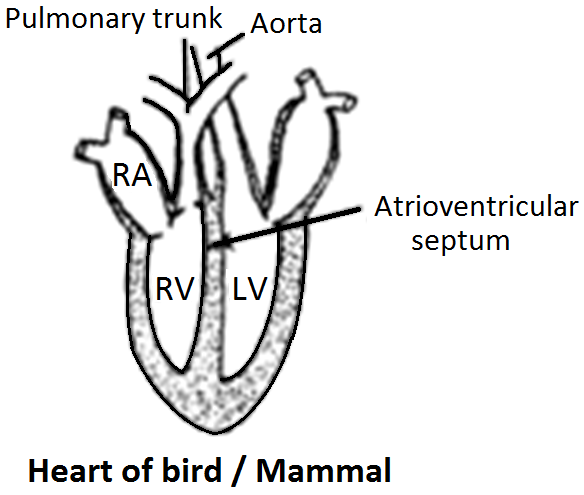
Explain the advantage of the complete partition of ventricle among birds and mammals and hence leading to double circulation.
Answer

The birds and mammals have evolutionary advancement as far as structure of heart is concerned. They need more oxygen to live in terrestrial habitat. In these animals, the blood received by left and right auricles is oxygenated and deoxygenated respectively. It passes towards the left and right ventricles and thus no oxygenated and deoxygenated blood is mixed. The ventricles pump oxygenated deoxygenated blood without mixing. Thus, two separate circulatory pathways are found thus this type of blood circulation is called as double circulation, which include systemic and pulmonary circulation.

View full question & answer
Question 223 Marks
Write the features that distinguish between the two, Plasma and Serum.
Answer
Differences between plasma and serum are:
  Plasma Serum
(i) It is the fluid minus blood corpuscles. It is liquid minus clotting elements.
(ii) It is faint yellow in colour. It is pale yellow.
(iii) It has fibrinogen and other clootting materials. It dose not have fibrinogen and other clotting materials.
(iv) It takes part in blood clotting. It dose not take part in blood clotting.
View full question & answer
Question 233 Marks
Name:
  1. The receiving chambers.
  2. The pumping chambers of heart.
Answer
  1. The blood recieving chambers of the heart are left and right atrium.
  2. The blood pumping chambers of the heart are left and right ventricles.
View full question & answer
Question 243 Marks
What happens to the valves and blood flow in the heart during ventricular diastole?
Answer
  • At the start of the ventricular diastole the semilunar valves close, producing the second heart sound dupp.
  • The atria are also in their diastole (joint diastole) for a brief period, before they start their systole.
  • During this phase, blood continues to flow into the atria from the major veins.
  • Blood also flows from the atria into the respective ventricles, through the open AV valves.
View full question & answer
Question 253 Marks
Can all the four chambers of the human heart experience systole simultaneously? Explain justifying your answer.
Answer
No, all cardiac chambers cannot experience systole simultaneously.
  • Atrial systole occurs first, since the sinoatrial node (SA node) that initiates the cardiac impulse is in direct contact with atrial muscles and the impulse is first discharged to atria.
  • The impulse is transmitted from the atrial muscles to the ventricular muscles through atrioventricular node and AV-bundle.
  • The impulse passes slowly across the AV-node and hence, ventricular systole begins after the atrial systole is completed.
View full question & answer
Question 263 Marks
How is cardiac activity regulated by the nervous system?
Answer
Normal activities of the heart are regulated intrinsically, Les, auto regulated by specialised muscles (nodal tissue), hence the heart is called myogenic. A special neural centre in the medulla oblongata can moderate the cardiac function through autonomic nervous system (ANS). Neural signals through the sympathetic nerves (part of ANS) can increase the rate of heart beat, the strength of ventricular contraction and thereby the cardiac output. On the other hand, parasympathetic neural signals (another component of ANS) decrease the rate of heart beat, speed of conduction of action potential and thereby the cardiac output. Adrenal medullary hormones can also increase the cardiac output.
View full question & answer
Question 273 Marks
Write short note on the following, Hypertension.
Answer
Hypertension is elevated blood pressure.Normal blood pressure in an adult is 120/ 80mmHg. The pressure on the higher side is called systolic blood pressure, while that on the lower side is called diastolic blood pressure. If blood pressure consistently shows 140/ 90mmHg or more in successive readings, then the person can be diagnosed to be suffering from hypertension. Hypertension can have serious long term repercussions because it can give rise to coronary artery disease, damage to kidneys, liver, retina and brain.
View full question & answer
Question 283 Marks
Differentiate between single circulation and double circulation; with an example for each.
Answer
S. No
Single circulation
Double circulation
(a)
It is the process in which the heart of an animal receives and pumps either oxygenated or deoxygenated blood.
It is the process in which the heart of an animal receives and pumps oxygenated and deoxygenated blood through two separate pathways, without any mixing up.
(b)
Heart is two-chambered with a single atriumand a single ventricle.e.g. fish.
Heart is four-chambered ventricles. e.g. mammals and birds.
View full question & answer
Question 293 Marks
Briefly describe the following: Heart failure.
Answer
Heart failure: It is the state of heart when it does not pump blood effectively enough to meet the need of the body. Congestion of lungs is one of the main symptoms of this disease. Heart failure is not the same as cardiac arrest (when the heart stops beating) or a heart attack (when the heart muscle is suddenly damaged by inadequate blood supply).
View full question & answer
Question 303 Marks
Describe the basic structure of an artery. How does it differ from that of a vein?
Answer
Structure of an artery:
  • An artery consists of a three-layered wall enclosing a narrow lumen.
  • Tunica externa is the outermost or external layer that is made of fibrous connective tissue with collagen fibres.
  • Tunica media is the middle layer composed of smooth muscles and elastic fibres.
  • Tunica interna is the innermost layer, made of squamous endothelium.
Differences:
  • The tunica media is thicker in arteries than in vein.
  • The lumen is narrow in the artery and is broader in the vein.
View full question & answer
Question 313 Marks
White Blood Cells fight infections and thus help in keeping the body healthy. Which of these is a good method to treat an infectious disease? Give reasons for your answer. What is the importance of maintaining personal hygiene?
  1. The patient should not be given medicine because the WBCs will take care of the infection.
  2. The patient should be given medicine because in case of certain infections, WBCs may not be enough to fight the infection.
Answer
  1. The patient should be given medicine because in case of certain infections, WBCs may not be enough to fight the infection.
Explanation:
Certain pathogens may be too harmful to be overcome by WBCs alone. Additionally, WBCs take time to fight the infection and a quick spread of infection can prove disastrous for the patient. The role of medicine is to limit the infection to a level so that the WBCs can do their job. It is always better to prevent a disease than to cure a disease. Personal hygiene is e very important in preventing many diseases. Bathing daily and maintaining personal cleanliness can prevent most of the skin diseases. Trimming nails and washing hands can prevent germs from entering our body along with food and water. Maintaining cleanliness around us can prevent many water borne diseases.
View full question & answer
Question 323 Marks
  1. Name the instrument used to obtain the ECG of a person.
  2. How many electrical leads connect the patien to the instrument? Mention the parts of the body connected.
Answer
  1. Electrocardiograph is the instrument.
  2. Three electrical leads connect the patient to the instrument, one to each of the wrists and one to the left ankle.
View full question & answer
Question 333 Marks
Explain the following events of a cardiac cycle.
  1. Atrial systole.
  2. Ventricular systole.
  3. Ventricular diastole.
Answer
  1. Atrial systole:
  • As the cardiac impulse from the SA node reaches E the atrial musculature, both the atria contract simultaneously.
  • The blood flow to the respective ventricles increases by about 30 percent.
  1. Ventricular systole:
  • The atria undergo diastole.
  • The ventricular systole increases the ventricular pressure that causes closure of the bicuspid and tricuspid valves.
  • As the pressure increases further, the semilunai valves guarding the pulmonary artery and the aorta are forced open.
  • Blood enters the pulmonary artery from the right ventricle and aorta from the left ventricle.
  1. Ventricular diastole:
  • The ventricles start relaxing.
  • Since, the pressure in the ventricles decreases the semilunar valves close preventing the backflow of blood into the ventricles.
View full question & answer
Question 343 Marks
What is an electrocardiogram? What do P wave and QRS complex represent in a standard ECG?
Answer
  • An electrocardiogram is the graphic record of the electrical potential differences produced by the cardiac muscles during a cardiac cycle.
  • The P wave represents the depolarisation of atria, which leads to atrial systole.
  • The QRS complex represents the depolarisation of the ventricles that leads to ventricular systole.
View full question & answer
Question 353 Marks
Briefly describe the following: Atherosclerosis.
Answer
Atherosclerosis or Coronary Artery Disease (CAD): It refers to the deposition of fatty substances specially cholesterol and triglycerides in the tunica interna and smooth muscles of medium sized and large arteries which results in plaque formation, which deform the arterial wall. Gradually these plaques grow and as a result, the lumen of the artery decreases and the flow of the blood is reduced. In extreme cases these plaques may block the artery completely. This may result in heart attack or stroke.
View full question & answer
Question 363 Marks
Why does atrial systole always precede ventricular systole?
Answer
  • The cardiac impulse arises from the SA node located in the wall of the right atrium.
  • The impulse first spreads through the atrial musculature, causing the atrial systole.
  • Then it passes through AV node and AV bundle to the ventricles to initiate ventricular systole, before which the atrial systole is completed; hence atrial systole always precedes ventricular systole.
View full question & answer
Question 373 Marks
How can we say that artificial pacemaker is a life saving instrument?
Answer
It is an electronic device, which regularly sends a small amount of electrical charge for maintaining the rhythmicity of the heart. It is implanted subcutaneously in the upper thoracic region having a connection with the heart.The artificial pacemaker is called a life-saving instrument because, it stimulates the heart electrically at regular intervals to maintain its beats. Thus, it replaces the SA node as the originator of the cardiac impulse. It is to be noted that some pacemakers stimulate the heart at a fixed rate, others sense when the natural heart rate falls below a predetermined value and then stimulates the heart.
View full question & answer
Question 383 Marks
Sumit, student of class XI when returned from school was told by his mother that his grandfather was complaining about some uneasiness. Sumit told his mother to take him to the doctor. The doctor tied a cuff around his arm and pumped air, then he slowly released the air. The handcuff was connected to a tube containing mercury. Doctor told Sumit that his grandfather is suffering from high blood pressure and put him on medication. The doctor also advised him to take precautions and rest and asked Sumit's mother to bring him for regular checkups.
  1. What is meant by blood pressure?
  2. What is the harmful effect of blood pressure on health?
  3. Enumerate the range of normal and high blood pressure in human.
  4. What values are displayed by Sumit as a good grandson?
Answer
  1. Blood pressure is the pressure exerted on the walls of the blood vessels by the pumping of blood into them by contraction of the left ventricle of heart.
  2. A persistent high blood pressure results from narrow arterial lumen and reduced elasticity of arterial walls in old age. It can cause rupturing of capillaries and is a silent killer.
  3. Normal range of blood pressure in human is 120/80mmHg, while, high blood pressure may occur if continuous readings come to be 140/90mmHg or slightly above this.
  4. Sumit was concerned about his grandfather's health. He is intelligent, and good observer. He has the ability to apply subject knowledge to real practical situations.
View full question & answer
Question 393 Marks
Explain different layers of arteries.
Answer
Layers in arteries:
  • Tunica Intima: This is the inner lining and is composed of squamous endothelium.
  • Tunica media: This is the middle layer and is composed of smooth muscles and elastic fibres.
  • Tunica externa: This is the external layer and is composed of collagen fibres.
View full question & answer
Question 403 Marks
Explain the functional significance of lymphatic system?
Answer
Functional significance of lymphatic system:
  1. It collects interstitial fluid from tissues.
  2. It plays special role in immunity building and memory generation.
  3. It transports many important nutrients and hormones.
  4. Fat is only absorbed through the lymph from small intestine. Thus, lymphatic system plays an important role in absorption of fat.
View full question & answer
Question 413 Marks
Briefly describe the following: Hypertension.
Answer
Hypertension (High blood pressure): It is the common disease affecting heart and blood vessels. A blood pressure of 120/ 80 is considered normal, but the increase in blood pressure beyond 140mmHg (systolic) and 90mmHg (diastolic) is called high blood pressure (hypertension). High blood pressure can harm heart, brain, kidneys and eyes. Hypertension can be due to mental stress, tobacco smoking, and intake of diet having high cholesterol.
View full question & answer