MCQ 1011 Mark
How many numbers of four digits can be formed from the digits $0, 1, 2, 3,$ and $4?$
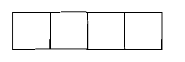
AnswerThe first box can be filled in four ways, because we cannot put $0$ in the first box.
The second box can also be filled in four ways, because we cannot put $0.$
The third box can be filled in three ways and the fourth in two ways.
Therefore, Total numbers $= 4 \times 4 \times 3 \times 2 = 96$
View full question & answer→MCQ 1021 Mark
There are $13$ players of cricket, out of which $4$ are bowlers. In how many ways a team of eleven be selected from them so as to include at least two bowlers?
Answer$4$ out of $13$ players are bowlers.
In other words, $9$ players are not bowlers.
A team of $11$ is to be selected so as to include at least $2$ bowlers.
Number of ways $={^\text{4}}\text{C}_{\text{2}}\times{^\text{9}}\text{C}_{\text{9}}+{^\text{4}}\text{C}_{\text{3}}\times{^\text{9}}\text{C}_{\text{8}}+{^\text{4}}\text{C}_{\text{4}}\times{^\text{9}}\text{C}_{\text{7}}$
$=6+36+36$
$=78$
View full question & answer→MCQ 1031 Mark
${^\text{5}}\text{C}_{\text{1}}+{^\text{5}}\text{C}_{\text{2}}+{^\text{5}}\text{C}_{\text{3}}+{^\text{5}}\text{C}_{\text{4}}+{^\text{5}}\text{C}_{\text{5}}$ is equal to:
Answer${^\text{5}}\text{C}_{\text{1}}+{^\text{5}}\text{C}_{\text{2}}+{^\text{5}}\text{C}_{\text{3}}+{^\text{5}}\text{C}_{\text{4}}+{^\text{5}}\text{C}_{\text{5}}$
$={^\text{5}}\text{C}_{\text{1}}+{^\text{5}}\text{C}_{\text{2}}+{^\text{5}}\text{C}_{\text{2}}+{^\text{5}}\text{C}_{\text{1}}+{^\text{5}}\text{C}_{\text{5}}$
$=2\times{^\text{5}}\text{C}_{\text{1}}+2\times{^\text{5}}\text{C}_{\text{2}}+{^\text{5}}\text{C}_{\text{5}}$
$= 2\times5+2\times\frac{5!}{2!3!}+1$
$=10+20+1$
$=31$
View full question & answer→MCQ 1041 Mark
Find the number of ways of arranging the letters of the words Danger so that no vowel occupies odd place.
AnswerThe given word is $\text{DANGER.}$ Number of letters is $6.$
Number of vowels is $2 ($ i.e., $\text{A, E}).$
Number of consonants is $4 ($ i.e., $\text{D,N,G,R}).$
As the vowels cannot occupy odd
places, they can be arranged in even places.
Two vowels can be arranged in $3$ even places in $3P2$ ways
i.e., $6.$ Rest of the consonants can arrange in the remaining $4$ places in $4!$ ways.
The total number of
arrangements is $6 \times 4! = 144.$
View full question & answer→MCQ 1051 Mark
The letters of the word $\text{RACHIT}$ are written in all possible manner and words are written as in dictionary. The rank of word $\text{RACHIT}$ is:
View full question & answer→MCQ 1061 Mark
Choose the correct answer. Given $5$ different green dyes, four different blue dyes and three different red dyes, the number of combinations of dyes which can be chosen taking at least one green and one blue dye is.
- A
$3600$
- ✓
$3720$
- C
$3800$
- D
$3600 $
AnswerCorrect option: B. $3720$
At least one green dye can be chosen in $^5\text{C}_1+\ ^5\text{C}_2\ +\ ^5\text{C}_3+\ ^5\text{C}_4+\ ^5\text{C}_5=22^5-1$ways.
At least one blue dye can be chosen in $^4\text{C}_1+\ ^4\text{C}_2\ +\ ^4\text{C}_3+\ ^4\text{C}_4=2^4-1$ ways.
Any number of red dyes can be chosen in $^3\text{C}_0+\ ^3\text{C}_1\ +\ ^3\text{C}_2+\ ^3\text{C}_3=2^3$ ways.
so, total nnumber of required selection $=(2^5-1)\times(2^4-1)\times2^3=3720$
View full question & answer→MCQ 1071 Mark
Choose the correct answer. A five digit number divisible by $3$ is to be formed using the numbers $0, 1, 2, 3, 4$ and $5$ without repetitions. The total number of ways this can be done is.
- ✓
$216$
- B
$600$
- C
$240$
- D
$3125$
AnswerWe know that a number is divisible by $3$ if the sum of its digits is divisible by $3.$
Now sum of the given six digits is $15$ which is divisible by $3.$
So to form a number of five$-$digit which is divisible by $3$ we can remove either $'O\ '$ or $'3\ '.$
If digits $1, 2, 3, 4, 5$ are used then number of required numbers $= 5!$
If digits $0, 1, 2, 4, 5$ are used then first place from left can be filled in $4$ ways and remaining $4$ places can be filled in $4!$ ways.
So in this case required numbers are $4 \times 4!$ ways.
So, total number of numbers $= 120 + 96 = 216$
View full question & answer→MCQ 1081 Mark
The number of words that can be made by re$-$arranging the letters of the word $\text{APURBA}$ so that vowels and consonants are alternate is:
AnswerThe word $\text{APURBA}$ is a $6$ letter word consisting of $3$ vowels that can be arranged in $3$ alternate places,
in $\frac{3!}{2!}$ ways.
The remaining $3$ consonants can be arranged in the remaining $3$ places in $3!$ ways.
$\therefore$ Total number of words that can be formed $=\frac{3!}{2!}\times3!=18$
But this whole arrangement can be set$-$up in total two ways,
i.e either $\text{VCVCVC}$ or $\text{CVCVCV.}$
$\therefore$ Total number of words $= 18 \times 2 = 36$
View full question & answer→MCQ 1091 Mark
How many different committees of $5$ can be formed from $6$ men and $4$ women on which exact $3$ men and $2$ women serve?
AnswerNumber of committes that can be formed $={^\text{6}}\text{C}_{\text{3}}\times{^\text{4}}\text{C}_{\text{2}}$
$=\frac{6!}{3!3!}\times\frac{4!}{2!2!}$
$=\frac{6\times5\times4}{3\times2}\times\frac{4\times3}{2}$
$=120$
View full question & answer→MCQ 1101 Mark
There are $'m\ '$ copies each of $'n\ '$ different books in a university library. The number of ways in which one or more than one book can be selected is:
- A
$m^n− 1$
- ✓
$(m + 1)^n− 1$
- C
$(m + 1)^n− m^n$
- D
$(m + 1)^n− m$
AnswerCorrect option: B. $(m + 1)^n− 1$
View full question & answer→MCQ 1111 Mark
There are $15$ points in a plane, no two of which are in a straight line except $4$, all of which are in a straight line.The number of triangle that can be formed by using these $15$ points is:
- A
$\ ^{15}\text{C}_3$
- B
$490$
- ✓
$451$
- D
$415$
AnswerThe required number of triangle$\ ^{15}\text{C}_3-\ ^4\text{C}_3=455-4=451$
View full question & answer→MCQ 1121 Mark
The number of unsuccessful attempts that can be made by a thief to open a number lock having $3$ rings in which each rings contains $6$ numbers is:
AnswerTotal number of attempts that can be made by thief is equal to placing $6$ number on $3$ places $($number may be repeated$).$
Total $= 6 \times 6 \times 6 = 216$
Hence, total number of unsuccessful attempt $= 216 − 1 = 215$
View full question & answer→MCQ 1131 Mark
There are $10$ true $-$ false questions in an examination.These questions can be answered in:
- A
$20$ ways.
- B
$100$ ways.
- C
$512$ ways.
- ✓
$1024$ ways.
AnswerCorrect option: D. $1024$ ways.
Given that there are $10$ questions.
Each question can be answered in two ways. $($i.e. either true or false$).$
Hence, the number of ways these questions can be answered is $2^{10}$,
which is equal to $1024.$
View full question & answer→MCQ 1141 Mark
At the end of a business conference, the ten people present all shake hands with each other once. How many handshakes will there be altogether?
AnswerEach person shakes hands with others.
Calculation : Total number of handshakes $= ^{10}C_2 = \frac{(10\times9)}{2} = 45$ handshakes.
View full question & answer→MCQ 1151 Mark
The total number of $9 -$ digit numbers which have all different digits is:
- A
$10!$
- B
$9!$
- ✓
$99x!$
- D
$10x, 10!$
AnswerCorrect option: C. $99x!$
View full question & answer→MCQ 1161 Mark
Choose the correct answer. The number of possible outcomes when a coin is tossed $6$ times is.
AnswerWe know that a coin has Head and Tail $(\text{H, T})$
$\therefore$ When a coin is tossed $6$ times, then the
Possible outcome $= 2^6 = 64$
View full question & answer→MCQ 1171 Mark
The number of ways $10$ digit numbers can be written using the digits $1$ and $2$ is:
AnswerCorrect option: A. $2^{10}$
Given digits are $1$ and $2.$
Here, each place can be filled in two ways either with $1$ or $2$ and every place has two chances.
Therefore, the number of ways $10$ digit numbers can be written using the digits $1$ and $2$ is $2^{10}$
View full question & answer→MCQ 1181 Mark
$...........$ are the ways to represent a group of objects by selecting them in a set and forming subsets.
AnswerCorrect option: C. Both $A$ and $B$
Permutation and combination are the ways to represent a group of objects by selecting them in a set and forming subsets.
View full question & answer→MCQ 1191 Mark
Ten different letter of an alphabet are given.Words with five letters are formed from these given letters.Then the number of words which have at least one letter repeated is:
- A
$19670$
- B
$39758$
- ✓
$69760$
- D
$99748$
AnswerCorrect option: C. $69760$
The total number of words that can be formed with five letters out of the ten given letters
$= 105 = 100000$
View full question & answer→MCQ 1201 Mark
In how many ways can $12$ people be divided into $3$ groups where $4$ persons must be there in each group?
AnswerCorrect option: D. $\frac{12!}{3!\times(4!)^3}$
Number of ways in which
$\text{m}\times\text{n"}>$
$\text{m}\times\text{n}$ distinct things can be divided equally into $n$
$\text{n"}>$ groups
$=\frac{(\text{mn})!}{\text{n}!\times(\text{m}!)\text{n}}$
Given, $12(3\times4)$ people needs to be divided into $3$ groups where $4$ persons must be there in each group.
So, the required number of ways $=\frac{({12})!}{{3}!\times(4!)\text{n}}$
View full question & answer→MCQ 1211 Mark
The total number of ways in which $9$ different boys can be distributed among three different children, so that the youngest gets $4,$ the middle gets $3$ and the oldest gets $2,$ is:
- A
$137$
- B
$236$
- C
$1240$
- ✓
$1260$
AnswerCorrect option: D. $1260$
View full question & answer→MCQ 1221 Mark
Choose the correct answer. The number of different four digit numbers that can be formed with the digits $2, 3, 4, 7$ and using each digit only once is
AnswerGiven digits $2, 3, 4$ and $7,$ we have to form four$-$digit numbers using these digits.
$\therefore$ Required number of ways $=^4P_4 = 4! = 4 \times 3 \times 2 \times 1 = 24$
View full question & answer→MCQ 1231 Mark
In how many ways can a committee of $5$ be made out of $6$ men and $4$ women containing at least one women?
AnswerRequired number of ways $={^\text{4}}\text{C}_{\text{1}}\times{^\text{6}}\text{C}_{\text{4}}+{^\text{4}}\text{C}_{\text{2}}\times{^\text{6}}\text{C}_{\text{3}}+{^\text{4}}\text{C}_{\text{3}}\times{^\text{6}}\text{C}_{\text{2}}+{^\text{4}}\text{C}_{\text{4}}\times{^\text{6}}\text{C}_{\text{1}}$
$=60+120+60+6$
$=246$
View full question & answer→MCQ 1241 Mark
There are $10$ points in a plane and $4$ of them are collinear. The number of straight lines joining any two of them is:
AnswerNumber of straight lines formed by joining the $10$ points if we take $2$ points at a time
$={^\text{10}}\text{C}_{\text{2}}=\frac{10}{2}\times\frac{9}{1}=45$
Number of straight lines formed by joining the $4$ points if we take $2$ points at a time
$={^\text{4}}\text{C}_{\text{2}}=\frac{4}{2}\times\frac{3}{1}=6$
But, $4$ collinear points, when joined in pairs, give only one line.
Required number of straight lines $= 14 - 6 + 1 = 40$
View full question & answer→MCQ 1251 Mark
Arrange the given words in the sequence in which they occur in the dictionary and then choose the correct sequence.
$1.$Page $2.$Pagan $3.$Palisade $4.$Pageant $5.$Palate
- A
$1, 4, 2, 3, 5$
- B
$2, 4, 1, 3, 5$
- ✓
$2, 1, 4, 5, 3$
- D
$1, 4, 2, 5, 3$
AnswerCorrect option: C. $2, 1, 4, 5, 3$
Words $1, 2$ and $4$ have first $3$ letter as pag and words $3$ and $5$ have first $3$ letters as pal.
So words starting with pal will come later than words starting with pag as in Alphabet set the letter $g$ comes after letter $a.$
The fourth letter of word $5$ is $a$ and of word $3$ is $i$ hence word $3$ will be the last in order.
So choice $A$ and $B$ are incorrect and the answer will be either $C$ or $D.$
Simply arranging the $4^{th}$ letter of words $1, 2$ and $4$ will give the correct sequence choice as $C.$
View full question & answer→MCQ 1261 Mark
How many combinations of two$-$digit numbers having $8$ can be made from the following numbers?
$8, 5, 2, 1, 7, 6:$
AnswerThe possible two$-$digit number are $88, 85, 82, 81, 87, 86, 58, 28, 18, 78, 68.$
These are $11$ in number.
View full question & answer→MCQ 1271 Mark
The number of ways in which four letters of the word $\text{MATHEMATICS}$ can be arranged is given by:
- A
$136$
- B
$192$
- C
$1680$
- ✓
$2454$
AnswerCorrect option: D. $2454$
View full question & answer→MCQ 1281 Mark
If ${^\text{m}}\text{C}_{\text{1}}={^\text{n}}\text{C}_{\text{2}},$ is then:
- A
$2m = n$
- B
$2m = n(n + 1)$
- ✓
$2m = n(n - 1)$
- D
$2n = m(m - 1)$
AnswerCorrect option: C. $2m = n(n - 1)$
${^\text{m}}\text{C}_{\text{1}}={^\text{n}}\text{C}_{\text{2}}$
$\Rightarrow \frac{\text{m!}}{1!(\text{m}-1)!}=\frac{\text{n!}}{2!(\text{n}-2)!}$
$\Rightarrow \frac{\text{m}(\text{m}-1)!}{(\text{m}-1)!}=\frac{\text{n}(\text{n}-1)(\text{n}-2)!}{2!(\text{n}-2)!}$
$\Rightarrow2\text{m}=\text{n}(\text{n}-1)$
View full question & answer→MCQ 1291 Mark
If ${^\text{n+1}}\text{C}_{\text{3}}=2.{^\text{n}}\text{C}_{\text{2}},$ then $n:$
Answer${^\text{n+1}}\text{C}_{\text{3}}=2\times{^\text{n}}\text{C}_{\text{2}}$
$\Rightarrow \frac{(\text{n}+1)!}{3!(\text{n-2})!}=2\times\frac{\text{n}!}{2!(\text{n}-1)!}$
$\Rightarrow \text{n+1}=6$
$\Rightarrow \text{n}=5$
View full question & answer→MCQ 1301 Mark
Using the digits $0, 2, 4, 6, 8$ not more than once in any number, the number of $5$ digited numbers that can be formed is:
AnswerTotal number of $5$ digit numbers will be $5!.$
Among these the ones starting with $0,$ are $4!.$
Hence the total number of $5$ digit numbers will be
$5! - 4!$
$= 4!(4)$
$=24\times4$
$=96$
View full question & answer→MCQ 1311 Mark
If $\ ^\text{n}\text{C}_9 = \ ^\text{n}\text{C}_8,$ what is the value of$\ ^\text{n}\text{C}_{17} $
View full question & answer→MCQ 1321 Mark
Match the terms given in Column$-I$ with the terms given in Column$-II$ and choose the correct option from the codes given below.
| |
Column$-I$ |
|
Column$-II$ |
| $(A)$ |
If $\text{P}(\text{n},4)=20.\text{P}(\text{n},2)$ then the value of $n$ is |
$(1)$ |
$28$ |
| $(B)$ |
$\ ^5\text{p}_\text{r}=\ ^{26}\text{p}_\text{r-1}$ |
$(2)$ |
$4$ |
| $(C)$ |
$\ ^5\text{p}_\text{r}=\ ^{6}\text{p}_\text{r-1}$ |
$(3)$ |
$7$ |
| $(D)$ |
Value of $\frac{8!}{6!\times2!}$ is |
$(4)$ |
$3$ |
Codes $\text{ABCD}$ - A
$4321$
- B
$3412$
- C
$4231$
- ✓
$3421$
AnswerCorrect option: D. $3421$
View full question & answer→MCQ 1331 Mark
A bag contains $3$ black, $4$ white and $2$ red balls, all the ballsbeing different. Number of selections of atmost $6$ balls containing balls of all the colours is:
- ✓
$1008$
- B
$1080$
- C
$1204$
- D
$1130$
AnswerCorrect option: A. $1008$
View full question & answer→MCQ 1341 Mark
Selection of menu, food, clothes, subjects, the team are examples of combinations:
MCQ 1351 Mark
There are $5$ roads leading to a town from a village.The number of different ways in which a villager can go to the town and return back, is:
AnswerA Permutation is an arrangement of all or part of a set of objects, with regard to the order of the arrangement.
For example, Suppose we have a set of three letters :$A, B$ and $C.....$ each possible arrangement would be an example of permutation.
Here in this question, there are $5$ roads leading to a town from a village.
He can go by $5$ ways and can return by $4$ ways.
So the number of different ways in which a villager can go to the town and return back is.
$5\times4=20$
View full question & answer→MCQ 1361 Mark
A shelf contains $1515$ books, of which $44$ are single volume and the others are $88$ and $33$ volumes respectively.In how many ways can these books be arranged on the shelf so that order of the volumes of same work is maintained ?
- A
$4!$
- B
$8!$
- C
$3!$
- ✓
$4! 8! 3! 3!$
AnswerCorrect option: D. $4! 8! 3! 3!$
No of books $1515$ No of ways $44$ volumes are arranged are $4!$ ways No of ways $88$ volumes are arranged are $8!$ ways No of ways $33$ volumes are arranged are $3!$ ways They are arranged in $3!$ ways one above the other.
So no of ways is $4!8!3!3!$
View full question & answer→MCQ 1371 Mark
There are $12$ points in a plane. The number of the straight lines joining any two of them when $3$ of them are collinear is:
AnswerNumber of straight lines joining $12$ points if we take $2$ points at a time $={^\text{12}}\text{C}_{\text{2}}$
$=\frac{12!}{2!10!}$
$=66$
Number of straight lines joining $3$ points if we take $2$ points at a time $={^\text{3}}\text{C}_{\text{2}}=3$
Required number of straight lines $= 66 - 3 + 1 = 64$
View full question & answer→MCQ 1381 Mark
The number of arrangements of the word $"\text{DELHI}"$ in which $E$ precedes I is:
AnswerThere are $4$ cases where $E$ precedes $I$ i.e.
Case $1:$ When $E$ and $I$ are together, which are possible in $4$ ways whereas other $3$ letters are arranged in $3!,$
So, the number of arrangements $= 4 \times 3! = 24$
Case $2:$ When $E$ and $I$ have $1$ letter in between, which are possible in $3$ ways whereas other $3$ letters are arranged in $3!,$
So,the number of arrangements $= 3 \times 3! = 18$
Case $3:$ When $E$ and I have $2$ letters in between, which are possible in $2$ ways whereas other $3$ letters are arranged in $3!,$
So,the number of arrangements $= 2 \times 3! = 12$
Case $4:$ When $E$ and I have $3$ letters in between, which are possible in $1$ way whereas other $3$ letters are arranged in $3!,$
So,the number of arrangements $= 1 \times 3! = 6$
Thus, total number of arrangements $= 24 + 18 +12 + 6 = 60$
View full question & answer→MCQ 1391 Mark
How many numbers of $4 -$ digits can be formed by using the digits $1, 2, 3, 4, 5, 6, 7$ if atleast one digit is repeated:
- A
$\ ^7\text{P}_4$
- B
$7^4$
- ✓
$7^4-\ ^7\text{p}_4$
- D
$\text{None of these}$
AnswerCorrect option: C. $7^4-\ ^7\text{p}_4$
View full question & answer→MCQ 1401 Mark
There were two women participants in a chess tournament.The number of games the men played between themselves exceeded by $52$ the number of games they played with women. If each player played one game with each other, the number of men in the tournament, was:
View full question & answer→MCQ 1411 Mark
Number of odd numbers of five distinct digits can be formed by the digits $0, 1, 2, 3, 4,$ is:
AnswerWe have total digits $0, 1, 2, 3, 4.$
We want to form odd number, then at last digit can become $1$ or $3.$
So, two number are fixed for last.
Now, we have option for $1^{st,} 2^{nd}, 3^{rd}$ and $4^{th}$ place are $3, 3, 2, 1$
So, number of getting odd numbers using given five distinct digit $= 3 \times 3 \times 2 \times 1 \times 2 = 36$
Hence, this is the answer.
View full question & answer→MCQ 1421 Mark
The number of nine digit numbers that can be formed with different digits is:
- A
$9.8!$
- B
$8.9!$
- ✓
$9.9!$
- D
$10!$
AnswerCorrect option: C. $9.9!$
The first digit is one of $(1, 2, 3, 4, 5, 6, 7, 8, 9) ($i.e., all expect $0).$
So, the no of ways $=9$
The remaining $8$ digits are to be taken from the remaining $9$ numbers.
So, the no of ways $= \ ^9\text{P}_8$
So, total no. of ways $=9\times\ ^9\text{P}_8$
$=9\times9!$
View full question & answer→MCQ 1431 Mark
The value of ${ }^{10} \mathrm{C}_4+{ }^{10} \mathrm{C}_5$ is:
View full question & answer→MCQ 1441 Mark
In the series given below. count the number of $9s,$ each of which Is not immediately preceded by $5$ but is immediately followed by either $2$ or $3.$ How many such 9s are there? $1\ 9\ 2\ 6\ 5\ 9\ 3\ 8\ 3\ 9\ 3\ 2\ 5\ 9\ 2\ 9\ 3\ 4\ 8\ 2\ 6\ 9\ 8:$
AnswerThere are $3$ such $9s$ that are not immediately preceded by $5$ and immediately followed by $2$ or $3$ in the given series. They are marked in bold.
$1\ 9\ 2\ 6\ 5\ 9\ 3\ 8\ 3\ 9\ 3\ 2\ 5\ 9\ 2\ 9\ 3\ 4\ 8\ 2\ 6\ 9\ 8.$
View full question & answer→MCQ 1451 Mark
If ${^\text{n}}\text{C}_{\text{r}}+{^\text{n}}\text{C}_{\text{r+1}}={^\text{n+1}}\text{C}_{\text{x}},$ is then $x:$
- A
$\text{r}$
- B
$\text{r}-1$
- C
$\text{n}$
- ✓
$\text{r}+1$
AnswerCorrect option: D. $\text{r}+1$
We have,
${^\text{n}}\text{C}_{\text{r}}+{^\text{n}}\text{C}_{\text{r+1}}={^\text{n+1}}\text{C}_{\text{x}}$
$\Rightarrow {^\text{n+1}}\text{C}_{\text{r+1}}={^\text{n+1}}\text{C}_{\text{x}}$
$\Rightarrow \text{r}+1=\text{x}$
${^\text{n}}\text{C}_{\text{x}}={^\text{n}}\text{C}_{\text{y}}$
$\Rightarrow \text{n}=\text{x}+\text{y},\text{x}=\text{y}$
View full question & answer→MCQ 1461 Mark
Choose the correct answer. The number of ways in which a team of eleven players can be selected from $22$ players always including $2$ of them and excluding $4$ of them is.
- A
$ { }^{16}{C}_{11} $
- B
$ { }^{16} {C}_5 $
- ✓
$ { }^{16} {C}_9 $
- D
$ { }^{20} {C}_9 $
AnswerCorrect option: C. $ { }^{16} {C}_9 $
Total number of players $= 22$
$2$ players are always included and $4$ are always excluding or never included $= 22 – 2 – 4 = 16$
$\therefore$ Required number of selection $= { }^{16} {C}_9 $
View full question & answer→MCQ 1471 Mark
The number of diagonals that can be drawn by joining the vertices of an octagon is:
AnswerAn octagon has $8$ vertices.
The number of diagonals of a polygon is given by $\frac{\text{n}(\text{n}-3)}{2}$
Number of diagonals of an octagon $=\frac{\text{8}(\text{8}-3)}{2}=20$
View full question & answer→MCQ 1481 Mark
The number of ways in which a committee of $6$ members can be formed from $8$ gentlemen and $4$ ladies so that the committee contains atleast $3$ ladies is:
View full question & answer→MCQ 1491 Mark
The number of arrangements of the letters of the word $\text{BHARAT}$ taking $3$ at a time is:
AnswerWhen we make words after selecting letters of the word $\text{BHARAT,}$ it could consist of a single $A,$ two As or no $A.$
Case$-I: A$ is not selected for the three letter word.
Number of arrangements of three letters out of $\text{B, H, R}$ and $\text{T} = 4 \times 3 \times 24 \times 3 \times 2 = 24$
Case$-II:$ One $A$ is selected and the other two letters are selected out of $\text{B, H, R}$ or $T.$ Possible ways of selection: Selecting two letters out of $\text{B, H, R}$ or $\text{T}$ can be done in $^4P_2 = 12$ ways. Now, in each of these $12$ ways, these two letters can be placed at any of the three places in the three letter word in $3$ ways.
$\therefore$ Total number of words that can be formed $= 12 \times 3 = 36$
Case$-III:$ Two $A's$ and a letter from $\text{B, H, R}$ or $\text{T}$ are selected.
Possible ways of arrangement:
Number of ways of selecting a letter from $\text{B, H, R}$ or $\text{T} = 4 $ And now this letter can be placed in any one of the three places in the three letter word other than the two $A's$ in $3$ ways.
$\therefore$ Total number of words having $2 A's = 4 \times 3 = 12$
Hence, total number of words that can be formed $= 24 + 36 + 12 = 72$
View full question & answer→MCQ 1501 Mark
How many numbers greater than $10$ lacs be formed from $2, 3, 0, 3, 4, 2, 3?$
Answer$10$ lakhs consists of seven digits.
Number of arrangements of seven numbers of which $2$ are similar of first kind, $3$ are similar of second kind $=\frac{7!}{2!\ 3!}$
But, these numbers also include the numbers in which the first digit has been considered as $0.$ This will result in a number less than $10$ lakhs.
Thus, we need to subtract all those numbers.
Numbers in which the first digit is fixed as $0 =$ Number of arrangements of the remaining $6$ digits $=\frac{6!}{2!\ 3!}$
Total numbers greater than $10$ lakhs that can be formed using the given digits $=\frac{7!}{2!\ 3!}-\frac{6!}{2!\ 3!}$
$=420-60$
$=360$
View full question & answer→