Questions

M.C.Q (1 Marks)

Take a timed test

30 questions · auto-graded multiple-choice test.

MCQ 11 Mark
In a streamline flow:
  1. The speed of a particle always remains same.
  2. The velocity of a particle always remains same.
  3. The kinetic energies of all the particles arriving at a given point are the same.
  4. The momenta of all the particles arriving at a given point are the same.
  • A
    $A$ and $B$
  • B
    $B$ and $D$
  • $C$ and $D$
  • D
    None of these
Answer
Correct option: C.
$C$ and $D$
In a streamline flow, every fluid particle arriving at a given point has the same velocity $v.$ Thus, the kinetic energies $\frac{1}{2}\text{m}\text{v}^2$ and momenta $(mv)$ of all particles
arriving at a given point are the same, as the mass of a particle is constant.

View full question & answer
MCQ 21 Mark
A barometer kept in an elevator reads 76cm when it is at rest. If the elevator goes up with increasing speed, the reading will be:
  • A
    zero.
  • B
    76cm.
  • < 76cm.
  • D
    > 76cm.
Answer
Correct option: C.
< 76cm.
If the elevator goes up at an increasing speed, then the effective value of g increases.
We know:
P = ρgh.
So, h will have a lesser value for the same value of P if g increases.
View full question & answer
MCQ 31 Mark
Suppose the pressure at the surface of mercury in a barometer tube is $\mathrm{P}_1$ and the pressure at the surface of mercury in the cup is $\mathrm{P}_2$,
  • $\mathrm{P}_1=0, \mathrm{P}_2=$ atmospheric pressure.
  • B
    $\mathrm{P}_1=$ atmospheric pressure $\mathrm{P}_2=0$
  • C
    $P_1=P_2=$ atmospheric pressure.
  • D
    $P_1=P_2=0$
Answer
Correct option: A.
$\mathrm{P}_1=0, \mathrm{P}_2=$ atmospheric pressure.
The upper part of the tube contains vacuum as the mercury goes down and no air is allowed in. Thus, the pressure at the upper end, i.e., at the surface of mercury in a barometer tube is zero $( P_1=0 )$. However, the pressure at the surface of mercury in the cup or any another point at the same horizontal plane is equal to the atmospheric pressure.
View full question & answer
MCQ 41 Mark
Consider the equations $\text{P}=\lim_\limits{\triangle\text{s}\rightarrow0}\frac{\text{F}}{\triangle\text{s}}$ and $\text{P}_1-\text{P}_2-\text{pgz}$ In an elevator accelerating upward.
 
  • A
    Both the equations are valid.
  • The first is valid but not the second.
  • C
    The second is valid but not the first.
  • D
    Both are invalid.
Answer
Correct option: B.
The first is valid but not the second.
For a point inside the elevator, pressure can be defined as $\text{P}=\lim_\limits{\triangle\text{s}\rightarrow0}\frac{\text{F}}{\triangle\text{s}}\cdot$
It is independent of the acceleration of the elevator.
The modified form of the second equation,
which will be valid in the given case, is given. $\text{P}_1-\text{P}_2=\text{p}(\text{g}+\text{a}_0)\text{z}$
Here, acceleration $a_0($say$)$ due to elevator accelerating upwards is also taken into account.
View full question & answer
MCQ 51 Mark
Water enters through end $A$ with a speed $v_1$ and leaves through end $B$ with a speed $v_2$ of a cylindrical tube $A B$. The tube is always completely filled with water. In case $I$ the tube is horizontal, in case $II$ it is vertical with the end $A$ upward and in case $III$ it is vertical with the end $B$ upward. We have $v_1=v_2$ for
  • A
    Case $I.$
  • B
    Case $II.$
  • C
    Case $III.$
  • Each case.
Answer
Correct option: D.
Each case.
This happens in accordance with the equation of continuity.
As the area of the cross section of cylindrical tube $AB$ is constant, the velocity of water will also be the same. The equation is derived from the principle of
conservation of mass and it is true for every case, i.e., when the tube is either horizontal or vertical.
View full question & answer
MCQ 61 Mark
Bernoulli's theorem is based on conservation of:
  • A
    Momentum.
  • B
    Mass.
  • Energy.
  • D
    Angular momentum.
Answer
Correct option: C.
Energy.
The principle behind the Bernoulli theorem is the law of conservation of energy. It states that energy can be neither created nor destroyed; it merely changes from One form to another.
View full question & answer
MCQ 71 Mark
Consider the situation of the previous problem. Let the water push the left wall by a force $F_1$ and the right wall by a force $F_2$
  • A
    $F_1=F_2$
  • $F_1>F_2$
  • C
    $F_1$
  • D
    The information is insufficient to know the relation between $F_1$ and $F_2$
Answer
Correct option: B.
$F_1>F_2$
When the box is accelerated towards right, the water in the box experiences a pseudo force $(ma)$ towards left, where $m$ is the mass of water.
So, the force $F_1$ exerted by the water on the the left wall of the box is greater.
View full question & answer
MCQ 81 Mark
A beaker containing a liquid is kept inside a big closed jar. If the air inside the jar is continuously pumped out the pressure in the liquid near the bottom of the liquid will:
  • A
    Increase
  • Decrease
  • C
    Remain constant
  • D
    First decrease and then increase.
Answer
Correct option: B.
Decrease
As the air inside the jar is pumped out, the air pressure decreases. Thus, the pressure in the liquid near the bottom of the beaker decreases.
View full question & answer
MCQ 91 Mark
A large cylindrical tank has a hole of area A at its bottom. Water is poured in the tank by a tube of equal cross-sectional area A ejecting water at the speed v.
  • A
    The water level in the tank will keep on rising.
  • B
    No water can be stored in the tank.
  • The water level will rise to a height $\frac{\text{v}^2}{2\text{g}}$ and then stop.
  • D
    The water level will oscillate.
Answer
Correct option: C.
The water level will rise to a height $\frac{\text{v}^2}{2\text{g}}$ and then stop.
From the principle of continuity and Bernoulli's equation, ​we have:
$\text{v}^2=2\text{gh}$
$\Rightarrow\text{h}=\frac{\text{v}^2}{2\text{g}}$
So, h is the maximum height up to which the water level will rise if the water is ejected at a speed v.
View full question & answer
MCQ 101 Mark
The pressure in a liquid at two points in the same horizontal plane are equal. Consider an elevator accelerating upward and a car accelerating on a horizontal road. The above statement is correct in:
  • A
    The car only.
  • The elevator only.
  • C
    Both of them.
  • D
    Neither of them.
Answer
Correct option: B.
The elevator only.
The two points in the same horizontal line will not have equal pressure if the liquid is accelerated horizontally. There should be vertical acceleration.
View full question & answer
MCQ 111 Mark
A solid floats in a liquid in a partially dipped position.
  • A
    The solid exerts a force equal to its weight on the liquid.
  • B
    The liquid exerts a force of buoyancy on the solid which is equal to the weight of the solid.
  • C
    The weight of the displaced liquid equals the weight of the solid.
  • All of the above
Answer
Correct option: D.
All of the above
Force exerted by any solid on a liquid $= F = mg = W =$  Weight of the solid.
According to Archimedes' principle, any object, wholly or partially immersed in a fluid, is buoyed up by a force equal to the weight of the fluid displaced by the
Object.
Also, any floating object displaces its own weight of fluid. Thus, we can say that the weight of the object is equal to the weight of the fluid displaced.
View full question & answer
MCQ 121 Mark
The weight of an empty balloon on a spring balance is $\text{W}_1$. The weight becomes $\text{W}_2$ when the balloon is filled with air. Let the weight of the Air itself be $\omega$ neglect the thickness of the balloon when it is filled with air. Also neglect the difference in the densities of air inside and outside the balloon.
  • A
    $\text{W}_2=\text{W}_1$
  • B
    $\text{W}_2=\text{W}_1+\omega$
  • Both $A$ and $B$
  • D
    $\text{W}_2>\text{W}_1$
Answer
Correct option: C.
Both $A$ and $B$

According to the question, the density of air inside and outside the balloon is the same.
So, the weight w of air inside the balloon is equal to the weight of displaced
air. Thus, the spring balance will not register any difference because the balloon will experience buoyant force equal to w that cancels out the weight of the added
air.

View full question & answer
MCQ 131 Mark
Water and mercury are filled in two cylindrical vessels up to same height. Both vessels have a hole in the wall near the bottom. The velocity of water and mercury coming Out of the holes are $\text{v}_1$ and $\text{v}_2$ respectively.
  • $\text{v}_1=\text{v}_2$
  • B
    $\text{v}_1=13.6\text{v}_2$
  • C
    $\text{v}_1=\frac{\text{v}_2}{\text{13.6}\cdot}$
  • D
    $\text{v}_1=\sqrt{13.6}\text{v}_2$
Answer
Correct option: A.
$\text{v}_1=\text{v}_2$
The velocity of efflux does not depend on the density of the liquid. It only depends on the height $h ($given same in the question$)$ and Acceleration due to gravity $g ($constant value here$).$
$\text{v}_1=\text{v}_2=\text{v}=\sqrt{2\text{gh}}$
View full question & answer
MCQ 141 Mark
To construct a barometer, a tube of length $1m$ is filled completely with mercury and is inverted in a mercury cup. The barometer reading on a particular day is $76\ cm$. Suppose a $1m$ tube is filled with mercury up to $76\ cm$ and then closed by a cork. It is inverted in a mercury cup and the cork is removed. The height of mercury column in the tube over the surface in the cup will be.
  • A
    zero.
  • B
    $76\ cm.$
  • C
    $> 76\ cm.$
  • $< 76\ cm.$
Answer
Correct option: D.
$< 76\ cm.$
Because of the trapped air, the pressure at the upper end of the mercury
column inside the tube is not zero.
In other words, $\mathrm{P}_0>0$.
Using this relation, we get:
$P_{\mathrm{atm}}=P_0+p g h$
Here,
$\mathrm{P}=$ density of mercury.
$\mathrm{h}=$ Height of the mercury column.
$\therefore P_0>0$
And,
$\text { Patm }>\text { pgh. }$
$\therefore 76 \mathrm{~cm}$ of $\mathrm{Hg}>\mathrm{pgh}$.
or, $\mathrm{h}<76 \mathrm{~cm}$.
View full question & answer
MCQ 151 Mark
A barometer kept in an elevator accelerating upward reads 76cm. The air pressure in the elevator is
  • A
    76cm.
  • B
    < 76cm.
  • > 76cm.
  • D
    zero.
Answer
Correct option: C.
> 76cm.
When the elevator is going upwards with acceleration a, the effective acceleration is a' = (g + a).
Thus, pressure is given by:
$\text{P}=\text{h}\rho(\text{g}+\text{a})$
Air pressure in the elevator $=\text{p}=\text{h}'\rho\text{g}$
Because the pressure is the same, h' > h.
$\therefore$ Air pressure > 76cm.
View full question & answer
MCQ 161 Mark
A closed cubical box is completely filled with water and is accelerated horizontally towards right with an acceleration α. The resultant normal force by the water on the top of the box.
  • A
    Passes through the centre of the top.
  • B
    Passes through a point to the right of the centre.
  • Passes through a point to the left of the centre.
  • D
    Pecomes zeros.
Answer
Correct option: C.
Passes through a point to the left of the centre.
When the box is accelerated towards right, the water in the box experiences a pseudo force (ma) towards left, where m is the mass of water. So, the resultant normal force by the water on the top of the box passes through a point to the left of the centre.
View full question & answer
MCQ 171 Mark
A wooden object floats in water kept in a beaker. The object is near a side of the beaker. Let $P_1, P_2, P_3$ be the pressures at the three points $\mathrm{A}, \mathrm{B}$ and $C$ of bottom as shown in the figure.
  • $P_1=P_2=P_3$
  • B
    $P_1$
  • C
    $P_1>P_2>P_3$
  • D
    $P_2=P_3 \neq P_1$
Answer
Correct option: A.
$P_1=P_2=P_3$
If the fluid is in equilibrium, then the pressure is the same at all points in the same horizontal level.
View full question & answer
MCQ 181 Mark
A liquid can easily change its shape but a solid can not because.
  • A
    The density of a liquid is smaller than that of a solid.
  • The forces between the molecules is stronger in solid than in liquids.
  • C
    The atoms combine to form bigger molecules in a solid.
  • D
    The average separation between the molecules is larger in solids.
Answer
Correct option: B.
The forces between the molecules is stronger in solid than in liquids.
The forces between the particles of a solid are stronger than those between the particles of a liquid, so the particles cannot move freely but can only vibrate. Thus, a solid has stable, definite shape and volume. A solid can only change its shape by force (when broken or cut), whereas a liquid can easily change its shape because of weak inter-particle forces.
View full question & answer
MCQ 191 Mark
Water is flowing in streamliries motion through a tube with its axis horizontal Consider two points $A$ and $B$ in the tube at the same horizontal level:
  1. The pressures at $A$ and $B$ are equal for any shape of the tube.
  2. The pressures are never equal.
  3. The pressures are equal if the tube has a uniform cross section.
  4. The pressures may be equal even if the tube has a nonuniform cross section.
  • A
    $A$ and $B$
  • B
    $B$ and $C$
  • C
    $B$ and $D$
  • $C$ and $D$
Answer
Correct option: D.
$C$ and $D$
In streamline flow in a tube, every particle of the liquid follows the path of its preceding particle and the velocity of all particles crossing a particular point is the
same. However, the velocity of the particles at different points in their path may not necessarily be the same. Thus, by applying Bernoulli's theorem and equation
of continuity, we can say that if the tube has a uniform cross section, the pressures will be equal; and if the tube has a non$-$uniform cross section, the pressures
may or may not be equal.
View full question & answer
MCQ 201 Mark
A closed vessel is half filled with water. There is a hole near the top of the vessel and air is pumped out from this hole.
  1. The water level will rise up in the vessel.
  2. The pressure at the surface of the water will decrease.
  3. The force by the water on the bottom of the vessel will decrease.
  4. The density of the liquid will decrease.
  • A
    $A$ and $B$
  • $B$ and $C$
  • C
    $B$ and $D$
  • D
    None of these
Answer
Correct option: B.
$B$ and $C$
As air is pumped out of the hole, there is a decrease in the atmospheric pressure above the water surface in the vessel. Due to this, pressure at the surface of the water decreases. Thus, the force exerted by the water on the bottom of the vessel also decreases.
View full question & answer
MCQ 211 Mark
There is a small hole near the bottom of an open tank filled with a liquid. The speed of the water ejected does not depend on.
  1. Area of the hole.
  2. Density of the liquid.
  3. Height of the liquid from the hole.
  4. Acceleration due to gravity.
  • $A$ and $B$
  • B
    $B$ and $C$
  • C
    $A$ and $D$
  • D
    $C$ and $D$
Answer
Correct option: A.
$A$ and $B$
The emergent speed $v$ of the liquid flowing from the hole in the bottom of the tank is given by:
$\text{v}=\sqrt{2\text{gh}}$
Here, $g$ is acceleration due to gravity and h is height of the liquid from the hole.
Thus, it is clear from the above relation that the speed of the liquid depends on the height of the liquid from the hole and on the acceleration due to gravity. It does
not depend on the area of the hole and the density of the liquid.
View full question & answer
MCQ 221 Mark
A piece of wood is floating in water kept in a bottle. The bottle is connected to an air pump. Neglect the compressibility of water. When more air is pushed into the bottle from the pump, the piece of wood will float with.
  • A
    Larger part in the water.
  • B
    Lesser part in the water.
  • Same part in the water.
  • D
    It will sink.
Answer
Correct option: C.
Same part in the water.
When more air is pushed into the bottle from the pump, the pressure of air increases on the wood as well as on the water surface with the same amount. So, the level of water and wood does not change. Thus, the piece of wood floats with the same part in the water.
View full question & answer
MCQ 231 Mark
A metal cube is placed in an empty vessel. When water is filled in the vessel so that the cube is completely immersed in the water, the force on the bottom of the vessel in contact with the cube.
  • A
    Will increase.
  • B
    Will decrease.
  • Will remain the same.
  • D
    Will become zero.
Answer
Correct option: C.
Will remain the same.
In the absence of water, the force acting on the bottom of the vessel is due to the air and the cube. Now, when water is filled in the vessel, the force due to the water and the cube is greater. The extra force is balanced by the buoyant force acting on the cube in the upward direction.
View full question & answer
MCQ 241 Mark
The three vessels shown in fisure $(13- Q2)$ have same base area. Equal volumes of a liquid are poured in the three vessels. The force on the base will be:
 
  • A
    Maximum in vessel $A.$
  • B
    Maximum in vessel $B.$
  • Maximum in vessel $C$.
  • D
    Equal in all the vessels.
Answer
Correct option: C.
Maximum in vessel $C$.
Here, the height of the liquid column is maximum in vessel $C$.
Thus, the force on the base of vessel $C$,
i.e., $\text{F}=\text{P}_0+\text{hPg}$ where $P_0$ is atmospheric pressure, is maximum.
View full question & answer
MCQ 251 Mark
Water is flowing through a long horizontal tube. Let $P_A$ and $P_B$ be the pressures at two points $A$ and $B$ of the tube.
 
  • A
    $\mathrm{P}_{\mathrm{A}}$ must be equal to $\mathrm{P}_{\mathrm{B}}$.
  • B
    $\mathrm{P}_{\mathrm{A}}$ must be greater than $\mathrm{P}_{\mathrm{B}}$.
  • C
    $\mathrm{P}_{\mathrm{A}}$ must be smaller than $\mathrm{P}_{\mathrm{B}}$.
  • $P_A=P_B$ only if the cross$-$sectional area at $A$ and $B$ are equal.
Answer
Correct option: D.
$P_A=P_B$ only if the cross$-$sectional area at $A$ and $B$ are equal.
According to Bernoulli's theorem, pressures at points $A$ and $B$ of the horizontal tube will be equal if water has the same velocity at These points. Also, according to the equation of continuity, velocity at points $A$ and $B$ will be equal only if the cross$-$sectional areas At $A$ and $B$ are equal. So, $P_A=P_B$ only if the cross$-$sectional areas at $A$ and $B$ are equal.
View full question & answer
MCQ 261 Mark
A 20N metal block is suspended by a spring balance. A beaker containing some water is placed on a weighing machine which reads 40N. The spring balance is now lowered so that the block gets immersed in the water. The spring balance now reads 16N. The reading of the weighing machine will be.
  • A
    36N.
  • B
    60N.
  • 44N.
  • D
    56N.
Answer
Correct option: C.
44N.
Upthrust exerted by the water on the block = Change in the reading of the spring balance:
= (20 - 16)N = 4N.
Downthrust = 4N.
Actual weight of the beaker containing water = 40N.
$\therefore$ Effective weight = (40 + 4)N = 44N.
View full question & answer
MCQ 271 Mark
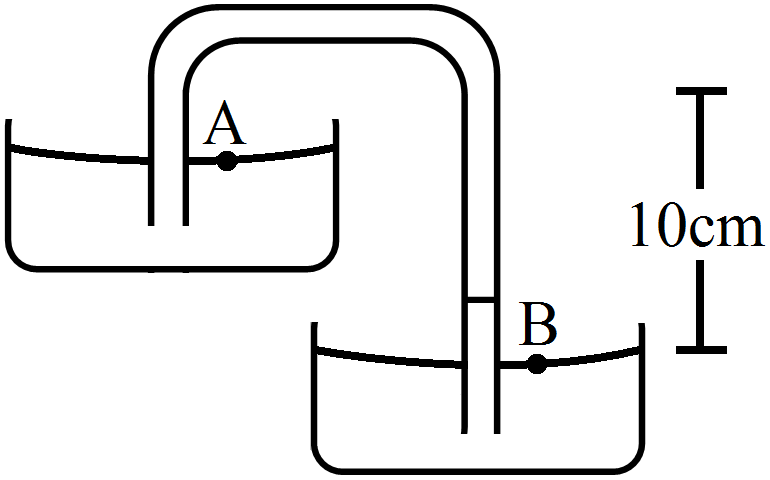
Figure shows a siphon. The liquid shown is water. The pressure difference $P_a P_A$ between the points $A$ and $B$ is the reading will be:
  • $400 \mathrm{Nm}^{-2}$
  • B
    $3000 \mathrm{Nm}^{-2}$
  • C
    $1000 \mathrm{Nm}^{-2}$
  • D
    zero.
Answer
Correct option: A.
$400 \mathrm{Nm}^{-2}$
At both points $A$ and $B,$ pressure is equal to atmospheric pressure.
Thus, we have:
$P_A = P_B = P_{atm}$
$\Rightarrow P_B- P_A = 0$
View full question & answer
MCQ 281 Mark
A solid is completely immersed in a liquid. The force exerted by the liquid on the solid will.
  1. Increase if it is pushed deeper inside the liquid.
  2. Change if its orientation is changed.
  3. Decrease if it is taken partially out bf the liquid.
  4. Be in the vertically upward direction.
  • A
    $A$ and $B$
  • B
    $B$ and $D$
  • C
    $B$ and $C$
  • $C$ and $D$
Answer
Correct option: D.
$C$ and $D$
The force exerted by the liquid on the solid is the vertically upward force $($buoyant force$)$ that opposes the weight of the immersed solid.​ As more and more volume
Of the Solid is immersed in the liquid, the buoyant force increases.
Buoyant force depends on the weight of the displaced liquid. So, maximum upward buoyant force acts on the solid when it is completely immersed in the liquid. It
Decreases if the solid is taken partially out of the liquid. Once the object is immersed in the liquid, then pushing it further in the liquid does not increase the
buoyant Force.
View full question & answer
MCQ 291 Mark
Equal mass of three liquids are kept in three identical cylindrical vessels $A, B$ and $C$. The densities are $P_A, P_B, P_C$ with $P_A$   
  • A
    Maximum in vessel $A$.
  • B
    Maximum in vessel $B$.
  • C
    Maximum in vessel $C$.
  • Equal in all the vessels.
Answer
Correct option: D.
Equal in all the vessels.
The force on the base is given by:
$F = hpg \times A$
$\Rightarrow F = (hpg)g$
$\Rightarrow F = ($volume $\times$ density$) \times g$
$\Rightarrow F = mg$
In the question, the masses are equal.
So, the force on the base is the same in all cases.
View full question & answer
MCQ 301 Mark
Water flows through two identical tubes $A$ and $B$. A volume $V_0$ of water passes through the tube $A$ and $2 V_0$ through $B$ in a given time. Which of the followinmay be correct?
​​​​​​
  • A
    Flow in both the tubes are steady.
  • B
    Flow in both the tubes are turbulent.
  • C
    Flow is steady in $A$ but turbulent in $B.$
  • All of the above
Answer
Correct option: D.
All of the above
In a steady flow, the velocity of liquid particles reaching a particular point is the same at all times, but if the liquid is pushed in the tube at a rapid rate, i.e., if the
flow rate increases, then the flow may become turbulent. Here, the flow rate is the volume of fluid per unit time per unit area flowing past a point.
Large volume of water passes through tube $B$ compared to tube $A.$ Thus, the flow rate is greater in tube $B$ than in tube $A.$ So, if the flow is turbulent in $A$, then the
flow in $B$ cannot be steady. Therefore, the first three options are possible.
View full question & answer