Questions

5 Marks Questions

Take a timed test

11 questions · self-marked practice — reveal the answer and mark yourself.

Question 15 Marks
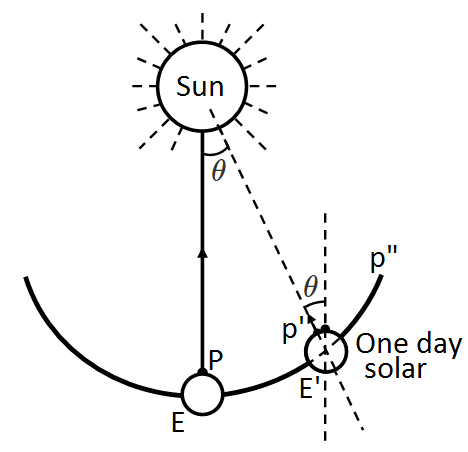
Mean solar day is the time interval between two successive noon when sun passes through zenith point (meridian). Sidereal day is the time interval between two successive transit of a distant star through the zenith point (meridian). By drawing appropriate diagram showing earth’s spin and orbital motion, show that mean solar day is four minutes longer than the sidereal day. In other words, distant stars would rise 4 minutes early every successive day.
Answer
According to the diagram alongside, when the earth revolves about its polar axis in one sidereal day, it also moves from E to E’ around the sun due to translational motion and the point P’ is at P’’.
When the Earth still rotates through an angle about its axis to complete one solar day until the point P’ is at P”, again facing the sun.
Earth advances in its orbit by approximately 1° every day, i.e. in 24 hours. Then, it will have to rotate by 361° (which we define as 1 day) to have the sun at zenith point again,
$\therefore$ Time taken to traverse $1^0=\frac{24\text{h}}{361^0}\times1^0\frac{24\times60\times6\text{s}}{361}=239.3\text{s}$
i.e., 239.3s = 3 min 59.3s ≈ 4 min
Hence, distante stars would rise 4 minutes early every successive day.
View full question & answer
Question 25 Marks
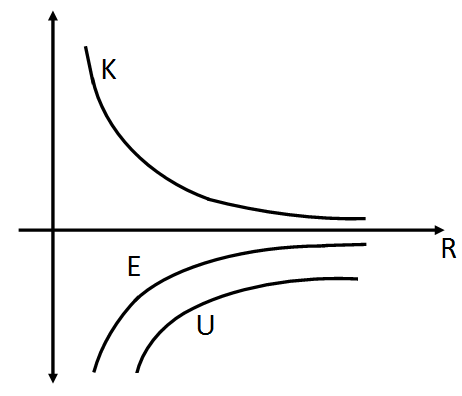
Show the nature of the following graph for a satellite orbiting the earth.
  1. KE vs orbital radius R
  2. PE vs orbital radius R
  3. TE vs orbital radius R.
Answer
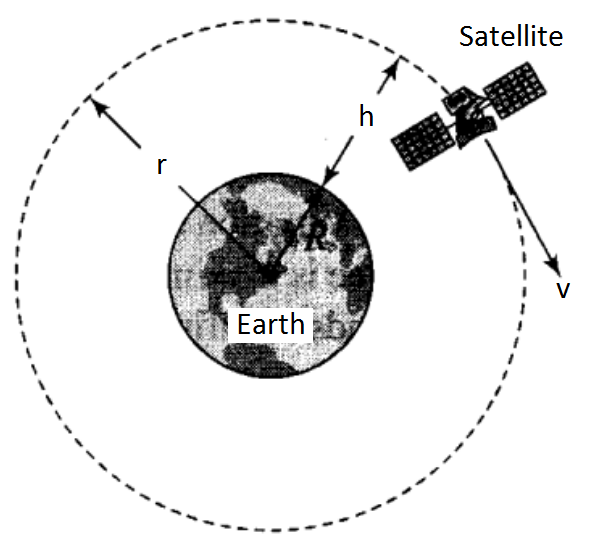
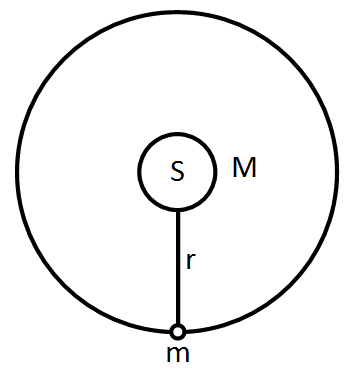
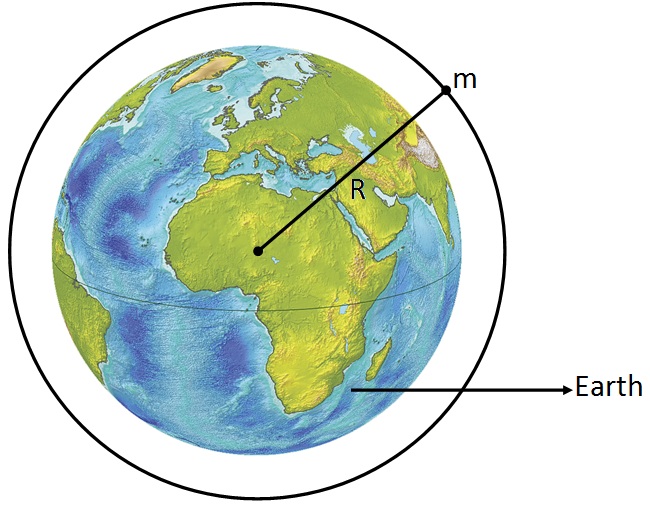
Let us first consider the diagram, which represents a satellite of mass m, moving around the earth in a circular orbit of radius R.

Orbital speed of the satellite is given by $\text{v}_0\sqrt{\frac{\text{GM}}{\text{R}}}$.


where, M is the mass of earth and R is the radius of the earth.
  1. So, kinetic energy of the satellite is given by
$\text{K}=\frac{1}{2}\text{mv}_0^2=\frac{1}{2}\text{m}\times\frac{\text{GM}}{\text{R}}$

We can say that kinetic energy is inversely proportional to R. It means the KE decreases exponentially with radius. The graph will be a rectangular hyperbola.

Hence, the variation of kinetic energy versus orbital radius is shown in graph.

  1. Potential energy of a satellite
$\text{U} = \frac{-\text{GMm}}{\text{R} = -\text{2K}}$

So, potential energy is twice of kinetic energy and negative sign implies that graph is downward hyperbola.
  1. Total energy of the satellite
$\text{E = K + U}=\frac{\text{GMm}}{\text{2R}}-\frac{\text{GMm}}{\text{R}}$

$=-\frac{\text{GMm}}{\text{2R}}$

Negative total energy, E signifies that earth and the satellite is a bounded system.

If $\text{E}\geq\text{U},$ the satellite will be free from earth’s gravity.
View full question & answer
Question 35 Marks
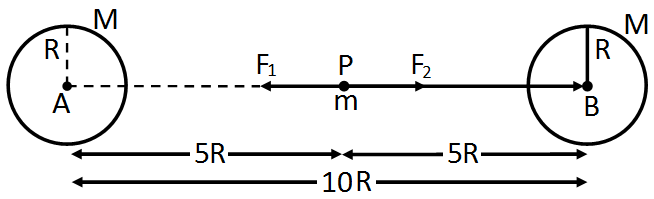
Two identical heavy spheres are separated by a distance $10$ times their radius. Will an object placed at the mid point of the line joining their centres be in stable equilibrium or unstable equilibrium? Give reason for your answer.
Answer
$\text{m}_1=\text{m}_2=\text{M }\text{r}=10\text{R}$
Let mass m is placed at the mid point P of line joining the centres of A and B sphere

$|\text{F}_2|=|\text{F}_1|=\frac{\text{GMm}}{(5\text{R})^2}$
$|\text{F}_1|=|\text{F}_2|=\frac{\text{GMm}}{(25\text{R})^2}$
As the direction of force $F_1$ and $F_2$ are opposite (equal and opposite forces acting on m at P). The net force $F_1 + F_2 = 0, (F_1 = -F_2)$. m will be in equilibrium.
If now m is displaced by x slightly from P to A then PA = (5R - x) and PB = (5R + x)
$\text{F}_1=\frac{\text{GMm}}{(5\text{R}-\text{x})^2}$ and $\text{F}_2=\frac{\text{GMm}}{(5\text{R}+\text{x})^2}$
$\therefore\ \text{F}_2<\text{F}_1$
Hence the resultant force acting on P is towards A, resulting in an unstable equilibrium.
View full question & answer
Question 45 Marks
Is it possibe for a body to have inertia but no weight?
Answer
Key concept: The weight of a body is the force with which it is attracted towards the centre of earth. When a body is stationary with respect to the earth, its weight equals the gravity. This weight of the body is known as its static or true weight.
Inertia is a property of mass. Hence, a body can have inertia (i.e., mass) but no weight. Everybody always have inertia but its weight (mg) can be zero, when it is taken at the centre of the earth or during free fall under gravity or a body placed at a very large distance from earth. Basically weight of a body can zero when acceleration due to gravity is zero, that condition is called weightlessness.
For example: When a satellite revolves in its orbit around the earth.

Weight less ness possess many serious problems to the astronauts. It becomes quite difficult for them to control their movements. Everything in the satellite has to be kept tied down. They can be displaced due to their inertia. Creation of artificial gravity is the answer to this problem.
View full question & answer
Question 55 Marks
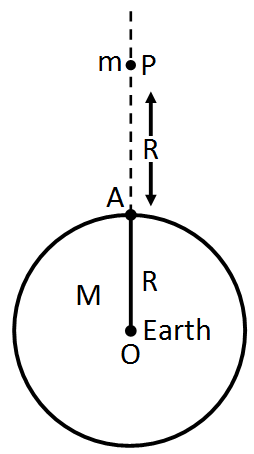
An object of mass m is raised from the surface of the earth to a height equal to the radius of the earth, that is, taken from a distance R to 2R from the centre of the earth. What is the gain in its potential energy?
Answer
As the object of mass m is lifted upward from surface of earth to a height equal to the radius of earth. i.e., from $\text{R}\rightarrow2\text{R}$ P.E. of body on the surface of earth $=\frac{\text{-GMm}}{\text{R}}$P.E. of the object at a equal to the radius of earth $=\frac{\text{-GMm}}{\text{R}}$
Gain in P.E. $\text{E}_\text{pf}-\text{E}_\text{pi}$ Gain in P.E. $=\frac{\text{-GMm}}{\text{2R}}$$=\Big(\frac{\text{-GMm}}{\text{R}}\Big)$
$=\frac{\text{GMm}}{\text{R}}\Big[-\frac{1}{2}+1\Big]$
$=\frac{\text{GMm}}{\text{2R}}\text{ GM = gR}^2$
Gain in P.E. $=\frac{\text{gR}^2\text{m}}{\text{2R}}$$=\frac{1}{2}\text{mgR}$
View full question & answer
Question 65 Marks
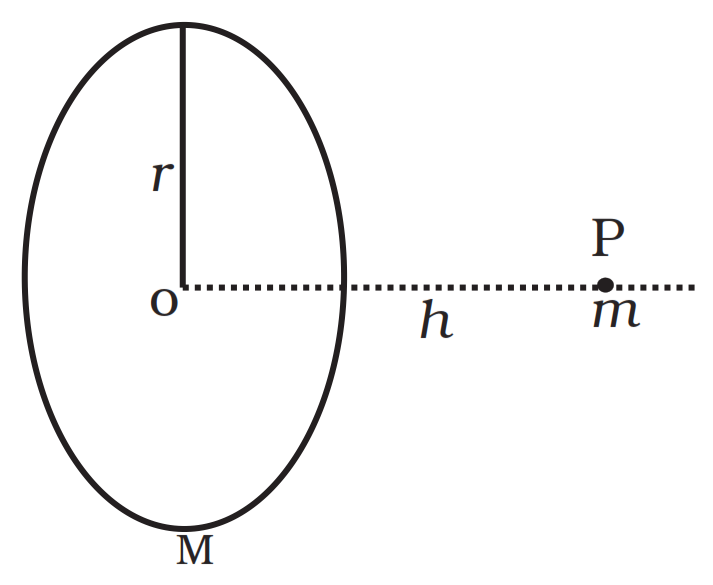
A mass m is placed at P a distance h along the normal through the centre O of a thin circular ring of mass M and radius r

If the mass is removed further away such that OP becomes 2h, by what factor the force of gravitation will decrease, if h = r?
Answer
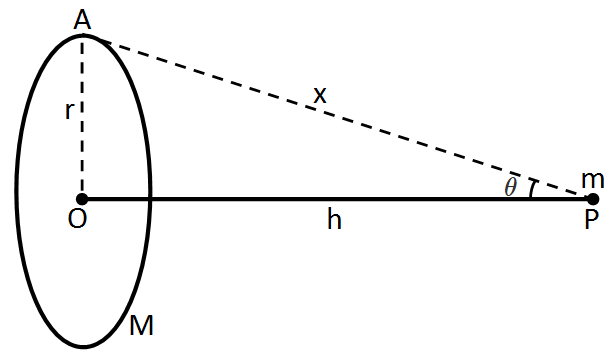
A ring has a radius r and mass M, and if a mass m is placed at a distance h axially at P. Consider a small element of the ring of mass dM at point A. Distance between dM and m is x.

Also $x^2 = r^2 + h^2$ Gravitational force between dM and m $\text{dF}=\frac{\text{G(dM)m}}{\text{x}^2}$$\text{dF}$ has two components $\text{dF}\cos^0$ along PO and $\text{dF}\sin^0$ perpendicular to PO.
Due to the symmetry of the ring, $\int \text{dF}\sin\theta=0$ Net force on mass m due to ring is given by $\text{F}=\int\text{dF}\cos\theta=\int\frac{\text{G(dm)m}}{\text{x}^2}.\frac{\text{h}}{\text{x}}$$=\frac{\text{Gmh}}{\text{x}^3}\int\text{dM}=\frac{\text{GMmh}}{\text{x}^3}=\frac{\text{GMmh}}{(\text{r}^2+\text{h}^2)^{\frac{3}{2}}}...(1)$
When mass is displaced upto distance 2h then;$\text{F}'=\frac{\text{GMm2h}}{(\text{r}^2(2\text{h})^2)^{\frac{3}{2}}}=\text{F}'=\frac{\text{GMm2h}}{(\text{r}^2(4\text{h})^2)^{\frac{3}{2}}}...(2)$
When h = r from eq. (1)$\text{F}=\frac{\text{GMmr}}{(\text{r}^2 +\text{r}^2)^{\frac{3}{2}}}=\frac{\text{GMm}}{2\sqrt{2}\text{r}^2}...(3)$
from eq.(2)$\text{F}'=\frac{\text{GMmr}}{(\text{r}^2 +4\text{r}^2)^{\frac{3}{2}}}=\frac{\text{2GMm}}{5\sqrt{5}\text{r}^2}...(4)$
Dividing eq (4) and eq (3) we have$\frac{\text{F}'}{\text{F}}=\frac{4\sqrt{2}}{5\sqrt{5}}$
or $\text{F}'=\frac{4\sqrt{2}}{5\sqrt{5}}\text{F},$ is the gravitational force between m and ring at distance 2h.
View full question & answer
Question 75 Marks
A satellite is to be placed in equatorial geostationary orbit around earth for communication.
  1. Calculate height of such a satellite.
  2. Find out the minimum number of satellites that are needed to cover entire earth so that at least one satellites is visible from any point on the equator.
[$M = 6 \times 10^{24}kg, R = 6400km, T = 24h, G = 6.67 \times 10^{–11}$ SI units]
Answer
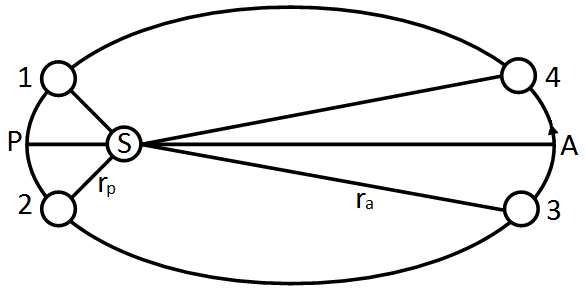
From the geometry of the ellipse of eccentricity e and semi major axis a, the aphelion and perihelion distances are:
$r_p = a(1 - e) and r_a= a(1 + e)...(i)$
As the earth orbits the sun, the angular momentum is conserved and a real velocity is constant.
Let M be the mass of the earth,
$v_p$ = velocity of the earth at perihelion (perigee).
$v_a$ = velocity of the earth at aphelion or apogee.
$\omega_\text{p}$ = angular velocity of the earth at perihelion.
$\omega_\text{a}$ = angular velocity of the earth at aphelion.
Angular momentum and areal velocity are constant as the earth orbits the sun.
$\text{r}^2_\text{p}\omega_\text{p}=\text{r}^2_\text{a}\omega_\text{a}...(\text{ii})$


From (i) and (ii), we get
$\frac{\omega_\text{p}}{\omega_\text{a}}=\Big(\frac{1+\text{e}}{1-\text{e}}\Big)^2\text{e}=0.0167$
$\therefore\ \frac{{\omega_\text{p}}}{{\omega_\text{a}}}=1.0691$
Let $\omega$ be the mean angular speed corresponds to mean solar day.
$\therefore\ \Big(\frac{{\omega_\text{p}}}{\omega}\Big)\Big(\frac{\omega}{{\omega_\text{a}}}\Big)=1.0691$
$\omega^2={\omega_\text{p}}{\omega_\text{a}}$
$\therefore\ \frac{{\omega_\text{p}}}{\omega}=\frac{\omega}{{\omega_\text{a}}}=1.034$
If mean angular velocity co corresponds to 1° per day, then p = 1.034° per day and a = 0.967° per day.
Since, 361° = 24 mean solar day we get (360 + 1.034) which corresponds to 24 h, 8.14" (8.1" longer) and 360.967°, corresponds to 23 h 59 min 52" (7.9" smaller).
This does not explain the actual variation of the length of the day during the year.
View full question & answer
Question 85 Marks
A star like the sun has several bodies moving around it at different distances. Consider that all of them are moving in circular orbits. Let r be the distance of the body from the centre of the star and let its linear velocity be v, angular velocity $\omega$, kinetic energy K, gravitational potential energy U, total energy E and angular momentum l. As the radius r of the orbit increases, determine which of the above quantities increase and which ones decrease.
Answer
In equilibrium condition, when a body moves around a star, the gravitational pull result in a centripetal force. Let us consider a body of mass m is rotating around the star S of mass M in circular path of radius r.
$\text{F}_\text{c}=\frac{\text{mv}^2_0}{\text{r}}=\frac{\text{GMm}}{\text{r}^2}$
  1. Then orbital velocity $\text{v}_0=\sqrt{\frac{\text{GM}}{\text{r}}}\text{or}\text{ v}_0\propto\frac{1}{\sqrt{\text{r}}}$
Hence, on increasing radius of circular path orbital velocity decreases.
  1. Angular velocity $\omega=\frac{2\pi}{\text{T}}$ and $\text{T}^2\propto\text{r}^3$ by Kepler’s third law
$\therefore\ \omega=\frac{2\pi}{\text{Kr}^{\frac{3}{2}}} \text{ or }\omega\propto\frac{1}{\sqrt{\text{r}^3}}$

Hence, on increasing the radius of circular orbit the angular velocity decreased.
  1. Kinetic energy $\text{E}_\text{k}=\frac{1}{2}\text{ m }\frac{\text{GM}}{\text{r}}$
Or $\text{E}_\text{k}\propto\frac{1}{\text{r}}.$ Hence on increasing the radius of circular path the kinetic energy decreased.
  1. Gravitation potential energy $\text{E}_\text{p}=\frac{-\text{GMm}}{\text{r}}$ or $\text{E}_\text{p}\propto-\Big(\frac{1}{\text{r}}\Big)$ so.
On increasing radius of circular orbit the P.E. (Ep) increases.
  1. Total energy $\text{E}=\text{E}_\text{k}+\text{E}_\text{p}=\frac{\text{GMm}}{2\text{r}}+\Big(\frac{-\text{GMm}}{\text{r}}\Big)$
$\text{E}=\frac{-\text{GMm}}{2\text{r}}$

Hence, on increasing the radius of circular orbit the total energy E will also be increased.
  1. Angular momentum $=\text{L}=\text{mvr}=\text{m}\sqrt{\frac{\text{GM}}{\text{r}}}\text{r}$
$\text{L}=\text{m}\sqrt{\text{GMr}}$ or $\text{L}\propto\sqrt{\text{r}}$

Hence, the increasing radius r of circular orbit increases the angular momentum.
View full question & answer
Question 95 Marks
Six point masses of mass m each are at the vertices of a regular hexagon of side l. Calculate the force on any of the masses.
Answer
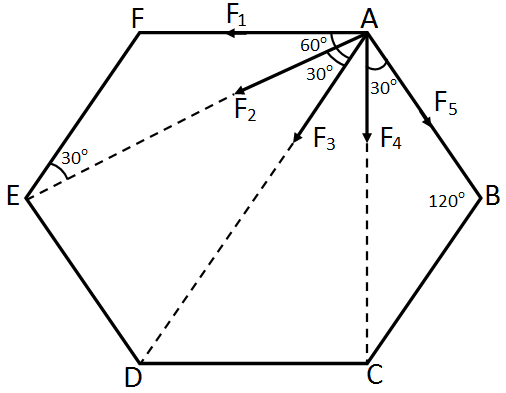
Resultant force will be equal to sum of individual forces by each point mass (m). According to the diagram below, in which six point masses are placed at six vertices A, B, C, D, E and F.$\text{AC}=\sqrt{\text{AB}^2+\text{BC}^2-2(\text{AB})(\text{BC})\cos120^0}$
$=\sqrt{\text{l}^2+\text{l}^2-2(\text{l})(\text{l})(-1/2)}$
Similarly, $\text{AE}=\text{l}\sqrt{3}$$\text{AD}=\sqrt{\text{AC}^2+\text{CD}^2}=\sqrt{3\text{l}^2+\text{l}^2}=2\text{l}$

Force on mass m at A due to mass m at F is,$\text{F}_1=\frac{\text{Gm}^2}{\text{l}^2} \text{ along AF}$
Force on mass m at A due to mass m at E is,$\text{F}_2=\frac{\text{Gm}^2}{(\sqrt{\text{3l}})^2}=\frac{\text{Gm}^2}{3\text{l}^2}\text{ along AE}$ $[\because\text{AC}=\sqrt{3}\text{l}]$
Force on mass m at A due to mass m at D is,$\text{F}_3=\frac{\text{Gm}\times\text{m}}{({\text{2l}})^2}=\frac{\text{Gm}^2}{4\text{l}^2}\text{ along AD}$ $[\because\text{AD}={2}\text{l}]$
Force on mass m at A due to mass m at C is,$\text{F}_4=\frac{\text{Gm}\times\text{m}}{(\sqrt{\text{3l}})^2}=\frac{\text{Gm}^2}{3\text{l}^2}\text{ along AC}.$
Force on mass m at A due to mass m at B is,$\text{F}_5=\frac{\text{Gm}\times\text{m}}{{\text{l}}^2}=\frac{\text{Gm}^2}{\text{l}^2}\text{ along AB}$
Since $F_1$ and $F_5$ are equal in magnitude and make equal angle (i.e., 60° each) withAD, their resultant is along AD.$\text{F}_{15}=\sqrt{\text{F}_1^2+\text{F}_5^2+2\text{F}_1\text{F}_5\cos120^0}$
$=\frac{\text{Gm}^2}{\text{l}^2} \text{ along AD}$ $[\because\text{Angle between F}_1\text{ and F}_5=120^0]$
Similarly, resultant force due to $F_2$ and $F_4$ is also along AD,$\text{F}_{24}=\sqrt{\text{F}_2^2+\text{F}_4^2+2\text{F}_2\text{F}_4\cos60^0}$
$=\frac{\sqrt{3}\text{Gm}^2}{\text{3l}^2}=\frac{\text{GM}^2}{\sqrt{3\text{l}^2}}\text{ along AD}$
So, net force along AD$\text{F}_\text{net}=\text{F}_{15}+\text{F}_{24}+\text{F}_3$
$=\frac{\text{GM}^2}{\text{l}^2}+\frac{\text{GM}^2}{\sqrt{3\text{l}^2}}+\frac{\text{GM}^2}{\text{4l}^2}$
$=\frac{\text{GM}^2}{\text{l}^2}\Big(1+\frac{1}{\sqrt{3}}+\frac{1}{4}\Big)$
View full question & answer
Question 105 Marks
A satellite is in an elliptic orbit around the earth with aphelion of $6R$ and perihelion of 2R where $R = 6400km$ is the radius of the earth. Find eccentricity of the orbit. Find the velocity of the satellite at apogee and perigee. What should be done if this satellite has to be transferred to a circular orbit of radius $6R$?[$G = 6.67 \times 10^{–11}$ SI units and $4M = 6 \times 10^{24}kg$]
Answer
$r_p = 2R r_a=6R$ Hence, $r_p = a(1 - e) = 2R ...(i) r_a= a(1 + e) = 6R ...(ii)$ on dividing (i) by (ii)$\frac{1-\text{e}}{1+\text{e}}=\frac{2}{6}$
$3-3\text{e}=1+\text{e}$
$4\text{e}=2\Rightarrow\text{e}=\frac{1}{2}$
There is not external force or torque on system. So by the law of conservation of angular momentum.$\text{L}_1=\text{L}_2$
$\text{m}_\text{a}\text{v}_\text{a}\text{r}_\text{a}=\text{m}_\text{p}\text{v}_\text{p}\text{r}_\text{p}\text{ m}_\text{a}=\text{m}_\text{p}=\text{m}=$ mass of satellite
$\therefore\ \frac{\text{v}_\text{a}}{\text{v}_\text{p}}=\frac{\text{r}_\text{p}}{\text{r}_\text{a}}\frac{2\text{R}}{6\text{R}}=\frac{1}{3}$
So, $\text{v}_\text{p}=3\text{v}_\text{a}$ Apply conservation of energy at apogee an d perigee …(iii)$\frac{1}{2}\text{mv}_\text{p}^2-\frac{\text{GMm}}{\text{r}_\text{p}}=\frac{1}{2}\text{mv}^2_\text{a}-\frac{\text{GMm}}{\text{r}_\text{a}}$
Multiplying $\frac{2}{\text{m}}$ to both side and putting $r_p= 2R$ and $r_a = 6R$$\text{v}^2_\text{p}-\frac{2\text{GM}}{2\text{R}}=\text{v}^2_\text{a}-\frac{2\text{GM}}{6\text{R}}$ (where M is mass of earth)
$\text{v}_\text{a}=\frac{\text{v}_\text{p}}{3}$
$\text{v}^2_\text{p}-\text{v}^2_\text{a}=\frac{\text{GM}}{\text{R}}-\frac{1}{3}\frac{\text{GM}}{\text{R}}$
$\text{v}^2_\text{p}-\Big(\frac{\text{v}_\text{p}}{3}\Big)^2=\frac{\text{GM}}{\text{R}}\Big[1+\frac{1}{3}\Big]$
$\text{v}^2_\text{p}\frac{8}{9}=\frac{\text{GM}}{\text{R}}.\frac{2}{3}$
$\text{v}^2_\text{p}=\frac{\text{GM}}{\text{R}}\frac{2}{3}\times\frac{9}{8}=\frac{3}{4}\frac{\text{GM}}{\text{R}}$
$\text{v}_\text{p}=\sqrt{\frac{3}{4}\frac{\text{GM}}{\text{R}}}=\sqrt{\frac{3\times6.67\times10^{-11}\times6\times10^{24}}{4\times6.6\times10^6}}$
$=\sqrt{\frac{9\times667\times10^{24-6-11-1}}{128}}$
$\text{v}_\text{p}=\sqrt{\frac{6003\times10^{18-11-1}}{128}}=\sqrt{46.89\times10^6}$
$=6.85\times10^3\text{m/s}=6.85\text{km/s}$
$\text{v}_\text{a}=\frac{\text{v}_\text{p}}{3}=\frac{6.85}{3}=2.28\text{km/s} $
$\text{v}_\text{c}=\sqrt{\frac{\text{GM}}{\text{r}}}=\sqrt{\frac{6.67\times10^{-11}\times6\times10^{24}}{6\text{R}}}$
$=\sqrt{\frac{6.67\times6\times10^{24-11}}{6\times6.8\times10^6}}=\sqrt{\frac{667}{640}\times10^{13-6}}$
$=\sqrt{1.042\times10\times10^6}=\sqrt{10.42\times10^6}$
$\text{v}_\text{c}=3.23\text{km/s}$
Hence to transfer to a circular orbit at apogee we have to boost the velocity by$\text{v}_0-\text{v}_\text{a}=(3.23-2.28)=0.95\text{km/ s}$
View full question & answer
Question 115 Marks
Earth’s orbit is an ellipse with eccentricity $0.0167$. Thus, earth’s distance from the sun and speed as it moves around the sun varies from day to day. This means that the length of the solar day is not constant through the year. Assume that earth’s spin axis is normal to its orbital plane and find out the length of the shortest and the longest day. A day should be taken from noon to noon. Does this explain variation of length of the day during the year?
Answer
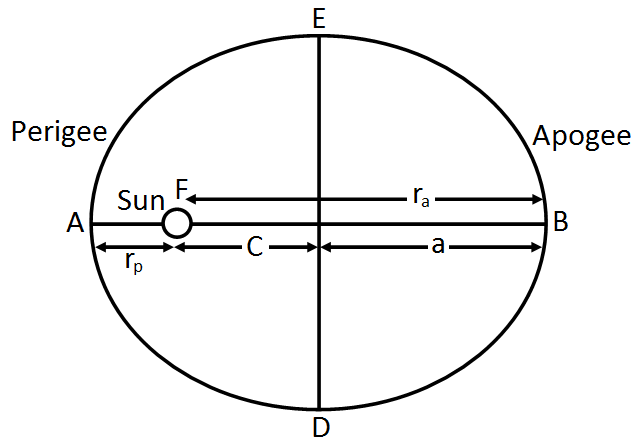
According to the diagram,
$r_p$ = radius of perigee = 2R
$r_a$ = radius of apogee = 6R
a = semi - major axis of the ellipse

Hence, we can write
$r_a = a(1 + e) = 6R$
$P_p = a(1 - e) = 2R$
$\frac{\text{a(1+e)}}{\text{a(1}-\text{e})}=\frac{6\text{R}}{2\text{R}}=3$
By solving, we get eccentricity $\text{e}=\frac{1}{2}$
If $v_a$ and $v_p$ are the velocities of the satellite (of mass m) at aphelion and perihelion respectively, then by conservation of angular momentum
$\therefore\ \text{L}_\text{at perigee}=\text{L}_\text{at apogee}$
$\text{mv}_\text{p}\text{r}_\text{p}=\text{mv}_\text{a}\text{r}_\text{a}$
$\therefore\ \frac{\text{v}_\text{a}}{\text{v}_\text{p}}=\frac{\text{r}_\text{p}}{\text{r}_\text{a}}=\frac{1}{3}$
Applying conservation of energy,
Energy at perigee = Energy at apogee
where M is the mass of the earth
$\therefore\ \text{v}_\text{p}^2\Big(1-\frac{1}{9}\Big)=-2\text{GM}\Big(\frac{1}{\text{r}_\text{a}}-\frac{1}{\text{r}_\text{p}}\Big)$
$=2\text{GM}\Big(\frac{1}{\text{r}_\text{p}}-\frac{1}{\text{r}_\text{a}}\Big)$ $(\text{By putting v}_\text{a}=\frac{\text{v}_\text{p}}{3})$
$\text{v}_\text{p}=\frac{\Big[2\text{GM}\big(\frac{1}{\text{r}_\text{p}}-\frac{1}{\text{r}_\text{a}}\big)\Big]^{\frac{1}{2}}}{\Big[1-\big(\frac{\text{v}_\text{a}}{\text{v}_\text{p}}\big)^2\Big]^{\frac{1}{2}}}$
$=\Bigg[\frac{\frac{2\text{GM}}{\text{R}}\Big(\frac{1}{2}-\frac{1}{6}\Big)}{\Big(1-\frac{1}{9}\Big)}\Bigg]^{\frac{1}{2}}=\Big(\frac{\frac{2}{3}}{\frac{8}{9}}\frac{\text{GM}}{\text{R}}\Big)^{\frac{1}{2}}=\sqrt{\frac{3}{4}\frac{\text{GM}}{\text{R}}}=6.85\text{km/ s}$
$\text{v}_\text{p}=6.85\text{km/ s,}\text{ v}_\text{a}=2.28\text{km/ s,}$
For circular orbit of radius r,
$v_c$= orbital velocity $=\sqrt{\frac{\text{GM}}{\text{r}}}$
For $r = 6R, v_c =\sqrt{\frac{\text{GM}}{\text{6R}}}$ = 3.23km/ s
View full question & answer