Questions

1 Marks Question

Take a timed test

55 questions · self-marked practice — reveal the answer and mark yourself.

Question 11 Mark
The pressure of a gas at -173°C is 1 atmosphere. Keeping the volume constant, to what temperature should the gas be heated so that its pressure becomes 2 atmosphere.
Answer
$\frac{\text{P}_1}{\text{T}_1}=\frac{\text{P}_2}{\text{T}_2}$$\text{T}_2=\frac{\text{P}_2\text{T}_1}{\text{P}_1}$
$=\frac{2\times(273\times173)}{1}=200\text{k}=-73^{\circ}\text{C}$
View full question & answer
Question 21 Mark
The specific heat of argon at constant volume is $0.075 ~kcal ~kg^{-1}K^{-1}$, then what will be its atomic weight?
$[Given, R = 2 ~cal ~mol^{-1}K^{-1}]$
Answer
Argon is a monoatomic gas, so$\text{C}_{\text{V}}=\frac{3}{2}\text{R}=\frac{3}{2}\times2=3\text{cal mol}^{-1}\text{K}^{-1}$
$\text{C}_{\text{V}}=\text{Mc}_{\text{V}}$
$\Rightarrow\text{M}=\frac{\text{C}_{\text{V}}}{\text{c}_{\text{V}}}=\frac{3}{0.075}=40$
View full question & answer
Question 31 Mark
  1. On the basis of Charle's law, what is the minimum possible temperature?
  2. What is the volume of gas at absolute zero temperature?
Answer
  1. $-273.15^{\circ} C.$
  2. Zero.
View full question & answer
Question 41 Mark
What is the minimum possible temperature on the basis of Charles' law?
Answer
The minimum possible temperature on the basis of Charles' law is -273.15°C.
View full question & answer
Question 51 Mark
The ratio of vapour densities of two gases at the same temperature is 6 : 9. Compare the r.m.s. velocities of their molecules.
Answer
The ratio of r.m.s velocities is given as$\frac{\text{C}_1}{\text{C}_2}=\sqrt{\frac{\text{M}_2}{\text{M}_1}}=\sqrt{\frac{\rho_2}{\rho_1}};$
$\frac{\text{C}_1}{\text{C}_2}=\sqrt{\frac{9}{6}}=\sqrt{3}:\sqrt{2}$
View full question & answer
Question 61 Mark
Can we define the temperature of vacuum? The temperature of a single molecule?
Answer
Temperature can be transferred only through one molecule to other so there would be no temperature of vacuum, also we cannot define temperature of single molecule we need to calculate temperature of whole gas.
View full question & answer
Question 71 Mark
Find degree of freedom of a monoatomic gas.
Answer
No. of degree of freedom for monoatomic gas, dof = 3N - K where N is the number of atoms and K is the number of constraints N = 1, K = 0 dof = 3 × 1 - 0 dof = 3 Therefore, degree of freedom of a monoatomic gas is 3.
View full question & answer
Question 81 Mark
Name at least two prominent phenomena which provide conclusive evidence of molecular motion.
Answer
Diffusion and evaporation.
View full question & answer
Question 91 Mark
What is the shape of the graph between pressure P and $\frac{1}{\text{V}}$ (reciprocal of volume) for a perfect gas at constant temperature?
Answer
Straight line.
View full question & answer
Question 101 Mark
It is said that the assumptions of kinetic theory are good for gases having low densities. Suppose a container is so evacuated that only one molecule is left in it. Which of the assumptions of kinetic theory will not be valid for such a situation? Can we assign a temperature to this gas?
Answer
When the gas is left for sufficient time, it becomes steady state. This assumption may be justified if the number of molecules is very large. No we can not assign temperature to the gas, as to assign temperature we need molecules colliding with each other thus transferring heat.
View full question & answer
Question 111 Mark
A brick weighing 4.0kg is dropped into a 1.0m deep river from a height of 2.0m. Assuming that 80% of the gravitational potential energy is finally converted into thermal energy, find this thermal energy is calorie.
Answer
Given, Mass of the brick, m = 4kg Total vertical distance travelled by the brick, h = 3m Percentage of gravitational potential energy converted to thermal energy = 80 Total change in potential energy of the brick = mgh = 4 × 10 × 3 = 120J Thermal Energy $=120\times\frac{80}{100}=96\text{J}$ Thermal energy in calories is given by,$\text{U}=\frac{96}{4.2}=22.857\text{cal}\approx23\text{cal}$
View full question & answer
Question 121 Mark
What is the law of equi-partition of energy?
Answer
According to law of equipartition of energy, for any dynamical system in thermal equilibrium the total energy is distributed equally amongst all the degrees of freedom and the energy associated with each molecule per degree of freedom is $\frac{1}{2}\text{K}_{\text{B}}\text{T},$ where $K_B$ is Boltzmann constant and $T$ is temperature of the system.
View full question & answer
Question 131 Mark
A vessel is filled with a mixture of two different gases. Will the mean kinetic energy per molecule of both the gases be equal?
Answer
Yes, This is because the mean kinetic energy per molecule, i.e., $\frac{3}{2}\text{kT}$ depends only upon temperature.
View full question & answer
Question 141 Mark
Can we define specific heat capacity at constant temperature?
Answer
We cannot define specific heat at constant temperature. As there must be change in temperature.
View full question & answer
Question 151 Mark
What is the kinetic energy per molecule of a gas whose pressure is P?
Answer
$\frac{3\text{k}_{\text{B}}\text{T}}{2}.$
View full question & answer
Question 161 Mark
A gas is kept in a rigid cubical container. If a load of 10kg is put on the top of the container, does the pressure increase?
Answer
As 10kg leads to force of 98N thus as force is applied thus pressure inside the container increases.
View full question & answer
Question 171 Mark
What is the mean translational kinetic energy of a mole of helium gas at 400K?
Answer
$\bar{\text{E}}_{\text{k}}=\frac{3}{2}\text{RT}=\frac{3}{2}\times8.31\times400=4986\text{J}.$
View full question & answer
Question 181 Mark
The density of oxygen is 16 times the density of hydrogen. What is the relation between the speeds of sound in two gases?
Answer
$\frac{\text{c}_{(\text{Oxy})}}{\text{c}_{\text{(Hyd)}}}=\sqrt{\frac{\rho_{\text{H}}}{\rho_{\text{O}}}}$$=\sqrt{\frac{1}{16}}=\frac{1}{4}=1:4$
View full question & answer
Question 191 Mark
Calculate the volume of 1 mole of an ideal gas at STP.
Answer
Volume of 1 mole of gas,$\text{PV}=\text{nRT}$
$\Rightarrow\text{V}=\frac{\text{RT}}{\text{P}}=\frac{0.082\times273}{1}$
$\Rightarrow22.38\approx22.4\text{L}=22.4\times10^{-3}$
$\Rightarrow2.24\times10^{-2}\text{m}^3$
View full question & answer
Question 201 Mark
Chlorine and carbon dioxide gases are maintained at 27°C. Which gas will have higher average molar kinetic energy of translation and why?
Answer
Both gases have same value of average translational kinetic energy per mole because their temperatures are equal and $\bar{\text{E}}=\frac{3}{2}\text{RT}.$
View full question & answer
Question 211 Mark
Name the type of motion associated with the molecules of a gas.
Answer
Brownian motion (in which any particular molecule will follow a zig-zag path due to the collisions with the other molecules or with the walls of the container.)
View full question & answer
Question 221 Mark
In a real gas the internal energy depends on temperature and also on volume. The energy increases when the gas expands isothermally. Looking into the derivation of $C_P - C_v = R$, find whether $C_P - C_v$ will be more than R, less than R or equal to R for a real gas.
Answer
For ideal gas $C_p - C_v$ = nr So, $C_P - C_v > R$
View full question & answer
Question 231 Mark
What is the relation between pressure and kinetic energy of a gas molecule?
Answer
$\text{P}=\frac{1}{3}\frac{\text{nmc}^2}{\text{V}}$$=\frac{2}{3\text{V}}.\frac{1}{2}\text{nmc}^2=\frac{2}{3\text{V}}\text{E},$
where V is volume and E is the total K.E. of the molecules.
View full question & answer
Question 241 Mark
If the molecules were not allowed to collide among themselves, would you expect more evaporation or less evaporation?
Answer
The collision in moplecules tranfer heat from one to another molecule thus lesser heat is tranfered thus there would be lesser evaporation.
View full question & answer
Question 251 Mark
Consider a gas of neutrons. Do you expect it to behave much better as an ideal gas as compared to hydrogen gas at the same pressure and temperature?
Answer
In case of neutron gas there would be no internal forces such as electrostatic forces between molecule between atoms of gases thus it can behave like ideal gas better than hydrogen gas.
View full question & answer
Question 261 Mark
If it were possible for a gas in a container to reach the temperature 0K, its pressure would be zero. Would the molecules not collide with the walls? Would they not transfer momentum to the walls?
Answer
In case of zero pressure the gas might become solid so in that case molecules would not collide with wall thus they will not transfer momentum to the wall.
View full question & answer
Question 271 Mark
What is the ratio of r.m.s. speed of oxygen and hydrogen molecules at the same temperature?
Answer
$\text{c}_{\text{rmc}}\propto\frac{1}{\sqrt{\text{M}}}$$\therefore\frac{\text{c}_{\text{O}_2}}{\text{c}_{\text{H}_2}}=\sqrt{\frac{2}{32}}=\sqrt{\frac{1}{16}}=\frac{1}{4}$
$\text{c}_{\text{O}_2}:\text{c}_{\text{H}_2}=1:4$
View full question & answer
Question 281 Mark
What would be the effect on rms velocity of gas molecules, if the temperature of the gas is increased by a factor 4?
Answer
As, $\mathrm{v}_{\mathrm{rms}} \propto \sqrt{\mathrm{T}}$ If temperature of the gas is increased 4 times, then $\mathrm{v}_{\mathrm{rms}}$ will be doubled.
View full question & answer
Question 291 Mark
The number of molecules in a container is doubled. What will be the effect on the rms speed of the molecules?
Answer
No effect.
View full question & answer
Question 301 Mark
Deduce the dimensional formula for R, using ideal gas equation PV = nRT
Answer
$\text{PV = nRT}$$\text{R}=\frac{\text{PV}}{\text{nT}}$
(n is a number of molecules)
$\text{R}=\frac{[\text{ML}^{-1}\text{T}^{-2}]\text{L}^3}{\text{K}}=[\text{ML}^2\text{T}^2\text{K}^{-1}]$
View full question & answer
Question 311 Mark
Is molar specific heat of a solid, a constant quantity?
Answer
Yes, the molar specific heat of a solid is a constant quantity as its value is $3 \mathrm{RJ} / \mathrm{mol}^{-K}$.
View full question & answer
Question 321 Mark
When we place a gas cylinder on a van and the van moves, does the kinetic energy of the molecules increase? Does the temperature increase?
Answer
No as the cylinder is isolated system thus there would be no change in kinetic energy of molecules of gases thus there would be no change in temperature too.
View full question & answer
Question 331 Mark
What do you mean by r.m.s speed of molecules of gas? Is r.m.s. speed same as the average speed at given temperature?
Answer
R.M.S speed is defined as square root of the mean of the squares of the random velocity of the individual molecules of gas. Average speed is the arithmetic mean of the speed of different molecules of a gas at given temperature. Thus r.m.s speed is greater than average speed of molecule.
View full question & answer
Question 341 Mark
Oxygen and hydrogen are at the same temperature T. What is the ratio of kinetic energies of oxygen molecule and hydrogen molecule when oxygen is 16 times heavier than hydrogen?
Answer
One, because the K.E. per molecule of the gas only depends upon the temperature.
View full question & answer
Question 351 Mark
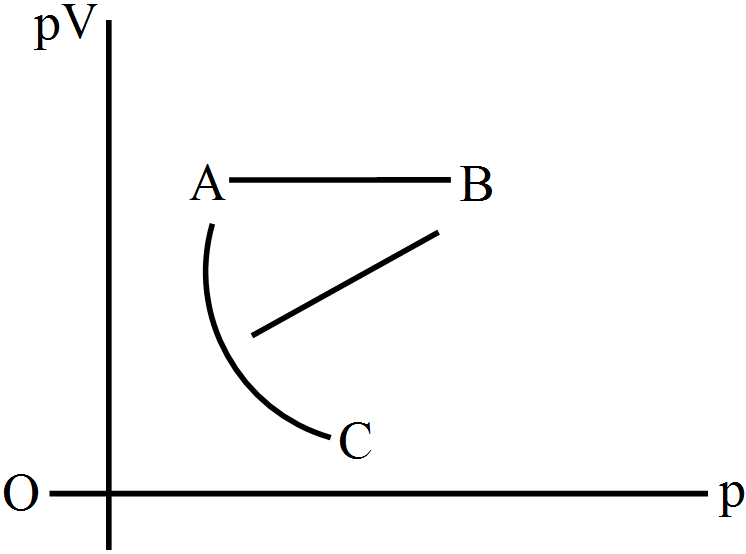
The given graph shows the variation of p-V versus p graph for different gases at constant temperature. Which of the following gas is ideal and why?
Answer
Gas A is ideal because pV is constant for gas A so, gas A obeys Boyle's law for all values of pressure.
View full question & answer
Question 361 Mark
According to kinetic theory of gases, explain absolute zero.
Answer
Absolute zero is the temperature at which the molecules of a gas becomes motionless. i.e. $\bar{\text{v}}_{\text{rms}}=0$
View full question & answer
Question 371 Mark
What is the number of degree of freedom of a bee flying in a room?
Answer
Three, because bee is free to move along x-direction or y-direction or z-direction.
View full question & answer
Question 381 Mark
A bullet of mass 20g enters into a fixed wooden block with a speed of $40ms^{-1}$ and stops in it. Find the change in internal energy during the process.
Answer
Given, Mass of bullet, m = 20g = 0.02kg Initial velocity of the bullet, $u = 40ms^{-1}$ Final velocity of the bullet $= 0ms^{-1}​​​​​​​$ Initial kinetic energy of the bullet $=\frac{1}{2}\text{mu}^2$$=\frac{1}{2}\times0.02\times40\times40=16\text{J}$
Final kinetic energy of the bullet = 0 Change in energy of the bullet = 16J It is given that the bullet enters the block and stops inside it. The total change in its kinetic energy is responsible for the change in the internal energy of the block.$\therefore$ Change in internal energy of the block = Change in energy of the bullet = 16J.
View full question & answer
Question 391 Mark
When you come out of a river after a dip, you feel cold. Explain.
Answer
The water on our body evaporates thus we feel cold after coming out of river.
View full question & answer
Question 401 Mark
The absolute temperature of the gas is increased 3 times. What will be the increase in root mean square velocity of the gas molecules?
Answer
Since $\text{C}\propto\sqrt{\text{T}}$ Therefore, the r.m.s. velocity becomes $\sqrt{3}\text{C}.$ Hence, increase in r.m.s. velocity $=\sqrt{3}\text{C}-\text{C}=0.732\text{C}.$
View full question & answer
Question 411 Mark
According to kinetic theory of gases, molecules of a gas behaves like ________.
Answer
According to kinetic theory of gases, molecules of a gas behaves like perfectly elastic rigid spheres.
View full question & answer
Question 421 Mark
Name an experimental evidence in support of random motion of gas molecules.
Answer
Brownian motion and diffusion of gases provide experimental evidence in support of random motion of gas molecules.
View full question & answer
Question 431 Mark
A 50kg man is running at a speed of $18kmh^{-1}$. If all the kinetic energy of the man can be used to increase the temperature of water from 20°C to 30°C, how much water can be heated with this energy?
Answer
Given, Mass of the man, m = 50kg Speed of the man, $\text{v}=18\text{km/h}$$=18\times\frac{5}{18}=5\text{m/s}$
Kinetic energy of the man is given by,$\text{K}=\frac{1}{2}\text{mV}^2$
$\text{K}=\Big(\frac{1}{2}\Big)50\times5^2$
$\text{K}=25\times25=625\text{J}$
Specific heat of the water, s = 4200J/Kg-K Let the mass of the water heated be M. The amount of heat required to raise the temperature of water from 20°C to 30°C is given by,$\text{Q}=\text{ms}\triangle\text{T}=\text{M}\times4200\times(30-20)$
$\text{Q}=42000\text{M}$
According to the question,$\text{Q}=\text{K}$
$\Rightarrow42000\text{M}=625 ​​$
$\Rightarrow\text{M}=\frac{625}{42}\times10^{-3}$
$\Rightarrow\text{M}=14.88\times10^{-3}$
$\Rightarrow\text{M}=15\text{g}$
View full question & answer
Question 441 Mark
Comment on the following statement: the temperature of all the molecules in a sample of a gas is the same.
Answer
As the pressure throughout the gas is same thus temperature distribution is same for all molecules.
View full question & answer
Question 451 Mark
How is mean free path depends on number density of the gas?
Answer
The mean free path is inversely proportional to the number density of the gas.
View full question & answer
Question 461 Mark
Although the r.m.s. speed of gas molecules is of the order of the speed of sound in that gas, yet on opening a bottle of ammonia in one corner of a room, its smell takes time in reaching the other corner. Explain why?
Answer
Because the molecules of ammonia move at random and continuously collide with one another. As a result of which they are not able to advance in one particular direction speedily.
View full question & answer
Question 471 Mark
A ball is dropped on a floor from a height of 2.0 m . After the collision it rises up to a height of 1.5 m . Assume that 40% of the mechanical energy lost goes as thermal energy into the ball. Calculate the rise in the temperature of the ball in the collision. Heat capacity of the ball is $800 \mathrm{JK}^{-1}$.
Answer
Height of the floor from which ball is dropped, $h_1=2.0 \mathrm{~m}$ Height to which the ball rises after collision, $h_2=1.5 \mathrm{~m}$ Let the mass of ball be $m \mathrm{~kg}$. Let the speed of the ball when it falls from $h_1$ and $h_2$ be $v_1$ and $v_2$, respectively.
respectively.$\text{v}_1=\sqrt{2\text{gh}_1}=\sqrt{2\times10\times2}=\sqrt{40}\text{m/s}$
$\text{v}_2=\sqrt{2\text{gh}_2}=\sqrt{2\times10\times1.5}=\sqrt{30}\text{m/s}$
Change in kinetic energy is given by,$\triangle\text{K}=\frac{1}{2}\times\text{m}\times40-\Big(\frac{1}{2}\text{m}\Big)\times30=\Big(\frac{10}{2}\Big)\text{m}$
$\Rightarrow\triangle\text{K}=5\text{m}$
If the position of the ball is considered just before hitting the ground and after its first collision, then 40% of the change in its KE will give the change in thermal energy of the ball. At these positions, the PE of the ball is same. Thus, Loss in PE = 0 The change in kinetic energy is utilised in increasing the temperature of the ball. Let the change in temperature be $\triangle\text{T}.$ Then,$\Big(\frac{40}{100}\Big)\times\triangle\text{K}=\text{m}\times800\times\triangle\text{T}$
$\Big(\frac{40}{100}\Big)\times\frac{10}{2}\text{m}=\text{m}\times800\times\triangle\text{T}$
$\Rightarrow\triangle\text{T}=\frac{1}{400}=0.0025$
$\Rightarrow2.5\times10^{-3}{^\circ}\text{C}$
View full question & answer
Question 481 Mark
A copper cube of mass 200g slides down on a rough inclined plane of inclination 37° at a constant speed. Assume that any loss in mechanical energy goes into the copper block as thermal energy. Find the increase in the temperature of the block as it slides down through 60cm. Specific heat capacity of copper $= 420Jkg^{-1} K^{-1}$.
Answer
Mass of copper cube, m = 200g = 0.2kg Length through which the block has slided, l = 60cm = 0.6m Since the block is moving with constant velocity, the net force on it is zero. Thus, Force of friction, f = mg Also, since the object is moving with a constant velocity, change in its K.E will be zero. As the object slides down, its PE decreases at the cost of increase in thermal energy of copper. The loss in mchanical energy of the copper block = Work done by the frictional force on the copper block to a distanceof 60cm.$\text{W}=\frac{\text{mg}}{\sin\theta}$
$\text{W}=0.2\times10\times0.6\sin37^\circ$
$\text{W}=1.2\times\Big(\frac{3}{5}\Big)=0.72$
Let the change in temperature of the block be $\triangle\text{T.}$ Thermal energy gained by block $=\text{ms}\triangle\text{T}=0.2\times420\times\triangle\text{T}=84\triangle\text{T}$ But $84\triangle\text{T}=0.72$$\Rightarrow\triangle\text{T}=\frac{0.72}{84}=0.00857$
$\Rightarrow\triangle\text{T}=0.0086=8.6\times10^{-3}{^\circ}\text{C}$
View full question & answer
Question 491 Mark
Do you expect the gas in a cooking gas cylinder to obey the ideal gas equation?
Answer
No as the gas inside cylinder is in liquid form thus we can not consider it as ideal gas.
View full question & answer
Question 501 Mark
A metal block of density $6000 \mathrm{~kg} \mathrm{~m}^{-3}$ and mass 1.2 kg is suspended through a spring of spring constant $200 \mathrm{~N} \mathrm{~m}^{-1}$. The spring-block system is dipped in water kept in a vessel. The water has a mass of 260 g and the block is at a height 40 cm above the bottom of the vessel. If the support to the spring is broken, what will be the rise in the temperature of the water. Specific heat capacity of the block is $250 \mathrm{Jkg}^{-1} \mathrm{~K}^{-1}$ and that of water is $4200 \mathrm{Jkg}^{-1} \mathrm{~K}^{-1}$. Heat capacities of the vessel and the spring are negligible.
Answer
Given, Density of metal block, $\mathrm{d}=600 \mathrm{kgm}^{-3}$ Mass of metal block, $\mathrm{m}=1.2 \mathrm{~kg}$ Spring constant of the spring, $\mathrm{k}=$ $200 \mathrm{Nm}^{-1}$ Volume of the block, $\mathrm{V}=\frac{1.2}{6000}=2 \times 10^{-4} \mathrm{~m}^3$ When the mass is dipped in water, it experiences a buoyant force and in the spring there is potential energy stored in it. If the net force on the block is zero before breaking of the support of the spring, then $\mathrm{kx}+\mathrm{V} p g=\mathrm{mg} 200 \mathrm{x}+\left(2 \times 10^{-4}\right) \times(1000) \times(10)=12 \Rightarrow \mathrm{x}=\frac{(12-2)}{200}$ $\Rightarrow \mathrm{x}=\frac{10}{200}=0.05 \mathrm{~m}$
$\Rightarrow\text{x}=\frac{10}{200}=0.05\text{m}$
The mechanical energy of the block is transferred to both block and water. Let the rise in temperature of the block and the water be $\triangle\text{T}.$ Applying conservation of energy, we get$\frac{1}{2}\text{kx}^2+\text{mgh}-\text{V}\rho\text{gh}=\text{m}_1\text{s}_1\triangle\text{T}+\text{m}_2\text{s}_2\triangle\text{T}$
$\Rightarrow\frac{1}{2}\times200\times0.0025+1.2\times10\times\Big(\frac{40}{100}\Big)\\-2\times10^{-4}\times1000\times10\times\Big(\frac{40}{100}\Big)$
$\Rightarrow\Big(\frac{260}{1000}\Big)\times4200\times\triangle\text{T}+1.2\times250\times\triangle\text{T}$
$\Rightarrow0.25+4.8-0.8=1092\triangle\text{T}+300\triangle\text{T}$
$\Rightarrow1392\triangle\text{T}=4.25$
$\Rightarrow\triangle\text{T}=\frac{4.25}{1392}=0.0030531$
$\Rightarrow\triangle\text{T}=3\times10^{-3}{^\circ}\text{C}$
View full question & answer
Question 511 Mark
Can we define specific heat capacity for an adiabatic process?
Answer
As in adiabatic process there is no heat exchanged thus specific heat capacity is zero.
View full question & answer
Question 521 Mark
What is the number of degrees of freedom of a molecule of a diatomic gas at room temperature?
Answer
Generally a molecule of a diatomic gas possesses 5 degrees of freedom at room temperature. 3 due to translational motion and 2 due to rotational motion.
View full question & answer
Question 531 Mark
Estimate the mean free path for a water molecule in water vapour at 373 K. Use information from Exercises 12.1 and Eq. (12.41) above.
Answer
A given mass of water in vapour state has $1.67 \times 10^3$ times the volume of the same mass of water in liquid state (Ex. 12.1). This is also the increase in the amount of volume available for each molecule of water. When volume increases by $10^3$ times the radius increases by $V^{1 / 3}$ or 10 times, i.e., $10 \times 2 \mathring A=20 \mathring A$. So the average distance is $2 \times 20=40 \mathring A$.
View full question & answer
Question 541 Mark
The density of water is 1000 $kg m ^{-3}$. The density of water vapour at $100^{\circ} C$ and $1 atm$ pressure is $0.6 kg m ^{-3}$. The volume of a molecule multiplied by the total number gives , what is called, molecular volume. The ratio (or fraction) of the molecular volume to the total volume occupied by the water vapour under the above conditions of temperature and pressure is $6 \times 10^{-4}$. The volume of a water molecule is $3 \times 10^{-29} m ^3$. What is the average distance between atoms (interatomic distance) in water?
Answer
A given mass of water in vapour state has $1.67 \times 10^3$ times the volume of the same mass of water in liquid state (Ex. 12.1). This is also the increase in the amount of volume available for each molecule of water. When volume increases by $10^3$ times the radius increases by $V^{1 / 3}$ or 10 times, i.e., $10 \times 2 \mathring A=20 \mathring A$. So the average distance is $2 \times 20=40 \mathring A$.
View full question & answer
Question 551 Mark
The density of water is 1000 $kg m ^{-3}$. The density of water vapour at $100^{\circ} C$ and $1 atm$ pressure is $0.6 kg m ^{-3}$. The volume of a molecule multiplied by the total number gives , what is called, molecular volume. Estimate the ratio (or fraction) of the molecular volume to the total volume occupied by the water vapour under the above conditions of temperature and pressure.
Answer
For a given mass of water molecules, the density is less if volume is large. So the volume of the vapour is $1000 / 0.6=1 /\left(6 \times 10^{-4}\right)$ times larger. If densities of bulk water and water molecules are same, then the fraction of molecular volume to the total volume in liquid state is 1. As volume in vapour state has increased, the fractional volume is less by the same amount, i.e. $6 \times 10^{-4}$.
View full question & answer