Questions

1 Marks Question

Take a timed test

144 questions · 4 auto-graded MCQ + 140 self-marked written.

MCQ 11 Mark
If, in Exercise $5.21$, the speed of the stone is increased beyond the maximum permissible value, and the string breaks suddenly, which of the following correctly describes the trajectory of the stone after the string breaks:
  • A
    The stone moves radially outwards.
  • The stone flies off tangentially from the instant the string breaks.
  • C
    The stone flies off at an angle with the tangent whose magnitude depends on the speed of the particle?
  • D
    Non of this
Answer
Correct option: B.
The stone flies off tangentially from the instant the string breaks.
When the string breaks, the stone will move in the direction of the velocity at that instant. According to the first law of motion, the direction of velocity vector is tangential to the path of the stone at that instant. Hence, the stone will fly off tangentially from the instant the string breaks.
View full question & answer
MCQ 21 Mark
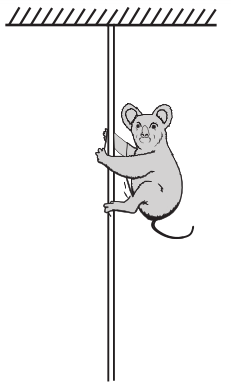
A monkey of mass $40kg$ climbs on a rope $($Fig.$)$ which can stand a maximum tension of $600 N$. In which of the following cases will the rope break: the monkey,

$($Ignore the mass of the rope$)$.
  • Climbs up with an acceleration of $6ms^{-2}$.
  • B
    Climbs down with an acceleration of $4ms^{-2}$.
  • C
    Climbs up with a uniform speed of $5ms^{-1}$.
  • D
    Falls down the rope nearly freely under gravity?
Answer
Correct option: A.
Climbs up with an acceleration of $6ms^{-2}$.
 Case $(a)$ Mass of the monkey, $m=40 \mathrm{~kg}$ Acceleration due to gravity, $\mathrm{g}=10 \mathrm{~m} / \mathrm{s}$ Maximum tension that the rope can bear, $T_{\max }=600 \mathrm{~N}$
Acceleration of the monkey, $a=6 \mathrm{~m} / \mathrm{s}^2$ upward Using Newton's second law of motion, we can write the equation of motion as: $T-m g=m a$
$\therefore T=m(g+a)=40(10+6)=640 \mathrm{~N}$ Since $T>T_{\text {max }}$ the rope will break in this case.
Case $(b)$ Acceleration of the monkey, $a=4 \mathrm{~m} / \mathrm{s}^2$ downward Using Newton's second law of motion,
we can write the equation of motion as: $\mathrm{mg}-\mathrm{T}=\mathrm{ma} $
$\therefore \mathrm{T}=\mathrm{m}(\mathrm{g}-\mathrm{a})=40(10-4)=240 \mathrm{~N}$ Since $\mathrm{T}<\mathrm{T}_{\text {max }}$, the rope will not break in this case.
Case $(c)$ The monkey is climbing with a uniform speed of $5 \mathrm{~m} / \mathrm{s}$.
Therefore, its acceleration is zero,
i.e., $\mathrm{a}=0$. Using Newton's second law of motion, we can write the equation of motion as: $\mathrm{T}-\mathrm{mg}=\mathrm{ma} \mathrm{T}-\mathrm{mg}$
$=0 $
$\therefore \mathrm{~T}=\mathrm{mg}=40 \times 10=400 \mathrm{~N}$ Since $\mathrm{T}<\mathrm{T}_{\max }$, the rope will not break in this case.
Case $(d)$ When the monkey falls freely under gravity, its will acceleration become equal to the acceleration due to gravity,
i.e., a $=\mathrm{g}$ Using Newton's second law of motion, we can write the equation of motion as: $\mathrm{mg}-\mathrm{T}=\mathrm{mg} $
$\therefore \mathrm{T}=\mathrm{m}(\mathrm{g}-\mathrm{g})=0$
Since $\mathrm{T}<\mathrm{T}_{\text {max }}$, the rope will not break in this case.
View full question & answer
Question 31 Mark
Give the magnitude and direction of the net force acting on. A car moving with a constant velocity of 30km/h on a rough road.
Answer
Force is being applied to overcome the force of friction. But as velocity of the car is constant, its acceleration, a = 0. Hence net force on the car F = ma = 0.
View full question & answer
Question 41 Mark
Give the magnitude and direction of the net force acting on. A cork of mass 10g floating on water.
Answer
As the cork is floating on water, its weight is balanced by the up thrust due to water. Therefore, the net force on the cork is 0.
View full question & answer
Question 51 Mark
Give the magnitude and direction of the net force acting on. A high-speed electron in space far from all material objects, and free of electric and magnetic fields.
Answer
As the high speed electron in space is far away from all gravitating objects and free of electric and magnetic fields, the net force on electron is 0.
View full question & answer
Question 61 Mark
Give the magnitude and direction of the net force acting on. A drop of rain falling down with a constant speed.
Answer
As the rain drop is filling with a constant speed, its acceleration, a = 0. Hence net force F = ma = 0.
View full question & answer
Question 71 Mark
Give the magnitude and direction of the net force acting on. A kite skillfully held stationary in the sky.
Answer
As the kite is held stationery, in accordance with the first law of motion, the net force on the kite is 0.
View full question & answer
Question 81 Mark
In the study of rocket propulsion $\vec{\text{F}}=\text{m}\vec{\text{a}}$ cannot be applied. Why?
Answer
Mass varies at every moment.
View full question & answer
Question 91 Mark
What do you mean by normal reaction?
Answer
It is the reaction due to the surface on which the body moves. It acts perpendicular to the surface of contact.
View full question & answer
Question 101 Mark
A pebble of mass 0.05kg is thrown vertically upward. Give the direction and magnitude of the net force on the pebble, at the highest point where it is momentary at rest. ($g = 10ms^{-2}$).
Answer
Mass of a pebble = 0.05kg Since a pebble is thrown vertically upward, then it is accelerated downwards under the influence of a gravity pull. Net force on the pebble = mg = 0.05 × 10 = 0.5N vertically downward.
View full question & answer
Question 111 Mark
Why is static friction called a self-adjusting force?
Answer
As the applied force increases, the static friction also increases and becomes equal to the applied force to make the object stationary. That is why static friction is called a self-adjusting force.
View full question & answer
Question 131 Mark
When a wheel is rolling on a level road, what is the direction of frictional force between the wheel and the road?
Answer
Friction, a tangential force provides the necessary torque to roll the body. This has to act opposite in the direction of motion to bring necessary motion.
View full question & answer
Question 141 Mark
Is earth an inertial frame of reference?
Answer
Since earth rotates on its own axis and also revolves around the sun, there will be acceleration associated. So earth cannot be taken as inertial frame of reference.
View full question & answer
Question 151 Mark
At which place on earth, is the centripetal force maximum?
Answer
Since $\text{F}=\frac{\text{mv}^2}{\text{r}},$ so at the pole, the value of F is maximum.
View full question & answer
Question 171 Mark
Why do we say friction is independent of area of contact?
Answer
Any change in area, leads to only variation in the pressure experienced, but the force to be balanced remains the same.
View full question & answer
Question 181 Mark
A force of 36 dyne is inclined to the horizontal at an angle of 60°. Find the acceleration in a mass of 18g that moves in a horizontal direction.
Answer
Given, F = 36 dyne at an angle of 60°. $\therefore$ Component of force along x-direction, $\text{F}_{\text{x}}=\cos60^\circ$ $=36\times\frac{1}{2}=18\text{dyne}$ But $\text{F}_\text{x}=\text{ms}_\text{x},$ $\text{a}_\text{x}=\frac{\text{F}_\text{x}}{\text{m}}=\frac{18}{18}=1\text{cm}/\ \text{s}^2$
View full question & answer
Question 191 Mark
A thief jumps from the roof of a house with a box of weight on his head. What will be the weight of the box as experienced by the thief during jump?
Answer
The thief is accelerated down by $\text{g}\Big(\frac{\text{m}}{\text{s}^2}\Big).$ $\therefore$ Apparent weight = m(g - a) = m(g - g) = 0. Weight experienced is zero.
View full question & answer
Question 201 Mark
Maximum static friction acting on body is known as _______.
Answer
Maximum static friction acting on body is known as limiting friction.
View full question & answer
Question 221 Mark
Why are curved roads generally banked?
Answer
Curved roads are generally banked so as to help in providing centripetal force needed to balance the centrifugal force, arising due to circular motion on the curved road.
View full question & answer
Question 231 Mark
The distance travelled by a moving body is directly proportional to time. Is any external force acting on it?
Answer
When $\text{S}\propto\text{t},$ so acceleration = 0, Therefore, no external force is acting on the body.
View full question & answer
Question 241 Mark
A retarding force is applied to stop a motor car. If the speed of the motor car is doubled, how much more distance will it cover before stopping under the same retarding force?
Answer
Since, $\text{S}\propto\text{v}^2,$ therefore motor car will cover a distance four times longer than before.
View full question & answer
Question 251 Mark
It is easier to catch a table tennis ball than a cricket ball even when both are moving with same velocity. Why?
Answer
Momentum transferred depends on mass and time in which it is brought to rest.
View full question & answer
Question 261 Mark
What is the source of centripetal force, when an electron revolves around the nucleus?
Answer
The electrostatic force of attraction between the nucleus and the electrons.
View full question & answer
Question 271 Mark
What provides the centripetal force in the following cases?
  1. Electron revolving around the nucleus.
  2. Earth revolving around the sun.
Answer
  1. Electrostatic force.
  2. Gravitational force.
View full question & answer
Question 281 Mark
Action and reaction are equal and opposite. Why do they not balance each other?
Answer
They always act on the two bodies in contact and not on the same body.
View full question & answer
Question 291 Mark
Why does a heavy rifle not kick as strongly as a light rifle using the same cartridges?
Answer
The recoil speed of rifle $\text{V}=\frac{\text{mv}}{\text{M}}$ is inversely proportional to its mass. So for a heavy rifle the kick is less stronger.
View full question & answer
Question 301 Mark
When several passengers are standing in a moving bus, it is said to be dangerous. How will you justify this statement?
Answer
It is dangerous because:When the passengers are standing in the bus, the centre of gravity of the system is raised and as such the whole system is in an unstable equilibrium.
When the running bus suddenly stops due to inertia of motion, the passengers fall forward on each other and this will cause a stampede.
View full question & answer
Question 311 Mark
Explain why does a cyclist bend inwards while riding along a curved road?
Answer
To make use of a component of normal reaction to negotiate the curve.
View full question & answer
Question 321 Mark
If a string of a rotating stone breaks, in which direction will the stone move?
Answer
The stone will move along the tangent at the point of breaking.
View full question & answer
Question 331 Mark
For uniform circular motion does the direction of the centripetal force depend on the sense of rotation (i.e., clockwise or anti-clockwise)?
Answer
No, centripetal force always acts towards the centre.
View full question & answer
Question 351 Mark
When are the two given bodies said to have same inertial mass?
Answer
If on applying same force on the bodies, same acceleration is produced, then their inertial masses are same.
View full question & answer
Question 361 Mark
A body is describing a vertical circle of radius r. What are the values of its minimum speed at the bottom and top of the vertical circle?
Answer
At bottom, $\text{v}=\sqrt{\text{5gr}}$ and at the top $\text{v}=\sqrt{\text{gr}}.$
View full question & answer
Question 371 Mark
It is easier to roll a barrel than to pull it along the road. Why?
Answer
It is easier to roll a barrel because at the time of rolling we require to apply a force in order to overcome rolling friction and value of rolling friction is much less than sliding friction.
View full question & answer
Question 391 Mark
A force of 1N acts on a body of mass 1g. Calculate the acceleration produced in the body.
Answer
Given, F = 1N, m = 1g = 10kg, Now, $\text{F}=\text{ma}$ $\Rightarrow\text{a}=\frac{\text{F}}{\text{m}}=\frac{1}{10^{-3}}=10^3\text{ms}^2$
View full question & answer
Question 401 Mark
The linear momentum of the body can change only in the direction of applied force. Comment.
Answer
The statement is correct. It is in accordance with Newton's second law of motion.
View full question & answer
Question 411 Mark
Proper inflation reduces fuel consumption. Give reason.
Answer
Friction depends on the hardness and smoothness of the surfaces in contact. So proper inflation is required.
View full question & answer
Question 421 Mark
What is momentum and on which factors it depends?
Answer
Momentum of a body is defined as the product of its mass and the velocity with which it is moving Momentum = Mass × Velocity Momentum of a body depends upon it mass and the velocity.
View full question & answer
Question 431 Mark
Why does a child feel more pain when she falls down on a hard cement floor, than when she falls on the soft muddy ground in the garden?
Answer
The effect of force F = ma. i.e., if the mass is constant for a system to decrease force, the ‘a’ should be decreased $\text{a}=\frac{(\text{v}-\text{u})}{\text{t}}$ initial and final velocity of falling body on a surface are u and zero. so it cannot be changed. If time during hitting is increased, the acceleration decreased and force will decrease. On cemented hard floor the time to stop after fall on it is very-very small. But when she/he falls on soft ground of garden she/ he sinks in ground and takes more time to stop hence smaller force or pain acts on her/ him.
View full question & answer
Question 461 Mark
Minimum velocity of body at lowest point looping in vertical circle of radius r is ________.
Answer
Minimum velocity of body at lowest point looping in vertical circle of radius r is $\text{V}_\text{L}=\sqrt{5\text{gr}}.$
View full question & answer
Question 471 Mark
What is the effect on the acceleration of a particle if the net force on the particle is doubled?
Answer
Since, $\text{a}=\frac{\text{F}}{\text{m}}.$ On doubling the force, the acceleration will also be doubled.
View full question & answer
Question 481 Mark
A body of mass 25g is moving with a constant velocity of 5m/ sec on a horizontal frictionless surface in vacuum. What is the force acting on the body?
Answer
Zero.
View full question & answer
Question 491 Mark
What is the angle between frictional force and instantaneous velocity of the body moving on a rough road?
Answer
The angle between the frictional force and instantaneous velocity is $180^o$.
View full question & answer
MCQ 501 Mark
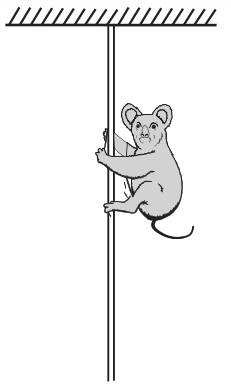
A monkey of mass $40kg$ climbs on a rope $($Fig.$)$ which can stand a maximum tension of $600 N$. In which of the following cases will the rope break: the monkey,

$($Ignore the mass of the rope$)$.
  • Climbs up with an acceleration of $6\ ms^{-2}$.
  • B
    Climbs down with an acceleration of $4\ ms^{-2}$.
  • C
    Climbs up with a uniform speed of $5\ ms^{-1}$.
  • D
    Falls down the rope nearly freely under gravity?
Answer
Correct option: A.
Climbs up with an acceleration of $6\ ms^{-2}$.
Case $(a)$ Mass of the monkey, $m=40 \mathrm{~kg}$ Acceleration due to gravity, $\mathrm{g}=10 \mathrm{~m} / \mathrm{s}$ Maximum tension that the rope can bear, $T_{\max }=600 \mathrm{~N}$
Acceleration of the monkey, $a=6 \mathrm{~m} / \mathrm{s}^2$ upward Using Newton's second law of motion, we can write the equation of motion as: $T-m g=m a$
$\therefore T=m(g+a)=40(10+6)=640 \mathrm{~N}$ Since $T>T_{\text {max }}$ the rope will break in this case.
Case $(b)$ Acceleration of the monkey, $a=4 \mathrm{~m} / \mathrm{s}^2$ downward Using Newton's second law of motion,
we can write the equation of motion as: $\mathrm{mg}-\mathrm{T}=\mathrm{ma} $
$\therefore \mathrm{T}=\mathrm{m}(\mathrm{g}-\mathrm{a})=40(10-4)=240 \mathrm{~N}$ Since $\mathrm{T}<\mathrm{T}_{\text {max }}$, the rope will not break in this case.
Case $(c)$ The monkey is climbing with a uniform speed of $5 \mathrm{~m} / \mathrm{s}$.
Therefore, its acceleration is zero,
i.e., $\mathrm{a}=0$. Using Newton's second law of motion, we can write the equation of motion as: $\mathrm{T}-\mathrm{mg}=\mathrm{ma} \mathrm{T}-\mathrm{mg}$
$=0 $
$\therefore \mathrm{~T}=\mathrm{mg}=40 \times 10=400 \mathrm{~N}$ Since $\mathrm{T}<\mathrm{T}_{\max }$, the rope will not break in this case.
Case $(d)$ When the monkey falls freely under gravity, its will acceleration become equal to the acceleration due to gravity,
i.e., a $=\mathrm{g}$ Using Newton's second law of motion, we can write the equation of motion as: $\mathrm{mg}-\mathrm{T}=\mathrm{mg} $
$\therefore \mathrm{T}=\mathrm{m}(\mathrm{g}-\mathrm{g})=0$
Since $\mathrm{T}<\mathrm{T}_{\text {max }}$, the rope will not break in this case.
View full question & answer
Question 511 Mark
Is the large brake on a bicycle wheel more effective than a small one? Explain.
Answer
No, because the frictional force is independent of area of contact.
View full question & answer
Question 521 Mark
Is a force required to maintain a body in its state of uniform motion along a straight line?
Answer
No, force is not required to maintain a body in its state of uniform motion along a straight line.
View full question & answer
Question 531 Mark
What is the source of centripetal force, when an electron revolves around the nucleus?
Answer
The electrostatic force of attraction between the nucleus and the electrons.
View full question & answer
Question 541 Mark
Name the forces which have shortest range and the longest range.
Answer
Nuclear forces have the shortest range and gravitational forces have the longest range.
View full question & answer
Question 551 Mark
What is the apparent weight felt by a person in an elevator, when it is accelerating: $(i)$ upward $(ii)$ downward?
Answer
  1. Apparent weight $= m(g + a).$
  2. Apparent weight $= m(g - a)$.
View full question & answer
Question 571 Mark
A mass m moving with a speed u collides on a similar stationary mass and sticks to it. What is the velocity after collision?
Answer
Applying conservation of momentum, we have 2mv = mu $\Rightarrow\ \text{v}=\frac{\text{u}}{2}$
View full question & answer
Question 581 Mark
Why are mountain roads generally made winding upwards rather than going straight up?
Answer
On an inclined plane force of friction on a body going upward is $\text{f}_\text{s}=\mu\text{N}\cos\theta$ where $\theta$ is angle of inclination of a plane with horizontal if $\theta$ is small, the force of friction is high and there is a less chance of skidding. The road straight up would have a larger angle and smaller would be the value of friction, hence more are the chances of skidding.
View full question & answer
Question 591 Mark
What are the units and dimensions of coefficient of friction?
Answer
Coefficient of friction is a unit less and dimensionless term.
View full question & answer
Question 601 Mark
Person sitting in a moving bus in uniform motion fall forward when sudden break is applied. It is due to ________.
Answer
Person sitting in a moving bus in uniform motion fall forward when sudden break is applied. It is due to inertia of motion.
View full question & answer
Question 611 Mark
Force acting on a body is directly proportional to rate of change of ______.
Answer
Force acting on a body is directly proportional to rate of change of linear momentum.
View full question & answer
Question 621 Mark
What is the angle of friction between two surfaces in contact, if coefficient of friction is $\sqrt{3}?$
Answer
Since $\tan\theta=\mu=\sqrt{3}$ $\theta=\tan^{-1}(\sqrt3)\Rightarrow\theta=60^\circ$
View full question & answer
Question 631 Mark
Rubber tyres are preferred over steel tyres. Why?
Answer
Rubber tyres are preferred because coefficient of friction between rubber and road is less than that between steel and road.
View full question & answer
Question 641 Mark
Give the magnitude and direction of the net force acting on. A car moving with a constant velocity of 30km/h on a rough road.
Answer
Force is being applied to overcome the force of friction. But as velocity of the car is constant, its acceleration, a = 0. Hence net force on the car F = ma = 0.
View full question & answer
Question 651 Mark
A body is dropped from the ceiling of a transparent cabin falling freely towards the earth. Describe the motion of the body as observed by an observer $(a)$ sitting in the cabin $(b)$ standing on earth.
Answer
  1. Appears stationary in the lift.
  2. Appears to fall freely $\Big(\text{a}=\frac{\text{g m}}{\text{s}^2}\Big)$
View full question & answer
Question 661 Mark
What is the angle between frictional force and instantaneous velocity of the body moving over a rough surface?
Answer
The angle is 180°, because force of friction always opposes the relative motion.
View full question & answer
Question 671 Mark
A cricketer pulls his hands backward, holding a catch. Explain.
Answer
To reduce the force experienced, by increasing the time of contact.
View full question & answer
Question 681 Mark
How is the motion of parachute different from a stone dropped from certain height?
Answer
Acceleration is $g(m/ s^2)$ for free fall for stone and not for a parachute.
View full question & answer
Question 691 Mark
A cricket player, while catching the ball, pulls his hand back. Why?
Answer
To reduce the force experienced, by increasing the time of contact.
View full question & answer
Question 701 Mark
Name the weakest and strongest force in nature.
Answer
Weakest - Gravitational force. Strongest - Nuclear force.
View full question & answer
Question 711 Mark
A body is acted upon by a number of external forces. Can it remain at rest?
Answer
Yes, if the external forces acting on the body can be represented in magnitude and direction by the sides of a closed polygon taken in the same order.
View full question & answer
Question 731 Mark
Calculate the force acting on a body which changes the momentum of the body at the rate of $1kg/ ms^2$.
Answer
We know that, F = rate of change of momentum, $F = 1kg-ms^2 = 1N$
View full question & answer
Question 741 Mark
Give the magnitude and direction of the net force acting on. A cork of mass 10g floating on water.
Answer
As the cork is floating on water, its weight is balanced by the up thrust due to water. Therefore, the net force on the cork is 0.
View full question & answer
Question 751 Mark
A bus weighing 1000kg is at rest on the bus stand. What is the linear momentum of the bus?
Answer
Linear momentum, $\vec{\text{p}}=\text{m}\vec{\text{v}}$ As $\vec{\text{v}}=0,$ therefore $\vec{\text{p}}=0.$
View full question & answer
Question 771 Mark
Name two absolute units of force. How are they related?
Answer
Newton and dyne are absolute units in MKS and CGS system. 1 newton = $10^5 dynes$.
View full question & answer
Question 781 Mark
What happens to coefficient of friction, when weight of body is doubled?
Answer
Coefficient of friction is not affected as it depends only on material and nature of surfaces in contact.
View full question & answer
Question 791 Mark
A mass m moving with a velocity u hits a surface at an angle $\theta$ with the normal at the point of hitting. How much force does it exerts, if no energy is lost?
Answer
Force = Rate of change in momentum $=\frac{2\text{mu}\cos\theta}{\text{time}}$ $\because\ \text{mu}\cos\theta$ is momentum along the normal at the point of incidence.
View full question & answer
Question 801 Mark
Minimum angle of inclined plane with horizontal plane at which when a body is placed, just start sliding down is known as _______.
Answer
Minimum angle of inclined plane with horizontal plane at which when a body is placed, just start sliding down is known as angle of repose.
View full question & answer
Question 811 Mark
A stone breaks the window glass into pieces, while a bullet pierces through the same. Why?
Answer
The velocity of bullet being large, the bullet remains in contact with window glass for a shorter time than the stone of lesser velocity.
View full question & answer
Question 821 Mark
The mountain road is generally made winding upwards rather than going straight up. Why?
Answer
When we go up a mountain, the opposing force of friction $\text{F}=\mu\text{R}=\mu\text{mg}\ \cos.$ where $\theta$ is angle of slope with horizontal. To avoid skidding, F should be large. $\therefore\cos\theta$ should be large and hence, 0 must be small. Therefore, mountain roads are generally made winding upwards. The road straight up would have large slope.
View full question & answer
Question 831 Mark
Which is greater: nuclear force or electrostatic force?
Answer
Nuclear force is the strongest of all forces.
View full question & answer
Question 841 Mark
A body having constant linear momentum then force acting on the body is equal to _______.
Answer
A body having constant linear momentum then force acting on the body is equal to zero.
View full question & answer
Question 851 Mark
It is easier to pull lawn roller than to push it. Why?
Answer
When we pull a lawn mover the vertical component of applied pull acts opposite to the weight of mover and it reduces the effective weight on the other hand. When the lawn mover is pushed vertical component of applied push adds to the weight of mover and therefore its effective weight is more than actual.
View full question & answer
Question 861 Mark
For finite change in linear momentum in short interval of time force acting on a body is inversely proportional to ________.
Answer
For finite change in linear momentum in short interval of time force acting on a body is inversely proportional to time.
View full question & answer
Question 871 Mark
A stone, when thrown on a glass window, smashes the window pane to pieces. But a bullet fired from a gun passes through making a hole. Why?
Answer
A stone gains lesser momentum compared to a bullet. Window pane can create enough resistance to the stone, and not to the bullet.
View full question & answer
Question 881 Mark
State the law of conservation of momentum.
Answer
When no external force acts on a body, there is no change in momentum or momentum will remain conserved.
View full question & answer
Question 891 Mark
Which law is to be used by a man stranded at the middle of a pond, when no friction is experienced by the boat?
Answer
Third law of Motion.
View full question & answer
Question 901 Mark
A body is moving in a circular path such that its speed always remains constant. Should there be a force acting on the body?
Answer
When a body is moving along a circular path, speed always remains constant and a centripetal force is acting on the body.
View full question & answer
Question 911 Mark
A retarding force is applied to stop a motor car. If the speed of the motor car is doubled, how much more distance will it cover before stopping under the same retarding force?
Answer
Retarding force is same. For the same car, the mass is same. So the deceleration is same. We know that v = 0, $\text{u}\neq0.$ Using $v^2 - u^2 = 2as$ we have $\text{s}=\frac{\text{u}^2}{2\text{a}}.$ So doubling the speed will make the distance increase to four times.
View full question & answer
Question 921 Mark
Give the magnitude and direction of the net force acting on. A high-speed electron in space far from all material objects, and free of electric and magnetic fields.
Answer
As the high speed electron in space is far away from all gravitating objects and free of electric and magnetic fields, the net force on electron is 0.
View full question & answer
Question 931 Mark
A heavy point mass tied to the end of string is whirled in a horizontal circle of radius 20cm with a constant angular speed. What is angular speed if the centripetal acceleration is $980cm/ s^{-2}$?
Answer
Here, radius r = 20cm Centripetal acceleration, = $980cm/ s^{-2}$ We know that centripetal acceleration, $\text{a}=\text{r}\omega^2$ $\omega=\sqrt{\frac{\text{a}}{\text{r}}}=\sqrt{\frac{980}{20}}$ $\omega=\sqrt{49}=7\text{rad/ }\text{s}$
View full question & answer
Question 941 Mark
In a connected motion of two body, acceleration of both the bodies are _______.
Answer
In a connected motion of two body, acceleration of both the bodies are equal.
View full question & answer
Question 951 Mark
Why do aeroplanes having wings fly at low altitudes?
Answer
The wings of aeroplane push the air backwards and the reaction of the air pushes the plane forward. At low altitudes, air is dense and as such the reaction of the air on plane is large.
View full question & answer
Question 961 Mark
One often comes across the following kind of statement concerning circular motion. A particle moving uniformly along a circle experiences a force directed towards the centre and an equal and opposite force directed away from the centre. The two forces together keep the particle in equilibrium. Explain, what is wrong with this statement?
Answer
This statement is wrong relative to any inertial frame of reference that we normally use (e.g., laboratory frame that is approximately inertial). The particle in circular motion is not in equilibrium, it has a centripetal acceleration. Centrifugal force does not exist relative to an inertial frame. The statement is correct relative to the (non-inertial) frame rotating with the particle.
View full question & answer
Question 971 Mark
A ball moving with a momentum of $5kg~ms^{-1}$ strikes against a wall at an angle of 45° and is reflected at the same angle and with same speed. Find the change in momentum of the ball.
Answer
$\Delta\text{p}=2\text{ mv}\cos\theta$$=2\times5\times\cos45^\circ$
$=5\sqrt{2}\text{ kg m/s}$
View full question & answer
Question 981 Mark
What provides the centripetal force to a car taking a turn on a level road?
Answer
The force of friction between the road and the tyres of car.
View full question & answer
Question 991 Mark
It is easier to maintain the motion of a body than to start it. Why?
Answer
We have to overcome static friction, which is more than kinetic friction.
View full question & answer
Question 1001 Mark
On what factors does the thrust on a rocket depend?
Answer
The upward thrust on a rocket depends on exhaust speed of the gases w.r.t. the rocket and rate at which mass of the exhaust gases escapes.
View full question & answer
Question 1011 Mark
When a bomb explodes in mid-air, at its highest point, what is the direction of motion of its core?
Answer
Vertically downward, since it was at rest at the highest point.
View full question & answer
Question 1021 Mark
Rockets can move in air-free space but jet plane cannot. Why?
Answer
Jet planes use atmospheric oxygen for burning fuel but rockets carry their own fuel and oxygen and do not depend on atmospheric oxygen.
View full question & answer
Question 1031 Mark
An impulse is applied to a moving object with a force at an angle of 20° w.r.t. velocity vector, what is the angle between the impulse vector and change in momentum vector?
Answer
Impulse and change in momentum are along the same direction. Therefore, angle between these two vectors is zero degree.
View full question & answer
Question 1041 Mark
Why wheels are made circular in automobiles?
Answer
It is easier to roll a body, than to bring sliding motion in it because $\mu_\text{r}<\mu_\text{k}.$
View full question & answer
Question 1051 Mark
What is the ratio of the SI to the CGS units of momentum?
Answer
$10^5 : 1$ is the ratio of the SI to CGS unit of momentum.
View full question & answer
Question 1061 Mark
Angle of friction which the resultant of limiting friction and normal reaction makes with the normal, is numerically equal to ______.
Answer
Angle of friction which the resultant of limiting friction and normal reaction makes with the normal, is numerically equal to coefficient of static friction.
View full question & answer
Question 1071 Mark
Carts with rubber tyres are easier to ply than those with iron tyres. Explain.
Answer
The carts with rubber tyres are easier to ply than those with iron types because the coefficient of friction between rubber and concrete is less than that between iron and the road.
View full question & answer
Question 1081 Mark
The casting of a rocket in flight burns up due to friction. At whose expense is the heat energy required for burning obtained? The rocket or the atmosphere or both.
Answer
From the kinetic energy of rocket.
View full question & answer
Question 1091 Mark
Why do we use shock absorbers in automobiles?
Answer
To reduce the effect of any force by increasing the time of experience.
View full question & answer
Question 1101 Mark
Give the magnitude and direction of the net force acting on. A drop of rain falling down with a constant speed.
Answer
As the rain drop is filling with a constant speed, its acceleration, a = 0. Hence net force F = ma = 0.
View full question & answer
Question 1121 Mark
Frame of reference in which Newton's first law of motion is applicable is known as ______.
Answer
Frame of reference in which Newton's first law of motion is applicable is known as Inertial frame of reference.
View full question & answer
Question 1131 Mark
Two boys on ice skates hold a rope between them. One boy is much heavier than the other. Discuss their motion when one of the boys pulls on the rope.
Answer
The initial momentum of the boys holding the rope is zero. When one of the two pulls the other they move towards each other. To conserve momentum in the absence of external force the heavier of the two boys will move slower than the other.
View full question & answer
Question 1141 Mark
Which of the following is a scalar quantity? Inertia, force and linear momentum.
Answer
Inertia of linear motion is measured by mass of the body, which is a scalar quantitiy.
View full question & answer
Question 1151 Mark
In the above given problem if the lower thread is pulled with a jerk, what happens?
Answer
Thread CD will break up if CD is pulled with the jerk because pull on thread CD is not transmitted from CD to AB by mass 2kg due to its inertia of rest.
View full question & answer
Question 1161 Mark
Why does a child in a merry-go-round press the side of his seat radially outwards?
Answer
Due to the accelerated nature of the frame, a pseudo force acts outward radially.
View full question & answer
Question 1171 Mark
What is the apparent weight of a man of mass 60kg who is standing on a lift which is moving up with a uniform speed? ($g = 10ms^{-2}$)
Answer
When lift moves with uniform speed acceleration is zero. Apparent weight = mg = 60 × 10 = 600N
View full question & answer
Question 1181 Mark
What is the effect on the direction of the centripetal force when the revolving body reverses its direction of motion?
Answer
The centripetal force will be directed towards the centre of the circle. This fact does not depend upon the sense of rotation of the particle.
View full question & answer
Question 1191 Mark
The two ends of a spring balance are pulled each by a force of 10kg wt. What will be the reading of the balance?
Answer
The reading will be only 10kg wt, since one end will act as a rigid support.
View full question & answer
Question 1201 Mark
What is the acceleration associated with a mass 'm' moving up an inclined plane $(\theta)$ with friction $\mu?$
Answer
Force acting are $\text{mg}\sin\theta$ and $\mu\text{ mg}\cos\theta,$ both in the downward directin, as the mass moves up.$\therefore\ \text{a}=\frac{\text{mg}\sin\theta+\mu\text{mg}\cos\theta}{\text{m}}$
$=\text{g}(\sin\theta+\mu\cos\theta).$
View full question & answer
Question 1221 Mark
If force is acting on a moving body perpendicular to the direction of motion, then what will be its effect on the speed and direction of the body?
Answer
No change in speed, but change in direction is possible. Forces acting on a body in circular motion is an example.
View full question & answer
Question 1231 Mark
Calculate the force acting on a body whose linear momentum changes from $20kg ~ms^{-1}$ to $40kg ~ms^{-1}$ in 10s.
Answer
Force = rate of change of linear momentum $=\frac{20}{10}=\text{2N}.$
View full question & answer
MCQ 1241 Mark
An astronaut accidentally gets separated out of his small spaceship accelerating in interstellar space at a constant rate of 100ms. What is the acceleration of the astronaut at the instant after he is outside the spaceship? $($Assume that there are no nearby starts to exert gravitational force on him$)$.
  • $0$
  • B
    $1$
  • C
    $\infty$
  • D
    Data insufficient.
Answer
Correct option: A.
$0$
Since, there are no near by stars to exert gravitational force on him and the small spaceship exert negligible gravitational attraction on him, the net force acting on the astronaut, once he is out of the spaceship is zero.
View full question & answer
Question 1251 Mark
An athelete runs some distance before taking a jump. Explain why?
Answer
Running provides greater momentum which helps in jumping through a longer distance.
View full question & answer
Question 1261 Mark
What is the acceleration of a train travelling at $50ms^{-1}$ as it goes round a curve of 250m radius?
Answer
Given, velocity, $v = 50ms^{-1}$ Radius, r = 250m Centripetal acceleration, $\text{a}=\frac{\text{v}^2}{\text{r}}$ $\text{a}=\frac{50\times50}{250}=10\text{ms}^{-2}$
View full question & answer
Question 1271 Mark
Can a body in linear motion be in equilibrium?
Answer
Yes, provided the vector sum of the forces acting upon the body is zero.
View full question & answer
Question 1281 Mark
The outer rail of a curved railway track is generally raised over the inner. Why?
Answer
When the outer rail of a curved railway track is raised over the inner, the horizontal component of the normal reaction of the rails, provides the necessary centripetal force for the train to enable it moving along the curved path.
View full question & answer
Question 1291 Mark
What is the weight felt by a person in a lift when it has free fall?
Answer
Zero, since there will be no reaction.
View full question & answer
Question 1301 Mark
Bodies of larger mass need greater initial effort to put them in motion. Why?
Answer
According to the Newton's second law of motion, F = ma, for given acceleration a, if m is large, F should be more i.e. greater force will be required to put a larger mass in motion.
View full question & answer
Question 1311 Mark
If friction can provide necessary centripetal force, why should the road be banked?
Answer
Friction depends on the nature of the surface and so is highly varying and not dependable.
View full question & answer
Question 1321 Mark
Two masses are in the ratio 1 : 5. What is the ratio of their inertia?
Answer
Mass is a measure of inertia. $\therefore\ 1:5.$
View full question & answer
Question 1341 Mark
The nucleus is at rest in the laboratory frame of reference. Show that if it disintegrates into two smaller nuclei, the products must be emitted in opposite directions.
Answer
Applying principle of conservation of momentum, $\text{m}_1\vec{\text{v}}_1+\text{m}_2\vec{\text{v}}_2=0$ or $\text{m}_2\vec{\text{v}}_2=-\text{m}_1\vec{\text{v}}_1$ or $\vec{\text{v}}_2=\frac{-\text{m}_1\vec{\text{v}}_1}{\text{m}_2}$ The negative sign indicates that the products move in opposite direction.
View full question & answer
Question 1351 Mark
Why are porcelain objects wrapped in paper or straw before packing for transportation?
Answer
Porcelain (or glass) objects are brittle in nature and can crack even small jerk on it. During transportation sudden jerks or even fall takes place. When objects are packed in paper or straw etc. The objects takes more time to stop or change velocity during jerks (due to breaks, or uneven road) so acceleration $\frac{(\text{v}-\text{u})}{\text{t}}$ decreased. So the force on objects will be smaller and objects become safer.
View full question & answer
Question 1361 Mark
Name the quantity that remains conserved in rocket propulsion.
Answer
Momentum, since no external force acts.
View full question & answer
Question 1381 Mark
Maximum velocity of vehicle taking turn on circular road of radius r is _______.
Answer
Maximum velocity of vehicle taking turn on circular road of radius r is $\text{v}=\sqrt{\mu\text{rg}}.$
View full question & answer
Question 1391 Mark
A lift is accelerated upward. Will the apparent weight of a person inside the lift increases, decreases or remains the same relative to its real weight? If the lift is going with uniform speed, then?
Answer
Apparent weight increases, when the lift is accelerated upward and is same as original weight if it has uniform speed.
View full question & answer
Question 1401 Mark
Give the magnitude and direction of the net force acting on. A kite skillfully held stationary in the sky.
Answer
As the kite is held stationery, in accordance with the first law of motion, the net force on the kite is 0.
View full question & answer
Question 1411 Mark
Two objects having different masses have same momentum.Which one of them will move faster?
Answer
Object with smaller mass.
View full question & answer
Question 1421 Mark
Determine the maximum acceleration of the train in which a box lying on its floor will remain stationary, given that the co-efficient of static friction between the box and the train’s floor is 0.15.
Answer
Since the acceleration of the box is due to the static friction,
$
\begin{aligned}
\quad m a & =f_s \leq \mu_s N=\mu_s m g \\
\text { i.e. } \quad a & \leq \mu_s g \\
\therefore a_{\max } & =\mu_s g=0.15 \times 10 m s ^{-2} \\
& =1.5 m s ^{-2}
\end{aligned}
$
View full question & answer
Question 1431 Mark
A batsman hits back a ball straight in the direction of the bowler without changing its initial speed of $12 m s ^{-1}$. If the mass of the ball is $0.15 kg$, determine the impulse imparted to the ball. (Assume linear motion of the ball)
Answer
Change in momentum
= 0.15 × 12–(–0.15×12)
= 3.6 N s,
Impulse = 3.6 N s,
in the direction from the batsman to the bowler. This is an example where the force on the ball by the batsman and the time of contact of the ball and the bat are difficult to know, but the impulse is readily calculated.
View full question & answer
Question 1441 Mark
An astronaut accidentally gets separated out of his small spaceship accelerating in inter stellar space at a constant rate of $100 m s ^{-2}$. What is the acceleration of the astronaut the instant after he is outside the spaceship ? (Assume that there are no nearby stars to exert gravitational force on him.)
Answer
Since there are no nearby stars to exert gravitational force on him and the small spaceship exerts negligible gravitational attraction on him, the net force acting on the astronaut, once he is out of the spaceship, is zero. By the first law of motion the acceleration of the astronaut is zero.
View full question & answer