Question types

Laws of Motion question types

503 questions across 6 question groups — pick any mix to generate a Physics paper with step-by-step answer keys.

503
Questions
6
Question groups
5
Question types
Sample Questions

Laws of Motion questions

One sample from each question group in this chapter. Select any group above to see the full set with answer keys.

A book is lying on the table. What is the angle between the action of the book on the table and reaction of the table on the book?
  • A
    $0^\circ$
  • B
    $30^\circ$
  • C
    $45^\circ$
  • $180^\circ$

Answer: D.

View full solution
If $3$ forces $F_1, F_2$ and $F_3$ act on a particle, then in equilibrium $............$
  • A
    $F_{21} + F_2 + F_3 = 0$.
  • $F_1 + F_2 + F_3 = 0$.
  • C
    $F_{21} + F_2 + F_3$.
  • D
    $F_{21} + F_2 - F_3$.

Answer: B.

View full solution
Two billiard balls $A$ and $B$, each of mass $50 g$ and moving in opposite directions with speed of $5\ m s ^{-1}$ each, collide and rebound with the same speed. If the collision lasts for $10^{-3} s,$ which of the following statements are true?
  • A
    The impulse imparted to each ball is $0.25\ kg\ m s ^{-1}$ and the force on each ball is $250 N .$
  • B
    The impulse imparted to each ball is $0.25\ kg\ m s ^{-1}$ and the force exerted on each ball is $25 \times 10^{-5} N$.
  • The impulse imparted to each ball is $0.5 Ns$ and The impulse and the force on each ball are equal in magnitude and opposite in direction.
  • D
    None  of these

Answer: C.

View full solution
When a car is taking a circular turn on a horizontal road, the centripetal force is the force of:
  • Friction.
  • B
    Weight of the car.
  • C
    Weight of the tyres.
  • D
    none of these

Answer: A.

View full solution
If the tension in the cable supporting an elevator is equal to the weight of the elevator, the elevator may:
  • Going up with uniform speed.
  • B
    Going down with non$-$uniform speed.
  • C
    Going up with increasing speed.
  • D
    None of these

Answer: A.

View full solution
If, in Exercise $5.21$, the speed of the stone is increased beyond the maximum permissible value, and the string breaks suddenly, which of the following correctly describes the trajectory of the stone after the string breaks:
  • A
    The stone moves radially outwards.
  • The stone flies off tangentially from the instant the string breaks.
  • C
    The stone flies off at an angle with the tangent whose magnitude depends on the speed of the particle?
  • D
    Non of this

Answer: B.

View full solution
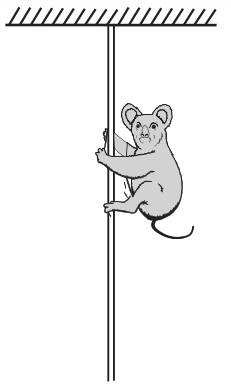
A monkey of mass $40kg$ climbs on a rope $($Fig.$)$ which can stand a maximum tension of $600 N$. In which of the following cases will the rope break: the monkey,

$($Ignore the mass of the rope$)$.
  • Climbs up with an acceleration of $6ms^{-2}$.
  • B
    Climbs down with an acceleration of $4ms^{-2}$.
  • C
    Climbs up with a uniform speed of $5ms^{-1}$.
  • D
    Falls down the rope nearly freely under gravity?

Answer: A.

View full solution
Give the magnitude and direction of the net force acting on. A high-speed electron in space far from all material objects, and free of electric and magnetic fields.
View full solution
Give the magnitude and direction of the net force acting on a stone of mass 0.1 kg , (Neglect air resistance throughout.) Just after it is dropped from the window of a train accelerating with $1 \mathrm{~ms}^{-2}$.
View full solution
Give the magnitude and direction of the net force acting on a stone of mass 0.1kg, (Neglect air resistance throughout.) Just after it is dropped from the window of a train running at a constant velocity of 36km/h.
View full solution
Give the magnitude and direction of the net force acting on a stone of mass 0.1 kg , (Neglect air resistance throughout.) Lying on the floor of a train which is accelerating with $1 \mathrm{~ms}^{-2}$, the stone being at rest relative to the train.
View full solution
Give the magnitude and direction of the net force acting on a stone of mass 0.1kg, (Neglect air resistance throughout.) Just after it is dropped from the window of a stationary train.
View full solution
Q 163 Marks Question3 Marks
A man of mass $70kg$ stands on a weighing scale in a lift which is moving. Upwards with a uniform acceleration of $5ms^{-2}$. What would be the readings on the scale in each case?
View full solution
Q 173 Marks Question3 Marks
A constant retarding force of $50N$ is applied to a body of mass $20kg$ moving initially with a speed of $15ms^{-1}$. How long does the body take to stop?
View full solution
Q 193 Marks Question3 Marks
A bob of mass $0.1\ kg$ hung from the ceiling of a room by a string $2m$ long is set into oscillation. The speed of the bob at its mean position is $1ms^{-1}$ . What is the trajectory of the bob if the string is cut when the bob is $(a)$ at one of its extreme positions, $(b)$ at its mean position.
View full solution
Explain why,
  1. A horse cannot pull a cart and run in empty space.
  2. Passengers are thrown forward from their seats when a speeding bus stops suddenly.
  3. It is easier to pull a lawn mower than to push it.
  4. A cricketer moves his hands backwards while holding a catch.
View full solution
A truck starts from rest and accelerates uniformly at $2.0ms^{-2}$​​​​​​​. At $t = 10s$, a stone is dropped by a person standing on the top of the truck (6m high from the ground). What are the (a) velocity, and (b) acceleration of the stone at $t = 11s$? (Neglect air resistance.)
View full solution
A helicopter of mass $1000kg$ rises with a vertical acceleration of $15ms^{-2}$. The crew and the passengers weigh $300kg$. Give the magnitude and direction of the,
  1. Force on the floor by the crew and passengers.
  2. Action of the rotor of the helicopter on the surrounding air.
  3. Force on the helicopter due to the surrounding air.
View full solution
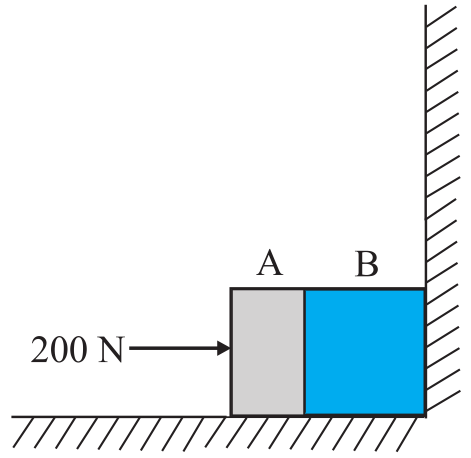
Two bodies A and B of masses $5kg$ and $10kg$ in contact with each other rest on a table against a rigid wall (Fig.). The coefficient of friction between the bodies and the table is $0.15$. A force of $200N$ is applied horizontally to A. What are (a) the reaction of the partition (b) the action-reaction forces between A and B? What happens when the wall is removed? Does the answer to (b) change, when the bodies are in motion? Ignore the difference between $µ_s$ and $µ_k$.
View full solution
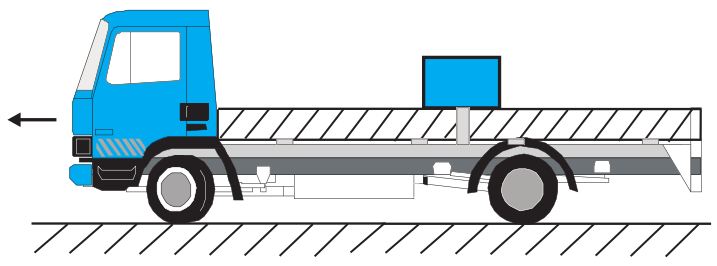
The rear side of a truck is open and a box of $40kg$ mass is placed 5m away from the open end as shown in Fig. The coefficient of friction between the box and the surface below it is $0.15$. On a straight road, the truck starts from rest and accelerates with $2ms^{-2}$. At what distance from the starting point does the box fall off the truck? (Ignore the size of the box).
View full solution
Read the passage given below and answer the following questions from $1$ to $5.$ Friction: Let us return to the example of a body of mass m at rest on a horizontal table. The force of gravity $(mg)$ is cancelled by the normal reaction force $(N)$ of the table. Now suppose a force F is applied horizontally to the body. We know from experience that a small applied force may not be enough to move the body. But if the applied force F were the only external force on the body, it must move with acceleration F/m, however small. Clearly, the body remains at rest because some other force comes into play in the horizontal direction and opposes the applied force F, resulting in zero net force on the body. This force fs parallel to the surface of the body in contact with the table is known as frictional force, or simply friction. When there is no applied force, there is no static friction. It comes into play the moment there is an applied force. As the applied force $F$ increases, fs also increases, remaining equal and opposite to the applied force $($up to a certain limit$),$ keeping the body at rest. Hence, it is called static friction. Static friction opposes impending motion. The term impending motion means motion that would take place $($but does not actually take place$)$ under the applied force, if friction were absent. It is found experimentally that the limiting value of static friction $(fs )$ max f is independent of the area of contact and varies with the normal force$(N)$ approximately as: $(\text{f}_{\text{s}})\text{max}=\mu\text{N}$ where μs is a constant of proportionality depending only on the nature of the surfaces in contact. The constant μs is called the coefficient of static friction. The law of static friction may thus be written as $(\text{f}_{\text{s}})\leq\mu\text{sN}$ Frictional force that opposes relative motion between surfaces in contact is called kinetic or sliding friction and is denoted by $fk$. Kinetic friction, like static friction, is found to be independent of the area of contact. Further, it is nearly independent of the velocity. It satisfies a law similar to that for static friction: $(\text{f}_{\text{k}})=\mu_{\text{k}}\text{N}$
  1. Force of static friction is directly proportional to:
  1. Normal reaction
  2. Force by gravity
  3. Velocity of body
  4. None of these
  1. Coefficient of kinetic friction is independent of area of contact. True or false?
  1. True
  2. False
  1. Give formula for law of static friction
  1. Explain law of static friction
  1. Explain kinetic friction.
View full solution
Read the passage given below and answer the following questions from (i) to (v). This principle is a consequence of Newton’s second and third laws of motion. In an isolated system (i.e. a system having no external force), mutual forces (called internal forces) between pairs of particles in the system causes momentum change in individual particles. Let a bomb be at rest, then its momentum will be zero. If the bomb explodes into two equal parts, then the parts fly off in exactly opposite directions with same speed, so that the total momentum is still zero. Here, no external force is applied on the system of particles (bomb).
  1. A bullet of mass 10g is fired from a gun of mass 1kg with recoil velocity of gun 5m/ s. The muzzle velocity will be:
  1. 30km/ min
  2. 60km/ min
  3. 30m/ s
  4. 500m/ s
  1. A shell of mass 10 kg is moving with a velocity of 10 ms" 1 when it blasts and forms two parts of mass 9 kg and 1 kg respectively. If the first mass is stationary, the velocity of the second is:
  1. $1ms^{-1}$
  2. $10ms^{-1}$
  3. $100ms^{-1}$
  4. $1000ms^{-1}$
  1. A bullet of mass 0.1kg is fired with a speed of 100ms’ 1 . The mass of gun being 50kg, then the velocity of recoil becomes:
  1. $0.05ms^{-1}$
  2. $0.5ms^{-1}$
  3. $0.lms^{-1}$
  4. $0.2ms^{-1}$
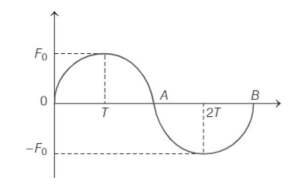
  1. A unidirectional force F varying with time Tas shown in the figure acts on a body initially at rest for a short duration:
2.T. Then, the velocity acquired by the body is
  1. $\frac{\pi\text{F}_\text{o}\text{T}}{4\text{m}}$
  2. $\frac{\pi\text{F}_\text{o}\text{T}}{2\text{m}}$
  3. $\frac{\text{F}_\text{o}\text{T}}{4\text{m}}$
  4. $\text{zero}$
  1. Two masses ofM and 4Af are moving with equal kinetic energy. The ratio of their linear momenta is
  1. $1 : 8$
  2. $1 : 4$
  3. $1 : 2$
  4. $4 : 1$
View full solution
Read the passage given below and answer the following questions from 1 to 5. The product of force and time which is the change in momentum of the body remains a measurable quantity. This product is called impulse Impulse = Force × time duration = Change in momentum Large force acting for a short time to produce a finite change in momentum is called an impulsive force. The third law of motion states that when one object exerts a force on another object, the second object instantaneously exerts a force back on the first. These two forces are always equal in magnitude but opposite in direction. These forces act on different objects and never on the same object. The two opposing forces are also known as action and reaction forces. Answer the following questions. The second and third laws of motion lead to an important consequence: the law of conservation of momentum. Take a familiar example. A bullet is fired from a gun. If the force on the bullet by the gun is F, the force on the gun by the bullet is – F, according to the third law. The two forces act for a common interval of time $\triangle\text{t}$ According to the second law,$\text{F}\triangle\text{t}$ is the change in momentum of the bullet and $-\text{F}\triangle\text{t}$ is the change in momentum of the gun. Since initially, both are at rest, the change in momentum equals the final momentum for each. Thus if pb is the momentum of the bullet after firing and pg is the recoil momentum of the gun, pg = – pb i.e. pb + pg = 0 That is, the total momentum of the (bullet + gun) system is conserved. Thus in an isolated system (i.e. a system with no external force), mutual forces between pairs of particles in the system can cause momentum change in individual particles, but since the mutual forces for each pair are equal and opposite, the momentum changes cancel in pairs and the total momentum remains unchanged. This fact is known as the law of conservation of momentum. The total momentum of an isolated system of interacting particles is conserved.
  1. Action reaction forces acts on bodies in order that:
  1. Action acts first then reaction force comes.
  2. Reaction acts first then action force comes.
  3. Both action reaction act at same time.
  4. None of the above.
  1. Which of the following is correct about action reaction forces?
  1. They act on different objects.
  2. They are equal in magnitude and opposite in direction.
  3. Both forces acted on different object simultaneously
  4. All the above.
  1. State Newton’s third law of motion.
  1. Define impulse. Give its formula.
  1. State law of conservation of momentum.
View full solution
Read the passage given below and answer the following questions from 1 to 5. Momentum of a body is defined to be the product of its mass m and velocity v, and is denoted By p: p = m v Momentum is clearly a vector quantity. SI unit is kg m/s. The following common experiences indicate the importance of this quantity for considering the effect of force on motion. Suppose a light-weight vehicle (say a small car) and a heavy weight vehicle (say a loaded truck) is parked on a horizontal road. We all know that a much greater force is needed to push the truck than the car to bring them to the same speed in same time. Similarly, a greater opposing force is needed to stop a heavy body than a light body in the same time, if they are moving with the same speed.
  • If two stones, one light and the other heavy, are dropped from the top of a building, a person on the ground will find it easier to catch the light stone than the heavy stone. The mass of a body is thus an important parameter that determines the effect of force on its motion.
  • Speed is another important parameter to consider. A bullet fired by a gun can easily pierce human tissue before it stops, resulting in casualty. The same bullet fired with moderate speed will not cause much damage. Thus for a given mass, the greater the speed, the greater is the opposing force needed to stop the body in a certain time. Taken together, the product of mass and velocity, that is momentum, is evidently a relevant variable of motion. The greater the change in the momentum in a given time, the greater is the force that needs to be applied.
  1. SI unit of momentum is:
  1. Kgm/s
  2. Kgm/s2
  3. m/s2
  4. None of these
  1. Momentum is:
  1. Scalar quantity
  2. Vector quantity
  1. Define momentum. Give its SI unit.
  1. Explain with example how mass of body is important for determining effect of force on its motion?
  1. Explain with example how speed is important for determining effect of force on its motion?
View full solution
Read the passage given below and answer the following questions from 1 to 5. The first law refers to the simple case when the net external force on a body is zero. The second law of motion refers to the general situation when there is net external force acting on the body. It relates the net external force to the acceleration of the body. These qualitative observations lead to the second law of motion expressed by Newton as follow: The rate of change of momentum of a body is directly proportional to the applied force and takes place in the direction in which the force acts. Thus, if under the action of a force F for time interval $\triangle\text{t},$ the velocity of a body of mass m changes from v to $\text{v}+\triangle\text{v},$ i.e. its initial momentum p = m v changes by $\triangle\text{p}=\text{m}\triangle\text{v}.$ According to the Second Law $\text{F}\alpha\frac{\triangle\text{p}}{\triangle\text{t}}$ or $\text{F}=\text{k}\frac{\triangle\text{P}}{\triangle\text{t}}$ Where k is a constant of proportionality. Mathematically, F = ma, the unit of force is $kg-m/s^2$ or Newton, which has the symbol N. Let us note at this stage some important points about the second law:
  • In the second law, F = 0 implies a = 0. The second law is obviously consistent with the first law.
  • The second law of motion is a vector law.
  • The second law of motion given by is applicable to a single point particle as well as to the rigid body but internal forces is not considered in F.
  • The second law of motion is a local relation which means that force F at a point in space (location of the particle) at a certain instant of time is related to a at that point at that instant.
  1. SI unit of force is:
  1. Newton
  2. Pascal
  3. m/s
  4. None of the above
  1. According to second law of motion The rate of change of momentum of a body is directly proportional to
  1. Velocity of body
  2. Applied force
  3. Only mass of body
  4. None of the above.
  1. The second law of motion is:
  1. Vector law
  2. Scalar law
  1. State second law of motion.
  1. Write a note on $2^{nd}$ law of motion. Enlist some deductions from $2^{nd} $ law.
View full solution

Generate a Laws of Motion paper free

Pick question groups from the list above, set marks and difficulty, and export a branded PDF with step-by-step answer keys. First 3 chapters free — no signup.

Download App