Question 15 Marks
Identical springs of steel and copper are equally stretched. On which, more work will have to be done?
Answer
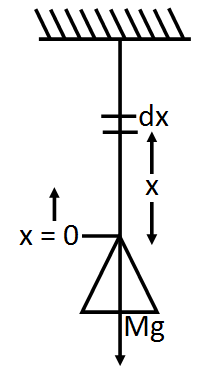
View full question & answer→Key concept: Work Done in stretching a Wire or Spring. In stretching a wire work is done against internal restoring forces. This work is stored in the wire as elastic potential energy or strain energy. If a force F acts along the length L of the wire of cross - section A and stretches it by x, then$\text{Y}=\frac{\text{stress}}{\text{strain}}=\frac{\text{F/A}}{\text{x/L}}=\frac{\text{FL}}{\text{Ax}}\Rightarrow\text{F}=\frac{\text{YA}}{\text{L}}\text{x}$
So the work done for an additional small increase dx in length,$\text{dW}=\text{Fdx}=\frac{\text{YA}}{\text{L}}\text{x}.\text{dx}$
Hence the total work done in increasing the length by I,$\text{w}=\int^1_0\text{dw}=\int^1_0\text{fdx}=\int^1_0\frac{\text{YA}}{\text{L}}\text{ xdx}=\frac{1}{2}\frac{\text{YA}}{\text{L}}\text{ l}^2$
This work done is stored in the wire. According to this problem work done in stretching a wire is given by$\text{W}=\frac{\text{YAl}^2}{2\text{L}}$
As springs of steel and copper are equally stretched. Therefore, for same force (F),$\text{W}\propto\Delta\text{l}\ ...(\text{i})$
As both springs are identical, so A and L are same.$\Delta\text{l}\propto\frac{\text{l}}{\text{Y}}\ ...(\text{ii})$
From eqs. (i) and (ii), we get $\text{W}\propto\frac{\text{l}}{\text{Y}}$$\therefore \frac{\text{W}_\text{steel}}{\text{W}_\text{copper}}=\frac{\text{Y}_\text{copper}}{\text{Y}_\text{steel}}<(\text{As, Y}_\text{steel}>\text{Y}_\text{copper})$
$\Rightarrow\text{W}_\text{steel}>\text{W}_\text{copper}$
Hence, more work will be done in case of spring made of copper.
So the work done for an additional small increase dx in length,$\text{dW}=\text{Fdx}=\frac{\text{YA}}{\text{L}}\text{x}.\text{dx}$
Hence the total work done in increasing the length by I,$\text{w}=\int^1_0\text{dw}=\int^1_0\text{fdx}=\int^1_0\frac{\text{YA}}{\text{L}}\text{ xdx}=\frac{1}{2}\frac{\text{YA}}{\text{L}}\text{ l}^2$
This work done is stored in the wire. According to this problem work done in stretching a wire is given by$\text{W}=\frac{\text{YAl}^2}{2\text{L}}$
As springs of steel and copper are equally stretched. Therefore, for same force (F),$\text{W}\propto\Delta\text{l}\ ...(\text{i})$
As both springs are identical, so A and L are same.$\Delta\text{l}\propto\frac{\text{l}}{\text{Y}}\ ...(\text{ii})$
From eqs. (i) and (ii), we get $\text{W}\propto\frac{\text{l}}{\text{Y}}$$\therefore \frac{\text{W}_\text{steel}}{\text{W}_\text{copper}}=\frac{\text{Y}_\text{copper}}{\text{Y}_\text{steel}}<(\text{As, Y}_\text{steel}>\text{Y}_\text{copper})$
$\Rightarrow\text{W}_\text{steel}>\text{W}_\text{copper}$
Hence, more work will be done in case of spring made of copper.
 Differentiating both sides$2\big[\text{d}(\text{l}_1\text{l}_3)\cdot\cos\theta+\text{l}_1\text{l}_3\text{d}(\cos\theta)\big]=2\text{l}_1\text{dl}_1+2\text{l}_3\text{dl}_3-2\text{l}_2\text{dl}_2$
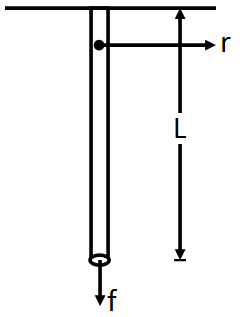 Both the wires are of same material, so Young's modulus will be same. From Eqs. (i) and (ii),$\frac{\text{f}}{\pi\text{r}^2}\times\frac{\text{L}}{\text{l}}=\frac{\text{f}}{\pi\text{r}^2}\times\frac{\text{L}}{\text{x}}$