Question 12 Marks
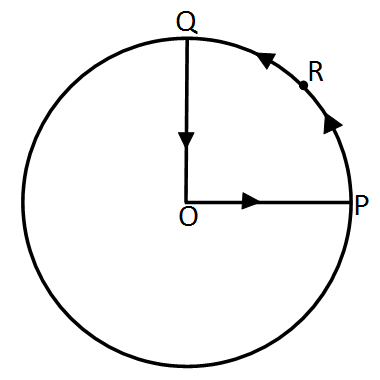
A cyclist starts from centre O of a circular park of radius 1km and moves along the path OPRQO as shown Fig. If he maintains constant speed of $10ms^{–1}$, what is his acceleration at point R in magnitude and direction?
Answer
View full question & answer→The path of the cyclist at R is circular of constant radius 1km with centre O and he is moving with constant speed 10m/ s. So his motion is uniform circular motion at R.
Hence, the R = 1000m, v =10m/ s
$\therefore\ \text{a}_\text{c}=\frac{\text{v}^2}{\text{R}}=\frac{10\times10}{1000}=\frac{1}{10}=0.1\text{m/ s}^2$ along RO.
Hence, the R = 1000m, v =10m/ s
$\therefore\ \text{a}_\text{c}=\frac{\text{v}^2}{\text{R}}=\frac{10\times10}{1000}=\frac{1}{10}=0.1\text{m/ s}^2$ along RO.