Questions

3 Marks Question

Take a timed test

8 questions · self-marked practice — reveal the answer and mark yourself.

Question 13 Marks
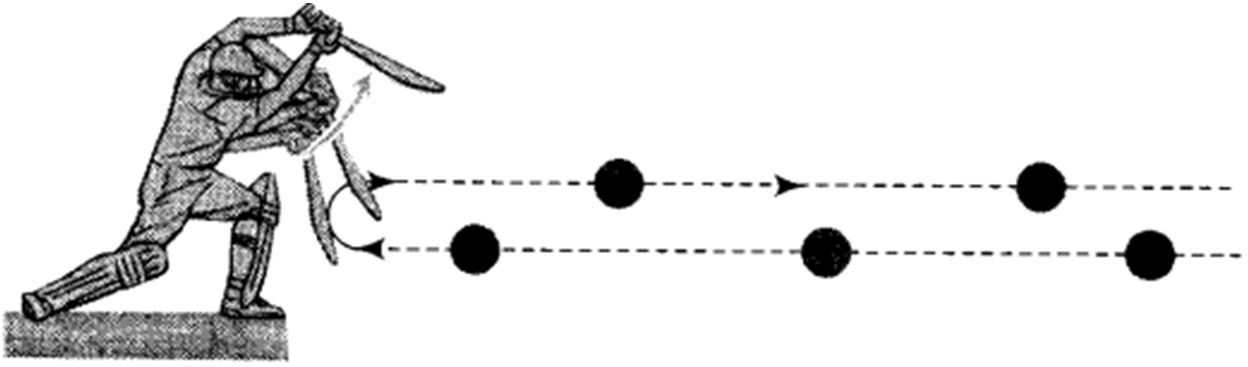
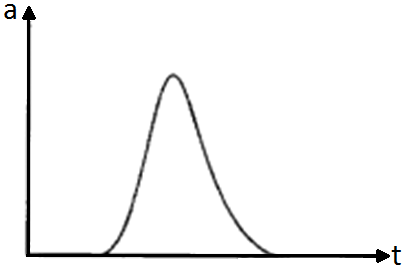
A uniformly moving cricket ball is turned back by hitting it with a bat for a very short time interval. Show the variation of its acceleration with time. (Take acceleration in the backward direction as positive).
Answer
Impulsive Force is generated by the bat: If we ignore the effect of gravity just by analyzing the motion of ball in horizontal direction only, then ball moving uniformly will return back with the same speed when a bat hits it.
Acceleration of the ball is zero just before it strikes the bat. When the ball strikes the bat, it gets accelerated due to the applied impulsive force by the bat.
The variation of acceleration with time is shown in the graph.
View full question & answer
Question 23 Marks
A monkey climbs up a slippery pole for 3 seconds and subsequently slips for 3 seconds. Its velocity at time t is given by v(t) = 2t(3 - t); 0 < t < 3 and v(t) = -(t - 3)(6 - t) for 3 < t < 6s in m/s. It repeats this cycle till it reaches the height of 20m.
How many cycles (counting fractions) are required to reach the top?
Answer
Given velocity$\text{v}(\text{t})=2\text{t}(3-\text{t})=6\text{t}-2\text{t}^2$
Distance covered in 0 to 3s = 9m Distance covered in 3 to 6s$=\int_3^6(18-9\text{t}+\text{t}^2)\text{dt}=\Big(18\text{t}-\frac{9\text{t}^2}{2}+\frac{\text{t}^3}{3}\Big)^6$
$=18\times6-\frac{9}{2}\times6^2+\frac{6^3}{3}-\Big(18\times3-\frac{9\times3^2}{2}+\frac{3^3}{3}\Big)$
$=108-9\times18+\frac{6^3}{3}-18\times3+\frac{9}{2}\times9-\frac{27}{3}$
$=-4.5\text{m}$
$\therefore$ Total distance travelled in one cycle
$=\text{s}_1+\text{s}_2=9-4.5=4.5\text{m}$
Number of cycles to be covered in total distance $=\frac{20}{4.5}\approx4.44\approx5$
View full question & answer
Question 33 Marks
Give examples of a one-dimensional motion where:
The particle moving along positive x-direction comes to rest periodically and moves forward.
Answer
The equation which contains sine and cosine functions is periodic in nature.
The particle will be moving along positive x-direction only if $\text{t}>\sin\text{t}$ We have displacement as a function of time, $(\text{x})=\text{t}-\sin\text{t}$ By differentiating this equation w.r.t. time we get velocity of the particle as a function of time.
Velocity $\text{v}(\text{t})=\frac{\text{dx(t)}}{\text{dt}}=1-\cos\text{t}$
If we again differentiate this equation w.r.t. time we will get acceleration of the particle as a function of time.
acceleration $\text{a}(\text{t})=\frac{\text{dv}}{\text{dt}}=\sin\text{t}$
When t = 0; x(t) = 0
When $\text{t}=\pi;\ \text{x}(\text{t})=\pi>0$
When $\text{t}=0;\ \text{x}(\text{t})=2\pi>0$
View full question & answer
Question 43 Marks
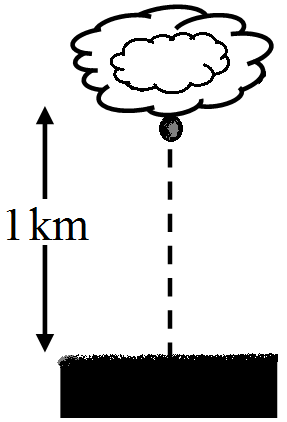
It is a common observation that rain clouds can be at about a kilometre altitude above the ground.
If a rain drop falls from such a height freely under gravity, what will be its speed? Also calculate in km/h. ($g = 10m/s^2$)
Answer
Key concept: This problem can be solved by kinematic equations of motion and Newton’s second law that $\text{F}_\text{ext}=\frac{\text{dp}}{\text{dt}}$ will be used, where dp is change in momentum over time dt. According to the problem (h) = 1km = 1000m and we know that the initial velocity of the ball is zero. And displacement covered by rain drop in downward direction, so we will taking h as negative. (We are neglecting the air resistance.)
Velocity attaind by the rain drop in falling through a height h is$\text{v}^2=\text{u}^2-2\text{g}(-\text{h})$
As u = 0 So, $\text{v}=\sqrt{2\text{gh}}=\sqrt{2\times10\times1000}=100\sqrt{2}\text{m/s}$$=100\sqrt{2}\times\frac{60\times60}{1000}\text{km/h}=360\sqrt{2}\text{km/h}=510\text{km/h}$
View full question & answer
Question 53 Marks
A particle executes the motion described by $\text{x}(\text{t})=\text{x}_0(1-\text{e}^{-\gamma\text{t}});\text{t}\ge0,\text{x}_0>0.$
Where does the particle start and with what velocity?
Answer
$\text{x}(\text{t})=\text{x}_0[1-\text{e}^{-\gamma\text{t}}]\ \ \ ...(\text{i})$$\text{v}(\text{t})=\frac{\text{dx(t)}}{\text{dt}}=\frac{\text{d}}{\text{dt}}[\text{x}_0(1-\text{e}^{\gamma\text{t}})]=+\text{x}_0\gamma\text{e}^{-\gamma\text{t}}\ \ \ ...(\text{ii})$
$\text{a}(\text{t})=\frac{\text{dv}}{\text{dt}}=\frac{\text{d}[+\text{x}_0\gamma^2\text{e}^{-\gamma^4}]}{2}=-\text{x}_0\gamma^2\text{e}^{-\gamma\text{t}}\ \ \ ..(\text{iii})$
$(\text{i})\text{At, t}=0\ \ \text{x}(0)=\text{x}_0[1-\text{e}^0]=\text{x}_0(1-1)=0$
$\text{v}(0)=\text{x}_0\gamma\text{e}^0=\text{x}_0\gamma$
Hence, the particle start from x = 0 with velocity $\text{v}_0=\text{x}_0\gamma.$
View full question & answer
Question 63 Marks
It is a common observation that rain clouds can be at about a kilometre altitude above the ground.
Estimate the order of magnitude force on umbrella. Typical lateral separation between two rain drops is 5cm. (Assume that umbrella is circular and has a diameter of 1m and cloth is not pierced through !!)
Answer
Key concept: This problem can be solved by kinematic equations of motion and Newton’s second law that $\text{F}_\text{ext}=\frac{\text{dp}}{\text{dt}}$ will be used, where dp is change in momentum over time dt. Radius of the umbrella (R) $=\frac{1}{2}\text{m}$$\therefore$ Area of the umbrella
$(\text{A})=\pi\text{R}^2=\frac{22}{7}\times\Big(\frac{1}{2}\Big)^2$
$=\frac{22}{28}=\frac{11}{14}=0.8\text{m}^2$
Number of drops striking the umbrella simultaneously with average separation of 5cm ($5 \times 10^{-2}m$)$\text{n}=\frac{0.8}{(5\times10^{-2})^2}=320$
$\therefore$ Net force exerted on umbrella $=320\times168=53760\text{N}=54000\text{N}$
View full question & answer
Question 73 Marks
Give examples of a one-dimensional motion where:
The particle moving along positive x-direction comes to rest periodically and moves backward.
Answer
Equation can be represented by,$\text{x}(\text{t})=\sin\text{t}$
$\text{v}=\frac{\text{d}}{\text{dt}}\text{x}(\text{t})=\cos\text{t}\ \text{ and}\ \ \text{a}=\frac{\text{dv}}{\text{dt}}=-\sin\text{t}$
At t = 0; x = 0, v = 1 (positive) and a = 0 At $\text{t}=\frac{\pi}{2};\text{x}=1$ (positive), v = 0 and a = -1 (negative) At $\text{t}={\pi};\text{x}=0,\text{v}=-1$ At $\text{t}=\pi,\text{x}=0,\text{v}=-1$ (negative) and a = 0 At $\text{t}=\frac{3\pi}{2};\text{x}=-1$ (negative), v = 0 and a = +1 (positive) At $\text{t}=2\pi,\text{x}=0,\text{v}=1$ (positive) and a = 0 Hence the particle moving along positive x-direction comes to rest periodically and moves backward. As displacement and velocity is involving sin t and cos t, hence these equations represent periodic nature.
View full question & answer
Question 83 Marks
A particle executes the motion described by $\text{x}(\text{t})=\text{x}_0(1-\text{e}^{-\gamma\text{t}});\text{t}\ge0,\text{x}_0>0.$
Find maximum and minimum values of x(t), v(t), a(t). Show that x(t) and a(t) increase with time and v(t) decreases with time.
Answer
x(t) is minimum at $\text{t}=0\ \because\ \text{At t}=0,[\text{x}(\text{t})]_\text{min}=0$
x(t) is maximum at $\text{t}=\infty\ \because\ \text{At t}=\infty[\text{x}(\text{t})]_\text{max}=\text{e}-\gamma\text{t}=\infty$
v(t) is maximum at $\text{t}=0\ \because\ \text{At t}=0;\text{v}(0)=\text{x}_0\gamma$
v(t) is minimum at $\text{t}=\infty\ \because\ \text{At t}=\infty\text{ v}(\infty)=0$
a(t) is maximum at $\text{t}=\infty\ \because\ \text{At t}=\infty\text{ a}(\infty)=0$
a(t) is minimum at $\text{t}=0\because\text{At t}=0\ \text{a}(0)=-\text{x}_0\gamma^2$
View full question & answer