Questions

5 Marks Questions

Take a timed test

8 questions · self-marked practice — reveal the answer and mark yourself.

Question 15 Marks
An object falling through a fluid is observed to have acceleration given by a = g - bv where g = gravitational acceleration and b is constant. After a long time of release, it is observed to fall with constant speed. What must be the value of constant speed?
Answer
Key concept: If a spherical body of radius r is dropped in a viscous fluid, it is first accelerated and then its acceleration becomes zero and it attains a constant velocity called terminal velocity. According to the problem, acceleration of object is given by the relation a = g - bv When speed becomes constant acceleration $\text{a}=\frac{\text{dv}}{\text{dt}}=0$ (uniform motion). where, g = gravitational acceleration Clearly, from above equation as speed increases acceleration will decrease. At a certain speed say $v_0$, acceleration will be zero and speed will remain constant. Hence, $\text{a}=\text{g}-\text{bv}_0=0$$\Rightarrow\text{v}_0=\frac{\text{g}}{\text{b}}$
View full question & answer
Question 25 Marks
Give example of a motion where x > 0, v < 0, a > 0 at a particular instant.
Answer
Let us consider function of motion$\text{x}(\text{t})=\text{A}+\text{Be}^{-\text{yt}}\ \ \ ...(\text{i})$
Where $\gamma$ and A, is a constant B is amplitude x(t) is displacement at time t, where A > B and $\gamma>0$$\text{v}(\text{t})=\frac{\text{dx(t)}}{\text{dt}}=0+(-\gamma)\text{Be}^{-\gamma\text{t}}=-\gamma\text{Be}^{-\gamma\text{t}}$
$\text{a}(\text{t})=\frac{\text{d}}{\text{dt}}[\text{v}(\text{t})]=\frac{\text{d}}{\text{dt}}(-\gamma\text{Bexp}^{-\gamma\text{t}})=(\gamma\text{B}^2\text{exp}^{-\gamma\text{t}})$
From (i) $\because$ A > B so x is always + ve i.e., x > 0. From (ii) v is always negative from (ii) v < 0 From (iii) a is always again positive a > 0 As the value of $\gamma^2\text{Be}^{-\gamma\text{t}}$ can varies from 0 to $+\infty$.
View full question & answer
Question 35 Marks
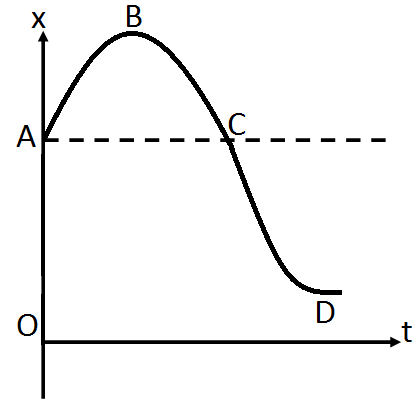
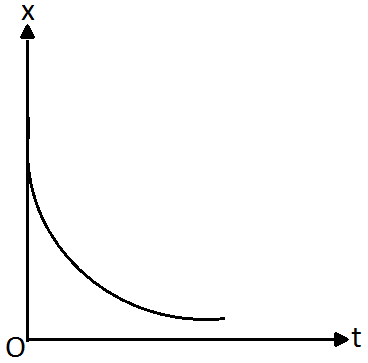
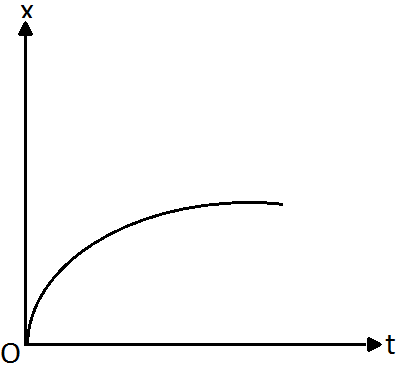
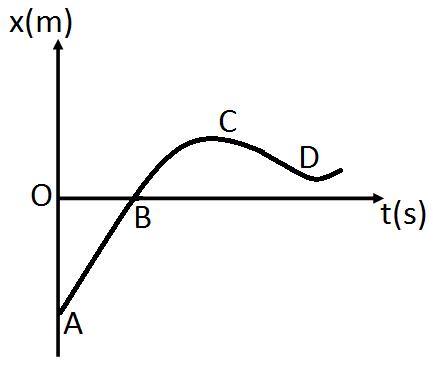
Refer to the graphs in Fig. Match the following.
Graph
 
Characteristic
a.
i.
has v > 0 and a < 0 throughout.
b.
ii.
has x > 0 throughout and has a point with v = 0 and a point with a = 0.
c.
iii.
has a point with zero displacement for t > 0.
d.
iv.
has v < 0 and a > 0.
Answer
Graph
 
Characteristic
a.
iii.
has a point with zero displacement for t > 0.
b.
ii.
has x > 0 throughout and has a point with v = 0 and a point with a = 0.
c.
iv.
has v < 0 and a > 0.
d.
i.
has v > 0 and a < 0 throughout.
Explanation:
In graph (a),

There is a point (B) on the curve for which displacement is zero. So curve, (a) matches with (iii).
In graph (b),

In this graph, x is positive (> 0) throughout and at point B the highest point of curve the slope of curve is zero. It means at
this point $\text{v}=\frac{\text{dx}}{\text{dt}}=0.$ Also at point C the dt
Curvature changes, it means at this point the acceleration of the particle should be zero or a = 0, So curve (b) matches with (ii).
In graph (c),

In this graph the slope is always negative, hence velocity will be negative or v < 0. Also x - t graph opens up, it represents positive acceleration. So curve (c) matches with (iv).
In graph (d),

In this graph the slope is always positive, hence velocity will be positive or v > 0. Also x - t graph opens down, it represents negative acceleration. So curve (d) matches with (i).
View full question & answer
Question 45 Marks
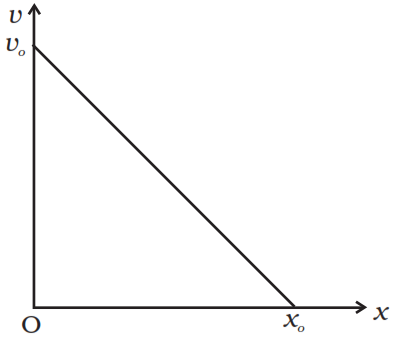
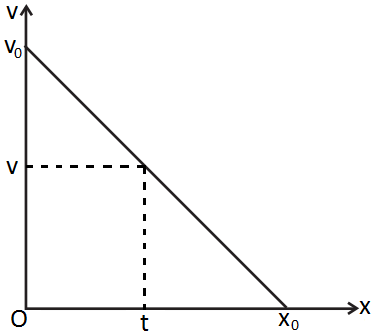
The velocity-displacement graph of a particle is shown in Fig.
  1. Write the relation between v and x.
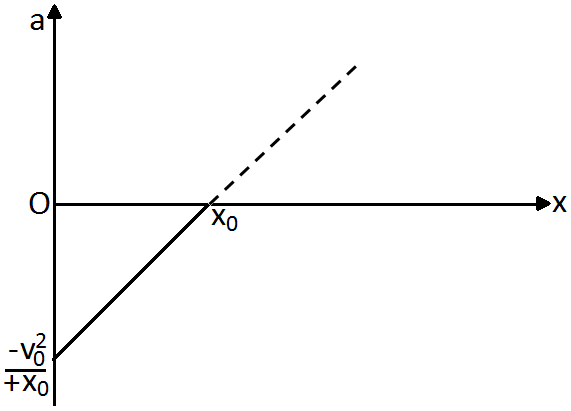
  2. Obtain the relation between acceleration and displacement and plot it.
Answer
In this problem, we will use equation of straight line graph (linear equation). y = mx + c. In this equation, m is the slope of the graph and c is the interception on y-axis.

Now according to the problem, initial velocity = $v_0$ Let the distance travelled in time $t = x_0$. For the graph $\tan\theta=\frac{\text{v}_0}{\text{x}_01}=\frac{\text{v}_0-\text{v}}{\text{x}}\ \ ...(\text{i})$ where, v is velocity and x is displacement at any instant of time t. From Eq. (i), $\text{v}_0-\text{v}=\frac{\text{v}_0}{\text{x}_0}\text{x}$
$\Rightarrow\text{v}=\frac{-\text{v}_0}{\text{x}_0}\text{x}+\text{v}_0$
We know that Acceleration $\text{a}=\frac{\text{dv}}{\text{dt}}=\frac{-\text{v}_0}{\text{x}_0}\frac{\text{dx}}{\text{dt}}+0$
$\Rightarrow\text{a}=\frac{-\text{v}_0}{\text{x}_0}(\text{v})$
$=\frac{-\text{v}_0}{\text{x}_0}\Big(\frac{-\text{v}_0}{\text{x}_0}\text{x}+\text{v}_0\Big)=\frac{\text{v}_0^2}{\text{x}_0^2}\text{x}-\frac{\text{v}_0^2}{\text{x}_0}$
Graph of a versus x is given below.
View full question & answer
Question 55 Marks
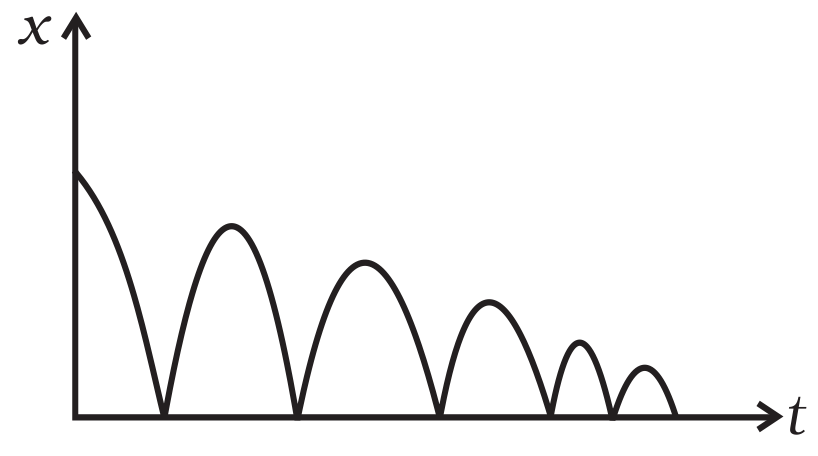
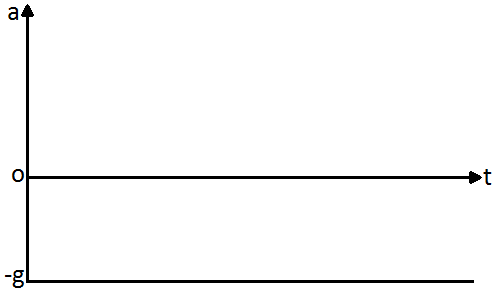
A ball is dropped and its displacement vs time graph is as shown Fig. (displacement x is from ground and all quantities are +ve upwards).
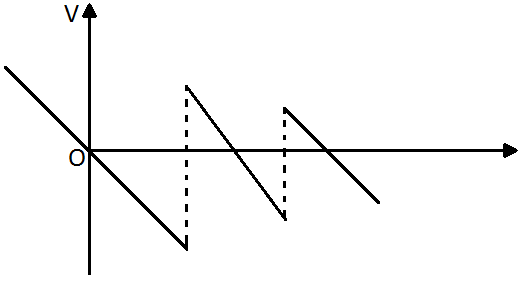
  1. Plot qualitatively velocity vs time graph.
  2. Plot qualitatively acceleration vs time graph.
Answer
Key concept: To calculate velocity we will find slope which is calculated by $\frac{\text{dx}}{\text{dt}}$ for displacement time curve and to find acceleration we will find slope $\frac{\text{dV}}{\text{dt}}$ of velocity times curve.
Sign convention: We are taking downward as negative and upward as positive.
Ball is bouncing on the ground and it is clear from the graph that displacement x is positive throughout. Ball is dropped from a height and its velocity increases in downward direction due to gravity pull. In this condition v is negative but accleration of the ball is equal to acceleration due to gravity i.e., a = -g. When ball rebounds in upward direction its velocity is positive but acceleration is a = -g.
The velocity-time graph of the ball is shown in fig.

The acceleration-time graph of the ball is shown in fig.
View full question & answer
Question 65 Marks
A ball is dropped from a building of height $45m$. Simultaneously another ball is thrown up with a speed $40m/s$. Calculate the relative speed of the balls as a function of time.
Answer
For the first ball falling from top
$V = v_1 = ?, U = 0, h = 45m, a = g, t = t$
V = u + at
$V_1 = 0 + gt$ or $v_1$ = gt downward $\therefore v_1 = -gt$ for the second ball thrown upward
$V = v_2, u = 40m/s, a = g, t = t$
$V = u + at$
$V_2=(40 - gt)$ upward $\therefore v_2 = (40 - gt)$
Relative velocity of ball $1^{st}$ with respect to $2^{nd}$
$v_{12} = v_1 - v_2 = -gt - (40 - gt)$
$= -gt - 40 + gt = -40m/s$ (downward)
Relative velocity of ball first with the respect to second is 40m/s downward.
In this problem due to acceleration the speed of one increases and of other decreases with the same rate.
So their relative speed remains $(40 - 0) = 40m/s$.
 
View full question & answer
Question 75 Marks
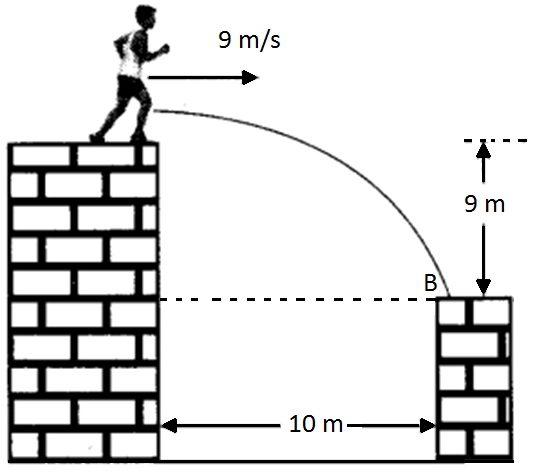
A man runs across the roof-top of a tall building and jumps horizontally with the hope of landing on the roof of the next building which is of a lower height than the first. If his speed is $9m/s$, the (horizontal) distance between the two buildings is $10m$ and the height difference is $9m$, will he be able to land on the next building? (take $g = 10m/s^2$).
Answer
Key concept: Horizontal Projectile: When a body is projected horizontally from a certain height ‘y’ vertically above the ground with initial velocity u. If friction is considered to be absent, then there is no other horizontal force which can affect the horizontal motion. The horizontal velocity therefore remains constant and so the object covers equal distance in horizontal direction in equal intervals of time. Time of flight: If a body is projected horizontally from a height h with velocity u and time taken by the body to reach the ground is T, then.$\text{h}=0+\frac{1}{2}\text{gT}^2$ (for vertical motion)
$\text{T}-\sqrt{\frac{2\text{h}}{\text{g}}}$
Horizontal range: Let R be the horizontal distance travelled by the body$\text{R}=\text{uT}+\frac{1}{2}0\text{T}^2$ (for horizontal motion a = 0)
$\text{R}=\text{u}\sqrt{\frac{2\text{h}}{\text{g}}}$
We will apply kinematic one by one along downward and along horizontal. We first consider motion along horizontal and there is no horizontal force which can affect the horizontal motion. The horizontal velocity therefore remains constant and so the object covers equal distance in horizontal direction in equal intervals of time.

 According the problem, horizontal speed of the man $(u_x) = 9m/s$ Horizontal distance between the two buildings = 10m Height difference between the two buildings $= 9m$ and $g = 10m/s^2$ and $g = 10ms^2$ Let the man jumps from point A and land on the roof of the next building at point B. Taking motion in vertical direction,$\text{y}=\text{ut}+\frac{1}{2}\text{at}^2$
$9=0\times\text{t}+\frac{1}{2}\times10\times\text{t}^2$
$9=5\text{t}^2$
or $\text{t}=\sqrt{\frac{9}{5}}=\frac{3}{\sqrt{5}}$$\therefore$ Horizontal distance travelled
$=\text{u}_\text{x}\times\text{t}=9\times\frac{3}{\sqrt{5}}=\frac{27}{\sqrt{5}}\text{m}=12\text{m}$
Horizontal distance travelled by the man is greater than 10m, therefore, he will land on the next building.
View full question & answer
Question 85 Marks
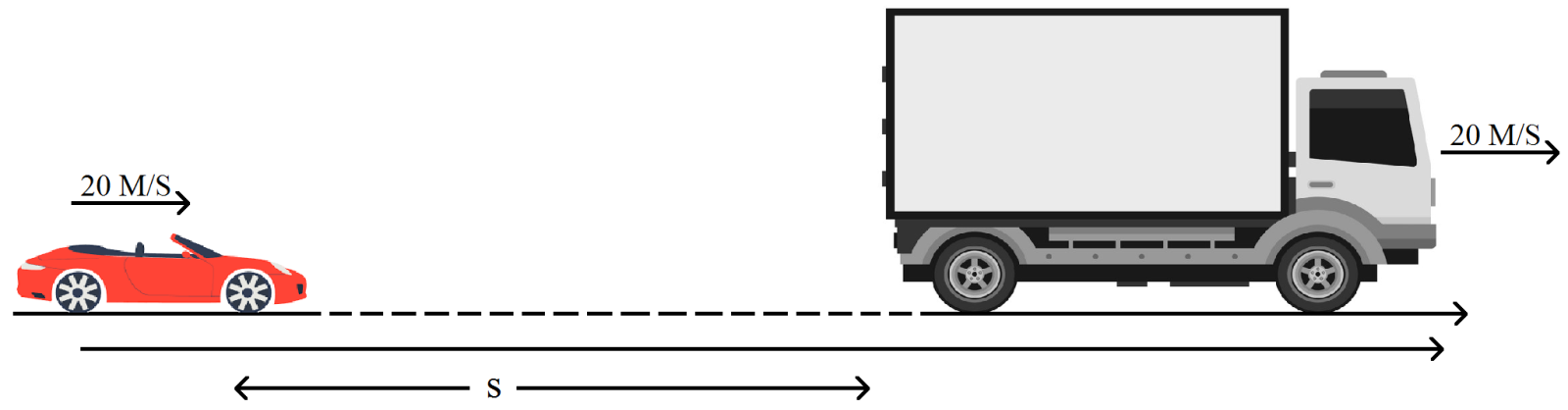
A motor car moving at a speed of 72km/h can not come to a stop in less than 3.0s while for a truck this time interval is 5.0s. On a higway the car is behind the truck both moving at 72km/h. The truck gives a signal that it is going to stop at emergency. At what distance the car should be from the truck so that it does not bump onto (collide with) the truck. Human response time is 0.5s.
Answer
According to the problem, speed of car as well as truck = 72km/h$=72\times\frac{5}{18}\text{m/s}=20\text{m/s}$

Time required to stop the truck = 5s Finally the truck comes to rest, so final velocity of truck will be zero. Retardation produced by truck:$\text{v}=\text{u}+\text{a}_\text{t}\text{t}$
$0=20+\text{a}_\text{t}\times5$
Or $\text{a}_\text{t}=-4\text{m/s}^2$ Time required to stop the car = 3s Finally the car comes to rest just behind the truck in the same time to avoid collision, so final velocity of car will also be zero. Retardation produced by car is$\text{v}=\text{u}+\text{a}_\text{c}\text{t}$
$0=20+\text{a}_\text{c}\times3$
Or $\text{a}_\text{c}=-\frac{20}{3}\text{m/s}^2$ Let car be at a distance s from the truck, when truck gives the signal and t be the time taken to cover this distance. As human response time is 0.5s, in this car will cover some distance with uniform velocity. Therefore, time of retarded motion of car is (t - 0.5)s. Velocity of truck after time t,$\text{v}_c=\text{u}-\text{at}=20-\Big(\frac{20}{3}\Big)(\text{t}-0.5)$
Velocity of truck after time t,$\text{v}_\text{t}=20-4\text{t}$
To avoid the car bump onto the truck$20-\frac{20}{3}(\text{t}-0.5)=20-4\text{t}$
$4\text{t}=\frac{20}{3}(\text{t}-0.5)$
$\Rightarrow\text{t}=\frac{2.5}{2}=\frac{5}{4}\text{s}$
Distance travelled by the truck in time t,$\text{s}_\text{t}=\text{u}_\text{t}\text{t}+\frac{1}{2}\text{a}_\text{t}\text{t}^2$
$\Rightarrow\text{s}_\text{t}=20\times\frac{5}{4}+\frac{1}{2}\times(-4)\times\Big(\frac{5}{4}\Big)^2=21.875\text{m}$
Distance travelled by car in time t = Distance travelled by car in 0.5s (without retardation) + Distance travelled by car in (t - 0.5)s (with retardation)$\text{s}_\text{c}=(20\times0.5)+20\Big(\frac{5}{4}-0.5\Big)\\-\frac{1}{2}\Big(\frac{20}{3}\Big)\Big(\frac{5}{4}-0.5\Big)^2=23.125\text{m}$
$\therefore\text{s}_\text{c}-\text{s}_\text{t}=23.125-21.875=1.250\text{m}$
Therefore, to avoid the collision with the truck, the car must maintain a distance from the truck more than 1.250m.
View full question & answer