Questions

2 Marks Questions

Take a timed test

14 questions · self-marked practice — reveal the answer and mark yourself.

Question 12 Marks
A particle of mass 0.3kg is subjected to a force F = -kx with k = 15N/m. What will be its initial acceleration if it is released from a point x = 20cm?
Answer
x = 20cm = 0.2m, k = 15N/m, m = 0.3kg.
Acceleration $\text{a}=\frac{\text{F}}{\text{m}}=\frac{-\text{kx}}{\text{x}}=\frac{-15(0.2)}{0.3}=\frac{3}{0.3}=-10\text{m/s}^2\text{(deceleration)}$
So, the acceleration is $10m/s^2$ opposite to the direction of motion.
View full question & answer
Question 22 Marks
A car moving at 40km/h is to be stopped by applying brakes in the next 4.0m. If the car weighs 2000kg, what average force must be applied on it?
Answer
$\text{u}=40\text{km/hr}=\frac{40000}{3600}=11.11\text{m/s}.$$\text{m}=20000\text{kg};\text{v}=0;\text{s}=4\text{m}$
acceleration ‘a’ $=\frac{\text{v}^2-\text{u}^2}{2\text{s}}=\frac{0^2-(11.11)^2}{2\times4}=-\frac{123.43}{8}$
$=-15.42\text{m/s}^2\text{(deceleration)}$
So, braking force = $F = ma = 2000 \times 15.42 = 30840 = 3.08 \times 10^4N$
View full question & answer
Question 32 Marks
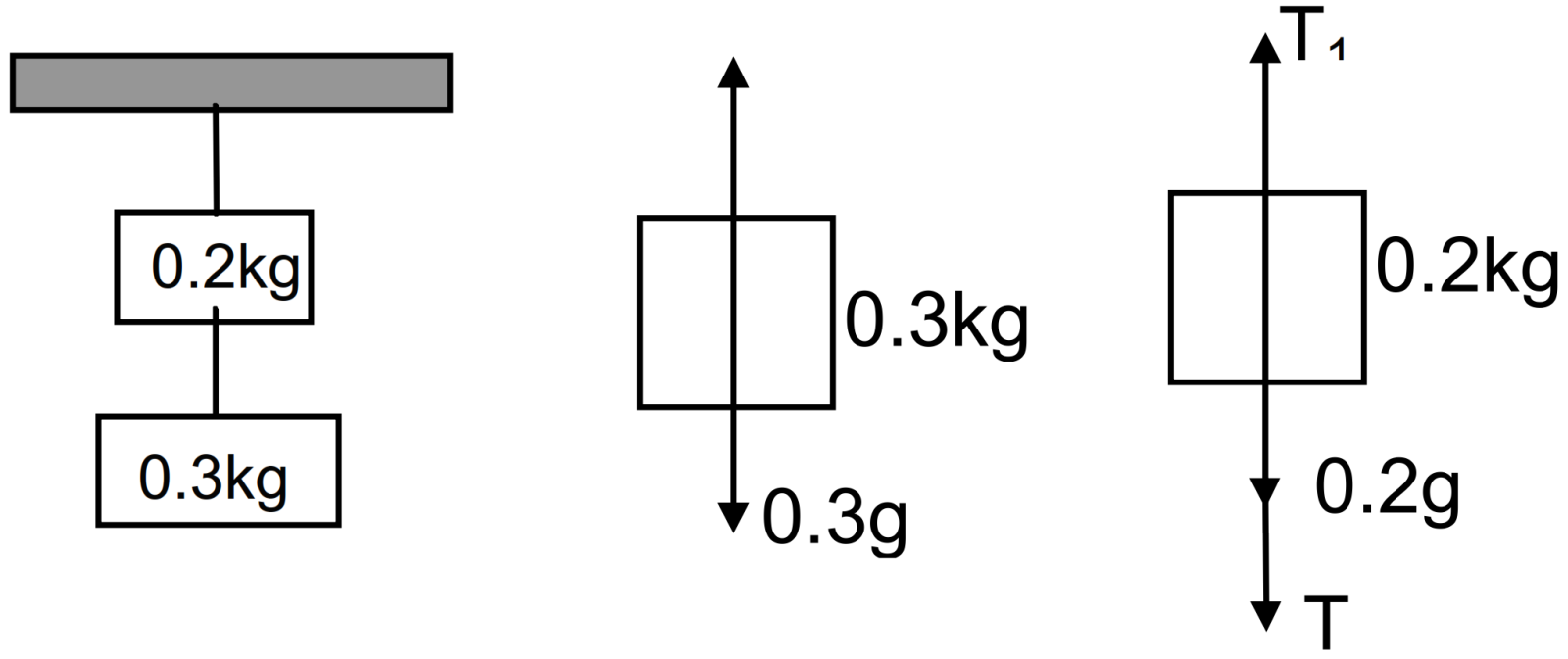
A block of mass $0.2kg$ is suspended from the ceiling by a light string. A second block of mass $0.3kg$ is suspended from the first block through another string. Find the tensions in the two strings. Take $g = 10m/s^2$.
Answer


$g = 10m/s^2$
$\mathrm{T}-0.3 \mathrm{~g}=0$
$\Rightarrow \mathrm{~T}=0.3 \mathrm{~g}=0.3 \times 10=3 \mathrm{~N}$
$\Rightarrow \mathrm{~T}_1-(0.2 \mathrm{~g}+\mathrm{T})=0$
$\Rightarrow \mathrm{~T}=0.2 \mathrm{~g}+\mathrm{T}=0.2 \times 10+3=5 \mathrm{~N}$
$\therefore$ Tension in the two strings are $5 \mathrm{~N}$ & $3 \mathrm{~N}$ respectively.
View full question & answer
Question 42 Marks
If you jump barefooted on a hard surface, your legs get injured. But they are not injured if you jump on a soft surface like sand or pillow. Explain.
Answer
In both the cases, change in momentum is same but the time interval during which momentum changes to zero is less in the first case. So, by $\text{F}=\frac{\text{dP}}{\text{dt}},$ force in the first case will be more. That’s why we are injured when we jump barefoot on a hard surface.
View full question & answer
Question 52 Marks
A block of mass 2kg placed on a long frictionless horizontal table is pulled horizontally by a constant force F. It is found to move 10m in the first two seconds. Find the magnitude of F.
Answer
m = 2kg S = 10m Let, acceleration = a, Initial velocity u = 0.$\text{S = ut}+\frac{1}{2}\text{at}^2$
$\Rightarrow10=\frac{1}{2}\text{a}(2^2)$
$\Rightarrow10=2\text{a}$
$\Rightarrow\text{a}=5\text{m/s}^2$
Force: F = ma = 2 × 5 = 10N
View full question & answer
Question 62 Marks
A boy puts a heavy box of mass M on his head and jumps down from the top of a multistoried building to the ground. How much is the force exerted by the box on his head during his free fall? Does the force greatly increase during the period he balances himself after striking the ground?
Answer
During free fall:
Acceleration of the boy = Acceleration of mass M = g
Acceleration of mass M w.r.t. boy, a = 0
So, the force exerted by the box on the boy’s head = M × a = 0
yes, the forece greatly increases during the period he balances himself after striking the groung because of the weight of the box.
View full question & answer
Question 72 Marks
A person drops a coin. Describe the path of the coin as seen by the person if he is in:
  1. A car moving at constant velocity.
  2. In a freely falling elevator.
Answer
  1. In the car, the path of the coin will be vertically downward because the only force acting on the coin is gravity in the downward direction.
  2. In a free falling elevator, the coin as well as the person will be in a condition of weightlessness. So, the coin will remain stationary $w.r.t$. the person.
View full question & answer
Question 82 Marks
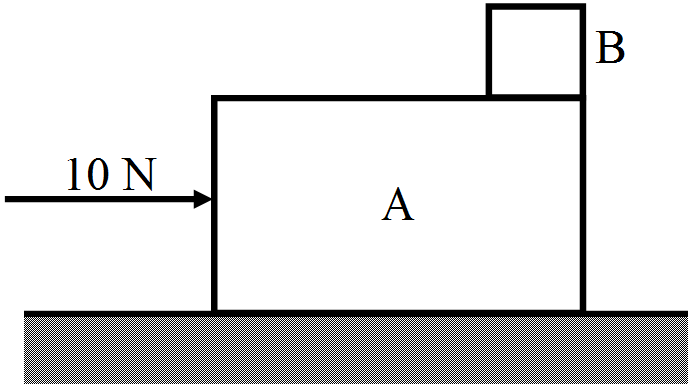
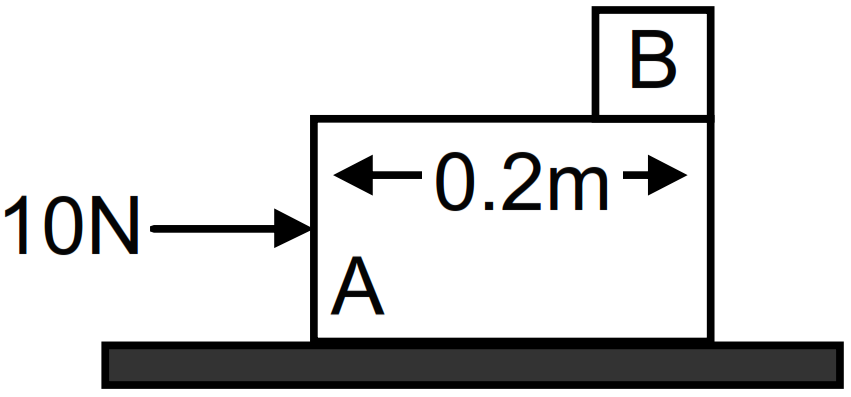
A small block B is placed on another block A of mass 5kg and length 20cm. Initially the block B is near the right end of block A. A constant horizontal force of 10N is applied to the block A. All the surfaces are assumed frictionless. Find the time elapsed before the block B separates from A.
Answer
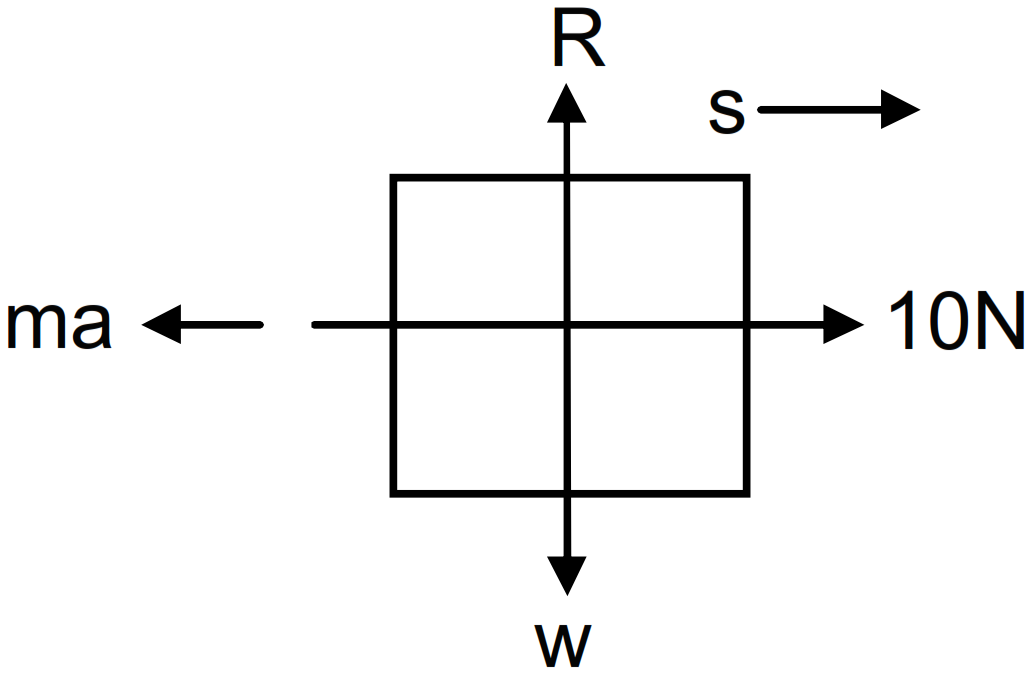
m = 5kg of block A. ma = 10N$\Rightarrow\text{a}\frac{10}{5}=2\text{m/s}^2.$

As there is no friction between A & B, when the block A moves, Block B remains at rest in its position. Initial velocity of A = u = 0. Distance to cover so that B separate out s = 0.2m. Acceleration $a = 2m/s^2 \therefore\text{s = ut}+\frac{1}{2}\text{at}^2$
$\Rightarrow0.2=0+\Big(\frac{1}{2}\Big)\times2\times\text{t}^2$
$\Rightarrow\text{t}^2=0.2$
$\Rightarrow\text{t}=0.44\sec\Rightarrow\text{t}=0.45\sec.$
View full question & answer
Question 92 Marks
A spy jumps from an airplane with his parachute. The spy accelerates downward for some time when the parachute opens. The acceleration is suddenly checked and the spy slowly falls on the ground. Explain the action of parachute in checking the acceleration.
Answer
Air applies a velocity-dependent force on the parachute in upward direction when the parachute opens. This force opposes the gravitational force acting on the spy. Hence, the net force in the downward direction decreases and the spy decelerates.
View full question & answer
Question 102 Marks
The apparent weight of an object increases in an elevator while accelerating upward. A moongphaliwala sells his moongphali using a beam balance in an elevator. Will he gain more if the elevator is accelerating up?
Answer
No, the accelerating elevator will affect the weight of both sides of the beam balance. So, the net effect of the accelerating elevator cancels out, and we get the actual mass.
View full question & answer
Question 112 Marks
Is it possible for a particle to describe a curved path if no force acts on it? Does your answer depend on the frame of reference chosen to view the particle?
Answer
If no force acts on the particle it cannot change its direction. So, it is not possible for a particle to describe a curved path if no force acts on it.
Yes, the answer depends on the frame of reference chosen to view the particle if the frame of reference describes a curved path.
View full question & answer
Question 122 Marks
When a train starts, the head of a standing passenger seems to be pushed backward. Analyse the situation from the ground frame. Does it really go backward? Coming back to the train frame, how do you explain the backward movement of the head on the basis of Newton's laws?
Answer
No, w.r.t. the ground frame, the person’s head is not really pushed backward.
As the train moves, the lower portion of the passenger’s body starts moving with the train, but the upper portion tries to be in rest according to Newton’s first law and hence, the passenger seems to be pushed backward.
View full question & answer
Question 132 Marks
You are riding in a car. The driver suddenly applies the brakes and you are pushed forward. Who pushed you forward?
Answer
We are pushed forward because of the inertia of motion, as our body opposes the sudden change.
View full question & answer
Question 142 Marks
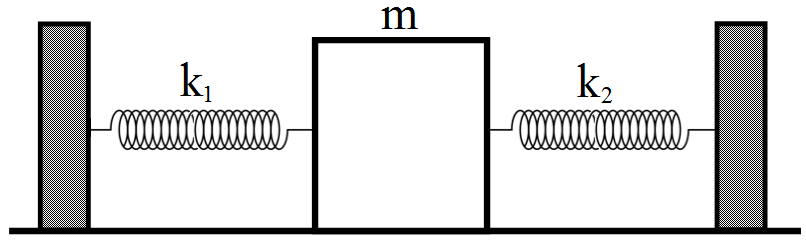
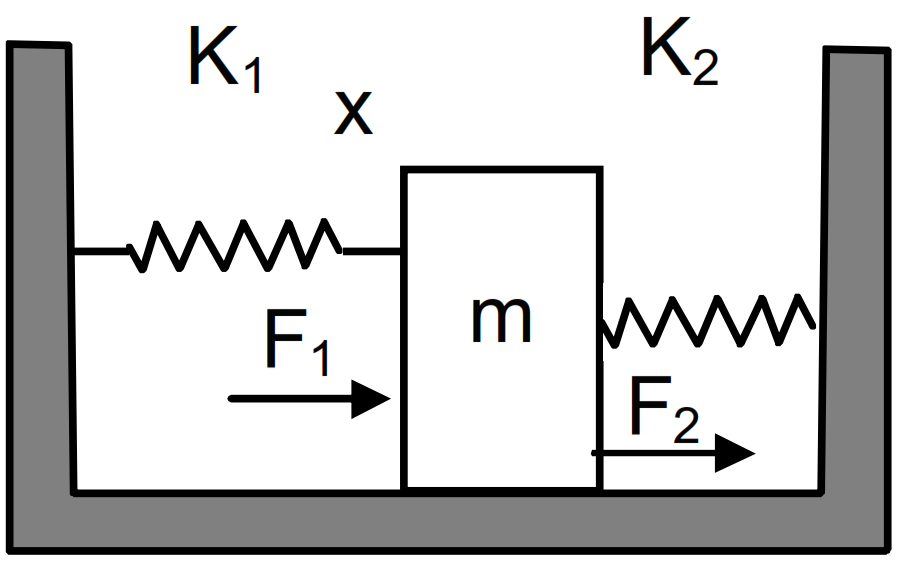
Both the springs shown in figure are unstretched. If the block is displaced by a distance x and released, what will be the initial acceleration?
Answer
Let, the block m towards left through displacement x .
$F_1=k_1 x \text { (compressed) }$
$F_2=k_2 x \text { (expanded) }$
They are in same direction.
$\text { Resultant } F=F_1+F_2$
$\Rightarrow F=k_1 x+k_2 x$
$\Rightarrow F=x\left(k_1+k_2\right)$
So, a = acceleration $=\frac{\text{F}}{\text{m}}=\frac{\text{x}(\text{k}_1+\text{k}_2)}{\text{m}}$ opposite to the displacement.
View full question & answer