Questions

3 Marks Question

Take a timed test

12 questions · self-marked practice — reveal the answer and mark yourself.

Question 13 Marks
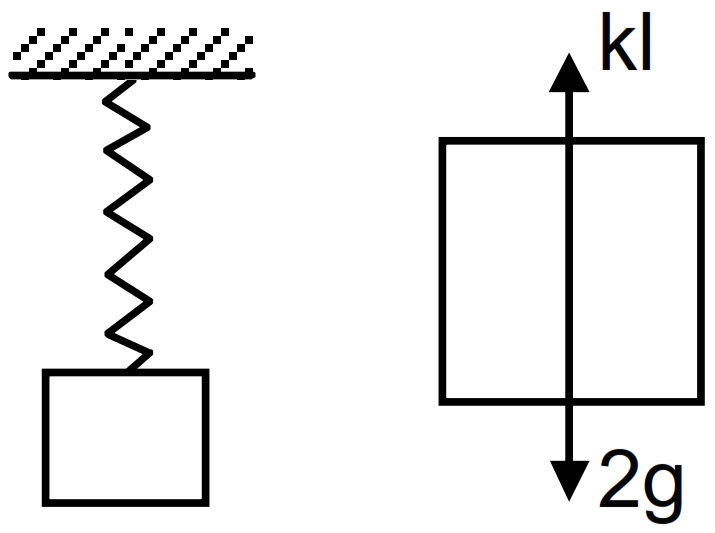
A block of 2kg is suspended from the ceiling through a massless spring of spring constant k = 100N/m. What is the elongation of the spring? If another 1kg is added to the block, what would be the further elongation?
Answer
Given, m = 2kg, k = 100N/m From the free body diagram, kl - 2g = 0 ⇒ kl = 2g$\Rightarrow\text{I}=\frac{2\text{g}}{\text{k}}=\frac{2\times9.8}{100}=\frac{19.6}{100}=0.196=0.2\text{m}$
Suppose further elongation when 1kg block is added be x, Then k(1 + x) = 3g$\Rightarrow\text{kx}=3\text{g}-2\text{g}=\text{g}=9.8\text{N}$
$\Rightarrow\text{x}=\frac{9.8}{100}=0.098=0.1\text{m}$
View full question & answer
Question 23 Marks
It is sometimes heard that inertial frame of reference is only an ideal concept and no such inertial frame actually exists. Comment.
Answer
We can’t find a body whose acceleration is zero with respect to all other bodies in the universe because every body in the universe is moving with respect to other bodies. As we live on earth which itself is accelerates due to its revolution around the sun and spinning about its own axis, so whatever observations and measurements, we make , are w.r.t to earth which itself is not an inertial frame. Similarly all other planets are also in motion around the sun so ideally no inertial frame is possible.
View full question & answer
Question 33 Marks
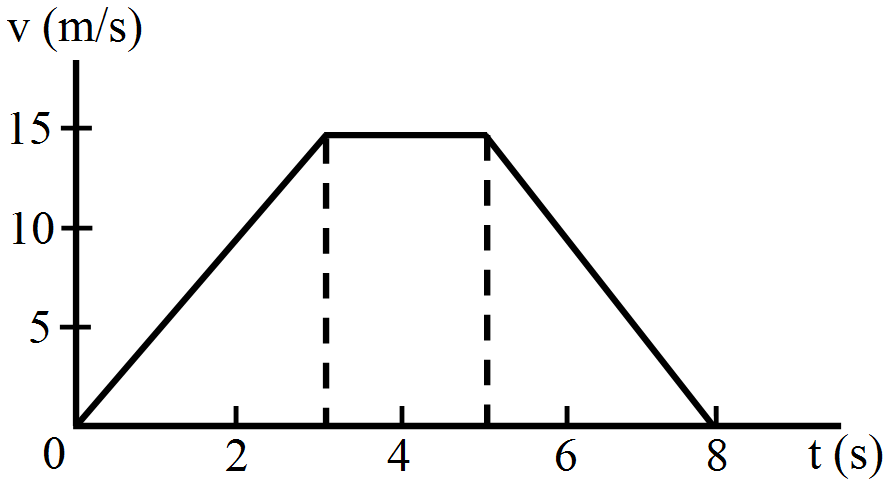
A particle of mass $50g$ moves on a straight line. The variation of speed with time is shown in figure. Find the force acting on the particle at $t = 2, 4$ and $6$ seconds.
Answer
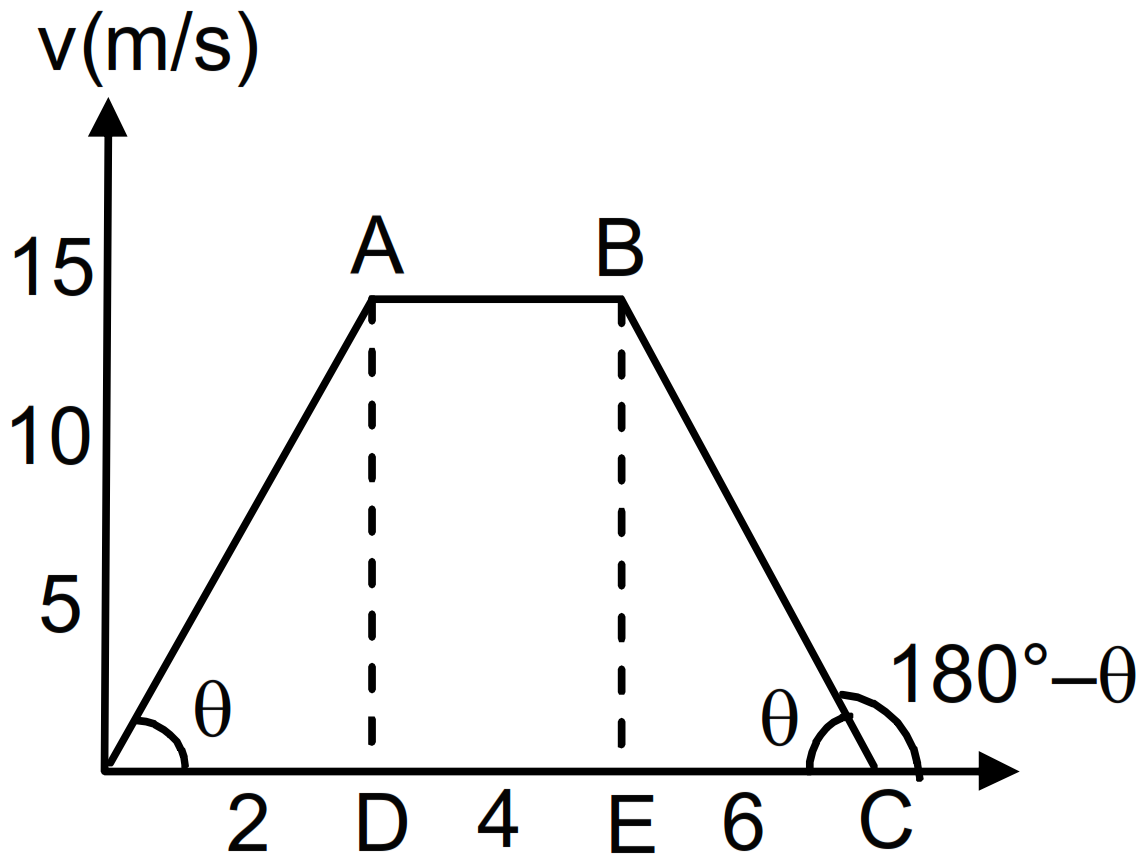
$\mathrm{m}=50 \mathrm{~g}=5 \times 10^{-2} \mathrm{~kg}$ As shown in the figure, Slope of $\mathrm{OA}=\tan \theta \frac{\mathrm{AD}}{\mathrm{OD}}=\frac{15}{3}=5 \mathrm{~m} / \mathrm{s}^2$ So, at $\mathrm{t}=2 \mathrm{sec}$ acceleration is $5 \mathrm{~m} / \mathrm{s}^2$ Force $=\mathrm{ma}=5 \times 10^{-2} \times 5=0.25 \mathrm{~N}$ along the motion At $\mathrm{t}=4 \mathrm{sec}$ slope of $\mathrm{AB}=0$, acceleration $=0\left[\tan 0^{\circ}=0\right]$
$\therefore$ Force $=0$
At $\mathrm{t}=6 \mathrm{sec}$, acceleration $=$ slope of $\mathrm{BC} . \ln \triangle \mathrm{BEC}=\tan \theta=\frac{\mathrm{BE}}{\mathrm{EC}}=\frac{15}{3}=5$. Slope of
$\mathrm{BC}=\tan \left(180^{\circ}-\theta\right)=-\tan \theta=-5 \mathrm{~m} / \mathrm{s}^2$ (deceleration) Force $=\mathrm{ma}=5 \times 5 \times 10^{-2}=0.25 \mathrm{~N}$. Opposite to the motion.
View full question & answer
Question 43 Marks
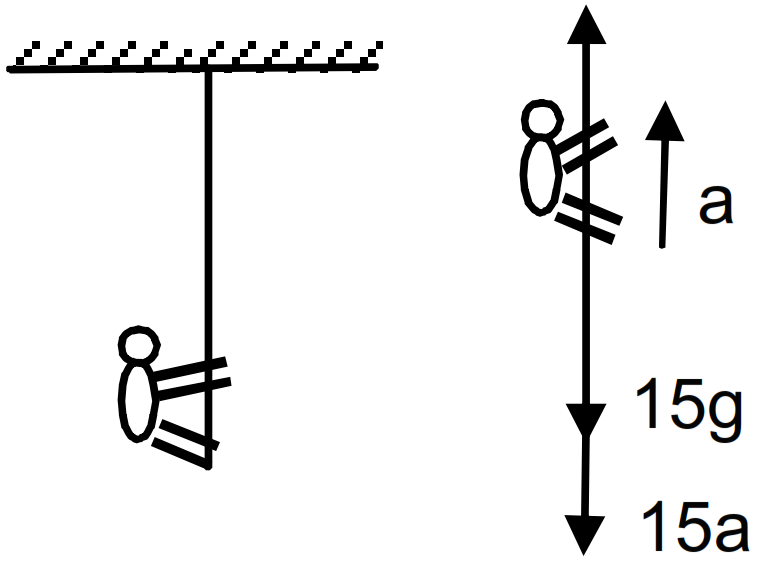
A monkey of mass $15kg$ is climbing on a rope with one end fixed to the ceiling. If it wishes to go up with an acceleration of $1m/s^2$, how much force should it apply to the rope? If the rope is $5m$ long and the monkey starts from rest, how much time will it take to reach the ceiling?
Answer


m = 15kg of monkey.
$a = 1m/s^2$.
From the free body diagram
$\therefore$ T - [15g + 15(1)] = 0
⇒ T = 15(10 + 1)
⇒ T = 15 × 11
⇒ T = 165N.
The monkey should apply 165N force to the rope.
Initial velocity u = 0 ; acceleration $a = 1m/s^2; s = 5m$.
$\therefore\text{s = ut}+\frac{1}{2}\text{at}^2$
$5=0+\Big(\frac{1}{2}\Big)1\text{t}^2$
$\Rightarrow\text{t}^2=5\times2$
$\Rightarrow\text{t}=\sqrt{10}\sec.$
Time required is $\sqrt{10}\text{sec}.$
View full question & answer
Question 53 Marks
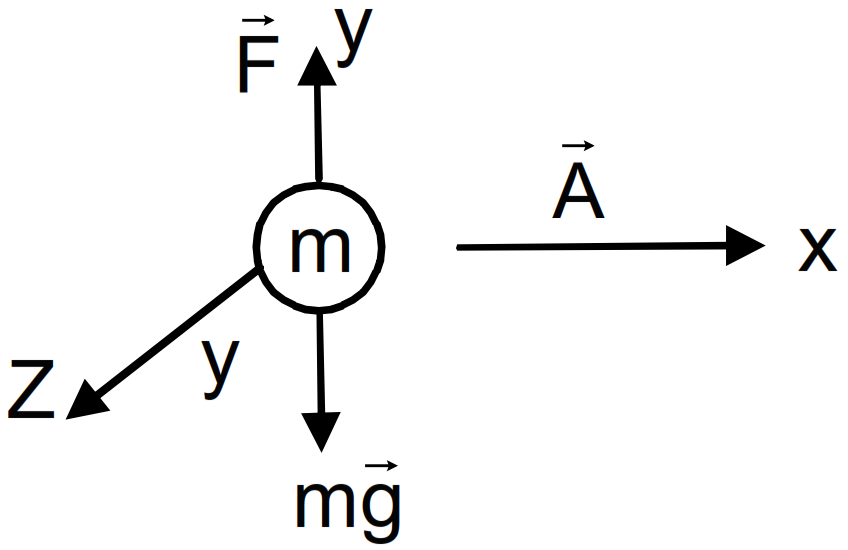
A force $\overrightarrow{\text{F}}=\overrightarrow{\text{v}}\times\overrightarrow{\text{A}}$ is exerted on a particle in addition to the force of gravity, where v is the velocity of the particle and $\overrightarrow{\text{A}}$ is a constant vector in the horizontal direction. With what minimum speed a particle of mass m be projected so that it continues to move undeflected with a constant velocity?
Answer
Given that, $\overrightarrow{\text{F}}=\overrightarrow{\text{u}}\times\overrightarrow{\text{A}}$ and $\overrightarrow{\text{mg}}$ act on the particle. For the particle to move undeflected with constant velocity, net force should be zero.$\therefore\big(\overrightarrow{\text{u}}\times\overrightarrow{\text{A}}\big)+\overrightarrow{\text{mg}}=0$
$\therefore\big(\overrightarrow{\text{u}}\times\overrightarrow{\text{A}}\big)-\overrightarrow{\text{mg}}=0$
Because, $\big(\overrightarrow{\text{u}}\times\overrightarrow{\text{A}}\big)$ is perpendicular to the plane containing $\overrightarrow{\text{u}}$ and $\overrightarrow{\text{A}},\overrightarrow{\text{u}}$ should be in the xz-plane. Again, $\text{u A}\sin\theta=\text{mg}$$\therefore\text{u}=\frac{\text{mg}}{\text{A}\sin\theta}$
u will be minimum, when $\sin\theta=1\Rightarrow\theta=90^{\circ}$$\therefore\text{u}_{\text{min}}=\frac{\text{mg}}{\text{A}}$ along Z-axis.
View full question & answer
Question 63 Marks
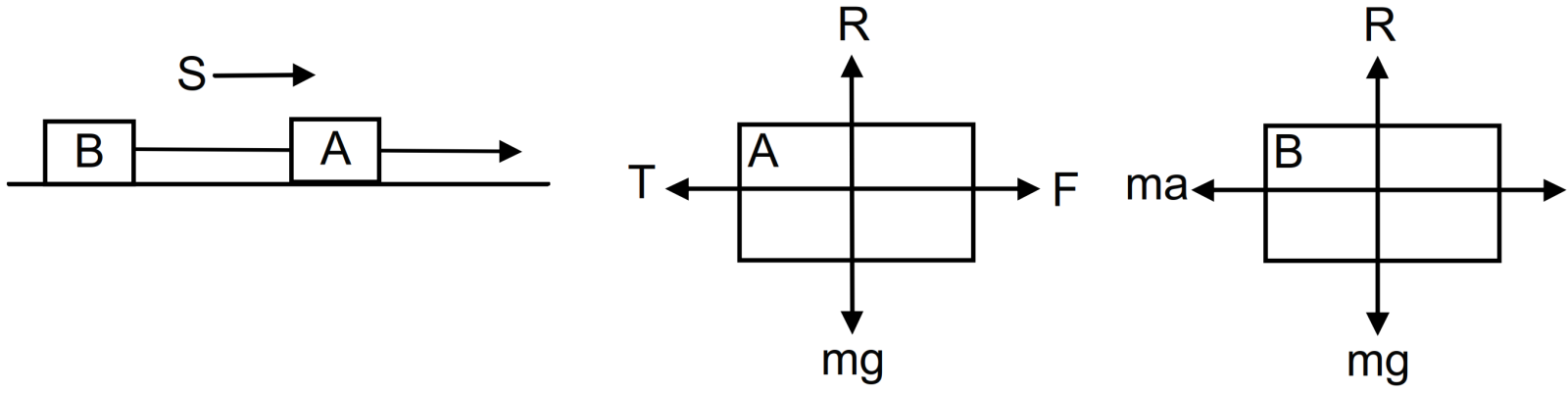
Two blocks of equal mass m are tied to each other through a light string. One of the blocks is pulled along the line joining them with a constant force F. Find the tension in the string joining the blocks.
Answer

T + ma - F = 0
T - ma = 0
⇒ T = ma …(i)
⇒ F = T + ma
⇒ F = T + T from (i)
⇒ 2T = F
$\Rightarrow\text{T}=\frac{\text{F}}{2}$
View full question & answer
Question 73 Marks
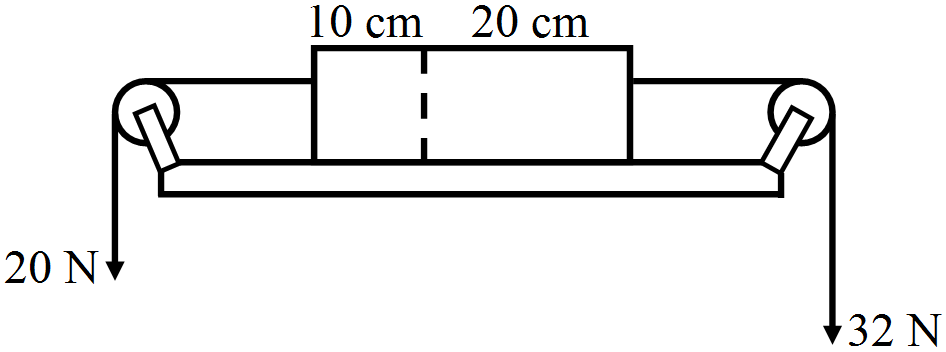
Figure shows a uniform rod of length $30cm$ having a mass of $3.0kg$. The strings shown in the figure are pulled by constant forces of $20N$ and $32N$. Find the force exerted by the $20cm$ part of the rod on the $10cm$ part. All the surfaces are smooth and the strings and the pulleys are light.
Answer
Mass per unit length $\frac{3}{30}\frac{\text{kg}}{\text{cm}}=0.10\frac{\text{kg}}{\text{cm}}.$

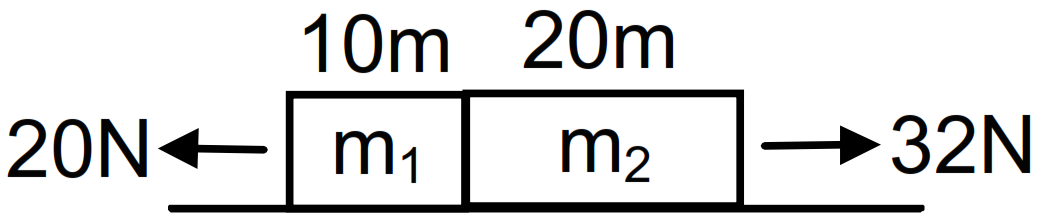
Mass of 10cm part = $m_1 = 1kg$ Mass of $20cm$ part = $m_2 = 2kg$. Let, F = contact force between them.
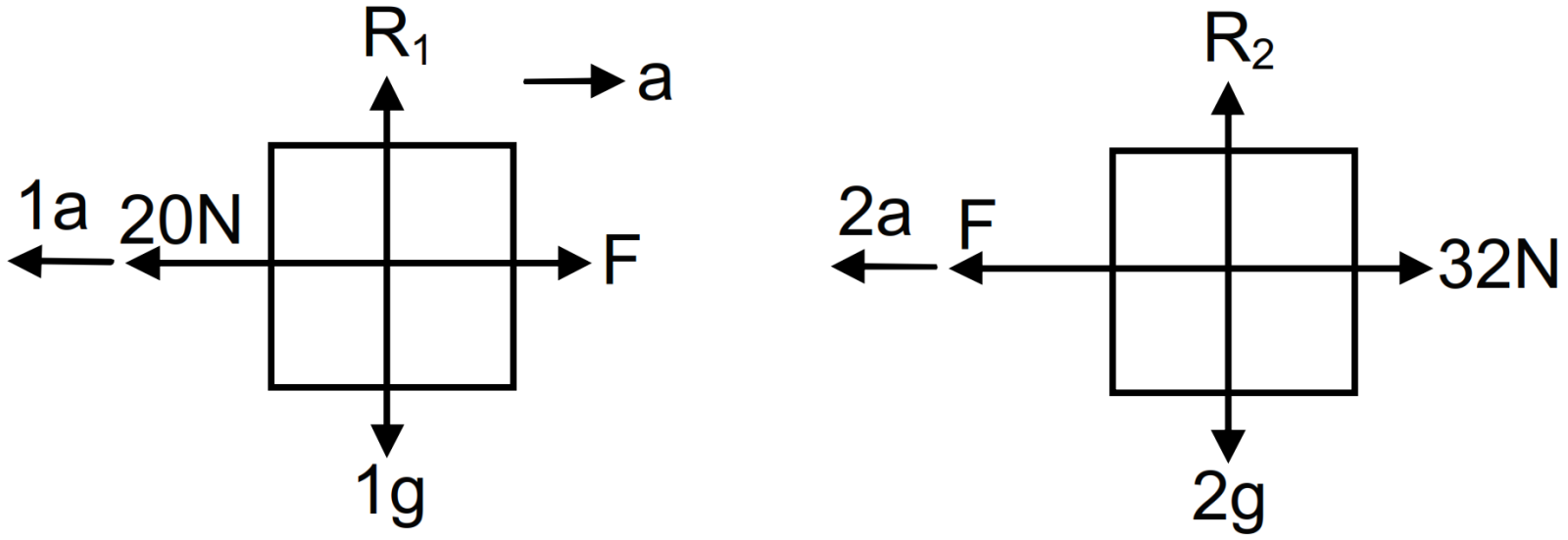
From the free body diagram F - 20 - 10 = 0 …(i) And, 32 - F - 2a = 0 …(ii) From eqa (i) and (ii)$3\text{a}-12=0\Rightarrow\text{a}=\frac{12}{3}=4\text{m/s}^2$
Contact force F = 20 + 1a = 20 + 1 × 4 = 24N.
View full question & answer
Question 83 Marks
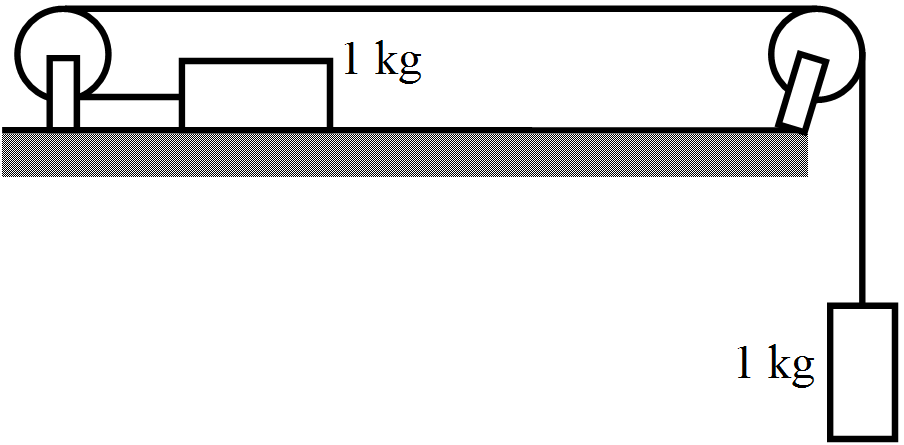
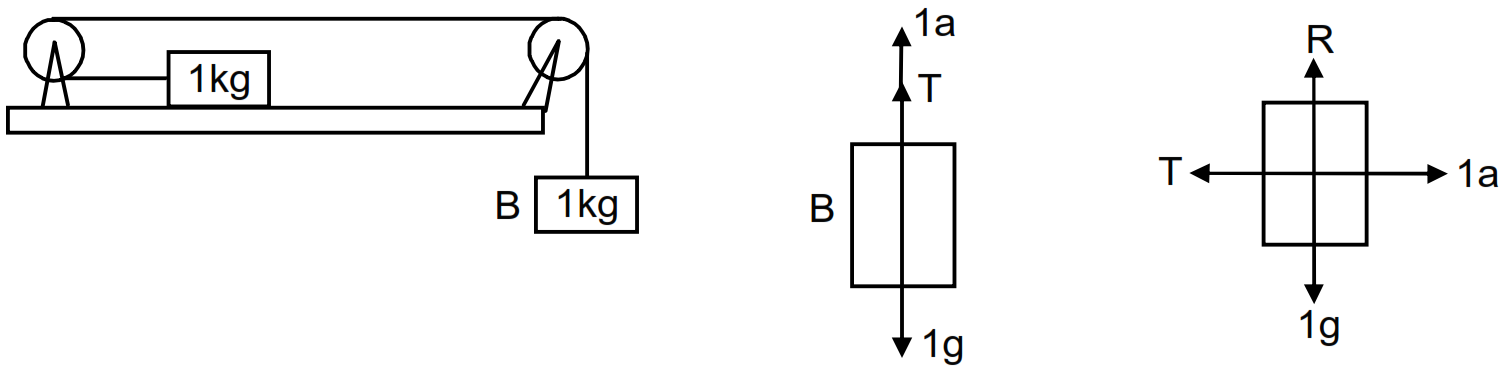
Calculate the tension in the string shown in figure. The pulley and the string are light and all surfaces are frictionless. Take $g = 10m/s^2$.
Answer


T + 1a = 1g ...(i)
T - 1a = 0 ⇒ T = 1a ...(ii)
From eqn (i) and (ii), we get
1a + 1a = 1g ⇒ 2a = g $\Rightarrow\text{a}=\frac{\text{g}}{2}=\frac{10}{2}=5\text{m/s}^2$
From (ii) T = 1a = 5N.
View full question & answer
Question 93 Marks
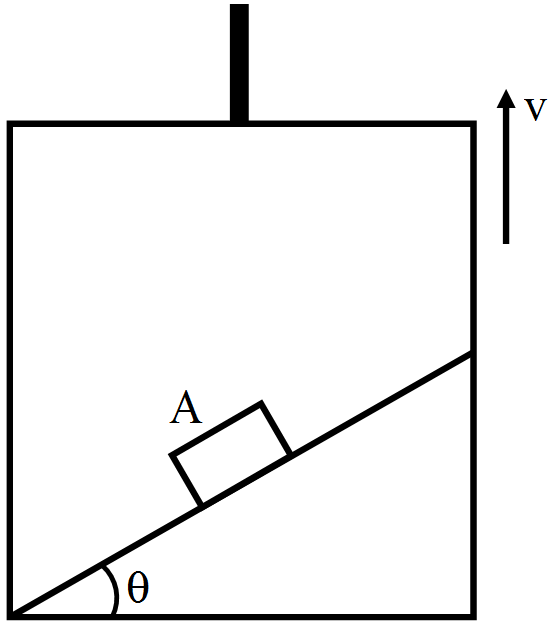
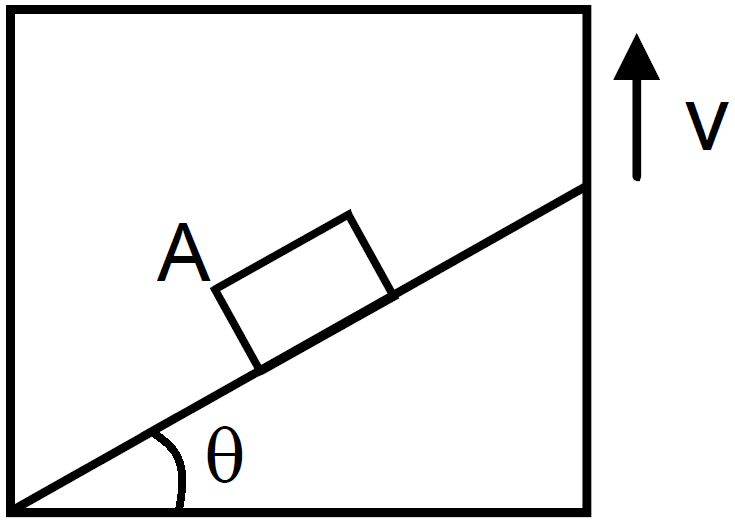
A block A can slide on a frictionless incline of angle $\theta$ and length l, kept inside an elevator going up with uniform velocity v. Find the time taken by the block to slide down the length of the incline if it is released from the top of the incline.
Answer

The driving force on the block which n the body to move sown the plane is $\text{F = mg}\sin\theta,$
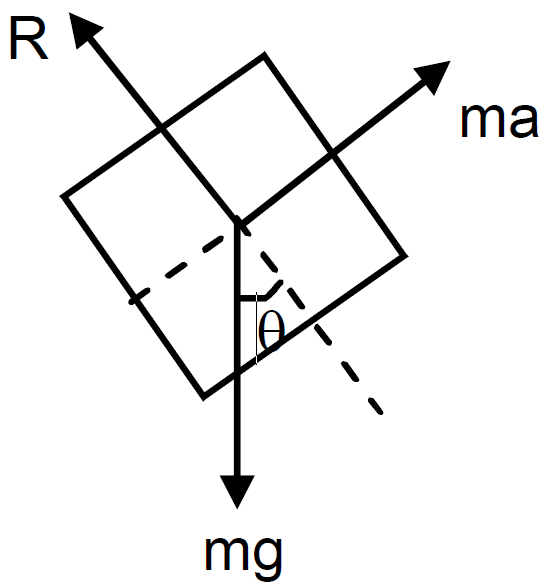
So, acceleration $=\text{g}\sin\theta$
Initial velocity of block u = 0.
$\text{s}=\ell,\text{a = g}\sin\theta$
Now, $\text{S = ut}+\frac{1}{2}\text{at}^2$
$\Rightarrow\ell=0+\frac{1}{2}(\text{g}\sin\theta)\text{t}^2$
$\Rightarrow\text{g}^2=\frac{2\ell}{\text{g}\sin\theta}$
$\Rightarrow\text{t}=\sqrt{\frac{2\ell}{\text{g}\sin\theta}}$
Time taken is $\sqrt{\frac{2\ell}{\text{g}\sin\theta}}$
View full question & answer
Question 103 Marks
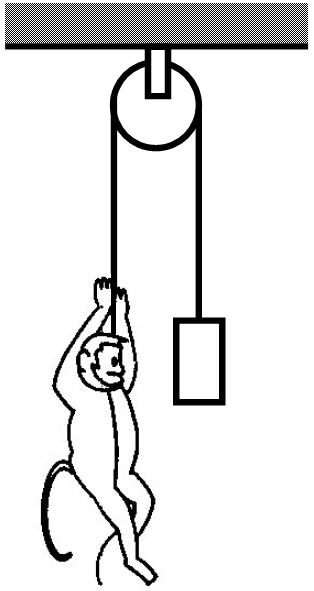
A monkey is climbing on a rope that goes over a smooth light pulley and supports a block of equal mass at the other end figure. Show that whatever force the monkey exerts on the rope, the monkey and the blockmove in the same direction with equal acceleration. If initially both were at rest, their separation will not change as time passes.
Answer


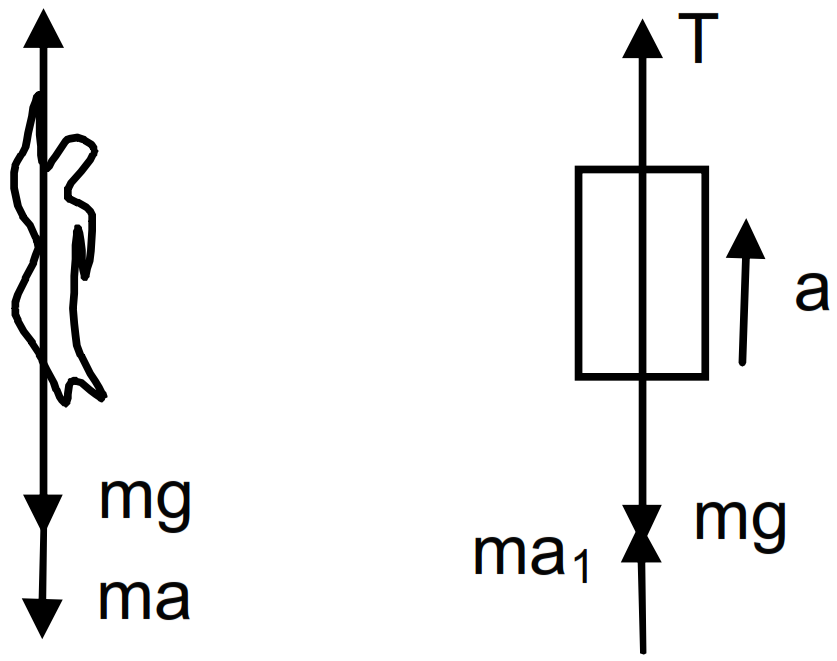
Suppose the monkey accelerates upward with acceleration ’a’ & the block, accelerate downward with acceleration $a_1$. Let Force exerted by monkey is equal to ‘T’
From the free body diagram of monkey
$\therefore$ T - mg - ma = 0 ...(i)
$\Rightarrow T = mg + ma$.
Again, from the FBD of the block,
$T = ma_1 - mg = 0$.
$\Rightarrow mg + ma + ma_1 - mg = 0 [From (i)]$
$\Rightarrow ma = -ma_1$
$\Rightarrow a = a_1.$
Acceleration ‘-a’ downward i.e. ‘a’ upward.
$\therefore$ The block & the monkey move in the same direction with equal acceleration.
If initially they are rest (no force is exertied by monkey) no motion of monkey of block occurs as they have same weight (same mass). Their separation will not change as time passes.
View full question & answer
Question 113 Marks
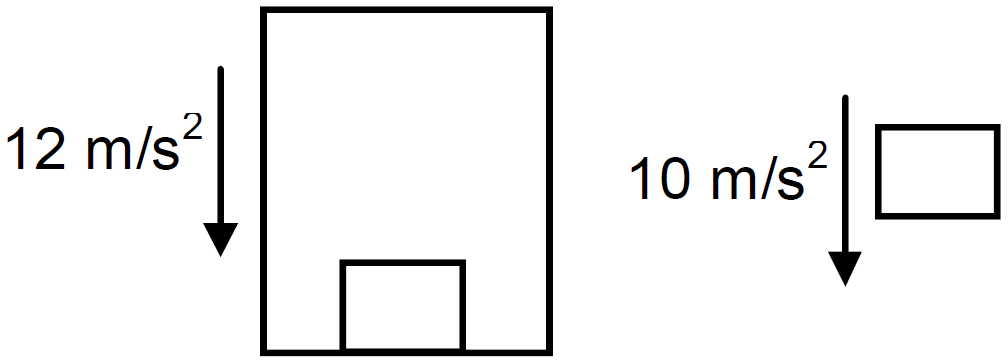
A block is kept on the floor of an elevator at rest. The elevator starts descending with an acceleration of $12m/s^2$. Find the displacement of the block during the first $0.2s$ after the start. Take $g = 10m/s^2$.
Answer
Because, the elevator is moving downward with an acceleration $12m/s^2$ (>g), the bodygets separated. So, body moves with acceleration $g = 10m/s^2$ [freely falling body] and the elevator move with acceleration $12m/s^2$

 Now, the block has acceleration $= g = 10m/s^2 u = 0 t = 0.2sec$ So, the distance travelled by the block is given by.$\therefore\text{s = ut}+\frac{1}{2}\text{at}^2$
$=0+\Big(\frac{1}{2}\Big)10(0.2)^2=5\times0.04=0.2\text{m}=20\text{cm.}$
The displacement of body is 20cm during first 0.2sec.
View full question & answer
Question 123 Marks
According to Newton's third law each team pulls the opposite team with equal force in a tug of war. Why then one team wins and the other loses?
Answer
The forces on the rope must be equal and opposite, according to Newton’s third law. But not all the forces acting on each team are equal. The friction between one team and the ground does not depend on the other team and can be larger on one side than on the other. In addition, the grips on the rope need not be equal and opposite. Thus, the net force acting on each team from all sources need not be equal.
View full question & answer