Question 15 Marks
A lady uses +1.5D glasses to have normal vision from 25cm onwards. She uses a 20D lens as a simple microscope to see an object. Find the maximum magnifying power if she uses then microscope
- Together with her glass
- Without the glass. Do the answers suggest that an object can be more clearly seen through a microscope without using the correcting glasses?
Answer
View full question & answer→The lady uses +1.5D glasses to have normal vision at 25cm.So, with the glasses, her least distance of clear vision = D = 25cm
Focal length of the glasses $=\frac{1}{1.5}\text{m}=\frac{100}{1.5}\text{cm}$
So, without the glasses her least distance of distinct vision should be more
If, $\text{u}=-25\text{cm},$
$\text{f}=\frac{100}{1.5}\text{cm}$
Now, $\frac{1}{\text{v}}-\frac{1}{\text{u}}=\frac{1}{\text{f}}=\frac{1.5}{100}-\frac{1}{25}=\frac{1.5{-4}}{100}=\frac{-2.5}{100}$
$\Rightarrow \text{v}=-40\text{cm}$ = near point without glasses
Focal length of magnifying glass $=\frac{1}{20}\text{m}=0.05\text{m}=5\text{cm}=\text{f}$
Focal length of the glasses $=\frac{1}{1.5}\text{m}=\frac{100}{1.5}\text{cm}$
So, without the glasses her least distance of distinct vision should be more
If, $\text{u}=-25\text{cm},$
$\text{f}=\frac{100}{1.5}\text{cm}$
Now, $\frac{1}{\text{v}}-\frac{1}{\text{u}}=\frac{1}{\text{f}}=\frac{1.5}{100}-\frac{1}{25}=\frac{1.5{-4}}{100}=\frac{-2.5}{100}$
$\Rightarrow \text{v}=-40\text{cm}$ = near point without glasses
Focal length of magnifying glass $=\frac{1}{20}\text{m}=0.05\text{m}=5\text{cm}=\text{f}$
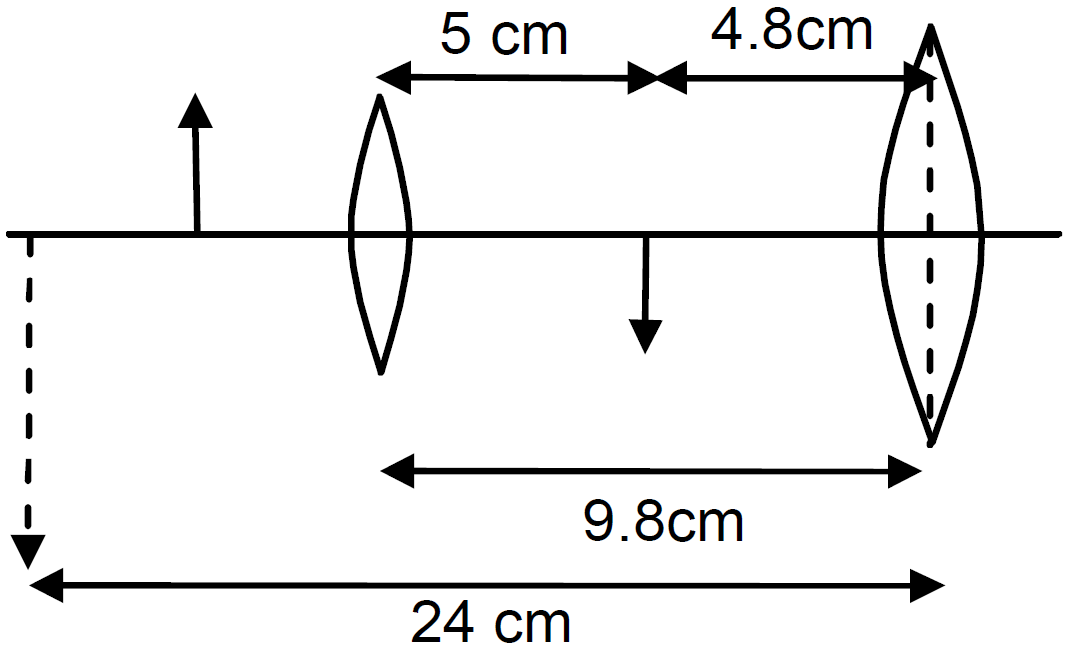
- The maximum magnifying power with glasses
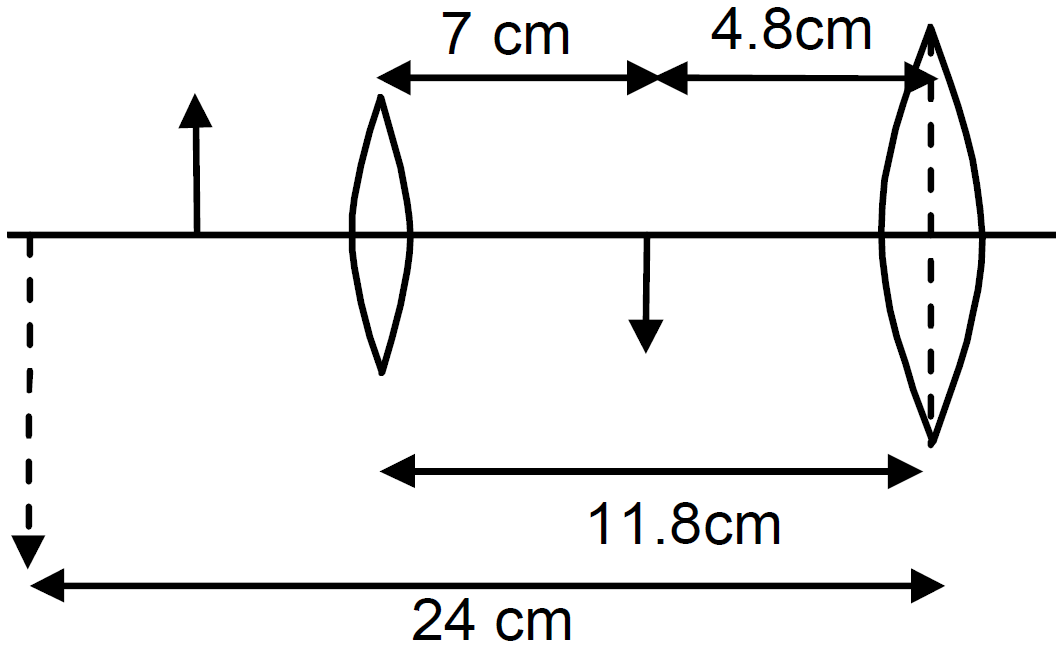
- Without the glasses, D = 40cm.