Questions

3 Marks Question

🎯

Test yourself on this topic

5 questions · timed · auto-graded

Question 13 Marks
Find the displacement of a simple harmonic oscillator at which its PE is half of the maximum energy of the oscillator.
Answer
Let us assume that the required displacement where PE is half of the maximum energy of the oscillator be x. The potential energy of the oscillator at this position,$\text{PE}=\frac{1}{2}\text{kx}^2=\frac{1}{2}\text{m}\omega^2\text{x}^2$
maximum energy of the oscillator = maximum potential energy = Total energy$\text{TE}=\frac{1}{2}\text{m}\omega^2\text{A}^2$
Where, A = amplitude of motion. We are given, $\text{PE}=\frac{1}{2}\text{TE}$$\Rightarrow\frac{1}{2}\text{m}\omega^2\text{x}^2=\frac{1}{2}\Big[\frac{1}{2}\text{m}\omega^2\text{A}^2\Big]$
$\Rightarrow\text{x}^2=\frac{\text{A}^2}{2}\ \text{or}\ \text{x}=\sqrt{\frac{\text{A}^2}{2}}=\pm\frac{\text{A}}{\sqrt{2}}$
View full question & answer
Question 23 Marks
What is the ratio of maxmimum acceleration to the maximum velocity of a simple harmonic oscillator?
Answer
Consider a SHM. $\text{x}=\text{A}\sin\omega\text{t}$$\text{v}=\frac{\text{dx}}{\text{dt}}=\text{A}\omega\cos\omega\text{t}$
For $\text{v}_\text{max}\cos\omega\text{t}=-1$$\therefore\text{v}_\text{max}=\text{A}\omega$
$\text{a}=\frac{\text{dv}}{\text{dt}}=-\text{A}\omega^2\sin\omega\text{t}$
For $\text{a}_\text{max}\sin\omega\text{t}=-1 $$\text{a}_\text{max}=\text{A}\omega^2$
$\therefore\frac{\text{a}_\text{max}}{\text{v}_\text{max}}=\frac{\text{A}\omega^2}{\text{A}\omega}=\frac{\omega}{1}$
View full question & answer
Question 33 Marks
Show that the motion of a particle represented by $\text{y}=\sin\text{ax}-\cos\cot$ is simple harmonic with a period of $\frac{2\pi}{\omega}.$
Answer
A function will represent S.H.M. if it can be written uniquely in the form of a or a sin$\Big(\frac{2\pi}{\text{T}}\text{t}+\phi\Big)$
Now $\text{y}=\sin\omega\text{t}-\cos\omega\text{t}$$\text{y}=\sqrt{2}\Big[\sin\omega\text{t}\frac{1}{\sqrt{2}}-\cos\omega\text{t}\sin\frac{\pi}{4}\Big]$
$\text{y}=\sqrt{2}\sin\Big(\omega\text{t}-\frac{\pi}{4}\Big)$
Comparing with standard SHM $\text{y}=\text{a}\sin\Big(\frac{2\pi}{\text{T}}\text{t}+\phi\Big)$$\text{w}=\frac{2\pi}{\text{T}}\ \text{or}\ \text{T}=\frac{2\pi}{\omega}.$
View full question & answer
Question 43 Marks
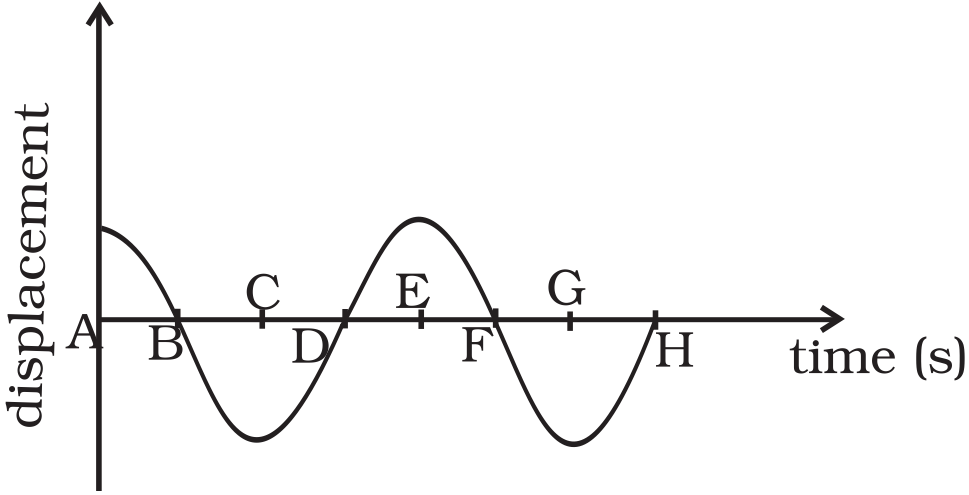
Displacement versus time curve for a particle executing $\text{S.H.M}$. is shown in Fig. Identify the points marked at which,
  1. Velocity of the oscillator is zero,
  2. Speed of the oscillator is maximum.
Answer

Key concept: In displacement$-$time graph of $\text{SHM}$, zero displacement values correspond to mean position; where velocity of the oscillator is maximum. Whereas the crest and troughs represent amplitude positions, where displacement is maximum and velocity of the oscillator is zero.
  1. The points $\text{A, C, E, G}$ lie at extreme positions $($maximum displacement, $y = A).$ Hence the velocity of the oscillator is zero.
  2. The points $\text{B, D, F, H}$ lie at mean position $($zero displacement, $y = 0)$. We know the speed is maximum at mean position.
View full question & answer
Question 53 Marks
When will the motion of a simple pendulum be simple harmonic?
Answer
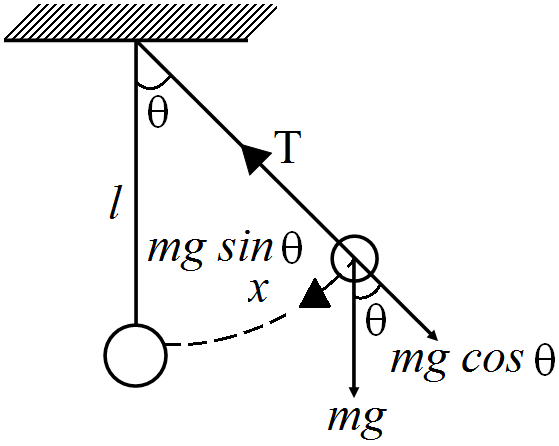
Consider a pendulum of length l and mass of bob m is displaced by angle $\theta$ as shown in fig. The restoring force = F $=\text{mg}\sin\theta$ If $\theta$ is small then $\sin\theta=\theta=\frac{\text{arc}}{\text{radius}}=\frac{\text{x}}{\text{l}}$$\therefore\text{F}=-\text{mg}\frac{\text{x}}{1}\ \text{or}\ \text{F}\propto(-\text{x})$
$(\because\text{m}_2\text{g},1\text{are constant})$
Hence, the motion of simple pendulam will be smile harmonic for small angle $\theta.$
View full question & answer
3 Marks Question - Physics STD 11 Science Questions - Vidyadip