Question
When will the motion of a simple pendulum be simple harmonic?
Answer

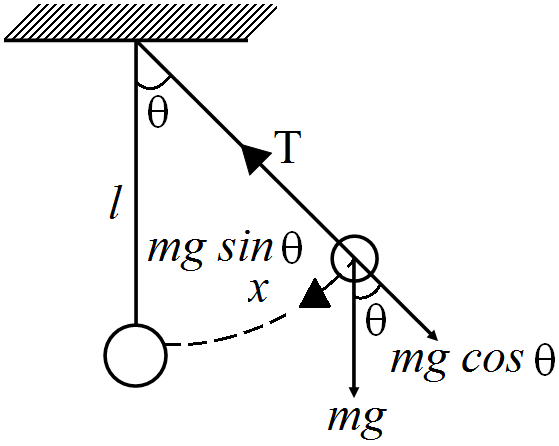
Consider a pendulum of length l and mass of bob m is displaced by angle $\theta$ as shown in fig. The restoring force = F $=\text{mg}\sin\theta$ If $\theta$ is small then $\sin\theta=\theta=\frac{\text{arc}}{\text{radius}}=\frac{\text{x}}{\text{l}}$$\therefore\text{F}=-\text{mg}\frac{\text{x}}{1}\ \text{or}\ \text{F}\propto(-\text{x})$
$(\because\text{m}_2\text{g},1\text{are constant})$
Hence, the motion of simple pendulam will be smile harmonic for small angle $\theta.$

Need a full question paper?

Generate a complete, print-ready paper with questions like this in minutes — across 16+ boards, with answer keys.
Start Generating Free

Similar questions

Find the frequency of note emitted by a string of length $10\sqrt{10}\text{cm},$ under tension of 3.14kg. Radius of string is 0.5mm and density = 9.8g/cc.
There are two displacement vectors, one of magnitude $3$ metres and the other of $4$ metres. How would the two vectors be added so that the magnitude of the resultant vector be $(a)\  7$ metres $(b)\  1$ metre and $(c)\  5$ metres?
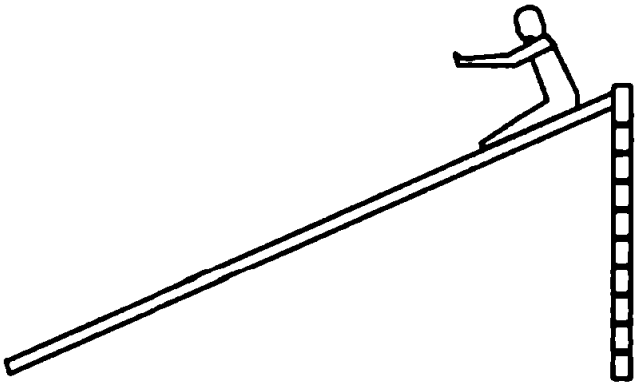
In a children's park, there is a slide which has a total length of 10m and a height of 8.0m (figure). Vertical ladder are provided to reach the top. A boy weighing 200N climbs up the ladder to the top of the slide and slides down to the ground. The average friction offered by the slide is three tenth of his weight. Find
  1. The work done by the ladder on the boy as he goes up.
  2. The work done by the slide on the boy as he comes down. Neglect any work done by forces inside the body of the boy.
The manual of a car instructs the owner to inflate the tyres to a pressure of 200 kPa .
i. What is the recommended gauge pressure?
ii. What is the recommended absolute pressure?
iii. If after the required inflation of the tyres, the car is driven to a mountain peak where the atmospheric pressure is $10 \%$ below that at sea level, what will the tyre gauge read?
Two rods of the same area of cross-section, but of lengths $l_1$ and $l_2$ and conductivities $K_1$ and $K_2$ are joined in series. Show that the combination is equivalent of a material of conductivity, $\text{K}=\frac{\text{l}_1+\text{l}_2}{\Big(\frac{\text{l}_1}{\text{K}_1}\Big)\Big(\frac{\text{l}_2}{\text{K}_2}\Big)}$
  1. Explain the term impulse. Show that impulse of a variable force is equal to the area enclosed by the force-time curve.
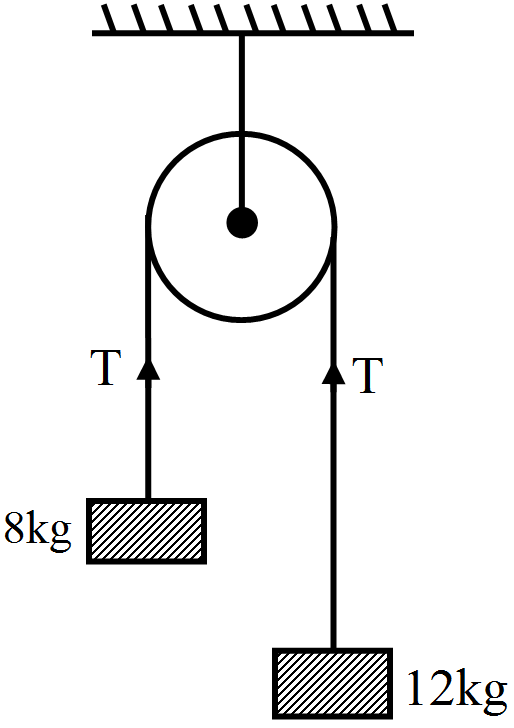
  2. Two masses $8kg$ and $12kg$ are connected at the two ends of a light inextensible string that passes over a frictionless pulley. Find the acceleration of the masses and tension in the string, when the masses are released.
Find the energy liberated in the reaction:
$^{223}Ra \rightarrow ^{209}Pb + ^{14}C$.
The atomic masses needed are as follows.
$^{223}Ra$ $^{209}Pb$ $^{14}C$
22.018u 208.981u 14.003u
A spaceship is launched into a circular orbit close to earth's surface. What additional velocity has to be imparted to the spaceship in the orbit to overcome the gravitational pull? Radius of earth = $6400km$ and $g = 9.8ms^{-2}$.
Calculate the percentage change in time period of a simple pendulum if its length is increased by 8%.
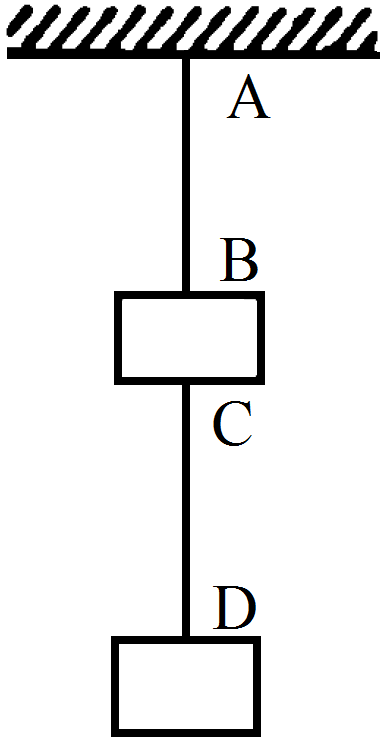
Two blocks each having a mass of 3.2kg are connected by a wire CD and the system is suspended from the ceiling by another wire AB figure, The linear mass delity of the wire AB is 10g/m and that of CD is 8g/m. Find the speed of a transverse wave pulse produced in AB and in CD.