Questions

Case study (4 Marks)

Take a timed test

5 questions · self-marked practice — reveal the answer and mark yourself.

Question 14 Marks
A player hits a baseball at some angle. The ball goes high up in space. The player runs and catches the ball before it hits the ground. Which of the two (the player or the ball) has greater displacement?
Answer
Same displacement.
View full question & answer
Question 24 Marks
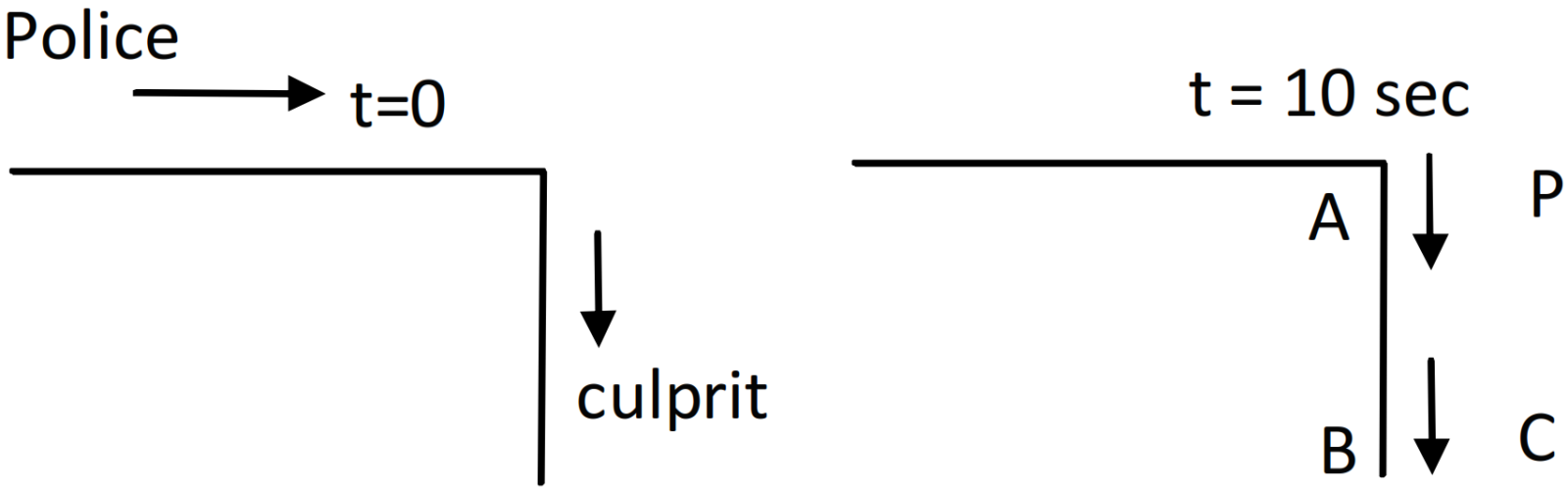
A police jeep is chasing a culprit going on a motorbike. The motorbike crosses a turning at a speed of $72km/h$. The jeep follows it at a speed of $90km/h$, crossing the turning ten seconds later than the bike. Assuming that they travel at constant speeds, how far from the turning will the jeep catch up with the bike?
 
Answer
$V_P = 90km/h = 25m/s. V_C= 72km/h = 20m/s$. In 10 sec culprit reaches at point B from A. Distance converted by culprit S = vt = 20 × 10 = 200m. At time t = 10 sec the police jeep is 200m behind the culprit.$\text{Time}=\frac{\text{s}}{\text{v}}=\frac{200}{5}=40\text{s}.$ (Relative velocity is considered).
In 40s the police jeep will move from A to a distance S, where S = vt = 25 × 40 = 1000m = 1.0km away.$\therefore$ The jeep will catch up with the bike, 1km far from the turning.
View full question & answer
Question 34 Marks
Complete the following table:
Car Model
Driver X
Reaction time 0.20s
Driver Y
Reaction time 0.30s
A (deceleration on hard braking = $6.0m/s^2$)
Speed = 54km/h
Braking distance
a = ...
Total stopping distance
b = ...
Speed = 72km/h
Braking distance
c = ...
Total stopping distance
d = ...
B (deceleration on hard braking = $7.5m/s^2$)
Speed = 54km/h
Breaking distance
e = ...
Total stopping distance
f = ...
Speed 72km/h
Braking distance
g = ...
Total stopping distance
h = ...
Answer
Car Model
Driver X
Reaction time 0.25s
Driver Y
Reaction time 0.35s
A (deceleration on hard braking = $6.0m/s^2$)
Speed = 54km/h
Braking distance
a = 19m
Total stopping distance
b = 22m
Speed = 72km/h
Braking distance
c = 33m
Total stopping distance
d = 39m
B (deceleration on hard braking = $7.5m/s^2$)
Speed = 54km/h
Breaking distance
e = 15m
Total stopping distance
f = 18m
Speed 72km/h
Braking distance
g = 27m
Total stopping distance
h = 33m
$\text{a}=\frac{0^2-15^2}{2(-6)}=19\text{m}$
So, b = 0.2 × 15 + 19 = 33m
Similarly other can be calculated.
Braking distance: Distance travelled when brakes are applied.
Total stopping distance = Braking distance + distance travelled in reaction time.
View full question & answer
Question 44 Marks
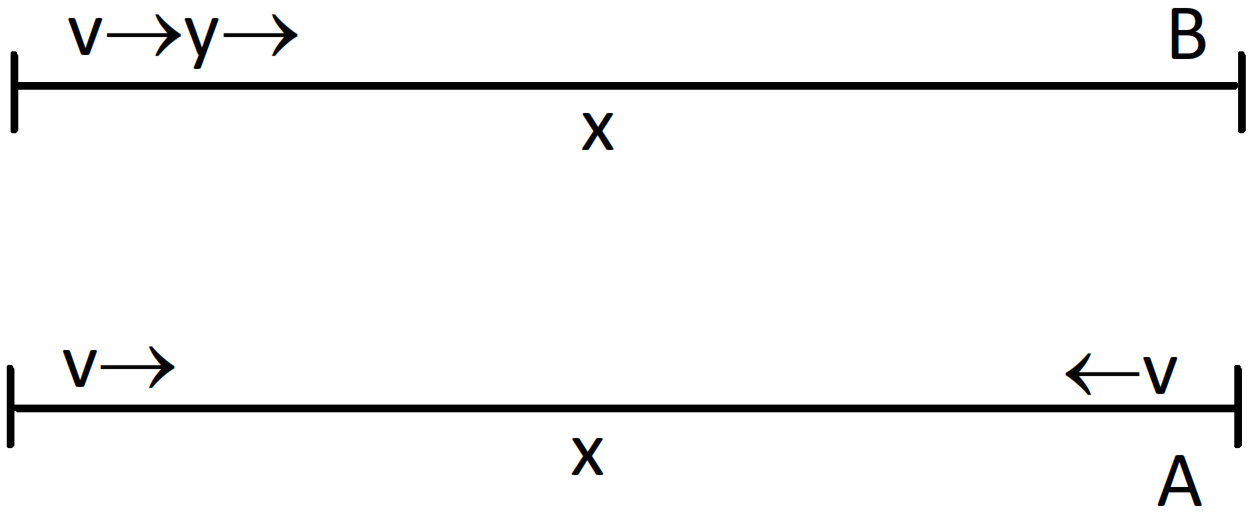
Two friends A and B are standing a distance x apart in an open field and wind is blowing from A to B. A beats a drum and B hears the sound $t_1$ time after he sees the event. A and B interchange their positions and the experiment is repeated. This time B hears the drum $t_2$ time after he sees the event. Calculate the velocity of sound in still air v and the velocity of wind u. Neglect the time light takes in travelling between the friends.
Answer
Velocity of sound v, Velocity of air u, Distance between A and B be x. In the first case, resultant velocity of sound $\text{= v + u}$

$\Rightarrow(\text{v + u})\text{t}_1=\text{x}$
$\Rightarrow\text{v + u}=\frac{\text{x}}{\text{t}_1} \ ...(1)$
In the second case, resultant velocity of sound $=\text{v}-\text{u}$$\therefore(\text{v}-\text{u})\text{t}_2=\text{x}$
$\Rightarrow\text{v}-\text{u}=\frac{\text{x}}{\text{t}_2} \ ...(2)$
From (1) and (2)$2\text{v}=\frac{\text{x}}{\text{t}_1}+\frac{\text{x}}{\text{t}_2}=\text{x}\Big(\frac{1}{\text{t}_1}+\frac{1}{\text{t}_2}\Big)$
$\Rightarrow\text{v}=\frac{\text{x}}{2}\Big(\frac{1}{\text{t}_1}+\frac{1}{\text{t}_2}\Big)$
From (1) $\text{u}=\frac{\text{x}}{\text{t}_1}-\text{v}=\frac{\text{x}}{\text{t}_1}-\Big(\frac{\text{x}}{2\text{t}_1}+\frac{\text{x}}{2\text{t}_2}\Big)=\frac{\text{x}}{2}\Big(\frac{1}{\text{t}_1}-\frac{1}{\text{t}_2}\Big)$$\therefore$ Velocity of air $\text{ V}=\frac{\text{x}}{2}\Big(\frac{1}{\text{t}_1}+\frac{1}{\text{t}_2}\Big)$
And Velocity of wind $\text{u}=\frac{\text{x}}{2}\Big(\frac{1}{\text{t}_1}-\frac{1}{\text{t}_2}\Big)$
View full question & answer
Question 54 Marks
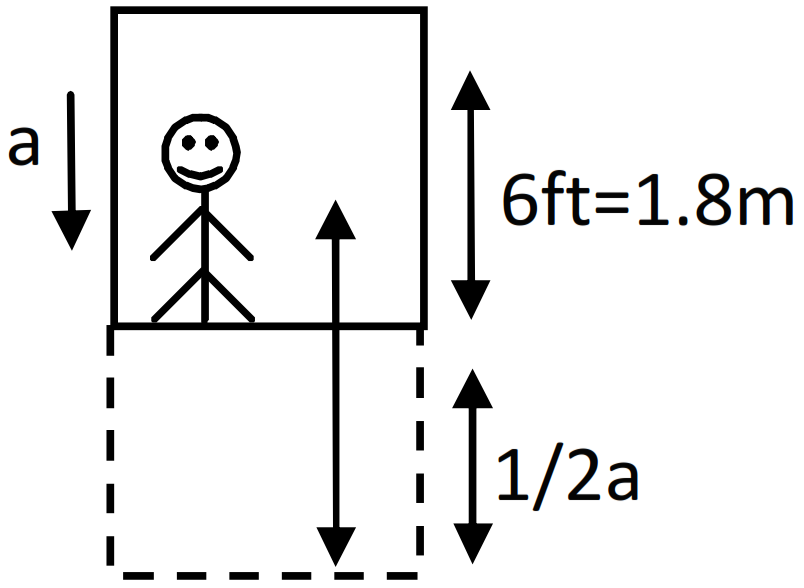
An elevator is descending with uniform acceleration. To measure the acceleration, a person in the elevator drops a coin at the moment the elevator starts. The coin is 6ft above the floor of the elevator at the time it is dropped. The person observes that the coin strikes the floor in 1 second. Calculate from these data the acceleration of the elevator.
Answer
For elevator and coin u = 0 As the elevator descends downward with acceleration a' (say) The coin has to move more distance than 1.8m to strike the floor. Time taken t = 1 sec.$\text{S}_{\text{c}}=\text{ut}+\frac{1}{2}\text{a}'\text{t}^2=0+\frac{1}{2}\text{g}(1)^2=\frac{1}{2}\text{g}$
$\text{S}_{\text{e}}=\text{ut}+\frac{1}{2}\text{at}^2=\text{u}+\frac{1}{2}\text{a}(1)^2=\frac{1}{2}\text{a}$
Total distance covered by coin is given by $=1.8+\frac{1}{2}\text{a}=\frac{1}{2}\text{g}$$\Rightarrow1.8+\frac{\text{a}}{2}=\frac{9.8}{2}=4.9$
$\Rightarrow\text{a}=6.2\text{m/s}^2=6.2\times3.28=20.34\text{ft/s}^2.$
View full question & answer