Questions

Case study (4 Marks)

Take a timed test

15 questions · self-marked practice — reveal the answer and mark yourself.

Question 14 Marks
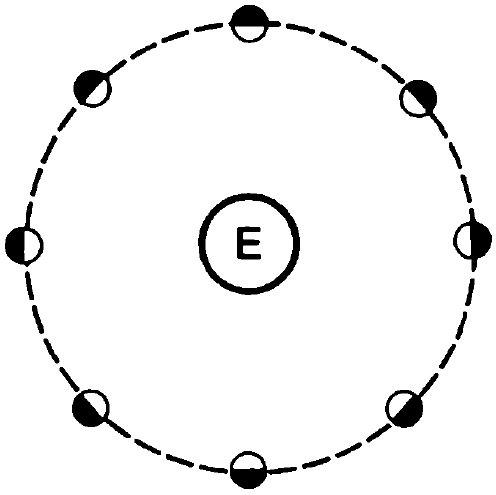
The moon rotates about the earth in such a way that only one hemisphere of the moon faces the earth. Can we ever see the ''other face'' of the moon from the earth? Can a person on the moon ever see all the faces of the earth?
Answer
No, we cannot see the other face of the Moon from the Earth. Yes, a person on the Moon can see all the faces of the Earth. Explanation: Angular velocity of the Moon about its own axis of rotation is same as its angular velocity of revolution about the Earth. This means that its rotation time period equals its revolution time period. So, we can see only one face of the Moon from the Earth. However, angular velocity of the Earth about its axis is not same as the angular velocity of Moon about the Earth. So, all the faces of the Earth is visible from the Moon.
View full question & answer
Question 24 Marks
When tall buildings are constructed on earth, the duration of day-night slightly increases. Is it true?
Answer
Yes, because tall buildings have their CM much above the ground. It increases moment of inertia of the Earth. As the Earth’s rotation does not involve torque, its angular momentum is constant. Thus, an increase in MI leads to lower angular velocity of the Earth about its axis of rotation. This means length of night and day will increase. However, the increase is very small.
View full question & answer
Question 34 Marks
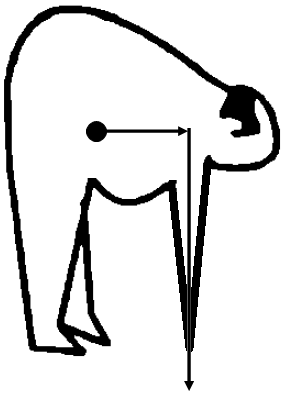
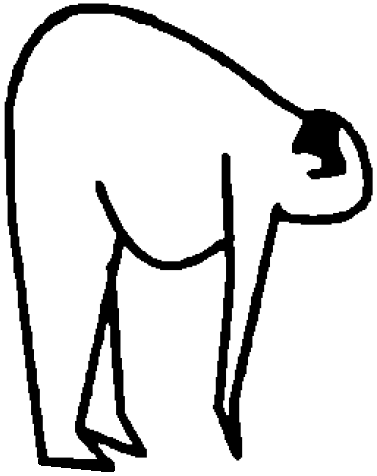
When a fat person tries to touch his toes, keeping the legs straight, he generally falls. Explain with reference to figure.
Answer
When the man tries to touch his toe, he exerts force along the hand downwards. This force produces amoment along the Centre of Mass CM of the man as shown in the figure. This moment makes him rotateand, thus, he falls down after losing the balance.
View full question & answer
Question 44 Marks
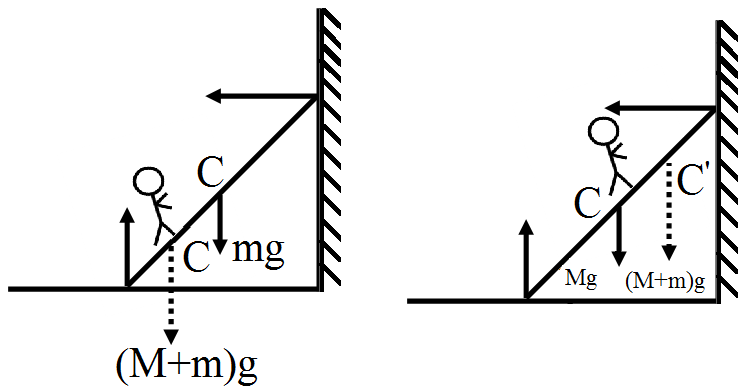
A ladder is resting with one end on a vertical wall and the other end on a horizontal floor. Is it more likely to slip when a man stands near the bottom or near the top?
Answer
The ladder is more likely to slide when the man stands near the top. This is because when the man stands near the top, it creates more torque compared to the torque caused by the weight of man near the bottom. When the man stands near the bottom, the Centre of Gravity of the ladder is shifted to C' from C. Now, the couple due to forces (m + M)g and N makes the ladder fall. We see that due to its shift from C to C', the moment arm of the couple decreases from r to r'; hence,
When the man stands near the top of the ladder, the Centre of Mass shifts from C to C'. This increases the moment arm of the couple and from r to r'. Increase in moment arm increases the couple and, thus, the ladder easily falls.
View full question & answer
Question 54 Marks
What can be said about the centre of mass of a uniform hemisphere without making any calculation? Will its distance from the centre be more than $\frac{\text{r}}{2}$ or less than $\frac{\text{r}}{2}?$
Answer
It would be less than $\frac{\text{r}}{2}$ as more of the mass is concentrated near center of the sphere so center of mass should be less than $\frac{\text{r}}{2}$.
View full question & answer
Question 64 Marks
You are holding a cage containing a bird. Do you have to make less effort if the bird flies from its position in the cage and manages to stay in the middle without touching the walls of the cage? Does it make a difference whether the cage is completely closed or it has rods to let air pass?
Answer
In case the cage is made of rods to let air pass the air displaced by bird to fly would pass and the weight of cage will be reduced in case of closed cage the air displaced by bird would remain inside the cage so cage would weigh same as it was before.
View full question & answer
Question 74 Marks
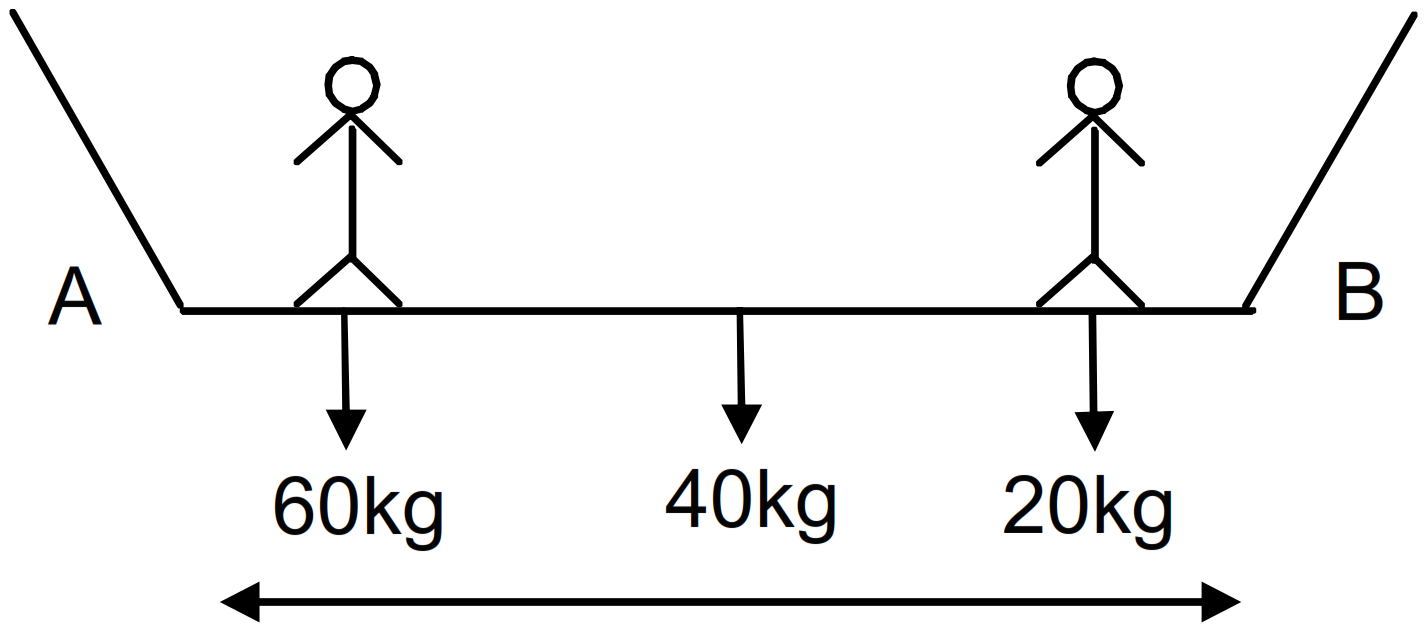
Mr. Verma $(50kg)$ and Mr. Mathur $(60kg)$ are sitting at the two extremes of a $4m$ long boat $(40kg)$ standing still in water. To discuss a mechanics problem, they come to the middle of the boat. Neglecting friction with water, how far does the boat move on the water during the process?
Answer
$m_1 = 60kg, m_2 = 40kg , m_3 = 50kg$, Let A be the origin of the system. Initially Mr. Verma & Mr. Mathur are at extreme position of the boat.
$\therefore$ The centre of mass will be at a distance $=\frac{60\times0+40\times2+50\times4}{150}=\frac{280}{150}=1.87\text{m}$ from ‘A’

When they come to the mid point of the boat the CM lies at 2m from ‘A’. $\therefore$ The shift in CM = 2 - 1.87 = 0.13m towards right. But, as there is no external force in longitudinal direction their CM would not shift. So, the boat moves 0.13m or 13cm towards right.
View full question & answer
Question 84 Marks
A kid of mass M stands at the edge of a platform of radius R which can be freely rotated about its axis. The moment of inertia of the platform is I. The system is at rest when a friend throws a ball of mass m and the kid catches it. If the velocity of the ball is v horizontally along the tangent to the edge of the platform when it was caught by the kid, find the angular speed of the platform after the event.
Answer
A kid of mass M stands at the edge of a platform of radius R which has a moment of inertia I. A ball of m thrown to him and horizontal velocity of the ball v when he catches it. Therefore if we take the total bodies as a system Therefore $mvR = {I + (M + m)R^2}ω$ (The moment of inertia of the kid and ball about the axis = $(M + m)R^2$) $\Rightarrow\omega=\frac{\text{mvR}}{1+(\text{M}+\text{m})\text{R}^2}$
View full question & answer
Question 94 Marks
The weight Mg of an extended body is generally shown in a diagram to act through the centre of mass. Does it mean that the earth does not attract other particles?
Answer
In order to simplify the situation, we consider that the weight Mg of an extended body acts through its centre of mass. Although the earth attracts all the particles, the net effect can be assumed to be at the center of mass.
View full question & answer
Question 104 Marks
Read the passage given below and answer the following questions from 1 to 5. Centre of Mass:
The centre of mass of a body or a system of bodies is the point which moves as though all of the mass were concentrated there and all external forces were applied to it. Hence, a point at which the entire mass of the body or system of bodies is supposed to be concentrated is known as the centre of mass. If a system consists of more than one particles (or bodies) and net external force on the system in a particular direction is zero with centre of mass at rest. Then, the centre of mass will not move along that direction. Even though some particles of the system may move along that direction.
  1. The centre of mass of a system of two particles divides, the distance between them:
  1. in inverse ratio of square of masses of particles
  2. in direct ratio of square of masses of particles
  3. in inverse ratio of masses of particles
  4. in direct ratio of masses of particles
  1. Two bodies of masses 1kg and 2 kg are lying in xy-plane at ( -1, 2 ) and ( 2, 4 ) respectively. What are the coordinates of the centre of mass?
  1. $\big(1,\frac{10}{3}\big)$
  2. (1, 10)
  3. (0, 1)
  4. None of these
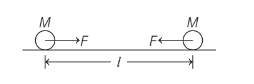
  1. Two balls of same masses start moving towards each other due to gravitational attraction, if the initial distance between them is l. Then, they meet at:
  1. $\frac{\text{ l}}{2}$
  2. l
  3. $\frac{\text{ l}}{3}$
  4. $\frac{\text{ l}}{4}$
  1. All the particles of a body are situated at a distance R from the origin. The distance of centre of mass of the body from the origin is:
  1. $=\text{R}$
  2. $\leq\text{R}$
  3. $>\text{R}$
  4. $\geq\text{R}$
  1. Two particles A and B initially at rest move towards each other under a mutual force of attraction. At the instant, when the speed of A is v and the speed of B is 2v, the speed of centre of mass of the system is:
  1. zero
  2. v
  3. 1. 5v
  4. 3v
Answer
  1. (c) in inverse ratio of masses of particles
Explanation:
Centre of mass of a system of two particles is
Then, $\text{r}_\text{cm}=\frac{\text{m}_1\text{r}_1+\text{m}_2\text{r}_2}{\text{M}}$
If $m_1+ m_2= M =$ total mass of the particles,
then $\text{r}_\text{cm}=\frac{\text{m}_1\text{r}_1+\text{m}_2\text{r}_2}{\text{M}}$
$\therefore \text{ r}_\text{cm}\infty\frac{1}{\text{M}}$
So, the above relation clearly shows that the centre of mass of a system of two particles divide the distance between them in inverse ratio of masses of particles.
  1. $\big(1,\frac{10}{3}\big)$
Explanation:
Let the coordinates of the centre of mass be (x, y).
$\therefore\text{ x}=\frac{\text{m}_1\text{x}_1+\text{m}_2\text{x}_2}{\text{m}_1+\text{m}_2}$
$\frac{1\times(-1)+2\times2}{3}=\frac{-1+4}{3}=1$
${y}=\frac{\text{m}_1\text{y}_1+\text{m}_2\text{y}_2}{\text{m}_1+\text{m}_2}$
$=\frac{1\times2+2\times4}{3}=\frac{2+8}{3}=\frac{10}{3}$
  1. $\frac{\text{ l}}{2}$
Explanation:
As the balls were initially at rest and the forces of attraction are internal, then their centre of mass (CM) will always remain at rest.
So, $v_{cm = 0}$​​​​​​​
As CM is at rest, they will meet at CM.
  1. $\leq\text{R}$
Explanation:
For a single particle, distance of centre of mass from origin is R. For more than one particles, distance $\leq\text{R}$
  1. zero
Explanation:
As per the question, two particles A and B are initially at rest, move towards each other under a mutual force of attraction. It means that, no external force is applied on the system. Therefore, $F_{ext} = 0.$
So, there is no acceleration of CM. This means velocity of the CM remain constant. As, initial velocity of $CM, v_i = 0$ and final velocity of $CM, v_f = 0.$
View full question & answer
Question 114 Marks
Read the passage given below and answer the following questions from 1 to 5 . Radius of gyration: The radius of gyration of a body about an axis may be defined as the distance from the axis of a mass point whose mass is equal to the mass of the whole body and whose moment of inertia is equal to the moment of inertia of the body about the axis. the moment of inertia of a rigid body analogous to mass in linear motion and depends on the mass of the body, its shape and size; distribution of mass about the axis of rotation, and the position and orientation of the axis of rotation. Theorem of perpendicular axes It states that the moment of inertia of a planar body (lamina) about an axis perpendicular to its plane is equal to the sum of its moments of inertia about two perpendicular axes concurrent with perpendicular axis and lying in the plane of the body. If we consider a planar body, An axis perpendicular to the body through a point $O$ is taken as the $z$-axis. Two mutually perpendicular axes lying in the plane of the body and concurrent with $z$-axis, i.e., passing through $O$, are taken as the $x$ and $y$-axes. The theorem states that $|z=1 x+| y$. Theorem of parallel axes The moment of inertia of a body about any axis is equal to the sum of the moment of inertia of the body about a parallel axis passing through its centre of mass and the product of its mass and the square of the distance between the two parallel axes. $z$ and $z^{\prime}$ are two parallel axes, separated by a distance $a$. The zaxis passes through the centre of mass $O$ of the rigid body. Then according to the theorem of parallel axes $I _{z^{\prime}}= I _{ z }+$ $M a^2$ Where $I_z$ and $I_z^{\prime}$ are the moments of inertia of the body about the $z$ and $z C$ axes respectively, $M$ is the total mass of the body and a is the perpendicular distance between the two parallel axes.
  1. SI unit of radius of gyration:
  1. Metre (m)
  2. $M^2$
  3. $M^3​​​​​​​$​​​​​​​
  4. None of these
  1. Moment of inertia is analogous to:
  1. Mass
  2. Area
  3. Force
  4. None of these
  1. Define radius of gyration:
  1. State Theorem of perpendicular axes:
  1. State Theorem of parallel axes:
Answer
  1. (a) Metre (m)
  1. (a) Mass
  1. Radius of gyration: The radius of gyration of a body about an axis may be defined as the distance from the axis of a mass point whose mass is equal to the mass of the whole body and whose moment of inertia is equal to the moment of inertia of the body about the axis.
  1. Theorem of perpendicular axes
It states that the moment of inertia of a planar body (lamina) about an axis perpendicular to its plane is equal to the sum of its moments of inertia about two perpendicular axes concurrent with perpendicular axis and lying in the plane of the body. If we consider a planar body, an axis perpendicular to the body through a point O is taken as the z-axis. Two mutually perpendicular axes lying in the plane of the body and concurrent with z-axis, i.e., passing through O, are taken as the x and y-axes. The theorem states that
I z = I x + I y
  1. The moment of inertia of a body about any axis is equal to the sum of the moment of inertia of the body about a parallel axis passing through its centre of mass and the product of its mass and the square of the distance between the two parallel axes. z and z’ are two parallel axes, separated by a distance a. The z-axis passes through the centre of mass O of the rigid body. Then according to the theorem of parallel axes
$I_{z’}= I_z + Ma^2$​​​​​​​
Where $I_z​​​​​​​$​​​​​​​ and $I_z​​​​​​​$​​​​​​​’ are the moments of inertia of the body about the z and z¢ axes respectively, M is the total mass of the body and a is the perpendicular distance between the two parallel axes.
View full question & answer
Question 124 Marks
Read the passage given below and answer the following questions from 1 to 5. Rolling Motion
The rolling motion can be regarded as the combination of pure rotation and pure translation. It is also one of the most common motions observed in daily life. Suppose the rolling motion (without slipping) of a circular disc on a level surface. At any instant, the point of contact P0 of the disc with the surface is at rest (as there is no slipping). If v CM is the velocity of centre of mass which is the geometric centre C of the disc, then the translational velocity of disc is v CM , which is parallel to the level surface. Velocity of centre of mass, $\text{V}_\text{cm}=\text{R}\omega$
  1. A solid cylinder is sliding on a smooth horizontal surface with velocity $v_0$ without rotation. It enters on the rough surface. After that it has travelled some distance, the friction force increases its:
  1. translational kinetic energy
  2. rotational kinetic energy
  3. total mechanical energy
  4. angular momentum about an axis passing through point of contact of the cylinder and the surface
  1. A cylinder rolls down an inclined plane of inclination $30^\circ$, the acceleration of cylinder is:
  1. $\frac{\text{g}}{3}$
  2. g
  3. $\frac{\text{g}}{2}$
  4. $\frac{2g}{3}$
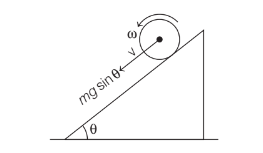
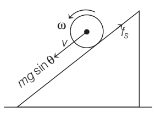
  1. Sphere is in pure accelerated rolling motion in the figure shown:

Choose the correct option.
  1. The direction of $f_s$ is upwards
  2. The direction of $f_s$ is downwards
  3. The direction of gravitational force is upwards
  4. The direction of normal reaction is downwards
  1. Kinetic energy of a rolling body will be:
  1. $\frac{1}{2}\text{mv}^2_\text{ cm}(\text{l}+\frac{\text{k}^2}{\text{R}^2}\big)$
  2. $\frac{1}{2}\text{I}\infty^2$
  3. $\frac{1}{2}\text{mv}^2\text{cm}$
  4. (d) None of the above
  1. A body is rolling down an inclined plane. Its translational and rotational kinetic energies are equal. The body is a:
  1. solid sphere
  2. hollow sphere
  3. solid cylinder
  4. hollow cylinder
Answer
  1. (b) rotational kinetic energy
Explanation:
The frictional force will reduce v 0, hence translational KE will also decrease. It will increases w, which increases its rotational kinetic energy. There is no torque about the line of contact, angular momentum will remain constant. The frictional force will decrease the mechanical energy.
  1. a$\frac{\text{g}}{3}$
Explanation:
$\text{a}=\frac{\text{g}\sin\theta}{1+\frac{\text{k}^2}{\text{R}^2}}=\frac{\text{g}\sin30^\circ}{1+\frac{1}{2}}\Rightarrow\text{a}\frac{\frac{\text{g}}{2}}{\frac{3}{2}}=\frac{\text{g}}{3}$
  1. (a) The direction of $f_s$ is upwards
Explanation:
As we know that,

The direction of $f_s$ will be upwards to provide torque for rolling of sphere.
  1. $\frac{1}{2}\text{mv}^2_\text{ cm}(\text{l}+\frac{\text{k}^2}{\text{R}^2}\big)$
Explanation:
KE of a rolling body = Rotational KE + Translational KE
$=\frac{1}{2}\text{l}\omega^2+\frac{1}{2}\text{mv}^2_\text{cm}(\because\text{I}=\text{mk}^2)$
and $\text{v}_\text{cm}=\text{R}\omega$
$=\frac{1}{2}\frac{\text{mk}^2\text{v}^2_\text{cm}}{\text{R}^2}+\frac{1}{2}\text{mv}^2_\text{cm}$
where, k is the corresponding radius of gyration of the body.
$\frac{1}{2}\text{mv}^2_\text{ cm}(\text{l}+\frac{\text{k}^2}{\text{R}^2}\big)$
  1. (d) hollow cylinder
Explanation:
When a body rolls down on inclined plane, it is accompanied by rotational and translational kinetic energies.
Rotational kinetic energy$=\frac{1}{2}\text{I}\omega^2=\text{K}_\text{R}$
where, I is the moment of inertia and w is the angular velocity. Translational kinetic energy for pure rolling,
$\text{v}_\text{cm}=\text{r}\omega$
$=\frac{1}{2}\text{mv}^2_\text{cm}=\text{K}_\text{r}=\frac{1}{2}\text{m}(r\omega)^2$
where, m is mass of the body, $v_{CM}$ is the velocity and $\omega$ is the angular velocity.
Given,
Translational KE = Rotational KE
$\therefore \frac{1}{2}\text{m}(\text{r}^2\omega^2)=\frac{1}{2}\text{I}\omega^2$
$\Rightarrow\text{I}=\text{mr}^2$
We know that, mr 2 is the moment of inertia of hollow cylinder about its axis, where m is the mass of hollow cylindrical body and r is the radius of the cylinder.
View full question & answer
Question 134 Marks
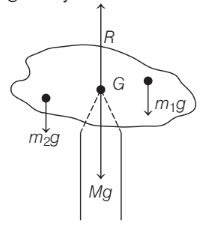
Read the passage given below and answer the following questions from 1 to 5. Torque and Centre of Gravity Torque is also known as moment of force or couple. When a force acts on a particle, the particle does not merely move in the direction of the force but it also turns about some point. So, we can define the torque for a particle about a point as the vector product of position vector of the point where the force acts and with the force itself. In the given figure, balancing of a cardboard on the tip of a pencil is done. The point of support, G is the centre of gravity.
  1. If the $F_{net, ext} $is zero on the cardboard, it means:
  1. $R = Mg$
  2. $m_1g = Mg$
  3. $m_2g = Mg$
  4. $ \text{R}=\frac{\text{m}_1}{\text{g}}$
  1. Choose the correct option.
  1. $\tau \text{Mg about CG =0}$
  2. $\tau \text{Rabout CG =0}$
  3. Net $\tau$ due to $m_1 g, m_2 g...., m_ng$ about $CG = 0$
  4. All of the above
  1. The centre of gravity and the centre of mass of a body coincide, when:
  1. g is negligible
  2. g is variable
  3. g is constant
  4. g is zero
  1. If value of g varies, the centre of gravity and the centre of mass will:
  1. coincide
  2. not coincide
  3. become same physical quantities
  4. None of the above
  1. A body lying in a gravitational field is in stable equilibrium, if:
  1. vertical line through CG passes from top
  2. horizontal line through CG passes from top
  3. vertical line through CG passes from base
  4. horizontal line through CG passes from base
Answer
  1. (a) R = Mg.
Explanation:
The tip of the pencil provides a vertically upward force due to which the cardboard is in equilibrium.
  1. (c) All of the above.
Explanation:
Net t due to all the forces of gravity $m_1g, m_2g,.., m_ng$ about cg is also zero as it is at CG.
$\tau$ of rection R about CG is also zero as it is at CG.
Point G is the centre of gravity of the cardboard and it is so located that the total torque on it due to forces $m_1g, m_2g,.., m_ng $ is zero.
It means, $\tau_\text{g}=\sum\tau_\text{i}$
$=\sum\text{r}_\text{i}\times\text{m}_\text{i}\text{g}=0$
  1. (b) g is constant.
Explanation:
As, $\tau_\text{g}=\sum\text{r}_\text{i}\times\text{m}_\text{i}\text{g}$
$(\tau_\text{g} = \text{total gravitational torque})$
$\sum\text{r}_\text{i} \times\text{m}_\text{i}\text{g}=0$
If g is constant,
$(\sum\text{m}_\text{i}\text{r}_\text{i})\times\text{g}=\text{g}\sum\text{m}_\text{i}\text{r}_\text{i}$
$\text{As}\text{g}\neq 0, \text{so}\sum\text{m}_\text{i}\text{r}_\text{i}=0$
It is the condition where the centre of mass (CM) of the body lies at origin and here origin is considered at centre of gravity (CG), when g is constant.
  1. (c) not coincide
Explanation:
If the value of g varies, then CM and CG will not coincide. Keep in mind that, CG and CM both are two different concepts. CM has nothing to do with CG.
  1. (c) vertical line through CG passes from base
Explanation:
A body in a gravitational field will be in stable equilibrium, if the vertical line through CG passes from the base of the body.
View full question & answer
Question 144 Marks
Read the passage given below and answer the following questions from 1 to 5. Moment of Inertia A heavy wheel called flywheel is attached to the shaft of steam engine, automobile engine etc., because of its large moment of inertia, the flywheel opposes the sudden increase or decrease of the speed of the vehicle. It allows a gradual change in the speed and prevents jerky motion and hence ensure smooth ride of passengers.
  1. Moment of inertia of a body depends upon:
  1. axis of rotation
  2. torque
  3. angular momentum
  4. angular velocity
  1. A particle of mass 1 kg is kept at (1m, 1m, 1m). The moment of inertia of this particle about Z-axis would be:
  1. $1 kg-m^2$
  2. $2 kg-m^2$
  3. $3 kg-m^2$
  4. (None of the above)
  1. Moment of inertia of a rod of mass m and length l about its one end is I. If one-fourth of its length is cut away, then moment of inertia of the remaining rod about its one end will be:
  1. $\frac{3}{4}\text{I}$
  2. $\frac{9}{16}\text{I}$
  3. $\frac{27}{64}\text{I}$
  4. $\frac{\text{I}}{16}$
  1. A circular disc is to be made by using iron and aluminium, so that it acquires maximum moment of inertia about its geometrical axis. It is possible with:
  1. iron and aluminium layers in alternate order
  2. aluminium at interior and iron surrounding it
  3. iron at interior and aluminium surrounding it
  4. Either (a) or (c)
  1. Three thin rods each of length L and mass M are placed along X ,Y and Z -axes such that one end of each rod is at origin. The moment of inertia of this system about Z-axis is:
  1. $\frac{2}{3}\text{ML}^2$
  2. $\frac{4\text{ML}^2}{3}$
  3. $\frac{5\text{ML}^2}{3}$
  4. $\frac{\text{ML}^2}{3}$
Answer
  1. (a) axis of rotation
Explanation:
Moment of inertia of a body depends on position and orientation of the axis of rotation with respect to the body.
  1. (b) $2 kg-m^2$
Explanation:
Perpendicular distance from Z-axis would be
$\sqrt{(1)^2+(1)^2}=\sqrt{2\text{m}}$
$\therefore \text{ I}=\text{Mr}^2=(1)(\sqrt{2})^2=2\text{kg}-\text{m}^2$
  1. c $\frac{27}{64}\text{I}$
Explanation:
Initial moment of inertia, $\text{I}=\frac{\text{ml}^2}{3}$
New moment of inertia,
$\text{I}=\frac{(\frac{3\text{m}}{4})(\frac{3\text{l}}{4})^2}{3}=\frac{27}{64}\big(\frac{\text{ml}^2}{3}\big)=\frac{27}{64}\text{I}$
  1. (b) aluminium at interior and iron surrounding it
Explanation:
A circular disc is made up of larger number of circular rings. Moment of inertia of a circular ring in given by
$\text{I}=\text{MR}^2$
$\Rightarrow\text{I}\infty\text{M}$
Since, mass is proportional to the density of material. The density of iron is more than that of aluminium. Hence to get maximum value of I , the less dense material should be used at interior and denser at the surrounding. Therefore, using aluminium at the interior and iron at its surrounding will maximise the moment of inertia.
  1. $\frac{2}{3}\text{ML}^2$
Explanation:
Moment of inertia of the rod lying along Z-axis will be zero. Moment of inertia of the rods along X and Y -axes will be $\frac{\text{ML}^2}{3}$ each.
View full question & answer
Question 154 Marks
Read the passage given below and answer the following questions from 1 to 5. The cross product of two vectors is given by Vector C = A × B. The magnitude of the vector defined from cross product of two vectors is equal to product of magnitudes of the vectors and sine of angle between the vectors. Direction of the vectors is given by right hand corkscrew rule and is perpendicular to the plane containing the vectors. $\therefore\mid\text{vector}\text{C}\mid=\text{AB}\sin\theta$ and $ \text{Vector}\ \text{C}=\text{AB}\sinθ\text{n}$ Where, cap n is the unit vector perpendicular to the plane containing the vectors A and B. Following are properties of vector product
  1. Cross product does not obey commutative law. But its magnitude obeys commutative low.
  2. $\overrightarrow{\text{A}}\times\overrightarrow{\text{B}}\neq\overrightarrow{\text{B}}\times\overrightarrow{\text{A}}\Rightarrow(\overrightarrow{\text{A}}\times\overrightarrow{\text{B}})$
$=-(\overrightarrow{\text{B}}\times\overrightarrow{\text{A}}),\mid\overrightarrow{\text{A}}\times\overrightarrow{\text{B}}\mid=\mid\overrightarrow{\text{B}}\times\overrightarrow{\text{A}}\mid$
  1. It obeys distributive law
$\overrightarrow{\text{A}}\times(\overrightarrow{\text{B}}\times\overrightarrow{\text{C}})=\overrightarrow{\text{A}}\times\overrightarrow{\text{B}}+\overrightarrow{\text{A}}\times\overrightarrow{\text{C}}$
  1. The magnitude cross product of two vectors which are parallel is zero. Since θ = 0;
$\text{vector}\mid\text{A}\times\text{B}\mid=\text{AB}\sin\theta\circ= 0$
  1. For perpendicular vectors, $ \theta=90\circ,\text{vector}\mid\text{A}\times\text{B}\mid=\text{AB}\sin90\circ\mid\text{cap}\ \text{n}\mid=\text{AB}$
î x î = ĵ x ĵ = ƙ x ƙ = 0
î x ĵ = ƙ; ĵ x ƙ = î; ƙ x î = ĵ
ĵ x î = – (î x ĵ) = – ƙ; ƙ x ĵ = – (ĵ x ƙ) = – î ; î x ƙ = – (ƙ x î) = – ĵ
  1. The expression for a × b can be put in a determinant form which is easy to remember
$\overrightarrow{\text{a}}\times\overrightarrow{\text{b}}=\begin{vmatrix}\overrightarrow{\text{i}}&\overrightarrow{\text{j}}&\overrightarrow{\text{k}} \\\text{a}_{\text{x}} & \text{a}_{\text{y}}&\text{a}_{\text{z}}\\ \text{b}_{\text{x}} &\text{b}_{\text{y}}&\text{b}_\text{z}\end{vmatrix}$
Answer the following questions from above case study.
  1. If θ is angle between two vectors then resultant vector is maximum when θ is:
  1. 0
  2. 90
  3. 180
  4. None of these
  1. Cross product is operation performed between:
  1. Two scalar numbers
  2. One scalar other vector
  3. 2 vectors
  4. None of these
  1. Define cross product of two vectors:
  1. State right hand screw rule for finding out direction of resultant after cross product of two vectors.
  1. Give properties of cross product of parallel vector.
Answer
  1. (a) 0
  1. (c) 2 vectors
  1. The cross product of two vectors is given by Vector C = A × B. The magnitude of the vector defined from cross product of two vectors is equal to product of magnitudes of the vectors and sine of angle between the vectors.
$\therefore\mid\text{vector}\text{C}\mid=\text{AB}\sin\theta$ and $ \text{Vector}\ \text{C}=\text{AB}\sinθ\text{n}$ Where, cap n is the unit vector perpendicular to the plane containing the vectors A and B.
  1. We can find the direction of the unit vector with the help of the right-hand rule. In this rule, we can stretch our right hand so that the index finger of the right hand in the direction of the first vector and the middle finger is in the direction of the second vector. Then, the thumb of the right hand indicates the direction or unit vector n.
  1. The cross product of two vectors is zero vectors if both the vectors are parallel or opposite to each other. Conversely, if two vectors are parallel or opposite to each other, then their product is a zero vector. Two vectors have the same sense of direction. $\theta=90\circ$ As we know, $\sin\theta\circ=0$ and $\sin90\circ=1$
$\overrightarrow{\text{x}}\times\overrightarrow{\text{y}}=\mid\overrightarrow{\text{x}}\mid\cdot\mid\overrightarrow{\text{y}}\mid\sin\theta$
$\overrightarrow{\text{x}}\times\overrightarrow{\text{y}}=\mid\overrightarrow{\text{x}}\mid\cdot\mid\overrightarrow{\text{y}}\mid\sin0\circ$
$\overrightarrow{\text{x}}\times\overrightarrow{\text{y}}=\mid\overrightarrow{\text{x}}\mid\cdot\mid\overrightarrow{\text{y}}\mid\times0$
Hance, the cross product of the parallel vectors becomes $\overrightarrow{\text{x}}\times\overrightarrow{\text{y}}=0,$ which is a unit vector.
View full question & answer