Question
Read the passage given below and answer the following questions from 1 to 5. Rolling Motion
The rolling motion can be regarded as the combination of pure rotation and pure translation. It is also one of the most common motions observed in daily life. Suppose the rolling motion (without slipping) of a circular disc on a level surface. At any instant, the point of contact P0 of the disc with the surface is at rest (as there is no slipping). If v CM is the velocity of centre of mass which is the geometric centre C of the disc, then the translational velocity of disc is v CM , which is parallel to the level surface. Velocity of centre of mass, $\text{V}_\text{cm}=\text{R}\omega$
  1. A solid cylinder is sliding on a smooth horizontal surface with velocity $v_0$ without rotation. It enters on the rough surface. After that it has travelled some distance, the friction force increases its:
  1. translational kinetic energy
  2. rotational kinetic energy
  3. total mechanical energy
  4. angular momentum about an axis passing through point of contact of the cylinder and the surface
  1. A cylinder rolls down an inclined plane of inclination $30^\circ$, the acceleration of cylinder is:
  1. $\frac{\text{g}}{3}$
  2. g
  3. $\frac{\text{g}}{2}$
  4. $\frac{2g}{3}$
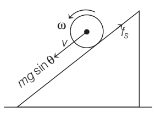
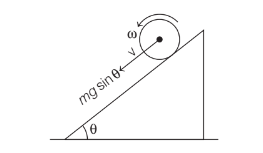
  1. Sphere is in pure accelerated rolling motion in the figure shown:

Choose the correct option.
  1. The direction of $f_s$ is upwards
  2. The direction of $f_s$ is downwards
  3. The direction of gravitational force is upwards
  4. The direction of normal reaction is downwards
  1. Kinetic energy of a rolling body will be:
  1. $\frac{1}{2}\text{mv}^2_\text{ cm}(\text{l}+\frac{\text{k}^2}{\text{R}^2}\big)$
  2. $\frac{1}{2}\text{I}\infty^2$
  3. $\frac{1}{2}\text{mv}^2\text{cm}$
  4. (d) None of the above
  1. A body is rolling down an inclined plane. Its translational and rotational kinetic energies are equal. The body is a:
  1. solid sphere
  2. hollow sphere
  3. solid cylinder
  4. hollow cylinder

Answer

  1. (b) rotational kinetic energy
Explanation:
The frictional force will reduce v 0, hence translational KE will also decrease. It will increases w, which increases its rotational kinetic energy. There is no torque about the line of contact, angular momentum will remain constant. The frictional force will decrease the mechanical energy.
  1. a$\frac{\text{g}}{3}$
Explanation:
$\text{a}=\frac{\text{g}\sin\theta}{1+\frac{\text{k}^2}{\text{R}^2}}=\frac{\text{g}\sin30^\circ}{1+\frac{1}{2}}\Rightarrow\text{a}\frac{\frac{\text{g}}{2}}{\frac{3}{2}}=\frac{\text{g}}{3}$
  1. (a) The direction of $f_s$ is upwards
Explanation:
As we know that,

The direction of $f_s$ will be upwards to provide torque for rolling of sphere.
  1. $\frac{1}{2}\text{mv}^2_\text{ cm}(\text{l}+\frac{\text{k}^2}{\text{R}^2}\big)$
Explanation:
KE of a rolling body = Rotational KE + Translational KE
$=\frac{1}{2}\text{l}\omega^2+\frac{1}{2}\text{mv}^2_\text{cm}(\because\text{I}=\text{mk}^2)$
and $\text{v}_\text{cm}=\text{R}\omega$
$=\frac{1}{2}\frac{\text{mk}^2\text{v}^2_\text{cm}}{\text{R}^2}+\frac{1}{2}\text{mv}^2_\text{cm}$
where, k is the corresponding radius of gyration of the body.
$\frac{1}{2}\text{mv}^2_\text{ cm}(\text{l}+\frac{\text{k}^2}{\text{R}^2}\big)$
  1. (d) hollow cylinder
Explanation:
When a body rolls down on inclined plane, it is accompanied by rotational and translational kinetic energies.
Rotational kinetic energy$=\frac{1}{2}\text{I}\omega^2=\text{K}_\text{R}$
where, I is the moment of inertia and w is the angular velocity. Translational kinetic energy for pure rolling,
$\text{v}_\text{cm}=\text{r}\omega$
$=\frac{1}{2}\text{mv}^2_\text{cm}=\text{K}_\text{r}=\frac{1}{2}\text{m}(r\omega)^2$
where, m is mass of the body, $v_{CM}$ is the velocity and $\omega$ is the angular velocity.
Given,
Translational KE = Rotational KE
$\therefore \frac{1}{2}\text{m}(\text{r}^2\omega^2)=\frac{1}{2}\text{I}\omega^2$
$\Rightarrow\text{I}=\text{mr}^2$
We know that, mr 2 is the moment of inertia of hollow cylinder about its axis, where m is the mass of hollow cylindrical body and r is the radius of the cylinder.

Need a full question paper?

Generate a complete, print-ready paper with questions like this in minutes — across 16+ boards, with answer keys.

Start Generating Free

Similar questions

Read the passage given below and answer the following questions from (i) to (v). A system is said to be isolated if no exchange or transfer of heat occurs between the system and its surroundings. When different parts of an isolated system are at different temperature a quantity of heat transfers from the part at higher temperature to the part at lower temperature. The heat lost by the part at higher temperature is equal to the heat gained by the part at lower temperature. Calorimetry means measurement of heat. When a body at higher temperature is brought in contact with another body at lower temperature, the heat lost by the hot body is equal to the heat gained by the colder body, provided no heat is allowed to escape to the surroundings. A device in which heat measurement can be done is called a calorimeter. It consists of a metallic vessel and stirrer of the same material, like copper or aluminium. The vessel is kept inside a wooden jacket, which contains heat insulating material. Matter normally exists in three states: solid, liquid and gas. A transition from one of these states to another is called a change of state. Two common changes of states are solid to liquid and liquid to gas (and, vice versa). These changes can occur when the exchange of heat takes place between the substance and its surroundings. The change of state from solid to liquid is called melting and from liquid to solid is called fusion. It is observed that the temperature remains constant until the entire amount of the solid substance melts. That is, both the solid and the liquid states of the substance coexist in thermal equilibrium during the change of states from solid to liquid. The temperature at which the solid and the liquid states of the substance is in thermal equilibrium with each other is called its melting point. The change of state from liquid to vapour (or gas) is called vaporisation. It is observed that the temperature remains constant until the entire amount of the liquid is converted into vapour. That is, both the liquid and vapour states of the substance coexist in thermal equilibrium, during the change of state from liquid to vapour. The temperature at which the liquid and the vapour states of the substance coexist is called its boiling point. The change from solid state to vapour state without passing through the liquid state is called sublimation, and the substance is said to sublime. Dry ice (solid $CO_2$) sublimes, so also iodine. During sublimation both the solid and vapour states of a substance coexist in thermal equilibrium.
  1. Device used for measurement of heat is:
  1. Calorimeter
  2. Thermometer
  3. Both a and b
  4. No one of these
  1. The change of state from solid to liquid is called:
  1. Melting
  2. Vaporization
  3. Sublimation
  4. None of these
  1. Define melting point and boiling point:
  2. What is sublimation?
  3. Define fusion process:
A triode value operates at $V_p=225 \mathrm{~V}$ and $V_g=-0.5 \mathrm{~V}$. The plate current remains unchanged if the plate voltage is increased to 250 V and the grid voltage is decreased to -2.5 V . Calculate the amplification factor.
The US athlete Florence Griffith-Joyner won the $100m$ sprint gold medal at Seol Olympic $1988$ setting a new Olympic record of $10.54s$. Assume that she achieved her maximum speed in a very short-time and then ran the race with that speed till she crossed the line. Take her mass to be $50kg$.
  1. Calculate the kinetic energy of Griffith-Joyner at her full speed.
  2. Assuming that the track, the wind etc. offered an average resistance of one tenth of her weight, calculate the work done by the resistance during the run.
  3. What power GriffithJoyner had to exert to maintain uniform speed?
A deflection magnetometer is placed with its arms in north-south direction. How and where should a short magnet having $\frac{\text{M}}{\text{B}_\text{H}}=40\text{A-m}^2\text{T}$ be placed so that the needle can stay in any position?
When tall buildings are constructed on earth, the duration of day-night slightly increases. Is it true?
An amount $n$ (in moles) of a monatomic gas at an initial temperature $T_0$ is enclosed in a cylindrical vessel fitted with a light piston. The surrounding air has a temperature $T_5\left(>T_0\right)$ and the atmospheric pressure is $\mathrm{P}_{\mathrm{a}} \cdot$ Heat may be conducted between the surrounding and the gas through the bottom of the cylinder. The bottom has a surface area A, thickness $x$ and thermal conductivity K. Assuming all changes to be slow, find the distance moved by the piston in time t.
The friction coefficient between an athelete's shoes and the ground is 0.90. Suppose a superman wears these shoes and races for 50m. There is no upper limit on his capacity of running at high speeds.
  1. Find the minimum time that he will have to take in completing the 50m starting from rest.
  2. Suppose he takes exactly this minimum time to complete the 50m, what minimum time will he take to stop?
You are holding a cage containing a bird. Do you have to make less effort if the bird flies from its position in the cage and manages to stay in the middle without touching the walls of the cage? Does it make a difference whether the cage is completely closed or it has rods to let air pass?
Read the passage given below and answer the following questions from (i) to (iv). Zeroth Law of Thermodynamics states that two systems in thermal equilibrium with a third system separately are in thermal equilibrium with each other. The Zeroth Law clearly suggests that when two systems A and B, are in thermal equilibrium, there must be a physical quantity that has the same value for both. This thermodynamic variable whose value is equal for two systems in thermal equilibrium is called temperature (T). Thus, if A and B are separately in equilibrium with C, TA = TC and TB = TC. This implies that TA = TB i.e. the systems A and B are also in thermal equilibrium. Zeroth Law of Thermodynamics leads to the concept of internal energy of a system. We know that every bulk system consists of a large number of molecules. Internal energy is simply the sum of the kinetic energies and potential energies of these molecules. A certain amount of heat is supplied to the system’ or ‘a certain amount of work was done by the system its energy changes.
  1. Three thermodynamic systems are at temperature of 500 c .what can we say about them?
  1. Heat flows between them
  2. It obeys Zeroth Law of Thermodynamics
  3. Temperature of one system will increase and temperature of remaining two will decrease
  4. None of these
  1. Zeroth law of thermodynamics helped in the creation of which scale?
  1. Temperature
  2. Heat energy
  3. Pressure
  4. Internal energy
  1. State Zeroth Law of Thermodynamics:
  2. Define Internal energy of system:
By mistake, an eye surgeon puts a concave lens in place of the lens in the eye after a cataract operation. Will the patient be able to see clearly any object placed at any distance?