Questions

3 Marks Question

Take a timed test

11 questions · self-marked practice — reveal the answer and mark yourself.

Question 13 Marks
How many astronomical units (A.U.) make 1 parsec?
Answer
According to the definition, 1 parsec is equal to the distance at which 1AU long arc subtends an angle of 1s.$\text{But}\ \ 1''=\frac{1}{3600}\times\frac{\pi}{180}\text{rad}$
$\therefore1\text{parsec}=\frac{3600\times180}{\pi}\text{AU}$
$=206265\text{AU}\approx2\times10^5\text{AU}$
View full question & answer
Question 23 Marks
Why do we have different units for the same physical quantity?
Answer
Because, bodies differ in order of magnitude significantly in respect to the same physical quantity. For example, interatomic distances are of the order of angstroms, inter-city distances are of the order of km, and interstellar distances are of the order of light year.
View full question & answer
Question 33 Marks
The volume of a liquid flowing out per second of a pipe of length l and radius r is written by a student as,$\text{v}=\frac{\pi}{8}\frac{\text{Pr}^4}{\eta\text{l}}$
where P is the pressure difference between the two ends of the pipe and $\eta$ is coefficent of viscosity of the liquid having dimensional formula $ML^{-1} T^{-1}$. Check whether the equation is dimensionally correct.
Answer
If dimensions of LHS of an equation is equal to dimensions of RHS, then equation is said to be dimensionally correct. According to the problem, the volume of a liquid flowing out per second of a pipe is given by $\text{V}=\frac{\pi}{8}\frac{\text{pr}^2}{\eta\text{l}}$ (where, V = rate of volume of liquid per unit time) Dimension of given physical quantities,$[\text{V}]=\frac{\text{Dimension of volume}}{\text{Dimension of time}}=\frac{[\text{L}^3]}{[\text{T}]}=[\text{L}^3\text{T}^{-1}],[\text{p}]=[\text{ML}^{-1}\text{T}^{-2}],$
$[\eta]=[\text{ML}^{-1}\text{T}^{-1}],[\text{l}]=[\text{L}],[\text{r}]=[\text{L}]$
$\text{LHS}=[\text{V}]=\frac{[\text{L}^3]}{[\text{T}]}=[\text{L}^3\text{T}^{-1}]$
$\text{RHS}=\frac{[\text{ML}^{-1}\text{T}^{-2}]\times[\text{L}^4]}{[\text{ML}^{-1}\text{T}^{-1}]\times[\text{L}]}=[\text{L}^3\text{T}^{-1}]$
Dimensionally, $L.H.S. = R.H.S$. Therefore, equation is correct dimensionally.
View full question & answer
Question 43 Marks
Express unified atomic mass unit in kg.
Answer
The unified atomic mass unit is the standard unit that is used for indicating mass on an atomic or molecular scale (atomic mass). One unified atomic mass unit is approximately the mass of one nucleon (either a single proton or neutron) and is numerically equivalent to 1g/mol. It is defined as one- twelfth of the mass of an unbound neutral atom of carbon-12 in its nuclear and electronic ground state.
View full question & answer
Question 53 Marks
The displacement of a progressive wave is represented by $\text{y} = \text{A} \sin(\omega \text{t} – \text{k x} ),$ where $x$ is distance and $t$ is time. Write the dimensional formula of $(i) \omega$ and $(ii) k$.
Answer
We have to apply principle of homogeneity to solve this problem. Principle of homogeneity states that in a correct equation, the dimensions of each term added or subtracted must be same, i.e., dimensions of $\text{LHS}$ and $\text{RHS}$ should be equal. According to the problem,$\text{y}=\text{A}\sin(\omega\text{t}-\text{kx})$
Here $y = [L]$ hence$\text{A}\sin(\omega\text{t}-\text{kx})=[\text{L}]$
Here $A = [L]$, which peak value of y So, $\omega\text{t}-\text{kx}$ Should be dimensionless,
  1. $[\omega\text{t}]=\text{constant}$
$\Rightarrow[\omega]=[\text{T}^{-1}]$
  1. $[\text{Kx}] = \text{Constant}$
$\Rightarrow[\text{k}]=[\text{L}^{-1}]$
View full question & answer
Question 63 Marks
 In the expression $P = El ^2 m^{-5} G ^{-2}, E , m , I$ and $G$ denote energy, mass, angular momentum and gravitational constant, respectively. Show that P is a dimensionless quantity.
Answer
According to the problem, expression is $\text{P}=\text{El}^2\text{m}^{-5}\text{G}^{-2}$ where E is energy $[\text{E}]=[\text{ML}^2\text{T}^{-2}],$ m is mass [m] = [M], L is angular momentum $[\text{L}] = [\text{ML}^2 \text{T}^{-1}],$ G is gravitational constant $[\text{G}] = [\text{M}^{-1}\text{L}^2\text{T}^{-2}]$ Substituting dimensions of each physical quantity in the given expression,$[\text{P}]=[\text{ML}^2\text{T}^{-2}]\times[\text{ML}^2\text{T}^{-1}]^2\times[\text{M}]^{-5}\times[\text{M}^{-1}\text{L}^3\text{T}^{-2}]^{-2}$
$=[\text{M}^{1+2-5+2}\text{L}^{2+4-6}\text{T}^{-2-2+4}]$
$=[\text{M}^0\text{L}^0\text{T}^0]$
This shows that P is a dimensionless quantity.
View full question & answer
Question 73 Marks
A function $\text{f}(\theta)$ is defined as:$\text{f}(\theta)=1-\theta+\frac{\theta^2}{2!}-\frac{\theta^3}{3!}+\frac{\theta^4}{4!}$
Why is it necessary for q to be a dimensionless quantity?
Answer
$\theta$ is represented by angle which is equal to $\frac{\text{arc}}{\text{radius}}$ so angle $\theta$ is dimensionless physical quantity.First term is 1 which is dimensionless, next term contain only powers of $\theta$, as $\theta$ is dimensionless so their powers will also be dimensionless. Hence, each term in R.H.S. expression are dimensionless so left hand side $\text{f}(\theta)$ must be dimensionless.
View full question & answer
Question 83 Marks
Consider a sunlike star at a distance of 2 parsecs. When it is seen through a telescope with 100 magnification, what should be the angular size of the star? Sun appears to be $\Big(\frac{1}{2}\Big)^0$ from the earth. Due to atmospheric fluctuations, eye can’t resolve objects smaller than 1 arc minute.
Answer
Sun's angular diameter from the earth is $\Big(\frac{1}{2}\Big)^\circ$ at 1AU. Angular diameter of the sun like star at a distance of 2 parsecs$=\frac{\Big(\frac{1}{2}\Big)^\circ}{2\times2\times10^5}=\Big(\frac{1}{8}\times10^{-5}\Big)^\circ$
$=\Big(\frac{1}{8}\times10^{-5}\Big)^\circ\times60'=7.5\times10^{-5}\text{arcmin}$
When the sun like star is seen through a telescope with magnification 100, the angular diameter of the star.$=100\times7.5\times10^{-5}=7.5\times10^{-3}\ \text{arcmin}$
But eye cannot resolve smaller than 1 arcmin due to atmospheric fluctuations. So angular size of sun like star appears as 1 arcmin.
View full question & answer
Question 93 Marks
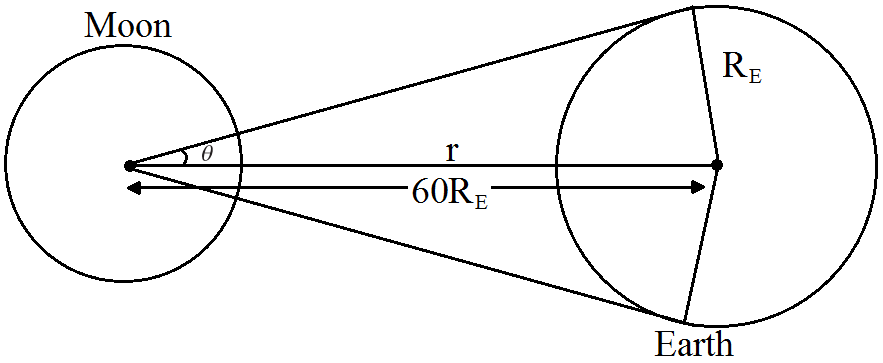
The earth-moon distance is about $60$ earth radius. What will be the diameter of the earth (approximately in degrees) as seen from the moon?
Answer
As the distance between moon and earth is greater than radius of earth, then radius of earth can be treated as an arc.
According to the problem, $R_E =$ length of arc Distance between moon and earth $= 60R_E$​​​​​​​
So, angle subtended at distance r due to an arc of length l is$\theta_\text{E}=\frac{\text{l}}{\text{r}}=\frac{2\text{R}_\text{E}}{60\text{R}_\text{E}}=\frac{1}{30}\text{rad}$
$=\frac{1}{30}\times\frac{180^\circ}{\pi}\text{degree}=\frac{6^\circ}{3.14}\text{degree}=1.9^\circ\approx2^\circ$
Hence, angle subtended by diameter of the earth $2\theta=2^\circ.$
View full question & answer
Question 103 Marks
From parallax measurement, the sun is found to be at a distance of about 400 times the earth-moon distance. Estimate the ratio of sun-earth diameters.
Answer
From parallax measurement given that Sun is at a distance of about 400 times the earth-moon distance, hence, $\frac{\text{r}_\text{Sun}}{\text{r}_\text{moon}}=400$ (Suppose, here r stands for distance and D for diameter) Sun and moon both appear to be of the same angular diameter as seen from the earth.$\therefore\frac{\text{D}_\text{Sun}}{\text{r}_{\text{Sun}}}=\frac{\text{D}_\text{moon}}{\text{D}_\text{moon}}\Rightarrow\frac{\text{D}_\text{Sun}}{\text{D}_\text{moon}}=400$
But $\frac{\text{D}_\text{earth}}{\text{D}_\text{moon}}=4\Rightarrow\frac{\text{D}_\text{Sun}}{\text{D}_\text{earth}}=100$
View full question & answer
Question 113 Marks
If the unit of force is 100N, unit of length is 10m and unit of time is 100s, what is the unit of mass in this system of units?
Answer
Dimension of force $=[\text{M}^1\text{L}^1\text{T}^2]=100\text{N}\ ...(\text{i})$ Dimension of length $=[\text{L}^1]=10\text{m}\ ...(\text{ii})$ Dimension of time $=[\text{T}^1]=100\text{s}\ ...(\text{iii})$ Substituting (ii), (iii) in (i)$\text{M}\times(10)\times(100)^{-2}=100$
$\frac{10\text{M}}{100\times100}=100$
$\text{M}=10^5\text{Kg L}=10^1\text{m}$
$\text{F}=10^2\text{N}\ \ \text{T}=10^2\text{sec}$
View full question & answer