Questions

2 Marks Questions

Take a timed test

17 questions · self-marked practice — reveal the answer and mark yourself.

Question 12 Marks
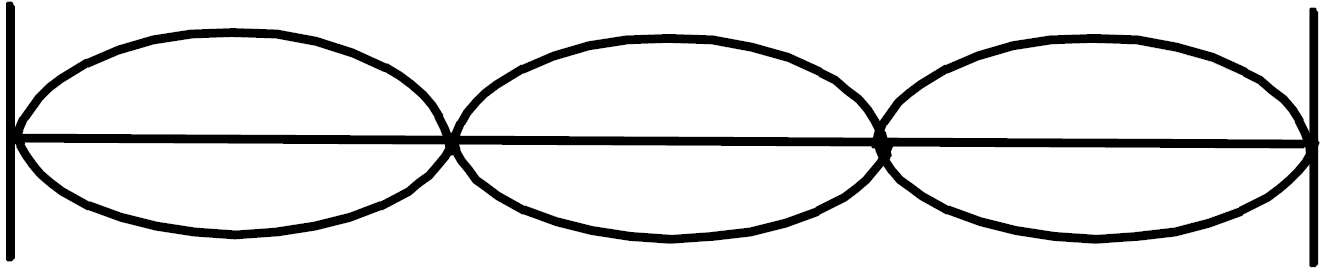
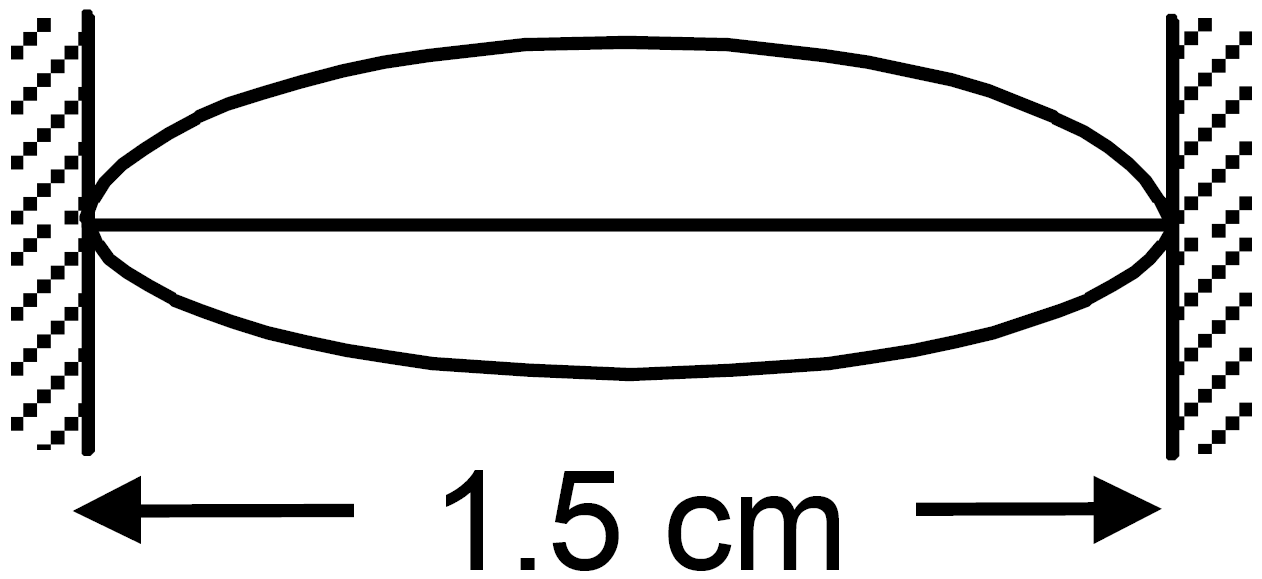
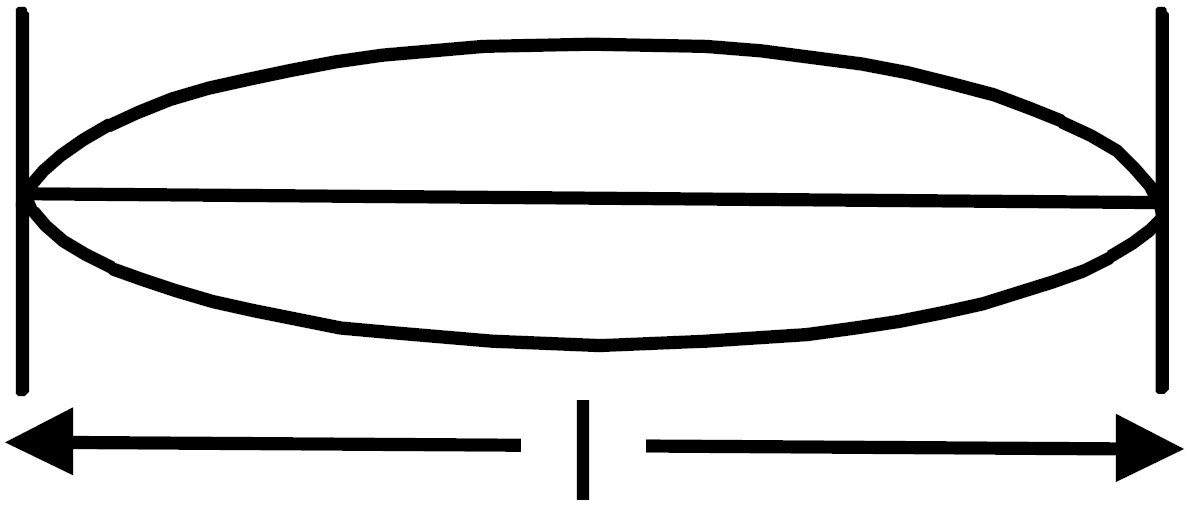
A sonometer wire having a length of $1.50m$ between the bridges vibrates in its second harmonic in resonance with a tuning fork of frequency $256Hz$. What is the speed of the transverse wave on the wire?
Answer

First harmonic be $f_0$, second harmonic be $f_1$
$\therefore\text{f}_1=2\text{f}_0$
$\Rightarrow\text{f}_0=\frac{\text{f}_1}{2}$
$\text{f}_1=256\text{Hz}$
$\therefore\$1^{st}$ harmonic or fundamental frequency
$\text{f}_0=\frac{\text{f}_1}{2}=\frac{256}{2}=128\text{Hz}$
$\frac{\lambda}{2}=1.5\text{m}\Rightarrow\lambda=3\text{m}$ (when fundamental wave is produced)
⇒ Wave speed = $\text{v}=\text{f}_0\text{Ql}=384\text{m/s}.$
View full question & answer
Question 22 Marks
A wire, fixed at both ends is seen to vibrate at a resonant frequency of $240Hz$ and also at $320Hz.$
  1. What could be the maximum value of the fundamental frequency?
  2. If transverse waves can travel on this string at a speed of $40m/s$, what is its length?
​​​​​​​
Answer

This wire makes a resonant frequency of $240Hz$ and $320Hz.$
The fundamental frequency of the wire must be divisible by both $240Hz$ and $320Hz.$
  1. So, the maximum value of fundamental frequency is $80Hz.$
  2. Wave speed, $v = 40m/s$
$\Rightarrow80=\frac{1}{2\text{l}}\times40$
$\Rightarrow0.25\text{m}.$
View full question & answer
Question 32 Marks
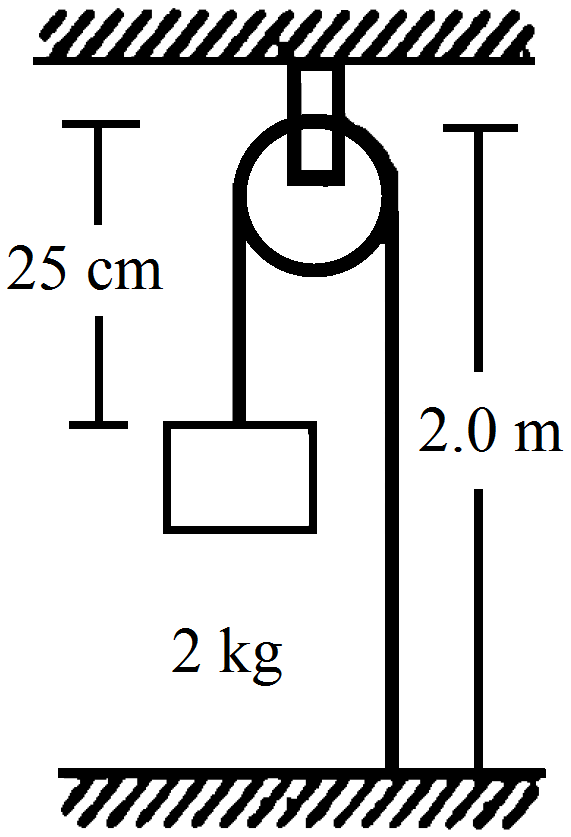
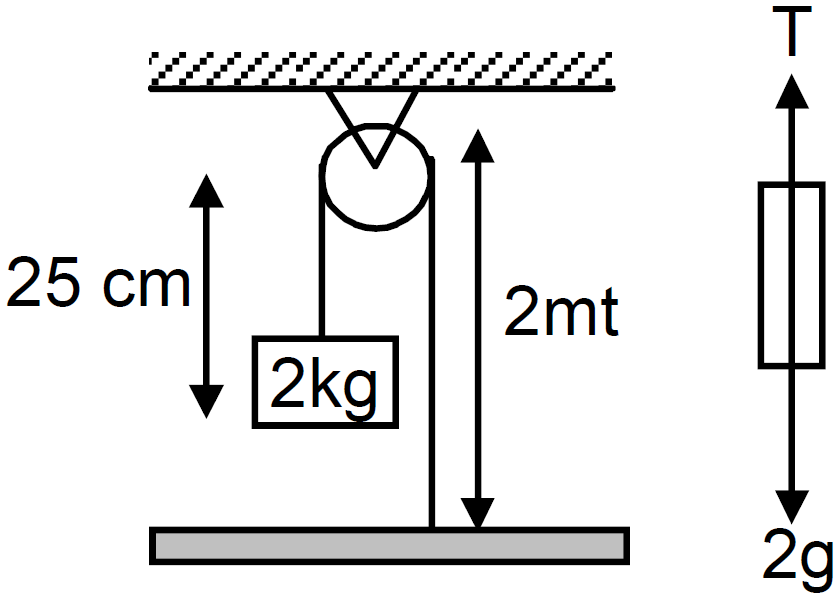
In the arrangement shown in figure, the string has a mass of $4.5g$. How much time will it take for a transverse disturbance produced at the floor to reach the pulley? Take $g = 10m/s^2$.
Answer


Total length of string $2+0.25=2.25\text{mt}$
Mass per unit length $\text{m}=\frac{4.5\times10^{-3}}{2.25}=2\times10^{-3}\text{kg/m}$
$\text{T}=2\text{g}=20\text{N}$
Wave speed,
$\text{v}=\sqrt{\Big(\frac{\text{T}}{\text{m}}\Big)}=\sqrt{\frac{20}{(2\times10^{-3})}}=\sqrt{10^4}=10^2\text{m/s}=100\text{m/s}$
Time taken to reach the pully, $\text{t}=\Big(\frac{\text{s}}{\text{v}}\Big)=\frac{2}{100}=0.02\text{sec}.$
View full question & answer
Question 42 Marks
A $200Hz$ wave with amplitude $1mm$ travels on a long string of linear mass density $6g/m$ kept under a tension of $60N.$
  1. Find the average power transmitted across a given point on the string.
  2. Find the total energy associated with the wave in a $2.0m$ long portion of the sring.
Answer
$\text{A}=1\text{mm}=10^{-3}\text{m},\ \text{m}=6\text{g/m}=6\times10^{-3}\text{kg/m}$$\text{T}=60\text{N},\text{f}=200\text{Hz}$
$\therefore\text{v}=\sqrt{\frac{\text{T}}{\text{m}}}=100\text{m/s}$
  1. $\text{P}_\text{average}=2\pi^2\text{mv}\text{A}^2\text{f}^2=0.47\text{W}$
  2. Length of the string is $2 m$. So, $\text{t}=\frac{2}{100}=0.02\text{sec}.$
Energy $=2\pi^2\text{mvf}^2\text{A}^2\text{t}=9.46\text{mJ}.$
View full question & answer
Question 52 Marks
A wire of length 2.00m is stretched to a tension of 160N. If the fundamental frequency of vibration is 100Hz, find its linear mass density.
Answer
$\text{l}=2\text{m},\ \text{f}_0=100\text{Hz},\ \text{T}=160\text{N}$$\text{f}_0=\frac{1}{2\text{l}}\sqrt{\frac{\text{T}}{\text{m}}}$
$\Rightarrow\text{m}=1\text{g/m}.$ So, the linear mass density is 1g/m.
View full question & answer
Question 62 Marks
A particular guitar wire is 30.0cm long and vibrates at a frequency of 196Hz when no finger is placed on it. The next higher notes on the scale are 220Hz, 247Hz, 262Hz and 294Hz. How far from the end of the string must the finger be placed to play these notes?
Answer
$\text{l}_1=30\text{cm}=0.3\text{m}$$\text{f}_1=196\text{Hz},\ \text{f}_2=220\text{Hz}$
We know $\text{f}\propto\Big(\frac{1}{\text{l}}\Big)$ (as V is constant for a medium)
$\Rightarrow\frac{\text{f}_1}{\text{f}_2}=\frac{\text{l}_2}{\text{l}_1}$
$\Rightarrow\text{l}_2=26.7\text{cm}$
Again $\text{f}_3=247\text{Hz}$
$\Rightarrow\frac{\text{f}_3}{\text{f}_1}=\frac{\text{l}_1}{\text{l}_3}$
$\Rightarrow\frac{0.3}{\text{l}_3}$
$\Rightarrow\text{l}_3=0.224\text{m}=22.4\text{cm}$ and $\text{l}_3=20\text{cm}$
View full question & answer
Question 72 Marks
A one metre long stretched string having a mass of 40g is attached to a tuning fork. The fork vibrates at 128Hz in a direction perpendicular to the string. What should be the tension in the string if it is to vibrate in four loops?
Answer

A string of mass 40g is attached to the tuning fork
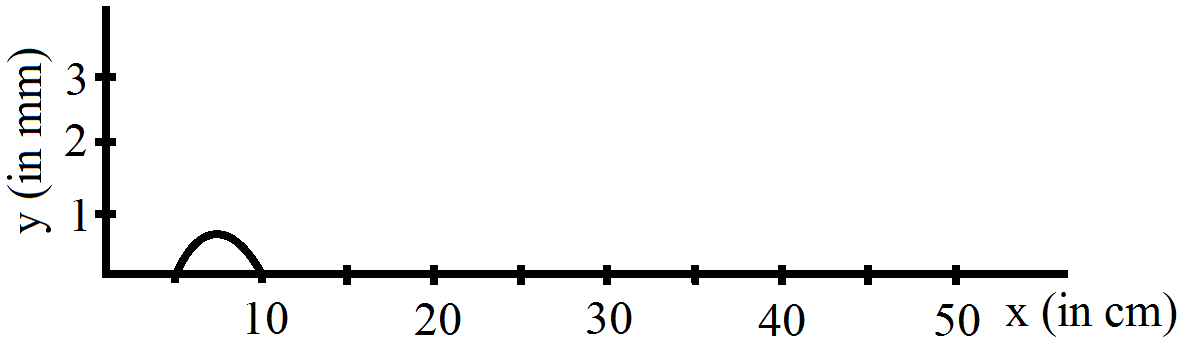
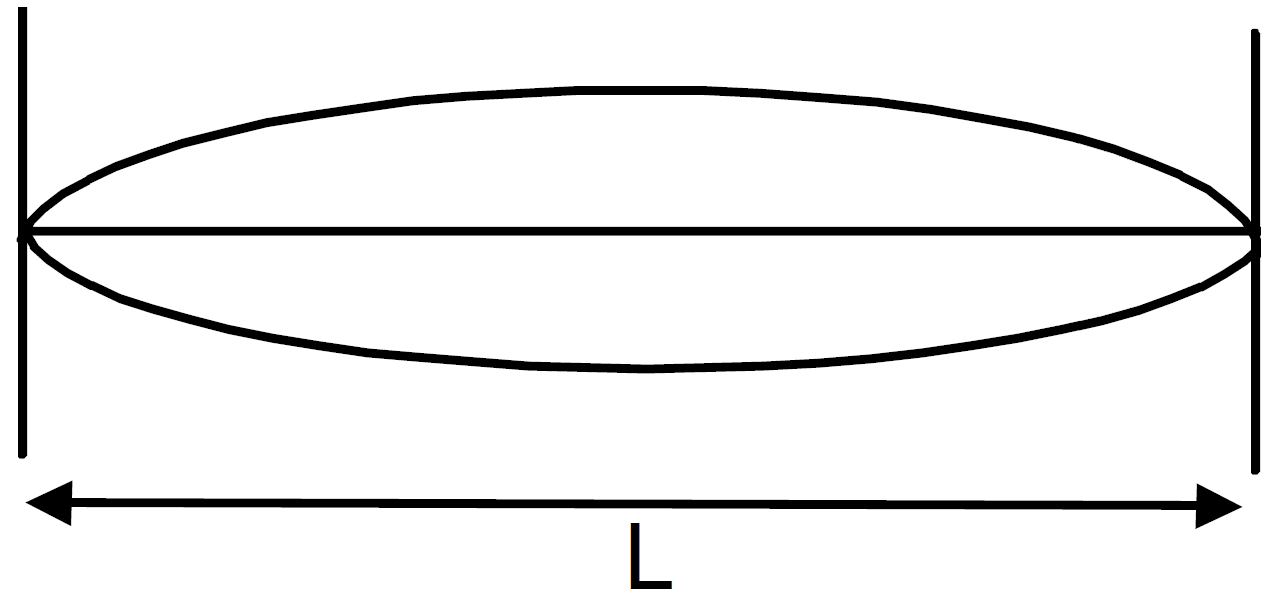
$\text{m}=(40\times10^{-3})\text{kg/m}$
The fork vibrates with $\text{f}=128\text{Hz}$
$\lambda=0.5\text{m}$
$\text{v}=\text{f}\lambda=128\times0.5=64\text{m/s}$
$\text{v}=\sqrt{\frac{\text{T}}{\text{m}}}$
$\Rightarrow\text{T}=\text{v}^2\text{m}=163.84\text{N}$
$\Rightarrow164\text{N}$
View full question & answer
Question 82 Marks
Figure shows a wave pulse at t = 0. The pulse moves to the right with a speed of 10cm/s. Sketch the shape of the string at t = 1s, 2s and 3s.
Answer
$\text { At } t=1 \mathrm{sec}, s_1=\mathrm{vt}=10 \times 1=10 \mathrm{~cm}$
$\mathrm{t}=2 \mathrm{sec}, \mathrm{s}_2=\mathrm{vt}=10 \times 2=20 \mathrm{~cm}$
$\mathrm{t}=3 \mathrm{sec}, \mathrm{s}_3=\mathrm{vt}=10 \times 3=30 \mathrm{~cm}$
View full question & answer
Question 92 Marks
The displacement of the particle at x = 0 of a stretched string carrying a wave in the positive x-direction is given by $\text{f(t)}=\text{a}\sin\Big(\frac{\text{t}}{\text{T}}\Big).$ The wave speed is v. Write the wave equation.
Answer
At x = 0, $\text{f(t)}=\text{a}\sin\Big(\frac{\text{t}}{\text{T}}\Big).$ Wave speed = v$\Rightarrow\lambda$ = wavelength = vT (T = Time period)
So, general equation of wave$\text{Y}=\text{A}\sin\bigg[\Big(\frac{\text{t}}{\text{T}}\Big)-\Big(\frac{\text{x}}{\text{vT}}\Big)\bigg]$ $\Bigg[$ because $\text{y}=\text{f}\bigg(\Big(\frac{\text{t}}{\text{T}}\Big)-\Big(\frac{\text{x}}{\lambda}\Big)\bigg)\Bigg]$
View full question & answer
Question 102 Marks
A pulse travelling on a string is represented by the function:$\text{y}=\frac{\text{a}^3}{(\text{x}-\text{vt})^2+\text{a}^2},$
where a = 5mm and v = 20cm/s. Sketch the shape of the string at t = 0, 1s and 2s.Take x = 0 in the middle of the string.
Answer
The pulse is given by, $ \text{y}=\Bigg[\frac{(\text{a}^3)}{\big\{(\text{x}-\text{vt})^2+\text{a}^2\big\}}\Bigg]$
a = 5mm = 0.5cm, v = 20cm/s
At t = 0s, $\text{y}=\frac{\text{a}^3}{(\text{x}^2+\text{a}^2)}$
The graph between y and x can be plotted by taking different values of x.
(left as exercise for the student)
Similarly, at t = 1s, $\text{y}=\frac{\text{a}^3}{\big\{(\text{x}-\text{v})^2+\text{a}^2\big\}}$
and at t = 2s, $\text{y}=\frac{\text{a}^3}{\big\{(\text{x}-2\text{v})^2+\text{a}^2\big\}}$
View full question & answer
Question 112 Marks
The equation of a standing wave, produced on a string fixed at both ends, is$\text{y}=(0.4\text{cm})\sin\big[(0.314\text{cm}^{-1})\text{x}\big]\cos\big[(600\pi\text{s}^{-1})\text{t}\big]$
What could be the smallest length of the string?
Answer

The equation of the standing wave is given by
$\text{y}=(0.4\text{cm})\sin\big[0.314\text{cm}^{-1}\text{x}\big]\cos\big[(6.00\pi\text{s}^{-1})\text{t}\big]$
$\Rightarrow\text{k}=0.314=\frac{\pi}{10}$
$\Rightarrow\frac{2\pi}{\lambda}=\frac{\pi}{10}$
$\Rightarrow\lambda=20\text{cm}$
for smallest length of the string, as wavelength remains constant, the string should vibrate in fundamental frequency
$\Rightarrow\text{l}=\frac{\lambda}{2}=\frac{20\text{cm}}{2} = 10\text{cm}$
View full question & answer
Question 122 Marks
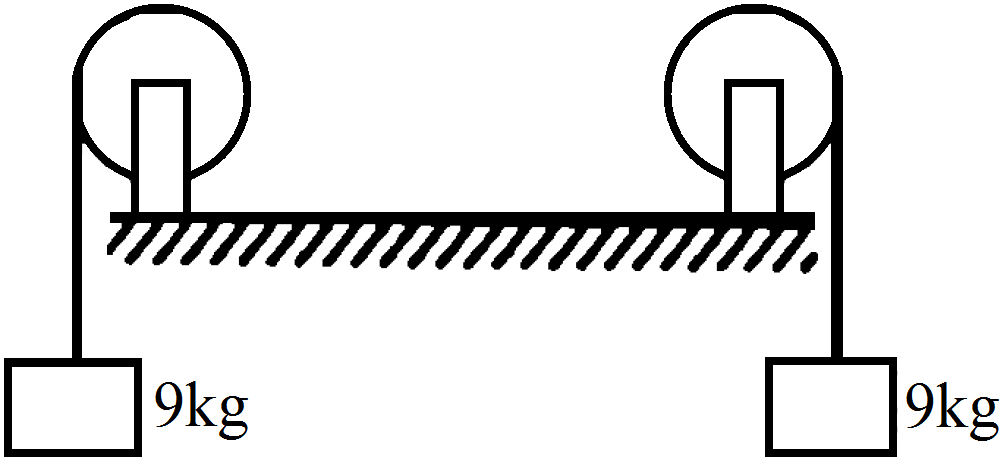
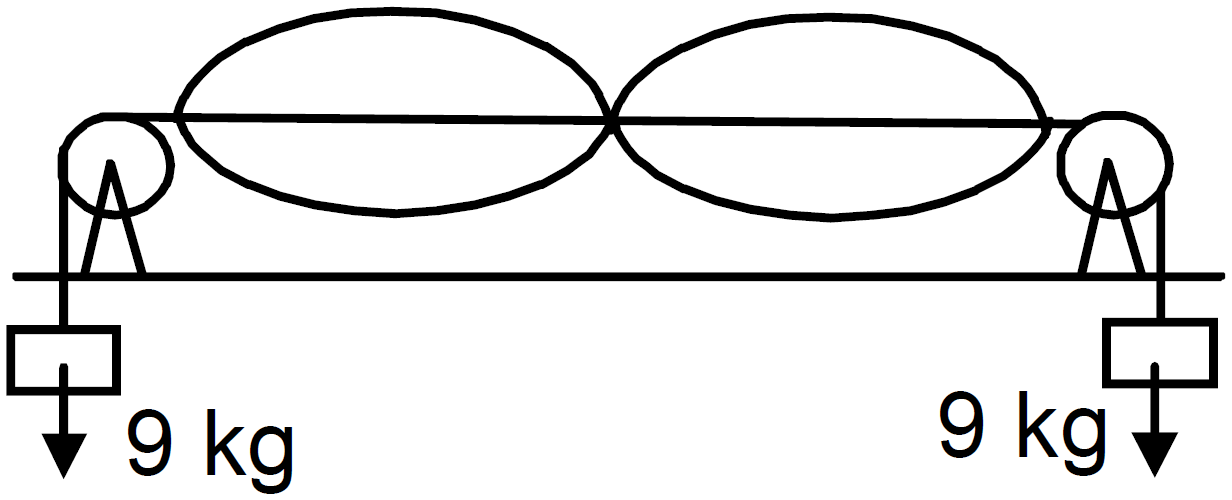
The length of the wire shown in figure, between the pulleys is 1.5m and its mass is 12.0g. Find the frequency of vibration with which the wire vibrates in two loops leaving the middle point of the wire between the pulleys at rest.
Answer

$\text{l}=1.5\text{m},\ \text{mass}=12\text{g}$
$\Rightarrow\text{m}=\frac{12}{1.5}\text{gm}=8\times10^{-3}\text{kg/m}$
$\text{T}=9\times\text{g}=90\text{N}$
$\lambda=1.5\text{m},\ \text{f}_1=\frac{2}{\text{2l}}\sqrt{\frac{\text{T}}{\text{m}}}$
[for, second harmonic two loops are produced]
$\text{f}_1=2\text{f}_0$
$\Rightarrow70\text{Hz}$
View full question & answer
MCQ 132 Marks
Three resonant frequencies of a string are $90, 150$ and $210Hz.$
  • A
    Find the highest possible fundamental frequency of vibration of this string.
  • B
    Which harmonics of the fundamental are the given frequencies?
  • C
    Which overtones are these frequencies.
  • D
    If the length of the string is 80cm, what would be the speed of a transverse wave on this string?
Answer
The resonant frequencies of a string are
$f_1=90 Hz, f_2=150 Hz, f_3=120 Hz$
a. The highest possible fundamental frequency of the string is $f=30 Hz$
[because $f_1, f_2$ and $f_3$ are integral multiple of 30 Hz ]
b. The frequencies are $f_1=3 f, f_2=5 f, f_3=7 f$
So, $f _1, f _2$ and $f _3$ are 3 rd harmonic, $5^{\text {th }}$ harmonic and $7^{\text {th }}$ harmonic respectively.
c. The frequencies in the string are $f , 2 f , 3 f , 4 f , 5 f , \ldots \ldots$.
So, $3 f =2^{\text {nd }}$ overtone and $3^{\text {rd }}$ harmonic
$5 f=4^{\text {th }}$ overtone and $5^{\text {th }}$ harmonic
$7 f=6^{\text {th }}$ overtone and $7^{\text {th }}$ harmonic
d. Length of the string is $1=80 cm$ $\Rightarrow\text{f}_1=\Big(\frac{3}{2\text{l}}\Big)\text{v}$ (v = velocity of the wave)
$\Rightarrow90=\Big\{\frac{3}{(2\times80)}\Big\}\times\text{K}$
$\Rightarrow\text{K}=\frac{(90\times2\times80)}{3}$
$=4800\text{cm/s}$
$=48\text{m/s}.$
View full question & answer
Question 142 Marks
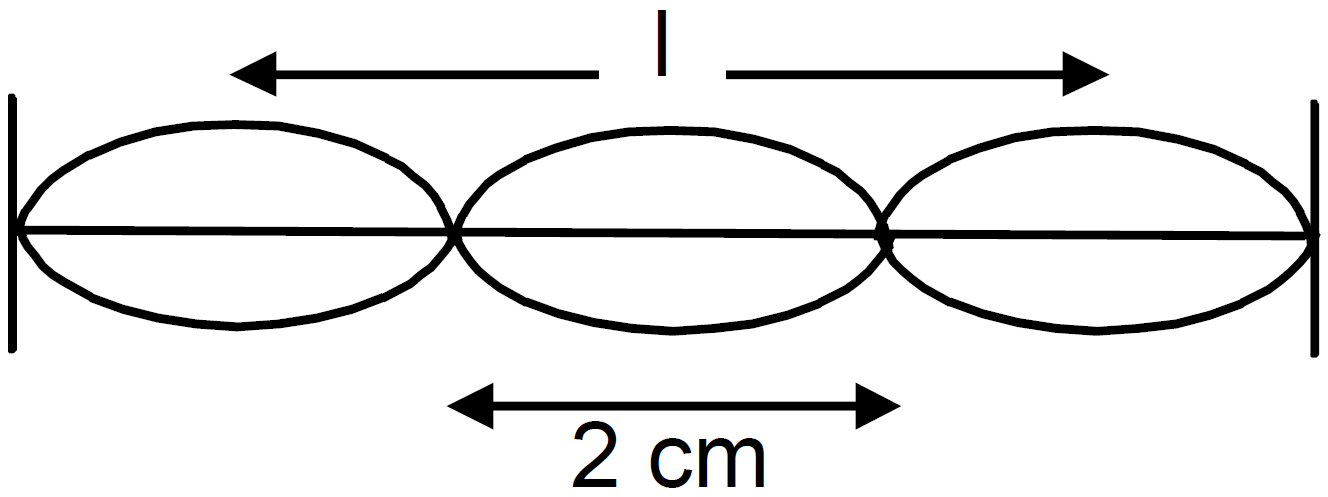
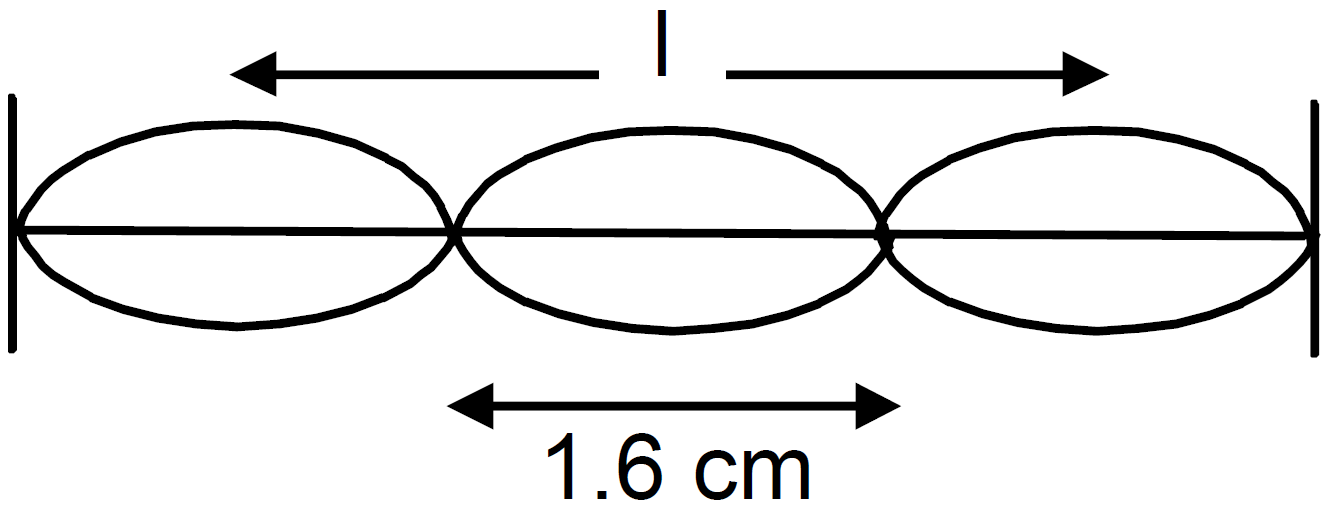
A string, fixed at both ends, vibrates in a resonant mode with a separation of $2.0cm$ between the consecutive nodes. For the next higher resonant frequency, this separation is reduced to $1.6cm$. Find the length of the string.
Answer

Let there be ‘n’ loops in the $1^{st}$ case ⇒ length of the wire, $\text{l}=\Big(\frac{\text{n}\lambda_1}{2}\Big)$ $[\lambda_1=2\times2=4\text{cm}]$ So there are (n + 1) loops with the $2^{nd}​​​​​​​$ case

⇒ length of the wire, $\text{l}=\Big\{\frac{(\text{n}+1)\lambda_2}{2}\Big\}$ $[\lambda=2\times1.6=3.2\text{cm}]$$\Rightarrow\frac{\text{n}\lambda_1}{2}=\frac{(\text{n}+1)\lambda_2}{2}$
$\Rightarrow\text{n}\times4=(\text{n}+1)(3.2)$
$\Rightarrow\text{n}=4$
$\therefore\ $length of the string, $\text{l}=\frac{\text{n}\lambda_1}{2}=8\text{cm}.$
View full question & answer
Question 152 Marks
A steel wire fixed at both ends has a fundamental frequency of 200Hz. A person can hear sound of maximum frequency 14kHz. What is the highest harmonic that can be played on this string which is audible to the person?
Answer
Fundamental frequency $\text{f}_1=200\text{Hz}$ Let $l_4$ Hz be nth harmonic$\Rightarrow\frac{\text{F}_2}{\text{F}_1}=\frac{14000}{200}$
$\Rightarrow\frac{\text{NF}_1}{\text{F}_1}=70$
$\Rightarrow\text{N}=70$
$\therefore\ $The highest harmonic audible is $70^{th}$ harmonic
View full question & answer
Question 162 Marks
A piano wire weighing 6.00g and having a length of, 90.0cm emits a fundamental frequency corresponding to the "Middle C" (v = 261.63Hz). Find the tension in the wire.
Answer
$\text{l}=90\text{cm}=0.9\text{m}$$\text{m}=\Big(\frac{6}{90}\Big)\text{g/cm}=\Big(\frac{6}{900}\Big)\text{kg/mt}$
$\text{f}=261.63\text{Hz}$
$\text{f}=\frac{1}{2\text{l}}\sqrt{\Big(\frac{\text{T}}{\text{m}}\Big)}\Rightarrow\text{T}=1478.52\text{N}=1480\text{N}.$
View full question & answer
Question 172 Marks
A tuning fork of frequency $440Hz$ is attached to a long string of linear mass density $0.01\ kg/m$ kept under a tension of $49N$. The fork produces transverse waves of amplitude $0.50\ mm$ on the string.
  1. Find the wave speed and the wavelength of the waves.
  2. Find the maximum speed and acceleration of a particle of the string.
  3. At what average rate is the tuning fork transmitting energy to the string?
Answer
$\text{f}=440\text{Hz},\ \text{m}=0.01\text{kg/m},\text{T}=49\text{N},\text{r}=0.5\times10^{-3}\text{m}$
  1. $\text{v}=\sqrt{\frac{\text{T}}{\text{m}}}=70\text{m/s}$
  2. $\text{v}=\lambda\text{f}\Rightarrow\lambda=\frac{\text{v}}{\text{f}}=16\text{cm}$
  3. $\text{P}_\text{avearage}=2\pi^2\text{mvr}^2\text{f}^2=0.67\text{W}.$
View full question & answer