Question
A steel wire fixed at both ends has a fundamental frequency of 200Hz. A person can hear sound of maximum frequency 14kHz. What is the highest harmonic that can be played on this string which is audible to the person?

Answer

Fundamental frequency $\text{f}_1=200\text{Hz}$ Let $l_4$ Hz be nth harmonic$\Rightarrow\frac{\text{F}_2}{\text{F}_1}=\frac{14000}{200}$
$\Rightarrow\frac{\text{NF}_1}{\text{F}_1}=70$
$\Rightarrow\text{N}=70$
$\therefore\ $The highest harmonic audible is $70^{th}$ harmonic

Need a full question paper?

Generate a complete, print-ready paper with questions like this in minutes — across 16+ boards, with answer keys.
Start Generating Free

Similar questions

Consider a small cube of volume $1mm^3$ at the centre of a circular loop of radius 10cm carrying a current of 4A. Find the magnetic energy stored inside the cube.
A closed organ pipe can vibrate at a minimum frequency of 500Hz. Find the length of the tube. Speed of sound in air = 340m/s.
A body is projected with a speed v at an angle $\theta$ with horizontal to have maximum range. What is the velocity at the highest point?
Explain why Surface tension of a liquid is independent of the area of the surface.
The driver of a truck travelling with a velocity v suddenly notices a brick wall in front of him at a distance d. Is it better for him to apply brakes or to make a circular turn without applying brakes in order to just avoid crashing into the wall? Why?
Moon is seen to be of $\Big(\frac{1}{2}\Big)^\circ$ diameter from the earth. What must be the relative size compared to the earth?
Show that the internal energy of the air (treated as an ideal gas) contained in a room remains constant as the temperature changes between day and night. Assume that the atmospheric pressure around remains constant and the air in the room maintains this pressure by communicating with the surrounding through the windows, doors, etc.
What is the difference between velocity-time graphs in uniform motion and uniformly accelerated motion?
The diameters of two planets are in the ratio $4: 1$ and the ratio of their density is $1: 2$. What will be the ratio of gravitational accelerations on the planets?
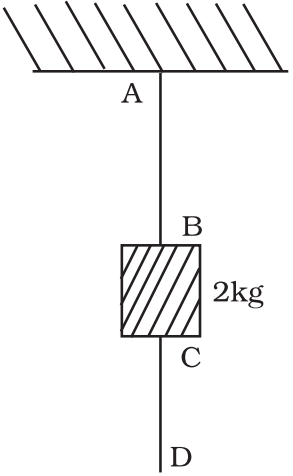
A mass of 2kg is suspended with thread AB Thread CD of the same type is attached to the other end of 2kg mass. Lower thread is pulled gradually, harder and harder in the downward directon so as to apply force on AB. Which of the threads will break and why?