Questions

5 Marks Questions

Take a timed test

14 questions · self-marked practice — reveal the answer and mark yourself.

Question 15 Marks
A wave propagates on a string in the positive x-direction at a velocity v. The shape of the string at t = to is given by $\text{g}(\text{x},\text{t}_0)=\text{A}\sin\big(\frac{\text{x}}{\text{a}}\big).$ Write the wave equation for a general time t.
Answer
At $\text{t}=\text{t}_0,\ \text{g}(\text{x},\text{t}_0)=\text{A}\sin\big(\frac{\text{x}}{\text{a}}\big)\ \dots(1)$ For a wave traveling in the positive x-direction, the general equation is given by$\text{y}=\text{f}\Big(\frac{\text{x}}{\text{a}}-\frac{\text{t}}{\text{T}}\Big)$
Putting $t = -t_0$ and comparing with equation (1), we get$\Rightarrow\text{g}(\text{x},0)=\text{A}\sin\Big\{\big(\frac{\text{x}}{\text{a}}\big)+\big(\frac{\text{t}_0}{\text{T}}\big)\Big\}$
$\Rightarrow\text{g}(\text{x, t})=\text{A}\sin\Big\{\big(\frac{\text{x}}{\text{a}}\big)+\big(\frac{\text{t}_0}{\text{T}}\big)-\big(\frac{\text{t}}{\text{T}}\big)\Big\}$
As $\text{T}=\frac{\text{a}}{\text{v}}$ (a = wave length, v = speed of the wave)$\Rightarrow\text{Y}=\text{A}\sin\Big(\frac{\text{x}}{\text{a}}+\frac{\text{t}_0}{(\frac{\text{a}}{\text{v}})}-\frac{\text{t}}{(\frac{\text{a}}{\text{v}})}\Big)$
$=\text{A}\sin\Big(\frac{\text{x}+\text{v}(\text{t}_0-\text{t})}{\text{a}}\Big)$
$\Rightarrow\text{y}=\text{A}\sin\Big[\frac{\text{x}-\text{v}(\text{t}-\text{t}_0)}{\text{a}}\Big]$
View full question & answer
Question 25 Marks
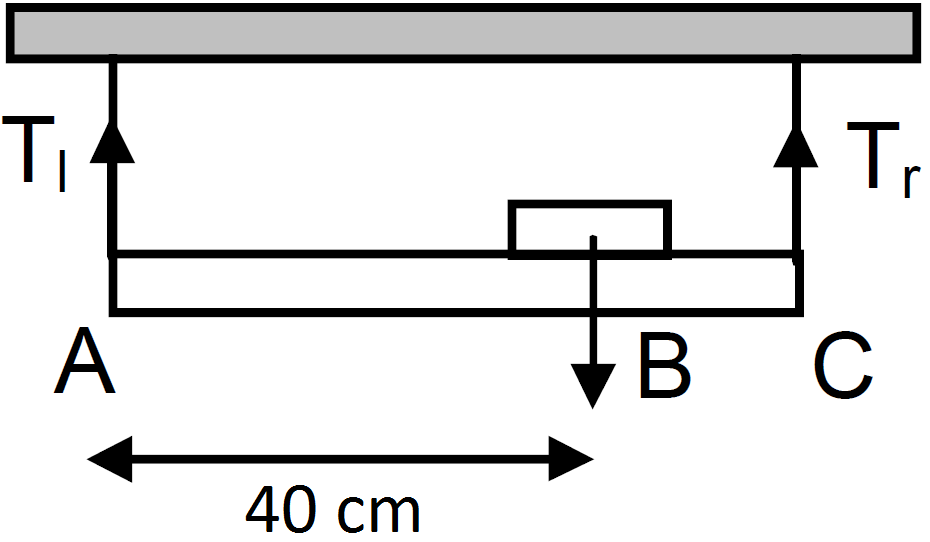
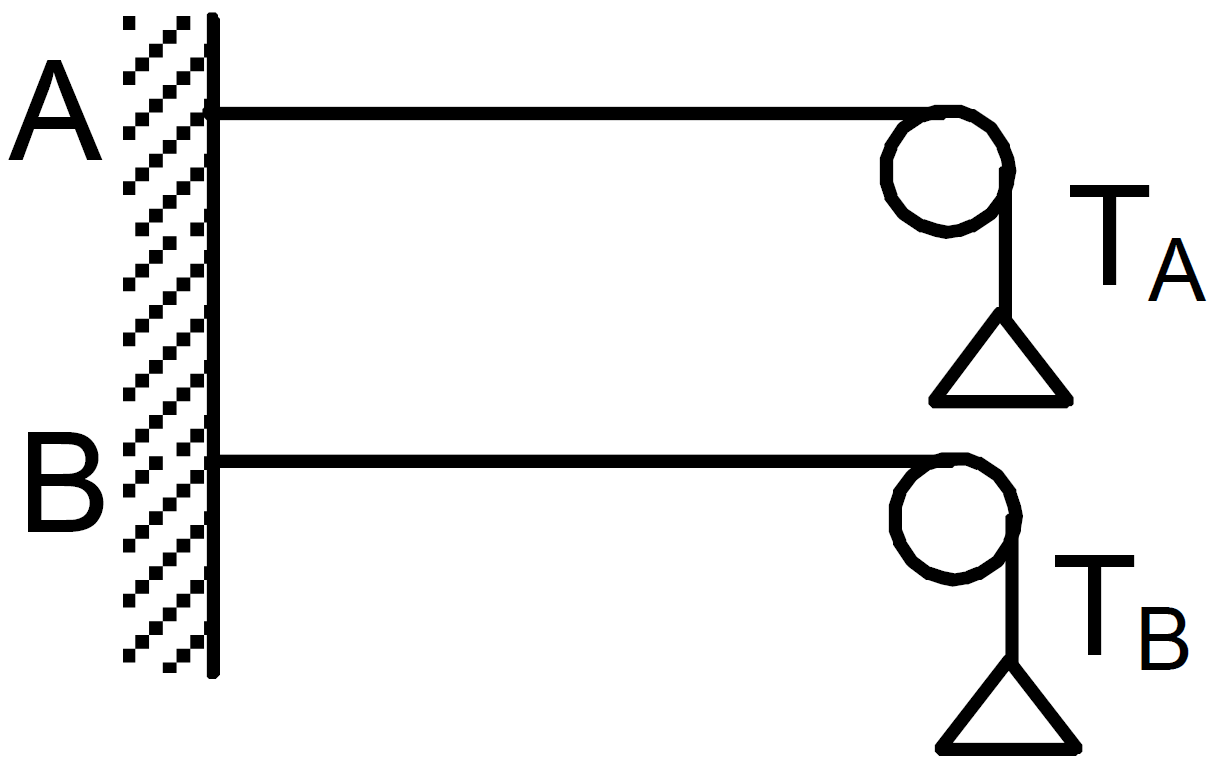
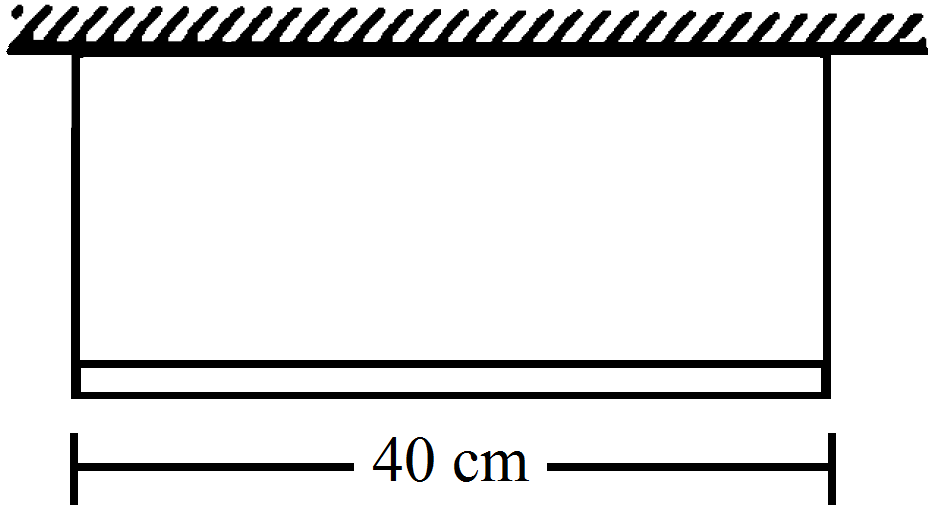
A uniform horizontal rod of length $40cm$ and mass $1.2kg$ is supported by two identical wires as shown in figure, Where should a mass of $4.8kg$ be placed on the rod so that the same tuning fork may excite the wire on left into its fundamental vibrations and that on right into its first overtone? Take $g = 10m/s^2$.
Answer
Length of the rod = $\text{L}=40\text{cm}=0.4\text{m}$ Mass of the rod $\text{m}=1.2\text{kg}$ Let the 4.8kg mass be placed at a distance ‘x’ from the left end. Given that, $f_l = 2f_r$

$\therefore\frac{1}{2\text{l}}\sqrt{\frac{\text{T}_\text{l}}{\text{m}}}=\frac{2}{2\text{l}}\sqrt{\frac{\text{T}_\text{r}}{\text{m}}}$
$\Rightarrow\sqrt{\frac{\text{T}_\text{l}}{\text{T}_\text{r}}}=2$
$\Rightarrow\frac{\text{T}_\text{l}}{\text{T}_r}=4\ \dots(1)$
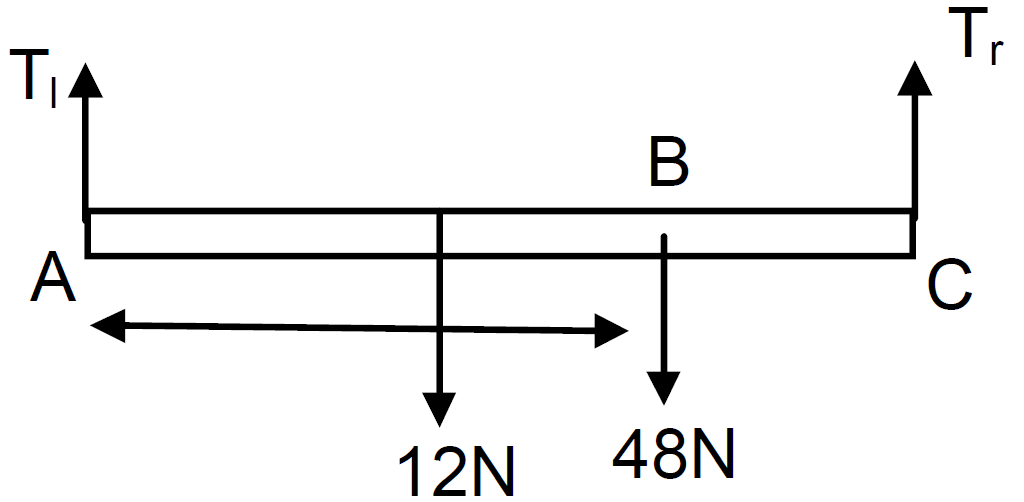
From the freebody diagram,

$\text{T}_\text{l}+\text{T}_\text{r}=60\text{N}$
$\Rightarrow4\text{T}_\text{r}+\text{T}_\text{r}=60\text{N}$
$\therefore \text{T}_\text{r}=12\text{N and T}_1=48\text{N} $
Now taking moment about point A,$\text{T}_\text{r}\times (0.4)=-48\text{x}+12(0.2)$
$\Rightarrow \text{x}=5\text{cm}$
So, the mass should be placed at a distance 5cm from the left end.
View full question & answer
Question 35 Marks
A wave travels along the positive x-direction with a speed of 20m/s. The amplitude of the wave is 0.20cm and the wavelength 2.0cm.
  1. Write a suitable wave equation which describes this wave.
  2. What is the displacement and velocity of the particle at x = 2.0cm at time t = 0 according to the wave equation written? Can you get different values of this quantity if the wave equation is written in a different fashion?
Answer
Wave speed, $\text{v}=20\text{m/s}$$\text{A}=0.20\text{cm}$
$\lambda=2\text{cm}$
  1. Equation of wave along the x-axis
$\text{y}=\text{A}\sin(\text{kx}-\text{wt})$
$\therefore\text{k}=\frac{2\pi}{\lambda}=\frac{2\pi}{2}=\pi\text{cm}^{-1}$
$\text{T}=\frac{\lambda}{\text{v}}=\frac{2}{2000}=\frac{1}{1000}\sec=10^{-3}\sec$
$\Rightarrow\omega=\frac{2\pi}{\text{T}}=2\pi\times10^{-3}\sec^{-1}$
So, the wave equation is,
$\therefore\text{y}=(0.2\text{cm})\sin\Big[(\pi\text{cm}^{-1})\text{x}-(2\pi\times10^3\sec^{-1})\text{t}\big]$
  1. At $\text{x}=2\text{cm}$ and $\text{t}=0,$
$\text{y}=(0.2\text{cm})\sin\big(\frac{\pi}{2}\big)=0$
$\therefore\text{v}=\text{r}\omega\cos\pi\text{x}=0.2\times2000\pi\times\cos2\pi=400\pi$
$=400\times(3.14)=1256\text{cm/s}$
$=400\pi\text{cm/s}=4\pi\text{m/s}$
View full question & answer
Question 45 Marks
Two wires are kept tight between the same pair of supports. The tensions in the wires are in the ratio 2 : 1, the radii are in the ratio 3 : 1 and the densities are in the ratio 1 :2. Find the ratio of their fundamental frequencies.
Answer
Frequency $\text{f}=\frac{1}{\text{ID}}\sqrt{\frac{\text{T}}{\pi\rho}}$$\Rightarrow\text{f}_1=\frac{1}{\text{l}_1\text{D}_1}\sqrt{\frac{\text{T}_1}{\pi\rho_1}}$
$\Rightarrow\text{f}_2=\frac{1}{\text{l}_2\text{n}_2}\sqrt{\frac{\text{T}_2}{\pi\rho_2}}$
Given that, $\frac{\text{T}_1}{\text{T}_2}=2,\frac{\text{r}_1}{\text{r}_2}=3=\frac{\text{D}_1}{\text{D}_2}$$\frac{\rho_1}{\rho_2}=\frac{1}{2}$
So, $\frac{\text{f}_1}{\text{f}_2}=\frac{\text{l}_2\text{D}_2}{\text{l}_1\text{D}_1}\sqrt{\frac{\text{T}_1}{\text{T}_2}}\sqrt{\frac{\pi\rho_2}{\pi\rho_1}}$ ($\text{l}_1$ = $\text{l}_2$ = length of string)$\Rightarrow\text{f}_1:\text{f}_2=2:3$
View full question & answer
Question 55 Marks
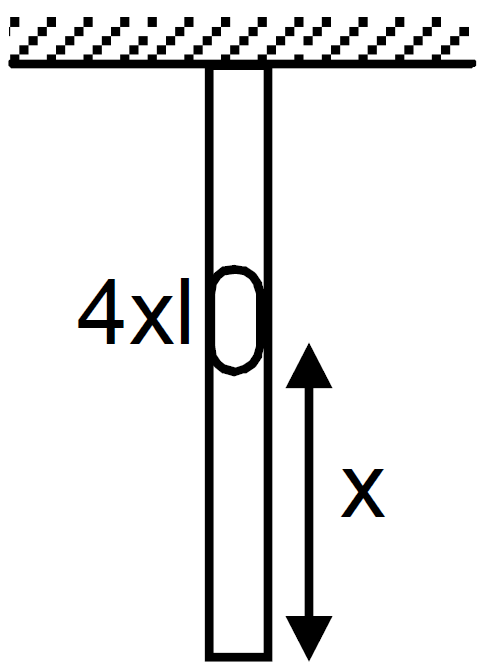
A heavy but uniform rope of length L is suspended from a ceiling.
  1. Write the velocity of a transverse wave travelling on the string as a function of the distance from the lower.
  2. If the rope is given a sudden sideways jerk at the bottom, how long will it take for the pulse to reach the ceiling?
  3. A particle is dropped from the ceiling at the instant the bottom end is given the jerk. Where will the particle meet the pulse ?
Answer
  1. m → mass per unit of length of string
Consider an element at distance ‘x’ from lower end.

Here wt acting down ward = (mx)g = Tension in the string of upper part

Velocity of transverse vibration = $\text{v}=\sqrt{\frac{\text{T}}{\text{m}}}=\sqrt{\Big(\frac{\text{mgx}}{\text{m}}\Big)}=\sqrt{(\text{gx})}$
  1. For samll displacement dx $\text{dt}=\frac{\text{dx}}{\sqrt{(\text{gx})}}$
Total time $\text{T}=\int\limits_0^\text{L}\frac{\text{dx}}{\sqrt{\text{gx}}}=\sqrt{\Big(\frac{4\text{l}}{\text{g}}\Big)}$
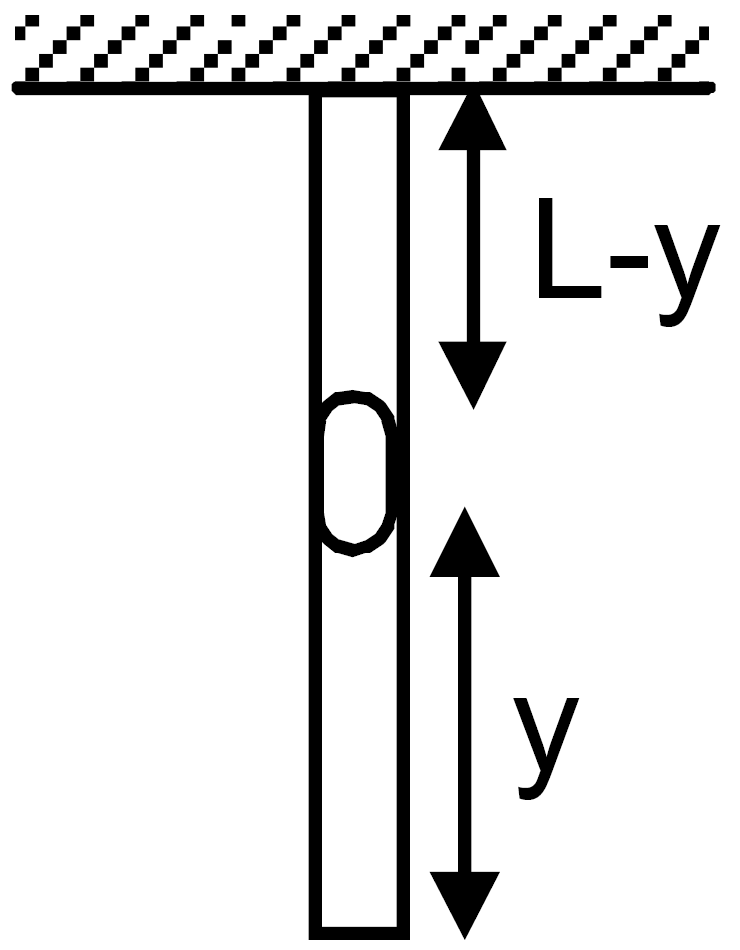
  1. Suppose after time ‘t’ from start the pulse meet the particle at distance y from lower end.
$\text{t}=\int\limits_0^\text{y}\frac{\text{dx}}{\sqrt{\text{gx}}}=\sqrt{\Big(\frac{4\text{y}}{\text{g}}\Big)}$

$\therefore\ $Distance travelled by the particle in this time is (L - y)

$\therefore\text{S}-\text{ut}+\frac{1}{2}\text{gt}^2$

$\Rightarrow\text{l}-\text{y}\Big(\frac{1}{2}\Big)\text{g}\times\Big\{\sqrt{\big(\frac{4\text{y}}{\text{g}}\big)^2}\Big\}$ $\big\{\text{u}=0\big\}$

$\Rightarrow\text{L}-\text{y}=2\text{y}\Rightarrow3\text{y}=\text{L}$

$\Rightarrow\text{y}=\frac{\text{L}}{3}$ So, the particle meet at distance $\frac{\text{L}}{3}$ from lower.
View full question & answer
Question 65 Marks
The equation of a wave travelling on a string stretched along the X-axis is given by-$\text{y}=\text{A}\text{e}^{-\Big(\frac{\text{x}}{\text{a}}+\frac{\text{t}}{\text{T}}\Big)^2}.$
  1. Write the dimensions of A, a and T.
  2. Find the wave speed.
  3. In which direction is the wave. travelling?
  4. Where is the maximum of the pulse located at t = T? at t = 2T?
Answer
Given $\text{y}=\text{Ae}^{-\big[(\frac{\text{x}}{\text{a}})+(\frac{\text{t}}{\text{T}})\big]^2}$
  1. $[\text{A}]=[\text{M}^0\text{L}^1\text{T}^0],[\text{T}]=[\text{M}^0\text{L}^0\text{T}^1]$
$[\text{a}]=[\text{M}^0\text{L}^1\text{T}^0]$
  1. Wave speed, $\text{v}=\frac{\lambda}{\text{T}}=\frac{\text{a}}{\text{T}}$ $\big[$Wave length $\lambda=\text{a}\big]$
  1. If $\text{y}=\text{f}\Big(\text{t}-\frac{\text{x}}{\text{v}}\Big)\rightarrow$ wave is traveling in positive direction and
If $\text{y}=\text{f}\Big(\text{t}+\frac{\text{x}}{\text{v}}\Big)\rightarrow$ wave is traveling in negative direction

so, $\text{y}=\text{Ae}^{-\big[(\frac{\text{x}}{\text{a}})+(\frac{\text{t}}{\text{T}})\big]^2}$

$=\text{Ae}^{-\big(\frac{1}{\text{T}}\big)\Big[\frac{\text{x}}{\frac{\text{a}}{\text{t}}}+\text{t}\Big]^2}$

$=\text{Ae}^{-\big(\frac{1}{\text{T}}\big)\big[\frac{\text{x}}{\text{v}}+\text{t}\big]}$

i.e., $\text{y}=\text{f}\Big\{\text{t}+\big(\frac{\text{x}}{\text{v}}\big)\Big\}$
  1. Wave speed, $\text{v}=\frac{\text{a}}{\text{T}}$
$\therefore\ $Max. of pulse at t =T is $\big(\frac{\text{a}}{\text{T}}\big)\times\text{T}=\text{a}$ (negative x-axis)

Max. of pluse at $\text{t}=2\text{T}=\big(\frac{\text{a}}{\text{T}}\big)\times2\text{T}=2\text{a}$ (along negative x-axis)

so, the wave travels in negative x-direction.
View full question & answer
Question 75 Marks
A travelling wave is produced on a long horizontal string by vibrating an end up and down sinusoidally. The amplitude of vibration is 1.0cm and the displacement becomes zero 200 times per second. The linear mass density of the string is 0.10kg/m and it is kept under a tension of 90N.
  1. Find the speed and the wavelength of the wave.
  2. Assume that the wave moves in the positive x-direction and at t = 0, the end x = 0 is at its positive extreme position. Write the wave equation.
  3. Find the velocity and acceleration of the particle at x - 50cm at time t = 10ms.
Answer
Amplitude, $\text{A}=1\text{cm},$ Tension $\text{T}=90\text{N}$
Frequency, $\text{f}=\frac{200}{2}=100\text{Hz}$
Mass per unit length, $\text{m}=0.1\text{kg/mt}$
  1. $\Rightarrow\text{v}=\sqrt{\frac{\text{T}}{\text{m}}}=30\text{m/s}$
$\lambda=\frac{\text{v}}{\text{f}}=\frac{30}{100}=0.3\text{m}=30\text{cm}$
  1. The wave equation $\text{y}=(1\text{cm})\cos2\pi\Big(\frac{\text{t}}{0.01\text{s}}\Big)-\Big(\frac{\text{x}}{30}\text{cm}\Big)$
[because at x = 0, displacement is maximum]
  1. $\text{y}=1\cos2\pi\Big(\frac{\text{x}}{30}-\frac{\text{t}}{0.01}\Big)$
$\Rightarrow\text{v}=\frac{\text{dy}}{\text{dt}}=\Big(\frac{1}{0.01}\Big)\sin2\pi\Big\{\big(\frac{\text{x}}{30}\big)-\big(\frac{\text{t}}{0.01}\big)\Big\}$

$\text{a}=\frac{\text{dv}}{\text{dt}}=-\Big\{\frac{4\pi^2}{(0.01)^2}\Big\}\cos2\pi\Big\{\big(\frac{\text{x}}{30}\big)-\big(\frac{\text{t}}{0.01}\big)\Big\}$

When, $\text{x}=50\text{cm},\ \text{t}=10\text{ms}=10\times10^{-3}\text{s}$

$\text{x}=\Big(\frac{2\pi}{0.01}\Big)\sin2\pi\Big\{\big(\frac{5}{3}\big)-\big(\frac{0.01}{0.01}\big)\Big\}$

$=\Big(\frac{\text{p}}{0.01}\Big)\sin\bigg(\frac{2\pi}{\frac{2}{3}}\bigg)=\Big(\frac{1}{0.01}\Big)\sin\Big(\frac{4\pi}{3}\Big)\\=-200\pi\sin\Big(\frac{\pi}{3}\Big)=-200\pi\text{x}\Big(\frac{\sqrt{3}}{2}\Big)$

$=544\text{cm/s}=5.4\text{m/s}$

Similarly

$\text{a}=\Big\{\frac{4\pi^2}{(0.01)^2}\Big\}\cos2\pi\Big\{\big(\frac{5}{3}\big)-1\Big\}$

$=4\pi^2\times10^4\times\frac{1}{2}$

$\Rightarrow2\times10^5\text{cm/s}^2$

$\Rightarrow2\text{km/s}^2$
View full question & answer
Question 85 Marks
A wave travelling on a string, at a speed of 10m/s causes each particle of the string to oscillate with a time period of 20ms.
  1. What is the wavelength of the wave?
  2. If the displacement of a particle is 1.5mm at a certain instant, what will be the displacement of a particle 10cm away from it at the same instant?
Answer
Wave speed $=\text{v}=10\text{m/sec}$
Time period $=\text{T}=20\text{ms}=20\times10^{-3}=2\times10^{-2}\text{sec}$
  1. wave length, $\lambda=\text{vT}=10\times2\times10^{-2}=0.2\text{m}=20\text{cm}$
  2. Wave length, $\lambda=20\text{cm}$
$\therefore\ $Phase diff $=\big(\frac{2\pi}{\lambda}\big)\text{x}=\big(\frac{2\pi}{20}\big)\times10=\pi\text{rad}$

$\text{y}_1=\text{a}\sin(\omega\text{t}-\text{kx})\Rightarrow1.5=\text{a}\sin(\omega\text{t}-\text{kx})$

So, the displancement of the particle at a distance x = 10cm.

$\Big[\phi=\frac{2\pi\text{x}}{\lambda}=\frac{2\pi\times10}{20}=\pi\Big]$ is given by

$\text{y}_2=\text{a}\sin(\omega\text{t}-\text{kx}+\pi)$

$\Rightarrow-\text{a}\sin(\omega\text{t}-\text{kx})$

$=-1.5\text{mm}$

$\therefore$ displancement = -1.5mm
View full question & answer
Question 95 Marks
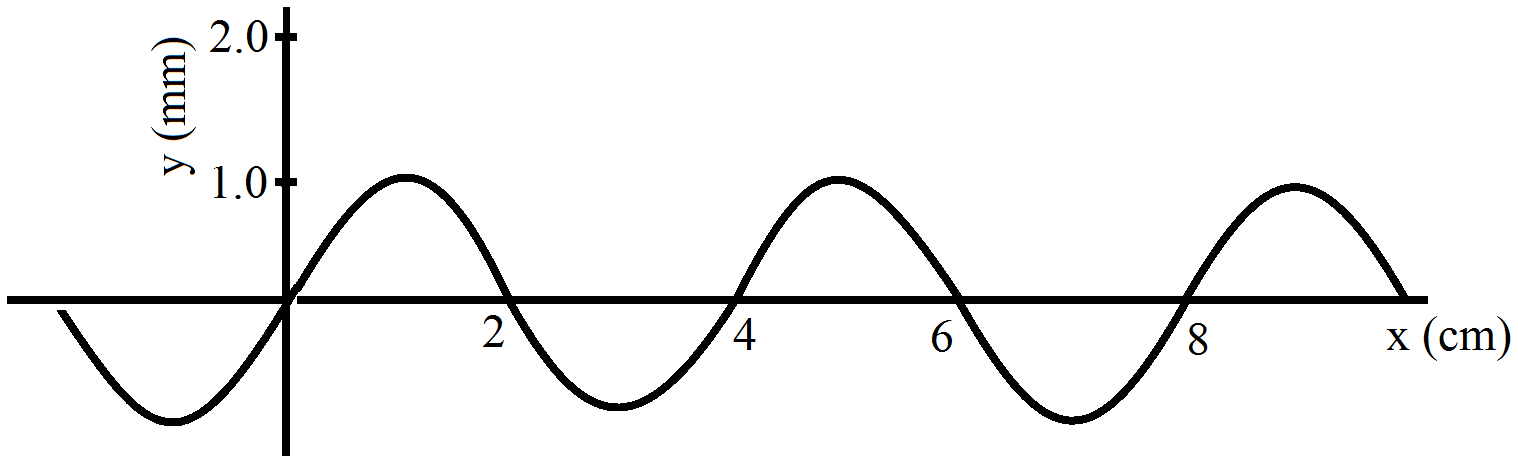
Figure shows a plot of the transverse displacements of the particles of a string at t = 0 through which a travelling wave is passing in the positive x-direction. The wave speed is 20cm/s. Find-
  1. The amplitude
  2. The wavelength
  3. The wave number
  4. The frequency of the wave.
Answer
Given that, $\text{v}=20\text{m/s}$
  1. Amplitude,$\text{A}=1\text{mm}$
  2. Wave length, $\lambda=4\text{cm}$
  3. Wave number, $\text{n}=\frac{2\pi}{\lambda}=\frac{(2\times3.14)}{4}=1.57\text{cm}^{-2}$ (wave number = k)
  4. Frequency, $\text{f}=\frac{1}{\text{T}}=\frac{\upsilon}{\lambda}$
$\Rightarrow \text{f}=\frac{20}{4}=5\text{Hz}$ $\Big($Where time period $\text{T}=\frac{\pi}{\text{v}}\Big)$
View full question & answer
Question 105 Marks
A particle on a stretched string supporting a travelling wave, takes 5.0ms to move from its mean position to the extreme position. The distance between two consecutive particles, which are at their mean positions, is 2.0cm. Find the frequency, the wavelength and the wave speed.
Answer
Time period, $\text{T}=4\times5\text{ms}$$=20\times10^{-3}$
$=2\times10^{-2}\text{s}$
$\Rightarrow\lambda=2\times2\text{cm}$
$=4\text{cm}$
Frequency, $\text{f}=\frac{1}{\text{T}}$$=\frac{1}{(2\times10^{-2})}=50\text{s}^{-1}$
$=50\text{Hz}$
Wave speed = $\lambda\text{f}=4\times50\text{m/s}$$=2000\text{m/s}$
$=2\text{m/s}$
View full question & answer
Question 115 Marks
A wave is described by the equation$\text{y}=(1.0\text{mm})\sin\pi\Big(\frac{\text{x}}{2.0\text{cm}}-\frac{\text{t}}{0.01\text{s}}\Big).$
  1. Find the time period and the wavelength.
  2. Write the equation for the velocity of the particles. Find the speed of the particle at x = 1.0cm at time t = 0.01s.
  3. What are the speeds of the particles at x = 3.0cm, 5.0cm and 7.0cm at t 0.01s?
  4. What are the speeds of the particles at x 1.0cm at t = 0.011, 0.012, and 0.013s?
Answer
$\text{y}=(1.0\text{mm})\sin\pi\Big(\frac{\text{x}}{2.0\text{cm}}-\frac{\text{t}}{0.01\text{s}}\Big)$
  1. $\text{T}=2\times0.01=0.02\sec=20\text{ms}$
$\lambda=2\times2=4\text{cm}$
  1. $\text{v}=\frac{\text{dy}}{\text{dt}}=\frac{\text{d}}{\text{dt}}\Big[\sin2\pi\big(\frac{\text{x}}{4}-\frac{\text{t}}{0.02}\big)\Big]\\=-\cos2\pi\Big\{\frac{\text{x}}{4}-\big(\frac{\text{t}}{0.02}\big)\Big\}\times\frac{1}{(0.02)}$
at $\text{x}=1$ and $\text{t}=0.01\sec,\text{v}=-50\cos2\times\Big[(\frac{1}{4})-\big(\frac{1}{2}\big)\Big]=0$
  1.  
  1. at $\text{x}=3\text{cm},\text{t}=0.01\sec$
$\text{v}=-50\cos2\pi\Big(\frac{3}{4}-\frac{1}{2}\Big)=0$
  1. at $\text{x}=5\text{cm},\ \text{t}=0.01\sec,\text{v}=0$ (Putting the values)
  2. at $\text{x}=7\text{cm}$ and $\text{t}=0.01\sec,\text{v}=0$
  1. at $\text{x}=1\text{cm},\text{t}=0.01\sec,\text{v}=0$
$\text{v}=-50\cos2\pi\Big\{\big(\frac{1}{4}\big)-\big(\frac{0.011}{0.02}\big)\Big\}\\=-50\cos\big(\frac{3\pi}{5}\big)=-9.7\text{cm/sec}$ (similarly the other two can be calculted)
View full question & answer
Question 125 Marks
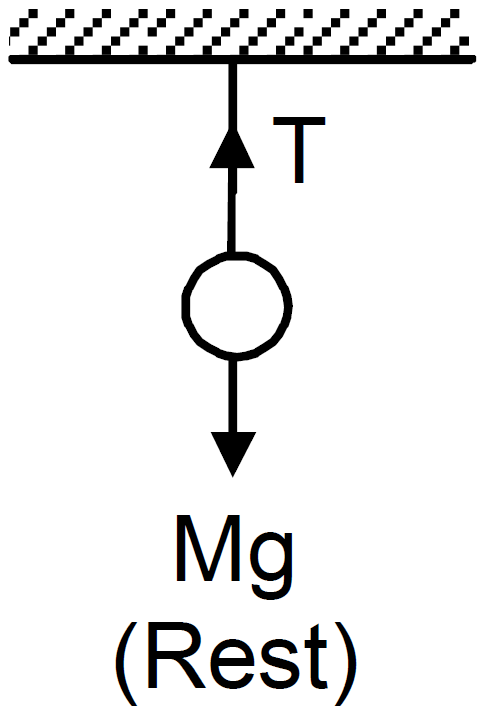
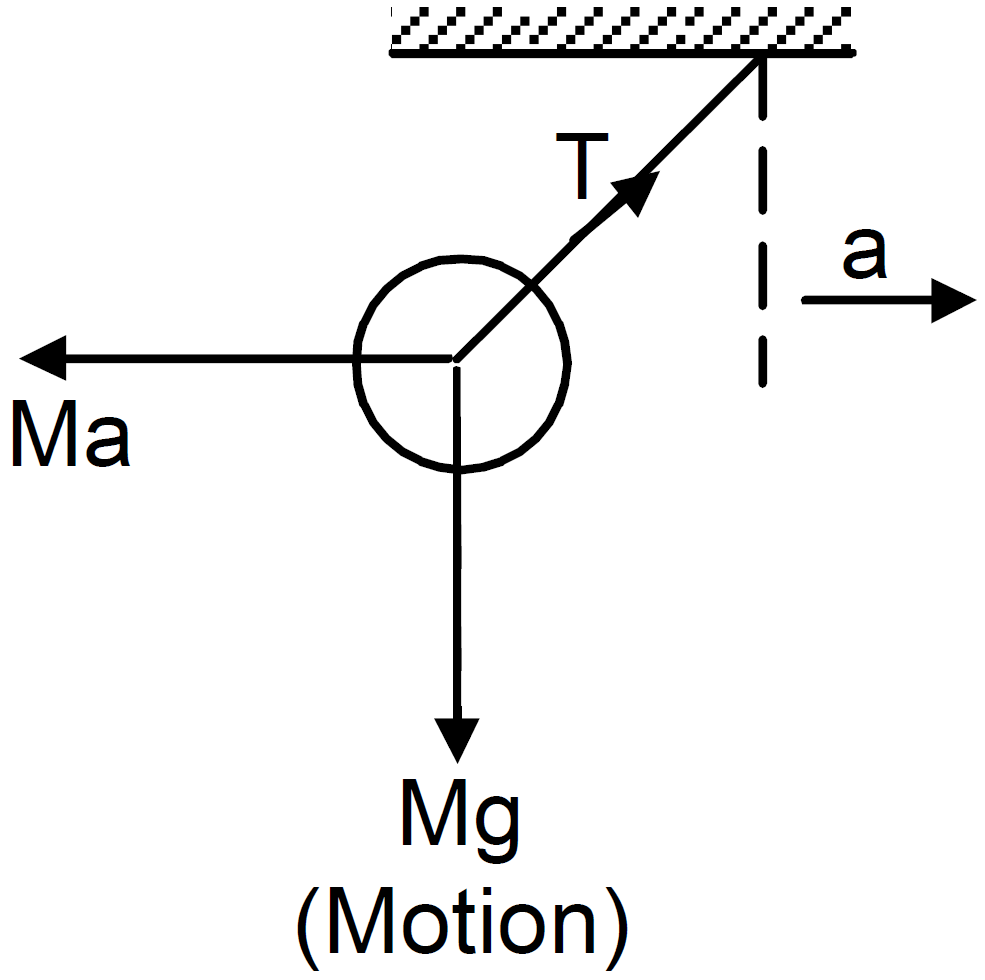
A heavy ball is suspended from the ceiling of a motor car through a light string. A transverse pulse travels at a speed of $60cm/s$ on the string when the car is at rest and $62cm/s$ when the car accelerates on a horizontal road. Find the acceleration of the car. Take $g = 10m/s^2$.
Answer
Let M = mass of the heavy ball (m = mass per unit length) Wave speed, $\text{v}_1=\sqrt{\Big(\frac{\text{T}}{\text{m}}\Big)}=\sqrt{\Big(\frac{\text{mg}}{\text{m}}\Big)}$ (because T = Mg)$\Rightarrow60=\sqrt{\Big(\frac{\text{Mg}}{\text{m}}\Big)}$
$\Rightarrow\frac{\text{Mg}}{\text{m}}=60^2\ \dots(1)$
From the freebody diagram (2),

$\text{v}_2=\sqrt{\Big(\frac{\text{T}'}{\text{m}}\Big)}$
$\Rightarrow\text{v}_2=\frac{\big[(\text{Ma})^2+(\text{Mg})^2\big]^{\frac{1}{4}}}{\text{m}^{\frac{1}{2}}}$ $\Big($ because $\text{T}'=\sqrt{(\text{Ma})^2+(\text{Mg})^2}\Big)$
$\Rightarrow62=\frac{\big[(\text{Ma})^2+(\text{Mg})^2\big]^{\frac{1}{4}}}{\text{m}^{\frac{1}{2}}}$
$\Rightarrow\frac{\big[(\text{Ma})^2+(\text{Mg})^2\big]^{\frac{1}{4}}}{\text{m}^{\frac{1}{2}}}=62^2\ \dots(2)$

Equation (1) + Equation(2),$\Rightarrow\Big(\frac{\text{Mg}}{\text{m}}\Big)\times\Big[\frac{\text{m}}{(\text{Ma})^2+(\text{Mg})^2}\Big]=\frac{3600}{3844}$
$\Rightarrow\frac{\text{g}}{\sqrt{(\text{a}^2+\text{g}^2)}}=0.936\Rightarrow\frac{\text{g}^2}{(\text{a}^2+\text{g}^2)}=0.876$
$\Rightarrow(\text{a}^2+100)\times0.876=100$
$\Rightarrow\text{a}^2=0.876=100-87.6=12.4$
$\Rightarrow\text{a}^2=\frac{12.4}{0.876}=14.15$
$\Rightarrow\text{a}=3.76\text{m/s}^2$
$\therefore\ Acce^n$ of the car $=3.7\text{m/s}^2$
View full question & answer
Question 135 Marks
Two waves, each having a frequency of $100Hz$ and a wavelength of $2.0cm$, are travelling in the same direction on a string. What is the phase difference between the waves,
  1. If the second wave was produced $0.015s$ later than the first one at the same place.
  2. If the two waves were produced at the same instant but the first one was produced a distance $4.0cm$ behind the second one?
  3. If each of the waves has an amplitude of $2.0mm$, what would be the amplitudes of the resultant waves in part (a) and (b)?
Answer
$\text{f}=100\text{Hz},\ \lambda=2\text{cm}=2\times10^{-2}\text{m}$$\therefore\ $Wave speed, $\text{v}=\text{f}\lambda=2\text{m/s}$
  1. In 0.015sec $1^{st}$ wave has travelled
$\text{x}=0.015\times2=0.03\text{m}=\text{path diff'}$
$\therefore\ $corresponding phase difference, $\phi=\frac{2\pi\text{x}}{\lambda}$
$=\Big\{\frac{2\pi}{(2\times10^{-2})}\Big\}\times0.03$
$=3\pi.$
  1. Path different $\text{x}=4\text{cm}=0.04\text{m}$
$\Rightarrow\phi=\Big(\frac{2\pi}{\lambda}\Big)\text{x}$
$=\bigg\{\Big(\frac{2\pi}{2}\times10^{-2}\Big)\times0.04\bigg\}$
$=4\pi$
  1. The waves have same frequency, same wavelength and same amplitude.
Let $\text{y}_1=\text{r}\sin\text{wt},\text{y}_2=\text{r}\sin(\text{wt}+\phi)$
$\Rightarrow\text{y}=\text{y}_1+\text{y}_2=\text{r}\big[\sin\text{wt}+(\text{wt}+\phi)\big]$
$=2\text{r}\sin\Big(\text{wt}+\frac{\phi}{2}\Big)\cos\Big(\frac{\phi}{2}\Big)$
$\therefore\ $resultant amplitude $=2\text{r}\cos\frac{\phi}{2}$
So, when $\phi=3\pi,\ \text{r}=2\times10^{-3}\text{m}$
$\text{R}_\text{res}=2\times(2\times10^{-3})\cos\Big(\frac{3\pi}{2}\Big)=0$
Again, when $\phi=4\pi,\ \text{R}_\text{res}$
$=2\times(2\times100^{-3})\cos\Big(\frac{4\pi}{2}\Big)$
$=4\text{mm}.$
View full question & answer
Question 145 Marks
A circular loop of string rotates about its axis on a frictionless horizontal plane at a uniform rate so that the tangential speed of any particle of the string is v. If a small transverse disturbance is produced at. a point of the loop, with what speed (relative to the string) will this disturbance travel on the string?
Answer
m = mass per unit length of the string R = Radius of the loop$\omega=$ angular velocity, V = linear velocity of the string
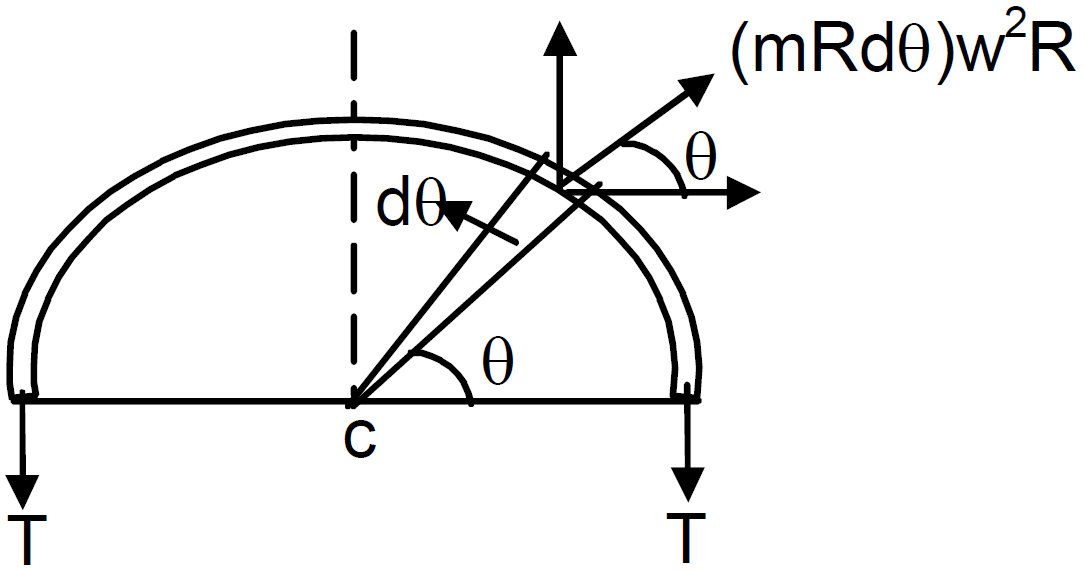
Consider one half of the string as shown in figure. The half loop experiences cetrifugal force at every point, away from centre, which is balanced by tension 2T. Consider an element of angular part $\text{d}\theta$ at angle $\theta.$ Consider another element symmetric to this centrifugal force experienced by the element $=(\text{mRd}\theta)\omega^2\text{R}.$$\big($Length of element $=\text{Rd}\theta,\ \text{mass}=\text{mRd}\theta\big)$
Resolving into rectangular components net force on the two symmetric elements,$\text{DF}=2\text{mR}^2\text{d}\theta\omega^2\sin\theta$ [horizontal components cancels each other]
So, total $\text{F}=\int\limits_0^{\frac{\pi}{2}}2\text{mR}^2\omega^2\sin\theta\text{d}\theta=2\text{mR}^2\omega^2[-\cos]\Rightarrow2\text{mR}^2\omega^2$ Again, $2\text{T}=2\text{mR}^2\omega^2\ \Rightarrow\text{T}=\text{mR}^2\omega^2$ Velocity of transverse vibration $\text{v}=\sqrt{\frac{\text{T}}{\text{m}}}=\omega\text{R}=\text{v}$
View full question & answer