Question
A circular loop of string rotates about its axis on a frictionless horizontal plane at a uniform rate so that the tangential speed of any particle of the string is v. If a small transverse disturbance is produced at. a point of the loop, with what speed (relative to the string) will this disturbance travel on the string?
Answer

m = mass per unit length of the string R = Radius of the loop$\omega=$ angular velocity, V = linear velocity of the string
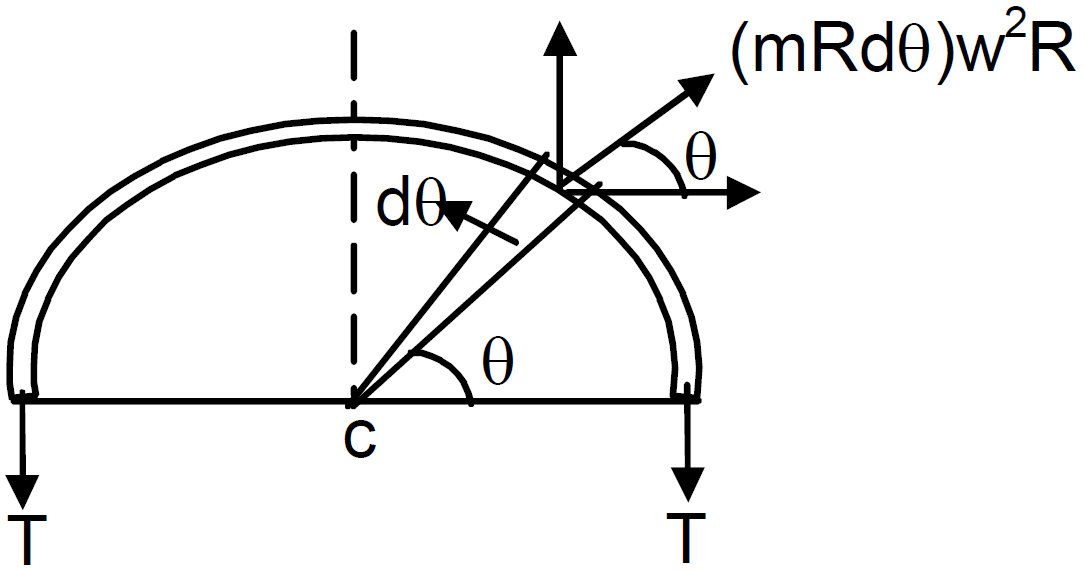
Consider one half of the string as shown in figure. The half loop experiences cetrifugal force at every point, away from centre, which is balanced by tension 2T. Consider an element of angular part $\text{d}\theta$ at angle $\theta.$ Consider another element symmetric to this centrifugal force experienced by the element $=(\text{mRd}\theta)\omega^2\text{R}.$$\big($Length of element $=\text{Rd}\theta,\ \text{mass}=\text{mRd}\theta\big)$
Resolving into rectangular components net force on the two symmetric elements,$\text{DF}=2\text{mR}^2\text{d}\theta\omega^2\sin\theta$ [horizontal components cancels each other]
So, total $\text{F}=\int\limits_0^{\frac{\pi}{2}}2\text{mR}^2\omega^2\sin\theta\text{d}\theta=2\text{mR}^2\omega^2[-\cos]\Rightarrow2\text{mR}^2\omega^2$ Again, $2\text{T}=2\text{mR}^2\omega^2\ \Rightarrow\text{T}=\text{mR}^2\omega^2$ Velocity of transverse vibration $\text{v}=\sqrt{\frac{\text{T}}{\text{m}}}=\omega\text{R}=\text{v}$

Need a full question paper?

Generate a complete, print-ready paper with questions like this in minutes — across 16+ boards, with answer keys.

Start Generating Free

Similar questions

What is the difference between cathode rays and beta rays? When the two are travelling in space, can you make out which is the cathode ray and which is the beta ray?
In Fig. 14.9, what will be the sign of the velocity of the point, which is the projection of the velocity of the P′ reference particle P .P is moving in a circle of radius R in anticlockwise direction.
Figure shows a cylindrical tube with adiabatic walls and fitted with an adiabatic separator. The separator can be slid into the tube by an external mechanism. An ideal gas $(\gamma=1.5)$ is injected in the two sides at equal pressures and temperatures. The separator remains in equilibrium at the middle. It is now slid to a position where it divides the tube in the ratio 1 : 3. Find the ratio of the temperatures in the two parts of the vessel.
What is meant by beats? Discuss graphical method of formation of beats.
Two identical billiard balls strike a rigid wall with the same speed but at different angles, and get reflected without any change in speed, as shown in Fig. 4.6. What is (i) the direction of the force on the wall due to each ball? (ii) the ratio of the magnitudes of impulses imparted to the balls by the wall ?
Image
Estimate the average mass density of a sodium atom assuming its size to be about $2.5 \mathring{\text{A}}.$ (Use the known values of Avogadro’s number and the atomic mass of sodium). Compare it with the mass density of sodium in its crystalline phase: $970kg ~m^{–3}$. Are the two densities of the same order of magnitude? If so, why?
The electrical resistance in ohms of a certain thermometer varies with temperature according to the approximate law:
$\text{R}=\text{R}_0[1+\alpha(\text{T}-\text{T}_0)]$
The resistance is $101.6W$ at the triple-point of water $273.16K$, and $165.5W$ at the normal melting point of lead $(600.5K)$. What is the temperature when the resistance is $123.4W$?
What are geostationary satellites? Find the expression of total energy of a satellite revolving around the surface of the earth. What is the significance of negative sign in the expression? Write the expression of angular momentum of a satellite.
Two molecules of a gas have speeds of $9 \times 10^{16} ms^{-1}$ and $1 \times I0^6ms^{-1}$ respectively. What is the root mean square speed of these molecules?
A heavy particle is suspended by a $1.5m$ long string. It is given a horizontal velocity of $\sqrt{57}\text{m/s}.$
  1. Find the angle made by the string with the upward vertical, when it becomes slack.
  2. Find the speed of the particle at this instant.
  3. Find the maximum height reached by the particle over the point of suspension. Take $g = 10m/s^2$.