Question 11 Mark
Explain why (or how):
Solids can support both longitudinal and transverse waves, but only longitudinal waves can propagate in gases,
AnswerThis is because solids have both, the elasticity of volume and elasticity of shape, whereas gases have only the volume elasticity.
View full question & answer→Question 21 Mark
Explain why (or how):
A violin note and sitar note may have the same frequency, yet we can distinguish between the two notes,
AnswerThe overtones produced by a sitar and a violin, and the strengths of these overtones, are different. Hence, one can distinguish between the notes produced by a sitar and a violin even if they have the same frequency of vibration.
View full question & answer→Question 31 Mark
For the travelling harmonic wave
$\text{y}(\text{x, t})=2.0\cos2\pi(10\text{t}-0.0080\text{x}+0.35)$
where x and y are in cm and t in s. Calculate the phase difference between oscillatory motion of two points separated by a distance of
0.5m,
AnswerEquation for a travelling harmonic wave is given as:
$\text{y}(\text{x, t})=2.0\cos2\pi(10\text{t}-0.0080\text{x}+0.35)$
$=2.0\cos(20\pi\text{t}-0.016\pi\text{x}+0.70\pi)$
Where,
Propagation constant, $\text{k}=0.0160\pi$
Amplitude, a = 2cm
Angular frequency, $\omega=20\pi\text{ rad/s}$
Phase difference is given by the relation:
$\phi=\text{kx}=\frac{2\pi}{\lambda}$
For x = 0.5m = 50cm
$\phi=0.016\pi\times50=0.8\pi\text{ rad}$
View full question & answer→Question 41 Mark
For the travelling harmonic wave
$\text{y}(\text{x, t})=2.0\cos2\pi(10\text{t}-0.0080\text{x}+0.35)$
where x and y are in cm and t in s. Calculate the phase difference between oscillatory motion of two points separated by a distance of
4m.
AnswerEquation for a travelling harmonic wave is given as:
$\text{y}(\text{x, t})=2.0\cos2\pi(10\text{t}-0.0080\text{x}+0.35)$
$=2.0\cos(20\pi\text{t}-0.016\pi\text{x}+0.70\pi)$
Where,
Propagation constant, $\text{k}=0.0160\pi$
Amplitude, a = 2cm
Angular frequency, $\omega=20\pi\text{ rad/s}$
Phase difference is given by the relation:
$\phi=\text{kx}=\frac{2\pi}{\lambda}$
For x = 4 m = 400cm
$\phi=0.016\pi\times400=6.4\pi\text{ rad}$
View full question & answer→Question 51 Mark
Given below are some functions of x and t to represent the displacement (transverse or longitudinal) of an elastic wave. State which of these represent (i) a travelling wave, (ii) a stationary wave or (iii) none at all:
$\text{y}=\cos\text{x}\sin\text{t}+\cos2\text{x}\sin2\text{t}$
AnswerThe given equation represents a stationary wave because the harmonic terms kx and $\omega\text{t}$ appear separately in the equation. This equation actually represents the superposition of two stationary waves.
View full question & answer→Question 61 Mark
For the travelling harmonic wave
$\text{y}(\text{x, t})=2.0\cos2\pi(10\text{t}-0.0080\text{x}+0.35)$
where x and y are in cm and t in s. Calculate the phase difference between oscillatory motion of two points separated by a distance of
$\frac{3\lambda}{4},$
AnswerEquation for a travelling harmonic wave is given as:
$\text{y}(\text{x, t})=2.0\cos2\pi(10\text{t}-0.0080\text{x}+0.35)$
$=2.0\cos(20\pi\text{t}-0.016\pi\text{x}+0.70\pi)$
Where,
Propagation constant, $\text{k}=0.0160\pi$
Amplitude, a = 2cm
Angular frequency, $\omega=20\pi\text{ rad/s}$
Phase difference is given by the relation:
$\phi=\text{kx}=\frac{2\pi}{\lambda}$
For $\text{x}=\frac{3\lambda}{4}$
$\phi=\frac{2\pi}{\lambda}\times\frac{3\lambda}{4}=1.5\pi\text{ rad}$
View full question & answer→Question 71 Mark
A transverse harmonic wave on a string is described by
$\text{y}(\text{x, t})=3.0\sin\big(36\text{t}+0.018\text{x}+\frac{\pi}{4}\big)$
where x and y are in cm and t in s. The positive direction of x is from left to right.
What is the initial phase at the origin?
Answer$\frac{\pi}{4}$
Explanation:
Given,
$\text{y}(\text{x, t})=3\sin\big(36\text{t}+0.018\text{x}+\frac{\pi}{4}\big)$
Initial phase at the origi $=\frac{\pi}{4}$
View full question & answer→Question 81 Mark
For the travelling harmonic wave
$\text{y}(\text{x, t})=2.0\cos2\pi(10\text{t}-0.0080\text{x}+0.35)$
where x and y are in cm and t in s. Calculate the phase difference between oscillatory motion of two points separated by a distance of
$\frac{\lambda}{2},$
AnswerEquation for a travelling harmonic wave is given as:
$\text{y}(\text{x, t})=2.0\cos2\pi(10\text{t}-0.0080\text{x}+0.35)$
$=2.0\cos(20\pi\text{t}-0.016\pi\text{x}+0.70\pi)$
Where,
Propagation constant, $\text{k}=0.0160\pi$
Amplitude, a = 2cm
Angular frequency, $\omega=20\pi\text{ rad/s}$
Phase difference is given by the relation:
$\phi=\text{kx}=\frac{2\pi}{\lambda}$
For $\text{x}=\frac{\lambda}{2}$
$\phi=\frac{2\pi}{\lambda}\times\frac{\lambda}{2}=\pi\text{ rad}$
View full question & answer→Question 91 Mark
Given below are some functions of x and t to represent the displacement (transverse or longitudinal) of an elastic wave. State which of these represent (i) a travelling wave, (ii) a stationary wave or (iii) none at all:
$\text{y}=3\sin(5\text{x}-0.5\text{t})+4\cos(5\text{x}-0.5\text{t})$
AnswerThe given equation represents a travelling wave as the harmonic terms kx and ωt are in the combination of $\text{kx}-\omega\text{t}.$
View full question & answer→Question 101 Mark
Given below are some functions of x and t to represent the displacement (transverse or longitudinal) of an elastic wave. State which of these represent (i) a travelling wave, (ii) a stationary wave or (iii) none at all:
$\text{y}=2\cos(3\text{x})\sin(10\text{t})$
AnswerThe given equation represents a stationary wave because the harmonic terms kx and ωt appear separately in the equation.
View full question & answer→Question 111 Mark
Given below are some functions of x and t to represent the displacement (transverse or longitudinal) of an elastic wave. State which of these represent (i) a travelling wave, (ii) a stationary wave or (iii) none at all:
$\text{y}=2\sqrt{\text{x}-\text{vt}}$
AnswerThe given equation does not contain any harmonic term. Therefore, it does not represent either a travelling wave or a stationary wave.
View full question & answer→Question 121 Mark
For the harmonic travelling wave $\text{y}=2\cos2\pi(10\text{t}-0.0080\text{x}+3.5)$ where x and y are in cm and t is second. What is the phase difference between the oscillatory motion at two points separated by a distance of:
$\frac{\lambda}{2}$
Answer$\text{y}=2\cos2\pi(10\text{t}-0.0080\text{x+3.5})$
$\text{y}=2\cos(20\pi\text{t}-0.0016\pi\text{x}+7.0\pi)$
Wave is propagated in $+\text{x}$ direction because $\omega\text{t}$ and kx are in with opposite sign standard equation $\text{y}=\text{a}\cos(\omega\text{t}-\text{kx}+\phi)$
a = 2, $\omega=20\pi,\ \text{k}=0.016\pi$ and $\phi=7\pi$
Path difference $\text{p}=\frac{\lambda}{2}$
$\Delta\phi=\frac{2\pi}{\lambda}\text{p}=\frac{2\pi}{\lambda}\times\frac{\lambda}{2}\pi\ \text{radian}$
View full question & answer→Question 131 Mark
Explain why (or how):
Solids can support both longitudinal and transverse waves, but only longitudinal waves can propagate in gases,
AnswerThis is because solids have both, the elasticity of volume and elasticity of shape, whereas gases have only the volume elasticity.
View full question & answer→Question 141 Mark
What is the condition to be satisfied by a mathematical relation between time and displacement to describe a periodic motion?
Answer$\text{y}=\text{a}\sin(\text{wt}-\phi_0).$ Similar displacement should happen at regular time intervals 18.
View full question & answer→Question 151 Mark
In the given progressive wave $\text{y}=5\sin(100\pi\text{t+0.4x})$ where y and x are in m, t is in s. What is the:Frequency
AnswerStandard form of progressive wave travelling in $+\text{x}$ direction (kx and $\omega\text{}t$ have opposite sign is given)
Eqn. is $\text{y}=\text{a}\sin(\omega\text{t}-\text{kx}+\phi)$
$\text{y}=5\sin(100\pi\text{t}-0.4\pi\text{t}+0)$
Frequency $\text{v},\omega=2\pi\text{v}\Rightarrow\text{v}=\frac{\omega}{2\pi}\because\omega=100\pi$
$\therefore\text{v}=\frac{100\pi}{2\pi}=50\text{Hz}$
View full question & answer→Question 161 Mark
Can sound waves be propagated in all the three states of matter?
Question 171 Mark
What is the distance between a compression and its nearest rarefaction in a longitudinal wave?
AnswerDistance between a compression and adjoining rarefaction is $\frac{\lambda}{2}.$
View full question & answer→Question 181 Mark
Is it possible to have longitudinal waves on a string a transverse wave in a steel rod?
AnswerNo, because string is not stretchable. It can neither be compressed nor rarefied. Yes, transverse waves are possible in steel rod, because steel has elasticity of shape.
View full question & answer→Question 191 Mark
What do you mean by reverberation time?
AnswerThe time during which the intensity of sound decreases to $10^{-6}$ times its original intensity.
View full question & answer→Question 201 Mark
Why does the speed of sound differ from a solid and a liquid medium of same length?
AnswerModulus of elasticity differs from the solid to liquid. Since side ways variation of elasticity is absent in liquids, only bulk modulus is used and not Young's modulus.
View full question & answer→Question 211 Mark
Why do stationary waves not transport energy?
AnswerSince nodes and antinodes formed remain stationary, the energy remains confined to one region. It cannot overcome the pressure maxima at nodes. So, energy is not transmitted by standing waves.
View full question & answer→Question 221 Mark
In a dispersive medium, how will you express the velocity of wave motion?
AnswerSpeed of a wave is expressed as $\frac{\text{d}\omega}{\text{dk}}$ for dispersive medium.
View full question & answer→Question 231 Mark
Why should the difference between the frequencies be less than ten to produce beats?
AnswerHuman ear cannot identify any change in intensity in less than $\Big(\frac{1}{10}\Big)^{\text{th}}$ of a second. So, difference should be less than 10.
View full question & answer→Question 241 Mark
In the given progressive wave $\text{y}=5\sin(100\pi\text{t+0.4x})$ where y and x are in m, t is in s. What is the:
Wave velocity
AnswerStandard form of progressive wave travelling in $+\text{x}$ direction kx and $\omega\text{}t$ have opposite sign is given) Eqn. is $\text{y}=\text{a}\sin(\omega\text{t}-\text{kx}+\phi)$ $\text{y}=5\sin(100\pi\text{t}-0.4\pi\text{t}+0)$Wave velocity $\text{v}=\text{v}\lambda=50\times5=250\text{m/ s}$
View full question & answer→Question 251 Mark
What is the relation between velocity of the wave (v) frequency of the wave (v) and wavelength of the wave $(\lambda)$?
Answer$\text{v}=\text{v}\lambda$
View full question & answer→Question 261 Mark
What propagates faster-a radio signal or sound in the air?
Question 271 Mark
What change is observed when a wave gets reflected from a hard, rigid support?
AnswerA phase change of $\pi$ radians.
View full question & answer→Question 281 Mark
Given below are some functions of x and t to represent the displacement of an elastic wave.
$\text{y}=4\sin(5\text{x}-\text{t/ 2})+3\cos(5\text{x}-\text{t/ 2})$
AnswerA stationary wave of the for $\text{y}=5\cos(4\text{x})\sin20\text{t}$ is a stationary wave so (b) (i).
View full question & answer→Question 291 Mark
Write two characteristics of a medium which determine the speed of sound waves in the medium.
Answer
- Elasticity of medium.
- Inertia of medium.
View full question & answer→Question 301 Mark
What is the source of the non-mechanical waves?
AnswerThey are produced due to the changes of the electric and magnetic fields associated with the moving changes.
View full question & answer→Question 311 Mark
What is the nature of ultrasonic waves and what is their frequency?
AnswerUltrasonic waves are longitudinal waves in nature and have frequency greater than 20kHz.
View full question & answer→Question 321 Mark
Why is sound heard in water more intense in comparison to sound heard in air?
AnswerThis is because intensity of sound increases with increase in density of the medium.
View full question & answer→Question 331 Mark
An observer places his ear at the end of a long steel pipe. He can hear two sounds, when a workman hammers the other end of the pipe. Why?
AnswerThis is because sound is transmitted both through air and medium.
View full question & answer→Question 341 Mark
Can two astronauts talk on the surface of moon as they do on earth?
AnswerNo, the astronauts cannot talk on the surface of moon as there is no atmosphere (air) on moon. Sound waves cannot travel without a medium.
View full question & answer→Question 351 Mark
For the harmonic travelling wave $\text{y}=2\cos2\pi(10\text{t}-0.0080\text{x}+3.5)$ where x and y are in cm and t is second. What is the phase difference between the oscillatory motion at two points separated by a distance of:0.5m
Answer$\text{y}=2\cos2\pi(10\text{t}-0.0080\text{x+3.5})$
$\text{y}=2\cos(20\pi\text{t}-0.0016\pi\text{x}+7.0\pi)$
Wave is propagated in $+\text{x}$ direction because $\omega\text{t}$ and kx are in with opposite sign standard equation $\text{y}=\text{a}\cos(\omega\text{t}-\text{kx}+\phi)$
a = 2, $\omega=20\pi,\ \text{k}=0.016\pi$ and $\phi=7\pi$
Path differencee p = 0.5m = 50cm
$\Delta\phi=\text{kp}=0.016\pi\times50=0.8\pi$ red.
View full question & answer→Question 361 Mark
Resonance is an example of________.
AnswerResonance is an example of forced vibration.
View full question & answer→Question 371 Mark
How does velocity of sound in air change when temperature rises by 1°C?
AnswerVelocity of sound in air increases by 0.61m/s, when temperature rises by 1°C.
View full question & answer→Question 381 Mark
How is the vibration of the air column in a flute different from that of a string in a sitar?
AnswerThe nodes in a sitar are replaced by the antinodes in a flute.
View full question & answer→Question 391 Mark
Two astronauts on the surface of moon cannot talk to each other. Why?
AnswerThis is because moon has no atmosphere and sound cannot travel in vacuum.
View full question & answer→Question 401 Mark
Does sound travel faster on a wet hot day or a dry cold day? Why?
AnswerSound travels faster on a wet hot day due to high temperature and lesser density of wet air.
View full question & answer→Question 411 Mark
Can mechanical waves travel through vacuum?
AnswerNo, mechanical waves cannot travel through vacuum.
View full question & answer→Question 421 Mark
Explain why (or how):
A violin note and sitar note may have the same frequency, yet we can distinguish between the two notes,
AnswerThe overtones produced by a sitar and a violin, and the strengths of these overtones, are different. Hence, one can distinguish between the notes produced by a sitar and a violin even if they have the same frequency of vibration.
View full question & answer→Question 431 Mark
What is the nature of thermal changes in air, when a sound wave propagates through it?
AnswerWhen a sound wave travels through air, the changes in pressure and volume are adiabatic, i.e., temperature rises in the region of compression and temperature falls in the region of rarefaction.
View full question & answer→Question 441 Mark
Why is it difficult some times to recognise your friends voice on phone?
Question 451 Mark
Why are longitudinal waves called pressure waves?
AnswerThis is because propagation of longitudinal waves through a medium involves changes in pressure and volume of air, when compressions and rarefactions are formed.
View full question & answer→Question 461 Mark
In which gas, hydrogen or oxygen, will sound have greater velocity?
AnswerSince $\nu\propto\sqrt{\frac{1}{\rho}},$ therefore velocity of sound will be greater in hydrogen gas.
View full question & answer→Question 471 Mark
Is air a material medium? Name two characteristics of the material medium necessary for the onward propagation of momentum and energy.
AnswerYes, Inertia and elasticity.
View full question & answer→Question 481 Mark
When a source moves at a speed greater than that of sound, will Doppler formula hold? What will happen?
AnswerNo, as it is valid only when $v_\text{s} When $v_\text{s}>v,$ shock waves are produced.
View full question & answer→Question 491 Mark
What is the phase difference between the waves $\text{y}=\text{a}\cos(\omega\text{t}+\text{kx})$ and $\text{y}=\text{a}\sin (\omega\text{t}+\text{kx})?$
AnswerPhase difference $=\frac{\pi}{2}=90^\circ.$
View full question & answer→Question 501 Mark
Which type of waves exhibit polarisation?
Question 511 Mark
For the travelling harmonic wave
$\text{y}(\text{x, t})=2.0\cos2\pi(10\text{t}-0.0080\text{x}+0.35)$
where x and y are in cm and t in s. Calculate the phase difference between oscillatory motion of two points separated by a distance of
0.5m,
AnswerEquation for a travelling harmonic wave is given as:
$\text{y}(\text{x, t})=2.0\cos2\pi(10\text{t}-0.0080\text{x}+0.35)$
$=2.0\cos(20\pi\text{t}-0.016\pi\text{x}+0.70\pi)$
Where,
Propagation constant, $\text{k}=0.0160\pi$
Amplitude, a = 2cm
Angular frequency, $\omega=20\pi\text{ rad/s}$
Phase difference is given by the relation:
$\phi=\text{kx}=\frac{2\pi}{\lambda}$
For x = 0.5m = 50cm
$\phi=0.016\pi\times50=0.8\pi\text{ rad}$
View full question & answer→Question 521 Mark
An observer is stationed at x = 10cm. When a train moves in the y-axis with a velocity 10m/s, what is the apparent frequency?
AnswerThere is no Doppler shift in perpendicular direction, so no apparent frequency.
View full question & answer→Question 531 Mark
Why bells are made of metal and not wood?
AnswerThis is because wood has high damping.
View full question & answer→Question 541 Mark
In an open organ pipe, third harmonic is 450Hz. What is the frequency of fifth harmonic?
Answer$\because \text{v}_3=3\text{v}_1$
$\text{v}_3=450\text{Hz}$
$\therefore 450=3\text{v}_1$
$\Rightarrow\text{v}_1=150\text{Hz}$
Fifth harmonic,
$\text{v}_5=5\text{v}_1$
$=5\times150$
$\text{v}_5=750\text{Hz}$
View full question & answer→Question 551 Mark
If oil of density higher than density of water is used in a resonance tube, how will the frequency change?
AnswerThe frequency will not change. Because frequency depends on length of air column above the liquid surface in the tube.
View full question & answer→Question 561 Mark
What is the difference between a tone and a note?
AnswerNote is sound of particular frequency, while tone is of a particular intensity.
View full question & answer→Question 571 Mark
The ratio of amplitude of two waves is 2 : 3. What is the ratio of intensities of these waves?
Answer$\frac{\text{I}_1}{\text{I}_2}=\frac{\text{a}^2}{\text{b}^2}=\frac{2^2}{3^2}$
$=\frac{4}{9}$
View full question & answer→Question 581 Mark
Which harmonics are absent in a closed organ pipe?
AnswerAll even harmonics are absent.
View full question & answer→Question 591 Mark
If tension of a wire is increased to four times, how is the wave speed changed?
AnswerAs $v\propto\sqrt{\text{T}},$ therefore, wave speed becomes twice.
View full question & answer→Question 601 Mark
Periodic rise and fall of intensity of sound when two sound waves moving in same direction, having same amplitude but differ in frequency by less than 10 is known as ________.
AnswerPeriodic rise and fall of intensity of sound when two sound waves moving in same direction, having same amplitude but differ in frequency by less than 10 is known as beat.
View full question & answer→Question 611 Mark
What causes the rolling sound of thunder?
AnswerThe rolling sound of thunder is due to multiple reflection of sound of lightning.
View full question & answer→Question 621 Mark
How many beats are formed when two sources vibrate in unison?
AnswerNo beats are formed, since $\mathrm{v}_{\mathrm{b}}=\mathrm{V}_1-\mathrm{V}_2$.
View full question & answer→Question 631 Mark
What will be the speed of sound in a perfectly rigid rod?
AnswerThe speed of sound in a perfectly rigid rod will be infinite.
View full question & answer→Question 641 Mark
The pattern of standing waves formed on a stretched string at two instants of time are shown in The velocity of two waves superimposing to form stationary waves is $360\ ms^{–1}$ and their frequencies are $256\ Hz$
- Calculate the time at which the second curve is plotted.
- Mark nodes and antinodes on the curve.
- Calculate the distance between $A′$ and $C′.$
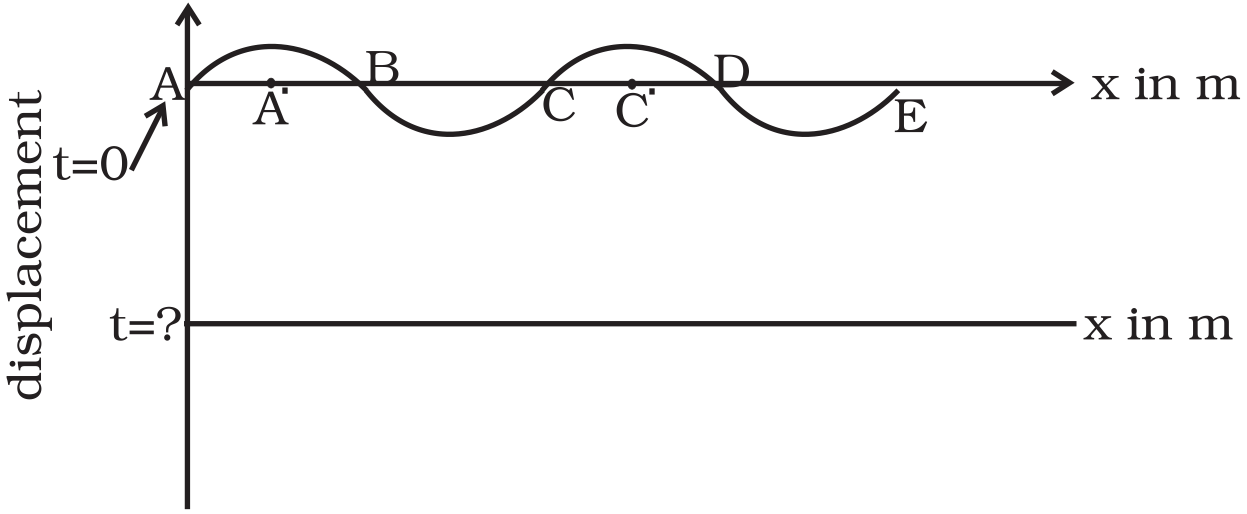
AnswerGiven frequency of the wave $v = 256Hz$
$\therefore\text{T}=\frac{1}{\text{v}}=\frac{1}{256}$ second $= 0.00390$
$\text{T}=3.9\times10^{-3}$ seconds.
$(a)$ In stationary wave a particle passes though it's mean position after ever $\frac{\text{T}}{4}$ time
$\therefore$ in II nd curve displacement of all medium particle, are zero so
$\text{t}=\frac{\text{T}}{4}=\frac{3.9\times10^{-3}}{4}=.975\times10^{-3}\sec$
$\text{t}=9.8\times10^{-4}$ secound.
$(b)$ Point does not vibrate i.t., their displacement is zero always so nodes $\text{A, B, C, D}$ and $E$. the point $A\ '$ and $C\ '$ are at maximam displacement so there are anti$-$nodes at $A\ '$ and $C\ '.$
Between $A\ '$ and $C\ '=\lambda=\frac{\text{v}}{\text{V}}=\frac{360}{256}=\frac{90}{64}=1.41\text{m}.$
View full question & answer→Question 651 Mark
Fundamental frequency of oscillation of a close pipe is 400Hz. What will be the fundamental frequency of oscillation of an open pipe of same length?
Question 661 Mark
State the factors on which the speed of a wave travelling along a stretched ideal string depends.
AnswerSpeed depends on Tension and Mass per unit length.
View full question & answer→Question 671 Mark
When a vibrating tunning fork is moved speedily towards a wall, beats are heard. Why?
AnswerThis is due to the difference in the frequency of the incident wave and the apparent frequency of the reflected wave.
View full question & answer→Question 681 Mark
For the travelling harmonic wave
$\text{y}(\text{x, t})=2.0\cos2\pi(10\text{t}-0.0080\text{x}+0.35)$
where x and y are in cm and t in s. Calculate the phase difference between oscillatory motion of two points separated by a distance of
4m.
AnswerEquation for a travelling harmonic wave is given as:
$\text{y}(\text{x, t})=2.0\cos2\pi(10\text{t}-0.0080\text{x}+0.35)$
$=2.0\cos(20\pi\text{t}-0.016\pi\text{x}+0.70\pi)$
Where,
Propagation constant, $\text{k}=0.0160\pi$
Amplitude, a = 2cm
Angular frequency, $\omega=20\pi\text{ rad/s}$
Phase difference is given by the relation:
$\phi=\text{kx}=\frac{2\pi}{\lambda}$
For x = 4 m = 400cm
$\phi=0.016\pi\times400=6.4\pi\text{ rad}$
View full question & answer→Question 691 Mark
What is the nature of light waves?
Question 701 Mark
What is the audible range of sound frequencies?
AnswerBetween 20Hz to 20,000Hz.
View full question & answer→Question 711 Mark
Given below are some functions of x and t to represent the displacement (transverse or longitudinal) of an elastic wave. State which of these represent (i) a travelling wave, (ii) a stationary wave or (iii) none at all:
$\text{y}=\cos\text{x}\sin\text{t}+\cos2\text{x}\sin2\text{t}$
AnswerThe given equation represents a stationary wave because the harmonic terms kx and $\omega\text{t}$ appear separately in the equation. This equation actually represents the superposition of two stationary waves.
View full question & answer→Question 721 Mark
What is the phase difference between two successive crests in a transverse wave?
AnswerPhase difference between two successive crests in a transverse wave is $2\pi$ rad.
View full question & answer→Question 731 Mark
What type of graph you expect between speed of sound through a gas and pressure of gas?
AnswerThe graph will be straight line parallel to pressure axis.
View full question & answer→Question 741 Mark
A pipe 20cm long is closed at one end. Which harmonic mode of the pipe is resonantly excited by a source of 1237.5Hz?(sound velocity in air $= 330ms^{–1}$)
AnswerLength of pipe, $\text{l}=20\text{cm}=20\times10^{-2}\text{m}$
Fundamental frequency of closed organ pipe
$\text{f}_0=\frac{\text{v}}{4\text{}L}=\frac{330}{4\times20\times10^{-2}}=412.5\text{Hz}$
$\frac{\text{f given}}{\text{f}_0}=\frac{1237.5}{412.5}=3$
View full question & answer→Question 751 Mark
How can we distinguish between a violin and a sitar note?
AnswerThe quality of sound and overtones produced will be different. So, we can identify.
View full question & answer→Question 761 Mark
Name the apparatus used to demonstrate the phenomenon of the reflection of waves.
Question 771 Mark
What is the nature of waves produced in a tuning fork?
AnswerIn tuning forks, standing waves are produced with antinode at the free ends.
View full question & answer→Question 781 Mark
Name the waves which do not require any material medium for their propagation.
AnswerNon-mechanical or electromagnetic waves.
View full question & answer→Question 791 Mark
When will Doppler effect in sound be symmetrical?
AnswerWhen the velocity of the source or observer is very much less than the velocity of sound.
View full question & answer→Question 801 Mark
For the harmonic travelling wave $\text{y}=2\cos2\pi(10\text{t}-0.0080\text{x}+3.5)$ where x and y are in cm and t is second. What is the phase difference between the oscillatory motion at two points separated by a distance of:
$\frac{3\lambda}{4}$(at a given instant of time)
Answer$\text{y}=2\cos2\pi(10\text{t}-0.0080\text{x+3.5})$ $\text{y}=2\cos(20\pi\text{t}-0.0016\pi\text{x}+7.0\pi)$ Wave is propagated in $+\text{x}$ direction because $\omega\text{t}$ and kx are in with opposite sign standard equation $\text{y}=\text{a}\cos(\omega\text{t}-\text{kx}+\phi)$ a = 2, $\omega=20\pi,\ \text{k}=0.016\pi$ and $\phi=7\pi$$\Delta\phi=\frac{2\pi}{\lambda}\text{p}=\frac{2\pi}{\lambda}\times\frac{3\pi}{4}=\frac{3}{2}\pi\ \text{radian}$
View full question & answer→Question 811 Mark
At the same temperature and pressure, the densities of two diatomic gases are d, and d. What is the ratio of the speeds of sound in these gases?
Answer$\frac{v_1}{v_2}=\sqrt{\frac{\text{d}_2}{\text{d}_1}}$
View full question & answer→Question 821 Mark
Which of the following media can pass longitudinal waves only-air, water or iron?
Question 831 Mark
A transverse harmonic wave on a string is described by
$\text{y}(\text{x, t})=3.0\sin\big(36\text{t}+0.018\text{x}+\frac{\pi}{4}\big)$
where x and y are in cm and t in s. The positive direction of x is from left to right.
What is the initial phase at the origin?
Answer$\frac{\pi}{4}$
Explanation:
Given,
$\text{y}(\text{x, t})=3\sin\big(36\text{t}+0.018\text{x}+\frac{\pi}{4}\big)$
Initial phase at the origi $=\frac{\pi}{4}$
View full question & answer→Question 841 Mark
Why should the difference between the frequencies be less than 10 to produce beats?
AnswerHuman ear cannot identify any change in intensity is less than $\Big(\frac{1}{10}\Big)\text{th}$ of a second. So, difference should be less than 10.
View full question & answer→Question 851 Mark
Is the phenomenon of beats observable in case of two light waves of nearly equal frequencies?
AnswerNo, this is because phase difference due to two independent light sources changes rapidly and randomly at a given position.
View full question & answer→Question 861 Mark
Name the factors affecting the velocity of sound in a medium.
AnswerTemperature, density and ratio $\gamma$ affect the velocity of sound in a medium.
View full question & answer→Question 871 Mark
Give one similarity and one difference between a S.H.M. and a Wave.
AnswerSimilarity- Periodic nature.
Difference- Wave is a function of position and time, while a SHM is a function of time only.
View full question & answer→Question 881 Mark
Velocity of sound in air at N.T.P. is 332m/s. What will be the velocity, when pressure is doubled and temperature is kept constant?
Answerv = 332m/s, as there is no effect of change in pressure when temperature remains constant.
View full question & answer→Question 891 Mark
In a longitudinal wave, what is the distance between a compression and its nearest rarefraction?
Answer$\frac{\lambda}{2}.$
View full question & answer→Question 901 Mark
Two sound sources produce 12 beats in 4 seconds. By how much do that frequencies differ?
AnswerBeat frequency $=\frac{12}{4}=3\text{beats/ sec}.$
View full question & answer→Question 911 Mark
_______ waves do not transfer any energy and momentum in the material medium.
AnswerStanding waves do not transfer any energy and momentum in the material medium.
View full question & answer→Question 921 Mark
When a source moves at a speed greater than that of sound, will Doppler formula hold? What will happen?
AnswerNo, as it is valid only when $v_s<v$. When $v_s>v$, shock waves are produced.
View full question & answer→Question 931 Mark
In the given progressive wave $\text{y}=5\sin(100\pi\text{t+0.4x})$ where y and x are in m, t is in s. What is the:
Amplitude
AnswerStandard form of progressive wave travelling in $+\text{x}$ direction (kx and $\omega\text{}t$ have opposite sign is given)
Eqn. is $\text{y}=\text{a}\sin(\omega\text{t}-\text{kx}+\phi)$
$\text{y}=5\sin(100\pi\text{t}-0.4\pi\text{t}+0)$
Amplitude $\text{a}=5\text{m}$
View full question & answer→Question 941 Mark
In which type of wave alternate crests and troughs are formed?
Question 951 Mark
State the factors on which the speed of a wave travelling along a stretched ideal string depends.
AnswerThe speed of a wave travelling along a streched ideal string,
$\text{v}=\sqrt{\frac{\text{T}}{\text{m}}}$
where, $T$ is the tension in the string and m is mass per unit length of the string.
Hence, it depends on two factors:
- Tension in the string.
- Mass per unit length.
View full question & answer→Question 961 Mark
AnswerThe persistence of audible sound after the source has ceased to produce the sound is called reverberation.
View full question & answer→Question 971 Mark
For the travelling harmonic wave
$\text{y}(\text{x, t})=2.0\cos2\pi(10\text{t}-0.0080\text{x}+0.35)$
where x and y are in cm and t in s. Calculate the phase difference between oscillatory motion of two points separated by a distance of
$\frac{\lambda}{2},$
AnswerEquation for a travelling harmonic wave is given as:
$\text{y}(\text{x, t})=2.0\cos2\pi(10\text{t}-0.0080\text{x}+0.35)$
$=2.0\cos(20\pi\text{t}-0.016\pi\text{x}+0.70\pi)$
Where,
Propagation constant, $\text{k}=0.0160\pi$
Amplitude, a = 2cm
Angular frequency, $\omega=20\pi\text{ rad/s}$
Phase difference is given by the relation:
$\phi=\text{kx}=\frac{2\pi}{\lambda}$
For $\text{x}=\frac{\lambda}{2}$
$\phi=\frac{2\pi}{\lambda}\times\frac{\lambda}{2}=\pi\text{ rad}$
View full question & answer→Question 981 Mark
Why is sound heard more intense in carbon dioxide in comparison to air?
AnswerThe intensity of sound increases with increase in density of the medium.
View full question & answer→Question 991 Mark
Given below are some functions of x and t to represent the displacement (transverse or longitudinal) of an elastic wave. State which of these represent (i) a travelling wave, (ii) a stationary wave or (iii) none at all:
$\text{y}=3\sin(5\text{x}-0.5\text{t})+4\cos(5\text{x}-0.5\text{t})$
AnswerThe given equation represents a travelling wave as the harmonic terms kx and ωt are in the combination of $\text{kx}-\omega\text{t}.$
View full question & answer→Question 1001 Mark
If radius of a stretched wire is reduced to half, how is the wave speed affected?
AnswerAs $v\propto\frac{1}{\sqrt{\text{r}}},$ therefore, wave speed becomes twice.
View full question & answer→Question 1011 Mark
Given below are some functions of x and t to represent the displacement (transverse or longitudinal) of an elastic wave. State which of these represent (i) a travelling wave, (ii) a stationary wave or (iii) none at all:
$\text{y}=2\cos(3\text{x})\sin(10\text{t})$
AnswerThe given equation represents a stationary wave because the harmonic terms kx and ωt appear separately in the equation.
View full question & answer→Question 1021 Mark
Is it possible to have interference between the waves produced by two violins? Why?
AnswerNo. This is because the sounds produced will not have a constant phase difference.
View full question & answer→Question 1031 Mark
Given below are some functions of x and t to represent the displacement (transverse or longitudinal) of an elastic wave. State which of these represent (i) a travelling wave, (ii) a stationary wave or (iii) none at all:
$\text{y}=2\sqrt{\text{x}-\text{vt}}$
AnswerThe given equation does not contain any harmonic term. Therefore, it does not represent either a travelling wave or a stationary wave.
View full question & answer→Question 1041 Mark
An open pipe makes a good musical instrument, in comparison to a closed pipe. Why?
AnswerIn open pipe, all harmonics are possible, while in a closed pipe, only odd harmonics are possible.
View full question & answer→Question 1051 Mark
What determines the type of wave motion in a medium?
AnswerType of wave motion is determined by:
- Nature of the medium.
- Mode of excitation of wave motion.
View full question & answer→Question 1061 Mark
What sort of waves are formed in a sitar wire when it is once plucked in the middle and then released?
AnswerTransverse stationary waves are formed in the sitar wire.
View full question & answer→Question 1071 Mark
What is the relation between path difference and phase difference?
AnswerPhase difference $=\frac{2\pi}{\lambda}\times\text{path difference.}$
View full question & answer→Question 1081 Mark
Where does the pressure of larger magnitude exist at nodes or at antinodes?
AnswerPressure is maximum at points of minimum displacement. So, it is maximum at nodes.
View full question & answer→Question 1091 Mark
Two sounds of very close frequencies, say 256Hz and 260Hz are produced simultaneously. What is the frequency of resultant sound and also write the number of beats heard in one second?
Answer$\text { No. of beats } n=n_2-n_1$
$=260-256$
$=4$
Frequency of resultant sound is the average of the two frequencies 258 Hz .
View full question & answer→Question 1101 Mark
What is the effect on the velocity of waves in a string if only $\frac{1}{4}\text{th}$ of the original length is used with the same tension?
AnswerSince $\frac{\text{m}}{\text{l}}$ is not altered and tension is same, velocity will remain the same.
View full question & answer→Question 1111 Mark
Is Newton's law of motion applicable for material waves? Is this applicable for electromagnetic waves?
AnswerNewton's laws of motion are applicable for material waves but not applicable for electromagnetic waves.
View full question & answer→Question 1121 Mark
Two sitar strings A and B playing the note ‘Dha’ are slightly out of tune and produce beats of frequency 5 Hz. The tension of the string B is slightly increased and the beat frequency is found to decrease to 3 Hz. What is the original frequency of B if the frequency of A is 427 Hz ?
AnswerIncrease in the tension of a string increases its frequency. If the original frequency of $B \left(v_B\right)$ were greater than that of $A \left(v_A\right)$, further increase in $v_B$ should have resulted in an increase in the beat frequency. But the beat frequency is found to decrease. This shows that $v_B<v_A$. Since $v_A-v_B=5 Hz$, and $v_A=427 Hz$, we get $v_B=422 Hz$.
View full question & answer→Question 1131 Mark
A steel wire $0.72 m$ long has a mass of $5.0 \times 10^{-3} kg$. If the wire is under a tension of $60 N$, what is the speed of transverse waves on the wire?
AnswerMass per unit length of the wire,
$
\begin{aligned}
\mu & =\frac{5.0 \times 10^{-3} kg }{0.72 m } \\
& =6.9 \times 10^{-3} kg m ^{-1}
\end{aligned}
$
Tension, $T=60 N$
The speed of wave on the wire is given by
$
v=\sqrt{\frac{T}{\mu}}=\sqrt{\frac{60 N }{6.9 \times 10^{-3} kg m ^{-1}}}=93 m s ^{-1}
$
View full question & answer→Question 1141 Mark
Given below are some examples of wave motion. State in each case if the wave motion is transverse, longitudinal or a combination of both:
(a) Motion of a kink in a longitudinal spring produced by displacing one end of the spring sideways.
(b) Waves produced in a cylinder containing a liquid by moving its piston back and forth.
(c) Waves produced by a motorboat sailing in water.
(d) Ultrasonic waves in air produced by a vibrating quartz crystal.
Answer(a) Transverse and longitudinal
(b) Longitudinal
(c) Transverse and longitudinal
(d) Longitudinal
View full question & answer→