Questions · Page 2 of 3

1 Marks Question

Question 511 Mark
The sign of work done by a force on a body is important to understand. State carefully if the following quantities are positive or negative: Work done by friction on a body sliding down an inclined plane.
Answer
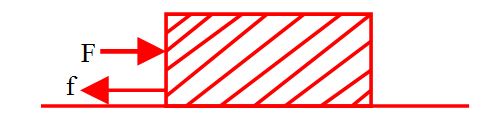
Negative: Since the direction of frictional force is opposite to the direction of motion, the work done by frictional force is negative in this case.
View full question & answer
Question 521 Mark
What type of energy stored in:
  1. The wound spring of a watch.
  2. A stretched bow while ready to project an arrow?
Answer
In both cases, energy is stored in the form of elastic potential energy due to change in configuration.
View full question & answer
Question 531 Mark
Can acceleration be produced without doing any work? Give example.
Answer
Yes, for uniform circular motion, no work done but a centripetal acceleration is present.
View full question & answer
Question 541 Mark
When work done by a force is independent of the path of motion but depends only on the initial and final position of the body displaced. Such force is known as_____________.
Answer
When work done by a force is independent of the path of motion but depends only on the initial and final position of the body displaced. Such force is known as conservative force.
View full question & answer
Question 551 Mark
Energy possessed by a body by virtue of its position or configuration is known as ­________.
Answer
Energy possessed by a body by virtue of its position or configuration is known as ­potential energy .
View full question & answer
Question 561 Mark
Is the total linear momentum conserved during the short time of an elastic collision of two balls?
Answer
During the short interval of an elastic collision, total linear momentum is conserved.
View full question & answer
Question 571 Mark
Answer carefully, with reasons: Is the total linear momentum conserved during the short time of an elastic collision of two balls?
Answer
Yes. Explanation: In an elastic collision, the total linear momentum of the system always remains conserved.
View full question & answer
Question 581 Mark
What is 1 eV?
Answer
Kinetic energy acquired by an electron to pass through a potential difference of 1volt.
View full question & answer
Question 591 Mark
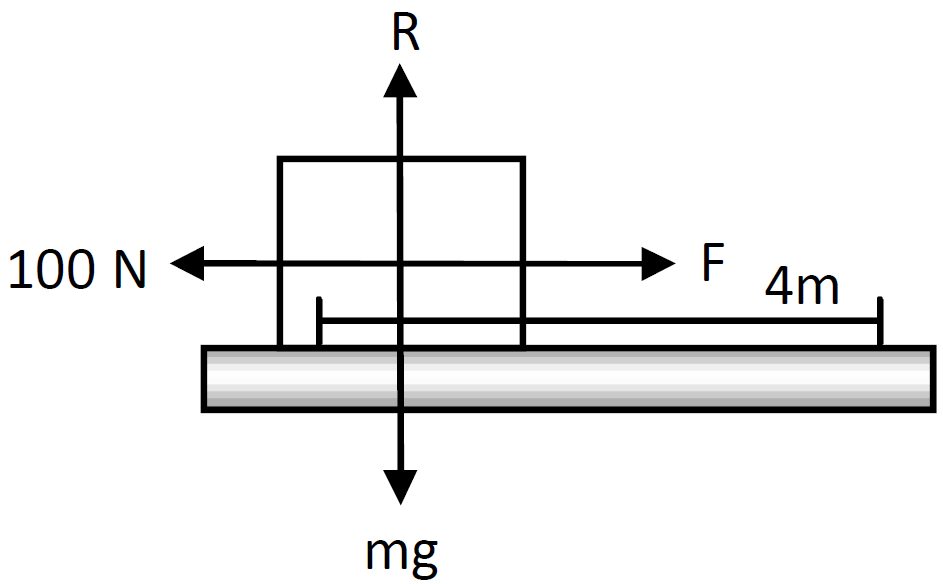
A box is pushed through 4.0m across a floor offering 100N resistance. How much work is done by the resisting force?
Answer

$\text{F}=100\text{N}$
$\text{S}=4\text{m},\theta=0^\circ$
$\omega=\vec{\text{F}}.\vec{\text{S}}$
$=100\times4=400\text{J}$
View full question & answer
Question 601 Mark
A truck and a car are moving with the same kinetic energy on a straight road. Their engines are simultaneously switched off. Which one will stop at a lesser distance?
Answer
$\text{S}=\frac{\text{K.E}}{\text{Reatarding force}}.$In this case retarding force is the force of friction (f); e, $\text{f}=\mu\text{R}$.Since the weight of truck is more, R will be more in case of truck. Therefore, f will be more. Obviously, S would be less in case of truck so it will come to rest at lesser distance.
View full question & answer
Question 621 Mark
What is one electron-volt?
Answer
$1 \mathrm{eV}=1.6 \times 10^{-19}$ joule. It is the energy required to transfer electron (charge $=1.6 \times 10^{-19 \circ} \mathrm{C}$ ) through a P.D. of 1 volt.
View full question & answer
Question 631 Mark
Commercial unit of power kWh is equal to ­________.
Answer
Commercial unit of power kWh is equal to $3.6 \times 10^6J$.
View full question & answer
Question 651 Mark
In an elastic collision, relative velocity of approach between two bodies is always ______to relative velocity of separation.
Answer
In an elastic collision, relative velocity of approach between two bodies is always equal to relative velocity of separation.
View full question & answer
Question 661 Mark
Is it necessary to do work to maintain a constant velocity with a body on a rough surface?
Answer
Yes, to overcome the frictional force of rough surface.
View full question & answer
Question 671 Mark
The sign of work done by a force on a body is important to understand. State carefully if the following quantities are positive or negative: Work done by a man in lifting a bucket out of a well by means of a rope tied to the bucket.
Answer
Positive: In the given case, force and displacement are in the same direction. Hence, the sign of work done is positive. In this case, the work is done on the bucket.
View full question & answer
Question 681 Mark
Ten identical balls are placed in contact on a smooth surface. If an eleventh identical ball moving with a speed 'u' collides on the first, what will you notice?
Answer
When the eleventh ball hits the first ball, the tenth ball will start moving with the same speed due to transfer of momentum of equal proportion.
View full question & answer
Question 691 Mark
A coolie with load on his head is walking on a horizontal plateform. What is work done against gravity?
Answer
Zero.
View full question & answer
Question 701 Mark
A mass is moving in a circular path with constant speed. What is the work done in $\frac{3}{4}\text{th}$ of a rotation?
Answer
Since centripetal force and displacement are perpendicular, work done is zero.
View full question & answer
Question 711 Mark
Write the work energy theorem.
Answer
Work done by a force is the change in kinetic energy associated with the body.
View full question & answer
Question 721 Mark
Work-energy theorem states that work done by the net force acting on a body is equal to the change in­________ of the body.
Answer
Work-energy theorem states that work done by the net force acting on a body is equal to the change in­ kinetic energy of the body.
View full question & answer
Question 731 Mark
Is it possible to have a collision in which all kinetic energy is lost? Give example.
Answer
Consider two particles having momentum $m_1u_1$ and $m_2u_2$ colliding perfectly inelastically to form single mass ($m_1 + m_2$) moving with velocity v. For K.E. to be completely lost $\frac{1}{2}(\text{m}_1+\text{m}_2)\text{v}^2=0 \text{ or}\text{ v}=0$ $\text{ i.e}\frac{\text{m}_1\text{u}_1+\text{m}_2\text{u}_2}{\text{m}_1+\text{m}_2}=0$ $\text{m}_1\text{u}_1=-\text{m}_2\text{u}_2$ i.e., the two particles should have equal and opposite momentum for K.E to be completely lost.
View full question & answer
Question 741 Mark
A bolt of mass 0.3kg falls from the ceiling of an elevator moving down with an uniform speed of $7ms^{-1}$. It hits the floor of the elevator (length of the elevator = 3m) and does not rebound. What is the heat produced by the impact? Would your answer be different if the elevator were stationary?
Answer
Mass of the bolt, m= 0.3kg Speed of the elevator = 7m/s Height, h = 3m Since the relative velocity of the bolt with respect to the lift is zero, at the time of impact, potential energy gets converted into heat energy. Heat produced = Loss of potential energy = mgh = 0.3 × 9.8 × 3 = 8.82J The heat produced will remain the same even if the lift is stationary. This is because of the fact that the relative velocity of the bolt with respect to the lift will remain zero.
View full question & answer
Question 751 Mark
Two equal masses, one at rest and another moving undergo elastic oblique collision. If one mass goes at an angle $\frac{\pi}{3}$with its original direction of motion, what is the direction of motion of the other?
Answer
The direction of the other mass is at an angle$\Big(\frac{\pi}{3}-\frac{\pi}{3}\Big),\text{i.e.},\frac{\pi}{6}\text{ or }30^\circ.$
View full question & answer
Question 761 Mark
Is work done by a non conservative force always negative? Comment.
Answer
No. For example, work done by a non-conservative force like friction is zero, so long as the body does not start moving. Again when friction causes motion, work done by friction is positive.
View full question & answer
Question 771 Mark
A light body and a heavy body have the same momentum. Which one will have greater kinetic energy?
Answer
As $\text{K}=\frac{\text{p}^2}{2\text{m}}$Since p is same for both bodies $\text{K}\propto\frac{1}{\text{m}},$i.e., lighter body has more K.E. than the heavier body.
View full question & answer
Question 781 Mark
Answer the following: An artificial satellite orbiting the earth in very thin atmosphere loses its energy gradually due to dissipation against atmospheric resistance, however small. Why then does its speed increase progressively as it comes closer and closer to the earth?
Answer
As an artificial satellite gradually loses its energy due to dissipation against atmospheric resistance, its potential energy decreases rapidly. As a result, kinetic energy of satellite slightly increases i.e. its speed increases progressively.
View full question & answer
Question 791 Mark
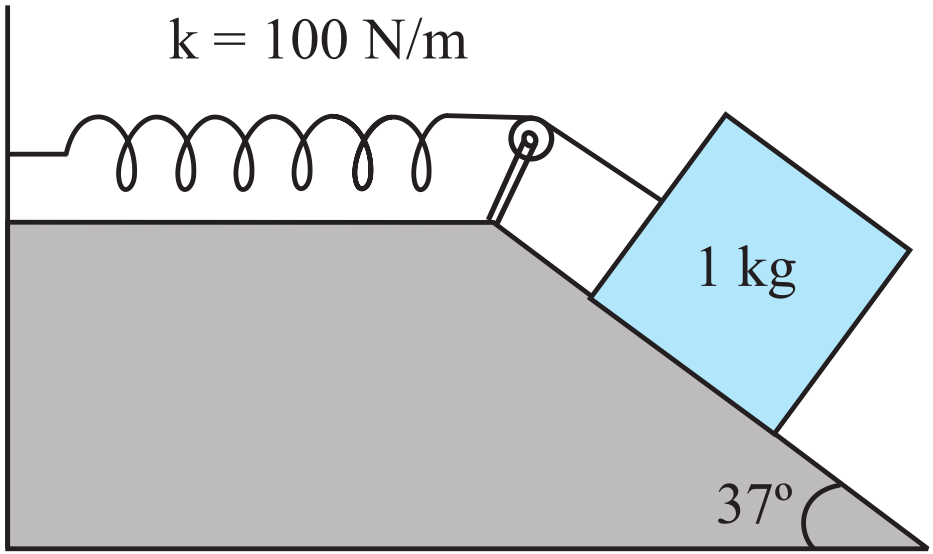
A $1kg$ block situated on a rough incline is connected to a spring of spring constant $100Nm^{-1}$ as shown in. The block is released from rest with the spring in the unstretched position. The block moves $10cm$ down the incline before coming to rest. Find the coefficient of friction between the block and the incline. Assume that the spring has a negligible mass and the pulley is frictionless.
Answer
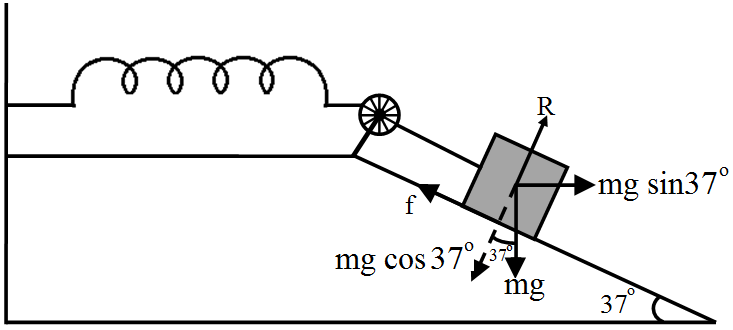
Mass of the block, $m = 1kg$ Spring constant, $k = 100Nm^{-1}$ Displacement in the block, $X = 10cm = 0.1m$ The given situation can be shown as in the following figure.At equilibrium:

 Normal reaction, $\text{R}=\text{mg}\cos37^{\circ}$ Frictional force, $\text{f}=\mu\text{R}=\text{mg}\sin37^{\circ}$ Where, $\mu$ is the coefficient of friction Net force acting on the block $ =\text{mg}\sin 37^{\circ}-\text{f}$ $=\text{mg}\sin37^{\circ}-\mu\text{m}\cos37^{\circ}$ $=\text{mg}(\sin37^{\circ}-\mu\cos37^{\circ})$ At equilibrium, the work done by the block is equal to the potential energy of the spring, i.e., $=\text{mg}(\sin37^{\circ}-\mu\cos37^{\circ})\text{x}=\Big(\frac{1}{2}\Big)\text{kx}^2$ $1\times9.8(\sin37^{\circ}-\mu\cos37^{\circ})=\Big(\frac{1}{2}\Big)\times100\times(0.1)$ $0.602-\mu\times0.799=0.510$ $\therefore\mu=\frac{0.092}{0.799}=0.115$
View full question & answer
Question 801 Mark
A body falling from a height of 10m rebounds from a hard floor. It loses 20% of its energy in impact. What is the height to which it would rise after the impact?
Answer
$\frac{80}{100}\text{mgh}=\text{mgh}'$ $\text{h}'=\frac{4}{5}\text{h}=\frac{4}{5}\times10\text{m}=8\text{cm}$
View full question & answer
Question 811 Mark
The sign of work done by a force on a body is important to understand. State carefully if the following quantities are positive or negative: Work done by gravitational force in the above case.
Answer
Negative: In the given case, the direction of force (vertically downward) and displacement (vertically upward) are opposite to each other. Hence, the sign of work done is negative.
View full question & answer
Question 821 Mark
Two blocks of masses $10 kg$ and $20 kg$ moving at speeds of $10 \mathrm{~ms}^{-1}$ and $20 \mathrm{~ms}^{-1}$ respectively in opposite directions, approach each other and collide. If the collision is completely inelastic, find the thermal energy developed in the process.
Answer
Given, Mass of the first block, $m_1=10 \mathrm{~kg}$ Mass of the second block, $m_2=20 \mathrm{~kg}$ Initial velocity of the first block, $u_1=$
$10 \mathrm{~m} / \mathrm{s}$ Initial velocity of the second block, $u_2=20 \mathrm{~m} / \mathrm{s}$ Let the velocity of the blocks after collision be v . Applying conservation of momentum, we get $\mathrm{m}_2 \mathrm{u}_2-\mathrm{m}_1 \mathrm{u}_1=\left(\mathrm{m}_1+\mathrm{m}_2\right) \mathrm{v} \Rightarrow 20 \times 20-10 \times 10=(10+20) \mathrm{v} \Rightarrow 400-100=30 \mathrm{v}$
$\Rightarrow 300=30 \mathrm{v} \Rightarrow \mathrm{v}=10 \mathrm{~m} / \mathrm{s}$ Initial kinetic energy is given by, $\mathrm{K}_{\mathrm{i}}=\frac{1}{2} \mathrm{~m}_1 \mathrm{u}_1^2+\frac{1}{2} \mathrm{~m}_2 \mathrm{u}_2^2$
$\mathrm{K}_{\mathrm{i}}=\frac{1}{2} \times 10 \times(10)^2+\frac{1}{2} \times 20 \times(20)^2 \mathrm{~K}_{\mathrm{i}}=500+4000=4500$ Final kinetic energy is given by, $\mathrm{K}_{\mathrm{f}}=\frac{1}{2}\left(\mathrm{~m}_1+\mathrm{m}_2\right) \mathrm{v}^2 \mathrm{~K}_{\mathrm{f}}=\frac{1}{2}(10+20)(10)^2 \mathrm{~K}_{\mathrm{f}}=\left(\frac{30}{2}\right) \times 100=1500$
$\therefore$ Total change in $\mathrm{KE}=4500 \mathrm{~J}-1500 \mathrm{~J}=$ 3000 J Thermal energy developed in the process $=3000 \mathrm{~J}$
View full question & answer
Question 831 Mark
Moutain roads rarely go straight up but wind up gradually. Why?
Answer
Frictional force f is given by $\text{f}=\mu\text{mg}\cos\theta$. If the roads go straight up the angle of slope $\theta$ would be large and frictional force will be less and vehicles may slip.
View full question & answer
Question 841 Mark
What is the work done by earth's gravitational force in keeping the moon in its orbit?
Answer
Force and displacement are always perpendicular. So W = 0.
View full question & answer
Question 861 Mark
A body of mass 2kg initially at rest moves under the action of an applied horizontal force of 7N on a table with coefficient of kinetic friction = 0.1. Compute the: Change in kinetic energy of the body in 10s.
Answer
M = 2kg Applied force F = 7N Coefficient of kinetic friction $\mu = 0.1$ Normal reaction is N = mg = 2 × 9.8 = 19.6N Hence, force or friction is $\text{f} = \mu\text{N} = 1.96\text{N}$ Total force = F - f = 7 - 1.96 = 5.04N
Acceleration of body is, $\text{a}=\Big(\frac{\text{F}-\text{f}}{\text{m}}\Big)$ $=\frac{5.04}{2}\simeq2.5\text{ms}^{-2}$ Displacement of body in time t is, $\text{x}=\frac{1}{2}\text{at}^2$ Int = 10s $\text{x}=\frac{1}{2}\times2.5\times10^2$ $=125\text{m}$ Change in kinetic energy = Net work done = 630J
View full question & answer
Question 871 Mark
What happens when two identical objects moving in mutually opposite directions suffer an elastic collision?
Answer
The objects mutually exchange their velocities as a consequence of collision.
View full question & answer
Question 881 Mark
What is meant by mass energy equivalence? Discuss its significance in Physics.
Answer
Energy and non-mass are interconvertible. In Physics, it gives explanation for the energy released in nuclear reactions.
View full question & answer
Question 891 Mark
In what type of collision, maximum kinetic energy is transferred?
Answer
Maximum kinetic energy is transferred when two bodies of equal mass collide.
View full question & answer
Question 901 Mark
When an air bubble rises in water, what happens to its potential energy?
Answer
Potential energy of air bubble decreases because work is done by upthrust on the bubble.
View full question & answer
Question 911 Mark
A spring is stretched. Is the work done by the stretching force positive or negative?
Answer
Positive work. Both the force and the displacement are in the same direction.
View full question & answer
Question 921 Mark
Area under the force-displacement curve is the measure of ______.
Answer
Area under the force-displacement curve is the measure of work done .
View full question & answer
Question 931 Mark
What is the source of the kinetic energy of the falling rain drop?
Answer
Potential energy stored in the rain drops.
View full question & answer
Question 941 Mark
Is work done a scalar or a vector?
Answer
Work done by a force for a certain displacement is a scalar quantity.
View full question & answer
Question 951 Mark
State the law of Conservation of energy.
Answer
Energy can neither be created nor destroyed, but only can be transformed from one form to another.
View full question & answer
Question 961 Mark
Why is it not necessary for a body following another body, to stop to avoid collision?
Answer
If relative velocity of object is zero, then collision can be stop.
View full question & answer
Question 971 Mark
In a game of tug of war, one team is slowly giving way to the other. Which team is doing positive work and which team negative?
Answer
The winning team (i.e. the team which is pulling the other team towards itself) is doing positive work and the losing team (i.e. the team slowly giving way to the other) is doing negative work.
View full question & answer
Question 981 Mark
The earth moving round the sun in circular orbit is acted upon by a force and hence work must be done on the earth by the force. Explain.
Answer
It is wrong. Since force and displacement are perpendicular to each other work done is zero.
View full question & answer
Question 1001 Mark
Answer the following: The casing of a rocket in flight burns up due to friction. At whose expense is the heat energy required for burning obtained? The rocket or the atmosphere?
Answer
Heat energy required for burning of casing of rocket comes from the rocket itself. As a result of work done against friction the kinetic energy of rocket continuously deceases and this work against friction reappears as heat energy.
View full question & answer
1 Marks Question - Page 2 - Physics STD 11 Science Questions - Vidyadip