Questions

3 Marks Question

Take a timed test

73 questions · self-marked practice — reveal the answer and mark yourself.

Question 13 Marks
Discuss briefly the following:
  1. Greenhouse gases.
  2. Catalytic converter.
  3. Ultraviolet B.
Answer
  1. Greenhouse gases: Gases that trap the heat of the sun in the earth's atmosphere increasing atmospheric temperature effect are called greenhouses gases. $\mathrm{CO}_2, \mathrm{CH}_4, \mathrm{~N}_2 \mathrm{O}$ and CFC , cause greenhouse. In the absence of greenhouse gases, the temperature of earth would go down to $-18^{\circ} \mathrm{C}$. The net effect of higher GHGs will be disastrous, (i) Melting of polar ice caps and mountain snow caps resulting in rising of sea level threatening submergence of many islands and coastal areas. Odd climate changes like EI Nino. Increased floods and drought.
  2. Catalytic converter: Catalytic converter 'are used to reduce emission of poisonous gases like nitrogen oxides, carbon monoxide \& un reacted hydrocarbon in automotive emission. It is made of platinum, palladium and rhodium and is used as catalyst. It converts unburnt hydrocarbons into $\mathrm{CO}_2$. The only precaution required is not to use gasoline having lead as lead inactivates the catalysts of the converter. Ultraviolet B:
  3. Ultraviolet B; is one of the three types of invisible light rays given off by the sun. Ultraviolet B penetrates the ozone layer in attenuated form \& reaches earths. This is more over equator than poles due to thinning of ozone shield over equator. It causes skin cancer, reduce rate of photosynthesis in phytoplanktons, reduces diversity of aquatic ecosystem.
View full question & answer
Question 23 Marks
List all the wastes that you generate, at home, school or during your trips to other places, could you very easily reduce? Which would be difficult or rather impossible to reduce?
Answer
Plastic containers, paper, electronic goods, left over food, food package, disposable glasses, cup plates, polythenes, excreta, soap and detergent waste are the wastes that one can generate at home, school or during trips to other places. Yes, we can easily reduce waste through judicious use of material by changing our habits & life styles.
Out of these, polythene and plastic material are hard to dispose off as they are non- biodegradable and they can be recycled back.
View full question & answer
Question 33 Marks
Write critical notes on the following:
Eutrophication.
Answer
Eutrophication: It is excessive growth of algae, plants and animals in water bodies due to the nutrient enrichment particularly with nitrogen and phosphorus. It is both natural and accelerated. It leads to loss of bio-diversity and cuases chemical accumulation in food chain and ageing of water body.
View full question & answer
Question 43 Marks
Write critical notes on the following:
Groundwater depletion and ways for its replenishment.
Answer
Ground water depletion and replacement: Ground water depletion, a term often defined as long term water level declines caused by sustained ground water pumping, is a key issue associated with ground water use. Many areas of India experiencing ground water depletion.
The most servere consequence of excessive ground water pumping is that the water table, below which the ground is saturated - with water, can be lowered. If ground water level declines too far, then the well owner might have to deepen the well, drill a new well, or at least attempt to lower the pump.
View full question & answer
Question 53 Marks
Discuss briefly the following:
  1. Radioactive wastes.
  2. Defunct ships and e-wastes.
  3. Municipal solid wastes.
Answer
  1. Any discarded material that emits radiations is called radioactive waste. Radiations, emitted by nuclear waste is extremely damaging to biological organisms. It causes mutations to occur at a very high rate, resulting in various disorders like cancer. At high doses, nuclear radiation is lethal. The Defunct ships are dead ships that are no longer in use. Such ships are broken down for scrap metal in countries such as India and Pakistan. These ships are a source of various toxicants such as asbestos, lead, mercury etc. Thus, they contribute to solid wastes that are hazardous to health.
  2. Defunct ships are dead ships that are no longer in use. Such ships are broken down for scrap metal in countries such as India and Pakistan. These ships are a source of various toxicants such as asbestos, lead, mercury etc. Thus, they contribute to solid wastes that are hazardous to health. E-wastes or electronic wastes generally include electronic goods such as computers etc. Such wastes are rich in metals such as copper, iron, silicon, gold etc. These metals are highly toxic and pose serious health hazards. People of developing countries are involved in the recycling process of these metals and therefore, get exposed to toxic substances present in these wastes.
  3. Municipal wastes includes homes, offices, schools, hospitals etc. It is collected and disposed off by the municipality. These generally consists of paper, leather textile, rubber, glass, etc. Sanitary landfills are used to dump these wastes.
View full question & answer
Question 63 Marks
Discuss the role of women and communities in protection and conservation of forests.
Answer
Women and communities have played a major role in environmental conservation movements.
  • Case study of the bishnoi community: he Bishnoi community in Rajasthan strictly believes in the concept of living peacefully with nature. In 1731, the king of Jodbpur ordered his ministers to arrange wood for the construction of his new palace. For this purpose, the minister and the workers went to bishnoi village. There, a Bishnoi woman called Amrita Devi along with her daughter and hundreds of other Bishnois showed the courage to step forward and stop them from cutting trees. They embraced the trees and lost their lives at the hands of soldiers of the king. This resistance by the people of the village forced the king to give up the idea of cutting trees.
  • Chipko movement: The Chipko movement was started in 1974 in the Garhwal region of the Himalayas. In this movement, the women from the village stopped the contractors from cutting forest trees by embracing them.
View full question & answer
Question 73 Marks
Write critical notes on the following:
Biological magnification.
Answer
Biological magnification: Increase in concentration of persistent chemical at successive trophic levels is called eutrophication. This happens because a toxic substance accumulated by an organism can not be metabolized or excreted, and is thus passed onto next trophic level, e.g., DDT.
View full question & answer
Question 83 Marks
What is the natural ageing of a lake called? How is it caused? Write the impact of uncontrolled human activities on it?
Answer
  1. Natural ageing of lake is called as eutrophication. Its caused due to gradual accumulation of organic matter over a period of time.
  2. Due to uncontrolled human activities like deposition of waste into the water bodies, there is an increase in the organic matter. Thus polluting the water.
  3. The human activities accelerated the accumulation of organic matter, thus resulting is early aging of lake which is known as accelerated eutrophication.
View full question & answer
Question 93 Marks
While on a visit to a pond in the city-neighbourhood, the visitors were delighted to find large expanse of water covered with colourful algal mass.
  1. As a student of biology, do you agree with their delight? Give reasons in support of your answer.
  2. Explain the cause of such algal growth.
Answer
  1. What the villagers saw and are delighted about is algal bloom over a stationary water body. This algal bloom will cut off the supply of light and oxygen to the submerged flora and fauna of the water body. It will outcompete the water bodies flora and fauna for nutrients and will rapidly grow and deplete other organisms in the given water body ecosystem of necessary nutrients. This will quickly lead to the death, decay and destruction of the already existing water body ecosystem.
  2. The flushed out and washed nutrients from the excess fertilisers of the nearby fields had accumulated and promoted the sudden burst in the growth of algal bloom on the water body. This phenomenon is often termed as Cultural or Accelerated Eutrophication.
View full question & answer
Question 103 Marks
Explain the effect on the characteristics of a river when urban sewage is discharged into it.
Answer
Effects of sewage discharge on river are:
  1. A sharp decline in dissolved oxygen and increase in BOD. Low oxygen levels in the water cause death of fish and other aquatic creatures.
  2. Algal bloom which results from the presence of organic matter in water.
It causes:
  1. Deterioration of the water quality.
  2. Fish mortality.
  3. Toxicity to humans and animals.
  1. Biological magnification of a few toxic substances, as DDT causing harmful effects in living species.
  2. Accelerated eutrophication, i.e. ageing of lakes and other water bodies due to human activities.
View full question & answer
Question 113 Marks
Describe the effects of human activities in influencing natural ecosystem cycles with special reference to carbon cycle.
Answer
Rapid deforestation, massive burning of fossil fuel, have significantly increased the rate of release of carbon dioxide, polluting atmosphere, this green house gas, contributes to global warming.
View full question & answer
Question 123 Marks
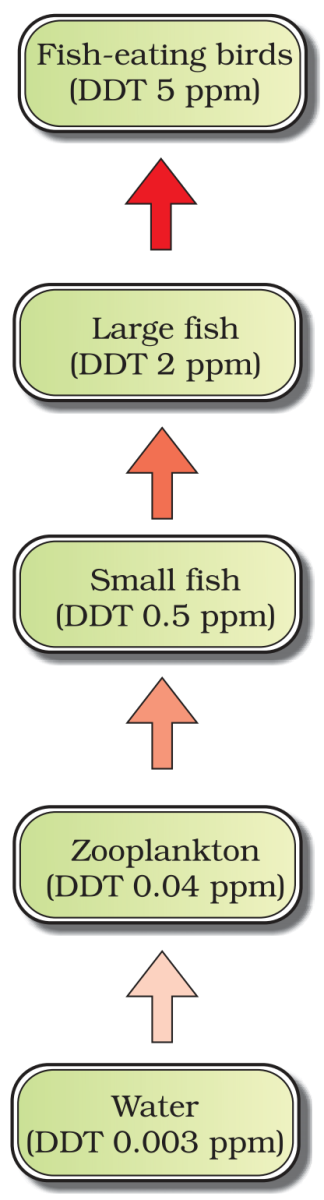
Explain how biomagnification of DDT occurs in an aquatic food chain.
Answer
DDT in water taken up by an organism cannot be metabolised or excreted and thus passed on to successive trophic level in higher concentration.
Water 0.003 ppm $\rightarrow$ Zooplankton 0.04 ppm $\rightarrow$ Small fish 0.5 ppm $\rightarrow$ Large fish 2 ppm $\rightarrow$ Fish eating birds 25 ppm.
View full question & answer
Question 133 Marks
  1. Rearrange the following greenhouse gases in increasing order of their relative contribution to the total global warming:
$\mathrm{N}_2 \mathrm{O} ; \mathrm{CFC}_{;} \mathrm{CO}_2 ; \mathrm{C}_2 \mathrm{H}_4$.
  1. What is the effect of global warming on polar ice-caps? Comment on its possible ecological impact.
Answer
  1. $\mathrm{C}_2 \mathrm{H}_4 \rightarrow \mathrm{~N}_2 \mathrm{O} \rightarrow \mathrm{CFC} \rightarrow \mathrm{CO}_2 / \mathrm{N}_2 \mathrm{O} \rightarrow \mathrm{CFC} \rightarrow \mathrm{CH}_4 \rightarrow \mathrm{CO}_2$ (Highest).
  2. (Global warming) $\rightarrow$ Rise in Atmospheric temperature $\rightarrow$ polar ice melts $\rightarrow$ increase in sea level $\rightarrow$ coastal land mass submerge.
View full question & answer
Question 143 Marks
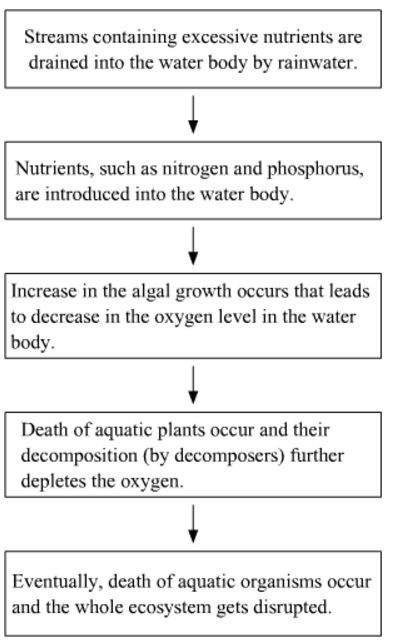
With the help of a flow-chart exhibit the events of eutrophication.
Answer
Enrichment of water body by excessive nutrients is known as eutrophication.
The events of eutrophication are as follows:
View full question & answer
Question 153 Marks
"Determination of Biological Oxygen Demand (BOD) can help in suggesting the quality of a water body." Explain.
Answer
High BOD of a water body indicates more number of micro-organisms in water, resulting in bad quality of water/death of aquatic creatures, more polluting potential.
Lower BOD of water body indicates less number of micro-organisms in water, good quality of water/aquatic life flourishes, less polluting potential.
View full question & answer
Question 163 Marks
With the help of a flow chart, show the phenomenon of biomagnification of DDT in an aquatic food chain.
View full question & answer
Question 173 Marks
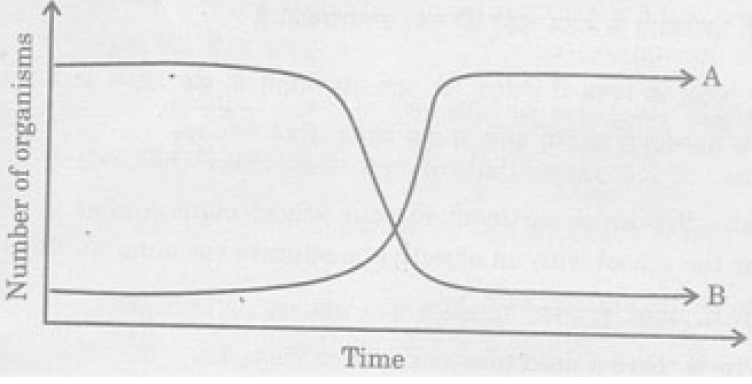
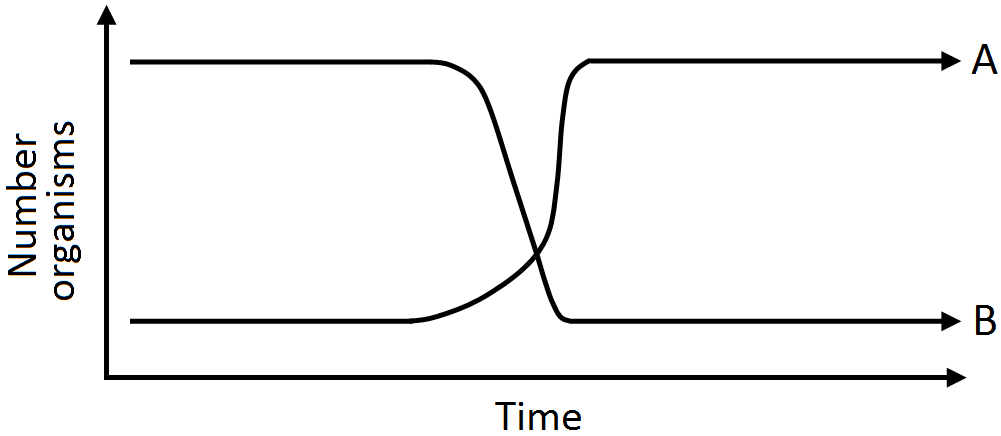
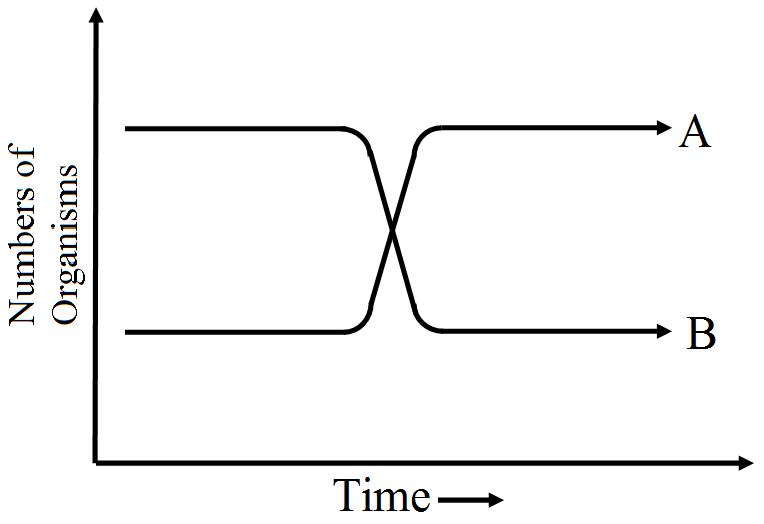
Two types of aquatic organisms in a lake show specific growth patterns as shown below, in a brief period of time. The lake is adjacent to an agricultural land extensively supplied with fertilizers.
Answer the questions based on the facts given above:
  1. Name the organisms depicting the patterns A and B.
  2. State the reason for the growth pattern seen in A.
  3. Write the effects of the growth patterns seen above.
Answer
  1. A - algae/planktonic (free floating) algae.
B - fish/aquatic animals.
  1. Due to excessive loading of nutrients/fertilizers from adjacent agriculture land resulting in increase in nutrients.
  2. Decrease in dissolved oxygen (DO), increase in BOD, fish mortality, unpleasant odour/eutrophication.
View full question & answer
Question 183 Marks
How does algal bloom destroy the quality of a fresh water body? Explain.
Answer
An algal bloom is the phenomenon of excessive growth of planktonic forms in a nutrient rich water body. As the planktonic species multiply on the surface they form a layer that eventually covers the entire surface of the water body.
They block sunlight, which does not reached submerged aquatic plants that may have a role in supplying necessary nutrients to other aquatic life forms and keeping the water clean. Some algal species can release toxic substances.
Due to the high respiratory needs of such a huge concentration of biomass on the surface, the biological oxygen demand (BOD) of the water body increases, causing many of the life forms to die, their carcasses further contribute to the deterioration of the quality of the water content.
View full question & answer
Question 193 Marks
By the end of 2002 the public transport of Delhi switched over to a new fuel. Name the fuel. Why is this fuel considered better? Explain.
Answer
CNG/Compressed Natural Gas.
It burns more efficiently unlike diesel or petrol, very little of it is left unburnt, cannot be adultered, cheaper than petrol or diesel.
View full question & answer
Question 203 Marks
  1. State the consequence if the electrostatic precipitator of a thermal plant fails to function.
  2. Mention any four methods by which the vehicular air pollution can be controlled.
Answer
  1. Particulate matter will pollute the air.
  2. Use of CNG/Phasing out of old vehicles/Use of unleaded petrol/Use of low sulphur fuel/Use of catalytic converters/Application of stringent pollution level norms.
View full question & answer
Question 213 Marks
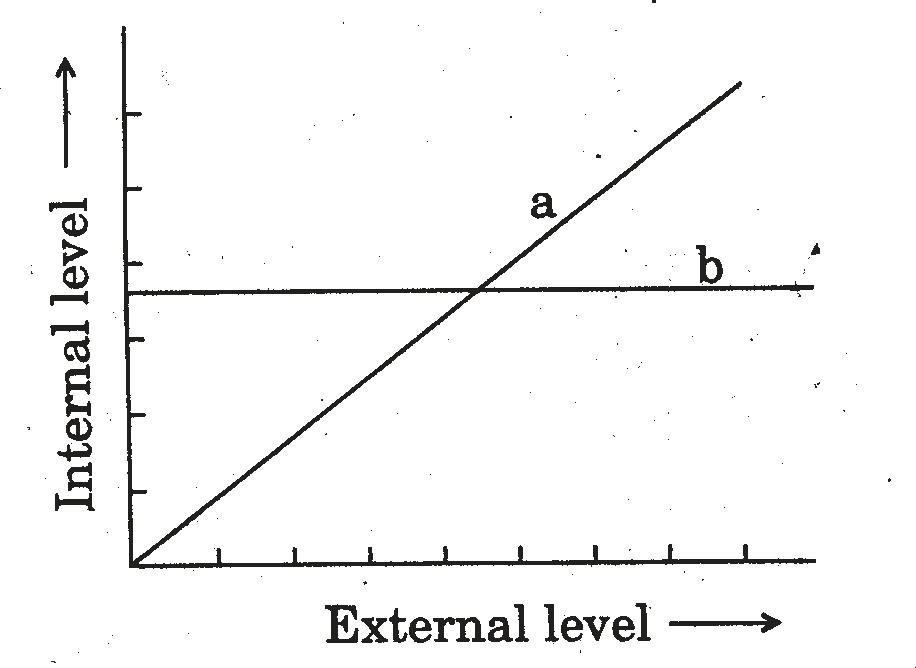
The following graph represents the organismic response to certain environmental condition (e.g., temperature):
  1. Which one of these, ‘a’ or ‘b’, depicts conformers?
  2. What does the other line graph depict?
  3. How do these organisms differ from each other with reference to homoeostasis?
  4. Mention the category to which humans belong.
Answer
  1. a = conformers.
  2. Response of the regulators.
  3. Maintain homoeostasis by physiological means, others either migrate or suspend activities.
  4. Regulators.
View full question & answer
Question 223 Marks
Explain the causes of global warming. Why is it a warning to mankind?
Answer
  1. Emission of greenhouse gases, absorb IR radiation from earth’s surface/emit it again to earth, the cycle continues, till the earth’s surface has no long wave radiations to emit.
  2. Deleterious changes in the environment, odd climatic changes, melting of polar/Himalayan ice caps, rise in sea level, flooding/submerging of coastal areas.
View full question & answer
Question 233 Marks
Ornithologists observed decline in the bird population in an area near a lake after the setting of an industrial unit in the same area. Explain the cause responsible for the decline observed.
Answer
Toxicants like DDT entered the trophic levels of the food chain, accumulated as it can neither be metabolised nor be excreted, toxicants disturb Ca metabolism, result in thinning of egg shells, premature breaking of eggs, population declined.
View full question & answer
Question 243 Marks
Explain any three measures which will control vehicular air pollution in Indian cities.
Answer
Use of CNG as the fuel, use of unleaded petrol, low-sulphur petrol/diesel, use of catalytic converter in the vehicles, phasing out of old vehicles.
View full question & answer
Question 253 Marks
It has been recorded that the temperature of the earth’s atmosphere has increased by O.6C.
  1. What has caused this increase?
  2. Explain its consequences.
Answer
  1. Increase in level of greenhouse gases, molecules of these gases do not allow the infrared radiation of the earth to escape into space; this heat is radiated back, causing global warming.
  2. Consequences - Polar ice caps and glaciers will melt, rise in sea level, mutation of DNA.
View full question & answer
Question 263 Marks
A factory drains its waste water into the nearby lake. It has caused algal bloom.
  1. How was the algal bloom caused?
  2. What would be the consequences?
  3. Name the phenomenon that caused it.
Answer
  1. Nutrients in the waste water cause/extensive growth or proliferation of planktonic or free floating algae.
  2. Algae use $O_2$, BOD value goes high, deterioration of water quality, high fish mortality, scum and unpleasant odour/lake gets chocked/faces death.
  3. Eutrophication.
View full question & answer
Question 273 Marks
What is the ozone shield and why is it important? Name the gases that cause stratospheric ozone depletion.
Answer
The ozone shield is defined as (a chemically distinct) region within the stratosphere, that protects the earth's surface from the Sun's harmful ultraviolet radiation.CFCs/ chlorofluorocarbon, $\mathrm{CH}_4 /$ methane, $\mathrm{N}_2 \mathrm{O} /$ nitrous oxide.
View full question & answer
Question 283 Marks
What is biological magnification? Explain how DDT as a water pollutant undergoes biological magnification?
Answer
Biological magnification: The phenomenon through which certain pollutants get accumulated in tissues in increasing concentrations, along the food chain.DDT concentration increases in the phytoplankton relative to the concentration in water, zooplankton contained greater DDT than phytoplankton, in different fish the DDT concentration increased relative to the concentration in zooplankton, birds showed greater DDT concentration relative to that in fish.
View full question & answer
Question 293 Marks
What is eutrophication? Explain its consequences on the life of plants and animals living in such waters. Why is oxygen depletion in a eutrophicated water-body faster at night than during the day?
Answer
Eutrophication: Process of nutrient enrichment of water, and consequent loss of species diversity.Consequences: Excess nutrients cause profuse growth of algae (algal bloom)/ blue-green algae causing oxygen deficiency in water.
Aquatic animals (e.g., fish) may die due to toxicity/ lack of oxygen.
Because photosynthesis which oxygenates the water ceases at night.
View full question & answer
Question 303 Marks
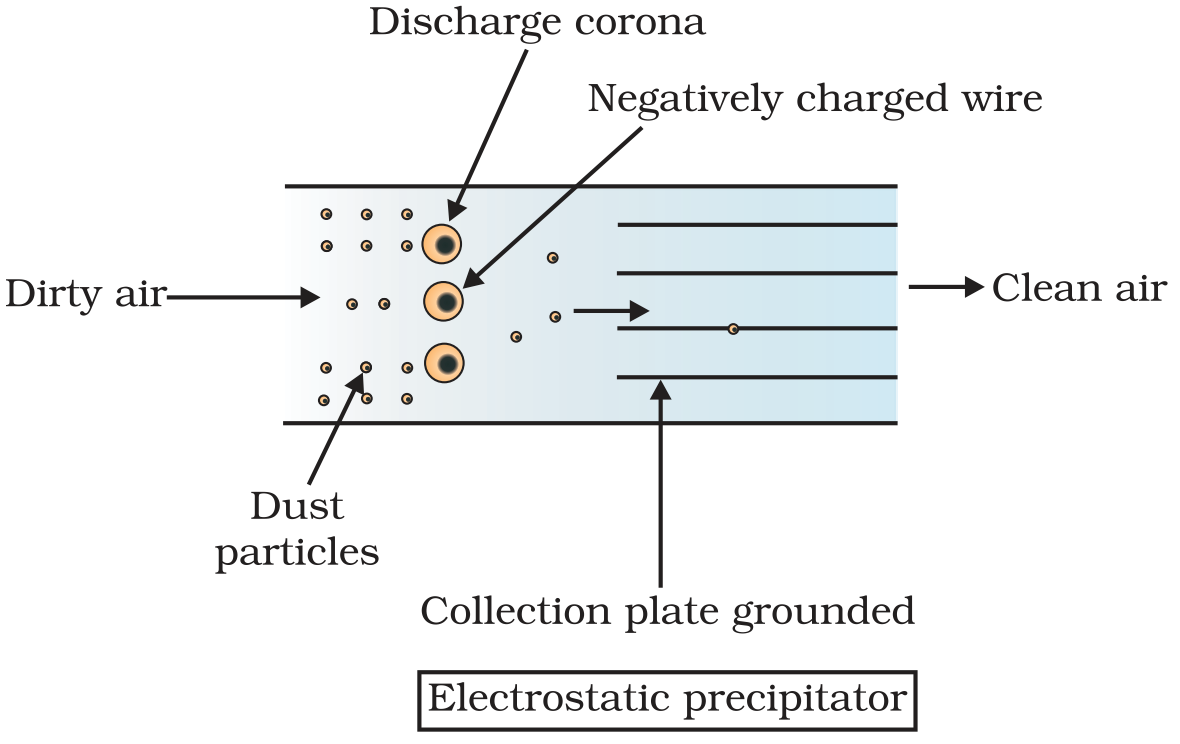
Explain the working of electrostatic precipitator along with diagram.
Answer
It. has electrode wires maintained at a very high voltage which produce a corona that releases electrons.

These electrons get attached to the dust particles and gives them a net negative charge. The collecting plates are grounded to attract the negatively charged dust particles' Thus, when the air passes through the collecting plate, it gets cleaned. Velocity of air between the-plares.is maintained at low value to allow the dust to fall on the collecting plate.
View full question & answer
Question 313 Marks
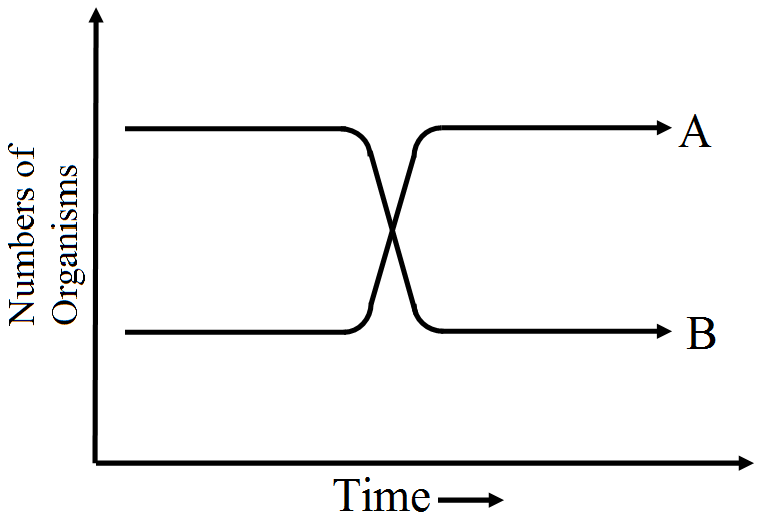
Two types of aquatic organisms in a lake show specific growth patterns as shown below, in brief period of time. The lake is adjacent to an agricultural land extensively supplied with fertilisers.

Answer the questions based on the facts given above:
  1. Name the organisms depicting the patterns A and B.
  2. State the reason for the growth pattern seen in
  3. Write the effects of the growth patterns seen above.
Answer
  1. A: Planktonic algae, Decomposers
B: Fish, other aquatic animals.
  1. Presence of large amount of nutrients like nitrogen and phosphorus.
  2.  
  • The growth of planktonic algae (algal bloom) causes deterioration of water quality and fish mortality.
  • The decomposers acting on the dead plants and animals (organic matter) consume a lot of oxygen (increased BOD) and this causes mortality of fish and other aquatic animals.
View full question & answer
Question 323 Marks
  1. Expand BOD.
  2. At a particular segment of a river near a sugar factory, the BOD is much higher than the normal level. What is it indicative of? What will happen to the living organisms in this part of the river?
  3. Under what conditions will the BOD be lowered in the river? How will it affect the aquatic life?
Answer
  1. BOD-Biochemical Oxygen Demand.
  2. It indicates the addition of lot of organic matter; microorganisms involved in the biodegradation of organic matter in the water body consume a lot of oxygen and as a result, there is a sharp decline in the dissolved oxygen content downstream from the point of addition of effluent from the factory. This causes mortality of fish and other aquatic organisms.
  3. When the amount of organic matter decreases and the microbes do not need oxygen for decomposition, the BOD decreases. Thus, aquatic organisms will start flourishing.
View full question & answer
Question 333 Marks
What are multipurpose trees? Give the botanical and local names of any two multipurpose trees known to you and list their uses.
Answer
Multipurpose trees are that which are grown for more than one purpose or benefits. They may provide food in the form of fruit, seeds, or roots; and also provides firewood, medicines, fibres, etc.
  1. Neem (Azadirachta indicd): Used as insect repellent, antibiotic, firewood and windbreaks.
  2. Coconut palm (Cocos nucifera): Used for food, purified water (juice from inside the coconut), roof thatching, firewood, shade and rope making.
View full question & answer
Question 343 Marks
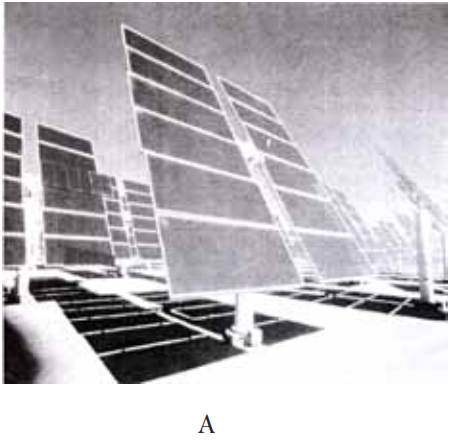
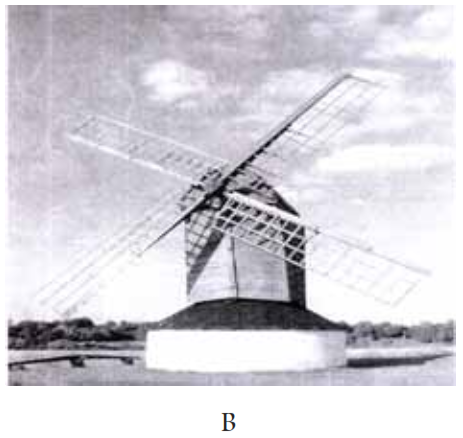
Observe the figure A and B given below and answer the following questions:

  1. The power generation by the above two methods is non-polluting True/False.
  2. List any two applications of solar energy.
  3. What is a photovoltaic cell?
Answer
  1. Yes, it is True.
  2. Two applications of solar energy are; using solar cells to produce electricity, using solar cooker to cook food, using solar heater for hot water.
  3. A cell which converts solar energy into electric energy is known as photovoltaic cell.
View full question & answer
Question 353 Marks
Bring out the relation between BOD, microorganisms and the quantity of biodegradable organic matter.
Answer
  • BOD is the amount of oxygen required by the decomposer micro-organisms for decomposing the organic matter in the water.
  • Higher the BOD, higher is the quantity of organic matter in the water body.
  • If more organic matter is there, the microbes also flourish in the water body and increase their number.
View full question & answer
Question 363 Marks
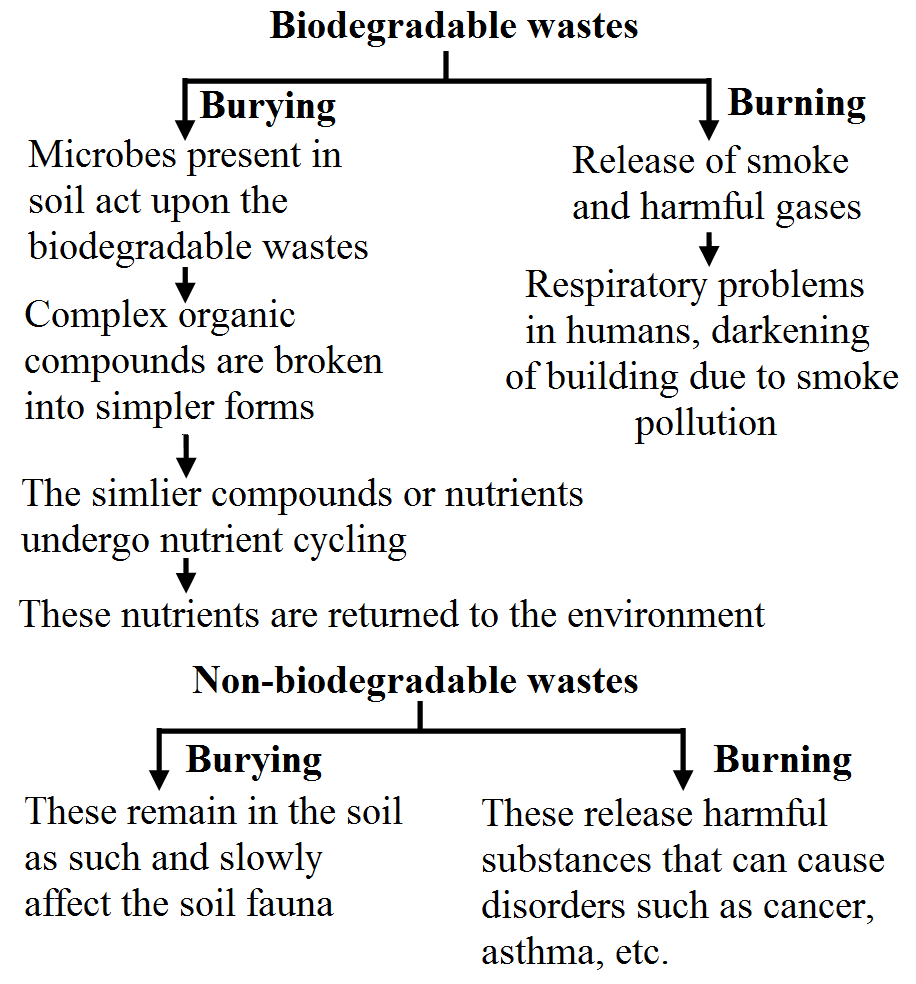
Public all over India is very much concerned about the deteriorating air quality in large parts of North India. Alarmed by this situation the Resident's Welfare Association of your locality organised an awareness programme entitled "Bury not burn'. They invited you, being a biology student to participate.
  1. How would you justify your arguments that promote burying and discourage burning? (Give two reasons).
  2. With the help of flowcharts, one for each practice, depict the chain of events that follow.
Answer
  1. Following arguments can be put forward to promote burying and discourage burning:
  1. When we burn wastes, pollutants such as carbon dioxide, $NO_2, SO_2$, etc., are released in the atmosphere. These pollutants damage the environment. Due to burning, smoke is released into atmosphere which causes problems like asthma, emphysema, etc.
  2. Burying the waste does not have any harmful effect in fact when we bury organic wastes, the soil becomes enriched with nutrients.
  1. The solid wastes are of two types:
  1. Biodegradable wastes: These can be degraded by the microbes, e.g. organic waster paper, etc.
  2. Non-biodegradable wastes: These cannot be degraded by the microbes and can remain as such for long periods, e.g. plastic.
Flowcharts depicting effects of burying and burning are:
View full question & answer
Question 373 Marks
Biological Oxygen Demand or BOD increases with increase in water pollution. In this reference, answer the questions that follow:
  1. At a particular segment of the river near a sugar factory, the BOD is much higher than the normal level. What is it indicative of?
  2. What will happen to the dissolved oxygen and living organisms in this part of the river?
Answer
  1. It indicates that the sugar factory releases organic waste in the water body. To degrade the organic matter, microbes utilise the dissolved oxygen in the water, thereby, reducing the levels of dissolved oxygen and increasing the BOD.
  2. In this part of river, the dissolved oxygen will be depleted making it difficult for aquatic species to survive. It can result in death of fishes in severe cases.
View full question & answer
Question 383 Marks
Two types of aquatic organisms in a lake show specific growth patterns as shown below, in a brief period of time. The lake is adjacent to an agricultural land extensively supplied with fertilisers.

Answer the questions based on the facts given above:
  1. Name the organisms depicting the patterns A and B.
  2. State the reason for the growth pattern seen in A.
  3. Write the effects of the growth patterns seen above.
Answer
  1. A-algae/ planktonic (free floating) algae.
B-fish/ aquatic animals.
  1. Due to excessive loading of nutrients or fertilisers from adjacent agricultural land results increase in nutrients.
  2. Effects: decrease in dissolved oxygen (DO), increase in BOD, fish mortality, unpleasant odour/ eutrophication.
View full question & answer
Question 393 Marks
What is the difference between biological oxygen demand and chemical oxygen demand? What is the effect of a higher biological oxygen demand on the level of dissolved oxygen and sensitive organisms in a water body?
Answer
S. No.
Biological Oxygen Demand (BOD)
Chemical Oxygen Demand (COD)
(i)
It is the amount of oxygen required for microbial breakdown of organic matter.
It is the amount of oxygen required for oxidation of both biodegradable and non-biodegradable organic matter in the water.
(ii)
Its value is less than COD.
Its value is more than BOD.
Higher biological oxygen demand shows that the dissolved oxygen in water bodies is much reduced and thus aquatic animals will die.
View full question & answer
Question 403 Marks
Waste disposal and waste management poses a major problem in present times. Generation of garbage and its disposal is a major threat and consequently leads to severe environmental issues. The problem is not with biodegradable and recycled wastes. We realise that the need is to reduce non-biodegradable wastes.
  1. Why is there a great concern of managing non-biodegradable waste in comparison to biodegradable waste? Explain.
  2. As a member of eco-club of your school, suggest any two ways that you will discuss with your fellow members to organise for a 'Zero garbage day' once in a month in the school.
Answer
  1. The management of non-biodegradable waste is of great concern as comparison to biodegradable waste because non biodegradable waste cannot be degraded by microbes and get accumulated in the environment. Biodegradable waste can be degraded by microbes into simpler form in which it can be used in ecosystem.
  2. Two ways to organise 'zero garbage day' is as follows
  1. Tell them about 'zero garbage day'.
  2. Remind them rules to organise the day and also telling them importance of this day.
View full question & answer
Question 413 Marks
It is a common practice to plant trees and shrubs near the boundary walls of buildings. What purpose do they serve?
Answer
Trees and shrubs are effective in reducing noise level. Planting trees and shrubs near the boundary walls of buildings helps in reducing noise level and act as dust catchers. Such a line of trees along the boundary or along the roadside is also called sound barrier.
View full question & answer
Question 423 Marks
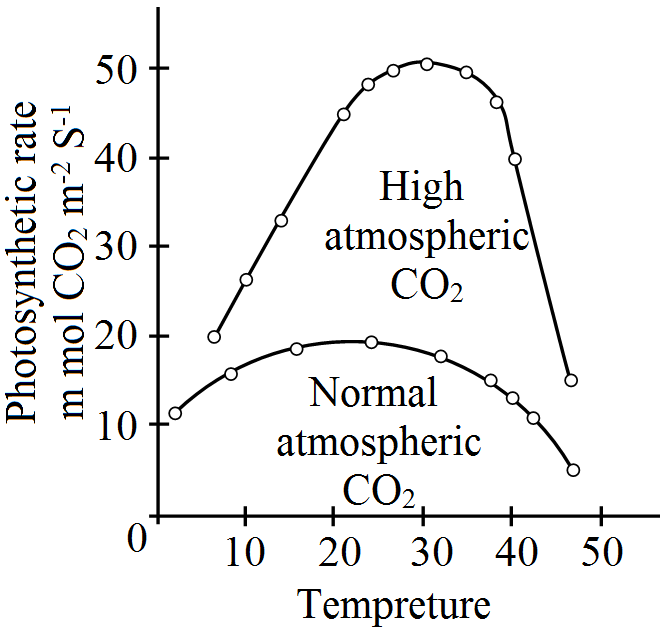
Increased levels of atmosphere $CO_2$ result in the 'greenhouse effect' and thus global warming. The graph shows the effect of these changes on photosynthesis. What do you infer about the effect of $CO_2$ and temperature on the rate of photosynthesis in plants?
Answer
The inferences about the effect of $CO_2$ and temperature on the rate of photosynthesis are:
  1. For most of the plants, temperature above 40°C reduces photosynthesis.
  2. Increase in the concentration of $CO_2$ results in increased rate of photosynthesis upto a limit.
View full question & answer
Question 433 Marks
What is hybrid vehicle technology? Explain its advantages.
Answer
The word hybrid itself suggests the combination of two. Hybrid Vehicle technology is the technology which allows the vehicle to run on dual mode like petrol and CNG.Advantages of hybrid vehicle technology:
  • As CNG is a green fuel, the fossil fuels are conserved.
  • Reduction in environmental pollution.
  • CNG is cheaper than petrol and diesel.
  • CNG can’t be adulterated like petrol or diesel.
View full question & answer
Question 443 Marks
Mention the six harmful effects of noise on human health.
Answer
Six harmful effects of noise on human population are:
  1. Sleeplessness.
  2. Stress.
  3. Increased rate of heartbeat and hypertension.
  4. Breathing problems.
  5. Damage of ear drums impairing hearing ability permanently.
  6. Gastric problems-nausea.
  7. Emotional disturbance
View full question & answer
Question 453 Marks
Soil pollution is mainly caused by agrochemicals. Justify.
Answer
After green revolution, the use of inorganic fertilisers, etc., has increased to enhance the crop productivity. Pesticides, fungicides, herbicides are being increasingly used to serve this Purpose.
These chemical substances are toxic to non-target organisms and also pollute the soil and water bodies. They cause problems like eutrophication, biomagnification and soil pollution.
View full question & answer
Question 463 Marks
What do you understand by Snow-blindness?
Answer
Snow-blindness is also known as photokeratitis. It happens because of exposure of eyes to UV-B radiation. Burning sensation, pain and increased tears are common symptoms of snow-blindness. The person suffering from snow-blindness feels that his eyes are full of sand.
View full question & answer
Question 473 Marks
It has been recorded that the temperature of the earth’s atmosphere has increased by 0.6°C.
  1. What has caused this increase?
  2. Explain its consequences.
Answer
Global Warming:
  • The gradual continuous increase in average temperature of surface of the Earth as a result of increase in concentration of greenhouse gases is termed as global warming.
  1. Cause:
  • Increase in the level of greenhouse gases $(CO_2$, CFCs, etc.$)$ in the atmosphere. These gases allow the heat waves to reach earth but prevent their escape and thus the earth becomes warm.
  1. Effects:
  • The temperature of the earth has increased by 0.6°C in last three decades, which will lead to changes in precipitation patterns.
  • Rise in temperature leads to deleterious changes in environment resulting in odd climatic changes called El Nino effect.
  • The rise in temperature will lead to the increased melting of polar ice caps which will cause the rise in sea level and many coastal areas will be submerged.
  • Increased temperature will lead to increased weed growth, eruption of diseases and pests. Thus, crop productivity will decrease.
View full question & answer
Question 483 Marks
With the revolution in information technology, now it has become an integral part of everybody's live, living in rural and urban India. You are asked to address the gathering of students of eco-clubs of your neighbourhood schools on generation and management of e-waste.
  1. Write how e-waste is generated.
  2. Explain how would you address the awareness issue of e-waste management amongst the students.
  3. How have the developed countries exploited the developing countries with respect to e-waste managements?
Answer
  1. With the rapid development of technology, as more and more electronic products are produced which is driving the ever-increasing production of e-wastes,
  2. Following point can be explained to students to address the awareness issues.
  1. Appropriate use of information technology equipment.
  2. Safe disposal of e-waste.
  1. Developed countries have exploited the developing countries with respect to e-waste managements. The information technology is more advanced in developed countries. They produce many equipment and export them to developing countries that leads to enormous collection of e-wastes in that countries.
View full question & answer
Question 493 Marks
Two types of aquatic organisms in a lake show specific growth patterns as shown below, in a brief period of time. The lake is adjacent to an Time - agricultural land extensively supplied with fertilisers. Answer the questions based on the facts given above.
  1. Name organisms depicting patterns A and B.
  2. State the reason for the growth patterns seen in A.
Answer
  1. The pattern A is depicted by microorganisms and pattern B is depicted by fishes or any other aquatic organism.
  2. As the lake is adjacent to an agricultural land extensively supplied with fertilisers, the run-off water from the field will result in increase in nutrients of lake. Thus, number of microorganisms will rise to degrade organic matter.
View full question & answer
Question 503 Marks
What is the main idea behind “Joint Forest Management Concept” introduced by the Government of India?
Answer
Realising the significance of participation by local communities, the Government of India in 1980s has introduced the concept of Joint Forest Management (JFM) so as to work closely with “the local communities for protecting and managing forests. In return for their services to the forest, the communities get benefit of various forest products (e.g., fruits, gum, rubber, medicine, etc.), and thus the forest can be conserved in a sustainable manner.
View full question & answer
Question 513 Marks
Mention any six harmful effects of noise on human health/ body.
Answer
Noise on human health:
  1. Sleeplessness.
  2. Increased rate of heart beat.
  3. Altered breathing pattern.
  4. Stress.
  5. Very high sound levels > 150 dB can cause damage to eardrum and permanent loss of hearing.
  6. Chronic exposure to low level noise may also cause damage to hearing abilities.
View full question & answer
Question 523 Marks
How does a water body age naturally? Explain. State how this phenomenon of ageing of a water body gets accelerated.
OR
How does eutrophication of a lake take place? Explain.
Answer
Young lake (water is cold and clear)
$\downarrow$
Streams drain into the lake and introduce nutrients like $N_2$, P etc.
$\downarrow$
Fertility of lake increases.
$\downarrow$
Plant and animal life burgeons.
$\downarrow$
Organic remains are deposited at the bottom of the lake.
$\downarrow$
Over centuries, the lake becomes shallower and warmer.
$\downarrow$
Marshy plants take roots and fill in the original lake basin.
$\downarrow$
Large masses of floating plants (bog).
$\downarrow$
Lake is converted into land.
View full question & answer
Question 533 Marks
Why is there a decline in the population of fish-eating birds when the water body is amidst agricultural fields?
Answer
  • It refers to the increase in concentration of the harmful/toxic substances at successive trophic levels.
  • It happens because such harmful/ toxic substances can neither be metabolised nor excreted, but are passed onto the next (higher) trophic level.
  • In fish-eating birds, the high concentrations of DDT disturb the calcium metabolism.
  • It causes thinning of eggshell and the premature breaking of such eggs leads to a decline in bird populations of fish-eating birds.
View full question & answer
Question 543 Marks
Match the Government initiatives to reduce pollution in Column I with the year in which they into effect in Column II.
S.No.
Column I
S.No.
Column II
A.
Air (Prevention and control of Pollution) Act
i.
1974
B.
Joint Forest Management water
ii.
1986
C.
Water (Prevention and Control Pollution)
iii.
1980
D.
Environment (Protection) Act
iv.
1981
Answer
S.No.
Column I
S.No.
Column II
A.
Air (Prevention and control of Pollution) Act
iv.
1981
B.
Joint Forest Management water
iii.
1980
C.
Water (Prevention and Control Pollution)
i.
1974
D.
Environment (Protection) Act
ii.
1986
View full question & answer
Question 553 Marks
A factory drains its waste water into the nearby lake. It has caused algal bloom.
Name the phenomenon that caused it.
Answer
Accelerated eutrophication.
View full question & answer
Question 563 Marks
Answer the following questions in one word:
  1. The impurities in domestic sewage.
  2. The natural source of water pollution.
Answer
  1. It primarily contains biodegradable organic matter degraded by the microorganisms. A mere 0.196 impurities make domestic sewage unfit for human use. The impurities include suspended solids (e.g. sand, silt and clay), colloidal material (e.g. faecal matter, bacteria, cloth and paper fibres), dissolved materials (e.g. nutrients like nitrate, ammonia, phosphate, sodium and calcium).
  2. Clay and silt from soil erosion, leaching of minerals and filling of organic matter from the banks constitute natural sources of water pollution.
View full question & answer
Question 573 Marks
Kishor visited his village and saw some trees on the boundary of the agricultural field. He thought that these are for partioning the land and discussed the matter with his grandfather. His grandfather explained him the utility of trees to the farmers and the farmlands.
  1. What are the benefits these trees impart to the farmland?
  2. What are such trees called?
Answer
  1. ​The benefits these trees impart to the farmland are:
  1. Prevent soil erosion.
  2. Provide shade during excessively high temperatures in the sunlight in hot season.
  3. Regulate/ control wind speed.
  1. Such trees are called multi-purpose trees.
  2. Kishor is a vigilant, nature loving and attentive boy.
View full question & answer
Question 583 Marks
How are solid wastes disposed of?
Answer
  1. Burning reduces the volume of solid wastes.
  2. Solid wastes are buried in the landfills.
  3. Hospital wastes are incinerated.
  4. Some materials are recycled.
  5. Biodegradable wastes can be decomposed into manure.
View full question & answer
Question 593 Marks
Explain two ways of 'improper resource utilization' that can cause degradation of natural resources.
Answer
  1. Soil erosion is caused by over-cultivation, unrestricted grazing, poor irrigation practices and deforestation
  2. Irrigation without proper drainage of water leads to waterlogging in the soil.
  • Waterlogging draws salts to the surface of the soil which are deposited as a thin crust on the surface or collect at the roots of plants, this affects crop growth severely.
View full question & answer
Question 603 Marks
  1. What are the three kinds into which all the wastes we generate can be categorised. How can they be disposed of?
  2. Why are the colourful polysterene and plastic packaging used for protecting the food, considered an environmental menace?
Answer
  1. The three categories of wastes are:
  1. Biodegradable.
  2. Recyclable.
  3. Non-biodegradable.
  1. Since polysterene and plastic are non-biodegradable; they remain in the soil for several years and contribute heavily to environmental pollution.
View full question & answer
Question 613 Marks
Why should the spraying of DDT as an insecticide on vegetable crops be banned? Explain.
Answer
  • When DDT is sprayed on the crop plants, it remains in the soil as it is non-biodegradable and enters the plant.
  • As it travels through food chain, it undergoes biomagnification, i.e. increase in concentration at successive higher trophic levels, as it can neither be metabolised nor excreted; this causes disorders in those organisms.
  • In birds, a high concentration of DDT interferes with calcium metabolism and causes thinning of egg shells leading to their premature breaking, consequently there is a decline in bird population.
View full question & answer
Question 623 Marks
Why has the National Forest Commission of India recommended a relatively larger forest cover for hills than for plains?
Answer
It is an established fact that conservation efforts in biodiversity rich area always give better results. Hills have better biodiversity than plans because of less degree of human intervention in plains. This is the reason the National Forest Commission of India has recommended a relatively larger forest cover for hills than for plains.
View full question & answer
Question 633 Marks
While explaining environmental issues, teacher makes a remark that 'Global warming is the most serious threat to civilisation now'. Kalpana gets curious about the various aspects of global warming and asks some questions to her teacher.
  1. What is global warming?
  2. What are various causes of global warming?
  3. How can global warming be reduced?
  4. What values are shown by Kalpana?
Answer
  1. The gradual continuous increase in average temperature of surface of the earth, is called global warming.
  2. Various causes of global warming are:
    1. High level of greenhouse gases in the atmosphere.
    2. Rise in atmospheric temperature.
  3. Global warming can be reduced by taking following steps:
  1. Cutting down use of fossil fuels.
  2. Improving energy usage efficiency.
  3. Reducing deforestation.
  1. Planting trees and slowing down the growth of human population.
  2. International initiatives are also being taken to curb the emission of greenhouse gases, mostly CFCS.
  3. Kalpana is inquisitive, attentive and environment friendly.
View full question & answer
Question 643 Marks
  1. How is ozone formed in the 'stratosphere'?
  2. CFCs contribute to ozone hole formation. Explain.
Answer
  1. Ozone is formed by the action of UV rays on molecular oxygen in the stratosphere.
  2.  
  • CFCs discharged in the lower part of the atmosphere move upward and reach stratosphere.
  • In the stratosphere, UV rays act on CFCs and release Cl atoms.
  • Cl atoms act as catalyst and degrade the ozone into molecular oxygen.
  • Since Cl atoms are not consumed, whatever CFCs are added to the stratosphere, they have a permanent and continuing effect on ozone levels.
View full question & answer
Question 653 Marks
  1. Expand BOD.
  2. At a particular segment of a river near a sugar factory, the BOD is much higher than the normal level. What is it indicative of? What will happen to the living organisms in this part of the river?
Answer
  1. BOD
  • Biochemical Oxygen Demand.
  1.  
  • It indicates the addition of lot of organic matter, micro-organisms involved in the biodegradation of organic matter in the water body consume a lot of oxygen and as a result, there is a sharp decline in the dissolved oxygen content downstream from the point of addition of effluent from the factory.
  • This causes mortality of fish and other aquatic organisms.
View full question & answer
Question 663 Marks
What is global warming? List four strategies for reducing global warming.
Answer
Increase in the level of greenhouse gases in the atmosphere causes the rise in global mean temperature called global warming.Four strategies for reducing global warming are:
  1. Reducing deforestation.
  2. Planting trees (afforestation).
  3. Slowing down the growth of human population.
  4. Reduction of emission of greenhouse gases into the atmosphere.
  5. Cutting down use of fossil fuels.
  6. Improving efficiency of energy usage.
View full question & answer
Question 673 Marks
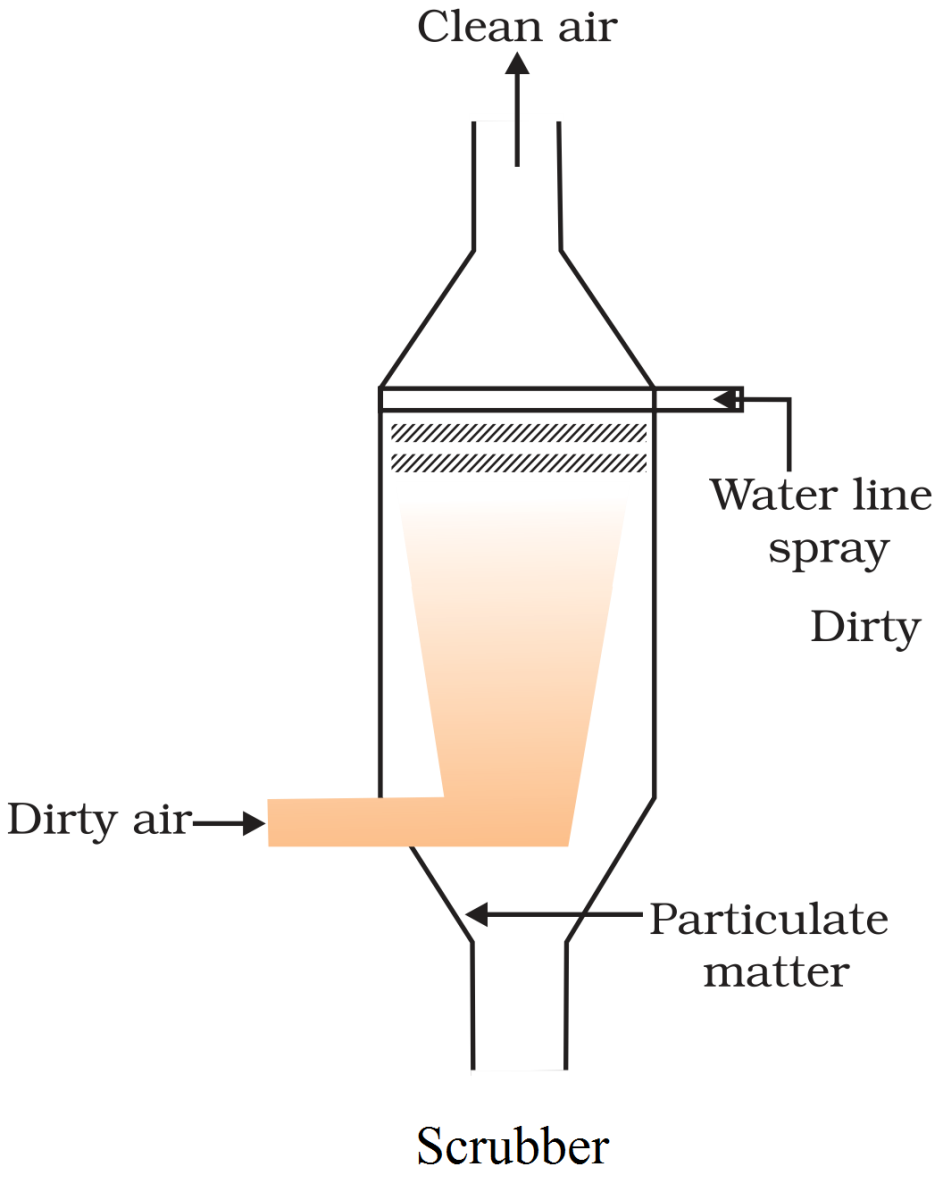
Draw a schematic labelled sketch of a scrubber and mention its use to remove pollutants.
Answer
Scrubber:
  • It is used to remove gases like sulphur dioxide from industrial exhaust.
  • The exhaust is passed through a spray of water or lime.
  • Water dissolves the gases and lime reacts with sulphur dioxide to form a precipitate of calcium sulphate or sulphite.
View full question & answer
Question 683 Marks
State the function of catalytic converter in automobile. Name any two metals used in these converters.
Answer
Catalytic converters are fitted into automobiles (major cause ofair pollution in metro cities) for reducing emissions of poisonous gases like CO and $NO_2$. They are made with expensive metals like platinum-palladium and rhodium as catalysts.As the exhaust passes through catalytic converter, following changes occur:
  • Unburnt hydrocarbons get burnt completely into $\mathrm{CO}_2$ and $\mathrm{H}_2 \mathrm{O}$.
  • Carbon monoxide and nitric oxide are convened into $\mathrm{CO}_2$ and $\mathrm{N}_2$ gases, respectively.
Motor vehicles equipped with catalytic converter should use unleaded petrol, as lead present in petrol inactivates the catalyst.
View full question & answer
Question 693 Marks
A factory drains its waste water into the nearby lake. It has caused algal bloom.
How was the algal bloom caused?
Answer
Algal bloom is caused due to large amounts of nutrients present in the waste water.
View full question & answer
Question 703 Marks
Match the DDT concentration in Column I with the organisms in an aquatic food chain in Coulmn II.
S. No. Column I S. No. Column II
A. 0.04ppm i. Large fish
B. 2.0ppm ii. Zooplanktons
C. 0.5ppm iii. Fish-eating birds
D. 25ppm iv. Small fish
Answer
S. No.
Column I
S. No.
Column II
A.
0.04ppm
ii.
Zooplanktons
B.
2.0ppm
i.
Large fish
C.
0.5ppm
iv.
Small fish
D.
25ppm
iii.
Fish-eating birds
View full question & answer
Question 713 Marks
A factory drains its waste water into the nearby lake. It has caused algal bloom.
What would be the consequences?
Answer
It causes deterioration of water quality and increased fish mortality rate. Some bloom forming algae are toxic to human beings and animals.
View full question & answer
Question 723 Marks
Since October 02, 2014 'Swachh Bharat Abhiyan' has been launched in our country.
  1. Write your views on this initiative giving justification.
  2. As a biologist name two problems that you may face while implementing the programme in your locality.
  3. Suggest two remedial methods to overcome these problems.
Answer
  1. 'Swachh Bharat Abhiyan' is a cleanliness drive launched by Shri Narendra Modi, Prime Minister of India on 2 October 2014. I totally support this campaign. This initiative is needed to solve the sanitation problem and waste management in India. Following this drive all citizens will ensure hygiene across the country. It will spread awareness among people on the importance of clean surroundings. An unclean environment leads to various diseases, different types of pollution and creates a feeling of disgust in the minds of viewer. As a responsible Indian citizen, we all should join this drive with enthusiasm.
  2. Two major problems can be:
  1. Lack of adequate sanitation.
  2. Separation of biodegradable and non-biodegradable substances, so that they can be treated properly.
  1. Two remedial measures to overcome these problems are:
  1. Large number of toilets need to be constructed and people should be made aware about the importance of proper sanitation.
  2. Separate bins have to be installed for biodegradable and non-biodegradable substances.
View full question & answer
Question 733 Marks
Delhi Municipality has started the concept of keeping two dustbins of two different colours (green and blue) in many places, for waste disposal.
  1. What is the significance of this practice?
  2. Differentiate between the two types of wastes we produce. Which of them is more harmful and must be reduced significantly?
  3. What value can be learnt from this arrangement?
Answer
  1. Two dustbins of different colours are meant for separating the two types of wastes.
  2. Two types of wastes are:
  • Biodegradable wastes in the green dustbin).
  • Non-biodegradable wastes (in the blue dustbin).
Biodegradable wastes
Non-biodegradable wastes
These are the wastes which can be broken down into simpler, harmless, (sometimes useful) substances by the action of living organisms through decomposition.
These are the wastes which cannot be broken down into simpler or harmless substances by the action of living organisms.
  • Non-biodegradable wastes are more harmful, as they tend to remain as such for many years on the surface of earth; this type of wastes must be reduced significantly.
  1. Non-biodegradable wastes must be reduced. Biodegradable wastes can be used for various purposes so as to reduce pressure on natural resources.
  • Pollution from non-biodegradable wastes can be reduced.
View full question & answer