Questions

2 Marks Questions

Take a timed test

128 questions · self-marked practice — reveal the answer and mark yourself.

Question 12 Marks
What is the key difference between primary and secondary sewage treatment?
Answer
Primary (1°) treatment is a physical process that involves for removal of particulate as settelable particle. Secondary (2°) treatment is purely a biological treatment involving microbial oxidation.
View full question & answer
Question 22 Marks
What is sewage? In which way can sewage be harmful to us?
Answer
Sewage is the municipal waste matter that is carried away in sewers and drains. It includes both liquid and solid wastes, rich in organic matter and microbes. Many of these microbes are pathogenic and can cause several water - borne diseases. Sewage water is a major cause of polluting drinking water. Hence, it is essential that sewage water is properly collected, treated, and disposed.
View full question & answer
Question 32 Marks
Give examples to prove that microbes release gases during metabolism.
Answer
  1. Making of dough for bread, dosa and idli with the help of fermenting microbes. Heat expels the gases and makes the food spongy.
  2. Production of biogas.
View full question & answer
Question 42 Marks
Find out the name of the microbes from which Cyclosporin A (an immunosuppressive drug) and Statins (blood cholesterol lowering agents) are obtained.
Answer
  1. Cyclosporin-A is obtained from the fungus Trichoderma polysporum.
  2. Statins is obtained from Monascus purpureus.
View full question & answer
Question 52 Marks
Find out the role of microbes in the following and discuss it with your teacher.
Soil
Answer
Soil
Microbes play an important role in maintaining soil fertility. They help in the formation of nutrient-rich humus by the process of decomposition. Manyspecies of bacteria and cyanobacteria have the ability to fix atmospheric nitrogen into usable form. Rhizobium is a symbiotic bacteria found in the root nodules of leguminous plants. Azospirillium and Azotobocter are free living nitrogen-fixing bacteria, whereas Anabena, Nostoc, and Oscillitoria are examples of nitrogen-fixing cyanobacteria.
View full question & answer
Question 62 Marks
Find out the role of microbes in the following and discuss it with your teacher.
Single cell protein (SCP)
Answer
Single cell protein (SCP):
A single cell protein is a protein obtained from certain microbes, which forms an alternate source of proteins in animal feeds. The microbes involved in the preparation of single cell proteins are algae, yeast, or bacteria. These microbes are grown on an industrial scale to obtain the desired protein. For example, Spirulina can be grown on waste materials obtained from molasses, sewage, and animal manures. It serves as a rich supplement of dietary nutrients such as proteins, carbohydrate, fats, minerals, and vitamins. Similarly, micro-organisms such as Methylophilus and methylotrophus have a large rate of biomass production. Their growth canproduce a large amount of proteins.
View full question & answer
Question 72 Marks
Bacteria cannot be seen with the naked eyes, but these can be seen with the help of a microscope. If you have to carry a sample from your home to your biology laboratory to demonstrate the presence of microbes under a microscope, which sample would you carry and why?
Answer
Curd can be used as a sample for the study of microbes. Curd contains numerous lactic acid bacteria (LAB) or Lactobacillus. These bacteria produce acids that coagulate and digest milk proteins. A small drop of curd contains millions of bacteria, which can be easily observed under a microscope.
View full question & answer
Question 82 Marks
Give the binomials of two types of yeast and the commercial bioactive products they help to produce.
Answer
Saccharomyces cerevisiae- ethanol/alcohol.
Monascus purpureus- statin.
View full question & answer
Question 92 Marks
Name a free-living and a symbiotic bacterium that serve as bio-fertilizer.Why are they so called?
Answer
Azospirillium/Azotobacter, Rhizobium.
They enrich soil nutrient/nitrogen fixation.
View full question & answer
Question 102 Marks
Explain the function of ‘‘anaerobic sludge digester’’ in a sewage treatment plant.
Answer
In anaerobic sludge digester, methanogens, i.e. anaerobic bacteria, digest the bacteria and fungi of the floe in the activated sludge.
This produces mixture of methane, hydrogen sulphide and carbon dioxide, i.e. biogas. This gas is used as a source of energy as it is inflammable.
View full question & answer
Question 112 Marks
Write the binomials of two fungi and mention the products/bioactive molecules they help to produce.
Answer
  • Trichoderma polysporum, cyclosporin A.
  • Aspergillus niger, citric acid.
  • Monascus purpureus, statin.
  • Saccharomyces cerevisiae, ethanol/alcohol.
  • Penicillium notatum, Penicillin.
View full question & answer
Question 122 Marks
Explain the process of secondary treatment given to the primary effluent up to the point it shows significant change in the level of biological oxygen demand (BOD) in it.
Answer
Supernatant from the primary treatment is passed into large aeration tanks during secondary treatment. In these tanks, the effluent is agitated mechanically and air is pumped into it. This causes vigorous growth of the bacteria that lead to the formation of floc, which consists of bacteria and fungal filaments in a mesh-like structure. While growing, these microbes consume the major part of organic matter in the effluent; it decreases the biological oxygen demand (BOD).
After a significant drop in BOD is observed, effluent is passed on to the settling tank.
View full question & answer
Question 132 Marks
Name the microbes that help production of the following products commercially:
  1. Statin.
  2. Citric acid.
  3. Penicillin.
  4. Butyric acid.
Answer
  1. Monascus purpureus.
  2. Aspergillus niger.
  3. Penicillium notatum.
  4. Clostridium butylicum.
View full question & answer
Question 142 Marks
Explain the different steps involved during primary treatment phase of sewage.
Answer
Physical removal of particles (large and small), mutualism by filtration and sedimentation, forming primary sludge/sedimented solids, forming effluent (supernatant) for secondary treatment.
View full question & answer
Question 152 Marks
Explain the significant role of the genus Nucleopolyhedrovirus in an ecological sensitive area.
Answer
Species specific, narrow spectrum, insecticidal application (IPM), no negative impact on plants/mammals/birds/fish/even non target insects.
View full question & answer
Question 162 Marks
Name the bacterium responsible for the large holes seen in “Swiss Cheese”. What are these holes due to?
Answer
Swiss cheese is ripened by bacterium Propionibacterium Sharmanil which produce $CO_2$. $CO_2$ caused the large holes in ‘Swiss cheese’.
View full question & answer
Question 172 Marks
  1. Mention the cause and the body system affected by ADA deficiency in humans.
  2. Name the vector used for transferring ADA-DNA into the recipient cells in humans. Name the recipient cells.
Answer
  1. Defective gene not producing ADA, immune system is affected.
  2. A retroviral vector is used, recipient cells are lymphocytes.
View full question & answer
Question 182 Marks
Name the enzyme produced by Streptococcus bacterium. Explain its importance inmedical sciences.
Answer
Streptokinase,
Used as a clot buster/for removing clots from the blood vessels (in a patient suffering from myocardial infarction/or in a heart patient).
View full question & answer
Question 192 Marks
A recombinant DNA is formed when sticky ends of vector DNA and foreign DNA join. Explain how the sticky ends are formed and get joined.
Answer
Restriction enzymes cut the DNA sequence a little away from the centre of the palindrome site but between the same two bases on the opposite strands, leaving single stranded portions at the ends these over hanging stretches are called sticky ends on each strand. They form hydrogen bonds with the complementary cut counterparts, facilitates the action of ligase enzymes to join the foreign and the vector DNA strands.
View full question & answer
Question 202 Marks
Name the blank spaces a, b, c and d from the table given below:
Type of Microbe Scientific Name Commercial Product
Bacterium a Lactic acid
Fungus b Cyclosporin A
c Monascus purpureus Statin
Fungus Penicillium notatum d
Answer
  1. Lactobacillus.
  2. Trichoderma polysporum.
  3. Yeast.
  4. Penicillin.
View full question & answer
Question 212 Marks
Name a bioactive molecule, its source organism and the purpose for which it is given to organ transplant patients.
Answer
Cyclosporin ASource- Trichoderma polysporum.
Purpose- Immuno suppressive agent.
View full question & answer
Question 222 Marks
Distinguish between the roles of flocks and anaerobic sludge digesters in sewage treatments.
Answer
 
Flocs
Anaerobic Sludge Digester
1.
Breakdown organic matter aerobically
Breakdown organic matter anaerobically
2.
Breakdown organic matter present in primary effluent.
Breakdown organic matter in secondary effluent.
3.
They do not produce biogas.
They produce biogas. (mixture of methane, $\mathrm{H}_2 \mathrm{S}$ and $\mathrm{CO}_2$ )
View full question & answer
Question 232 Marks
How does the application of cyanobacteria help improve agriculture output?
Answer
Fixes atmospheric $N_2$/adds organic matter/increases soil fertility/replenish soil nutrients/acts as bio fertiliser/reduce dependence on chemical fertilisers.
View full question & answer
Question 242 Marks
List the events that lead to biogas production from waste water whose BOD has been reduced significantly.
Answer
Sedimentation of flocs to form activated sludge, sludge pumped to anaerobic sludge digester, growth of anaerobic bacteria, digestion of sludge by bacteria to release biogas.
View full question & answer
Question 252 Marks
How does the application of the fungal genus, Glomus, to the agricultural farm increase the farm output?
Answer
Glomus forms mycorrhizal association, absorbs phosphorus, provide resistance to root borne pathogens, enhanced to tolerate salinity/drought.
View full question & answer
Question 262 Marks
List the events that reduce the Biological Oxygen Demand (BOD) of a primary effluent during sewage treatment.
Answer
Effluent from the primary settling tank passed into aeration tank, agitated mechanically and air is pumped into it, vigorous growth of aerobic microbes into flocs, microbes consume major part of the organic matter in effluent.
View full question & answer
Question 272 Marks
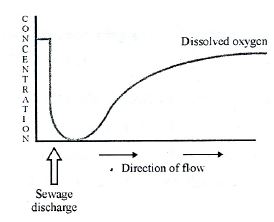
Study the graph given below. Explain how is oxygen concentration affected in the river when sewage is discharged into it.
Answer
Oxygen is used up by microorganisms involved in biodegradation resulting in sharp decline at the point of sewage discharge, the concentration of oxygen increases as we move farther from the point of sewage discharge.
View full question & answer
Question 282 Marks
During the secondary treatment of the primary effluent, how does the significant decrease in BOD occur?
Answer
During the secondary treatment of the primary affluent (Primary effluents are passed into a large aeration tank, where it is constantly agitated, and air is pumped into it) vigorous growth of useful aerobic microbes, into flocs takes place, these microbes use major part of the organic matter, and this reduces BOD.
View full question & answer
Question 292 Marks
Name the blank space a, b, c and d in the table given below:
S.No. Type of Microbe Name Commercial Product
1. Fungus a Penicillin.
2. Bacterium Acetobacter aceti. b
3. c Aspergillus niger. Citric acid.
4. Yeast d Ethanol.
Answer
  1. Penicillium notatum.
  2. Acetic acid.
  3. Fungus.
  4. Saccharomyces cerevisiae.
View full question & answer
Question 302 Marks
Your advice is sought to improve the nitrogen content of the soil to be used for cultivation of a non-leguminous terrestrial crop.
  1. Recommend two microbes that can enrich the soil with nitrogen.
  2. Why do leguminous crops not require such enrichment of the soil?
Answer
  1. Azospirillum, Azotobacter, Anabaena, Oscillatoria.
  2. Leguminous crops have symbiotic association with Rhizobium bacteria which traps $N_2$ directly from atmosphere and provides it to the plant and in turn gets food and shelter.
View full question & answer
Question 312 Marks
During the secondary treatment of the primary effluent how does the significant decrease in BOD occur?
OR
During the secondary treatment of the primary effluent how does the significant decrease in BOD occur?
Answer
During secondary treatment of primary effluents, vigorous growth of useful aerobic microbes into flocs occur when it is agitated mechanically and air is pumped into it in a large aeration tank. These microbes while growing consume major part of the organic matter in the effluent. This significantly reduces BOD.
  • Useful aerobic microbes grow rapidly and form flocs.
  • Flocs are masses of bacteria associated with fungal filaments to form mesh-like structures.
  • The growing microbes consume organic matter and thus reduce the biochemical oxygen demand (BOD).
View full question & answer
Question 322 Marks
What are methanogens? How do they generate biogas?
Answer
Anaerobic methane producing bacteria are called methanogens. Methanogens generate biogas when they act by anaerobic decomposition on cellulose rich biowaste (anaerobically).
View full question & answer
Question 332 Marks
Name any two varieties of cheese and mention the names of microbes used?
Answer
  • Swiss cheese: Propionibacterium
  • Roquefort cheese: Penicillium roqueforti
View full question & answer
Question 342 Marks
What would happen if a large volume of untreated sewage is discharged into a river?
Answer
Due to increasing urbanisation, sewage is being produced in much larger quantities than ever before. However the number of sewage treatment plants has not increased enough to treat such large quantities. So the untreated sewage is often discharged directly into rivers leading to their pollution and increase in water-borne diseases.
View full question & answer
Question 352 Marks
How do cyanobacteria act as biofertiliser?
Answer
Cyanobacteria as biofertilisers:
  • They fix atmospheric nitrogen and increase the organic matter of the soil through their photosynthetic activity, e.g., Nostoc, Anabaena, Oscillatoria, etc.
  • Blue-green algae increase the soil fertility by adding organic matter to the soil.
View full question & answer
Question 362 Marks
Name a free-living and a symbotic bacterium that serves as biofertiliser. Why are they called so?
Answer
Azotobacter is a free-living bacteria serving as a biofertiliser. This bacteria absorb free nitrogen from the soil, air and convert it into salts of nitrogen compounds and enrich the soil nutrients.
Rhizobium is a symbiotic bacterium that lives in the root nodules of legumes and fixes atmospheric nitrogen into organic compounds and enrich the soil nutrients.
View full question & answer
Question 372 Marks
List four advantages that a symbiotic mycorrhizal association provides to the host plant.
Answer
  • The fungus absorbs phosphorus from the soil and passes it to the plant.
  • Plants with mycorrhiza show resistance to root-borne pathogens.
  • They show increased tolerance to salinity and drought.
  • There is an overall increase in plant growth and development.
View full question & answer
Question 382 Marks
What is biogas? Why is it preferred to other conventional energy fuels?
Answer
The gas produced by the anaerobic action of bacteria on biomass is known as biogas. It is preferred over other conventional energy fuels because it is a cleaner fuel, has no foul smell and can be used as a source of energy as it is inflammable.
View full question & answer
Question 392 Marks
Which plant sap is used in making toddy? Mention the process involved in it.
Answer
It is a traditional drink of some parts of Southern India. It is made by fermenting sap from palm trees, coconut, etc. Microbes are also used to ferment fish, soybean, bamboo shoos, etc. to make food.
View full question & answer
Question 412 Marks
What is BOD? What does it mean if a water sample has more BOD?
Answer
BOD stands for biochemical oxygen demand which represents the amount of dissolved oxygen that would be consumed if all the organic matter in one litre of water were oxidised by microorganisms. More BOD value means the water sample is polluted by organic matter.
View full question & answer
Question 422 Marks
How is ‘toddy’ prepared?
Answer
Toddy is a traditional drink of southern India which is prepared by the yeast fermentation of coconut water.
View full question & answer
Question 432 Marks
Write the binomials of two fungi and mention the products/ bioactive molecules they help to produce.
Answer
Fungi Products/ Bioactive molecules produced
Trichoderma polysporum Cyclosporin A
Aspergillus niger Citric Acid
Monascus purpureus Statin
Saccharomyces cerevisiae Ethanol/alcohol
Penicillium notatum Penicillin
View full question & answer
Question 442 Marks
Name the enzyme produced by Streptococcus bacterium. Explain its importance in medical sciences.
Answer
Streptococcus bacterium produces streptokinase.
It is used for removing clots from the blood vessels in a patient suffering from myocardial infarction/ or in a heart patient.
View full question & answer
Question 452 Marks
What would happen if our intestine harbours microbial flora exactly similar to that found in the rumen of cattle?
Answer
The microbial flora in the rumen of cattle facilitates digestion of cellulose. If such microbial flora will be present in our intestine then humans will also be able to digest cellulose.
View full question & answer
Question 462 Marks
Legumes fertilise the soil but cereals do not. Discuss
Answer
Leguminous plants possess root nodules where nitrogen is fixed by symbiotic nitrogen fixing bacteria Rhizobium whereas cereals do not possess nitrogen fixing bacteria in their root nodules, so, they cannot fertilise the soil.
View full question & answer
Question 472 Marks
Why are some molecules called bioactive molecules? Give two examples of such molecules.
Answer
Some molecules are called bioactive molecules, because microbes like bacteria or fungi are used in their production.
Example:
  • Citric acid: Acetic acid
  • Butyric acid: Lactic acid
  • Ethanol: Lipase
  • Streptokinase: Cyclosporin A
View full question & answer
Question 482 Marks
Why are flocs important in biological treatment of waste water?
Answer
Flocs are masses of bacteria associated with fungal filaments to form mesh like structure. Flocs digest most of the organic material from the sludge. Thus, floc helps in reducing the BOD (Biochemical Oxygen Demand) of the effluent. This helps in further treatment of sludge.
View full question & answer
Question 492 Marks
What does the Ganga Action Plan tend to achieve?
Answer
Ganga Action Plan tends to save the major rivers from pollution. Under these plans, a large number of sewage treatment plants were built so that only treated sewage is discharged in the rivers.
View full question & answer
Question 502 Marks
How has the bacterium Bacillus thuringiensis helped us in controlling caterpillars of insect pests?
Answer
Bacillus thuringiensis products are endotoxin which when ingested and released in the gut of the larvae of insect pest disrupts the insect gut lining thereby killing them.
View full question & answer
Question 512 Marks
Discuss with your teacher and find out how to distinguish between:
Plasmid DNA and Chromosomal DNA
Answer
Plasmid DNA and Chromosomal DNA
Plasmid DNA is an extra-chromosomal DNA molecule in bacteria that is capable of replicating, independent of chromosomal DNA.
Chromosomal DNA is the entire DNA of an organism present inside chromosomes.
View full question & answer
Question 522 Marks
How has the discovery of antibiotics helped mankind in the field of medicine?
Answer
Antibiotics have created a revolution in treatment of diseases. Many infectious diseases which were incurable earlier can now be treated with antibiotics. Antibiotics have helped in saving millions of life.
View full question & answer
Question 532 Marks
Your advice is sought to improve the nitrogen content of the soil to be used for cultivation of a non-leguminous terrestrial crop:
  1. Recommend two microbes that can enrich the soil with nitrogen.
  2. Why do leguminous crops not require such enrichment of the soil?
Answer
  1. Azotobacter, Azospirillum, Nostoc, Anabaena.
  2. Leguminous crops harbour Rhizobium in their root nodules; this bacterium fixes atmospheric nitrogen as nitrogen compounds in the soil.
View full question & answer
Question 542 Marks
Name the two different categories of microbes naturally occurring in sewage water. Explain their role in cleaning sewage water into usable water.
Answer
Aerobic and anaerobic bacteria or fungi exist in sewage water. After the primary treatment of water, aerobic bacteria are added in aeration tanks. Growth of these bacteria reduces BOD as they consume organic matter. Anaerobic bacteria are added in anaerobic sludge digesters, where these digest the sludge and form biogas, etc.
View full question & answer
Question 552 Marks
Describe critically the main ideas behind the biological control of pests and diseases.
Answer
Biological control means life against life. It’s a natural and ecofriendly concept. It employs the natural organisms to control the population of pathogens and pests in an ecosystem. Classical examples are Trichoderma which is antagonist against many soilborne plant pathogens. Similarly, Penicillium inhibits the growth of Staphylococcus and therefore has been successfully used in the production of penicillin antibiotic to control many human bacterial pathogens.
View full question & answer
Question 562 Marks
Consuming curd keeps the gastrointestinal tract intact. Give reason.
Answer
Curd contains lactic acid bacteria which checks the growth of disease-causing microbes and protects the gastrointestinal tract.
View full question & answer
Question 572 Marks
Mention a product of human welfare obtained with the help of the following microbes:
Aspergillus niger.
Answer
Citric acid.
View full question & answer
Question 582 Marks
Common yeast is known as Baker's yeast and also as Brewer's yeast. Justify.
Answer
Common yeast is employed in the fermentation of:
  1. Dough, used for making bread, cakes in bakeries.
  2. Fruit juices and malt in breweries for the production of alcoholic beverages; hence it is known as both as baker's and brewer's yeast.
View full question & answer
Question 592 Marks
How do bioactive molecules of fungal origin help in restoring good health of humans?
Answer
Following are some bioactive molecules of fungal origin which help in restoring good health in humans:
  • Cyclosporin A is produced by Trichoderma polysporum and is used as immunosuppressive agent.
  • Penicillin is a major antibiotic which is produced from Penicillium notatum.
View full question & answer
Question 602 Marks
What is the chemical nature of biogas? Name an organism which is known to be employed in biogas.
Answer
The biogas contains methane, $\mathrm{CO}_2$ and $\mathrm{H}_2$. Methanobacterium, a type of methanogen is employed for biogas production.
View full question & answer
Question 612 Marks
List four advantages that a symbiotic mycorrhizal association provides to the host plant.
Answer
  1. The fungus absorbs phosphorus from the soil and passes it to the plant.
  2. Plants with mycorrhiza show resistance to root-borne pathogens.
  3. They show increased tolerance to salinity and drought.
  4. These show an overall increase in plant growth and development.
View full question & answer
Question 622 Marks
What is a broad spectrum antibiotic? Name a broad spectrum antibiotic and source organism.
Answer
A broad spectrum antibiotic is one which can inhibit the growth of both gram positive and gram negative bacteria. For example, tetracycline, which is obtained from Streptomyces aureofaciens.
View full question & answer
Question 632 Marks
List the events that lead to biogas production from waste water whose BOD has been reduced significantly
Answer
The effluent is passed into a settling tank where the bacterial ‘flocs’ are allowed to sediment. This is called activated sludge. The sludge is pumped into anaerobic sludge digesters where they are anaerobically digested. During this digestion, bacteria produce biogas.
View full question & answer
Question 642 Marks
How does addition of a small amount of curd to fresh milk help in the formation of curd? Mention a nutritional quality that gets added to the curd.
OR
How does ‘starter’ added to milk help it to set into curd?
Answer
When a small amount of curd as starter is added to fresh milk, millions of lactic acid bacteria(LAB) present in the starter grow in milk and convert it to curd. During this process, acids are produced by LAB that coagulate and partially digest the milk proteins.
LAB increases vitamin B12 content along with other vitamins in the curd.
View full question & answer
Question 652 Marks
Distinguish between the roles of flocs and anaerobic sludge digesters in sewage treatments.
Answer
Flocs are masses of bacteria associated with fungal filaments to form mesh-like structures. These consume the major part of the organic matter in the effluent, significantly reducing the BOD. The effluent is then passed into a settling tank where the flocs sediment. A part of this sediment (activated sludge) is pumped into anaerobic sludge digestors where anaerobic digestion of sludge takes place, producing biogas in the process.
View full question & answer
Question 662 Marks
What is the role of baker’s yeast in the production of bread?
Answer
Saccharomyces cerevisiae (Baker’s yeast) causes the alcoholic fermentation of sugars in wheat flour and produce ethanol and CO2. CO2 raises the bread when baked and makes it soft.
View full question & answer
Question 672 Marks
A farmer is advised to sow leguminous seeds inoculated with a bacterial culture that helps in increasing crop yield. Name the bacterium in the culture. How is this bacterium useful to the crop?
Answer
  1. The bacterium is Rhizobium.
  2. It fixes atmospheric nitrogen in the form of nitrogenous compounds in the soil; thus the legume crop is benefitted with nitrogen.
View full question & answer
Question 682 Marks
Name a free-living and a symbiotic bacterium that serve as bio-fertiliser. Why are they so called?
Answer
Azospirillium/ Azotobacter and Rhizohium act as biofertilisers. They are so called because they enrich soil nutrient by nitrogen fixation.
View full question & answer
Question 692 Marks
Which bacterium has been used as a clot buster? What is its mode of action.
Answer
Streptokinase produced by the bacterium Streptococcus and modified by genetic engineering is used as a ‘clot buster’ for removing clots from the blood vessels of patients who have undergone myocardial infarction leading to heart attack.
View full question & answer
Question 702 Marks
Distinguish between primary sludge and activated sludge.
Answer
Primary sludge includes all solid substances which got settled after primary treatment. It traps lot of microbes and debris.
Activated sludge is sediment formed from effluent after secondary treatment. It contains bacterial flocs.
View full question & answer
Question 722 Marks
Name the microbes that help production of the following products commercially:
Penicillin.
Answer
Penicillium notatum.
View full question & answer
Question 732 Marks
What for Nucleopolyhydro viruses are being used now a days?
Answer
Nucleopolyhydro viruses are used for controlling pests and other arthropods in farms. These are narrow spectrum viruses and do not harm plants, cattle and humans or even on non-target insects.
View full question & answer
Question 742 Marks
A person recuperating from illness is advised to have curd regularly. Why?
Answer
Curd contains Lactic Acid Bacteria, which play beneficial role in checking diseasecausing microbes. It is also a source of vitamin $B_{12}$.
View full question & answer
Question 752 Marks
Following is the process of curd formation from milk.
Milk is incubated with curd
$\downarrow$
LAB grows in milk
$\downarrow$
(a) Production
$\downarrow$
Coagulation and digestion of milk protien
$\downarrow$
Improved nutritional quality by (b)
  1. What does (a) and (b) signifies in the flow chart.
  2. Expand the word LAB.
Answer
  1.  
  1. Lactic acid.
  2. Increased vitamin $B_{12}$.
  1. Actic Acid Bacteria.
View full question & answer
Question 762 Marks
Following is the list of some commercially important products. Give the name of bacteria responsible for producing each of these products.
  1. Citric acid.
  2. Acetic acid.
  3. Butyric acid.
  4. Lactic acid.
Answer
  1. Aspergillus niger - Citric acid.
  2. Acetobacter aceti - Acetic acid.
  3. Clostridium butylicum - Butyric acid.
  4. Lactobacillus - Lactic acid.
View full question & answer
Question 772 Marks
How do mycorrhizal fungi help the plants harbouring them?
Answer
The mycorrhizal fungi absorb phosphorus from the soil and transfer them to the host cells. They also impart resistance to host plants against root pathogens. They also help plants to tolerate salinity and draught.
View full question & answer
Question 782 Marks
Name the group of organisms which constitute 'flocs'. Write their influence in the level of BOD during biological treatment of sewage.
OR
Explain the role of flocs in sewage treatment.
Answer
  • The primary effluent is passed into large aeration Tanks; it is constantly agitated mechanically and air is pumped into it.
  • The useful aerobic microbes grow vigorously to form flocs, which are the mesh-like structures formed by masses of bacteria in association with fungal hyphae.
  • During their growth, these microbes consume a major part of the organic matter and hence, there is a significant reduction in the BOD of the effluent.
View full question & answer
Question 792 Marks
What roles do enzymes play in detergents that we use for washing clothes? Are these enzymes produced from some unique microorganisms?
Answer
Microbes are also used for production of enzymes. Lipases are used in detergent formulations and are helpful in removing oily stains from the laundry. Lipases are produced by Candida lipolytica (fungus).
View full question & answer
Question 802 Marks
Name two liquid household products obtained by microbial activity.
Answer
The products are vinegar and toddy.
View full question & answer
Question 812 Marks
What are biofertilisers? Give two examples.
Answer
Biofertilisers are organisms that enrich the nutrient quality of the soil. The main sources of biofertilisers are bacteria, fungi and cyanobacteria.
View full question & answer
Question 822 Marks
Why is distillation required for producing certain alcoholic drinks?
Answer
Distillation increases the alcohol content in alcoholic drinks.
View full question & answer
Question 832 Marks
How do mycorrhizae help the plants to grow better?
Answer
Mycorrhizae absorb phosphorus, provide resistance to root-borne pathogens and enhance the tolerance of the plants towards salinity and drought.
View full question & answer
Question 842 Marks
Name the source of cyclosporin-A. How does this bioactive molecule function in our body?
Answer
Trichoderma polysporum. It acts as an immuno-suppresant and is used in organ transplant patient
View full question & answer
Question 852 Marks
Name two alcoholic drink produced in each of the following ways:
  1. With distillation
  2. without distillation
Answer
  1. With distillation: Brandy, Whisky, Rum
  2. Without distillation: Wine and Beer.
View full question & answer
Question 862 Marks
What is the medical use of cyclosporin A?
Answer
Cyclosporin A is used as an immunosuppressive agent in organ transplant patient.
View full question & answer
Question 872 Marks
Discuss the role of LAB in producing curd.
Answer
Lactobacillus lactis and Streptococcus lactis bacterias produce acids which cause coagulation of milk protein called casein and changes milk into curd.
View full question & answer
Question 882 Marks
Mention a product of human welfare obtained with the help of the following microbes:
Saccharomyces cerevisiae.
Answer
Bread/ alcoholic drinks.
View full question & answer
Question 892 Marks
Type of microbe Scientific name Product Medical application
(i) Fungus a Cyclosporin b
(ii)c Monascus purepureus statin d
Answer
  1. Trichoderma polysporum.
  2. Immuno-suppressive agent.
  3. Fungus.
  4. Blood cholesterol lowering agent.
View full question & answer
Question 902 Marks
Name the source of statin and state its action on the human body.
OR
Name a microbe used for statin production. How do statin lower blood cholesterol level?
Answer
Statin is produced by the yeast Monascus purpureus. It acts as a bloodcholesterol lowering agent, by competitively inhibiting the enzyme responsible for synthesis of cholesterol.
View full question & answer
Question 912 Marks
Name the scientists who were credited for showing the role of Penicillin as an antibiotic?
Answer
Its full potential as an effective antibiotic was established much later by Ernest Chain and Howard Florey. This antibiotic was extensively used to treat American soldiers wounded in World War II. Fleming, Chain and Florey were awarded the Nobel Prize in 1945, for this discovery.
View full question & answer
Question 922 Marks
Name a microbe used for statin production. How do statins lower blood cholesterol level?
Answer
The yeast Monascus purpureus is used for commercial production of stain. Stain competitively inhibits the enzyme responsible for cholesterol formation and thus helps in lowering the blood cholesterol level.
View full question & answer
Question 932 Marks
What is a broad spectrum antibiotic? Name one such antibiotic.
Answer
An antibiotic which are effective against most of the common pathogenic bacteria is called a broad spectrum antibiotic. Cefoperazone and Ceftazidime are examples of broad spectrum antibiotic.
View full question & answer
Question 942 Marks
How does the application of cyanobacteria help to improve agriculture output?
Answer
Cyanobacteria are autotrophic, free-living or symbiotic microbes. They can fix atmospheric nitrogen. Blue-green algae also add organic matter to the soil and increases its fertility. They replenish soil nutrients and reduce dependence on chemical fertilisers.
View full question & answer
Question 952 Marks
Why are biogas plants considered more beneficial in rural areas?
Answer
The raw material for the biogas plant is mainly cow dung, which is available in plenty in rural areas where cattle are used. The biogas is used for lighting and cooking in these areas, as distribution is only in short distances. The spent slurry from the biogas plant is used as manure in agriculture; hence biogas plants are more suitable in rural areas.
View full question & answer
Question 962 Marks
What is the chemical nature of biogas. Name an organism which is involved in biogas production?
Answer
Biogas is mainly composed of methane, other gases are $CO_2$ and $H_2$. It is highly inflammable and is used as fuel; especially in rural areas. Methanogen bacteria are involved in production of biogas.
View full question & answer
Question 972 Marks
What are methanogens? Name the animals they are present in and the role they play there.
Answer
Methanogens are bacteria which grow anaerobically on cellulosic material. They are present in the rumen of cattles. These bacteria are responsible for the breakdown of cellulose help in nutrition of animal.
View full question & answer
Question 982 Marks
What are fermentors?
Answer
Even in industry, microbes are used to synthesise a number of products valuable to human beings. Beverages and antibiotics are some of the examples. Production on an industrial scale, requires growing microbes in very large vessels called fermentors.
View full question & answer
Question 1002 Marks
Mention the importance of Lactic acid bacteria to humans other than setting milk into curd.
Answer
Lactic acid bacteria increase vitamin B12 absorption and also checks diseasecausing microbes.
View full question & answer
Question 1012 Marks
Write the most important characteristic that Aspergillus niger, Clostridium butylicum, and Lactobacillus share.
Answer
These all are acid producers. Examples of acid producers are Aspergillus niger (a fungus) of citric acid, Clostridium butylicum (a bacterium) of butyric acid and Lactobacillus (a bacterium) of lactic acid.
View full question & answer
Question 1022 Marks
Describe how biogas is generated from activated sludge. List the components of biogas.
Answer
The activated sludge is pumped into large tanks called anaerobic sludge digesters. Here, bacteria which grow anaerobically digest the bacteria and the fungi in the sludge. During this digestion, bacteria produce a mixture of gases which form biogas. Biogas is made up of methane, hydrogen sulphide and carbon dioxide.
View full question & answer
Question 1032 Marks
Why are antibiotics always sold in combination with Lactobacillus?
Answer
Antibiotics may kill even the useful bacteria present in the digestive tract. LAB is given, which will protect some microbes in the digestive tract and enhance the production of vitamin $B_{12}$.
View full question & answer
Question 1042 Marks
What is puffed up appearance of Idli/ Dosa due to which metabolic pathway is involved in it?
Answer
Puffed up appearance of dough is due to production of CO2 as a result of fermentation.
View full question & answer
Question 1052 Marks
How was penicillin discovered?
Answer
Penicillin was an accidental discovery. Sir Alexander Fleming observed that in unwanted culture plates of Staphylococcus a mould of Penicillium was growing This mould inhibited the growth of Staphylococcusaround it. Later the antibiotic penicillin was isolated from this fungus.
View full question & answer
Question 1062 Marks
Mention a product of human welfare obtained with the help of the following microbes:
Propionibacterium sharmanii
Answer
Swiss cheese.
View full question & answer
Question 1072 Marks
Mention a product of human welfare obtained with the help of the following microbes:
LAB
Answer
Convert milk to curd.
View full question & answer
Question 1082 Marks
Which species of Penicillium produces roquefort cheese?
Answer
Roquefort cheese are ripened by growing a specific fungi, Penicillium roquefortii on them, which gives them a particular flavour.
View full question & answer
Question 1092 Marks
What is Chakravarthy bug? Give its scientific name and its application?
Answer
Chakravarthy bug is a super bug of Pseudomonas with multiple plasmids. They are helpful in removing oil spills.
View full question & answer
Question 1102 Marks
How is cheese prepared?
Answer
Cheese is partially degraded flavoured milk curd formed by the activity of microorganisms. Processed cheese is formed by blending and emulsifying different types of cheese with or without cream.
View full question & answer
Question 1112 Marks
Name the microbes that help production of the following products commercially:
Statin.
Answer
Monascus purpureus.
View full question & answer
Question 1122 Marks
Why do bottled juices appear clearer?
Answer
Bottled juices appear clearer because the proteases along with pectinases are used in clearing of juice. Pectinases are obtained from Byssochlamys fulvo. These are also used in rettling of fibres and preparation of green coffee.
View full question & answer
Question 1132 Marks
Why is Rhizobium categorised as a ‘symbiotic bacterium’? How does it act as a biofertiliser?
Answer
Rhizobium is present in the root nodules of leguminous plants. Theirs is a symbiotic relationship in which the bacterium obtains food and shelter from the plant and the plant gets fixed nitrogen in return. These bacteria fix atmospheric nitrogen into organic forms, which is used by the plant as nutrient.
View full question & answer
Question 1142 Marks
How do mycorrhizae act as biofertilisers? Explain. Name a genus of fungi that forms a mycorrhizal association with plants
Answer
Mycorrhizae is a symbiotic association of a fungus with roots of higher plants. The fungus absorbs phosphate from soil and passes it to the plant. It also provides resistance to root-borne pathogen and increase the tolerance of plant to salinity and drought. This way they act as biofertilisers.
Genus of fungi: Glomus
View full question & answer
Question 1162 Marks
Answer the following questions: Patients who have undergone myocardial infarction are given clot buster. Mention the clot buster administered and its microbial source.
Answer
Streptokinase is the clot buster and its microbial source is Streptococcus.
View full question & answer
Question 1172 Marks
Name the biocontrol agents that get rid of aphids and mosquitoes.
Answer
Lady bird and dragonflies.
View full question & answer
Question 1182 Marks
How do microbes reduce the environmental degradation caused by chemicals?
Answer
Many harmful chemicals are produced as byproduct of modern lifestyle. These chemicals are finally dumped in soil and end up contaminating the soil. Help of microbes can be taken to reduce soil contamination. The removal of soil contamination with the help of microbes is called bioremediation. This is usually achieved by bio-augmentation of soil flora.
View full question & answer
Question 1192 Marks
Why does ‘Swiss cheese’ have big holes?
Answer
A bacterium called Propionibacterium shermanii produces a large amount of carbon dioxide during fermentation. This is the reason of big holes in Swiss cheese.
View full question & answer
Question 1202 Marks
Why are cyanobacteria considered useful in paddy fields?
Answer
Cyanobacteria are autotrophic microbes widely distributed in aquatic and terrestrial environments many of which can fix atmospheric nitrogen, e.g. Anabaena, Nostoc, Oscillatoria, etc. In paddy fields, cyanobacteria serve as an important biofertiliser. Blue green algae also add organic matter to the soil and increase its fertility.
View full question & answer
Question 1212 Marks
Why are certain groups of bacteria referred to as methanogens? List any two characteristic features of methanogens.
Answer
  • Those bacteria which produce large quantities of methane, are referred to as methanogens.
Characteristics:
  1. They are anaerobes.
  2. They grow on cellulosic material.
View full question & answer
Question 1222 Marks
Mention the three enzymes of industrial importance.
Answer
Three enzymes of industrial importance are proteases, pectinases and lipases.
View full question & answer
Question 1232 Marks
What causes doughing of wheat flour?
Answer
Production of $CO_2$ gas during yeast fermentation of bacteria.
View full question & answer
Question 1242 Marks
Give reason:
  1. Antibiotics are sold in combination with Lactobacillus.
  2. The insects which are the so called pests are not eradicated in organic farming.
Answer
  1. The Lactobacillus naturally present in our stomach and intestine are killed by the antibiotics; to regenerate them, Lactobacillus is provided along with the antibiotics.
  2. The insect pests are not eradicated because the beneficial predatory insects and other parasites which depend on these insects can survive.
View full question & answer
Question 1252 Marks
What are biopesticides? Give the scientific name and use of first commercially used biopesticide in the world.
Answer
Biopesticides are living organisms which are able to kill or repel specific pests. Nowadays biopesticides are used in place of chemical fertilisers. Bacillus thuringiensis (Bt) is the first bacterial biopesticide to be used on commercial scale.
View full question & answer
Question 1262 Marks
Why do we prefer to call secondary waste water treatment as biological treatment?
Answer
The secondary treatment is also called biological treatment because in secondary treatment living organisms like bacteria and fungi are used.
View full question & answer
Question 1272 Marks
Name the blank spaces a, b, c and d given in the following table:
Answer
Type of microbe Name Commercial product
Bacterium a Clot buster enzyme
b Aspergillus niger Citric acid
Fungus Trichoderma polysporum c
Bacterium d Butyric acid
  1. Streptococcus
  2. Fungus
  3. Cyclosporin A
  4. Clostridium butylicum
View full question & answer
Question 1282 Marks
Why are drinks like Whisky and Rum are more intoxicating than wine?
Answer
This is because wine is produced without distillation whereas whisky and rum are produced by distillation of the fermented broth.
View full question & answer