MCQ 11 Mark
What is the scientific name of the Italian bee?
AnswerApis mellifera is the scientific name of the Italian honey bee. It is used in honey production and is a good strain. This bee is found in North$-$West region of the Italian Alps and has been imported to various regions of the world for honey production.
View full question & answer→MCQ 21 Mark
In virus$-$infected plants the meristematic tissues in both apical and axillary buds are free of virus because:
AnswerCorrect option: A. The cell division of meristems are faster than the rate of viral multiplication.
View full question & answer→MCQ 31 Mark
Picking up only homozygous plants for further cultivation is known as:
MCQ 41 Mark
Pulses usually lack amino acids.
- ✓
- B
Methionine and tryptophan.
- C
- D
View full question & answer→MCQ 51 Mark
Which one of the following pair of organ$-$isms are exotic species introduced in India?
- A
Ficus religiosa, Lantana camara.
- B
Lantana camara, Water hyacinth.
- ✓
Water hyacinth, Prosopis cinereria.
- D
Nile perch, Ficus religiosa.
AnswerCorrect option: C. Water hyacinth, Prosopis cinereria.
View full question & answer→MCQ 61 Mark
Cross between unrelated organisms is:
MCQ 71 Mark
A waxy substance produced by honey bee to repair combs is called as$........... :$
AnswerPropolis is a red or brown resinous substance collected by honeybees from tree buds, used by them to fill crevices and to fix and varnish honey combs.
View full question & answer→MCQ 81 Mark
Which of the following is generally used for induced mutagenesis in crop plants?
AnswerCorrect option: C. Gamma rays $($from cobalt $60).$
View full question & answer→MCQ 91 Mark
Reproducing plants by cells instead of seeds is called as:
MCQ 101 Mark
Apis is economically important as it produces
AnswerCorrect option: C. Both $A$ and $B$
View full question & answer→MCQ 111 Mark
The scientific process by which crop plants are enriched with certain desirable nutrients is called:
- A
Bio$-$remediation.
- ✓
Bio$-$fortification.
- C
- D
AnswerCorrect option: B. Bio$-$fortification.
View full question & answer→MCQ 121 Mark
- ✓
- B
- C
When queen is absent then acts as a fertile females
- D
AnswerThe worker bees are sterile females and cannot reproduce. They perform all function for the hives and thus, called as worker honey bee. They have the responsibility of maturing honey, feeding the larvae and drones, grooming the queen, cleaning cells, producing wax, pollinating flowers and much more.
View full question & answer→MCQ 131 Mark
Which of the following is not used for crop improvement?
MCQ 141 Mark
$33$ Percent of India’s $\text{GDP} ($Gross Domestic Product$)$ comes from $..........$ and employs $........$ percent of the population.
- A
Industry$, 70$
- ✓
Agriculture$, 62$
- C
Export$, 30$
- D
Agriculture$, 75$
AnswerCorrect option: B. Agriculture$, 62$
View full question & answer→MCQ 151 Mark
Which of the following honey bee collects the nectar?
MCQ 161 Mark
Which of the following secretes honey?
AnswerHoney is a sweet food made by honeybees using nectar from flowers. The other main product of honey bees is beeswax.
View full question & answer→MCQ 171 Mark
A branch of science that deals with the maintenance of hives of honeybees for the production of honey is called:
MCQ 181 Mark
Which of the following step is the backbone of plant breeding programme?
- ✓
- B
- C
Selection of super hybrids
- D
View full question & answer→MCQ 191 Mark
Cross between two species of the same genus is:
- A
Intraspecific hybridisation.
- B
Intervarietal hybridisation.
- ✓
Interspecific hybridisation.
- D
Intergeneric hybridisatio.
AnswerCorrect option: C. Interspecific hybridisation.
View full question & answer→MCQ 201 Mark
Viral disease$-$free plants are obtained through
View full question & answer→MCQ 211 Mark
Apiculture is done to obtain the following substances. $\text{I}.$ Bees wax $\text{II}.$ Honey $\text{III}.$ Pear $\text{IV}.$ Gold:
- ✓
Option $\text{I}$ and $\text{II}$
- B
Option $\text{II}$ and $\text{III}$
- C
Option $\text{III}$ and $\text{IV}$
- D
Option $\text{IV}$ and $\text{I}$
AnswerCorrect option: A. Option $\text{I}$ and $\text{II}$
View full question & answer→MCQ 221 Mark
Sonalika and Kalyan Sona are varieties of:
MCQ 231 Mark
Stiffling is related with
MCQ 241 Mark
AnswerCorrect option: A. It is flora from which honey bees collect nectar, pollen and bee$-$glue
The term pasturage refers to plants and vegetation on which grazing animals feed. Paturage is the flora from which honey bees collect nectar, pollen, and bee glue . These decide the quality and quantity of honey produced by honey bees.
View full question & answer→MCQ 251 Mark
Selection is a method of:
MCQ 261 Mark
Piece of plant tissue used in tissue culture is:
MCQ 271 Mark
Collection of genetic variability is required in plant breeding programme because:
- A
It leads to inbreeding depression in hybrids
- B
It is the root of any breeding programme
- C
Diverse alleles in germplasm helps you to choose desirable charters
- ✓
Both $(2)$ and $(3)$
AnswerCorrect option: D. Both $(2)$ and $(3)$
View full question & answer→MCQ 281 Mark
The fungus used for the commercial production of $\text{SCP}$ is:
View full question & answer→MCQ 291 Mark
Plant part used for culture is called as:
AnswerExplant is any portion taken from a plant that will be used to initiate a culture. It can be a portion of the shoot or of the leaves or even just some cells.
View full question & answer→MCQ 301 Mark
Which of the following animals is used for drawing sledges, tracing criminals, guarding sheep, leading the blind?
MCQ 311 Mark
Which one is an oil yielding plant among the following?
AnswerSunflower oil is produced from the seeds of sunflower. Sunflower seeds are rich in protein and yield a high quality vegetable oil used as cooking oil.
View full question & answer→MCQ 321 Mark
The chances of contracting bird flu from a properly cooked $($above $100^\circ C)$ chicken and egg are:
View full question & answer→MCQ 331 Mark
When breeding is between animals of the same breed it is called $.........,$ while crosses between different breeds are called?
- A
Out$-$breeding, inbreeding.
- ✓
Inbreeding, out$-$breeding.
- C
Out breeding, cross$-$breeding.
- D
Cross$-$breeding, inbreeding.
AnswerCorrect option: B. Inbreeding, out$-$breeding.
View full question & answer→MCQ 341 Mark
The agriculture sector of India employs.
- A
$30$ percent of the population.
- B
$70$ percent of the population.
- C
$60$ percent of the population.
- ✓
$62$ percent of the population.
AnswerCorrect option: D. $62$ percent of the population.
View full question & answer→MCQ 351 Mark
Sugarcane breeding research institute $\text{(SBRI)}$ is situated at:
View full question & answer→MCQ 361 Mark
Which of the following species of honey bee i reared most commonly in apiaries?
MCQ 371 Mark
Bombay green banana cultivation is the result of?
MCQ 381 Mark
Wool is obtained from the fleece of $..........:$
AnswerSheep is an animal that has a rich layer of wool over it. It is used for economic purposes. Many blankets, sweaters, jackets, etc are obtained from sheep wool.
View full question & answer→MCQ 391 Mark
Isinglass is prepared from:
AnswerIsinglass is the transparent form of gelatin used to form jellies, glue and in the refining of beer, wine etc. It is prepared from dried swim blabber of fish, especially sturgeon fish.
View full question & answer→MCQ 401 Mark
Most of our crop plants are:
- ✓
- B
- C
Mixed genotypic in origin.
- D
View full question & answer→MCQ 411 Mark
The species of Saccharum $($sugarcane$)$ originally grown in North India is:
- A
$S.$ munja.
- B
$S.$ officinarum.
- ✓
$S.$ barberi.
- D
AnswerCorrect option: C. $S.$ barberi.
View full question & answer→MCQ 421 Mark
Steps to be followed by a plant breeder to get disease$-$resistant crops are:
- ✓
Screening of germplasm for disease resistant varieties.
- B
Hybridisation of selected parents.
- C
Selection and evaluation of the hybrids.
- D
Testing and release of new varieties.
AnswerCorrect option: A. Screening of germplasm for disease resistant varieties.
View full question & answer→MCQ 431 Mark
The branch of biology which deals with the improvement of plant variety is:
AnswerPlant breeding is the genetic improvement of the crop in order to create desired plant types that are better suited for cultivation, gives better yields and are disease resistant.
View full question & answer→MCQ 441 Mark
Brooding period of chicken is $.........:$
- A
- B
- ✓
First $3-8$ weeks
- D
First $8-10$ weeks
AnswerCorrect option: C. First $3-8$ weeks
View full question & answer→MCQ 451 Mark
$\text{MOET}$ stands for:
- ✓
Multiple Ovulation and Embryo Transfer Technology.
- B
Multiple Ovulation Energy Transport Technology.
- C
Method of Ovulation Energy Transfer Technology.
- D
Method of Ovulation Energy Transport Technology.
AnswerCorrect option: A. Multiple Ovulation and Embryo Transfer Technology.
View full question & answer→MCQ 461 Mark
Which one of the following products of apiculture is used in cosmetics and polishes?
MCQ 471 Mark
Plants providing nectar and pollen to the honey bee are collectively called:
MCQ 481 Mark
Grains of major cereals and millets lack amino acids.
MCQ 491 Mark
Cuniculture is related to:
- A
- ✓
- C
Cultivation of fruits and vegetables
- D
AnswerCuniculture is the practice of breeding and raising domestic rabbits as livestock for their meat, fur and wool.
View full question & answer→MCQ 501 Mark
Haploid plant cultures are got from:
MCQ 511 Mark
India and China have more than $70\%$ of world livestock population and produce the following percentage of world farm.
- A
$10\%$
- ✓
$25\%$
- C
$40\%$
- D
$50\%$
AnswerCorrect option: B. $25\%$
View full question & answer→MCQ 521 Mark
Fungicides and antibiotics are chemicals that:
- A
Enhance yield and disease resistance.
- ✓
Kill pathogenic fungi and bacteria, respectively.
- C
Kill all pathogenic microbes.
- D
Kill pathogenic bacteria and fungi respectively.
AnswerCorrect option: B. Kill pathogenic fungi and bacteria, respectively.
Fungicides and antibiotics are chemicals that kill pathogenic fungi and bacteria, respectively.
View full question & answer→MCQ 531 Mark
One of the most important reason why wild plants should thrive is that these are good sources of:
- A
- B
Highly nutritive animals feed.
- ✓
Genes for resistance to diseases and pests.
- D
Rare and highly sought after fruits of medical importance.
AnswerCorrect option: C. Genes for resistance to diseases and pests.
View full question & answer→MCQ 541 Mark
Farm animals require proper care and management, such as shelter, feeding, breeding and disease control. This is called $..... :$
View full question & answer→MCQ 551 Mark
Breeding of crops with high levels of minerals, vitamins and proteins is called:
MCQ 561 Mark
Micro$-$propagation is:
- ✓
Propagation of plants in vitro.
- B
Propagation of microbes in vitro.
- C
Propagation of cells in vitro.
- D
Growing plants on smaller scale.
AnswerCorrect option: A. Propagation of plants in vitro.
View full question & answer→MCQ 571 Mark
Before the European invaders which vegetable was$/$ were absent in India?
View full question & answer→MCQ 581 Mark
The term ‘totipotency’ refers to the capacity of a:
- ✓
Cell to generate whole plant.
- B
Bud to generate whole plant.
- C
- D
AnswerCorrect option: A. Cell to generate whole plant.
View full question & answer→MCQ 591 Mark
- A
Another name for protoplasm.
- B
- ✓
A plant cell without a cell wall.
- D
AnswerCorrect option: C. A plant cell without a cell wall.
Protoplast is a plant cell without a cell wall.
View full question & answer→MCQ 601 Mark
Cellular totipotency is demonstrated by:
MCQ 611 Mark
The entire collection $($of plants$/$ seeds$)$ having all the diverse alleles for all genes in a given crop is called $.........$ collection.
View full question & answer→MCQ 621 Mark
The name of Norman Borlaug is associated with:
MCQ 631 Mark
Which one of the following is a marine fish?
MCQ 641 Mark
If a breeder has to evolve a disease resistant strain, what step should be taken first?
- A
- ✓
- C
- D
Looking for the subject in the library
View full question & answer→MCQ 651 Mark
$33$ percent of India’s $($Gross Domestic Product$)$ comes from:
Answer$33$ percent of India’s $($Gross Domestic Product$)$ corner from agriculture.
View full question & answer→MCQ 661 Mark
In which of the following bee, wax glands are found?
MCQ 671 Mark
Use of certain chemicals and radiation to change the base sequences of genes of crop plants is termed.
MCQ 681 Mark
Why is vivipary an undesirable character for annual crop plants?
- A
It reduces the vigour of plant.
- ✓
The seeds cannot be stored under normal conditions for the next season.
- C
The seeds exhibit long dormancy.
- D
It adversely affects the fertility of the plant.
AnswerCorrect option: B. The seeds cannot be stored under normal conditions for the next season.
View full question & answer→MCQ 691 Mark
The 'mule' is the result of:
AnswerCorrect option: D. Inter$-$specific hybridization.
View full question & answer→MCQ 701 Mark
The zoological name of honey bee is:
MCQ 711 Mark
Which one of the following is not a fungal disease?
MCQ 721 Mark
Which one of the following is a freshwater fish?
MCQ 731 Mark
In crop improvement programme, haploids are important because they:
- A
Require one half of nutrients.
- B
Are helpful in study of meiosis.
- C
Grow better under adverse conditions.
- ✓
View full question & answer→MCQ 741 Mark
A collection of all the alleles of all the genes of a crop plant is called:
AnswerA collection of all the alleles of all the genes of a crop plant is called germplasm collection.
View full question & answer→MCQ 751 Mark
Which of the following animal is used for the domestic purpose?
MCQ 761 Mark
In honey the percentage of maltose and other sugar is $...........\%:$
- A
$9.2$
- ✓
$8.81$
- C
$10.5$
- D
$11.2$
AnswerCorrect option: B. $8.81$
View full question & answer→MCQ 771 Mark
Which one of the above figures represents Queen bee?
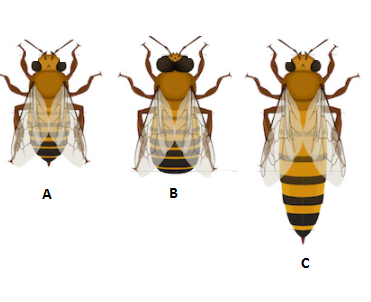
- A
Figure $A$
- B
Figure $B$
- ✓
Figure $C$
- D
Both $A$ and $B$
AnswerCorrect option: C. Figure $C$
View full question & answer→MCQ 781 Mark
The hormone injected to cows for excessive milk production is:
AnswerOxytocin helps in lactation in cattle. The breeds of cattle that are reared for milk production on a commercial scale are injected with the hormone oxytocin to secrete more milk. This hormone causes contraction of the mammary glands and also allows ejection of milk.
View full question & answer→MCQ 791 Mark
Golden rice includes the expression of which of the following enzymes?
AnswerCorrect option: A. Beta$-$carotene
View full question & answer→MCQ 801 Mark
Number of queens in a hive is $..........:$
View full question & answer→MCQ 811 Mark
The part of the plant used in culturing is called:
MCQ 821 Mark
Pisciculture is rearing and production of:
MCQ 831 Mark
What is the main nutritive element in honey:
MCQ 841 Mark
The technique of obtaining a large number of plantlets by tissue culture method is known as:
MCQ 851 Mark
The world’s highly prized wool yielding ‘Pashmina’ breed is:
MCQ 861 Mark
Queen bee is adapted for $......... :$
- ✓
- B
Laying eggs and rearing the young.
- C
- D
View full question & answer→MCQ 871 Mark
The reason why vegetatively reproducing crop plants are best suited for maintaining hybrid vigour is that:
- A
They can be easily propagated.
- B
They have a longer life span.
- C
They are more resistant to disease.
- ✓
Once a desired hybrid is produced, there are no chances of losing it.
AnswerCorrect option: D. Once a desired hybrid is produced, there are no chances of losing it.
View full question & answer→MCQ 881 Mark
A group of animals which are related by descent and share many similarities are referred to as:
AnswerA group of animals which are related by descent and share many similarities are referred to as breed.
View full question & answer→MCQ 891 Mark
Which one of the following combination would a sugarcane farmer look for in the sugarcane crop?
- ✓
Thick stem, long internodes, high sugar content and disease resistant.
- B
Thick stem, high sugar content and profuse flowering.
- C
Thick stem, short internodes, high sugar content, disease resistant.
- D
Thick stem, low sugar, conten, disease resistant.
AnswerCorrect option: A. Thick stem, long internodes, high sugar content and disease resistant.
View full question & answer→MCQ 901 Mark
- ✓
Pure culture without any contamination
- B
Pure culture without any nutrient
- C
- D
AnswerCorrect option: A. Pure culture without any contamination
View full question & answer→MCQ 911 Mark
To isolate protoplast, one needs:
- A
- B
- ✓
Both pectinase and cellulase.
- D
AnswerCorrect option: C. Both pectinase and cellulase.
These are needed to dissolve the cell wall.
View full question & answer→MCQ 921 Mark
Pulses are obtained from:
MCQ 931 Mark
Lysine and tryptophan are:
MCQ 941 Mark
Himgiri developed by hybridisation and selection for disease resistance against rust pathogens is a variety of:
MCQ 951 Mark
The silk worm silk is the product of:
- A
- B
- C
Salivary gland of the adult.
- ✓
Salivary gland of the larva.
AnswerCorrect option: D. Salivary gland of the larva.
View full question & answer→MCQ 961 Mark
AnswerThe yak is a long$-$haired bovid and is found in Tibet, Ladakh, Garhwal, Kumaon, Sikkim, Lahaul and Spiti. It is reared in high mountainous regions for meat, hide or skin, wool, milk, transport and tilling.
View full question & answer→MCQ 971 Mark
Maize hybrids developed by biofortification technique was mainly done to improve which of the following micronutrients?
MCQ 981 Mark
The new varieties of plants are produced by:
- ✓
Selection and hybridization.
- B
Selection and introduction.
- C
- D
Introduction and mutation.
AnswerCorrect option: A. Selection and hybridization.
View full question & answer→MCQ 991 Mark
Pisciculture does not include:
MCQ 1001 Mark
The practice of bee keeping is called:
MCQ 1011 Mark
Which one of the following combination would a sugarcane farmer look for in the sugarcane crop?
- ✓
Thick stem, long internodes, high sugar content and disease resistant.
- B
Thick stem, high sugar content and profuse flowering.
- C
Thick stem, short internodes, high sugar content, disease resistant.
- D
Thick stem, low sugar, conten, disease resistant.
AnswerCorrect option: A. Thick stem, long internodes, high sugar content and disease resistant.
Thick stem, long internodes, high sugar content and disease resistant, combination would a sugarcane farmer look for in the sugarcane crop.
View full question & answer→MCQ 1021 Mark
Three crops that contribute maximum to global food grain production are:
- ✓
- B
Wheat, maize and sorghum.
- C
- D
View full question & answer→MCQ 1031 Mark
In honey bees, the drones $($males$)$ are produced from $.........:$
- ✓
- B
- C
Larvae fed by royal jelly
- D
AnswerThe queen after fertilization lays fertilized and unfertilized eggs both. From unfertilized eggs male bees emerge which are known as drones.
View full question & answer→MCQ 1041 Mark
In honey bee, drones are produced by:
- ✓
- B
- C
- D
Larva fed with royal jelly
View full question & answer→MCQ 1051 Mark
European bee is called as:
MCQ 1061 Mark
More than $70$ per cent of livestock population is in:
View full question & answer→MCQ 1071 Mark
If a honey bee is conveying an information, by round dance then the distance of source will be about"
- A
$1000$ meters
- ✓
$50$ meters
- C
$2000$ meters
- D
$150$ meters
AnswerCorrect option: B. $50$ meters
View full question & answer→MCQ 1081 Mark
Parthenocarpic tomato fruits can be produced by:
- A
Removing androecium of flowers before pollen grains are released.
- ✓
Treating the plants with low concentrations of gibberellic acid and auxins.
- C
Raising the plants from vernalized seeds.
- D
Treating the plants with phenyl mercuric acetate.
AnswerCorrect option: B. Treating the plants with low concentrations of gibberellic acid and auxins.
View full question & answer→MCQ 1091 Mark
Several South Indian states raise $2-3$ crops of rice annually. The agronomic feature that makes this possible is because of:
- A
- B
Better irrigation facilities.
- ✓
Early yielding rice variety.
- D
Disease resistant rice variety.
AnswerCorrect option: C. Early yielding rice variety.
View full question & answer→MCQ 1101 Mark
In bees, dance is meant for:
- A
- B
- C
Visiting the sources of food
- ✓
Both $B$ and $C$
AnswerCorrect option: D. Both $B$ and $C$
View full question & answer→MCQ 1111 Mark
Nobel Prize for deciphering the language of bees was awarded to:
- ✓
- B
$K. V.$ Frisch
- C
$H. G.$ Khurana
- D
View full question & answer→MCQ 1121 Mark
Triticale, the first man$-$made cereal crop, has been obtained by crossing wheat with:
View full question & answer→MCQ 1131 Mark
Which of the following is generally used for induced mutagenesis in crop plants?
AnswerCorrect option: D. Gamma rays $($from cobalt $60).$
View full question & answer→MCQ 1141 Mark
Which of the following is a variety of Brassica resistant to white rust disease?
AnswerCorrect option: C. Pusa swarnim $($Karan rai$).$
View full question & answer→MCQ 1151 Mark
Breeding in Fowl is done between:
- ✓
Six month old hen and cock
- B
One year old hen and two year old cock
- C
Two year old hen and one year old cock
- D
Two year old hen and cock
AnswerCorrect option: A. Six month old hen and cock
View full question & answer→MCQ 1161 Mark
Mark the odd one in the following groups.
MCQ 1171 Mark
Honey is $........$ in nature:
View full question & answer→MCQ 1181 Mark
- ✓
Undifferentiated mass of a tissue
- B
Root formation in culture media
- C
- D
AnswerCorrect option: A. Undifferentiated mass of a tissue
View full question & answer→MCQ 1191 Mark
Queen bee is known for $........:$
AnswerThe queen bee is the most valued bee in the whole hive. The main job of queen is to lay eggs. She can lay up to $2,000$ per day.
View full question & answer→MCQ 1201 Mark
The desired varieties of economically useful crops are raised by:
MCQ 1211 Mark
Plants can be disease resistant by:
- ✓
Breeding with their wild relatives
- B
- C
- D
AnswerCorrect option: A. Breeding with their wild relatives
Plants can be disease resistant by breeding with a plant which naturally have resistance gene. Generally, wild varieties of plants have resistance gene for disease so breed important crop with their wild varieties to get disease resistant plants.
View full question & answer→MCQ 1221 Mark
Which one is a plant wax?
AnswerCarnauba wax is made from the leaves of the palm tree. It is also known as palm wax. It is obtained from the leaves of the carnauba palm by collecting and drying them, beating them to loosen the wax, then refining and bleaching the wax.
View full question & answer→MCQ 1231 Mark
The indica varieties of rice is crossed with japonica varieties, as these are:
MCQ 1241 Mark
More than $70$ percent of livestock population is in:
View full question & answer→MCQ 1251 Mark
- A
- B
- ✓
Part of the plant used in tissue culture.
- D
Part of the plant that expresses a specific gene.
AnswerCorrect option: C. Part of the plant used in tissue culture.
Explant is used for growing a whole new plant.
View full question & answer→MCQ 1261 Mark
Which one of the following is not a fungal disease?
AnswerBlack rot of crucifers is a bacterial disease.
View full question & answer→MCQ 1271 Mark
The life span of a honey bee drone is:
- A
$4 - 5$ months
- ✓
$1 - 3$ months
- C
$6 - 7$ months
- D
$10 - 12$ months
AnswerCorrect option: B. $1 - 3$ months
View full question & answer→MCQ 1281 Mark
Breeding of crops to increase the levels of essential nutrients, is called.
MCQ 1291 Mark
Which of the following species of honey bee is reared in artificial hives in India?
MCQ 1301 Mark
Life span of Honey Bee drone is $.........:$
- A
$3-4$ months
- ✓
$1-2$ months
- C
$6-7$ months
- D
$10-12$ months.
AnswerCorrect option: B. $1-2$ months
View full question & answer→MCQ 1311 Mark
Sonalika and Kalyan Sona are varieties of:
AnswerSonalika and Kalyan Sona are varieties of wheat.
View full question & answer→MCQ 1321 Mark
View full question & answer→MCQ 1331 Mark
Given below are a few statements regarding somatic hybridization. Choose the correct statements.
- Protoplasts of different cells of the same plant are fused.
- Protoplasts from cells of different species can be fused.
- Treatment of cells with cellulase and pectinase is mandatory.
- The hybrid protoplast contains characters of only one parental protoplast.
- ✓
$(ii)$ and $(iii)$
- B
$(iii)$ and $(iv)$
- C
$(i)$ and $(ii)$
- D
$(ii)$ and $(iv)$
AnswerCorrect option: A. $(ii)$ and $(iii)$
View full question & answer→MCQ 1341 Mark
Sexing in poultry is done by observing $.........:$
View full question & answer→MCQ 1351 Mark
What are micro$-$mutations?
AnswerMicro$-$mutation is a small$-$scale or highly localized mutation especially one involving alteration at a single gene locus.
View full question & answer→MCQ 1361 Mark
The following cells cannot be grown under tissue culture conditions:
AnswerNerve cells cannot replicate under Tissue culture conditions hence they cannot be grown by the tissue culture technique.
View full question & answer→MCQ 1371 Mark
To isolate protoplast, one needs.
- A
- B
- C
- ✓
Both pectinase and cellulase.
AnswerCorrect option: D. Both pectinase and cellulase.
View full question & answer→MCQ 1381 Mark
$..........$ is a breed of cattle.
View full question & answer→MCQ 1391 Mark
- A
- B
- C
Another name for protoplasm.
- ✓
A plant cell without a cell wall.
AnswerCorrect option: D. A plant cell without a cell wall.
View full question & answer→MCQ 1401 Mark
Several South Indian states raise $2-3$ crops of rice annually. The agronomic feature that makes this possible is because of:
AnswerCorrect option: B. Early yielding rice variety.
View full question & answer→MCQ 1411 Mark
In India, which state occupies first position in poultry farming:
MCQ 1421 Mark
In Abelmoschus esculentus $($bhindi$),$ resistance genes are transferred from a wild species against yellow mosaic virus and resulted in a new variety of $A.$ Esculentus called $..........$
View full question & answer→MCQ 1431 Mark
A collection of plants and seeds having diverse alleles of all the genes of a crop is:
MCQ 1441 Mark
Which of the following is the requirement of animal husbandry?
MCQ 1451 Mark
Which one of the following is a new breed of sheep developed in Punjab by crossing Bikaneri ewes and Marino rams?
MCQ 1461 Mark
Controlled breeding experiment in animals are carried out by:
- A
$\text{MOET}.$
- B
- C
- ✓
Both $(a)$ and $(b).$
AnswerCorrect option: D. Both $(a)$ and $(b).$
View full question & answer→MCQ 1471 Mark
The biggest constraint of plant breeding is:
- ✓
Availability of desirable gene in the crop and its wild relatives.
- B
- C
- D
Transfer of genes from unrelated sources.
AnswerCorrect option: A. Availability of desirable gene in the crop and its wild relatives.
Enough infrastructures is available for the purpose and there is not dearth of trained manpower because of over thousands of years of experience in farming.
View full question & answer→MCQ 1481 Mark
Cultivation of fishes, oysters, shrimps and crabs come under $........:$
View full question & answer→MCQ 1491 Mark
Mark the odd one in the following groups.
MCQ 1501 Mark
$...........$ is a setup of a number of bee hives in good desirable locations that can allow maximum nectar and pollen collection:
View full question & answer→MCQ 1511 Mark
Life span of worker bee is $.............$
- A
$10$ days
- B
$15$ days
- ✓
$6$ weeks
- D
$10$ weeks
AnswerCorrect option: C. $6$ weeks
View full question & answer→MCQ 1521 Mark
- A
- ✓
Young birds reared for meat
- C
Birds raised for breeding
- D
Birds raised for both eggs and meat
AnswerCorrect option: B. Young birds reared for meat
Poultry farming is undertaken to raise domestic fowl for egg production and chicken meat.
Chickens that are reared especially for meat are called broilers.
Broilers have tender meat with soft, pliable, smooth textured skin and flexible breast bone cartilage.
View full question & answer→MCQ 1531 Mark
Which of the following processes is used for creating genetic variation by changing the base sequence within genes resulting in the creation of a new character or trait not found in the parental type?
MCQ 1541 Mark
Which of the following crops have been brought to India from New world?
- A
- ✓
Cashewnut, potato, rubber.
- C
- D
AnswerCorrect option: B. Cashewnut, potato, rubber.
View full question & answer→MCQ 1551 Mark
$...........$ is the most demanded fish:
AnswerRohu is the most demanded fish because it is easily aquacultured so it is cheaper.
View full question & answer→MCQ 1561 Mark
Which one of the following is$/$ are marine fish?
- A
- B
- C
- ✓
Both $(b)$ and $(c).$
AnswerCorrect option: D. Both $(b)$ and $(c).$
View full question & answer→MCQ 1571 Mark
The practice of $.......$ keeping is called as apiculture.
AnswerThe practice of beekeeping is called as apiculture. It is done to get honey and beeswax.
View full question & answer→MCQ 1581 Mark
Triticale has been evolved by intergeneric hybridization between:
MCQ 1591 Mark
The part of the plant used for somatic hybridisation is:
MCQ 1601 Mark
View full question & answer→MCQ 1611 Mark
Identify the edible fresh water teleost.
MCQ 1621 Mark
Of the world’s top five crops $($in terms of annual production$).$
AnswerCorrect option: C. Four belong to Poaceae, one to Solanaceae.
View full question & answer→MCQ 1631 Mark
Which is the root of breeding programmes?
MCQ 1641 Mark
Cod liver oil is a rich source of $.........$
- A
- ✓
Vitamin $A.$
- C
Vitamin $B.$
- D
AnswerCorrect option: B. Vitamin $A.$
View full question & answer→MCQ 1651 Mark
The new varieties of plants are produced by:
- ✓
Selection and hybridization.
- B
- C
Introduction and mutation.
- D
Selection and introduction.
AnswerCorrect option: A. Selection and hybridization.
View full question & answer→MCQ 1661 Mark
- A
Preservation of living beings in chemicals
- B
Preservation through gases
- ✓
Preservation at very low temperature
- D
Preservation at high temperature
AnswerCorrect option: C. Preservation at very low temperature
View full question & answer→MCQ 1671 Mark
- ✓
- B
- C
- D
Characteristics of biomolecule
View full question & answer→MCQ 1681 Mark
The alkaloid ajmalicine is obtained from:
MCQ 1691 Mark
The earliest animal to have been domesticated by man was most likely the:
MCQ 1701 Mark
Which organism is used as a major source to obtain the single cell protein?
MCQ 1711 Mark
Which culture is suitable for the production of virus free plants?
MCQ 1721 Mark
Gobar gas plants use $.........$ bacteria.
View full question & answer→MCQ 1731 Mark
The agriculture sector of India employs:
- A
$60$ per cent of the population.
- B
$70$ per cent of the population.
- C
$30$ per cent of the population.
- ✓
$62$ per cent of the population.
AnswerCorrect option: D. $62$ per cent of the population.
View full question & answer→MCQ 1741 Mark
Which one of the following technique is used for the manipulation of plant species in order to create desired plant types that are better suited for cultivation and give better yields and are disease resistant?
- A
Out$-$breeding.
- B
Out$-$crossing.
- C
Cross$-$breeding.
- ✓
View full question & answer→MCQ 1751 Mark
Which of the following is a diseases resistant high yielding breed of poultry developed in Karnataka?
MCQ 1761 Mark
The biggest constraint of plant breeding is:
- ✓
Transfer of genes from unrelated sources.
- B
- C
Availability of desirable gene in the crop and its wild relatives.
- D
AnswerCorrect option: A. Transfer of genes from unrelated sources.
View full question & answer→MCQ 1771 Mark
The Triticum aestivum wheat is:
MCQ 1781 Mark
Use of certain chemicals and radiation to change the base sequences of genes of crop plants is termed:
MCQ 1791 Mark
In which part of the body, pollen basket is found in the honey bee?
- A
- B
- ✓
- D
At union of thorax and abdomen
View full question & answer→MCQ 1801 Mark
Elephants are poached for their:
MCQ 1811 Mark
Which statement is correct about centre of origin of plants?
- ✓
More diversity in varieties.
- B
Frequency of dominant gene is more.
- C
Climatic conditions more favourable.
- D
AnswerCorrect option: A. More diversity in varieties.
View full question & answer→MCQ 1821 Mark
View full question & answer→MCQ 1831 Mark
In virus$-$infected plants the meristematic tissues in both apical and axillary buds are free of virus because:
AnswerCorrect option: C. The cell division of meristems are faster than the rate of viral multiplication.
Because of faster rate of multiplication; meristematic cells are not affected by virus.
View full question & answer→MCQ 1841 Mark
In honeybee, royal jelly is secreted from which of the following gland?
MCQ 1851 Mark
In late $1950s, F.C$ Steward experimented on the following plant and confirmed the principal of totipotency:
View full question & answer→MCQ 1861 Mark
India’s wheat yield revolution in the $1960s$ was possible primarily due to:
- A
- B
Increased chlorophyll content.
- ✓
Mutations resulting in plant height reduction.
- D
Quantitative trait mutations.
AnswerCorrect option: C. Mutations resulting in plant height reduction.
View full question & answer→MCQ 1871 Mark
Which is a product of insect body?
MCQ 1881 Mark
Which one of the following products of apiculture is used in cosmetics and polishes:
AnswerWax is a product of apiculture used in cosmetics and polishes.
View full question & answer→MCQ 1891 Mark
What is the reason for the formation of embryoid from pollen grain in tissue culture medium?
MCQ 1901 Mark
The term aquaculture means.
- A
- B
- C
- ✓
Both $(b)$ and $(c).$
AnswerCorrect option: D. Both $(b)$ and $(c).$
View full question & answer→MCQ 1911 Mark
Which of the following plant produces beta$-$carotene naturally?
View full question & answer→MCQ 1921 Mark
Mark the odd one in the following groups.
MCQ 1931 Mark
Micro$-$propagation is:
- A
Propagation of microbes in vitro.
- ✓
Propagation of plants in vitro.
- C
Propagation of cells in vitro.
- D
Growing plants on smaller scale.
AnswerCorrect option: B. Propagation of plants in vitro.
Smaller scale can mean a small flower pot, so option $'d\ ’$ is incorrect. Microbes and cells are small enough to be easily growth in vitro and hence options $a$ and $c$ are incorrect.
View full question & answer→MCQ 1941 Mark
The hybrids are generally found to be superior to their parents, it is because of:
- A
- ✓
- C
Parents are generally weak
- D
View full question & answer→MCQ 1951 Mark
Which of the following species of honeybee is reared in artificial hives?
MCQ 1961 Mark
Which plant will loss its economic value, if its fruits are produced by induced parthenocarpy?
MCQ 1971 Mark
View full question & answer→MCQ 1981 Mark
Pusa Snowball $K-1$ is a variety of:
View full question & answer→MCQ 1991 Mark
View full question & answer→MCQ 2001 Mark
Crop plants grown in monoculture are:
- A
- B
Free from intraspecific competition.
- C
Characterized by poor root system.
- ✓
View full question & answer→MCQ 2011 Mark
Composite fish culture system is commonly used for $........... :$
View full question & answer→MCQ 2021 Mark
Inbreeding is carried out in animal husbandry because it:
- A
Increases heterozygosity.
- ✓
- C
- D
View full question & answer→MCQ 2031 Mark
Best aquarium is located at $............ :$
- A
- B
- ✓
- D
$\text{Z.S.I},$ Calcutta
View full question & answer→MCQ 2041 Mark
Aim of plant breeding is to produce:
MCQ 2051 Mark
Fungicides and antibiotics are chemicals that:
- ✓
Kill pathogenic fungi and bacteria, respectively.
- B
Enhance yield and disease resistance.
- C
Kill all pathogenic microbes.
- D
Kill pathogenic bacteria and fungi respectively.
AnswerCorrect option: A. Kill pathogenic fungi and bacteria, respectively.
View full question & answer→MCQ 2061 Mark
The chances of contacting bird flu from a properly cooked $($above $100^\circ C)$ chicken and egg are:
AnswerWhen chicken is properly cooked, it helps in destroying the virus of bird flu.
View full question & answer→MCQ 2071 Mark
Which of the following stage is transferred to surrogate mothers in livestock breeding experiments?
AnswerCorrect option: C. $8$ to $32$ celled embryo.
View full question & answer→MCQ 2081 Mark
Any cell, tissue or an organ removed from a plant for the purpose of culturing is called as:
MCQ 2091 Mark
Mule is the interspecific breed of:
- A
Female donkey and male horse
- ✓
Male donkey and female horse
- C
Male sheep and female horse
- D
Male horse and female sheep
AnswerCorrect option: B. Male donkey and female horse
Interspecific breeding occurs between genetically dissimilar parents of different species. A mule is the offspring of a male donkey and a female horse. The organism is sterile in nature and not capable of exchanging the genes or interbreeding with each other.
View full question & answer→MCQ 2101 Mark
In a bee hive, there are thousands of worker bees performing number of day$-$to$-$day activities. Genetically, the worker bees are:
View full question & answer→MCQ 2111 Mark
- A
Usually increases fertility only.
- B
Usually reduces productivity only.
- ✓
Usually reduces fertility and productivity.
- D
Usually increases fertility and productivity.
AnswerCorrect option: C. Usually reduces fertility and productivity.
View full question & answer→MCQ 2121 Mark
Which part is most suitable for raising virus free plants in micropropagation.
MCQ 2131 Mark
Which of the following countries is the lowest in milk yield per cow?
MCQ 2141 Mark
Inbreeding is carried out in animal husbandry because it:
- A
- B
- C
Increases heterozygosity.
- ✓
AnswerIncreased homozygosity is helpful in obtaining a pure line of breed.
View full question & answer→MCQ 2151 Mark
View full question & answer→MCQ 2161 Mark
Lysine and tryptophan are:
AnswerLysine and tryptophan are essential amino acids.
View full question & answer→MCQ 2171 Mark
Cod and shark liver oil is a source of:
- A
- B
- C
Energetic and constructive nutrients
- ✓
View full question & answer→MCQ 2181 Mark
- A
Part of the plant that expresses a specific gene.
- ✓
Part of the plant used in tissue culture.
- C
- D
AnswerCorrect option: B. Part of the plant used in tissue culture.
View full question & answer→MCQ 2191 Mark
In those plants whose pulp is of economical importance, they are generally propagated by vegetative means because:
- A
- B
- ✓
The pulp quality remains same
- D
The pulp quality becomes better
AnswerCorrect option: C. The pulp quality remains same
View full question & answer→MCQ 2201 Mark
High milk yielding varieties of cows are obtained by:
MCQ 2211 Mark
Find the incorrect statement:
AnswerCorrect option: C. Himgiri is a variety of cauliflower.
View full question & answer→MCQ 2221 Mark
A group of animals which are related by descent and share many similarities are referred to as:
MCQ 2231 Mark
Which one of the following is a marine fish:
MCQ 2241 Mark
Famous embryologist of India who also advanced the science of morphology and tissue culture in India is?
- ✓
$P.$ Maheshwari
- B
$T. S.$ Sadasivan
- C
- D
AnswerCorrect option: A. $P.$ Maheshwari
View full question & answer→MCQ 2251 Mark
The scientific process by which crop plants are enriched with certain desirable nutrients is called:
- A
- B
- ✓
Bio$-$fortification.
- D
Bio$-$remediation.
AnswerCorrect option: C. Bio$-$fortification.
View full question & answer→MCQ 2261 Mark
Pure line breeds refer to:
- A
Homozygosity and independent assortment
- ✓
- C
- D
Heterozygosity and linkage
View full question & answer→MCQ 2271 Mark
$.........$ is a haploid, fertile male whereas $.........$ is a diploid sterile female:
View full question & answer→MCQ 2281 Mark
Which of the following animal can be formed without fertilization?
MCQ 2291 Mark
The number of calves produced during its whole reproductive period of a cow or buffalo is:
- ✓
$8 - 10$ calves
- B
$15 - 20$ calves
- C
$12 - 16$ calves
- D
$5 - 7$ calves
AnswerCorrect option: A. $8 - 10$ calves
View full question & answer→MCQ 2301 Mark
- ✓
Plantlet is placed in reduced light and high humidity for short time.
- B
Plantlet is placed in favourable conditions for long time.
- C
Plantlet is transfer in a new fresh medium.
- D
Plantlet is placed in a high light intensity.
AnswerCorrect option: A. Plantlet is placed in reduced light and high humidity for short time.
View full question & answer→MCQ 2311 Mark
$.........$ is the agricultural practice of breeding and raising livestock:
View full question & answer→MCQ 2321 Mark
The resistant variety of rice to bacterial blight is?
- A
- B
$\text{TMK}-6$
- C
$IR-20$
- ✓
$IR-8$
AnswerCorrect option: D. $IR-8$
View full question & answer→MCQ 2331 Mark
Breeding crops for improved nutritional quality is referred to as:
MCQ 2341 Mark
$.........$ is the rearing care and management of honey bees for obtaining honey, wax and other substance:
View full question & answer→MCQ 2351 Mark
- A
Protein synthesised by skin cell
- B
A protein synthesised by liver cell
- ✓
Protein synthesised by microorganisms
- D
A protein synthesised by muscle cell
AnswerCorrect option: C. Protein synthesised by microorganisms
View full question & answer→