Questions

5 Marks Questions

Take a timed test

13 questions · self-marked practice — reveal the answer and mark yourself.

Question 15 Marks
What is a semiconductor? Describe the two main types of semiconductors and contrast their conduction mechanism.
Answer
Semiconductors are substances having conductance in the intermediate range of $10^{–6}$ to $10^4ohm^{–1}m^{–1}$. The two main types of semiconductors are:
  1. n-type semiconductor.
  2. p-type semiconductor.
n-type semiconductor: The semiconductor whose increased conductivity is a result of negatively-charged electrons is called an n-type semiconductor. When the crystal of a group 14 element such as Si or Ge is doped with a group 15 element such as P or As, an n-type semiconductor is generated.
Si and Ge have four valence electrons each. In their crystals, each atom forms four covalent bonds. On the other hand, P and As contain five valence electrons each. When Si or Ge is doped with P or As, the latter occupies some of the lattice sites in the crystal. Four out of five electrons are used in the formation of four covalent bonds with four neighbouring Si or Ge atoms. The remaining fifth electron becomes delocalised and increases the conductivity of the doped Si or Ge.
p-type semiconductor: The semiconductor whose increased in conductivity is a result of electron hole is called a p-type semiconductor. When a crystal of group 14 elements such as Si or Geis doped with a group 13 element such as B, Al, or Ga (which contains only three valence electrons), a p-type of semiconductor is generated.
When a crystal of Si is doped with B, the three electrons of B are used in the formation of three covalent bonds and an electron hole is created. An electron from the neighboring atom can come and fill this electron hole, but in doing so, it would leave an electron hole at its original position. The process appears as if the electron hole has moved in the direction opposite to that of the electron that filled it. Therefore, when an electric field is applied, electrons will move toward the positively-charged plate through electron holes. However, it will appear as if the electron holes are positively-charged and are moving toward the negatively- charged plate.
View full question & answer
Question 25 Marks
How will you distinguish between the following pairs of terms:
  1. Hexagonal close-packing and cubic close-packing?
  2. Crystal lattice and unit cell?
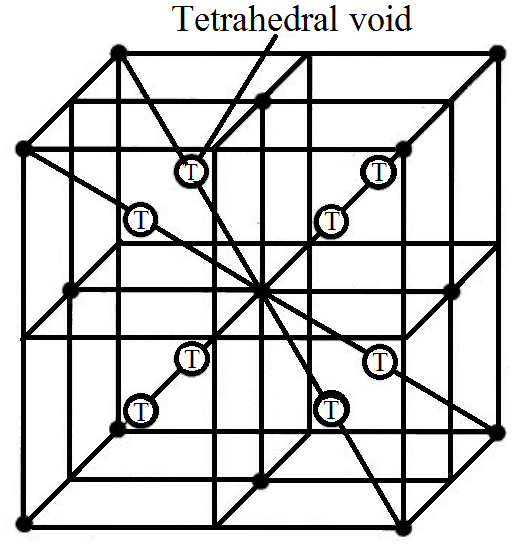
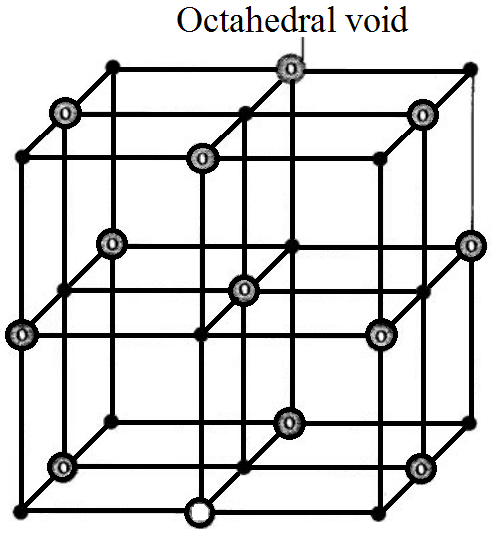
  3. Tetrahedral void and octahedral void?
Answer
  1. Hexagonal close-packing and cubic close-packing: When the third layer is placed over the second layer in such a way that the spheres cover the octahedral voids, a layer different from first (A) and second (B) is produced. If we continue packing in this manner, then a packing is obtained where the spheres in every fourth layer will vertically aligned. This pattern of packing spheres is called ABCABC pattern or cubic close packing. Hexagonal close packing: When a third layer is placed over the second layer in such a manner that the spheres cover the tetrahedral void, a three dimensional close packing is obtained where the spheres in every third or alternate layers are vertically aligned. If we continue packing in this manner, then the packing obtained would be called ABAB pattern or hexagonal close packing.
  2. Crystal lattice: It is a regular arrangement of the constituent particles (i.e., ions, atoms or molecules) of a crystal in three dimensional space. Unit cell: The smallest three dimensional portion of a complete space lattice which when repeated over and over again in different directions produces the complete crystal lattice is called the unit cell.
  3. Tetrahedral void: A simple triangular void is a crystal is surrounded by four spheres and is called a tetrahedral void.
Octahedral void: A double triangular void is surrounded by six spheres and is called a octahedral void.
View full question & answer
Question 35 Marks
The edge length of unit cell of a metal having molecular weight $75g/ mol$ is $5\mathring{\text{A}}$ which crystallises in cubic lattice. If the density is $2g/ cm^3$ then find the radius of metal atom. $(N_A = 6.022 \times 10^{23}​​​​​​​)$
Answer
$\text{M}=75\text{g/mol}^{-1},\text{a}=5\mathring{\text{A}}=5\times10^{-8}\text{cm},\text{N}_{\text{A}}$
$=6.022\times10^{23}\text{mol}^{-1},\text{d}=2\text{g/cm}^{-3}$
$\text{d}=\frac{z\times\text{M}}{\text{a}^3\times\text{N}_{\text{A}}}$
$\Rightarrow\text{z}=\frac{\text{d}\times\text{a}^3\times\text{N}_{\text{A}}}{\text{M}}$
$=\frac{2\text{g/cm}^3\big(5\times10^{-8}\text{cm}\big)^3\times6\times10^{23}\text{mol}^{-1}}{75\text{g/mol}}=2$
As the metal (z = 2) has bcc structure,
$\text{r}=\frac{\sqrt{3}}{4}\text{a}=\frac{\sqrt{3}}{4}\times5$
$=\frac{1.732\times5}{4}=2.165\mathring{\text{A}}$
$=2.165\times10^{-8}\text{cm}=216.5\text{pm}$
View full question & answer
Question 45 Marks
With the help of a labelled diagram show that there are four octahedral voids per unit cell in a cubic close packed structure.
Answer
In cep, each cube consists of eight cubic components, number of atoms per unit cell in ccp is. Where $\mathrm{N}_{\mathrm{C}}=$ No. of atoms at corner $N_f=$ No. of atoms at face centre $=N_c \times$ contribution $+N_f \times$ contribution $=8 \times \frac{1}{8}+6 \times \frac{1}{2}=4$

Position of octahedral voids = Edge centre and body centre Number of octahendral voids per unit cell in cubic close packing $=\text{N}_\text{e}\times\frac{1}{4}+\text{N}_\text{b}\times1$ $=12\times\frac{1}{4}+1\times1=4$ ⇒ Number of octahendral voids = 4.
View full question & answer
Question 55 Marks
Chromium crystallises in bcc structure. If its atomic diameter is $245\ pm$, find its density. Atomic mass of $Cr = 52$ amu and $N_A = 6.02 \times 10^{23}\ mol^{–1}.$
Answer
Deameter =$ 245pm$
$\therefore\text{Radius}=\frac{245}{2}\text{pm}=122.5\text{pm}$
In a bcc structure, $\text{r}=\frac{\sqrt{3}}{4}\text{a}\text{ or }\text{a}=\frac{4\text{r}}{\sqrt{3}}$
$\text{a}=\frac{4\times122.5}{\sqrt{3}}=\frac{490}{1.732}=282.91\text{pm}$
$\text{d}=\frac{\text{z}\times\text{M}}{\text{a}^3\times\text{N}_{\text{A}}}=\frac{2\times52}{(282.91\times10^{-10}\text{cm})^3\times6.02\times10^{23}}$
$=\frac{104}{2.264\times10^{-23}\times6.02\times10^{23}}=\frac{104}{2.264\times6.02}$
$=7.63\text{g/cm}^{-3}$
View full question & answer
Question 65 Marks
An element has fcc structure with a cell edge 200pm. Calculate the density of element, if $200\ g$ of the element contains $24 \times 1023$ atoms.
Answer
$a = 200pm \times 10^{-10}cm = 2 \times 10^{-8}cm, z = 4 (for fcc)$,
Mass of unit cell $=\frac{200\times4}{24\times10^{23}}$
$=33.33\times10^{-23}\text{g}$
$\text{Density}=\frac{\text{Masso funitcell}}{\text{Volumeo funticell}}$
$=\frac{33.33\times10^{23}\text{g}}{(2\times10^{8}\text{cm})^3}=41.6\text{g/cm}^{-3}$
View full question & answer
Question 75 Marks
An element with molar mass $63g/ mol$ forms a cubic unit cell with edge length of 360.8pm. If its density is $8.92g/ cm^3$. What is the nature of the cubic unit cell?
Answer
$\text{d}=\frac{\text{z}\times\text{M}}{\text{a}^3\times\text{N}_{\text{A}}}\text{or}\ \text{z}=\frac{\text{d}\times\text{a}^3\times\text{N}_{\text{A}}}{\text{M}}...(\text{i})$
Here, $d = g/ cm^{-3}, N_A = 6.022 \times 10^{23} mol^{-1}, M = 63g/ mol^{-1}$
$a = 360.8pm = 360.8 \times 10^{-10}cm = 3.608 \times 10^{-8}cm,$
Substituting these values in expression (i), we get,
$\text{z}=\frac{8.92\text{g/cm}^3\times\big(3.608\times10^{-8}\text{cm}\big)^3\times6.022\times10^{23}\text{mol}^{-1}}{63\text{g/mol}^{-1}}=4$
The unit cell is face centred cubic.
View full question & answer
Question 85 Marks
An element has a body-centred cubic bcc structure with a cell edge of $288\ pm$. The density of the element is $7.2g/ cm^3$​​​​​​​. How many atoms are present in $208\ g$ of the element?
Answer
Density of unit cell, $\text{d}=\frac{\text{z}\times\text{M}}{\text{a}^3\times\text{N}_{\text{A}}}\ \text{or}\ \text{M}=\frac{\text{d}\times\text{a}^3\times\text{N}_{\text{A}}}{\text{z}}...(\text{i)}$
Here, $z = 2, d = 7.2g/ cm^{-3}, N_A = 6.022 \times 1023mol^{-1},$
$a = 288pm = 288 \times 10^{-10}cm = 2.88 \times 10^{-8}cm,$
Substituting these values in expression (i), we get,
$\text{M}=\frac{7.2\text{g/cm}^{-3}\times(2.88\times10^{-8}\text{cm})^3\times6.022\times10^{23}\text{mol}^{-1}}{2}=51.75\text{g/mol}^{-1}$
Moles of element $=\frac{\text{Masso felement}}{\text{Malarmass}}=\frac{208\text{g}}{51.78\text{g/mol}^{-1}}=4.02\text{mol}$
$\therefore$ toms present in 208g of element $= 6.022 \times 10^{23} \times 4.02$ atoms,
$2.421 \times 10^{24}$​​​​​​​ atoms
View full question & answer
Question 95 Marks
Sodium has a bcc structure with nearest neighbour distance 365.9pm. Calculate its density (Atomic mass of sodium = 23).
Answer
For the structure, nearest neighbour distance (d) is related to the edge (a) as $\text{d}=\frac{\sqrt{3}}{2}\text{a},$
or, $\text{a}=\frac{2}{\sqrt{3}}\text{d}=\frac{2}{1.732}\times365.9=422.5\text{pm}$
For bcc structure z = 2,
For sodium, M = 23
Density, $\text{d}=\frac{\text{z}\times\text{M}}{\text{a}^3\times\text{N}_{\text{a}}}$
$=\frac{2\times23\text{g/mol}^{-1}}{(422.5\times10^{-10}\text{cm)}^3\times(6.02\times10^{23}\text{mol}^{-1})}=1.013\text{g/cm}^3$
View full question & answer
Question 105 Marks
How does the doping increase the conductivity of semiconductors?
Answer
For practical use conductivity of a semiconductor is very low conductivity can be increased by adding small impurity, this process is called doping. Doping can be done with an impurity which is electron rich or electron deficient.
  1. N -type semiconductors: Silicon or Germanium (group-14) doped with electron rich impurity (group-15 element like P or As) is called n-type semiconductors. Here conductivity is due to the extra electron or delocalized electron.
Explanation for increase in conductivity in n-type semiconductors: When intrinsic semiconductors like Si or Ge are doped with pentavalent elements as P or As, they occupy some of the lattice sites in silicon or germanium crystal. Four out of five electrons are used in formation of four covalent bonds with four neighbouring silicon atoms. The fifth electron is extra and gets delocalised. These delocalised electrons increase the conductivity of doped silicon (or germanium).
  1. P -type semiconductors: Silicon or Germanium (group-14) doped with electron deficient impurity (group 13 element like B or Al or Ga) is called p-type semiconductors. Here conductivity is due to positively charged electron holes.
Explanation for increase in conductivity in p-type semiconductors: In this case the doping of intrinsic semiconductors like silicon or germanium with trivalent elements lke B / In / Ga, three out of four electrons in silicon or germanium form bonds with doping impurity ( I.e. B/ In / Ga). The fourth electron remains unbonded. The place where fourth valence electron is missing is called electron hole or electron vacancy. An electron from neighbouring atom can come and fill up the electron hole, but in doing so it would leave an electron hole at its original position. If this happens it would appear that electron hole has moved in a direction opposite to that of the electron that filled it. Under the influence of electric field electrons would move towards the positively charged plate through electron holes, but it would appear as if electrons are positively charged and are moving towards the negatively charged plate.
View full question & answer
Question 115 Marks
  1. Identify the type of magnetism. What happens when these substances are heated?
  1. If the radius of the octahedral void is ‘r’ and radius of the atoms in close packing is ‘R’. What is the relation between ‘r’ and ‘R’?
  2. Tungsten crystallizes in body centred cubic unit cell. If the edge of the unit cell is 316.5pm. What is the radius of tungsten atom?
Answer
  1. Ferrimagnetism.
These substances lose ferrimagnetism on heating and become paramagnetic. This is due to randomisation of domains (spins) on heating.
  1. r = 0.414 R.
  2. For bcc structure, $\text{r}=\frac{\sqrt{3}}{4}\text{a}$
$\text{r}=\frac{1.732}{4}\times316.5\text{pm}=137.04\text{pm}$
View full question & answer
Question 125 Marks
Show that in a cubic close packed structure, eight tetrahedral voids are present per unit cell.
Answer
In ccp, each cube consists of eight cubic components. Number of atoms per unit cell in ccp is $N_c \times$ contribution + $N_f​ \times$ contribution $8\times\frac{1}{6}+6\times\frac{1}{2}=4$

Position of tetrahedral Voids = At the centre of each cubic component Number of tetrahedral voids per unit cell in cubic close packing = 8 × 1 = 8 Number of tetrahedral Voids = 8.
View full question & answer
Question 135 Marks
A sample of ferrous oxide has actual formula $Fe_{0.93}O_{1.00}.$ In this sample what fraction of metal ions are $Fe^{2+}$​​​​​​​ ions? What type of nonstoichiometric defect is present in this sample?
Answer
Let the formula of sample be
$(Fe^{2+})_x (Fe^{3+})_yO$.
On looking at the given formula of the compound
$x + y = 0.93 ..... (i)$
Total positive charge on ferrous and ferric ions should balance the two units of negative charge on oxygen. Therefore,
$2x + 3y = 2 ..... (ii)$
$\Rightarrow \text{x}+\frac{3}{2}\text{y}=1\ .....(\text{iii})$
On subtracting equation (i) from equation (iii) we have
$\Rightarrow \frac{3}{2}\text{y}-\text{y}=1-0.93$
$\Rightarrow \frac{1}{2}\text{y}=0.07$
$\Rightarrow y = 0.14$
On putting the value of y in equation (i) we get,
$x + 0.14 = 0.93$
$\Rightarrow x = 0.93 - 0.14$
$x = 0.79$
Fraction of $Fe^{2+}$​​​​​​​ ions present in the sample $=\frac{0.79}{0.93}=0.81$
Metal deficiency defect is present in the sample because iron is less in amount than that required for stoichiometric composition.
View full question & answer