Questions

3 Marks Question

Take a timed test

7 questions · self-marked practice — reveal the answer and mark yourself.

Question 13 Marks
Show that if a matrix A is invertible, then A is non-singular.
Answer
Writing the above statement in symbolic form, we have p ⇒ q, where, p is “matrix A is invertible” and q is “A is non singular”
Instead of proving the given statement, we prove its contrapositive statement, i.e., if A is not a non singular matrix, then the matrix A is not invertible.
If A is not a non singular matrix, then it means the matrix A is singular, i.e.,
|A| = 0
Then $\mathrm{A}^{-1}=\frac{a d j \mathrm{A}}{| \mathrm{Al}} \text { does not exist as } \mathrm{|A|}=0$
Hence, A is not invertible.
Thus, we have proved that if A is not a non singular matrix, then A is not invertible.
i.e -q = -p
Hence, if a matrix A is invertible, then A is non singular.
View full question & answer
Question 23 Marks
Prove that the function $f : R → R $defined by $f (x) = 2x + 5$ is one-one.
Answer
Note that a function f is one-one if
$f(x_1 ) = f (x_2 ) \Rightarrow x_1 = x_2 ($definition of one-one function$)$
Now, given that $f (x_1 ) = f (x_2 ), i.e., 2x_1 + 5 = 2x_2 + 5$
$\Rightarrow 2x_1 + 5 – 5 = 2x_2 + 5 – 5 ($adding the same quantity on both sides$)$
$2x_1 + 0 = 2x_2 + 0$
$2x_1 = 2x_2($ using additive identity of real number$)$
$\frac{2}{2} x_{1}=\frac{2}{2} x_{2}$ dividing by the same non zero quantity
$x_1 = x_2$_
Hence, the given function is one one
View full question & answer
Question 33 Marks
Show that the set of all prime numbers is infinite.
Answer
Let $P$ be the set of all prime numbers. We take the negation of the statement "the set of all prime numbers is infinite", i.e., we assume the set of all prime numbers to be finite. Hence, we can list all the prime numbers as $\mathrm{P}_1, \mathrm{P}_2$, $\mathrm{P}_3, \ldots, \mathrm{P}_{\mathrm{k}}$ (say). Note that we have assumed that there is no prime number other than $\mathrm{P}_1, \mathrm{P}_2, \mathrm{P}_3, \ldots, \mathrm{P}_{\mathrm{k}}$. Now consider $N=\left(P_1, P_2, P_3, \ldots, P_k+1\right) \ldots (i)$
$N$ is not in the list as $N$ is larger than any of the numbers in the list. $N$ is either prime or composite. If $N$ is a prime, then by $(i),$ there exists a prime number which is not listed. On the other hand, if $N$ is composite, it should have a prime divisor. But none of the numbers in the list can divide $N,$ because they all leave the remainder $1 .$ Hence, the prime divisor should be other than the one in the list. Thus, in both the cases whether $N$ is a prime or a composite, we ended up with contradiction to the fact that we have listed all the prime numbers. Hence, our assumption that a set of all prime numbers is finite is false. Thus, the set of all prime numbers is infinite.
View full question & answer
Question 43 Marks
Show that in any triangle $ABC a = b \cos C + c \cos B$
Answer
Let $p$ be the statement “$ABC$ is any triangle” and q be the statement “
$a = b \cos C + c \cos B”$
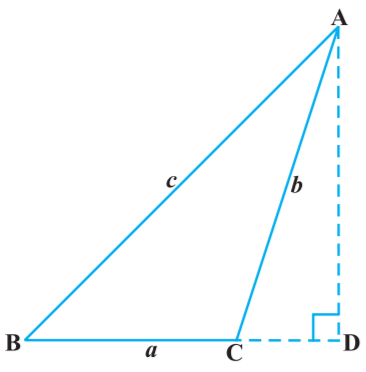
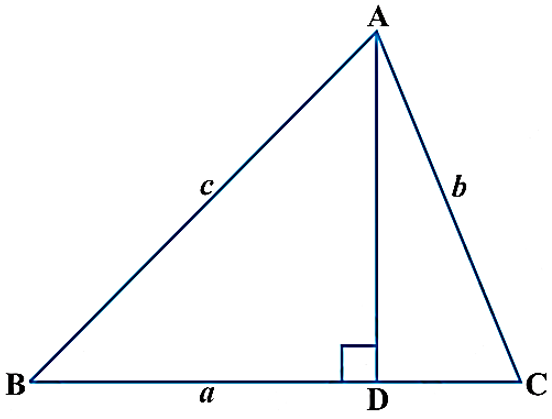
Let $ABC$ be a triangle. From A draw $AD$ perpendicular to $BC (BC$ produced if necessary$)$.
As we know that any triangle has to be either acute or obtuse or right-angled, we can split p into three statements r, s and t, where
$r : ABC$ is an acute-angled triangle with $\angle C$ is acute.
$s : ABC$ is an obtuse-angled triangle with $\angle C$ is obtuse
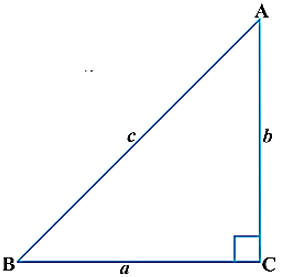
$4$ is a right-angled triangle with $∠C$ is a right angle.
Hence, we prove the theorem by three cases
case (i) When $C$ is acute (Fig.
From the right-angled triangle ADB,
$\frac{B D}{A B}=\cos E$
$\mathrm{BD}=\mathrm{AB} \cos \mathrm{B}$
$=c \cos B$

from the right-angled triangle $ADC $
$\frac{C D}{\Delta C}=\cos C$
$CD = AC \cos C$
$= b \cos C$
$a = BD + CD$
$= c \cos B + b \cos C ...(1)$
case(ii) When $\angle C$ is obtuse in below figure.

From the right angled triangle $ADB$,
$BD \over AB = \cos B$
i.e. $BD = AB \cos B$
$= c \cos B$ From the right angled triangle $ADC,$
$\frac{C D}{A C}=\cos \angle A C D$
$= \cos (180^o - C) = - \cos C$ i.e. $CD = - AC \cos C = - b \cos C$
Now $a = BC = BD - CD$
i.e. $a = c \cos B - ( - b \cos C)$
$a = c \cos B + b \cos C ... (2)​​​​​​​$​​​​​​​
Case (iii) When $\angle C$ is a right angle in the given figure.

From the right angled triangle $ACB,$
$BC \over AB = \cos B$
i.e. $BC = AB \cos B$
$a = c \cos B,$
and $b \cos C = b \cos 900 = 0.$
Thus, we may write $a = 0 + c \cos B$
$= b \cos C + c \cos B ... (3)$
From $(1), (2)$ and $(3).$ We assert that for any triangle $ABC,$
$a = b \cos C + c \cos B$
By case $(i), r \Rightarrow q$ is proved.
By case $(ii), s \Rightarrow q$ is proved.
By case $(iii), t \Rightarrow q$ is proved.
Hence, from the proof by cases, $(r\ v\ s\ v\ t) \Rightarrow q$ is proved, i.e., $p \Rightarrow q$ is proved.
View full question & answer
Question 53 Marks
Show that if $A=\left[\begin{array}{ll} \cos \theta & \sin \theta \\ -\sin \theta & \cos \theta \end{array}\right], \text { then } A^{n}=\left[\begin{array}{cc} \cos n \theta & \sin n \theta \\ -\sin n \theta & \cos n \theta \end{array}\right]$
Answer
we have
$P(n): A^{n}=\left[\begin{array}{cc} \cos n \theta & \sin n \theta \\ -\sin n \theta & \cos n \theta \end{array}\right]$
we note that $\mathrm{P}(1): \mathrm{A}^{1}=\left[\begin{array}{cc} \cos \theta & \sin \theta \\ -\sin \theta & \cos \theta \end{array}\right]$
Therefore, p (1) is true.
Assume that p(k) is true i,e.
$P(k): A^{*}=\left[\begin{array}{ll} \cos k \theta & \sin k \theta \\ -\sin k \theta & \cos k \theta \end{array}\right]$
We want to prove that P (k +1) is true whenever p(k) is true ie
$P(k+1): A^{k+1}=\left[\begin{array}{ll} \cos (k+1) \theta & \sin (k+1) \theta \\ -\sin (k+1) \theta & \cos (k+1) \theta \end{array}\right]$
Now $A^{i+1}=A^{k} \cdot A$
Since p(k) is true, we have
$A^{\Delta 1}=\left[\begin{array}{rr} \cos k \theta & \sin k \theta \\ -\sin k \theta & \cos k \theta \end{array}\right]\left[\begin{array}{rr} \cos \theta & \sin \theta \\ -\sin \theta & \cos \theta \end{array}\right]$
$=\left[\begin{array}{cc} \cos k \theta \cos \theta-\sin k \theta \sin \theta & \cos k \theta \sin \theta+\sin k \theta \cos \theta \\ -\sin k \theta \cos \theta-\cos k \theta \sin \theta & -\sin k \theta \sin \theta+\cos k \theta \cos \theta \end{array}\right]$
$=\left[\begin{array}{ll} \cos (k+1) \theta & \sin (k+1) \theta \\ -\sin (k+1) \theta & \cos (k+1) \theta \end{array}\right]$
Thus, P(k + 1) is true whenever P(k) is true.
Hence, P(n) is true for all n ≥ 1 (by the principle of mathematical induction).
View full question & answer
Question 63 Marks
Prove that the function $f : R → R$ defined by $f (x) = 2x + 5$ is one-one.
Answer
Note that a function $f$ is one-one if
$f\left(x_1\right)=f\left(x_2\right) \Rightarrow x_1=x_2 \text { (definition of one-one function) }$
Now, given that $f\left(x_1\right)=f\left(x_2\right)$, i.e., $2 x_1+5=2 x_2+5$
$\Rightarrow 2 x_1+5-5=2 x_2+5-5$ (adding the same quantity on both sides)
$2 \mathrm{x}_1+0=2 \mathrm{x}_2+0$
$2 x_1=2 x_2$ (using additive identity of real number)
$\frac{2}{2} x_1=\frac{2}{2} x_2$ dividing by the same non zero quantity $\mathrm{x}_1=\mathrm{x}_2$
Hence, the given function is one one
View full question & answer
Question 73 Marks
Show that if $x^2 – 5x + 6 = 0$, then $x = 3$ or $x = 2$
Answer
$x^2-5 x+6=0$ (given)
$\Rightarrow(x-3)(x-2)=0$ (replacing an expression by an equal/equivalent expression)
$\Rightarrow \mathrm{x}-3=0$ or $\mathrm{x}-2=0$ (from the established theorem $\mathrm{ab}=0 \Rightarrow$ either $\mathrm{a}=0$ or $\mathrm{b}=0$, for $\mathrm{a}, \mathrm{b}$ in R )
$\Rightarrow x-3+3=0+3$ or $x-2+2=0+2$ (adding equal quantities on either side of the equation does not alter the nature of the equation)
$\Rightarrow x+0=3$ or $x+0=2$ (using the identity property of integers under addition)
$\Rightarrow x=3$ or $x=2$ (using the identity property of integers under addition)
Hence, $x^2-5 x+6=0$ implies $x=3$ or $x=2$
View full question & answer