Sample QuestionsApplication of Derivatives questions
One sample from each question group in this chapter. Select any group above to see the full set with answer keys.
Every invertible function is :
- ✓
- B
- C
- D
Not necessarily monotonic function.
Answer: A.
View full solution →Choose the correct answer from the given four options : $f(x) = x^x$ has a stationary point at :
Answer: B.
View full solution →If $s=t^3-4 t^2+5$ describes the motion of a particle, then its velocity when the acceleration vanishes, is :
- A
$\frac{16}{2}\ \text{unit}/\text{sec}.$
- B
$\frac{\text{-32}}{3}\ \text{unit}/\text{sec}.$
- C
$\frac{4}{3}\ \text{unit}/\text{sec}.$
- ✓
$-\frac{16}{3}\ \text{unit}/\text{sec}.$
Answer: D.
View full solution →If the function $\text{f}(\text{x})=\frac{-\text{x}}{2}+\sin\text{x}$ defined on $\Big[\frac{-\pi}{3},\frac{\pi}{3}\Big]$ is :
Answer: A.
View full solution →If $\text{f}(\text{x})=\frac{1}{4\text{x}^{2}+2\text{x}+1}$, then its maximum value is :
- ✓
$\frac{4}{3}$
- B
$\frac{2}{3}$
- C
$1$
- D
$\frac{3}{4}$
Answer: A.
View full solution →Directions: In the following questions, the Assertions $(A)$ and Reason$(s) (R)$ have been put forward. Read both the statements carefully and choose the correct alternative from the following:
Assertion $(A):$ Let $\text{f(x)}=\text{e}^\frac{1}{\text{x}}$ is defined for all real values of $x.$
Reason$(R): \text{f(x)}=\text{e}^\frac{1}{\text{x}}$ is always decreasing as $\text{f'(x)}<0$ is $\text{x }\in\text{ R}$
- ✓
Both $A$ and $R$ are true and $R$ is the correct explanation of $A$
- B
Both $A$ and $R$ are true but $R$ is $\text{NOT}$ the correct explanation of $A$
- C
$A$ is true but $R$ is false.
- D
$A$ is false but $R$ is true.
Answer: A.
View full solution →Directions: In the following questions, the Assertions $(A)$ and Reason$(s) (R)$ have been put forward. Read both the statements carefully and choose the correct alternative from the following:
Assertion $(A):$ if $\text{f(x)}=\text{a}(\text{x}+\sin\text{x})$ is increasing function if $a\in(0,\infty)$
Reason $(R):$ The given function $\text{f(x) }$is increasing only if $a\in(0,\infty)$
- A
Both $A$ and $R$ are true and $R$ is the correct explanation of $A$
- B
Both $A$ and $R$ are true but $R$ is $\text{NOT}$ the correct explanation of $A$
- C
$A$ is true but $R$ is false.
- ✓
$A$ is false but $R$ is true.
Answer: D.
View full solution →Directions: In the following questions, the Assertions $(A)$ and Reason$(s) (R)$ have been put forward. Read both the statements carefully and choose the correct alternative from the following:
Assertion $(A):$ The curve $y = x^2$ represents a parabola with vertex at origin.
Reason $(R):$ For a curve Tangent and Normal lines are always perpendicular at thepoint of contact.
- A
Both $A$ and $R$ are true and $R$ is the correct explanation of $A$
- ✓
Both $A$ and $R$ are true but $R$ is $\text{NOT}$ the correct explanation of $A$
- C
$A$ is true but $R$ is false.
- D
$A$ is false but $R$ is true.
Answer: B.
View full solution →Directions: In the following questions, the Assertions $(A)$ and Reason$(s) (R)$ have been put forward. Read both the statements carefully and choose the correct alternative from the following:
Assertion $(A):$ The function $\text{y}=\log(1+\text{x)}\ \frac{2\text{x}}{2+\text{x}}$ is decreasing throughout its domain
Reason $(R):$ The domain of the function $\text{y}=\log(1+\text{x)} \ \frac{2\text{x}}{2+\text{x}}$ is $(-1,\infty).$
- A
Both $A$ and $R$ are true and $R$ is the correct explanation of $A$
- B
Both $A$ and $R$ are true but $R$ is $\text{NOT}$ the correct explanation of $A$
- C
$A$ is true but $R$ is false.
- ✓
$A$ is false but $R$ is true.
Answer: D.
View full solution →Directions: In the following questions, the Assertions $(A)$ and Reason$(s) (R)$ have been put forward. Read both the statements carefully and choose the correct alternative from the following:
Assertion $(A):$ The equation of tangent to the curve $ \text{y} = \sin\text{x}$ at the point $(0, 0)$ is $y = x.$
Reason $(R):$ if $\text{y}=\sin$ then $\frac{\text{dy}}{\text{dx}}$ at $x = 0$ is $1.$
- ✓
Both $A$ and $R$ are true and $R$ is the correct explanation of $A$
- B
Both $A$ and $R$ are true but $R$ is $\text{NOT}$ the correct explanation of $A$
- C
$A$ is true but $R$ is false.
- D
$A$ is false but $R$ is true.
Answer: A.
View full solution →The maximum value of $[x(x-1)+1]^{\frac{1}{3}}, 0 \leq x \leq 1$ is
View full solution →For all real values of $x$, the minimum value of $\frac{1-x+x^{2}}{1+x+x^{2}}$ is
View full solution →The point on the curve $x^2 = 2y$ which is nearest to the point $(0, 5)$ is
View full solution →Find the interval of the function that is strictly increasing or decreasing: $(x + 1)^3 (x - 3)^3$
View full solution →Find the interval in function $6 - 9x - x^2$ is increasing or decreasing.
View full solution →What is the maximum value of the function sin x + cos x?
At what points in the interval [0, 2$\pi$], does the function sin 2x attain its maximum value?
View full solution →Find both the maximum value and minimum value of $3{x^4} - 8{x^3} + 12{x^2} - 48x + 25$ on the interval [0, 3].
View full solution →Find the maximum profit that a company can make, if the profit function is given by
$p(x) = 41 – 72x – 18x^2$
View full solution →Find the absolute maximum value and the absolute minimum value of the function:
$f(x)=(x-1)^{2}+3, x \in[-3,1]$
View full solution →Find the intervals in which the function f given by $f(x) = x ^ { 3 } + \frac { 1 } { x ^ { 3 } } , x \neq 0$ is $x (i)$ increasing. $(ii)$ decreasing.
View full solution →Find the intervals in which the function f given by $f\left( x \right) = \frac{{4\sin x - 2x - x\cos x}}{{2 + \cos x}}$ is
- increasing
- decreasing
View full solution →Show that the function given by f(x) = $\frac{\log x}{x}$ has maximum at x = e.
View full solution →Find the local maxima and local minima of function,
$f(x)=x \sqrt{1-x}, \quad 0<x<1$
Find also the local maximum and the local minimum value.
View full solution →Find the local maxima and local minima of function
$g(x)=\frac{1}{x^{2}+2}$
Find also the local maximum and the local minimum value.
View full solution →A point on the hypotenuse of a triangle is at distance a and b from the sides of the triangle. Show that the minimum length of the hypotenuse is$(a^{\frac{2}{3}} + b^{\frac{2}{3}})^{\frac{3}{2}}$
View full solution →A window is in the form of a rectangle surmounted by a semicircular opening. The total perimeter of the window is 10 m. Find the dimensions of the window to admit maximum light through the whole opening.
The sum of the perimeter of a circle and square is k, where k is some constant. Prove that the sum of their area is least when the side of square is double the radius of the circle.
A tank with rectangular base and rectangular sides, open at the top is to be constructed so that its depth is 2 m and volume is $8\ m^3.$ If building of tank costs Rs $70$ per sq.metres for the base and Rs $45$ per sq. metre for sides. What is the cost of least expensive tank ?
View full solution →Find the maximum area of an isosceles $\triangle $ inscribed in the ellipse $\frac{{{x^2}}}{{{a^2}}} + \frac{{{y^2}}}{{{b^2}}} = 1$ with its vertex at one end of the major axis
View full solution → On her birthday, Seema decided to donate some money to the children of an orphanage home. If there were $8$ children less, everyone would have got $₹10$ more. However, if there were $16$ children more, everyone would have got $₹10$ less. Let the number of children be $\mathrm{x}$ and the amount distributed by Seema for one child be $\mathrm{y} \ ($in $₹)$.
$(i)$ Represent given information in matrix algebra.
$(ii)$ Find the adjoint of Matrix containing information about of number of children and amount she paid?
$(iii)$ Find the number of children who were given some money by Seema?
OR
How much amount does Seema spend in distributing the money to all the students of the Orphanage? View full solution →A gardener wants to construct a rectangular bed of garden in a circular patch of land. He takes the maximum perimeter of the rectangular region as possible. (Refer to the images given below for calculations) 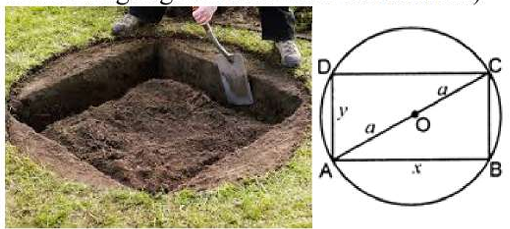
(i) Find the perimeter of rectangle in terms of any one side and radius of circle.
(ii) Find critical points to maximize the perimeter of rectangle?
(iii) Check for maximum or minimum value of perimeter at critical point.
OR
If a rectangle of the maximum perimeter which can be inscribed in a circle of radius $10 \mathrm{~cm}$ is square, then the perimeter of region.
View full solution →The Government declare that farmers can get ₹ 300 per quintal for their onions on 1st July and after that, the price will be dropped by ₹ 3 per quintal per extra day. Govind's father has 80 quintals of onions in the field on 1st July and he estimates that the crop is increasing at the rate of 1 quintal per day.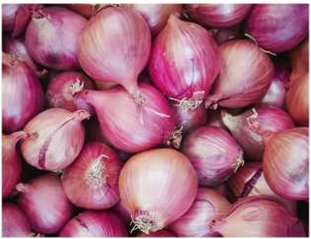
(i) If $x$ is the number of days after $1^{\text {st }}$ July, then express price and quantity of onion and the revenue as a function of $x$.
(ii) Find the number of days after 1st July, when Govind's father attains maximum revenue.
(iii) On which day should Govind's father harvest the onions to maximize his revenue?
OR
Find the maximum revenue collected by Govind's father.
View full solution →The relation between the height of the plant ( $\mathrm{y}$ in $\mathrm{cm}$ ) with respect to exposure to sunlight is governed by the following equation $\mathrm{y}=4 \mathrm{x}-\frac{1}{2} \mathrm{x}^2$ where $\mathrm{x}$ is the number of days exposed to sunlight.
(i) Find the rate of growth of the plant with respect to sunlight.
(ii) What is the number of days it will take for the plant to grow to the maximum height?
(iii) Verify that height of the plant is maximum after four days by second derivative test and find the maximum height of plant.
OR
What will be the height of the plant after 2 days?
View full solution →Ankit wants to construct a rectangular tank for his house that can hold $80 \mathrm{ft}^3$ of water. He wants to construct on one corner of terrace so that sufficient space is left after construction of tank. For that he has to keep width of tank constant $5 \mathrm{ft}$, but the length and heights are variables. The top of the tank is open. Building the tank cost ₹20 per sq. foot for the base and ₹10 per sq. foot for the side.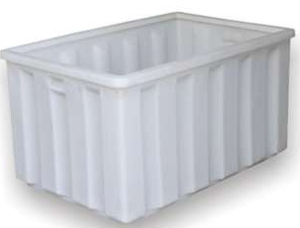
(i) Express cost of tank as a function of height(h).
(ii) Verify by second derivative test that cost is minimum at critical point.
(iii) Find the value of $\mathrm{h}$ at which $\mathrm{c}(\mathrm{h})$ is minimum.
OR
Find the minimum cost of tank?
View full solution →Fill in the blanks:
The equation of normal to the curve y = tan x at (0, 0) is ________.
Fill in the blanks:
The values of a for which the function f(x) = sinx - ax + b increases on R are ______.
Fill in the blanks:
The function $\text{f(x)}=\frac{2\text{x}^2-1}{\text{x}^4},\text{ x}>0,$ decreases in the interval _______.
View full solution →Fill in the blanks:
The least value of the function $\text{f(x)}=\text{ax}+\frac{\text{b}}{\text{a}}(\text{a}>0,\text{b}>0,\text{x}>0)$ is ______.
View full solution →Fill in the blanks:
The curves $y = 4x^2 + 2x - 8$ and $y = x^3 - x + 13$ touch each other at the point _____.
View full solution →