Questions

Case study (4 Marks)

Take a timed test

31 questions · self-marked practice — reveal the answer and mark yourself.

Question 14 Marks
 On her birthday, Seema decided to donate some money to the children of an orphanage home. If there were $8$ children less, everyone would have got $₹10$ more. However, if there were $16$ children more, everyone would have got $₹10$ less. Let the number of children be $\mathrm{x}$ and the amount distributed by Seema for one child be $\mathrm{y} \ ($in $₹)$.Image

$(i)$ Represent given information in matrix algebra.
$(ii)$ Find the adjoint of Matrix containing information about of number of children and amount she paid?
$(iii)$ Find the number of children who were given some money by Seema?
OR
How much amount does Seema spend in distributing the money to all the students of the Orphanage?
Answer
$(i) \begin{aligned}& 5 x-4 y=40 \\& 5 x-8 y=-80 \\& {\left[\begin{array}{rr}5 & -4 \\ 5 & -8\end{array}\right]\left[\begin{array}{l}x \\y\end{array}\right]=\left[\begin{array}{c}40 \\-80\end{array}\right]}\end{aligned}$
$(ii) A=\left[\begin{array}{ll}5 & -4 \\ 5 & -8\end{array}\right], \mathrm{X}=\left[\begin{array}{l}x \\ y\end{array}\right] \text { and } \mathrm{B}=\left[\begin{array}{c}40 \\ -80\end{array}\right] $
$ |A|=-40+20=-20 \neq 0  \text { Cofactor matrix } \mathrm{A}$
$=\left[\begin{array}{ll}-8 & -5 \\ 4 & 5\end{array}\right] \text { adj } \mathrm{A}=\left[\begin{array}{cc}-8 & 4 \\ -5 & 5\end{array}\right]$
$(iii) \mathrm{A}=\left[\begin{array}{ll}5 & -4 \\ 5 & -8\end{array}\right],$
$ \mathrm{X}=\left[\begin{array}{l}x \\ y\end{array}\right] \text { and } \mathrm{B}=\left[\begin{array}{c}40 \\ -80\end{array}\right]$
$ \mathrm{A} \mid=-40+20=-20 \neq 0  \text { Cofactor matrix } \mathrm{A}$
$=\left[\begin{array}{ll}-8 & -5 \\ 4 & 5\end{array}\right] \text {, adj } \mathrm{A}=\left[\begin{array}{ll}-8 & 4 \\ -5 & 5\end{array}\right] $
$ \mathrm{X}=\mathrm{A}^{-1} \mathrm{~B} \ldots(\mathrm{i}) $
$ \mathrm{A}^{-1}=\frac{1}{|A|} \cdot \operatorname{adjA} $
$ \mathrm{A}^{-1}=\frac{1}{-20} \cdot\left[\begin{array}{ll}-8 & 4 \\ -5 & 5\end{array}\right] $
From $(i)\ {\left[\begin{array}{l}x \\ y\end{array}\right]=\frac{1}{-20} \cdot\left[\begin{array}{ll}-8 & 4 \\ -5 & 5\end{array}\right]\left[\begin{array}{c}40 \\ -80\end{array}\right]} $
$ \Rightarrow \left[\begin{array}{l}x \\ y\end{array}\right]=\frac{1}{-20}\left[\begin{array}{l}-320-320 \\ -200-400\end{array}\right]=\left[\begin{array}{l}32 \\ 30\end{array}\right] $
$ \mathrm{X}=32 $ and $ \mathrm{y}=30$
Or
There are $32$ Children, and each child is given $₹30$.
Total money spent by Seema $=32 \times 30=₹\ 960$
Hence Seema spends $₹\ 96$0 in distributing the money to all the students of the Orphanage.
View full question & answer
Question 24 Marks
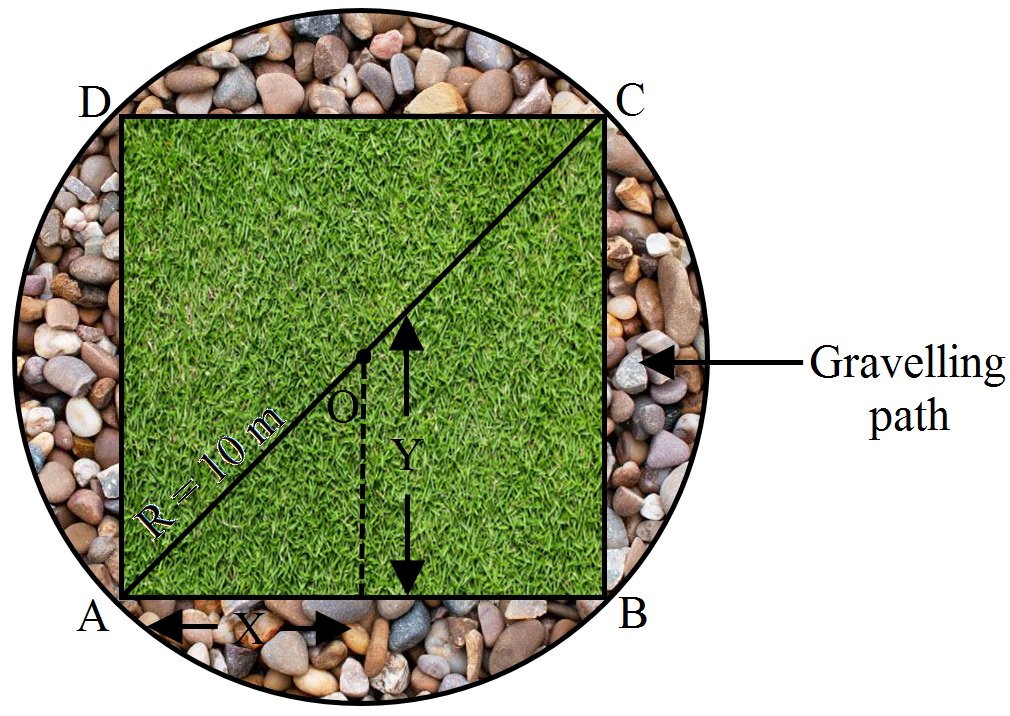
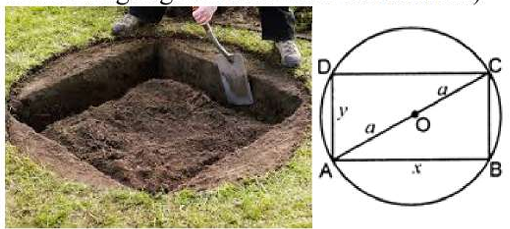
A gardener wants to construct a rectangular bed of garden in a circular patch of land. He takes the maximum perimeter of the rectangular region as possible. (Refer to the images given below for calculations)

Image

(i) Find the perimeter of rectangle in terms of any one side and radius of circle.

(ii) Find critical points to maximize the perimeter of rectangle?

(iii) Check for maximum or minimum value of perimeter at critical point.

OR

If a rectangle of the maximum perimeter which can be inscribed in a circle of radius $10 \mathrm{~cm}$ is square, then the perimeter of region.

Answer
(i) Let ' $y$ ' be the breadth and ' $x$ ' be the length of rectangle and ' $a$ ' is radius of given circle.

From fig $4 a^2=x^2+y^2$

$\begin{aligned}& \Rightarrow y^2=4 a^2-x^2 \\& \Rightarrow y=\sqrt{4 a^2-x^2} \\& \text { Perimeter }(P)=2 x+2y=2\left(x+\sqrt{4 a^2-x^2}\right)\end{aligned}$

(ii) We know that $\mathrm{P}=2\left(x+\sqrt{4 a^2-x^2}\right)$

Critical points to maximize perimeter $\frac{d P}{d x}=0$

$\begin{aligned} & \Rightarrow \frac{d p}{d x}=2\left(1+\frac{1}{2 \sqrt{4 a^2-x^2}}(-2 x)\right)=0 \\ & 2\left(\frac{\sqrt{4 a^2-x^2}-x}{\sqrt{4 a^2-x^2}}\right)=0 \\ & \Rightarrow \sqrt{4 a^2-x^2}=\mathrm{x} \\ & \Rightarrow 4 \mathrm{a}^2-\mathrm{x}^2=\mathrm{x}^2 \\ & \Rightarrow 2 \mathrm{a}^2=\mathrm{x}^2 \\ & \Rightarrow \mathrm{x}= \pm \sqrt{2 a}\end{aligned}$

when $\mathrm{x}=\sqrt{2 a}, \mathrm{y}=\sqrt{2 a}$

when $\mathrm{x}=-\sqrt{2 a}$ not possible as ' $\mathrm{x}$ ' is length critical point is $(\sqrt{2 a}, \sqrt{2 a})$

(iii) $\begin{aligned} & \frac{d p}{d x}=2\left(1+\frac{1}{2 \sqrt{4 a^2-x^2}}(-2 x)\right) \\ & \frac{d^2 P}{d x^2}=-2\left(\frac{\sqrt{4 a^2-x^2}-(x)\left(\frac{-2 x}{2 \sqrt{4^2-x^2}}\right)}{\left(4 a^2-x^2\right)}\right) \\ & =-2\left(\frac{\left(4 a^2-x^2\right)+x^2}{\left(4 a^2-x^2\right)^{3 / 2}}\right) \\ & \left.\left.\Rightarrow \frac{d^2 P}{d x^2}\right]_{x=a \sqrt{2}=-2}^{\left(4 a^2-2 a^2\right)^{3 / 2}}\right)=\frac{-2}{(2 \sqrt{2}) a}<0\end{aligned}$

Perimeter is maximum at a critical point.

From the above results know that $\mathrm{x}=\mathrm{y}=\sqrt{2} a$

$\mathrm{a}=$ radius

Here, $\mathrm{x}=\mathrm{y}=10 \sqrt{2}$

Perimeter $=\mathrm{P}=4 \times$ side $=40 \sqrt{2} \mathrm{~cm}$

View full question & answer
Question 34 Marks
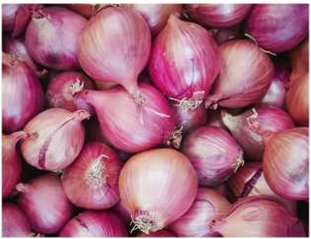
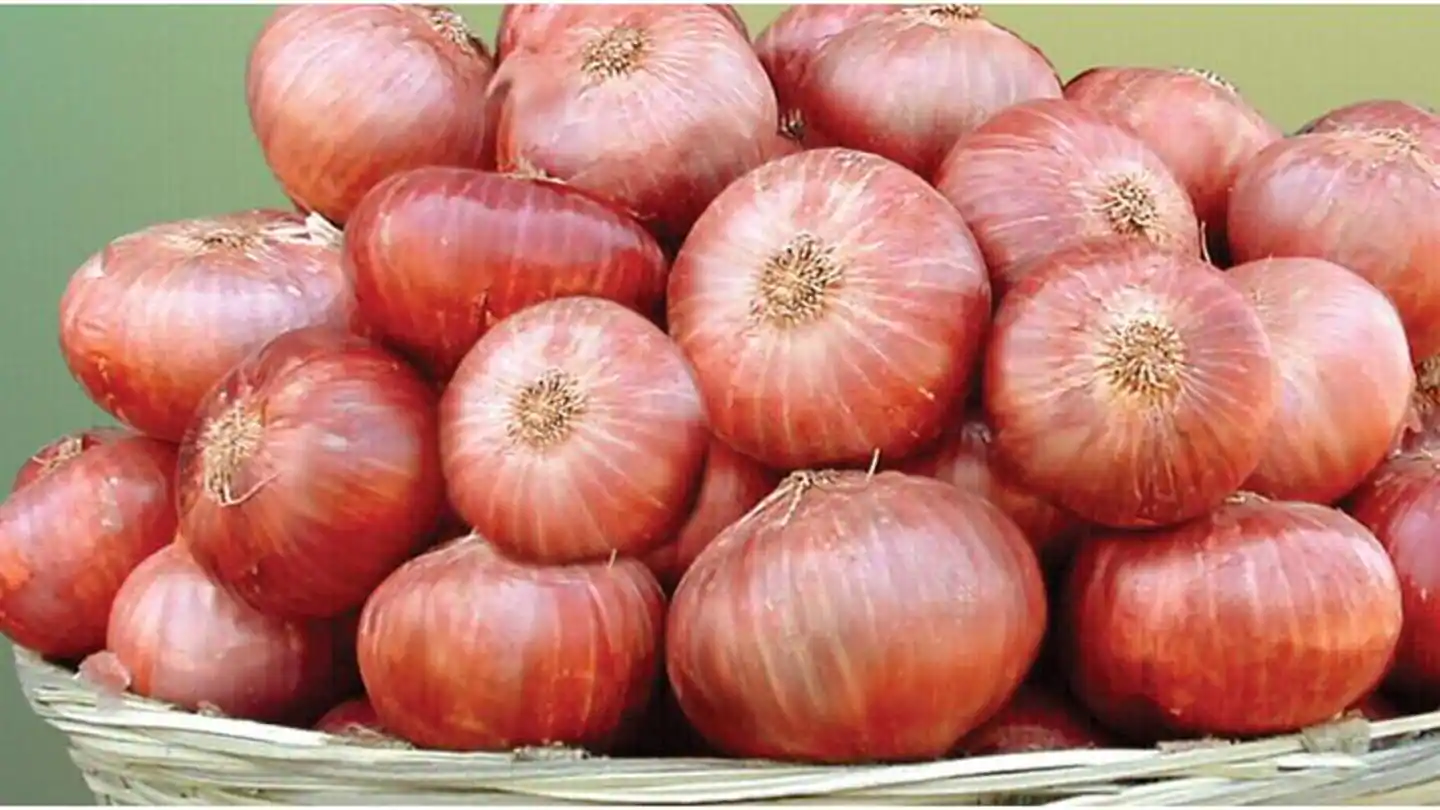
The Government declare that farmers can get ₹ 300 per quintal for their onions on 1st July and after that, the price will be dropped by ₹ 3 per quintal per extra day. Govind's father has 80 quintals of onions in the field on 1st July and he estimates that the crop is increasing at the rate of 1 quintal per day.

Image

(i) If $x$ is the number of days after $1^{\text {st }}$ July, then express price and quantity of onion and the revenue as a function of $x$.

(ii) Find the number of days after 1st July, when Govind's father attains maximum revenue.

(iii) On which day should Govind's father harvest the onions to maximize his revenue?

OR

Find the maximum revenue collected by Govind's father.

View full question & answer
Question 44 Marks
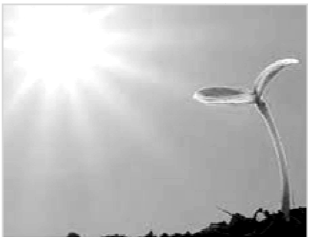
The relation between the height of the plant ( $\mathrm{y}$ in $\mathrm{cm}$ ) with respect to exposure to sunlight is governed by the following equation $\mathrm{y}=4 \mathrm{x}-\frac{1}{2} \mathrm{x}^2$ where $\mathrm{x}$ is the number of days exposed to sunlight.

Image

(i) Find the rate of growth of the plant with respect to sunlight.

(ii) What is the number of days it will take for the plant to grow to the maximum height?

(iii) Verify that height of the plant is maximum after four days by second derivative test and find the maximum height of plant.

OR

What will be the height of the plant after 2 days?

View full question & answer
Question 54 Marks
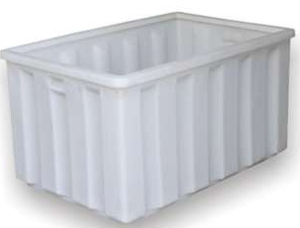
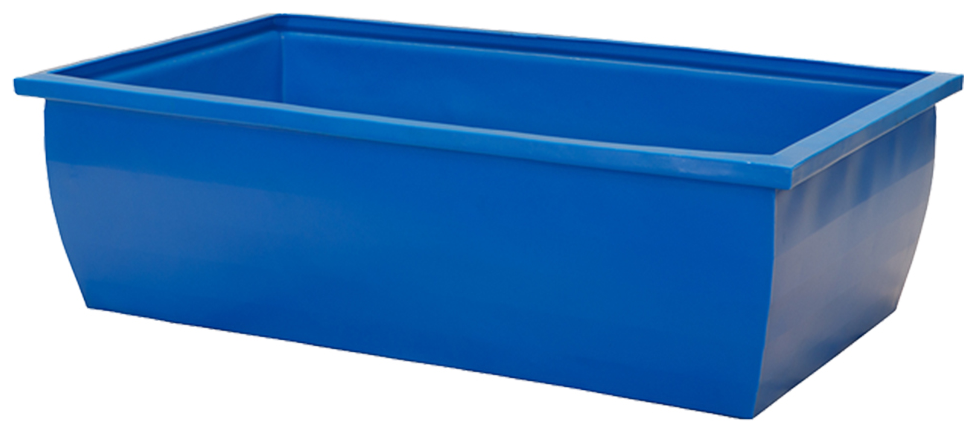
Ankit wants to construct a rectangular tank for his house that can hold $80 \mathrm{ft}^3$ of water. He wants to construct on one corner of terrace so that sufficient space is left after construction of tank. For that he has to keep width of tank constant $5 \mathrm{ft}$, but the length and heights are variables. The top of the tank is open. Building the tank cost ₹20 per sq. foot for the base and ₹10 per sq. foot for the side.

Image

(i) Express cost of tank as a function of height(h).

(ii) Verify by second derivative test that cost is minimum at critical point.

(iii) Find the value of $\mathrm{h}$ at which $\mathrm{c}(\mathrm{h})$ is minimum.

OR

Find the minimum cost of tank?

Answer
(i) $\mathrm{c}(\mathrm{h})=100 \mathrm{~h}+320+\frac{1600}{h}$

Let $\mathrm{l} \mathrm{ft}$ be the length and $\mathrm{h} \mathrm{ft}$ be the height of the tank. Since breadth is equal to $5 \mathrm{ft}$. (Given)

$\therefore$ Two sides will be $5 \mathrm{~h}$ sq. feet and two sides will be lh sq. feet. So, the total area of the sides is $(10 \mathrm{~h}+2 \mathrm{lh}) \mathrm{ft}^2$ Cost of the sides is ₹10 per sq. foot. So, the cost to build the sides is $(10 h+2 \mathrm{Ih}) \times 10=₹(100 \mathrm{~h}+20 \mathrm{Ih})$

Also, cost of base $=(5 \mathrm{l}) \times 20=₹ 100 \mathrm{l}$

$\therefore$ Total cost of the tank in $₹$ is given by $\mathrm{c}=100 \mathrm{~h}+20 \mathrm{lh}+100 \mathrm{l}$Since, volume of tank $=80 \mathrm{ft}^3$

$\begin{aligned}& \therefore 5 \mathrm{lh}=80 \mathrm{ft}^3 \therefore l=\frac{80}{5 h}=\frac{16}{h} \\& \therefore \mathrm{c}(\mathrm{h})=100 \mathrm{~h}+20\left(\frac{16}{h}\right) h+100\left(\frac{16}{h}\right) \\& =100 \mathrm{~h}+320+\frac{1600}{h}\end{aligned}$

$\begin{aligned}& \text { (ii) } \mathrm{C}(\mathrm{h})=100 \mathrm{~h}+320+\frac{1600}{h} \\& \frac{d C(h)}{d h}=100-\frHac{1600}{h^2} \\& \frac{d^2 C(h)}{d h^2}=-\left(\frac{-2}{h^3}\right) 1600 \\& \text { at } \mathrm{h}=4 \\& \frac{d^2 C(h)}{dh^2}=50>0\end{aligned}$

Hence cost is minimum when $\mathrm{h}=4 \mathrm{ft}$

$\begin{aligned} & \text { (iii)To minimize cost, } \frac{d c}{d h}=0 \\ & \Rightarrow 100-\frac{1600}{h^2}=0 \\ & \Rightarrow 100 \mathrm{~h}^2=1600 \Rightarrow \mathrm{h}^2=16 \Rightarrow \mathrm{h}= \pm 4 \\ & \Rightarrow \mathrm{h}=4[\because \text { height can not be negative }]\end{aligned}$

Or

Minimum cost of tank is given by

$\begin{aligned}& c(4)=400+320+\frac{1600}{4} \\& =720+400=₹ 1120\end{aligned}$

View full question & answer
Question 64 Marks
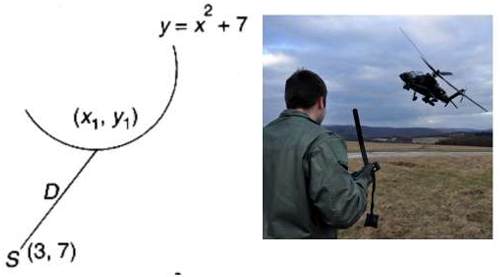
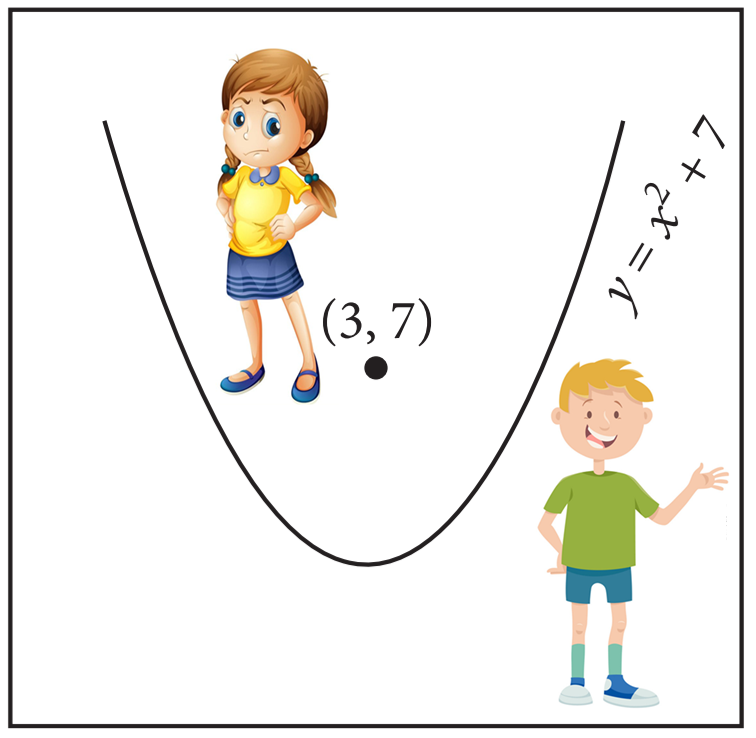
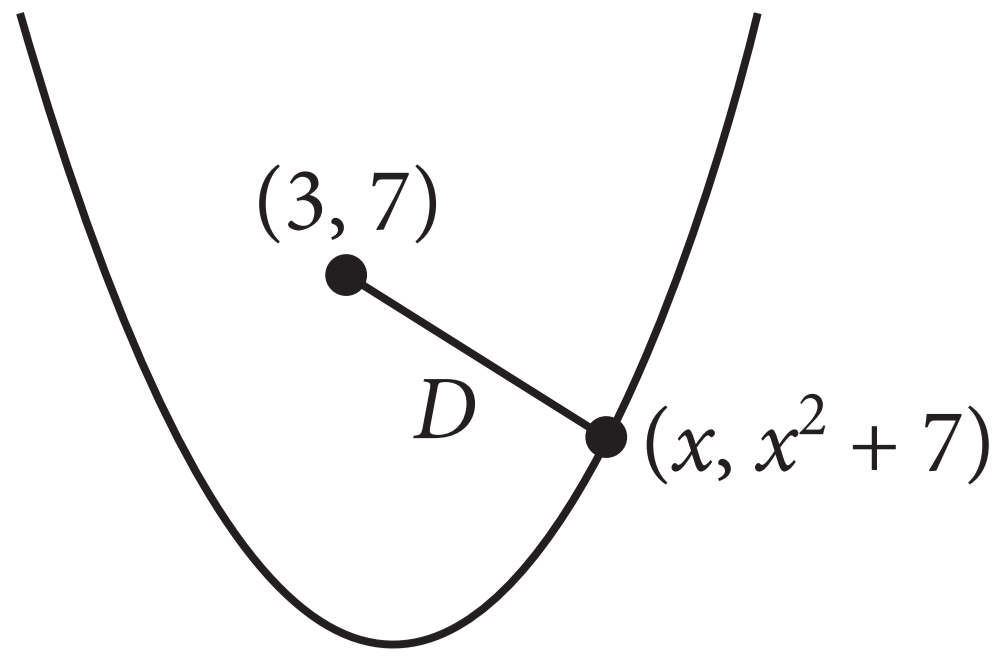
An Apache helicopter of the enemy is flying along the curve given by $y=x^2+7$. A soldier, placed at $(3,7)$ want to shoot down the helicopter when it is nearest to him.

Image

(i) If $\mathrm{P}\left(\mathrm{x}_1, \mathrm{y}_1\right)$ be the position of a helicopter on curve $\mathrm{y}=\mathrm{x}^2+7$, then find distance $\mathrm{D}$ from $\mathrm{P}$ to soldier place at $(3,7)$.

(ii) Find the critical point such that distance is minimum.

(iii) Verify by second derivative test that distance is minimum at $(1,8)$.

OR

Find the minimum distance between soldier and helicopter?

View full question & answer
Question 74 Marks
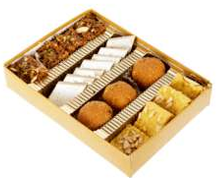
Naina is creative she wants to prepare a sweet box for Diwali at home. She took a square piece of cardboard of side $18 \mathrm{~cm}$ which is to be made into an open box, by cutting a square from each corner and folding up the flaps to form the box. She wants to cover the top of the box with some decorative paper. Naina is interested in maximizing the volume of the box.

Image

(i) Find the volume of the open box formed by folding up the cutting each corner with $\mathrm{x} \mathrm{cm}$.

(ii) Naina is interested in maximizing the volume of the box. So, what should be the side of the square to be cut off so that the volume of the box is maximum?

(iii) Verify that volume of the box is maximum at $x=3 \mathrm{~cm}$ by second derivative test?

OR

Find the maximum volume of the box.

View full question & answer
Question 84 Marks

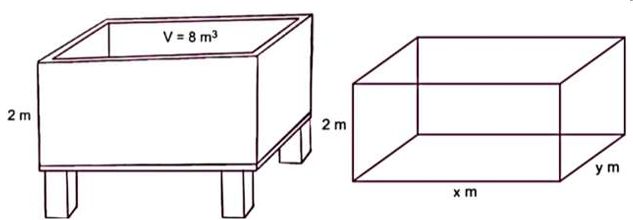
On the request of villagers, a construction agency designs a tank with the help of an architect. Tank consists of a rectangular base with rectangular sides, open at the top so that its depth is $2 \mathrm{~m}$ and volume is $8 \mathrm{~m}^3$ as shown below. The construction of the tank costs ₹ 70 per sq. metre for the base and ₹ 45 per square metre for sides.
Image
(i) Express making cost $\mathrm{C}$ in terms of length of rectangle base.
(ii) If $\mathrm{x}$ and $\mathrm{y}$ represent the length and breadth of its rectangular base, then find the relation between the variables.
(iii) Find the value of $\mathbf{x}$ so that the cost of construction is minimum.
OR
Verify by second derivative test that cost is minimum at a critical point.
View full question & answer
Question 94 Marks
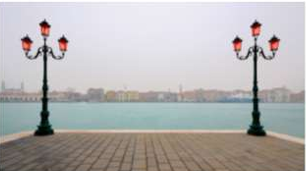
In a street two lamp posts are 600 feet apart. The light intensity at a distance $d$ from the first (stronger) lamp post is $\frac{1000}{d^2}$, the light intensity at distance $d$ from the second (weaker) lamp post is $\frac{125}{d^2}$ (in both cases the light intensity is inversely proportional to the square of the distance to the light source). The combined light intensity is the sum of the two light intensities coming from both lamp posts.

Image

(i) If $\mathrm{l}(\mathrm{x})$ denotes the combined light intensity, then find the value of $\mathrm{x}$ so that $\mathrm{I}(\mathrm{x})$ is minimum.

(ii) Find the darkest spot between the two lights.

(iii) If you are in between the lamp posts, at distance $\mathrm{x}$ feet from the stronger light, then write the combined light intensity coming from both lamp posts as function of $\mathrm{x}$.

OR

Find the minimum combined light intensity?

View full question & answer
Question 104 Marks
Read the following passage and answer the questions given below.

Image

The temperature of a person during an intestinal illness is given by $f(x)=-0.1 x^2+m x+98.6,0 \leq x \leq 12, \mathrm{~m}$ being a constant, where $\mathrm{f}(\mathrm{x})$ is the temperature in ${ }^{\circ} \mathrm{F}$ at $x$ days.

(i) Is the function differentiable in the interval $(0,12)$ ? Justify your answer.

(ii) If 6 is the critical point of the function, then find the value of the constant $\mathrm{m}$.

(iii) Find the intervals in which the function is strictly increasing/strictly decreasing.
OR
(iii) Find the points of local maximum/local minimum, if any, in the interval (0, 12) as well as the points of absolute maximum/absolute minimum in the interval [0, 12]. Also, find the corresponding local maximum/local minimum and the absolute maximum/absolute minimum values of the function.

Answer
(i) $\mathrm{f}(x)=-0.1 x^2+m x+98.6$, being a polynomial function, is differentiable everywhere, hence, differentiable in $(0,12)$
(ii) $f^{\prime}(x)=-0.2 x+m$
Since, 6 is the critical point,
$f^{\prime}(6)=0 \Rightarrow m=1.
(iii) $f(x)=-0.1 x^2+1.2 x+98.6$
$f^{\prime}(x)=-0.2 x+1.2=-0.2(x-6)$

In the Interval$f^{\prime}(\boldsymbol{x})$Conclusion
(0, 6)+vef is strictly increasing in [0, 6]
(6, 12)-vef is strictly decreasing in [6, 12]

OR

$\begin{aligned} & \text { (iii) } f(x)=-0.1 x^2+1.2 x+98.6 \\ & f^{\prime}(x)=-0.2 x+1.2, f^{\prime}(6)=0 \\ & f^{\prime \prime}(x)=-0.2 \\ & f^{\prime \prime}(6)=-0.2<0\end{aligned}$

Hence, by second derivative test 6 is a point of local maximum. The local maximum value $=f(6)=-0.1 \times 6^2+1.2 \times 6+98.6=102.2$

We have $f(0)=98.6, f(6)=102.2, f(12)=98.6$

6 is the point of absolute maximum and the absolute maximum value of the function = 102.2.

0 and 12 both are the points of absolute minimum and the absolute minimum value of the function = 98.6.

View full question & answer
Question 114 Marks
Read the following passage and answer the questions given below: elation between the height of the plant $\left(y^{\prime}\right.$ in cm $)$ with respect to its exposure to is governed by the following equation $y=4 x-\frac{1}{2} x^2$, where ' $x$ ' is the number of days exposed to the sunlight, for $x \leq 3$

Image

(i) Find the rate of growth of the plant with respect to the number of days exposed to the sunlight.

(ii) Does the rate of growth of the plant increase or decrease in the first three days?
What will be the height of the plant after 2 days?

Answer
$y=4 x-\frac{1}{2} x^2$

(i) The rate of growth of the plant with respect to the number of days exposed to sunlight is given by $\frac{d y}{d x}=4-x$

(ii) Let rate of growth be represented by the function $g(x)=\frac{d y}{d x}$

Now, $g^{\prime}(x)=\frac{d}{d x}\left(\frac{d y}{d x}\right)=-1<0$

$\Rightarrow g(x)$ decreases.

So the rate of growth of the plant decreases for the first three days.

Height of the plant after 2 days is $y=4 \times 2-\frac{1}{2}(2)^2=6 \mathrm{~cm}$.

View full question & answer
Question 124 Marks
A magazine company in a town has $5000$ subscribers on its list and collects fix charges of $₹\ 3000$ per year from each subscriber. 'The company proposes to increase the annual charges, and it is believed that for every increase of $₹\ 1$ one subscriber will discontinue service.

Based on the above information, answer the following questions.
  1. If $x$ denote the amount of increase in annual charges, then revenue $R,$ as a function of $x$ can be represented as.
  1. $R(x) = 3000 × 5000 × x$
  2. $R(x) = (3000 - 2x)(5000 + 2x)$
  3. $R(x) = (5000 + x)(3000 - x)$
  4. $R(x) = (3000 + x)(5000 - x)$
  1. If magazine company increases $₹\ 500$ as annual charges, then $R$ is equal to.
  1. $₹\ 15750000$
  2. $₹\ 16750000$
  3. $₹\ 17500000$
  4. $₹\ 15000000$
  1. If revenue collected by the magazine company is $₹\ 15640000$, then value of amount increased as annual charges for each subscriber, is.
  1. $400$
  2. $1600$
  3. Both $(a)$ and $(b)$
  4. None of these
  1. What amount of increase in annual charges will bring maximum revenue?
  1. $₹\ 1000$
  2. $₹\ 2000$
  3. $₹\ 3000$
  4. $₹\ 4000$
  1. Maximum revenue is equal to.
  1. $₹\ 15000000$
  2. $₹\ 16000000$
  3. $₹\ 20500000$
  4. $₹\ 25000000$
Answer
  1. (d) $R(x) = (3000 + x)(5000 - x)$
Solution:
If $x$ be the amount of increase in annual charges, then number of subscriber reduces to $5000 - x$
$\therefore$ Revenue, $R(x) = (3000 + x)(5000 - x)$
$= 15000000 + 2000x - x^2, 0 < x < 5000$
  1. (a) $₹\ 15750000$
Solution:
Clearly, at $x = 500$
$R(500) = 15000000 + 2000(500) - (500)^2$
$= 15000000 + 1000000 - 250000 = ₹ 15750000$
  1. $(c)$ Both $(a)$ and $(b)$
Solution:
Since, $15000000 + 2000x - x^2 = 15640000 ($Given$)$
$\Rightarrow x^2 - 2000x + 640000 = 0$
$\Rightarrow x^2 - 1600x - 400x + 640000 = 0$
$\Rightarrow x(x - 1600) - 400(x - 1600) = 0$
$\Rightarrow x = 400, 1600$
  1. (a) $₹\ 1000$
Solution:
$\frac{\text{dR}}{\text{dx}}=2000-2\text{x}\text{ and } \frac{\text{d}^2\text{R}}{\text{dx}^2}=-2<0$
For maximum revenue $\frac{\text{dR}}{\text{dx}}=0$
$\Rightarrow\text{x}=0=1000$
$\therefore $ Required amount $=₹\ 1000$
  1. (b) $₹\ 16000000$
Solution:
Maximum revenue $= R(1000)$
$= (3000 + 1000)(5000 - 1000)$
$= 4000 × 4000 = ₹ 16000000$
View full question & answer
Question 134 Marks
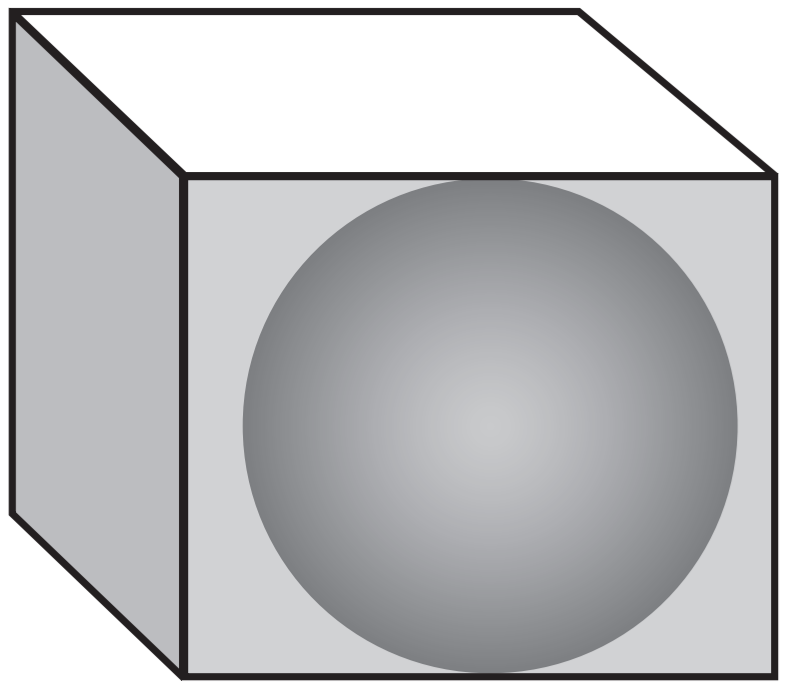
Shreya got a rectangular parallelepiped shaped box and spherical ball inside it as return gift. Sides of the box are $x, 2x,$ and $\frac{\text{x}}{3},$ while radius of the ball is $r.$

Based on the above information, answer the following questions.
  1. If S represents the sum of volume of parallelepiped and sphere, then Scan be written as.
  1. $\frac{4\text{x}^3}{3}+\frac{2}{2}\pi\text{r}^2$
  2. $\frac{2\text{x}^2}{3}+\frac{4}{3}\pi\text{r}^2$
  3. $\frac{2\text{x}^3}{3}+\frac{4}{3}\pi\text{r}^3$
  4. $\frac{2}{3}\text{x}+\frac{4}{3}\pi\text{r}$
  1. If sum of the surface areas of box and ball are given to be constant $k^2$ then $x$ is equal to.
  1. $\sqrt{\frac{\text{k}^2-4\pi\text{r}^2}{6}}$
  2. $\sqrt{\frac{\text{k}^2-4\pi\text{r}}{6}}$
  3. $\sqrt{\frac{\text{k}^2-4\pi}{6}}$
  4. $\text{None of these}$
  1. The radius of the ball, when Sis minimum, is.
  1. $\sqrt{\frac{\text{k}^2}{54+\pi}}$
  2. $\sqrt{\frac{\text{k}^2}{54+4}}$
  3. $\sqrt{\frac{\text{k}^2}{64+3\pi}}$
  4. $\sqrt{\frac{\text{k}^2}{4\pi+3}}$
  1. Relation between length of the box and radius of the ball can be represented as.
  1. $\text{x} = \frac{2}{\text{r}}$
  2. $\text{x}=\frac{\text{r}}{2}$
  3. $\text{x}=\frac{2}{\text{r}}$
  4. $\text{x}=3\text{r}$
  1. Minimum value of $S$ is.
  1. $\frac{\text{k}^2}{2(3\pi+54)^\frac{2}{3}}$
  2. $\frac{\text{k}}{2(3\pi+54)^\frac{3}{2}}$
  3. $\frac{\text{k}^3}{2(4\pi+54)^\frac{1}{2}}$
  4. $\text{None of these}$
Answer
  1. (c) $\frac{2\text{x}^3}{3}+\frac{4}{3}\pi\text{r}^3$
Solution:
Let $S$ be the sum of volume of parallelepiped and sphere, then
$\text{S}=\text{x}(2\text{x})\Big(\frac{\text{x}}{3}\Big)+\frac{4}{3}\pi\text{r}^3=\frac{2\text{x}^3}{3}+\frac{4}{3}\pi\text{r}^3$
  1. (a) $\sqrt{\frac{\text{k}^2-4\pi\text{r}^2}{6}}$
Solution:
Since, sum of surface area of box and sphere is given to be constant $k^2.$
$\therefore2\Big(\text{x}\times\text{2x}+\text{2x}\times\frac{\text{x}}{3}+\frac{\text{x}}{3}\times\text{x}\Big)+4\pi\text{r}^2=\text{k}^2$
$\Rightarrow6\text{x}^2+4\pi\text{r}^2=\text{k}^2$
$\Rightarrow\text{x}^2=\frac{\text{k}^2-4\pi\text{r}}{6}\Rightarrow\text{x}=\sqrt{\frac{\text{k}^2-4\pi\text{r}}{6}}$
  1. (b) $\sqrt{\frac{\text{k}^2}{54+4}}$
Solution:
From $(1)$ and $(2),$ we get
$\text{s}=\frac{2}{3}\bigg(\frac{\text{k}^2-4\pi\text{r}^2}{6}\bigg)^\frac{3}{2}+\frac{4}{3}\pi\text{r}^3$
$=\frac{2}{3\times6\sqrt{6}}(\text{k}^2-4\pi\text{r}^2)^\frac{3}{2}+\frac{4}{3}\pi\text{r}^3$
$\Rightarrow\frac{\text{ds}}{\text{dr}}=\frac{1}{9\sqrt{6}}\frac{3}{2}(\text{k}^2-4\pi\text{r}^2)^\frac{1}{2}-8\pi\text{r}+4\pi\text{r}^2$
$=4\pi\text{r}\bigg[\text{r}\frac{1}{3\sqrt{6}}\sqrt{\text{k}^2-4\pi\text{r}^2}\bigg]$
For maximum/minimum, $\frac{\text{ds}}{\text{dr}}=0$
$\Rightarrow\frac{4\pi\text{r}}{3\sqrt{6}}\sqrt{\text{k}-4\pi\text{r}^2}=-4\pi\text{r}^2$
$\text{k}^2-4\pi\text{r}^2=54\text{r}^2$
$\Rightarrow\text{r}^2=\frac{\text{k}^2}{54+4\pi}\Rightarrow\text{r}=\sqrt{\frac{\text{k}^2}{54+4\pi}}$
  1. (d) $\text{x}=3\text{r}$
Solution:
$\text{Since},\text{x}^2=\frac{\text{k}-4\pi\text{r}^2}{6}=\frac{1}{6}\bigg[\text{k}^2-4\pi\Big(\frac{\text{k}^2}{54+4\pi}\Big)\bigg]$
[From (2) and (3)
$=\frac{9\text{k}^2}{54+4\pi}=9\Big(\frac{\text{k}^2}{54+4\pi}\Big)=9\text{r}^2=(3\text{r})^2$
$⇒ x = 3r$
  1. (c) $\frac{\text{k}^3}{2(4\pi+54)^\frac{1}{2}}$
Solution:
Minimum value of $S$ is given by
$\frac{2}{3}(3\text{r})^3+\frac{4}{3}\pi\text{r}^3$
$=18\text{r}^3+\frac{4}{3}\pi\text{r}^3=\bigg(18+\frac{4}{3}\pi\bigg)\text{r}^3$
$\bigg(18+\frac{4}{3}\pi\bigg)\text{r}^3\bigg(\frac{\text{k}^2}{54+4\pi}\bigg)^\frac{3}{2}$
$\frac{1}{3}\frac{\text{k}^3}{(54+4\pi)^\frac{1}{2}}$
View full question & answer
Question 144 Marks
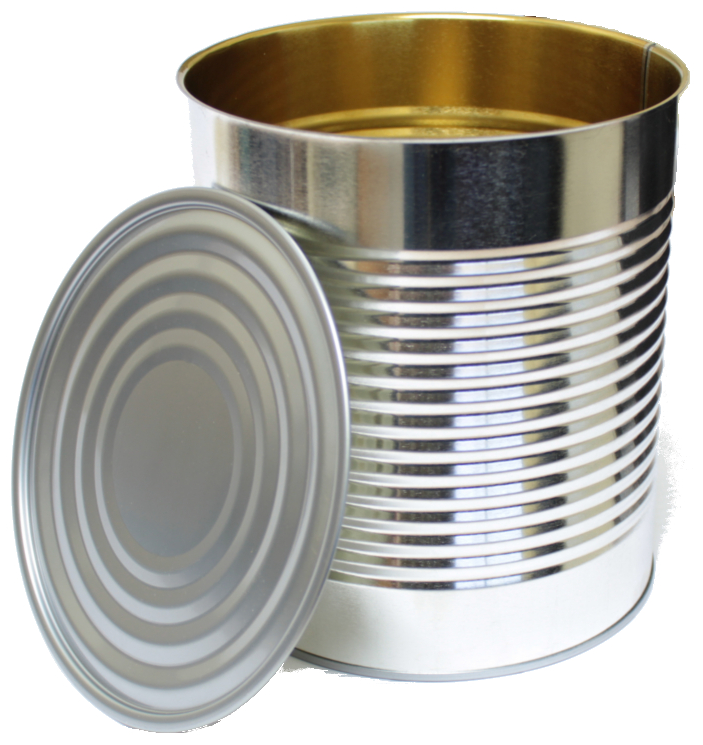
A tin can manufacturer designs a cylindrical tin can for a company making sanitizer and disinfector. The tin can is made to hold $3$ litres of sanitizer or disinfector.

Based on the above in formation, answer the following questions.
  1. If $r$ cm be the radius and h cm be the height of the cylindrical tin can, then the surface area expressed as a function of $r$ as.
  1. $2\pi\text{r}^2$
  2. $2\pi\text{r}^2+6000$
  3. $2\pi\text{r}^2+\frac{5000}{\text{r}}$
  4. $2\pi\text{r}^2+\frac{6000}{\text{r}}$
  1. The radius that will minimize the cost of the material to manufacture the tin can is.
  1. $\sqrt[3]{\frac{600}{\pi}}\text{cm}$
  2. $\sqrt{\frac{500}{\pi}}\text{cm}$
  3. $\sqrt[3]{\frac{1500}{\pi}}\text{cm}$
  4. $\sqrt{\frac{1500}{\pi}}\text{cm}$
  1. The height that will minimize the cost of the material to manufacture the tin can is.
  1. $\sqrt[3]{\frac{600}{\pi}}\text{cm}$
  2. $2\sqrt[3]{\frac{1500}{\pi}}\text{cm}$
  3. $\sqrt{\frac{1500}{\pi}}$
  4. $2\sqrt{\frac{1500}{\pi}}$
  1. If the cost of material used to manufacture the tin can is $₹\frac{100}{\text{m}^2}$ and $\sqrt[3]{\frac{1500}{\pi}}\approx7.8,$ then minimum cost is approximately.
  1. $₹\ 11.538$
  2. $₹\ 12$
  3. $₹\ 13$
  4. $₹\ 14$
  1. To minimize the cost of the material used to manufacture the tin can, we need to minimize the.
  1. Volume.
  2. Curved surface area.
  3. Total surface area.
  4. Surface area of the base.
Answer
  1. $2\pi\text{r}^2+\frac{6000}{\text{r}}$
Solution:
Given, $r$ cm is the radius and $11$cm is the height of required cylindrical can. Given that, volume $= 3 l = 3000cm^3$
$(\therefore 11\ l = 1000cm^3)$
$\Rightarrow\pi\text{r}^2\text{h}=3000\Rightarrow\text{h}=\frac{3000}{\pi\text{r}^2}$
Now, the surface area, as a function of r is given by
$\text{S}\big(\text{r}\big)=2\pi\text{r}^2+2\pi\text{r}^2+2\pi\text{r}\bigg(\frac{3000}{\pi\text{r}^2}\bigg)$
$=2\pi\text{r}^2+\frac{6000}{\text{r}}$
  1. (c) $\sqrt[3]{\frac{1500}{\pi}}\text{cm}$
Solution:
$\text{Now},\text{S}'\big(\text{r}\big)=2\pi\text{r}^2+\frac{6000}{\text{r}}$
$\Rightarrow\text{S}\big(\text{r}\big)=4\pi\text{r}-\frac{6000}{\text{r}^2}$
To find critical points, put $S'(r) = 0$
$\Rightarrow\frac{4\pi\text{r}^3-6000}{\text{r}^2}=0$
$\Rightarrow\text{r}^3=\frac{6000}{4\pi}\Rightarrow\text{r}=\bigg(\frac{1500}{\pi}\bigg)^\frac{1}{3}$
$\text{Also},\text{S}''\big(\text{r}\big)\mid_\text{r}=\sqrt[3]{\frac{1500}{\pi}}=4\pi+\frac{12000\times\pi}{1500}$
$=4\pi+8\pi=12\pi>0$
Thus, the critical point is the point of minima.
  1. (b) $2\sqrt[3]{\frac{1500}{\pi}}\text{cm}$
Solution:
The cost of material for the tin can is minimized when $\text{r}=\sqrt[3]{\frac{1500}{\pi}}\text{cm}$ and the height is
$\frac{3000}{\pi\bigg(\sqrt[3]{\frac{1500}{\pi}}\bigg)^2}=2\sqrt[3]{\frac{1500}{\pi}}\text{cm}$
  1. (a) $₹\ 11.538$
Solution:
We have minimum surface area $=\frac{2\pi\text{r}^3+6000}{\text{r}}$
$=\frac{2\pi.\frac{1500}{\pi}+6000}{\sqrt[3]{\frac{1500}{\pi}}}=\frac{9000}{7.8}=1153.84\text{cm}^2$
Cost of $1m^2$ material $= ₹\ 100$
$\therefore$ Cost of $1cm^2$ material = $₹\ \frac{1}{100}$
$\therefore$ minimum cost $=₹\frac{1153.84}{100}=₹\ 11.538$
  1. (c) Total surface area
Solution:
To minimize the cost, we need to minimize the total surface area.
View full question & answer
Question 154 Marks
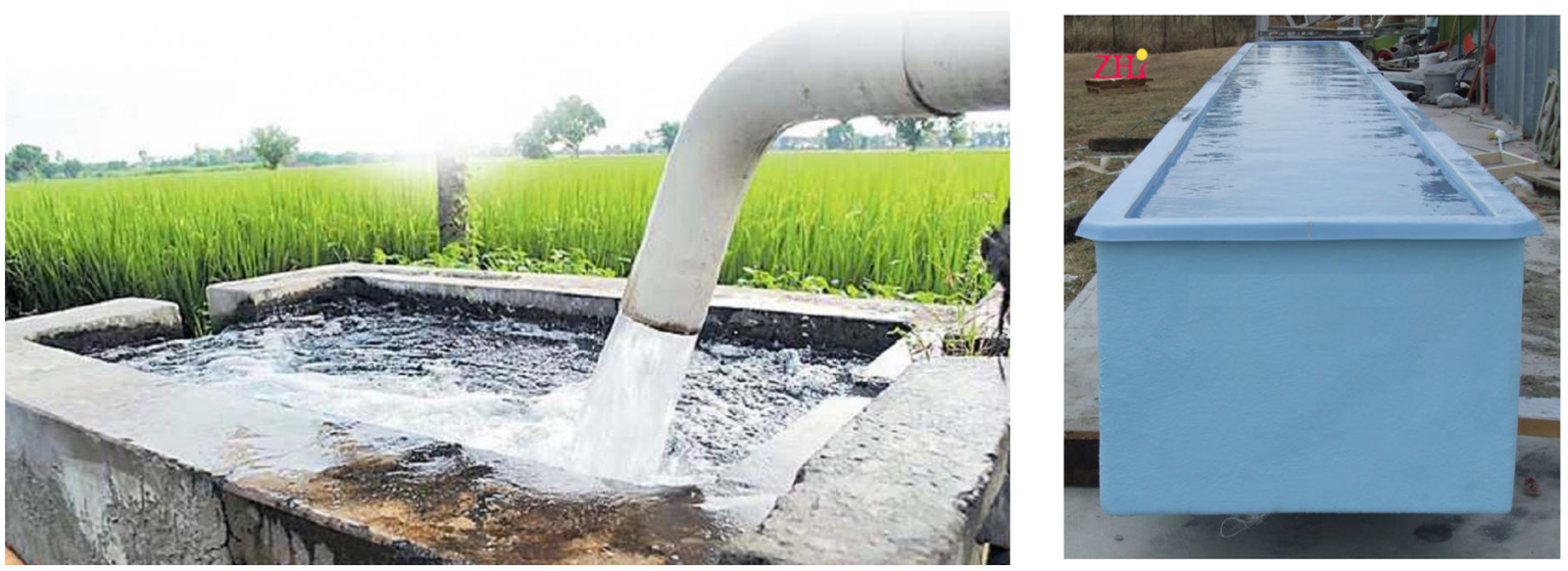
An open water tank of aluminium sheet of negligible thickness, with a square base and vertical sides, is to be constructed in a farm for irrigation. It should hold $32000$ l of water, that comes out from a tube well.

Based on above information, answer the following questions.
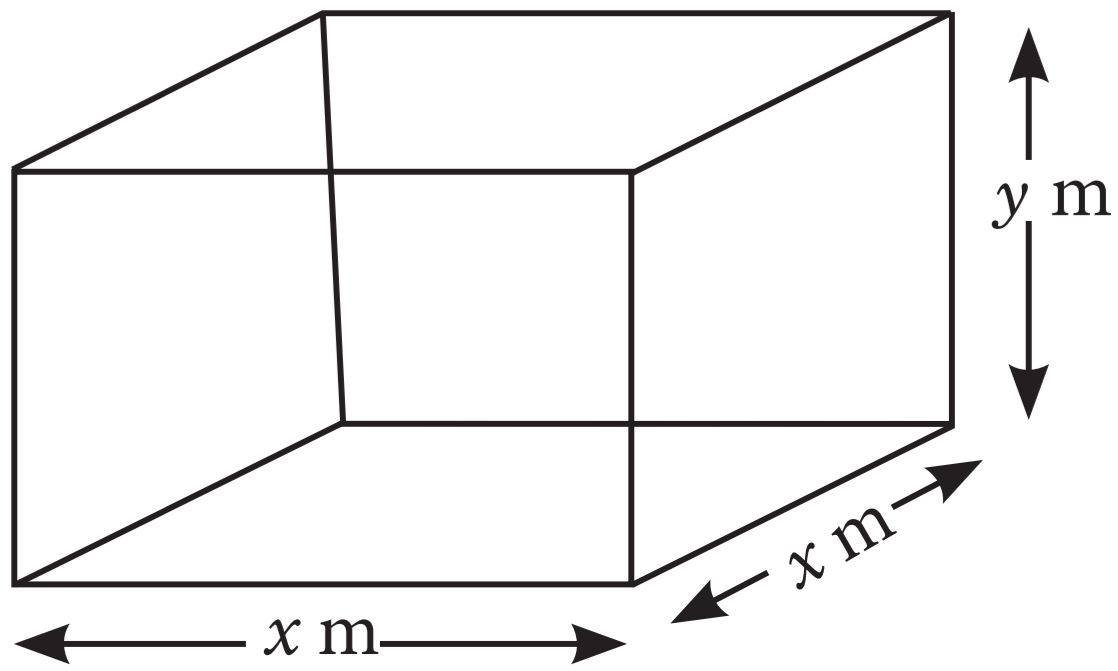
  1. If the length, width, and height of the open tank be $x, x$ and $y\ m$ respectively, then total surface area of tank is.
  1. $(x^2 + 2xy)m^2$
  2. $(2x^2 + 4xy)m^2$
  3. $(2x^2 + 2xy)m^2$
  4. $(2x^2 + 8xy)m^2$
  1. The relation between $x$ and $y$ is.
  1. $x^2y = 32$
  2. $xy^2 = 32$
  3. $x^2y^2 = 32$
  4. $xy = 32$
  1. The outer surface area of tank will be minimum when depth of tank is equal to.
  1. Half of its width.
  2. Its width.
  3. $\big(\frac{1}{4}\big)^\text{th}$ of its Width
  4. $\big(\frac{1}{3}\big)^\text{rd}$ of its Width
  1. The cost of material will be least when width of tank is equal to.
  1. Half of its depth
  2. Twice of its depth
  3. $\big(\frac{1}{4}\big)^\text{th}$ of its depth
  4. Thrice of its depth
  1. If cost of aluminium sheet is $ ₹ \frac{360}{\text{m}^2}$ then the minimum cost for the construction of tank will be.
  1. $₹\ 15, 000$
  2. $₹\ 16, 280$
  3. $₹\ 17, 280$
  4. $₹\ 18, 280$
Answer
  1. (d) $(2x^2 + 8xy)m^2$
Solution:
Since the tank is open from the top, therefore the total surface area is
$= ($Outer $+$ Inner$)$ surface area
$= 2(x \times x + 2(xy + yx)) = 2(x^2 + 2(2xy)) = (2x^2 + 8xy)m^2$
  1. (a) $x^2y = 32$
Solution:
Since, volume of tank should be $32000l.$
$\therefore x^2y m^3 = 32000l = 32m^3$
[$\therefore I$ litre $= 0.001m^3]$
So, $x^2y = 32$​​​​​​​
  1. (c) $\big(\frac{1}{4}\big)^\text{th}$ of its width
Solution:
Let $S$ be the outer surface area of tank. Then, $S = x^2 + 4xy$
$\Rightarrow\text{S}(\text{x})=\text{x}^2+4\text{x}\frac{32}{\text{x}^2}=\text{x}^2+\frac{128}{\text{x}}$
$\Rightarrow\frac{\text{dS}}{\text{dx}}=2\text{x}-\frac{128}{\text{x}^2}\text{ and }\frac{\text{d}^2\text{S}}{\text{dx}^2}=2+\frac{256}{\text{x}^3}$
For maximum or minimum values of S, consider $\frac{\text{dS}}{\text{dx}}=0$
$\Rightarrow2\text{x}=\frac{128}{\text{x}^2}$
$\Rightarrow\text{x}^3=64$
$\Rightarrow\text{x}=4\text{m}$
$\text{At}\text{ x }=4\frac{\text{d}^2\text{S}}{\text{dx}^2}=2+\frac{256}{4^3}=2+4=6>0$
$\therefore$ S is minimum when $x = 4$
Now as $x - y = 32,$ therefore $y = 2$ Thus $x = 2y$​​​​​​​
  1. (b) Twice of its depth
Solution:
Since, surface area is minimum when $x = 2y$, therefore cost of material will be least when $x = 2y$. Thus, cost of material will be least when width is equal to twice of its depth Since, surface area is minimum when $x = 2y,$ therefore cost of material will be least when $x = 2y$. Thus, cost of material will be least when width is equal to twice of its depth.
  1. (c) $₹ 17280$
Solution:
Since, minimum surface area $= x^2 + 4xy = 4^2 + 4 \times 4 \times 2 = 48m^2$  and cost per $m^2 = ₹ 360$
minimum cost is $= ₹ (48 \times 360) = ₹ 17280.$
View full question & answer
Question 164 Marks
Western music concert is organised every year in the stadium that can hold 36000 spectators. With ticket price of ₹ 10, the average attendance has been 24000. Some financial expert estimated that price of a ticket should be determined by the function.
$\text{p}(\text{x})=15-\frac{\text{x}}{3000}$ where x is the number of tickets sold.

Based on the above information, answer the following questions.
  1. The revenue, R as a function of x can be represented as.
  1. $15\text{x}-\frac{\text{x}^2}{3000}$
  2. $15-\frac{\text{x}^2}{3000}$
  3. $15\text{x}-\frac{1}{3000}$
  4. $15\text{x}-\frac{\text{x}}{3000}$
  1. The range of x is.
  1. [24000, 36000]
  2. [0, 24000]
  3. [0, 36000]
  4. None of these
  1. The value of x for which revenue is maximum, is.
  1. 20000
  2. 21000
  3. 22500
  4. 25000
  1. When the revenue is maximum, the price of the ticket is.
  1. ₹ 5
  2. ₹ 5.5
  3. ₹ 7
  4. ₹ 7.5
  1. How many spectators should be present to maximize the revenue?
  1. 21500
  2. 21000
  3. 22000
  4. 22500
Answer
  1. (a) $15\text{x}-\frac{\text{x}^2}{3000}$
Solution:

Let p be the price per ticket and x be the number of tickets sold. Then, revenue function $\text{R}\big(\text{x}\big)=\text{p}\times\text{x}=\bigg(15-\frac{\text{x}}{3000}\bigg)\text{x}=15\text{x}-\frac{\text{x}^2}{3000}$
  1. [0, 36000]
Solution:

Since, more than 36000 tickets cannot be sold. So, range of x is [0, 36000]
  1. (c) 22500
Solution:

We have, $\text{R}\big(\text{x}\big)=15\text{x}-\frac{\text{x}^2}{3000}$

$\Rightarrow\text{R}\big(\text{x}\big)=15-\frac{\text{x}^2}{1500}$

For maxima/ minima, put R'(x) = 0

$\Rightarrow15-\frac{\text{x}}{1500}=0$

$\Rightarrow\text{x}=2250$

Also $\text{R}''\big(\text{x}\big)=-\frac{1}{1500}<0$
  1. (d) ₹ 7.5
Solution:

Maximum revenue will be at x = 22500

$\therefore$ Price of a ticket $=15-\frac{22500}{3000}=15-7.5=₹\ 7.5$
  1. (d) 22500
Solution:

Number of spectators will be equal to number of tickets sold

$\therefore$ Required number of spectators = 22500
View full question & answer
Question 174 Marks
Nitin wants to construct a rectangular plastic tank for his house that can hold $80\ ft^3$ of water. The top of the tank is open. The width of tank will be $5$ ft but the length and heights are variables. Building the tank cost$?\ ₹ 20$ per sq. foot for the base and $₹\ 10$ per sq. foot for the side.

Based on the above information, answer the following questions.
  1. In order to make a least expensive water tank, Nitin need to minimize its.
  1. Volume
  2. Base
  3. Curved surface area
  4. Cost
  1. Total cost of tank as a function of h can be represented as.
  1. $c(h) = 100h - 320 - 1600/ h$
  2. $c(h) = 100h - 320h - 720h^2$
  3. $c(h) = 100 + 320h + 1600h^2$
  4. $\text{c}\big(\text{h}\big)=100\text{h}+320+\frac{1600}{\text{h}}$
  1. Range of $h$ is.
  1. $(3, 5)$
  2. $\big(0,\infty\big)$
  3. $(0, 8)$
  4. $(0, 3)$
  1. Value of hat which $c(h)$ is minimum, is.
  1. $4$
  2. $5$
  3. $6$
  4. $6, 7$
  1. The cost of least expensive tank is.
  1. $₹\ 1020$
  2. $₹\ 1100$
  3. $₹\ 1120$
  4. $₹\ 1220$
Answer
  1. (d) Cost
Solution:
In order to make least expensive water tank, Nitin need to minimize its cost.
  1. (d) $\text{c}\big(\text{h}\big)=100\text{h}+320+\frac{1600}{\text{h}}$
Solution:
Let l ft be the length and h ft be the height of the tank. Since breadth is equal to $5$ ft. (Given)
$\therefore$ Two sides will be $5h$ sq. feet and two sides will be $l/ h$ sq. feet. So, the total area of the sides is $(10h + 2l/ h)ft^2$
Cost of the sides is $₹\ 10$ per sq. foot. So, the cost to build the sides is $(10h + 2l/ h) × 10\ ₹ (100h +20l/ h)$
Also, cost of base $= (5l) × 20 = ₹\ 100l$
$\therefore$ Total cost of the tank in ₹ is given by
$c = 100h + 20l/ h + 100l$
Since, volume of tank$= 80\ ft^3$​​​​​​​
$\therefore5l\text{h}=80\text{ft}^3\therefore\text{l}=\frac{80}{5\text{h}}=\frac{16}{\text{h}}$
$\therefore\text{c}\big(\text{h}\big)=100\text{h}+20\Big(\frac{16}{\text{h}}\Big)\text{h}+100(\frac{16}{\text{h}}\Big)$
$=100\text{h}+320+\frac{1600}{\text{h}}$
  1. (b) $\big(0,\infty\big)$
Solution:
Since, all side lengths must be positive.
$\therefore\text{h}>0\ \text{and}\frac{16}{\text{h}}>0$
Since $\frac{16}{\text{h}}>0$ whenever $h > 0$
$\therefore$ Range of h is $(0,\infty)$
  1. (a) $4$
Solution:
To minimize cost, $\frac{\text{dc}}{\text{dh}}=0$
$\Rightarrow100-\frac{1600}{\text{h}^2}=0$
$\Rightarrow100\text{h}^2=1600$
$\Rightarrow\text{h}^2=16$
$\Rightarrow\text{h}=\pm4$
$\Rightarrow\text{h}=4$ [$\therefore$ height can not be negative]
  1. (c) $₹\ 1120$
Solution:
Cost of least expensive tank is given by
$\text{c}(4)=400+320+\frac{1600}{4}$
$=720+400=₹\ 1120$
View full question & answer
Question 184 Marks
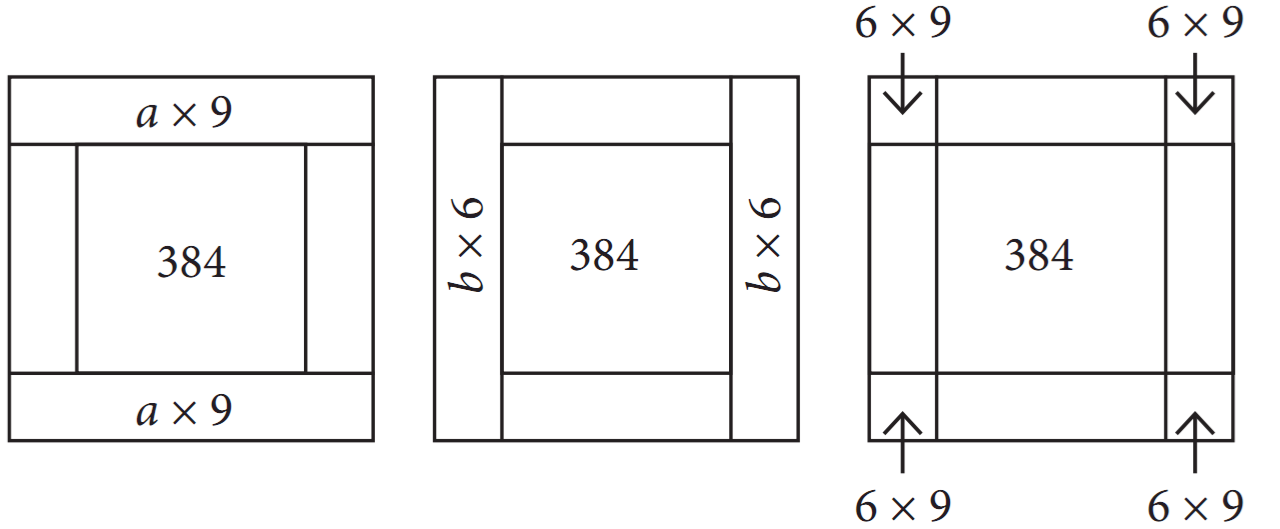
A poster is to be formed for a company advertisement. The top and bottom margins of poster should be 9cm and the side margins should be $6\ cm. $ Also, the area for printing the advertisement should be $864 \ cm^2.$

Based on the above information, answer the following questions.
  1. If $a$ cm be the width and $b$ cm be the height of Poster, then the area of poster, expressed in terms of $a$ and $b$, is given by.
  1. $648 + 18a + 12b$
  2. $18a + 12b$
  3. $584 + 18a + 12b$
  4. None of these
  1. The relation between $a$ and $b$ is given by.
  1. $\text{a}=\frac{648+12\text{b}}{\text{b}-18}$
  2. $\text{a}=\frac{12\text{b}}{\text{b}-18}$
  3. $\text{a}=\frac{12\text{b}}{\text{b}+18}$
  4. $\text{None of these}$
  1. Area of poster in terms of bis given by.
  1. $\text{a}=\frac{12\text{b}^2}{\text{b}-18}$
  2. $\text{a}=\frac{648\text{b}+12\text{b}^2}{\text{b}-18}$
  3. $\text{a}=\frac{648\text{b}+12\text{b}^2}{\text{b}+18}$
  4. $\text{a}=\frac{12\text{b}^2}{\text{b}+18}$
  1. The value of $b$, so that area of the poster is minimized, is.
  1. $54$
  2. $36$
  3. $27$
  4. $22$
  1. The value of a, so that area of the poster is minimized, is.
  1. $24$
  2. $36$
  3. $40$
  4. $22$
Answer
  1. (a) $648 + 18a + 12b$
Solution:
Let A be the area of the poster, then
$A = 864 + 2(a·9) + 2(b·6) - 4(6·9)$
$= 864 + 18a + 12b - 216 = 648 + 18a + 12b$

  1. (a) $\text{a}=\frac{648+12\text{b}}{\text{b}-18}$
Solution:
Clearly, $A = a·b$
$\therefore 648 + 18a + 12b = ab$
$⇒ ab - 18a = 648 + 12b$
$⇒ a(b - 18) = 648 + 12b$
$\Rightarrow\text{a}=\frac{648+12\text{b}}{\text{b}-18}$
  1. (b) $\text{a}=\frac{648\text{b}+12\text{b}^2}{\text{b}-18}$
Solution:

Since, $A = a·b,$ therefore

$\text{A}=\bigg(\frac{648+12\text{b}}{\text{b}-18}\bigg)\text{b}=\frac{648\text{b}+12\text{b}^2}{\text{b}-18}\bigg[\therefore\text{a}=\frac{648+12\text{b}}{\text{b}-18}\bigg]$
  1. (a) $54$
Solution:
Clearly
$\text{A}'\big(\text{b}\big)=\frac{\big(\text{b}-18\big)\big(648+2\text{ab}\big)-\big(648\text{b}+12\text{b}^2\big)}{\big(\text{b}-18\big)^2}$
$=\frac{12(\text{b}^2-36\text{b}-972)}{\big(\text{b}-18\big)^2}$
For minimum, consider $A'(b) = 0$
$\Rightarrow b^2 - 36b - 972 = 0$
$\Rightarrow b^2 - 54b + 18b - 972 = 0$
$\Rightarrow b(b - 54) + 18(b - 54) = 0$
$\Rightarrow b = -18$ or $b = 54$
$\therefore$ b is height, therefore can't be negative. So, $b = 54.$
  1. (b)$ 36$
Solution:
$\text{Since},\text{a}=\frac{648+12\text{b}}{\text{b}-18}$
$\therefore\text{a}=\frac{648+12\times54}{54-18}=\frac{648+648}{36}=36$
View full question & answer
Question 194 Marks
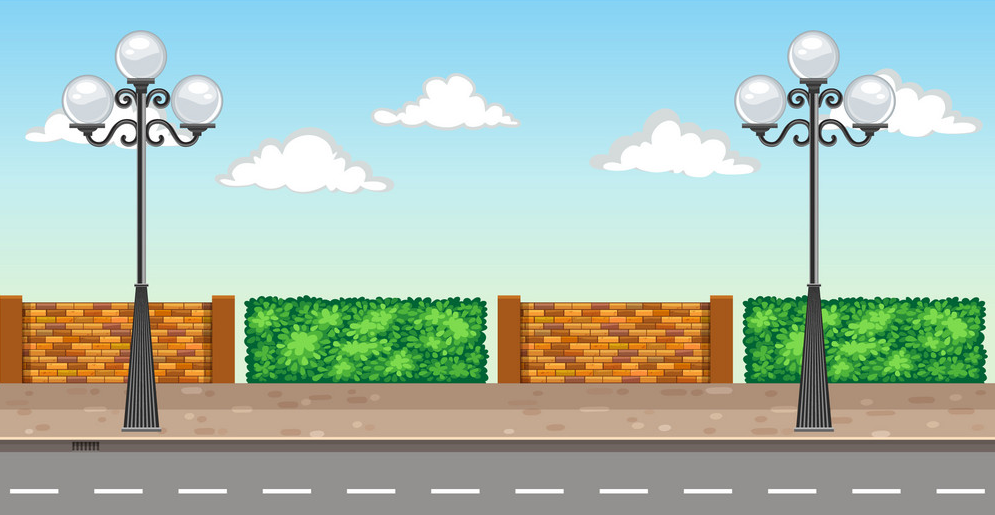
In a street, two lamp posts are 600 feet apart. The light intensity at a distanced from the first (stronger) lamp post is $\frac{1000}{\text{d}^2}$ the light intensity at distance d from the second (weaker) lamp post is $\frac{125}{\text{d}^2}$ (in both cases the light intensity is inversely proportional to the square of the distance to the light source). The combined light intensity is the sum of the two light intensities coming from both lamp posts.

Based on the above information, answer the following questions.
  1. If you are in between the lamp posts, at distance x feet from the stronger tight, then the formula for the combined light intensity coming from both lamp posts as function of x, is
  1. $\frac{1000}{\text{x}^2}+\frac{125}{\text{x}^2}$
  2. $\frac{1000}{\big(600-\text{x}^2\big)}+\frac{125}{\text{x}^2}$
  3. $\frac{1000}{\text{x}^2}+\frac{125}{\big(600-\text{x}^2\big)}$
  4. $\text{None of these}$
  1. The maximum value of x can not be.
  1. 100
  2. 200
  3. 600
  4. None of these
  1. The minimum value of x can not be.
  1. 0
  2. 100
  3. 200
  4. None of these
  1. If l(x) denote the combined tight intensity, then l(x) will be minimum when x =
  1. 200
  2. 400
  3. 600
  4. 800
  1. The darkest spot between the two lights is.
  1. At a distance of 200 feet from the weaker lamp post.
  2. At distance of 200 feet from the stronger lamp post.
  3. At a distance of 400 feet from the weaker lamp post.
  4. None of these
Answer
  1. (c) $\frac{1000}{\text{x}^2}+\frac{125}{\big(600-\text{x}^2\big)}$
Solution:

Since, the distance is x feet from the stronger light, therefore the distance from the weaker light will be 600 - x

So, the combined light intensity from both lamp posts is given by $\frac{1000}{\text{x}^2}+\frac{125}{(600-\text{x})^2}$
  1. (c) 600
Solution:

Since, the person is in between the lamp posts, therefore x will lie in the interval (0, 600). So, maximum value of x can't be 600.
  1. (a) 0
Solution:

Since, 0 < x < 600, therefore minimum value of x cant be 0.
  1. (b) 400
Solution:

$\text{We have l (x)}=\frac{1000}{\text{x}^2}+\frac{125}{(600-\text{x})^2}$

$\Rightarrow \text{l}'(\text{x})=\frac{-2000}{\text{x}^3}+\frac{250}{(600-\text{x})^2}\text{and}$

$\Rightarrow \text{l}'(\text{x})=\frac{6000}{\text{x}^4}+\frac{750}{(600-\text{x})^4}$

For maxima/ minima, l'(x) = 0

$\Rightarrow \frac{2000}{\text{x}^3}=\frac{250}{(600-\text{x})^3}$

$\Rightarrow8(600-\text{x})^3=\text{x}^3$

Taking cube root on both sides, we get 2(600 - x) = x

⇒ 1200 = 3x

⇒ x = 400

Thus, l(x) is minimum when you are at 400 feet from the strong intensity lamp post.
  1. (a) At a distance of 200 feet from the weaker lamp post.
Solution:

Since, l(x) is minimum when x = 400 feet, therefore the darkest spot between the two light is at a distance of 400 feet from stronger lamp post, i.e., at a distance of 600 - 400 = 200 feet from the weaker lamp post.
View full question & answer
Question 204 Marks
The Government declare that farmers can get $₹\ 300$ per quintal for their onions on $1^{st}$ July and after that, the price will be dropped by $₹\ 3$ per quintal per extra day. Shyams father has $80$ quintal of onions in the field on $1^{st}$ July, and he estimates that crop is increasing at the rate of $1$ quintal per day.

Based on the above information, answer the following questions.
  1. If $x$ is the number of days after $1^{st}$ July, then price and quantity of onion respectively can be expressed as.
  1. $₹(300 - 3x), (80 + x)$ quintals
  2. $₹(300 - 3x), (80 - x)$ quintals
  3. $₹(300 + x), 80$ quintals
  4. None of these
  1. Revenue R as a function of x can be represented as.
  1. $R(x) = 3x^2 - 60x - 24000$
  2. $R(x) = 3x^2 + 60x - 24000$
  3. $R(x) = 3x^2 + 40x - 16000$
  4. $R(x) = 3x^2 - 60x - 14000$
  1. Find the number of days after $1^{st}$ July, when Shyam's father attain maximum revenue.
  1. $10$
  2. $20$
  3. $12$
  4. $22$
  1. On which day should Shyam's father harvest the onions to maximise his revenue?
  1. $11^{th}$ July
  2. $20^{th}$ July
  3. $12^{th}$ July
  4. $22^{nd}$ July
  1. Maximum revenue is equal to.
  1. $₹\ 20,000$
  2. $₹\ 24,000$
  3. $₹\ 24,300$
  4. $₹\ 24,700$
Answer
  1. (a) $₹(300 - 3x), (80 + x)$ quintals
Solution:
Let x be the number of extra days after $1^{st}$ July.
$\therefore$ Price $= ₹(300 - 3 × x) = ₹(300 - 3x)$
Quantity $= 80$ quintals $+ x (1$ quintal per day$) = (80 + x)$ quintals
  1. (b) $R(x) = 3x^2 + 60x - 24000$
Solution:
$R(x) =$ Quantity $×$ Price
$= (80 + x)(300 - 3x) = 24000 - 240x + 300x - 3x^2$
$= 24000 + 60x - 3x^2$
  1. (a) 10
Solution:
We have, $R(x) = 24000 + 60x - 3x^2$
$\Rightarrow R'(x) = 60 - 6x \Rightarrow R''(x) = -6$
For $R(x)$ to be maximum, $R'(x) = 0$ and $R"(x) < 0$
$⇒ 60 - 6x = 0 ⇒ x = 10$
  1. (a) $11^{th}$ July
Solution:
Shyam's father will attain maximum revenue after $10$ days. So, he should harvest the onions after $10$ days of $1^{st}$ July i.e., on $11^{th}$ July.​​​​​​​
  1. (c) $₹ 24,300$
Solution:
Maximum revenue is collected by Shyam's father when $x = 10$
$\therefore$ Maximum revenue $= R(10)$
$ = 24000 + 60(10) - 3(10)^2 = 24000 + 600 - 300 = 24300$
View full question & answer
Question 214 Marks
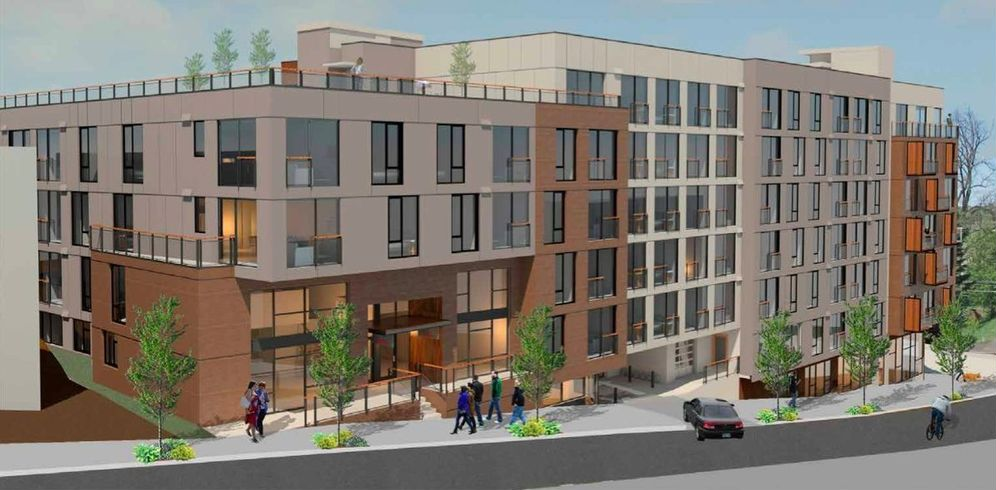
A real estate company is going to build a new residential complex. The land they have purchased can hold at most $4500$ apartments. Also, if they make x apartments, then the monthly maintenance cost for the whole complex would be as follows: Fixed cost $= ₹\ 50,00,000$. Variable cost $= (160x - 0.04x^2)$

Based on the above information, answer the following questions.
  1. The maintenance cost as a function of x will be.
  1. $160x - 0.04x^2$
  2. $5000000$
  3. $5000000 + 160x - 0.04x^2$
  4. None of these
  1. If $C(x)$ denote the maintenance cost function, then maximum value of $C(x)$ occur at $x =$
  1. $0$
  2. $2000$
  3. $4500$
  4. $5000$
  1. The maximum value of $C(x)$ would be.
  1. $₹\ 5225000$
  2. $₹\ 5160000$
  3. $₹\ 5000000$
  4. $₹\ 4000000$
  1. The number of apartments, that the complex should have in order to minimize the maintenance cost, is.
  1. $4500$
  2. $5000$
  3. $1750$
  4. $3500$
  1. If the minimum maintenance cost is attain, then the maintenance cost for each apartment would be.
  1. $₹\ 1091.11$
  2. $₹\ 1200$
  3. $₹\ 1000$
  4. $₹\ 2000$
Answer
  1. (c) $5000000 + 160x - 0.04x^2$
Solution:
Let $C(x)$ be the maintenance cost function, then $C(x) = 5000000 + 160x - 0.04x^2$
  1. (b) $2000$
Solution:
We have, $C(x) = 5000000 + 160x - 0.04x^2$
Now, $C'(x) = 160 - 0.08x$
For maxima/ minima, put $C'(x) = 0$
$⇒ 160 = 0.08x$
$⇒ x = 2000$​​​​​​​
  1. (b) $₹\ 5160000$
Solution:
Clearly, from the given condition we can see ...that we only want critical points that are in the interval $[0, 4500]$
Now, we have $C(O) = 5000000$
$C(2000) = 5160000$
And C$(4500) = 4910000$
$\therefore$ Maximum value of $C(x)$ would be $₹\ 5160000$​​​​​​​
  1. (a) $4500$
Solution:
The complex must have $4500$ apartments to minimise the maintenance cost.
  1. (a) $₹\ 1091.11$
Solution:
The minimum maintenance cost for each apartment woud be $₹\ 1091.11$
View full question & answer
Question 224 Marks
Megha wants to prepare a handmade gift box for her friend's birthday at home. For making lower part of box, she takes a square piece of cardboard of side $20$cm.

Based on the above information, answer the following questions.
  1. If $x$ cm be the length of each side of the square cardboard which is to be cut off from corners of the square piece of side 20cm, then possible value of $x$ will be given by the interval.
  1. $[0, 20]$
  2. $(0, 10)$
  3. $(0, 3)$
  4. None of these
  1. Volume of the open box formed by folding up the cutting corner can be expressed as.
  1. $\text{V}=\text{x}(20-2\text{x})(20-2\text{x)}$
  2. $\text{V}=\frac{\text{x}}{2}(20+\text{x})(20-\text{x})$
  3. $\text{V}=\frac{\text{x}}{3}(20-\text{x})(20+\text{x})$
  4. $\text{V}=\text{x}(20-2\text{x})(20-\text{x)}$
  1. The values of $x$ for which $\frac{\text{dV}}{\text{dX}}=0$, are.
  1. $3, 4$
  2. $0,\frac{10}{3}$
  3. $0, 10$
  4. $10,\frac{10}{3}$
  1. Megha is interested in maximizing the volume of the box. So, what should be the side of the square to be cut off so that the volume of the box is maximum?
  1. $12$cm
  2. $8$cm
  3. $\frac{10}{3}\text{cm}$
  4. $2$cm
  1. The maximum value of the volume is.
  1. $\frac{17000}{27}\text{cm}^3$
  2. $\frac{11000}{27}\text{cm}^3$
  3. $\frac{8000}{27}\text{cm}^3$
  4. $\frac{16000}{27}\text{cm}^3$
Answer
  1. (b) $(0, 10)$
Solution:
Since, side of square is of length 20cm therefore $\text{x}\in$ (0, 10)
  1. (a) $\text{V}=\text{x}(20-2\text{x})(20-2\text{x)}$
Solution:
Clearly, height of open box $= x$ cm Length of open box $= 20 - 2x$ and width of open box $= 20 - 2x$
$\therefore$ Volume (V) of the open box
$= x × (20 - 2x) × (20 - 2x)$
  1. (d) $10,\frac{10}{3}$
Solution:
We have, $V = x(20 - 2x)^2$​​​​​​​
$\therefore\frac{\text{dV}}{\text{dX}}=\text{x}2(20-2\text{x})+(20-2\text{x})^2$
$= (20 - 2x)(-4x + 20 - 2x) = (20 - 2x)(20 - 6x)$
Now $\frac{\text{dV}}{\text{dX}}=0$
$⇒ 20 - 2x = 0$ or $20 - 6x = 0$
$\therefore\text{x}=10\ \text{or}\ \frac{10}{3}$
  1. (c) $\frac{10}{3}\text{cm}$
Solution:
We have, $V = x(20 - 2x)^2$
and $\frac{\text{dV}}{\text{dX}} = (20 - 2x)(20 - 6x)$
$\Rightarrow​​\frac{\text{d}^2\text{V}}{\text{dX}^2} = (20 - 2x)(-6) + (20 - 6x)(-2)$
$= (-2)[60 - 6x + 20 - 6x) = (-2)[80 - 12x) = 24x - 160$
For $\text{x}=\frac{10}{3},\frac{\text{d}^2\text{V}}{\text{dX}^2}<0$
and For $\text{x}=\frac{10}{3},\frac{\text{d}^2\text{V}}{\text{dX}^2}>0$
So, volume will be maximum when $\text{x} = \frac{10}{3}$
  1. (d) $\frac{16000}{27}\text{cm}^3$
Solution:
We have, $V = x(20 - 2x)2,$ which will be maximum when $\text{x} = \frac{10}{3}$
$\therefore\text{Maximum volume}=\frac{10}{3}\Big(20-2\times\frac{10}{3}\Big)^2$
$=\frac{10}{3}\times\frac{40}{3}\times\frac{40}{3}=\frac{16000}{27}\text{cm}^3$
View full question & answer
Question 234 Marks
A student Arun is running on a playground along the curve given by $y = x^2 + 7.$ Another student Manila standing at point $(3, 7)$ on playground wants to hit Arun by paper ball when Arun is nearest to Manila.

Based on above information, answer the following questions.
  1. Arun's position at any value of x will be.
  1. $(x^2, y - 7)$
  2. $(x^2, y + 7)$
  3. $(x, x^2 + 7)$
  4. $(x^2, x - 7)$
  1. Distance (say D) between Arun and Manila will be.
  1. $(\text{x}-1)(2\text{x}^2+2\text{x}+3)$
  2. $(\text{x}-3)^2+\text{x}^4$
  3. $\sqrt{(\text{x}-3)+\text{x}^4}$
  4. $\sqrt{(\text{x}-1)(2\text{x}^2+2\text{x}+3)}$
  1. For which real value$(s)$ of $x$, first derivative of $D^2$ w.r.t, x will Vanish?
  1. $1$
  2. $2$
  3. $3$
  4. $4$
  1. Find the position of Arun when Manila will hit the paper hall.
  1. $(5, 32)$
  2. $(1, 8)$
  3. $(3, 7)$
  4. $(3, 16)$
  1. The minimum value of $D$ is.
  1. $3$
  2. $\sqrt{3}$
  3. $5$
  4. $\sqrt{5}$
Answer
  1. (c) $(x, x^2 + 7)$
Solution:
For all values of $x, y = x^2 + 7$
$\therefore$ Arun's position at any point of x will be $(x, x^2 + 7)$
  1. (c) $\sqrt{(\text{x}-3)+\text{x}^4}$
Solution:

Distance between Arun and Manila, i.e., $D$


$=\sqrt{(\text{x}-3)^2+(\text{x}^2+7-7)^2}$
$=\sqrt{(\text{x}-3)^2+\text{x}^4}$
  1. (a) $1$
Solution:
We have, $\text{D}=\sqrt{(\text{x}-3)^2+\text{x}^4}$
$\therefore\text{D}^2=(\text{x}-3)^3+\text{x}^4$
Now, $\frac{\text{d}}{\text{dx}}(\text{D}^2)=2(\text{x}-3)+4\text{x}^3=0$
$\Rightarrow4\text{x}^3+2\text{x}-6=0$
$\Rightarrow2\text{x}^3+\text{x}-3=0$
$\Rightarrow(\text{x}-1)(2\text{x}+2\text{x}+3)=0$
$\therefore\text{x}=1$
$[\therefore2\text{x}^2+2\text{x}+3=0\text{ will give imaginary values]}$
  1. (b) $(1, 8)$
Solution:
We have, $D =\sqrt{(\text{x}-3)^2+\text{x}^4}$
$\text{D}'(\text{x})=\frac{2(\text{x}-3)+4\text{x}^3}{2\sqrt{(\text{x}-3)^2+\text{x}^4}}=0$
$\Rightarrow2\text{x}^3+\text{x}-3=0$
$\therefore\text{x}=1$


Clearly, $D'' (x)$ at $x = 1$ is $> 0$
Value of $x$ for which $D$ will be minimum is $1$ For $x = 1, y = 8$
Thus, the required position is $(1, 8)$
  1. (d) $\sqrt{5}$
Solution:
Minimum value of $\text{D}=\sqrt{(1-3)^3+(1)^4}$
$=\sqrt{4+1}=\sqrt{5}$
View full question & answer
Question 244 Marks
Mr. Sahil is the owner of a high rise residential society having 50 apartments. When he set rent at ₹ 10000/ month, all apartments are rented. If he increases rent by ₹ 250/ month, one fewer apartment is rented. The maintenance cost for each occupied unit is ₹ 500/ month.

Based on the above information, answer the following questions.
  1. If P is the rent price per apartment and N is the number of rented apartment, then profit is given by.
  1. NP
  2. (N - 500)P
  3. N(P - 500)
  4. None of these
  1. If x represent the number of apartments which are not rented, then the profit expressed as a function of x is.
  1. (50 - x)(38 + x)
  2. (50 + x)(38 - x)
  3. 250(50 - x)(38 + x)
  4. 250(50 + x)(38 - x)
  1. If P = 10500, then N =
  1. 47
  2. 48
  3. 49
  4. 50
  1. If P = 11,000, then the profit is.
  1. ₹ 4,83,000
  2. ₹ 5,00,000
  3. ₹ 5,05,000
  4. ₹ 6,50,000
  1. The rent that maximizes the total amount of profit is.
  1. ₹ 11000
  2. ₹ 11500
  3. ₹ 15800
  4. ₹ 16500
Answer
  1. (c) N(P - 500)
Solution:

If P is the rent price per apartment and N is the number of rented apartment, the profit is given by

NP - 500 N = N(P - 500)

[$\therefore$ ₹ 500/month is the maintenance charges for each occupied unit]
  1. (c) 250(50 - x)(38 + x)
Solution:

Now, if x be the number of non-rented apartments, then N = 50 - x and P = 10000 + 250 x

Thus, profit = N(P - 500) = (50 - x)(10000 + 250 x - 500)

= (50 - x)(9500 + 250 x) = 250(50 - x)(38 + x)
  1. (b) 48
Solution:

Clearly, if P = 10500, then 10500 = 10000 + 250x

⇒ x = 2 ⇒ N = 48
  1. (a) ₹ 4,83,000
Solution:

Also, if P = 11000, then

11000 = 10000 + 250 x ⇒ x = 4 and so profit

P(4) = 250(50 - 4)(38 + 4) = ₹ 4,83,000
  1. (b) ₹ 11500
Solution:

We have, P(x) = 250(50 - x) (38 + x)

Now, P(x) = 250[50 - x - (38 + x)] = 250[12 - 2x)

For maxima/minima, put p'(x) = 0

⇒ 12 - 2x = 0

⇒ x = 6

Thus, price per apartment is, P = 10000 + 1500 = 11500 Hence, the rent that maximizes the profit is ₹ 11500.
View full question & answer
Question 254 Marks
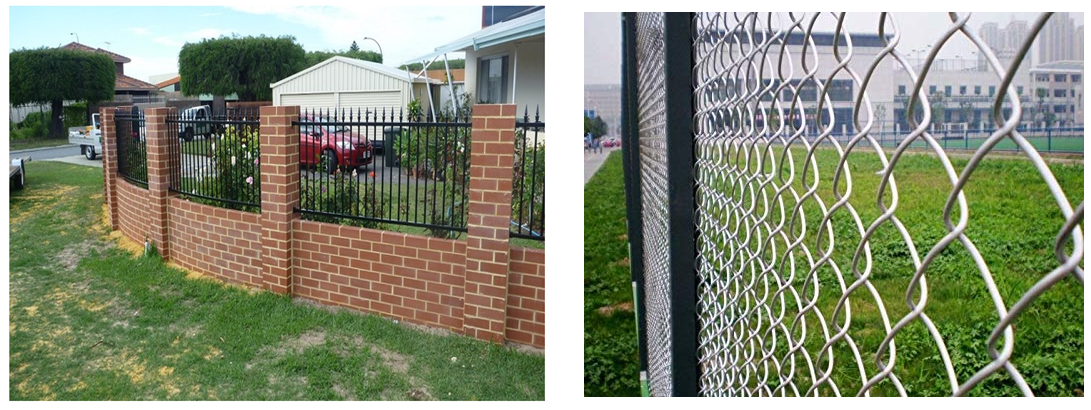
Shobhit's father wants to construct a rectangular garden using a brick wall on one side of the garden and wire fencing for the other three sides as shown in figure. He has $200$ ft of wire fencing.

Based on the above information, answer the following questions.
  1. To construct a garden using $200$ ft of fencing, we need to maximise its.
  1. Volume
  2. Area
  3. Perimeter
  4. Length of the side
  1. If x denote the length of side of garden perpendicular to brick wall and y denote the length of side parallel to brick wall, then find the relation representing total amount of fencing wire.
  1. $x + 2y = 150$
  2. $x + 2y = 50$
  3. $y + 2x = 200$
  4. $y + 2x = 100$
  1. Area of the garden as a function of $x$, say $A(x),$ can be represented as.
  1. $200 + 2x^2$
  2. $x - 2x^2$
  3. $200x - 2x^2$
  4. $200 - x^2$
  1. Maximum value of $A(x)$ occurs at $x$ equals.
  1. $50$ ft
  2. $30$ ft
  3. $26$ ft
  4. $31$ ft
  1. Maxi mum area of garden will be.
  1. $2500$ sq. ft
  2. $4000$ sq. ft
  3. $5000$ sq. ft
  4. $6000$ sq. ft
Answer
  1. (b) Area
Solution:
To create a garden using $200$ ft fencing, we need to maximise its area.
  1. (c) $y + 2x = 200$
Solution:
Required relation is given by $2x + y = 200.$
  1. (c) $200x - 2x^2$
Solution:
Area of garden as a function of x can be rep resented as
$A(x) = x·y = x(200 - 2x) = 200x - 2x^2$
  1. (a) $50$ ft
Solution:
$A(x) = 200x - 2x^2 \Rightarrow A'(x) = 200 - 4x$
For the area to be maximum $A'(x) = 0$
$⇒ 200 - 4x =0$
$⇒ x = 50$ ft
  1. (c) $5000$ sq. ft
Solution:
Maximum area of the garden $= 200(50) - 2(50)^2 = 10000 - 5000 = 5000$ sq. ft
View full question & answer
Question 264 Marks
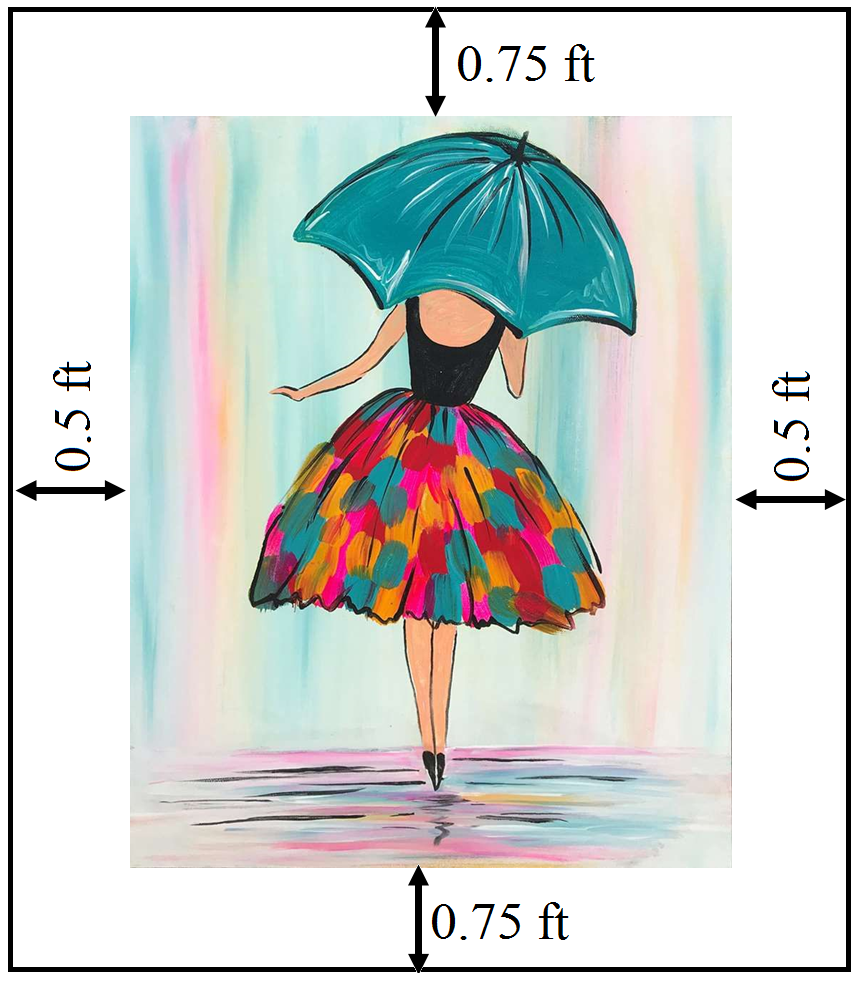
Kyra has a rectangular painting canvas having a total area of $24\ ft^2$ which includes a border of $0.5\ ft.$ on the left right and a border of $0.75\ ft.$ on the bottom, top inside it.

Based on the above information, answer the following questions.
  1. If Kyra wants to paint in the maximum area, then she needs to maximize.
  1. Area of outer rectangle.
  2. Area of inner rectangle.
  3. Area of top border.
  4. None of these.
  1. If x is the length of the outer rectangle, then area of inner rectangle in terms of $x$ is.
  1. $(\text{x}+3)\Big(\frac{24}{\text{x}}-2\Big)$
  2. $(\text{x}-1)\Big(\frac{24}{\text{x}}+1.5\Big)$
  3. $(\text{x}-1)\Big(\frac{24}{\text{x}}-1.5\Big)$
  4. $(\text{x}-1)\Big(\frac{24}{\text{x}}\Big)$
  1. Find the range of $x.$
  1. $(1, \infty)$
  2. $(1, 16)$
  3. $(-\infty, 16)$
  4. $(-1, 16)$
  1. If area of inner rectangle is maximum, then x is equal to.
  1. $2$ ft.
  2. $3$ ft.
  3. $4$ ft.
  4. $5$ ft.
  1. If area of inner rectangle is maximum, then length and breadth of this rectangle are respectively.
  1. $3$ ft, $4.5$ ft.
  2. $4.5$ ft, $5$ ft.
  3. $1$ ft, $2$ ft.
  4. $2$ ft, $4$ ft.
Answer
  1. (b) Area of inner rectangle
Solution:
In order to paint in the maximum area, Kyra needs to maximize the area of inner rectangle.
  1. (c) $(\text{x}-1)\Big(\frac{24}{\text{x}}-1.5\Big)$
Solution:
Let x be the length and y be the breadth of outer rectangle.
$\therefore$ Length of inner rectangle $= x - 1$
and breadth of inner rectangle $= y - 1.5$
$\therefore A(x) = (x - 1)(y - 1.5) [ \therefore  xy = 24 ($given$)$
$=\big(\text{x}-1\big)\bigg(\frac{24}{\text{x}}-1.5\bigg)$
  1. (b) $(1, 16)$
Solution:
Dimensions of rectangle (outer/inner) should be positive.
$\therefore\text{x}-1>0\text{ and }\frac{24}{\text{x}}-1.5>0$
$\therefore\text{x}>1\text{ and }{\text{x}}<16$
$\therefore$ Range of $x$ is $(1, 16)$
  1. (c) $4$ ft
Solution:
We have $\text{A}'\text{(x)}=(\text{x}-1)\bigg(\frac{24}{\text{x}}-1.5\bigg)$
$\Rightarrow\text{A}'(\text{x)}=(\text{x}-1)\Big(\frac{-24}{\text{x}^2}\Big)+\bigg(\frac{24}{\text{x}}-1.5\bigg)$
$=\frac{24}{\text{x}^2}-1.5\ \text{and}\ \text{A}''(\text{x})=\frac{-48}{\text{x}^3}$
For $A(x)$ to be maximum or minimum, $A'(x) = 0$
$\Rightarrow-1.5+\frac{24}{\text{x}^2}=0$
$\Rightarrow\text{x}^2=16$
$\Rightarrow\text{x}=\pm4$
$\therefore\text{x}=4$ [Since, length can't be negative]
Also, $\text{A}''(4)=\frac{-48}{4^3}<0$
Thus, at $x = 4$, area is maximum.
  1. (a) $3$ ft, $4.5$ ft.
Solution:
If area of inner rectangle is maximum, then Length of inner rectangle $= x - 1 = 4 - 1 = 3$ ft.
And breadth of inner rectangle $=\text{y}-1.5=\frac{24}{\text{x}}-1.5$
$=\frac{24}{4}-1.5=6-1.5=4.5\ \text{ft}$
View full question & answer
Question 274 Marks
In a society there is a garden in the shape of rectangle inscribed in a circle of radius 10m as shown in given figure.

Based on the above information, answer the following questions.
  1. If $2x$ and $2y$ denotes the length and breadth in metres, of the rectangular part, then the relation between the variables is.
  1. $x^2 - y^2 = 10$
  2. $x^2 + y^2 = 10$
  3. $x^2 + y^2 = 100$
  4. $x^2 - y^2 = 100$
  1. The area $(A)$ of green grass, in terms of $x,$ is given by.
  1. $2\text{x}\sqrt{100-\text{x}^2}$
  2. $4\text{x}\sqrt{100-\text{x}^2}$
  3. $2\text{x}\sqrt{100+\text{x}^2}$
  4. $4\text{x}\sqrt{100+\text{x}^2}$
  1. The maximum value of $A$ is.
  1. $100\text{m}^2$
  2. $200\text{m}^2$
  3. $400\text{m}^2$
  4. $1600\text{m}^2$
  1. The value of length of rectangle, when $A$ is maximum, is.
  1. $10\sqrt{2}\text{m}$
  2. $20\sqrt{2}\text{m}$
  3. $20\text{m}$
  4. $5\sqrt{2}\text{m}$
  1. The area of gravelling path is.
  1. $100(\pi+2)\text{m}^2$
  2. $100(\pi-2)\text{m}^2$
  3. $200(\pi+2)\text{m}^2$
  4. $200(\pi-2)\text{m}^2$
Answer
  1. (c) $x^2 + y^2 = 100$
Solution:
Length, $AB = 2x$ Breadth,$BC = 2y$
Also, radius, $OA = 10$
$\therefore\text{AC}=20$
$\text{in }\triangle\text{ABC},\text{AB}+\text{BC}^2=\text{AC}^2$
$\Rightarrow(2\text{x})^2+(2\text{y}^2)=(20)^2$
$\Rightarrow\text{x}^2+\text{y}^2=100$
  1. (b) $4\text{x}\sqrt{100-\text{x}^2}$
Solution:
Area of green grass $=$ Area of rectangular part
$\therefore\text{A}=2\text{x}.2\text{y}$ $[\therefore\text{Area of rectangle} = \text{length }\times \text{breadth}]$
$=4\text{xy}=4\text{x}\sqrt{100-\text{x}^2}$
$[\therefore\text{x}^2+\text{y}^2=100]$
  1. (b) $200\text{m}^2$
Solution:
We have, $\text{A}=4\text{x}\sqrt{100-\text{x}^2}$
$\frac{\text{dA}}{\text{dx}}=\frac{4\text{x}(-2\text{x})}{2\sqrt{100-\text{x}^2}}+\sqrt{100-\text{x}^2.4}$
$\frac{-4\text{x}^2+4(100-\text{x}^2)}{\sqrt{100-\text{x}^2}}$
For maximum value, $\frac{\text{dA}}{\text{dx}}=0$
$\Rightarrow-4\text{x}^2+4000-4\text{x}^2=0$
$\Rightarrow-8\text{x}+400=0$
$\Rightarrow\text{x}^2=50$
$\Rightarrow\text{x}=5\sqrt{2}$
$\text{At}\ \text{x}=5\sqrt{2}$
$\text{A}=4\text{x}\sqrt{100-\text{x}^2}$
$=4\times5\sqrt{2}.\sqrt{100-50}=4\times5\sqrt{2}\times5\sqrt{2}=200\text{m}^2$
  1. $10\sqrt{2}\text{m}$
Solution:
Length of rectangle for which $A$ is maximum
$=2\times5\sqrt{2}=10\sqrt{2}$
  1. (b) $100(\pi-2)\text{m}^2$
Solution:
Area of gravelling path $=\pi(10)^2-200$
$=100(\pi-2)\text{m}^2$
View full question & answer
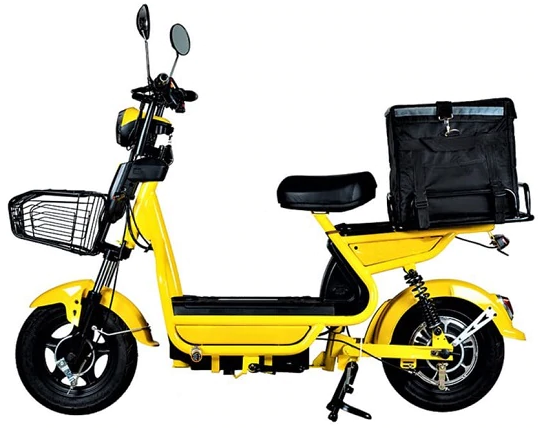
Question 284 Marks
An owner of an electric bike rental company have determined that if they charge customers $₹\ x$ per day to rent a bike, where $50 < x < 200$, then number of bikes $(n),$ they rent per day can be shown by linear function $n(x) = 2000 - 10x.$ If they charge $₹\ 50$ per day or less, they will rent all their bikes. If they charge $₹\ 200$ or more per day, they will not rent any bike.

Based on the above information, answer the following questions.
  1. Total revenue $R$ as a function of $x$ can be represented as.
  1. $2000x - 10x^2$
  2. $2000x + 10x^2$
  3. $2000 - 10x$
  4. $2000 - 5x^2$
  1. If $R(x)$ denote the revenue, then maximum value of $R(x)$ occur when $x$ equals.
  1. $10$
  2. $100$
  3. $1000$
  4. $50$
  1. At $x = 260,$ the revenue collected by the company is.
  1. $₹\ 10$
  2. $₹\ 500$
  3. $₹\ 0$
  4. $₹\ 1000$
  1. The number of bikes rented per day, if $x = 105$ is.
  1. $850$
  2. $900$
  3. $950$
  4. $1000$
  1. Maximum revenue collected by company is.
  1. $₹\ 40,000$
  2. $₹\ 50,000$
  3. $₹\ 75,000$
  4. $₹\ 1,00,000$
Answer
  1. (a) $2000x - 10x^2$
Solution:
Let $x$ be the charges per bike per day and n be the number of bikes rented per day.
$R(x) = n \times x = (2000 - 10x) x = -10x^2 + 2000x$
  1. (b) $100$
Solution:
We have, $R(x) = 2000x - 10x^2$
$\Rightarrow R'(x) = 2000 - 20x$
For $R(x)$ to be maximum or minimum, $R'(x) = 0$
$⇒ 2000 - 20x = 0 ⇒ x = 100$
Also, $R"(x) = -20 < 0$
Thus, $R(x)$ is maximum at $x = 100$​​​​​​​
  1. (c) $₹\ 0$
Solution:
If company charge $₹\ 200$ or more, they will not rent any bike. Therefore, revenue collected by him will be zero.
  1. (c) $950$
Solution:
If $x = 105$, number of bikes rented per day is given by
$n = 2000 - 10 × 105 = 950$​​​​​​​
  1. (d) $₹\ 1,00,000$
Solution:
At $x = 100, R(x)$ is maximum.
$\therefore$ Maximum revenue $= R(100)$
$= -10(100)^2 + 2000(100) = ₹ 1,00,000$
View full question & answer
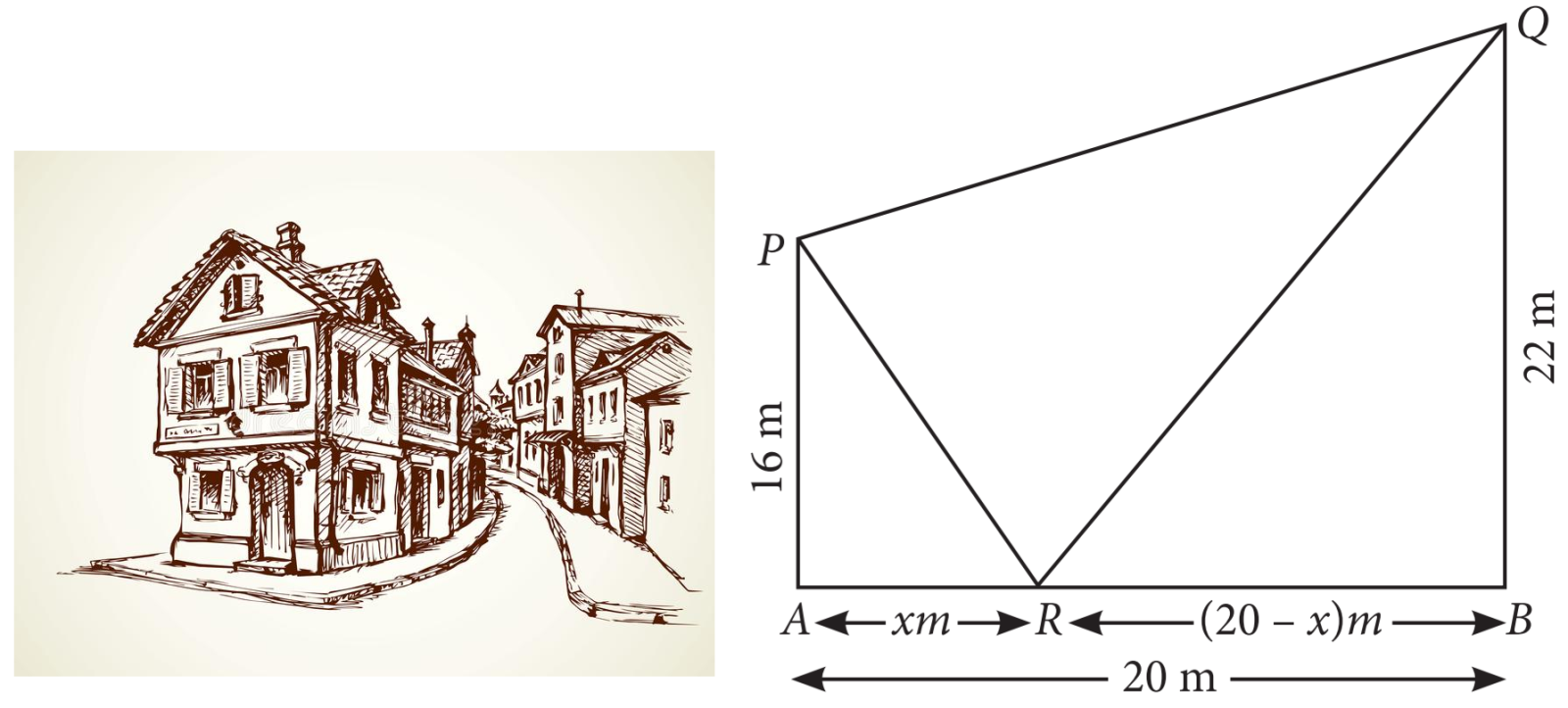
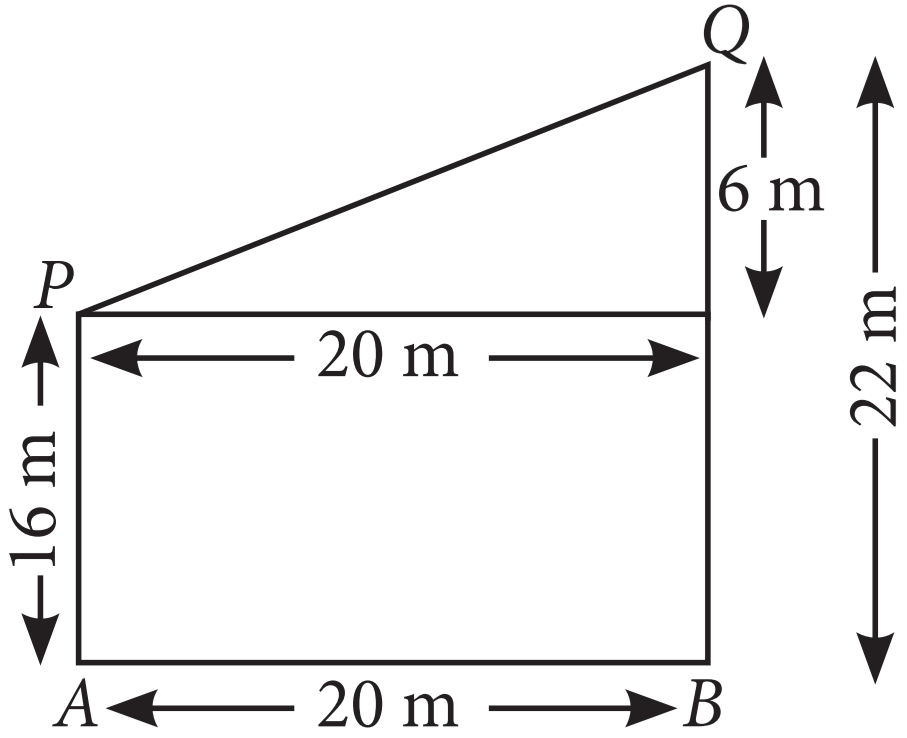
Question 294 Marks
Two multi-storey buildings $($represented by $AP$ and $BQ)$ are on opposite side of a 20m wide road at point $A$ and $B$ respectively. There is a point $R$ on road as shown in figure.

Based on the above information, answer the following questions.
  1. Area of trapezium $ABQP$ is.
  1. $380$ sq. m
  2. $280$ sq. m
  3. $320$ sq. m
  4. $430$ sq. m
  1. The length PQ is.
  1. $20.5$m
  2. $19.80$ m
  3. $20.88$m
  4. $21$m
  1. Let there be a quantity $S$ such that $S = RP^2 + RQ^2$, then $S$ is given by.
  1. $2x^2 - 40x - 1140$
  2. $2x^2 + 40x + 1140$
  3. $2x^2 - 40x + 1140$
  4. $2x^2 + 40x - 1140$
  1. Find the value of $x$ for which value of $S$ is minimum.
  1. $10$
  2. $0$
  3. $4$
  4. $-10$
  1. For minimum value of $S,$ find the value of $PR$ and $RQ.$
  1. $18.50$m, $19.36$m
  2. $18.86$m, $24.17$m
  3. $17.56$m, $23.29$m
  4. None of these
Answer
  1. (a) $380$ sq. m
Solution:
Area of trapezium $=\frac{1}{2}\times$ (sum of parallel 2 sides) × distance between parallel sides
$=\frac{1}{2}\times(16+22)\times20=380\text{m}^2$
  1. (c) $20.88$m
Solution:
$\text{PQ}^2=6^2+(20)^2=36+400=436$
$\therefore\text{PQ}=\sqrt{436}=20.88\text{m}$

  1. (c) $2x^2 - 40x + 1140$
Solution:
$\text{S}=\text{RP}^2+\text{RQ}^2$
Since $\text{RP}^2=(16)^2+\text{x}^2=256+\text{x}^2$
and $\text{RQ}^2=(22)^2+(20-\text{x})^2=484+400+\text{x}^2-40\text{x}$
$\therefore\text{S}=2\text{x}-40\text{x}+1140$
  1. (a) $10$
Solution:
We have $\text{S}(\text{x})=2\text{x}^2-40\text{x}+1140$
$\therefore\text{S}'(\text{x})=4\text{x}-40$
For minimum value of $x, S(x) = 0$
$\Rightarrow4\text{x}-40=0$
$\Rightarrow\text{x}=10$
Clearly, at $x = 10, S (x) = 4 > 0$
  1. (b) $18.86$m, $24.17$m
Solution:
At $x = 10, PR^2 = 16^2 + x^2$
$= (16)^2 + (10)^2 = 256 + 100 = 356$
$\therefore\text{PR}=\sqrt{356}=18.86\text{m}$
Also $\text{RQ}^2=(22)^2+(20-10)^2=484+100=584$
$\therefore\text{RQ}=\sqrt{584}=24.17\text{m}$
View full question & answer
Question 304 Marks
An architecture design a auditorium for a school for its cultural activities. The floor of the auditorium is rectangular in shape and has a fixed perimeter $P.$

Based on the above information, answer the following questions.
  1. If $x$ and $y$ represents the length and breadth of the rectangular region, then relation between the variable is.
  1. $x + y = P$
  2. $x^2 + y^2 = P^2$
  3. $2(x + y) = P$
  4. $x + 2y = P$
  1. The area (A) of the rectangular region, as a function of $x,$ can be expressed as.
  1. $\text{A}=\text{px}+\frac{\text{x}}{2}$
  2. $\text{A}=\frac{\text{px}+\text{x}^2}{2}$
  3. $\text{A}=\frac{\text{px}-\text{2x}^2}{2}$
  4. $\text{A}=\frac{\text{x}^2}{2}+\text{px}^2$
  1. School's manager is interested in maximising the area of floor $'A'$ for this to be happen, the value of $x$ should be.
  1. $\text{P}$
  2. $\frac{\text{P}}{2}$
  3. $\frac{\text{P}}{3}$
  4. $\frac{\text{P}}{4}$
  1. The value of $y,$ for which the area of floor is maximum, is.
  1. $\frac{\text{P}}{2}$
  2. $\frac{\text{P}}{3}$
  3. $\frac{\text{P}}{4}$
  4. $\frac{\text{P}}{16}$
  1. Maximum area of floor is.
  1. $\frac{\text{P}^2}{16}$
  2. $\frac{\text{P}^2}{64}$
  3. $\frac{\text{P}^2}{4}$
  4. $\frac{\text{P}^2}{28}$
Answer
  1. (c) $2(x + y) = P$
Solution:
Perimeter of floor $= 2($Length $+$ breadth$)$
$⇒ P = 2(x + y)$
  1. (c) $\text{A}=\frac{\text{px}-\text{2x}^2}{2}$
Solution:
Area, $A =$ length $×$ breadth
$⇒ A = xy$
Since,$ P = 2(x + y)$
$\Rightarrow\frac{\text{P}-2\text{x}}{2}=\text{y}$
$\therefore\text{A}=\text{x}\Big(\frac{\text{P}-2\text{x}}{2}\Big)$
$\Rightarrow\text{A}=\frac{\text{Px}-2\text{x}^2}{2}$
  1. (d) $\frac{\text{P}}{4}$
Solution:
We have, $\text{A}=\frac{1}{2}(\text{Px}-2\text{x}^2)$
$\frac{\text{dA}}{\text{dx}}=\frac{1}{2}(\text{P}-4\text{x})=0$
$\Rightarrow\text{P}-4\text{x}=0\Rightarrow\text{x}=\frac{\text{P}}{4}$
Clearly, at $\text{x}=\frac{\text{P}}{4},\frac{\text{d}^2\text{A}}{\text{dx}^2}=-2<0$
$\therefore$ Area of maximum at $\text{x}=\frac{\text{P}}{4}$
  1. (c) $\frac{\text{P}}{4}$
Solution:
We have, $\text{y}=\frac{\text{P}-2\text{x}}{2}=\frac{\text{P}}{2}-\frac{\text{P}}{4}=\frac{\text{P}}{4}$
  1. (a) $\frac{\text{P}^2}{16}$
Solution:
$\text{A}=\text{xy}=\frac{\text{P}}{4}\cdot\frac{\text{P}}{4}=\frac{\text{P}^2}{16}$
View full question & answer
Question 314 Marks
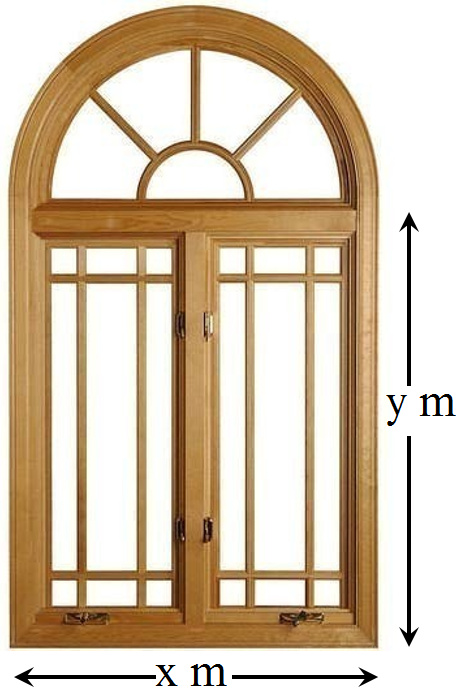
Rohan, a student of class XII, visited his uncle's flat with his father. He observe that the window of the house is in the form of a rectangle surmounted by a semicircular opening having perimeter 10m as shown in the figure.

Based on the above information, answer the following questions.
  1. If x and y represents the length and breadth of the rectangular region, then relation between x and y can be represented as.
  1. $\text{x}+\text{y}+\frac{\pi}{2}=10$
  2. $\text{x}+\text{2y}+\frac{\pi\text{x}}{2}=10$
  3. $\text{2x}+\text{2y}=10$
  4. $\text{x}+\text{2y}+\frac{\pi}{2}=10$
  1. The area (A) of the window can be given by.
  1. $\text{A}=\text{x}-\frac{\text{x}^3}{8}-\frac{\text{x}^2}{2}$
  2. $\text{A}=\text{5x}-\frac{\text{x}^2}{8}-\frac{\pi\text{x}^2}{8}$
  3. $\text{A}=\text{x}+\frac{\pi\text{x}^3}{8}-\frac{\text{3x}^2}{8}$
  4. $\text{A}=\text{5x}+\frac{\text{x}^3}{2}+\frac{\pi\text{x}^2}{8}$
  1. Rohan is interested in maximizing the area of the whole window, for this to happen, the value of x should be.
  1. $\frac{10}{2-\pi}$
  2. $\frac{20}{4-\pi}$
  3. $\frac{20}{4+\pi}$
  4. $\frac{10}{2+\pi}$
  1. Maximum area of the window is.
  1. $\frac{30}{4+\pi}$
  2. $\frac{30}{4-\pi}$
  3. $\frac{50}{4-\pi}$
  4. $\frac{50}{4+\pi}$
  1. For maximum value of A, the breadth of rectangular part of the window is.
  1. $\frac{10}{4+\pi}$
  2. $\frac{10}{4-\pi}$
  3. $\frac{20}{4+\pi}$
  4. $\frac{20}{4-\pi}$
Answer
  1. (b) $\text{x}+\text{2y}+\frac{\pi\text{x}}{2}=10$
Solution:

Given, perimeter of window = 10m

$\therefore$ x + y + y + perimeter of semicircle = 10

$\Rightarrow\text{x}+2\text{y}+\pi\frac{\text{2}}{2}=10$
  1. (b) $\text{A}=\text{5x}-\frac{\text{x}^2}{8}-\frac{\pi\text{x}^2}{8}$
Solution:

$\text{A}=\text{x}\cdot\text{y}+\frac{1}{2}\pi\Big(\frac{\text{x}}{2}\Big)^2$

$=\text{x}\Big(5-\frac{\text{x}}{2}-\frac{\pi\text{x}}{4}\Big)+\frac{1}{2}\frac{\pi\text{x}^2}{4}$

$[\therefore\text{From }(\text{i)},\text{y}=5-\frac{\text{x}}{2}-\frac{\pi\text{x}}{4}]$

$=\text{5x}-\frac{\text{x}}{2}^2-\frac{\pi\text{x}^2}{4}+\frac{\pi\text{x}^2}{8}=5\text{x}-\frac{\text{x}}{2}^2-\frac{\pi\text{x}^2}{8}$
  1. (c) $\frac{20}{4+\pi}$
Solution:

We have, $\text{A}=5\text{x}-\frac{\text{x}^2}{2}-\frac{\pi\text{r}^2}{8}$

$\Rightarrow\frac{\text{dA}}{\text{dx}}=5-\text{x}-\frac{\pi\text{x}}{4}$

Now, $\Rightarrow\frac{\text{dA}}{\text{dx}}=0$

$\Rightarrow5=\text{x}+\frac{\pi\text{x}}{4}$

$\Rightarrow\text{x}(4+\pi)=20$

$\Rightarrow\text{x}=\frac{20}{4+\pi}$

$\Bigg[\text{Clearly},\frac{\text{d}^2\text{A}}{\text{dx}^2}<0\text{ at }\text{x}=\frac{20}{4+\pi}\Bigg]$
  1. (d) $\frac{50}{4+\pi}$
Solution:

At $\text{x}=\frac{20}{\text{x}}=\frac{20}{4+\pi}$

$\text{A}=5\Big(\frac{20}{4+\pi}\Big)-\Big(\frac{20}{4+\pi}\Big)^2\frac{1}{2}-\frac{\pi}{8}\Big(\frac{20}{4+\pi}\Big)^2$

$=\frac{100}{4+\pi}-\frac{200}{(4+\pi)^2}-\frac{50\pi}{(4+\pi)^2}$

$\frac{(4+\pi)(100)-200-50\pi}{(4+\pi)^2}=\frac{400+100\pi-200-50\pi}{(4+\pi)^2}$

$\frac{200+50\pi}{(4+\pi)}=\frac{50(4+\pi)}{(4+\pi)}=\frac{50}{4+\pi}$
  1. (a) $\frac{10}{4+\pi}$
Solution:

We have, $\text{y}=5-\frac{\text{x}}{2}-\frac{\pi\text{x}}{4}=5-\text{x}\Big(\frac{1}{2}+\frac{\pi}{4}\Big)$

$=5-\text{x}\Big(\frac{2+\pi}{4}\Big)=5-\Big(\frac{20}{4+\pi}\Big)\Big(\frac{2+\pi}{4}\Big)$

$=5-5\frac{(2+\pi)}{4+\pi}=\frac{20+5\pi-10-5\pi}{4+\pi}=\frac{10}{4+\pi}$
View full question & answer