Question 15 Marks
Prove that the curves $\text{y}^{2} = 4x \text{ and } x^{2} = 4y $ divided the area of square bounded by $x = 0, x = 4,y=4 \text{ and } y = 0$ into three equal parts.
Answer
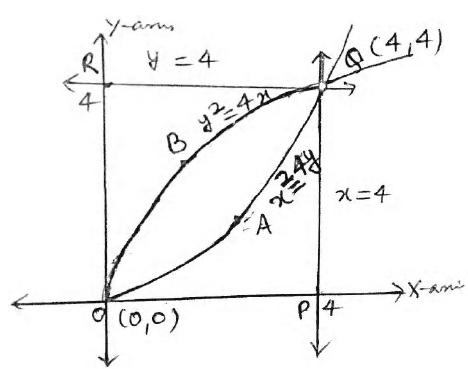 Point of intersection of $\text{y}^{2} = \text{4x and x}^{2} = \text{4y}$ are (, 0_ and (4, 4):
$\text{are (OAQBO)} = \int\limits^{4}_{0} \bigg(2\sqrt{\text{x}}-\frac{\text{x}^{2}}{4}\bigg)\text{dx}$
$= \left\{\frac{4}{3}\text{x}^{3/2}- \frac{\text{x}^{3}}{12}\right\}\Bigg]^{4}_{0}$
$= \frac{32}{3}-\frac{16}{3} = \frac{16}{3}$
$\text{area(OPQAO)} = \int\limits^{4}_{0}\frac{\text{x}^{2}}{4}\text{dx} = \frac{1}{12} \text{x}^{3}\bigg]^{4}_{0} = \frac{16} {3}$
$\text{area(OBQRO)} = \int\limits^{4}_{0}\frac{\text{y}^{2}}{4}\text{dy} = \frac{1}{12} \text{y}^{3}\bigg]^{4}_{0} = \frac{16} {3}$
Hence the areas of the three regions are equal. View full question & answer→Question 25 Marks
Tangent to the circle $\text{x}^{2} + \text{y}^{2} = 4$ at any point on it in the first quadrant makes intercepts OA and OB on x and y axes respectively, O being the centre of the circle. Find the minimum value of (OA + OB).
Answer
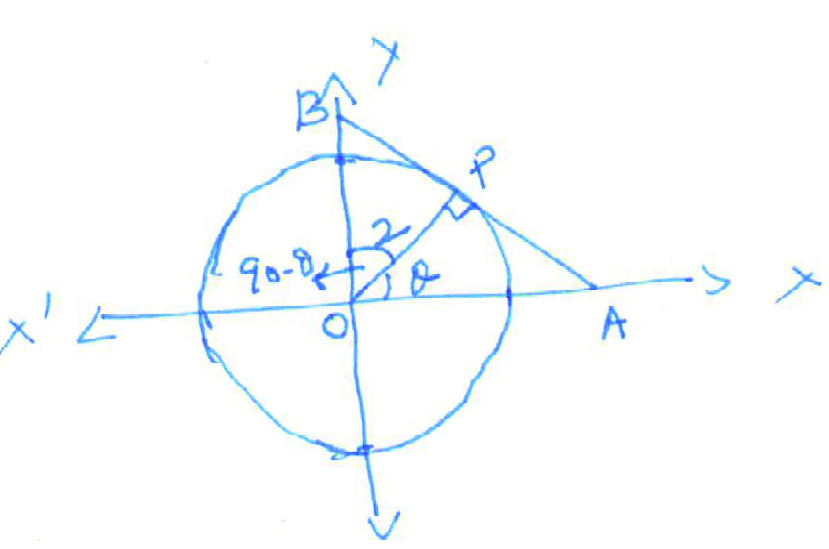 $\text{x}^{2} + \text{y}^{2} = 4. \text{OP is} \bot \text{to AB}$
$\cos\theta = \frac{2}{\text{OA}}; \text{OA} = 2\sec\theta$
$\cos(90^{0} - \theta) = \frac{2}{\text{OB}}$
$\text{OB 2 cosec}\theta$
$\text{Let S = OA + OB = }2(\sec\theta + \text{cosec}\theta)\dots\dots\dots\dots\dots\text{(1)}$
$\frac{\text{ds}}{\text{d}\theta}= 2(\sec\theta \tan\theta - \text{cosec}\theta .\cot\theta)$
$= 2 \frac{\sin^{3}\theta- \cos^{3}\theta}{\sin^{2}\theta. \cos^{2}\theta}\dots\dots\dots\dots\dots\dots\dots\dots\dots\dots\dots\dots\text{(2)}$
for maxima or minima $\frac{\text{ds}}{\text{d}\theta} = 0$
$\Rightarrow \theta = \frac{\pi}{4},$
$\text{(2)} \Rightarrow \frac{\text{d}^{2}\text{S}}{\text{d}\theta^{2}} > \text{0 when} \theta = \frac{\pi}{4}$
$\therefore \text{OA + OB is minimum}$
$\Rightarrow \text{OA + OB = } 4\sqrt{2}$ unit View full question & answer→Question 35 Marks
If the area bounded by the parabola $\text{y}^{2} = 16\text{ax}$ and the line $\text{y = 4 mx}$ is $\frac{\text{a}^{2}}{12}$ sq. units, then using integration, find the value of m.
Answer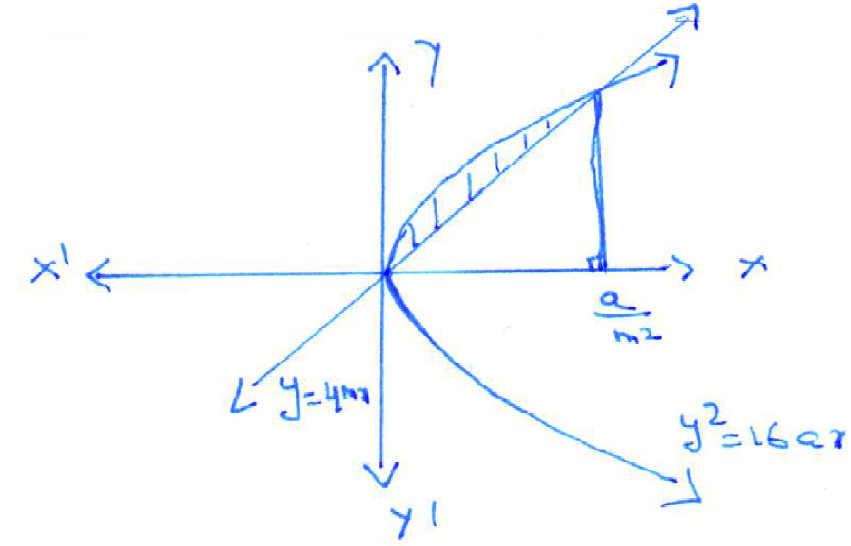
$\text{y = 4 mx} \rightarrow \text{(1) and } \text{y}^{2} = 16\text{ax} \rightarrow\text{(2)}$
$\Rightarrow \text{x} = \frac{\text{a}}{\text{m}^{2}}$
Required area $= 4\sqrt{\text{a}} \int\limits^{\text{}^{\frac{\text{a}}{\text{m}^{2}}}}_{0}\sqrt{\text{x}} \text{dx - 4m} \int\limits^{\text{}^{\frac{\text{a}}{\text{m}^{2}}}}_{0}\text{x dx}$
$= \frac{8}{3} \sqrt{\text{a}} \text{x}^{3/2}\bigg]^{\frac{\text{a}}{\text{m}^{2}}}_{0} - 2\text{m x}^{2}]^{\frac{\text{a}}{\text{m}^{2}}}_{0}$
$= \frac{8}{3} \frac{\text{a}^{2}}{\text{m}^{3}} -\frac{\text{2a}^{2}}{\text{m}^{3}} = \frac{2}{3}\frac{\text{a}^{2}}{\text{m}^{3}}$
$\Rightarrow \frac{2}{3}. \frac{\text{a}^{2}}{\text{m}^{3}} = \frac{\text{a}^{2}}{12} \text{given}$
$\text{m}^{3} = 8$
$\text{m} = 2$ View full question & answer→Question 45 Marks
Using integration, find the area of the region bounded by the triangle whose vertices are (–1, 2), (1, 5) and (3, 4).
AnswerCorrect fiqure

Equation of
$\text{AB is}:\text{y} =\frac{1}{2}(3 \text{x} + 7 )$
$\text{BC is:}\text{y} = \frac{1}{2}(11 - \text{x})$
$\text{AC is}:\text{y} =\frac{1}{2}(\text{x} + 5 )$
Required area $ =\frac{1}{2}\int\limits_{-1}^{1}(3 \text{x} + 7 )\text{dx} + \frac{1}{2}\int\limits_{1}^{3}(11 - \text{x})\text{dx} - \frac{1}{2}\int\limits_{-1}^{3}(\text{x} + 5 )\text{dx}$
$ = \bigg[\frac{1}{12}(3 \text{x} + 7 )^{2}\bigg]_{-1}^{1} - \frac{1}{4}\bigg[(11-\text{x})^{2}\bigg]_{1}^{3} - \frac{1}{4}\bigg[(\text{x} + 5)^{2}\bigg]_{-1}^{3}$
= 7 + 9 – 12 = 4 sq. units. View full question & answer→Question 55 Marks
Prove that the curves $\text{y}^{2} = 4x \text{ and } x^{2} = 4y $ divided the area of square bounded by $x = 0, x = 4,y=4 \text{ and } y = 0$ into three equal parts.
Answer
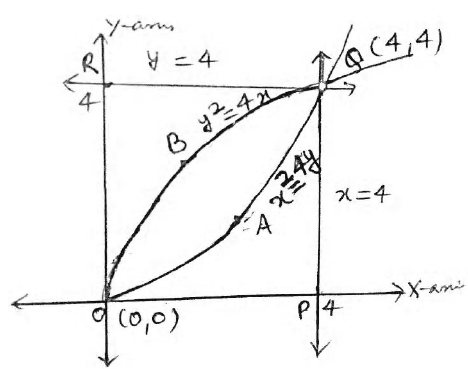 Point of intersection of $\text{y}^{2} = \text{4x and x}^{2} = \text{4y}$ are (, 0_ and (4, 4):
$\text{are (OAQBO)} = \int\limits^{4}_{0} \bigg(2\sqrt{\text{x}}-\frac{\text{x}^{2}}{4}\bigg)\text{dx}$
$= \left\{\frac{4}{3}\text{x}^{3/2}- \frac{\text{x}^{3}}{12}\right\}\Bigg]^{4}_{0}$
$= \frac{32}{3}-\frac{16}{3} = \frac{16}{3}$
$\text{area(OPQAO)} = \int\limits^{4}_{0}\frac{\text{x}^{2}}{4}\text{dx} = \frac{1}{12} \text{x}^{3}\bigg]^{4}_{0} = \frac{16} {3}$
$\text{area(OBQRO)} = \int\limits^{4}_{0}\frac{\text{y}^{2}}{4}\text{dy} = \frac{1}{12} \text{y}^{3}\bigg]^{4}_{0} = \frac{16} {3}$
Hence the areas of the three regions are equal. View full question & answer→Question 65 Marks
If the area bounded by the parabola $\text{y}^{2} = 16\text{ax}$ and the line $\text{y = 4 mx}$ is $\frac{\text{a}^{2}}{12}$ sq. units, then using integration, find the value of m.
Answer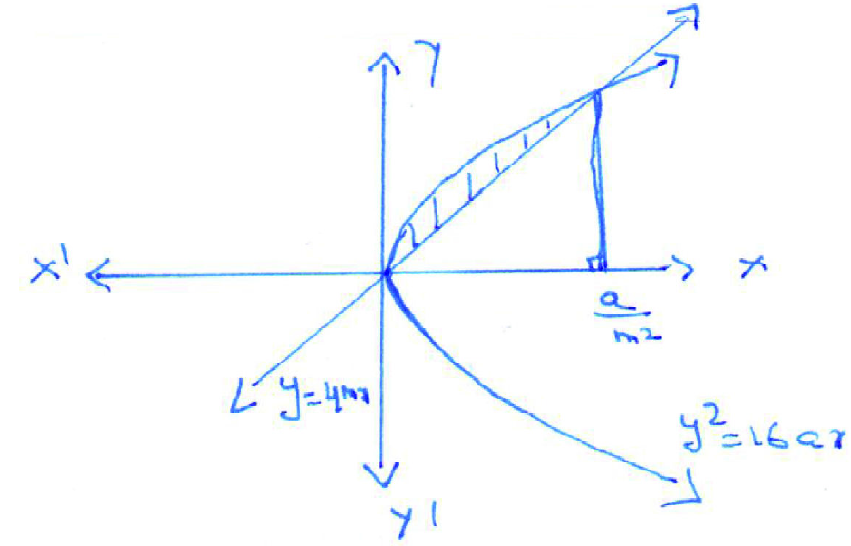
$\text{y = 4 mx} \rightarrow \text{(1) and } \text{y}^{2} = 16\text{ax} \rightarrow\text{(2)}$
$\Rightarrow \text{x} = \frac{\text{a}}{\text{m}^{2}}$
Required area $= 4\sqrt{\text{a}} \int\limits^{\text{}^{\frac{\text{a}}{\text{m}^{2}}}}_{0}\sqrt{\text{x}} \text{dx - 4m} \int\limits^{\text{}^{\frac{\text{a}}{\text{m}^{2}}}}_{0}\text{x dx}$
$= \frac{8}{3} \sqrt{\text{a}} \text{x}^{3/2}\bigg]^{\frac{\text{a}}{\text{m}^{2}}}_{0} - 2\text{m x}^{2}]^{\frac{\text{a}}{\text{m}^{2}}}_{0}$
$= \frac{8}{3} \frac{\text{a}^{2}}{\text{m}^{3}} -\frac{\text{2a}^{2}}{\text{m}^{3}} = \frac{2}{3}\frac{\text{a}^{2}}{\text{m}^{3}}$
$\Rightarrow \frac{2}{3}. \frac{\text{a}^{2}}{\text{m}^{3}} = \frac{\text{a}^{2}}{12} \text{given}$
$\text{m}^{3} = 8$
$\text{m} = 2$ View full question & answer→Question 75 Marks
Tangent to the circle $\text{x}^{2} + \text{y}^{2} = 4$ at any point on it in the first quadrant makes intercepts OA and OB on x and y axes respectively, O being the centre of the circle. Find the minimum value of (OA + OB).
Answer
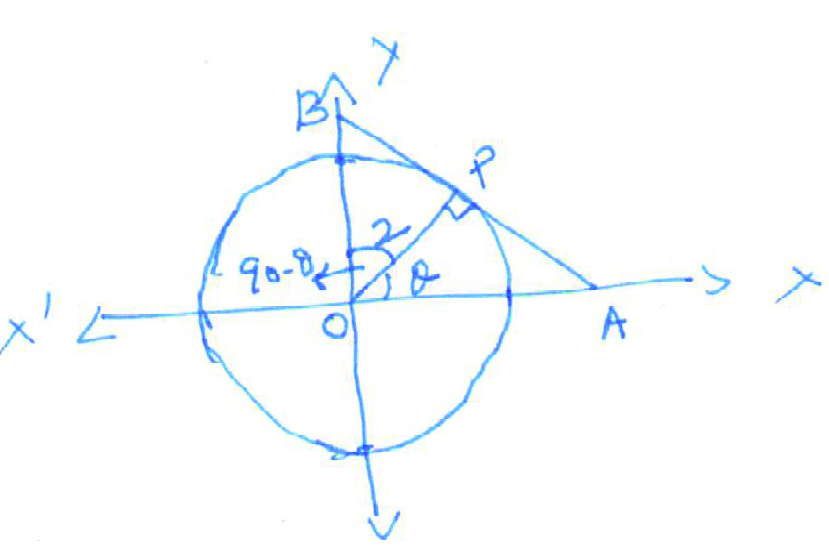 $\text{x}^{2} + \text{y}^{2} = 4. \text{OP is} \bot \text{to AB}$
$\cos\theta = \frac{2}{\text{OA}}; \text{OA} = 2\sec\theta$
$\cos(90^{0} - \theta) = \frac{2}{\text{OB}}$
$\text{OB 2 cosec}\theta$
$\text{Let S = OA + OB = }2(\sec\theta + \text{cosec}\theta)\dots\dots\dots\dots\dots\text{(1)}$
$\frac{\text{ds}}{\text{d}\theta}= 2(\sec\theta \tan\theta - \text{cosec}\theta .\cot\theta)$
$= 2 \frac{\sin^{3}\theta- \cos^{3}\theta}{\sin^{2}\theta. \cos^{2}\theta}\dots\dots\dots\dots\dots\dots\dots\dots\dots\dots\dots\dots\text{(2)}$
for maxima or minima $\frac{\text{ds}}{\text{d}\theta} = 0$
$\Rightarrow \theta = \frac{\pi}{4},$
$\text{(2)} \Rightarrow \frac{\text{d}^{2}\text{S}}{\text{d}\theta^{2}} > \text{0 when} \theta = \frac{\pi}{4}$
$\therefore \text{OA + OB is minimum}$
$\Rightarrow \text{OA + OB = } 4\sqrt{2}$ unit View full question & answer→Question 85 Marks
Using integration, find the area of the region bounded by the triangle whose vertices are (–1, 2), (1, 5) and (3, 4).
AnswerCorrect fiqure
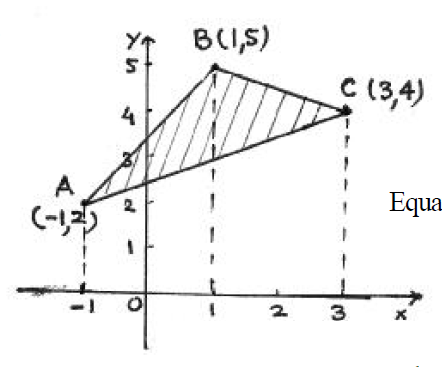
Equation of
$\text{AB is}:\text{y} =\frac{1}{2}(3 \text{x} + 7 )$
$\text{BC is:}\text{y} = \frac{1}{2}(11 - \text{x})$
$\text{AC is}:\text{y} =\frac{1}{2}(\text{x} + 5 )$
Required area $ =\frac{1}{2}\int\limits_{-1}^{1}(3 \text{x} + 7 )\text{dx} + \frac{1}{2}\int\limits_{1}^{3}(11 - \text{x})\text{dx} - \frac{1}{2}\int\limits_{-1}^{3}(\text{x} + 5 )\text{dx}$
$ = \bigg[\frac{1}{12}(3 \text{x} + 7 )^{2}\bigg]_{-1}^{1} - \frac{1}{4}\bigg[(11-\text{x})^{2}\bigg]_{1}^{3} - \frac{1}{4}\bigg[(\text{x} + 5)^{2}\bigg]_{-1}^{3}$
= 7 + 9 – 12 = 4 sq. units. View full question & answer→Question 95 Marks
Prove that the curves $\text{y}^{2} = 4x \text{ and } x^{2} = 4y $ divided the area of square bounded by $x = 0, x = 4,y=4 \text{ and } y = 0$ into three equal parts.
Answer
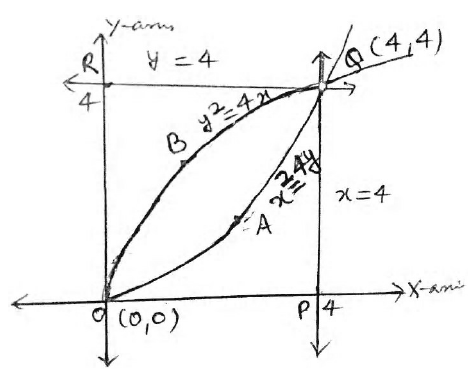 Point of intersection of $\text{y}^{2} = \text{4x and x}^{2} = \text{4y}$ are (, 0_ and (4, 4):
$\text{are (OAQBO)} = \int\limits^{4}_{0} \bigg(2\sqrt{\text{x}}-\frac{\text{x}^{2}}{4}\bigg)\text{dx}$
$= \left\{\frac{4}{3}\text{x}^{3/2}- \frac{\text{x}^{3}}{12}\right\}\Bigg]^{4}_{0}$
$= \frac{32}{3}-\frac{16}{3} = \frac{16}{3}$
$\text{area(OPQAO)} = \int\limits^{4}_{0}\frac{\text{x}^{2}}{4}\text{dx} =\Big[ \frac{1}{12} \text{x}^{3}\Big]^{4}_{0} = \frac{16} {3}$
$\text{area(OBQRO)} = \int\limits^{4}_{0}\frac{\text{y}^{2}}{4}\text{dy} =\Big[ \frac{1}{12} \text{y}^{3}\Big]^{4}_{0} = \frac{16} {3}$
Hence the areas of the three regions are equal. View full question & answer→Question 105 Marks
Tangent to the circle $\text{x}^{2} + \text{y}^{2} = 4$ at any point on it in the first quadrant makes intercepts OA and OB on x and y axes respectively, O being the centre of the circle. Find the minimum value of (OA + OB).
Answer
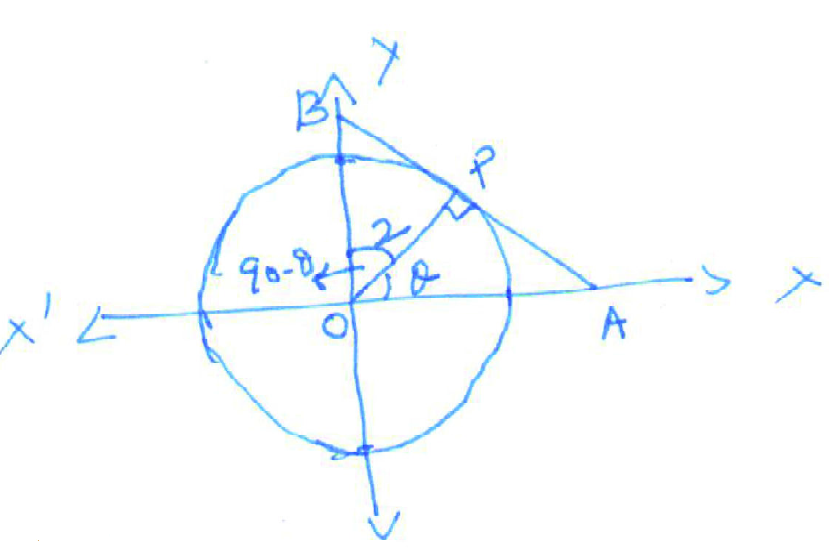 $\text{x}^{2} + \text{y}^{2} = 4. \text{OP is} \bot \text{to AB}$
$\cos\theta = \frac{2}{\text{OA}}; \text{OA} = 2\sec\theta$
$\cos(90^{0} - \theta) = \frac{2}{\text{OB}}$
$\text{OB 2 cosec}\theta$
$\text{Let S = OA + OB = }2(\sec\theta + \text{cosec}\theta)\dots\dots\dots\dots\dots\text{(1)}$
$\frac{\text{ds}}{\text{d}\theta}= 2(\sec\theta \tan\theta - \text{cosec}\theta .\cot\theta)$
$= 2 \frac{\sin^{3}\theta- \cos^{3}\theta}{\sin^{2}\theta. \cos^{2}\theta}\dots\dots\dots\dots\dots\dots\dots\dots\dots\dots\dots\dots\text{(2)}$
for maxima or minima $\frac{\text{ds}}{\text{d}\theta} = 0$
$\Rightarrow \theta = \frac{\pi}{4},$
$\text{(2)} \Rightarrow \frac{\text{d}^{2}\text{S}}{\text{d}\theta^{2}} > \text{0 when} \theta = \frac{\pi}{4}$
$\therefore \text{OA + OB is minimum}$
$\Rightarrow \text{OA + OB = } 4\sqrt{2}$ unit View full question & answer→Question 115 Marks
If the area bounded by the parabola $\text{y}^{2} = 16\text{ax}$ and the line $\text{y = 4 mx}$ is $\frac{\text{a}^{2}}{12}$ sq. units, then using integration, find the value of m.
Answer
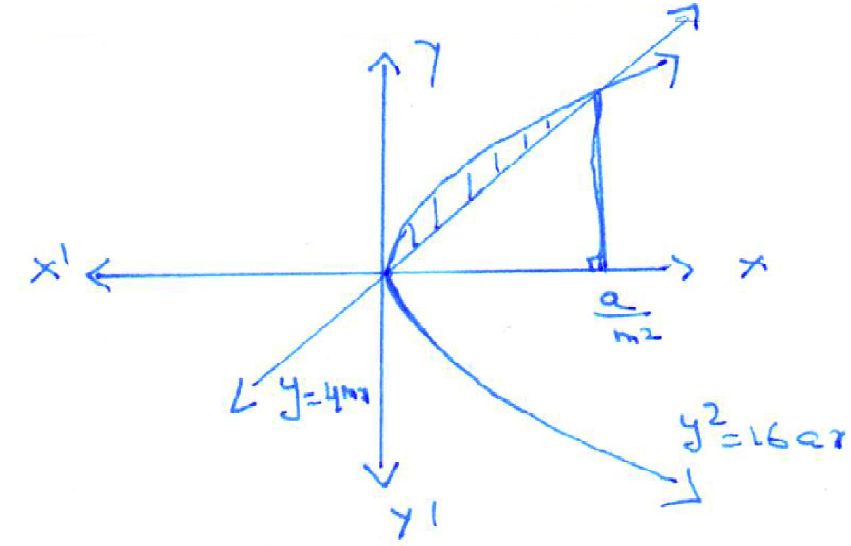 $\text{y = 4 mx} \rightarrow \text{(1) and } \text{y}^{2} = 16\text{ax} \rightarrow\text{(2)}$
$\Rightarrow \text{x} = \frac{\text{a}}{\text{m}^{2}}$
Required area $= 4\sqrt{\text{a}} \int\limits^{\text{}^{\frac{\text{a}}{\text{m}^{2}}}}_{0}\sqrt{\text{x}} \text{dx - 4m} \int\limits^{\text{}^{\frac{\text{a}}{\text{m}^{2}}}}_{0}\text{x dx}$
$= \frac{8}{3} \sqrt{\text{a}} \text{x}^{3/2}\bigg]^{\frac{\text{a}}{\text{m}^{2}}}_{0} - 2\text{m x}^{2}]^{\frac{\text{a}}{\text{m}^{2}}}_{0}$
$= \frac{8}{3} \frac{\text{a}^{2}}{\text{m}^{3}} -\frac{\text{2a}^{2}}{\text{m}^{3}} = \frac{2}{3}\frac{\text{a}^{2}}{\text{m}^{3}}$
$\Rightarrow \frac{2}{3}. \frac{\text{a}^{2}}{\text{m}^{3}} = \frac{\text{a}^{2}}{12} \text{given}$
$\text{m}^{3} = 8$
$\text{m} = 2$ View full question & answer→Question 125 Marks
Using integration, find the area of the region bounded by the triangle whose vertices are (–1, 2), (1, 5) and (3, 4).
AnswerCorrect fiqure
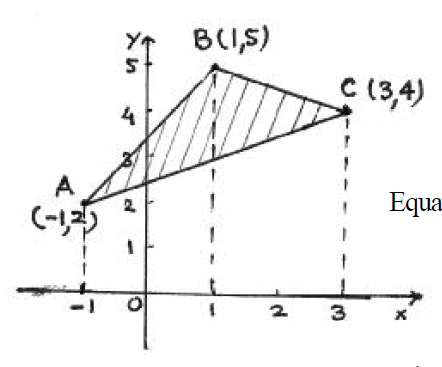
Equation of
$\text{AB is}:\text{y} =\frac{1}{2}(3 \text{x} + 7 )$
$\text{BC is:}\text{y} = \frac{1}{2}(11 - \text{x})$
$\text{AC is}:\text{y} =\frac{1}{2}(\text{x} + 5 )$
Required area $ =\frac{1}{2}\int\limits_{-1}^{1}(3 \text{x} + 7 )\text{dx} + \frac{1}{2}\int\limits_{1}^{3}(11 - \text{x})\text{dx} - \frac{1}{2}\int\limits_{-1}^{3}(\text{x} + 5 )\text{dx}$
$ = \bigg[\frac{1}{12}(3 \text{x} + 7 )^{2}\bigg]_{-1}^{1} - \frac{1}{4}\bigg[(11-\text{x})^{2}\bigg]_{1}^{3} - \frac{1}{4}\bigg[(\text{x} + 5)^{2}\bigg]_{-1}^{3}$
= 7 + 9 – 12 = 4 sq. units. View full question & answer→Question 135 Marks
Sketch the graph of y = | x + 3 | and evaluate the area under the curve y = | x + 3 | above x-axis and between x = – 6 to x = 0.
Answer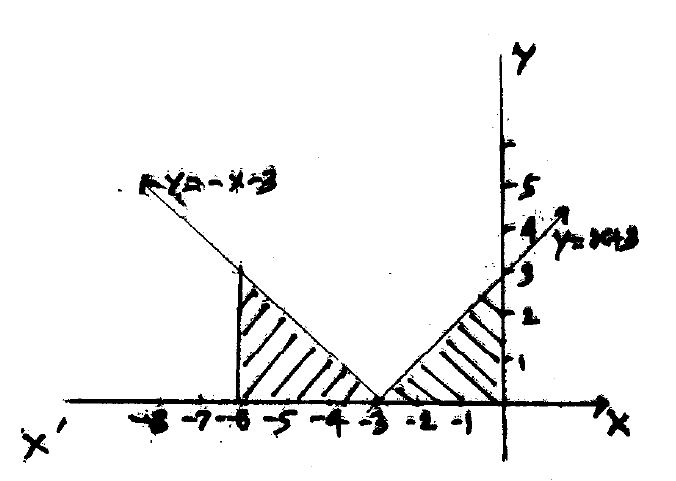
$\text{A}=\int\limits_{-6}^{-3}-\text{(x + 3)dx}+\int\limits_{-3}^{0}\text{(x + 3)dx}$
$\text{A}=\Bigg[-\frac{\text{(x + 3)}^{2}}{2}\Bigg]^{-3}_{-6}+\Bigg[\frac{\text{(x + 3)}^{2}}{2}\Bigg]^{0}_{-3}$
$=-0+\frac{9}{2}+\frac{9}{2}-0=9\text{ sq. U.}$ View full question & answer→Question 145 Marks
Find the area of the region included between the parabola $y^2 = x$ and the line$ x + y = 2.$
Answer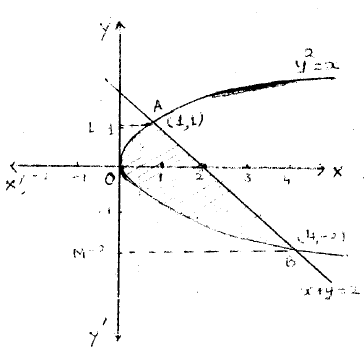
Finding points of intersection correctly
as $(y = 1, y = - 2)$
Required area
$\int\limits_{-2}^{1}{(2-\text{y})}\text{ dy}-\int\limits_{-2}^{1}\text{y}^{2}\text{ dy}$
$=\Bigg[\text{2y -}\frac{\text{y}^{2}}{2}\Bigg]_{-2}^{1}-\Bigg[\frac{\text{y}^{3}}{3}\Bigg]^{1}_{-2}$
$=\Bigg[\Big(2-\frac{1}{2}\Big)-(-4-2)\Bigg]-\Bigg[\frac{1}{3}+\frac{8}{3}\Bigg]$
$=\Bigg(6+\frac{3}{2}-3\Bigg)=\frac{9}{2}\text{sq. units}.$ View full question & answer→Question 155 Marks
Find the area of the region bounded by the parabolas $y^2 = 4ax$ and $x^2 = 4ay$.
Answer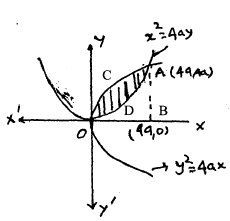
Point of intersection i.e. x = 4a
Area of shaded region
= Area of region OCABO
- Area of region ODABO
$=\int\limits_{0}^{4a}\sqrt{\text{4a x dx}}-\int\limits_{0}^{4a}\frac{\text{x}^{2}}{\text{4a}}\text{dx}$
=$\Bigg|2\sqrt{\text{a}}\cdot\frac{2}{3}\text{x}^{3/2}\Bigg|^{\text{4a}}_{0}-\frac{1}{4\text{a}}\Bigg[\frac{\text{x}^{3}}{3}\Bigg]^{\text{4a}}_{0}$
$=\frac{32}{3}\text{a}^{2}-\frac{16}{3}\text{a}^{2}=\frac{16}{3}\text{a}^{2}\text{ square units}.$ View full question & answer→Question 165 Marks
Find the angle of intersection of the curves $y^2=4 a x$ and $x^2=4 b y$.
AnswerEqn of given curves $y^2 = 4ax$ and $x^2 = 4by$ Their point of intersections are (0, 0) and $(4\text{a}^{1/3} \text{b}^{2/3}, \text{4a}^{2/3} \text{b}^{1/3})$
$\text{y}^{2} = \text{4ax} \Rightarrow \frac{\text{dy}}{\text{dx}}= \frac{2\text{a}}{\text{y}}, \text{slope} = \frac{\text{a}^{1/3}}{2\text{b}^{1/3}} \text{ }\text{ }\text{ }\text{ } \dots \text{(i)} $
$\text{x}^{2} = \text{4by} \Rightarrow \frac{\text{dy}}{\text{dx}} = \frac{\text{x}}{\text{2b}}, \text{slope} = \frac{\text{2a}^{1/3}}{\text{b}^{1/3}} \text{ }\text{ }\text{ }\text{ } \dots\text{(ii)}$ At (0, 0), angle between two curves is $90^\circ$ or
Acute angle q between (i) and (ii) is $\theta = \tan^{-1} \left\{\frac{3}{2} \bigg(\frac{\text{a}^{1/3} \text{b}^{1/3}}{\text{a}^{2/3} + \text{b}^{2/3}}\bigg)\right\}$
View full question & answer→Question 175 Marks
Using integration find the area of the region bounded by the curves $\text{y} = \sqrt{4 - \text{x}^{2}}, \text{x}^{2} + \text{y}^{2} \text{4x} = 0$ and the x-axis.
Answer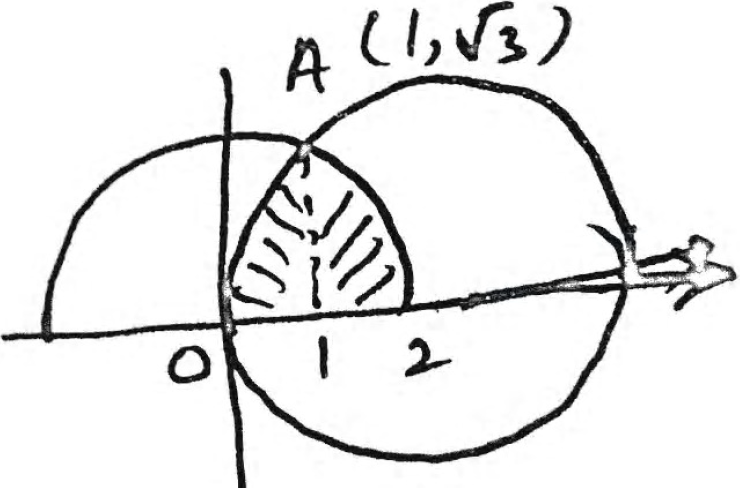
Their point of intersection $(1, \sqrt{3})$
Required Area $= \int\limits^{1}_{0}\sqrt{(2)^{2} - \text{x - 2)}^{2}} \text{dx} + \int\limits^{2}_{1} \sqrt{2^{2} - \text{x}^{2}} \text{dx}$
$= \bigg[\frac{\text{(x - 2) }\sqrt{4\text{x - x}^{2}}}{2} + 2 \sin^{-1} \frac{\text{x - 2}}{2} \bigg]^{1}_{0} + \bigg[\frac{\text{x} \sqrt{4 - \text{x}^{2}}}{2} + 2 \sin^{-1} \frac{\text{x}}{2} \bigg]^{2}_{1}$
$= \big(\frac{5\pi}{3} -\sqrt{3}\big) \text{ Sq. units}$ View full question & answer→Question 185 Marks
Find the angle of intersection of the curves $y^2 = 4ax$ and $x^2 = 4by.$
AnswerEqn of given curves $y^2 = 4ax$ and $x^2 = 4by$ Their point of intersections are $(0, 0)$ and $(4\text{a}^{1/3} \text{b}^{2/3}, \text{4a}^{2/3} \text{b}^{1/3})$
$\text{y}^{2} = \text{4ax} \Rightarrow \frac{\text{dy}}{\text{dx}}= \frac{2\text{a}}{\text{y}}, \text{slope} = \frac{\text{a}^{1/3}}{2\text{b}^{1/3}} \text{ }\text{ }\text{ }\text{ } \dots \text{(i)} $
$\text{x}^{2} = \text{4by} \Rightarrow \frac{\text{dy}}{\text{dx}} = \frac{\text{x}}{\text{2b}}, \text{slope} = \frac{\text{2a}^{1/3}}{\text{b}^{1/3}} \text{ }\text{ }\text{ }\text{ } \dots\text{(ii)}$
At (0, 0), angle between two curves is 90^\circ or
Acute angle q between (i) and (ii) is $\theta = \tan^{-1} \left\{\frac{3}{2} \bigg(\frac{\text{a}^{1/3} \text{b}^{1/3}}{\text{a}^{2/3} + \text{b}^{2/3}}\bigg)\right\}$
View full question & answer→Question 195 Marks
Using integration find the area of the region bounded by the curves $\text{y} = \sqrt{4 - \text{x}^{2}}, \text{x}^{2} + \text{y}^{2} \text{4x} = 0$ and the x-axis.
Answer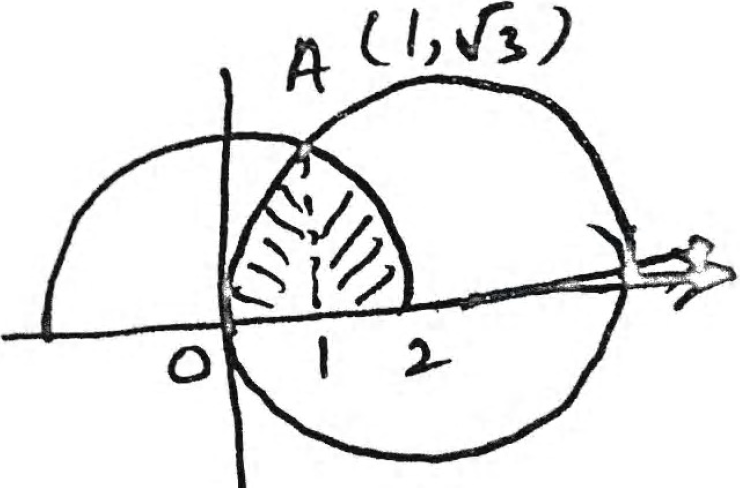
Their point of intersection $(1, \sqrt{3})$
Required Area $= \int\limits^{1}_{0}\sqrt{(2)^{2} - \text{x - 2)}^{2}} \text{dx} + \int\limits^{2}_{1} \sqrt{2^{2} - \text{x}^{2}} \text{dx}$
$= \bigg[\frac{\text{(x - 2) }\sqrt{4\text{x - x}^{2}}}{2} + 2 \sin^{-1} \frac{\text{x - 2}}{2} \bigg]^{1}_{0} + \bigg[\frac{\text{x} \sqrt{4 - \text{x}^{2}}}{2} + 2 \sin^{-1} \frac{\text{x}}{2} \bigg]^{2}_{1}$
$= \big(\frac{5\pi}{3} -\sqrt{3}\big) \text{ Sq. units}$ View full question & answer→Question 205 Marks
Find the angle of intersection of the curves $y^2 = 4ax$ and $x^2 = 4by.$
AnswerEqn of given curves $y^2 = 4ax$ and $x^2 = 4by$ Their point of intersections are (0, 0) and $(4\text{a}^{1/3} \text{b}^{2/3}, \text{4a}^{2/3} \text{b}^{1/3})$ $\text{y}^{2} = \text{4ax} \Rightarrow \frac{\text{dy}}{\text{dx}}= \frac{2\text{a}}{\text{y}}, \text{slope} = \frac{\text{a}^{1/3}}{2\text{b}^{1/3}} \text{ }\text{ }\text{ }\text{ } \dots \text{(i)} $ $\text{x}^{2} = \text{4by} \Rightarrow \frac{\text{dy}}{\text{dx}} = \frac{\text{x}}{\text{2b}}, \text{slope} = \frac{\text{2a}^{1/3}}{\text{b}^{1/3}} \text{ }\text{ }\text{ }\text{ } \dots\text{(ii)}$ At (0, 0), angle between two curves is 90°or
Acute angle q between (i) and (ii) is $\theta = \tan^{-1} \left\{\frac{3}{2} \bigg(\frac{\text{a}^{1/3} \text{b}^{1/3}}{\text{a}^{2/3} + \text{b}^{2/3}}\bigg)\right\}$
View full question & answer→Question 215 Marks
Using integration find the area of the region bounded by the curves $\text{y} = \sqrt{4 - \text{x}^{2}}, \text{x}^{2} + \text{y}^{2} \text{4x} = 0$ and the x-axis.
Answer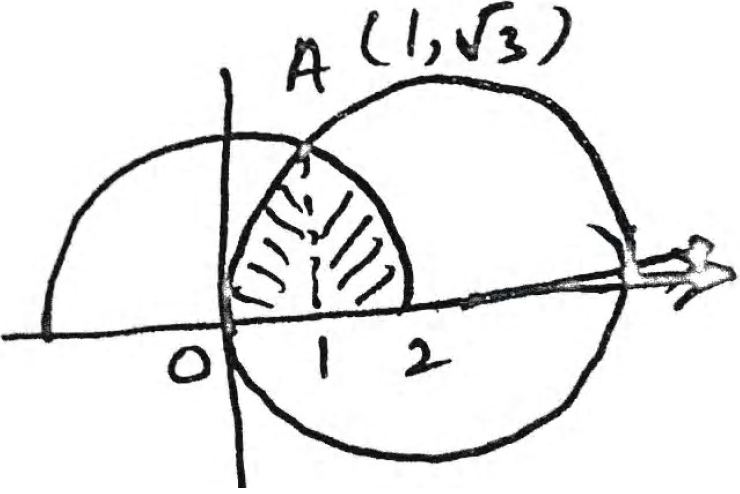
Their point of intersection $(1, \sqrt{3})$
Required Area $= \int\limits^{1}_{0}\sqrt{(2)^{2} - \text{x - 2)}^{2}} \text{dx} + \int\limits^{2}_{1} \sqrt{2^{2} - \text{x}^{2}} \text{dx}$
$= \bigg[\frac{\text{(x - 2) }\sqrt{4\text{x - x}^{2}}}{2} + 2 \sin^{-1} \frac{\text{x - 2}}{2} \bigg]^{1}_{0} + \bigg[\frac{\text{x} \sqrt{4 - \text{x}^{2}}}{2} + 2 \sin^{-1} \frac{\text{x}}{2} \bigg]^{2}_{1}$
$= \big(\frac{5\pi}{3} -\sqrt{3}\big) \text{ Sq. units}$ View full question & answer→Question 225 Marks
Using integration find the area of the region $\big\{\text{(x, y) : x}^{2} + \text{y}^{2} \leq 2\text{ax,y}^{2}\geq \text{ax, x, y}\geq 0.\big\}$
Answer$\text{y}^{2} = \text{ax, x}^{2} + \text{y}^{2} = \text{2ax} \Rightarrow\text{x}^{2} -\text{ax} = 0$ $\Rightarrow\text{x = 0, x = a}$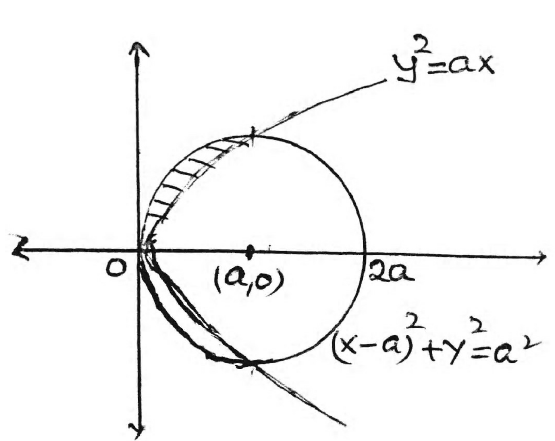
$\text{Shaded area} = \bigg[\int\limits^{\text{a}}_{0}[\sqrt{\text{a}^{2} - \text{(x - a)}^{2}} -\sqrt{\text{a}} \sqrt{\text{x}} ]\text{dx}$ $\text{A} = \bigg[\frac{\text{x - a}}{2}\sqrt{\text{a}^{2} - \text{(x - a)}^{2}} + \frac{\text{a}^{2}}{2} \sin^{-1} \frac{\text{x - a}}{\text{a}} -\sqrt{\text{a}} \frac{2}{3}\text{x}^{3/2}\bigg]^{\text{a}}_{0}$ $ \text= \bigg[-\frac{2}{3}\text{a}^{2}+ \frac{\text{a}^{2}}{2}\frac{\pi}{2}\bigg] = \frac{\pi\text{a}^{2}}{4} - \frac{2\text{a}^{2}}{3} \text{sq. units}$ View full question & answer→Question 235 Marks
Find the local maximum and local minima, of the function $\text{f(x)} = \sin x - \cos x, 0< x < 2\pi.$ Also find the local maximum and local minimum values.
Answer$\text{f(x)} = \sin x - \cos x, 0< x < 2\pi.$
$\text{f' (x) = 0} \Rightarrow \cos\text{x} + \sin \text{x} = \text{0 or} \tan \text{x} = -1, $
$\therefore \text{x} = 3\pi/4, \frac{7\pi}{4}$
$\text{f"(x)} = \cos\text{x}- \sin\text{x}$
$\text{f"} (3\pi/4) = -\frac{1}{\sqrt{2}} - \frac{1}{\sqrt{2}} \text{i.e. - ve so, x} = 3\pi/ \text{4 is Local Maxima}$
$\text{and f"} (7\pi/4) = -\frac{1}{\sqrt{2}} + \frac{1}{\sqrt{2}} \text{i.e + ve so, x} = 7\pi/ \text{4 is Local Minima }$
Local Maximum value = $\frac{1}{\sqrt{2}} + \frac{1}{\sqrt{2}} = \sqrt{2}$
Local Minimum value = $-\frac{1}{\sqrt{2}} - \frac{1}{\sqrt{2}} = \sqrt{2}$
View full question & answer→Question 245 Marks
Find the area of the region in the first quadrant enclosed by the x-axis, the line $y = x$ and the circle $x^2+ y^2 = 32.$
Answer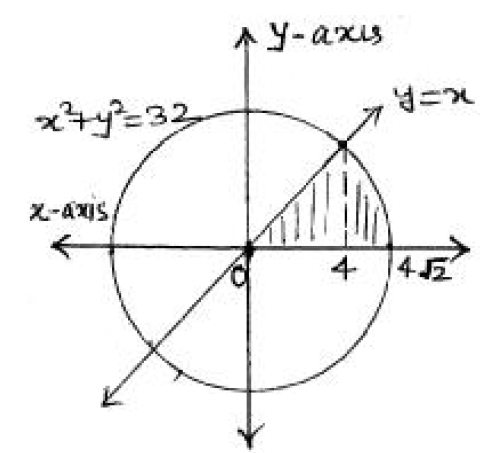
Correct Figure
The line and circle intersect
each other at x $ = \pm4$
Area of shaded region
$ = \int\limits_{0}^{4}\text{x dx} + \int\limits_{4}^{4\sqrt{2}}\sqrt{\big(4\sqrt{2}\big)^{2} - \text{x}^{2}}\text{dx}$
$ = \bigg[\frac{\text{x}^{2}}{2}\bigg]_{0}^{4} + \bigg[\left\{\frac{\text{x}\sqrt{32 - \text{x}^{2}}}{2} + 16 \sin^{-1}\bigg(\frac{\text{x}}{4\sqrt{2}}\bigg)\right\}\bigg]_{4}^{4\sqrt{2}}$
= 8 + 4$\pi$ – 8 = 4$\pi$ sq.units. View full question & answer→Question 255 Marks
Using integration find the area of the region $\big\{\text{(x, y) : x}^{2} + \text{y}^{2} \leq 2\text{ax,y}^{2}\geq \text{ax, x, y}\geq 0.\big\}$
Answer$\text{y}^{2} = \text{ax, x}^{2} + \text{y}^{2} = \text{2ax} \Rightarrow\text{x}^{2} -\text{ax} = 0$ $\Rightarrow\text{x = 0, x = a}$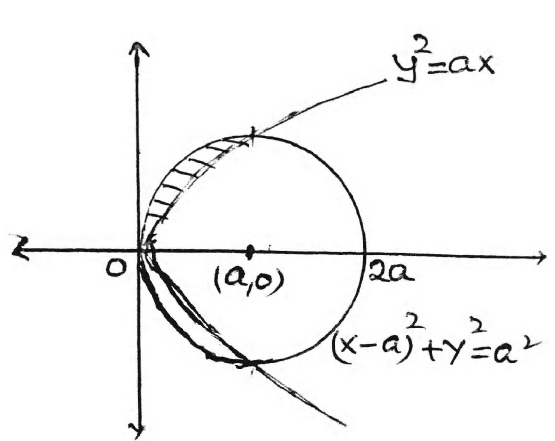
$\text{Shaded area} = \bigg[\int\limits^{\text{a}}_{0}[\sqrt{\text{a}^{2} - \text{(x - a)}^{2}} -\sqrt{\text{a}} \sqrt{\text{x}} ]\text{dx}$ $\text{A} = \bigg[\frac{\text{x - a}}{2}\sqrt{\text{a}^{2} - \text{(x - a)}^{2}} + \frac{\text{a}^{2}}{2} \sin^{-1} \frac{\text{x - a}}{\text{a}} -\sqrt{\text{a}} \frac{2}{3}\text{x}^{3/2}\bigg]^{\text{a}}_{0}$ $ \text= \bigg[-\frac{2}{3}\text{a}^{2}+ \frac{\text{a}^{2}}{2}\frac{\pi}{2}\bigg] = \frac{\pi\text{a}^{2}}{4} - \frac{2\text{a}^{2}}{3} \text{sq. units}$ View full question & answer→Question 265 Marks
Find the local maximum and local minima, of the function $\text{f(x)} = \sin x - \cos x, 0< x < 2\pi.$ Also find the local maximum and local minimum values.
Answer$\text{f(x)} = \sin x - \cos x, 0< x < 2\pi.$
$\text{f' (x) = 0} \Rightarrow \cos\text{x} + \sin \text{x} = \text{0 or} \tan \text{x} = -1, $
$\therefore \text{x} = 3\pi/4, \frac{7\pi}{4}$
$\text{f"(x)} = \cos\text{x}- \sin\text{x}$
$\text{f"} (3\pi/4) = -\frac{1}{\sqrt{2}} - \frac{1}{\sqrt{2}} \text{i.e. - ve so, x} = 3\pi/ \text{4 is Local Maxima}$
$\text{and f"} (7\pi/4) = -\frac{1}{\sqrt{2}} + \frac{1}{\sqrt{2}} \text{i.e + ve so, x} = 7\pi/ \text{4 is Local Minima }$
Local Maximum value = $\frac{1}{\sqrt{2}} + \frac{1}{\sqrt{2}} = \sqrt{2}$
Local Minimum value = $-\frac{1}{\sqrt{2}} - \frac{1}{\sqrt{2}} = \sqrt{2}$
View full question & answer→Question 275 Marks
Find the area of the region in the first quadrant enclosed by the x-axis, the line $y = x$ and the circle $x^2+ y^2 = 32.$
Answer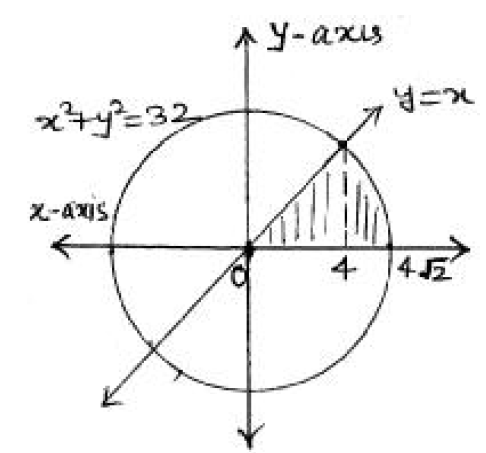
Correct Figure
The line and circle intersect
each other at x $ = \pm4$
Area of shaded region
$ = \int\limits_{0}^{4}\text{x dx} + \int\limits_{4}^{4\sqrt{2}}\sqrt{\big(4\sqrt{2}\big)^{2} - \text{x}^{2}}\text{dx}$
$ = \bigg[\frac{\text{x}^{2}}{2}\bigg]_{0}^{4} + \bigg[\left\{\frac{\text{x}\sqrt{32 - \text{x}^{2}}}{2} + 16 \sin^{-1}\bigg(\frac{\text{x}}{4\sqrt{2}}\bigg)\right\}\bigg]_{4}^{4\sqrt{2}}$
= 8 + 4$\pi$ – 8 = 4$\pi$ sq.units. View full question & answer→Question 285 Marks
Using integration find the area of the region $\big\{\text{(x, y) : x}^{2} + \text{y}^{2} \leq 2\text{ax,y}^{2}\geq \text{ax, x, y}\geq 0.\big\}$
Answer$\text{y}^{2} = \text{ax, x}^{2} + \text{y}^{2} = \text{2ax} \Rightarrow\text{x}^{2} -\text{ax} = 0$ $\Rightarrow\text{x = 0, x = a}$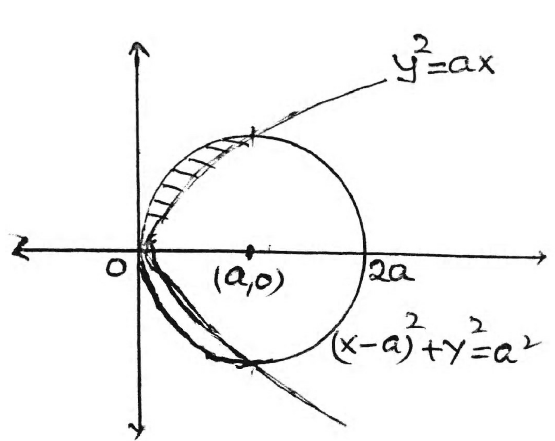
$\text{Shaded area} = \bigg[\int\limits^{\text{a}}_{0}[\sqrt{\text{a}^{2} - \text{(x - a)}^{2}} -\sqrt{\text{a}} \sqrt{\text{x}} ]\text{dx}$ $\text{A} = \bigg[\frac{\text{x - a}}{2}\sqrt{\text{a}^{2} - \text{(x - a)}^{2}} + \frac{\text{a}^{2}}{2} \sin^{-1} \frac{\text{x - a}}{\text{a}} -\sqrt{\text{a}} \frac{2}{3}\text{x}^{3/2}\bigg]^{\text{a}}_{0}$ $ \text= \bigg[-\frac{2}{3}\text{a}^{2}+ \frac{\text{a}^{2}}{2}\frac{\pi}{2}\bigg] = \frac{\pi\text{a}^{2}}{4} - \frac{2\text{a}^{2}}{3} \text{sq. units}$ View full question & answer→Question 295 Marks
Find the local maximum and local minima, of the function $\text{f(x)} = \sin x - \cos x, 0< x < 2\pi.$ Also find the local maximum and local minimum values.
Answer$\text{f(x)} = \sin x - \cos x, 0< x < 2\pi.$
$\text{f' (x) = 0} \Rightarrow \cos\text{x} + \sin \text{x} = \text{0 or} \tan \text{x} = -1, $
$\therefore \text{x} = 3\pi/4, \frac{7\pi}{4}$
$\text{f"(x)} = \cos\text{x}- \sin\text{x}$
$\text{f"} (3\pi/4) = -\frac{1}{\sqrt{2}} - \frac{1}{\sqrt{2}} \text{i.e. - ve so, x} = 3\pi/ \text{4 is Local Maxima}$
$\text{and f"} (7\pi/4) = -\frac{1}{\sqrt{2}} + \frac{1}{\sqrt{2}} \text{i.e + ve so, x} = 7\pi/ \text{4 is Local Minima }$
Local Maximum value = $\frac{1}{\sqrt{2}} + \frac{1}{\sqrt{2}} = \sqrt{2}$
Local Minimum value = $-\frac{1}{\sqrt{2}} - \frac{1}{\sqrt{2}} = \sqrt{2}$
View full question & answer→Question 305 Marks
Find the area of the region in the first quadrant enclosed by the x-axis, the line $y = x$ and the circle $x^2+ y^2 = 32$.
Answer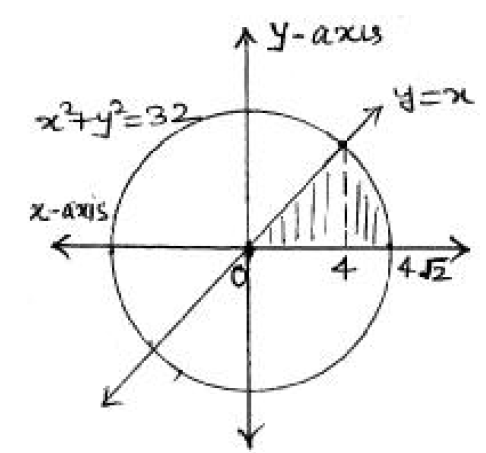
Correct Figure
The line and circle intersect
each other at x $ = \pm4$
Area of shaded region
$ = \int\limits_{0}^{4}\text{x dx} + \int\limits_{4}^{4\sqrt{2}}\sqrt{\big(4\sqrt{2}\big)^{2} - \text{x}^{2}}\text{dx}$
$ = \bigg[\frac{\text{x}^{2}}{2}\bigg]_{0}^{4} + \bigg[\left\{\frac{\text{x}\sqrt{32 - \text{x}^{2}}}{2} + 16 \sin^{-1}\bigg(\frac{\text{x}}{4\sqrt{2}}\bigg)\right\}\bigg]_{4}^{4\sqrt{2}}$
= 8 + 4$\pi$ – 8 = 4$\pi$ sq.units. View full question & answer→Question 315 Marks
Using the method of integration, find the area of the region bounded by the lines 3x – 2y + 1 = 0, 2x + 3y – 21 = 0 and x – 5y + 9 = 0.
AnswerLet AB be 3x – 2y + 1 = 0, BC be 2x + 3y – 21 = 0 and AC be x – 5y + 9 = 0
solving to get A(1, 2), B (3, 5) and C (6, 3)
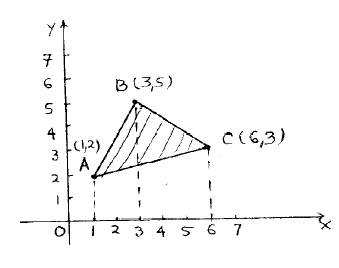
area ABC $=\frac{1}{2}\int\limits_1^3\text{(3x + 1) dx}+ \frac{1}{3}\int\limits_3^6\text{(21 - 2x) dx } -\frac{1}{5}\int\limits_1^6\text{(x + 9)}\text{dx}$
$=\frac{1}{2}\Bigg[\frac{\text{3x}^{2}}{{2}}+\text{x}\Bigg]^3_1+\frac{1}{3}\Big[\text{21x - x}^{2}\Big]^{6}_{3}-\frac{1}{5}\Bigg[\frac{\text{x}^{2}}{\text{2}}+{\text{9x}}\Bigg]^{6}_{1}$
$=\frac{1}{2}\Bigg[\frac{27}{3}+3-\frac{3}{2}-1\Bigg]+\frac{1}{3}[126-36-63+9]-\frac{1}{5}\Bigg[18+54-\frac{1}{2}-9\Bigg]$
$ =\frac{1}{2}[14]+\frac{1}{3}[36]-\frac{1}{5}\Bigg[\frac{125}{2}\Bigg]$
$ =\frac{1}{2}[14]+\frac{1}{3}[36]-\frac{25}{2}$
$=7+12-\frac{25}{2}=19-\frac{25}{2}=\frac{38-25}{2}=\frac{13}{2}\text{sq. units}$. View full question & answer→Question 325 Marks
Using integration find the area of the triangular region whose sides have equations y = 2x + 1, y = 3x + 1 and x = 4.
Answer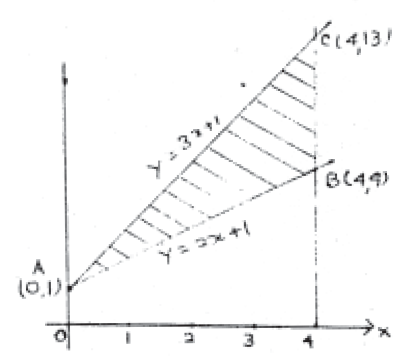
Getting the points of intersection as
A(0,1),B(4, 9) and C(4,13)
Area $\Delta$ ABC = $\int\limits_0^4\text{x}\text{(3x + 1)}\text{dx}-\int\limits_0^4\text{(2x + 1)}\text{dx}$
$=\int\limits_0^4\text{x dx}=\Bigg[\frac{\text{x}^{2}}{\text{2}}\Bigg]^4_0=8\text{sq. units}$. View full question & answer→Question 335 Marks
Show that of all the rectangles inscribed in a given fixed circle, the square has the maximum area.
AnswerLet ABCD be the rectangle of maximum area inscribed in a circle of radius r. For figure If $AB = x$ and $BC = y$, then $x^2 + y^2 = 4r^2$
$\Rightarrow y^2 = 4r^2 - x^2$ and area $(A) = xy$ let $S = x^2y^2 = x^2 (4r^2 - x^2) = 4r^2x^2 - x^4$
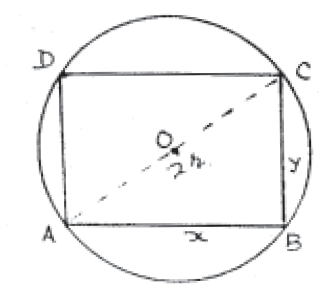
$\frac{\text{ds}}{\text{dx}}=0\Rightarrow\text{8r}^{2}\text{x-4x}^{3}=0$
$\Rightarrow\text{x}^{2}=\text{2r}^{2}\Rightarrow\text{x}=\sqrt{2}\text{ r}$
$\frac{\text{d}^{2}\text{s}}{\text{dx}^{2}}=\text{16r}^{2}-\text{12x}^{2}=\text{16r}^{2}-12\text{(2r}^{2})\text{2r}^{2}=-8\text{r}^{2}<0$
$\therefore$ For maximum area x = $\sqrt{2}\text{ r}\text{ and y}=\sqrt{\text{4r}^{2}-2\text{r}^{2}}=\sqrt{2}\text{ r}$ $\therefore$ Square has the maximum area. View full question & answer→Question 345 Marks
Using the method of integration, find the area of the region bounded by the lines
$\text{2x + y = 4, 3x - 2y = 6 and x -3y + 5 = 0}$
AnswerGetting the points of intersection, as (2, 0), (4, 3) and (1, 2)
Correct Figure
$\text{Equation of AB is 2x + y = 4}$
$\text{Equation of AC is x - 3y + 5 = 0}$
$\text{Equation of BC is 3x - 2y = 6}$
$\text{ar} \triangle \text{ABC} = \int\limits^{4}_{1} \frac{1}{3} ( \text{x + 5) dx} + \int\limits^{2}_{1} 2 (2-\text{x) dx}- \int\limits^{4}_{2} \frac{1}{2} (\text{3x - 6) dx}$
$= \bigg[\frac{1}{3} \frac{(\text{x} + 5)^{2}}{2}\bigg]^{4}_{1} + \bigg[(2 - \text{x})^{2}\bigg]^{2}_{1} - \frac{3}{2} \bigg[\frac{(x - 2)^{2}}{2}\bigg]^{4}_{2}$
$= \frac{15}{2} - 1 - 3 = \frac{7}{2} \text{sq. U.}$
View full question & answer→Question 355 Marks
Find the equation of tangent to the curve $x = \sin 3_{t}, y = \cos 2_{t}, \text{at, t} = \frac{\pi}{4} $
Answer$\text{x} = \sin 3_{t} \Rightarrow \frac{dx}{dt} = 3 \cos 3t, (x)_{t} = \frac{\pi} {4} = \frac{1}{\sqrt{2}}, (y)_{t} = \frac{\pi}{4} = 0 $$\text{y} = \cos \text{2t} \Rightarrow \frac{\text{dy}}{\text{dt}} = -2 \sin \text{2t}$
$\therefore \frac{\text{dy}}{\text{dx}} = \frac{-2}{3} \frac{\sin\text{2 t}}{\cos \text{3 t}}$
$\bigg(\frac{\text{dy}}{\text{dx}}\bigg)_{t =\frac{\pi}{4}} = \frac{-2}{3} \frac{\sin\frac{\pi}{2}}{\cos 3 \frac{\pi}{4}} $
$= \frac{2\sqrt{2}}{3}$
$\therefore \text{Equation of tangent is y} - 0 = \frac{2\sqrt{2}}{3} \bigg(x - \frac{1}{\sqrt{2}}\bigg)$
$3 y = 2\sqrt{{2}}$ $x - 2$
$\text{or 3y} - 2\sqrt{2} $ $\text{x + 2} = 0$
View full question & answer→Question 365 Marks
Using integration find the are of the region bounded by the parabola $y^{2} ={4x}$ and the circle $4x^{2} + 4y^{2} = 9$
Answer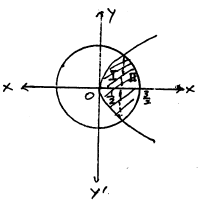 Correct figure
Point of intersection, $x = \frac{1}{2}$
The required area $= \text{I + II}$
$= 2 \int\limits_0^\frac{1}{2} 2\sqrt{x}$ $\text{dx} +2 \int\limits_\frac{1}{2}^\frac{3}{2} \sqrt{\frac{9}{4}} - x^{2} dx$
$= 2 \bigg| 2. \frac{2}{3} x^\frac{3}{2}\bigg|^{\frac{1}{2}}_{0} + \Bigg| \frac{\frac{x \sqrt{9}}{4} - x^{2}}{2}\Bigg| + \frac{9}{8} \sin^{-1} \frac{\frac{x}{3}}{2}\Bigg|^\frac{3}{2}_\frac{1}{2}$
$= \frac{2\sqrt{2}}{3} - \frac{\sqrt{2}}{2} + \frac{9 \pi}{8} - \frac{9}{4} \sin^{-1} \frac{1}{3}$ View full question & answer→Question 375 Marks
Using integration, find the area of the region in the first quadrant enclosed by the x-axis, the line $y = x$ and the circle $x^2 + y^2 = 32$.
Answer$\text{x}^2+\text{y}^2=32$
$\text{x}^2+\text{y}^2=\big(\sqrt{32}\big)^2=\big(4\sqrt{2}\big)^2$
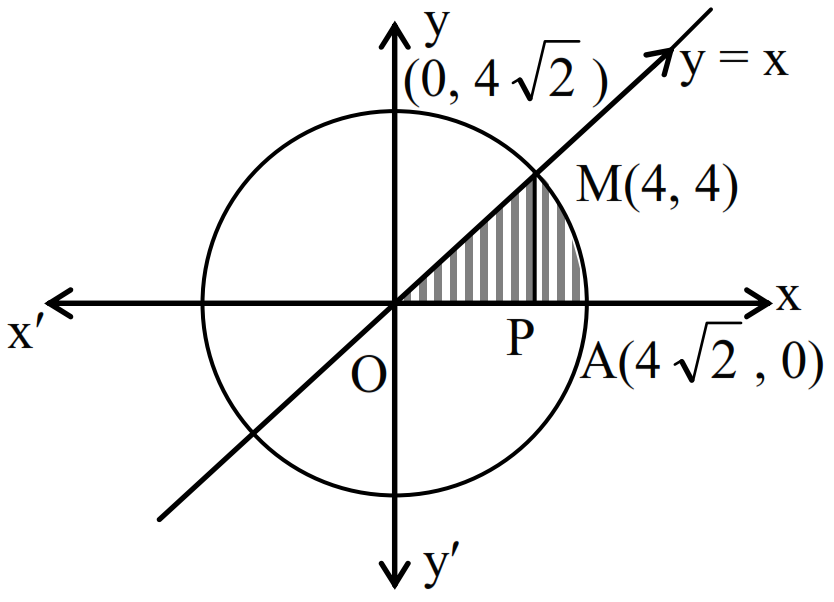
For coordinate of M put y = x in $\text{x}^2+\text{y}^2=32$
$2\text{x}^2=32$
$\text{x}^2=16$
$\text{x}^2=\pm4$ M(4, 4) = area of OMA = area OMP + area MPA $\int\limits_0^4\text{y}^1\text{dx}+\int\limits_4^{4\sqrt{2}}\text{y}_2\text{dx}$
$\int\limits_0^4\text{x dx}+\int\limits_4^{4\sqrt{2}}\sqrt{\big(4\sqrt{2}\big)^2-\text{x}^2\text{dx}}$
$=\Big(\frac{\text{x}^2}{2}\Big)_0^4+\Bigg[\frac{\text{x}}{2}\sqrt{\big(4\sqrt{2}\big)^2-\text{x}^2}+\frac{\big(4\sqrt{2}\big)^2}{2}\sin^{-1}\Big(\frac{\text{x}}{4\sqrt{2}}\Big)\Bigg]_4^{4\sqrt{2}}$
$=\frac{16}{2}+\bigg(\frac{4\sqrt{2}}{2}\sqrt{\big(4\sqrt{2}\big)^2-\big(4\sqrt{2}\big)^2}+\frac{32}{2}\sin^{-1}1\bigg)$
$-\bigg(\frac{4}{2}\sqrt{\big(4\sqrt{2}\big)^2-4^2}+\frac{32}{2}\sin^{-1}\frac{1}{\sqrt{2}}\bigg)$
$=8+\Big(2\sqrt{2}(0)+16\times\frac{\pi}{2}\Big)-\Big(2\times4+16\times\frac{\pi}{4}\Big)$
$=8+8\pi-8-4\pi$
$=4\pi$ View full question & answer→Question 385 Marks
Using integration, find the area of the region in the first quadrant enclosed by the x-axis, the line $y = x$ and the circle $x^2 + y^2 = 32$.
Answer$\text{x}^2+\text{y}^2=32$
$\text{x}^2+\text{y}^2=\big(\sqrt{32}\big)^2=\big(4\sqrt{2}\big)^2$
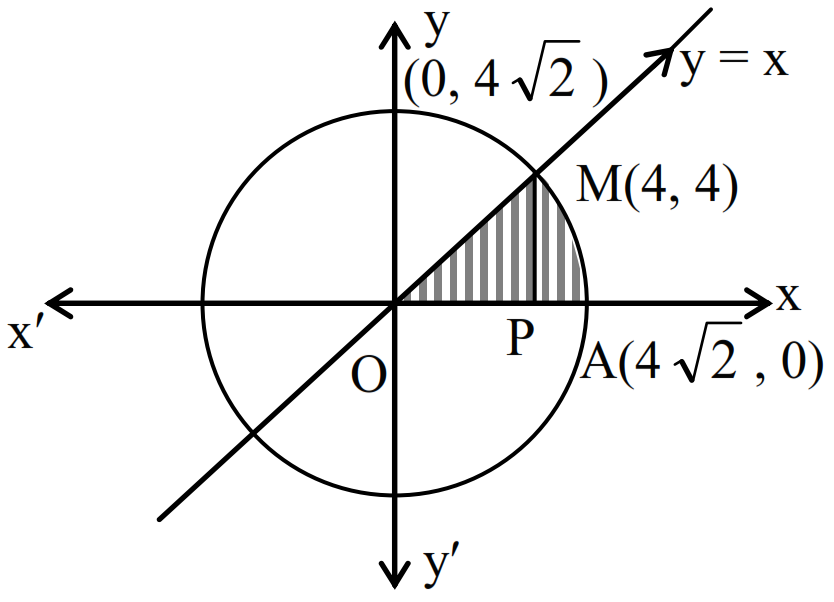
For coordinate of M put y = x in $\text{x}^2+\text{y}^2=32$
$2\text{x}^2=32$
$\text{x}^2=16$
$\text{x}^2=\pm4$ M(4, 4) = area of OMA = area OMP + area MPA $\int\limits_0^4\text{y}^1\text{dx}+\int\limits_4^{4\sqrt{2}}\text{y}_2\text{dx}$
$\int\limits_0^4\text{x dx}+\int\limits_4^{4\sqrt{2}}\sqrt{\big(4\sqrt{2}\big)^2-\text{x}^2\text{dx}}$
$=\Big(\frac{\text{x}^2}{2}\Big)_0^4+\Bigg[\frac{\text{x}}{2}\sqrt{\big(4\sqrt{2}\big)^2-\text{x}^2}+\frac{\big(4\sqrt{2}\big)^2}{2}\sin^{-1}\Big(\frac{\text{x}}{4\sqrt{2}}\Big)\Bigg]_4^{4\sqrt{2}}$
$=\frac{16}{2}+\bigg(\frac{4\sqrt{2}}{2}\sqrt{\big(4\sqrt{2}\big)^2-\big(4\sqrt{2}\big)^2}+\frac{32}{2}\sin^{-1}1\bigg)$
$-\bigg(\frac{4}{2}\sqrt{\big(4\sqrt{2}\big)^2-4^2}+\frac{32}{2}\sin^{-1}\frac{1}{\sqrt{2}}\bigg)$
$=8+\Big(2\sqrt{2}(0)+16\times\frac{\pi}{2}\Big)-\Big(2\times4+16\times\frac{\pi}{4}\Big)$
$=8+8\pi-8-4\pi$
$=4\pi$ View full question & answer→Question 395 Marks
Using integration, find the area of the region in the first quadrant enclosed by the x-axis, the line $y = x$ and the circle $x^2 + y^2 = 32$.
Answer$\text{x}^2+\text{y}^2=32$
$\text{x}^2+\text{y}^2=\big(\sqrt{32}\big)^2=\big(4\sqrt{2}\big)^2$
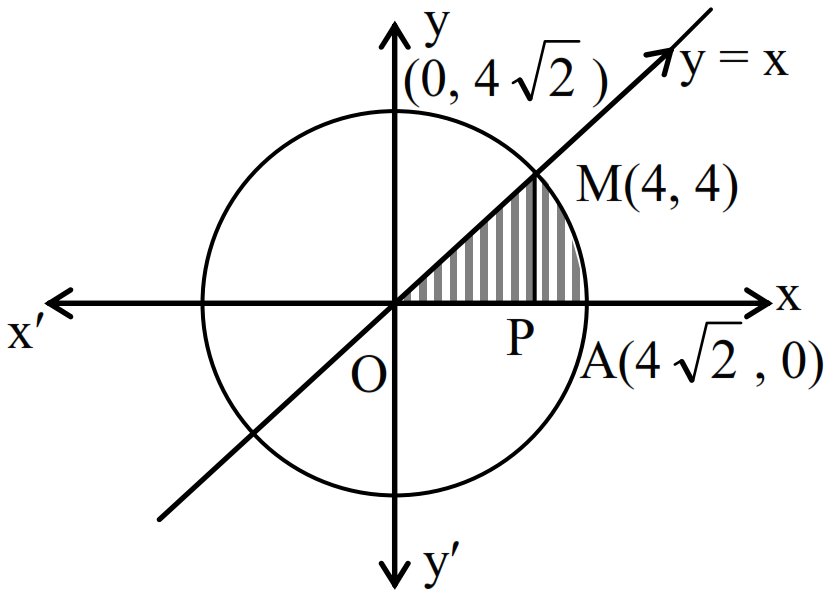
For coordinate of M put y = x in $\text{x}^2+\text{y}^2=32$
$2\text{x}^2=32$
$\text{x}^2=16$
$\text{x}^2=\pm4$ M(4, 4) = area of OMA = area OMP + area MPA $\int\limits_0^4\text{y}_1\text{dx}+\int\limits_4^{4\sqrt{2}}\text{y}_2\text{dx}$
$\int\limits_0^4\text{x dx}+\int\limits_4^{4\sqrt{2}}\sqrt{\big(4\sqrt{2}\big)^2-\text{x}^2\text{dx}}$
$=\Big(\frac{\text{x}^2}{2}\Big)_0^4+\Bigg[\frac{\text{x}}{2}\sqrt{\big(4\sqrt{2}\big)^2-\text{x}^2}+\frac{\big(4\sqrt{2}\big)^2}{2}\sin^{-1}\Big(\frac{\text{x}}{4\sqrt{2}}\Big)\Bigg]_4^{4\sqrt{2}}$
$=\frac{16}{2}+\bigg(\frac{4\sqrt{2}}{2}\sqrt{\big(4\sqrt{2}\big)^2-\big(4\sqrt{2}\big)^2}+\frac{32}{2}\sin^{-1}1\bigg)$
$-\bigg(\frac{4}{2}\sqrt{\big(4\sqrt{2}\big)^2-4^2}+\frac{32}{2}\sin^{-1}\frac{1}{\sqrt{2}}\bigg)$
$=8+\Big(2\sqrt{2}(0)+16\times\frac{\pi}{2}\Big)-\Big(2\times4+16\times\frac{\pi}{4}\Big)$
$=8+8\pi-8-4\pi$
$=4\pi$ View full question & answer→Question 405 Marks
Using integration, find the area of the region enclosed by the parabola $y = 3x^2$ and the line $3x - y + 6 = 0$.
Answer$y = 3x^2 3x - y + 6 $
$= 0 3x - 3x^2 + 6 $
$= 0 x - x^2 + 2 $
$= 0 x^2 - x - 2 = 0 x^2 - 2x + x - 2$
$= 0 x(x - 2) + 1(x - 2)$
$= 0 (x + 1)(x - 2) $
$= 0 x $
$= +2, -1$
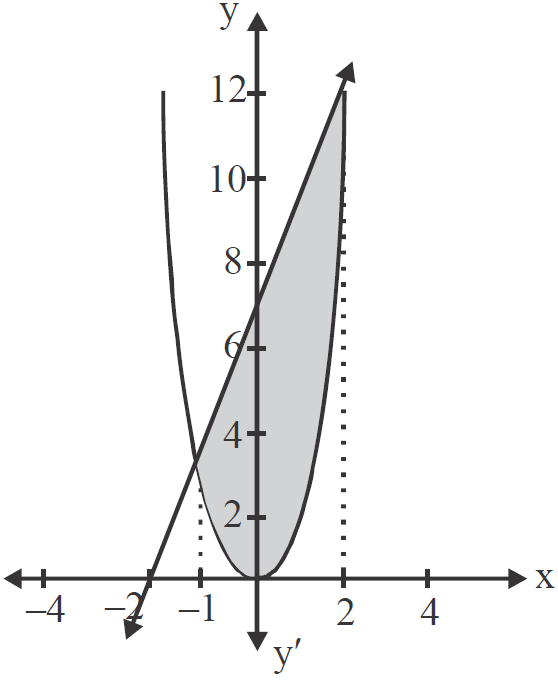
Required area, $=\int\limits^2_{-1}3(\text{x}+2)\text{dx}-3\int\limits^2_{-1}\text{x}^2\text{dx}$ $=\frac{3}{2}\big[(\text{x}+2)^2\big]^2_{-1}-\big[\text{x}^3\big]^2_{-1}$ $=\frac{3}{2}\times15-9=\frac{27}{2}$ View full question & answer→Question 415 Marks
Using integration, find the area of the region $\{(\text{x},\text{y}):\text{x}^2+\text{y}^2\leq9,\text{x}+\text{y}\geq3\}.$
AnswerGiven, $\{(\text{x},\text{y}):\text{x}^2+\text{y}^2\leq9,\text{x}+\text{y}\geq3\}$ $\text{x}^2+\text{y}^2\leq9$ $\text{x}^2+\text{y}^2=9$ $\text{y}=\sqrt{9-\text{x}^2}\ \dots(1)$ $\text{x}+\text{y}\geq3$ $\text{x}+\text{y}=3$ $\text{y}=3-\text{x}\ \dots(2)$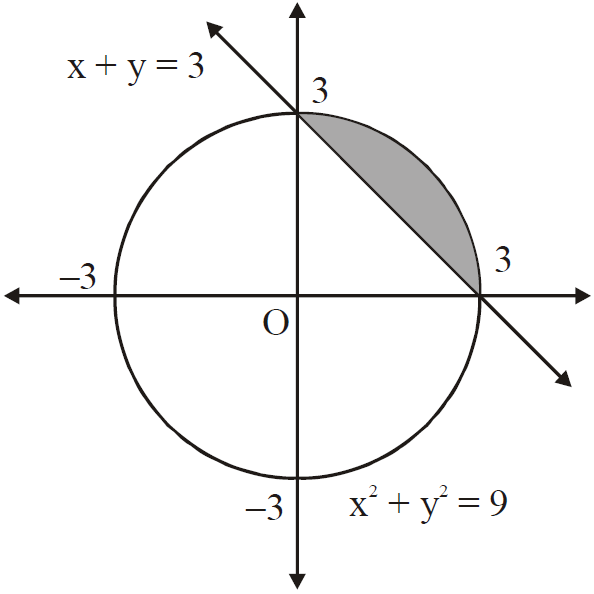
By Using Eq. (1) & (2) Required area $=\int\limits^3_0\sqrt{9-\text{x}^2}\text{dx}-\int\limits^3_0(3-\text{x})\text{dx}$ $=\frac{\text{x}}{2}\sqrt{9-\text{x}^2}+\frac{9}{2}\sin^{-1}\Big(\frac{\text{x}}{3}\Big)\Big]^3_0+\frac{1}{2}(3-\text{x})^2\Big]^3_0$ $=\frac{9\pi}{4}-\frac{9}{2}$ or $\frac{9}{4}(\pi-2)$ View full question & answer→Question 425 Marks
Using integration, find the area of the region bounded by the triangle whose vertices are (2, –2), (4, 5) and (6, 2).
Answeryet A = (2 - 2)
B = (4, 5)
C = (6, 2)
We have to find the area of $\triangle\text{ABC}$
Equation of line AB $\text{y}-5=\Big(\frac{-2-5}{2-4}\Big)(\text{x}-4)$
$\text{y}-5=\frac72(\text{x}-4)$
$2\text{y}-10=7\text{x}-28$
$\text{7x}-2\text{y}=-10+28$
$\text{7x}-2\text{y}=18\dots(\text{i})$
Equation of line BC $\text{y}-2=\Big(\frac{5-2}{4-6}\Big)(\text{x}-6)$
$-2\text{y}+4=3\text{x}-18$
$4+18=3\text{x}+\text{2y}$
$\text{3x}+\text{2y}=22\dots{\text{(ii)}}$
Equation of line AC $\text{y}-2=\frac{-2-2}{2-6}(\text{x}-6)$
$\text{y}-2=\frac{-4}{-4}(\text{x}-6)$
$\text{y}-2=\text{x}-6$
$\text{x}-\text{y}=-2+6$
$\text{x}-\text{y}=4\dots(\text{iii})$
So the required are:
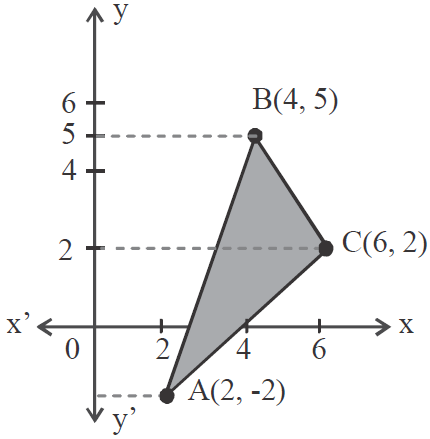
$\text{ar}(\triangle\text{ABC})=\int_\limits{2}^{2} (\text{y}+4)\text{dy}+\Big(\frac{-2}{3}\Big)\\\int_\limits{2}^{5}(\text{y}-11)\text{dy}-\int_\limits{-2}^{5}\frac27(\text{y}+9)\text{dy}$
$=\frac12\Big[(\text{y}+4)^2\Big]^2_{-2}-\frac13\Big[(\text{y}-11)^2\Big]^5_{2}-\frac17\Big[(\text{y}+9)^2\Big]^5_{-2}$
$=16+15-21=10.$ View full question & answer→Question 435 Marks
Find the area of the region common to the parabolas $4y^2= 9x$ and $3x^2= 16y$.
Answer
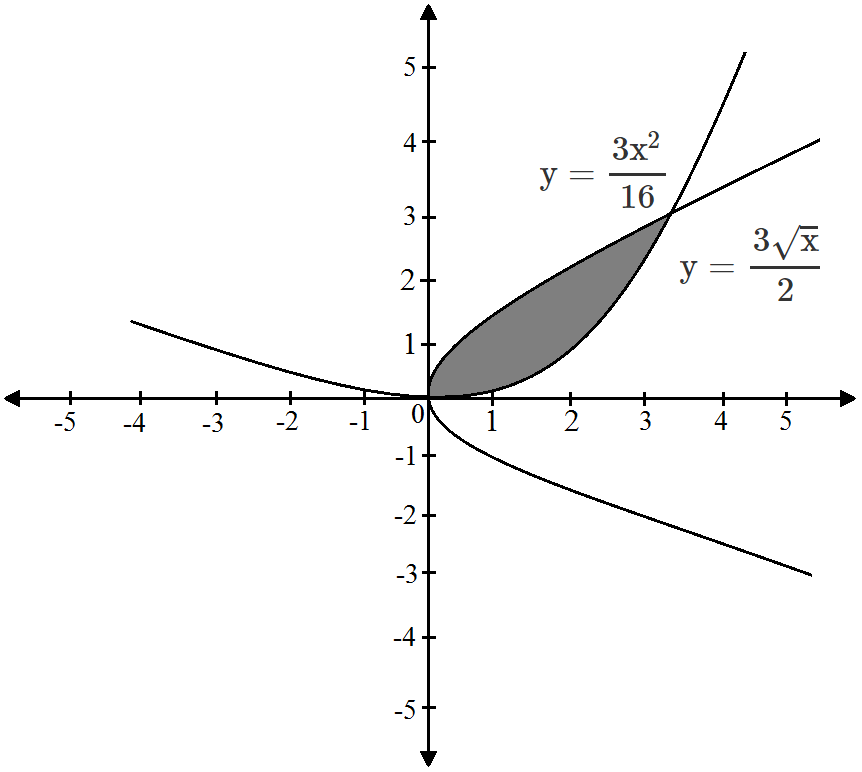
Area of the region $=\int\limits_{0}^{4}\Big[\frac{3\sqrt{\text{x}}}{2}-\frac{3\text{x}^{2}}{16}\Big]\text{dx} $
$=\Big[\text{x}^\frac{3}{2}-\frac{\text{x}^{3}}{16}\Big]^{4}_{0}$
$=\Big[\text{4}^\frac{3}{2}-\frac{\text{4}^{3}}{16}\Big]$
$=\Big[\text{8}-\frac{64}{16}\Big]$
$=[8-4]$
$=4\ \text{sq.}\ \text{units}$ View full question & answer→Question 445 Marks
Using the method of integration find the area bounded by the curve |x| + |y| = 1
[Hint: the required region is bounded by lines x + y = 1, x - y = 1, -x + y = 1 and -x - y = 11]
AnswerThe are bounded by the curve, |x| + |y| = 1, is represented by the shaded region ADCB as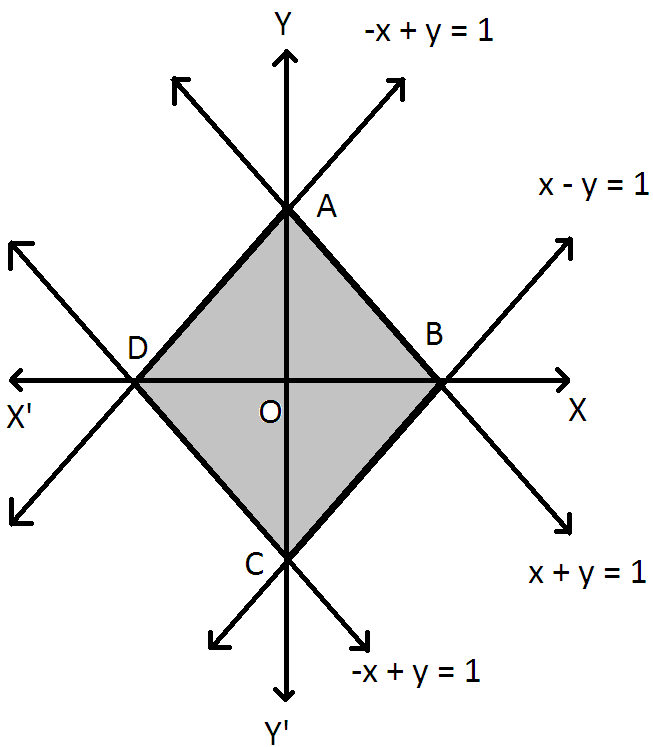
The curve intersects the axes at points A(0, 1), B(1, 0), C(0, -1), and D(-1, 0). $\therefore\text{Area ADCB}=4\times\text{Area OBAO}$ $=4\int\limits^1_0(1-\text{x})\text{dx}$ $=4\Big(\text{x}-\frac{\text{x}^2}{2}\Big)^1_0$ $=4\Big[1-\frac12\Big]$ $=4\Big(\frac12\Big)$ $=2\text{ units}.$ View full question & answer→Question 455 Marks
Find the area of region bounded by the triangle whose vertices are (-1, 1), (0, 5) and (3, 2), using integration.
AnswerWe have vertices of $\triangle\text{ABC}$ as A(-1, 1), B(0, 5) and C(3, 2)
$\therefore$ Equation of AB is y - 1 $=\Big(\frac{5-1}{0+1}\Big)(\text{x}+1)$
$\Rightarrow\ \text{y}-1=4\text{x}+4$
$\Rightarrow\ \text{y}=4\text{x}+5$
Equation of BC is y - 5 $=\Big(\frac{2-5}{3-0}\Big)(\text{x}-0)$
$\Rightarrow\ \text{y}-5=-\text{x}$
$\Rightarrow\ \text{y}=5-\text{x}$
Equation of line AC is y - 1 $=\Big(\frac{2-1}{3+1}\Big)(\text{x}+1)$
$\Rightarrow\ \text{y}-1=\frac{1}{4}(\text{x}+1)$
$\Rightarrow\ 4\text{y}=\text{x}+5$
Now see the solution of q. no. 21
View full question & answer→Question 465 Marks
Find the area of the smaller region bounded by the ellipse $\frac{\text{x}^2}{9}+\frac{\text{y}^2}{4}=1$ and the line $\frac{\text{x}}{3}+\frac{\text{y}}{2}=1.$
AnswerThe area of the smaller region bounded by the ellipse, $\frac{\text{x}^2}{9}+\frac{\text{y}^2}{4}=1,$ and the line, $\frac{\text{x}}{3}+\frac{\text{y}}{2}=1,$ is represented by the shaded region BCAB as
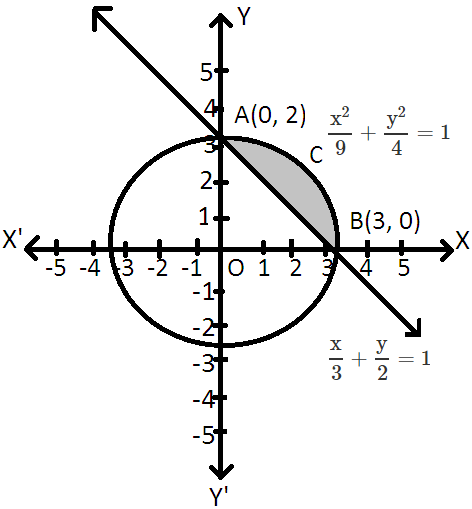
$\therefore$ Area BCAB = Area (OBCAO) - Area (OBAO)
$=\int\limits^3_02\sqrt{1-\frac{\text{x}^2}{9}}\text{dx}-\int\limits^3_02\Big(1-\frac{\text{x}}{3}\Big)\text{dx}$
$=\frac23\Bigg[\int\limits^3_0\sqrt{9-\text{x}^2}\text{ dx}\Bigg]-\frac23\int\limits^3_0(3-\text{x})\text{dx}$
$=\frac23\bigg[\frac{\text{x}}{2}\sqrt{9-\text{x}^2}+\frac92\sin^{-1}\frac{\text{x}}{3}\bigg]^3_0-\frac23\bigg[3\text{x}-\frac{\text{x}^2}{2}\bigg]^3_0$
$=\frac23\bigg[\frac92\Big(\frac{\pi}{2}\Big)\bigg]-\frac23\bigg[9-\frac92\bigg]$
$=\frac23\Big[\frac{9\pi}{4}-\frac92\Big]$
$=\frac23\times\frac94(\pi-2)$
$=\frac32(\pi-2)\text{ units}.$ View full question & answer→Question 475 Marks
find the area of the region bounded by y = |x - 1| and y = 1.
AnswerTo find area bounded by y = 1 and
y = |x - 1|
$\text{y}=\begin{cases}\text{x}-1 & \text{x} > 0\ ....(\text{i})\\1-\text{x} & \text{x} < 0\ ...(\text{ii})\end{cases}$
A rough sketch of the curve is as under:
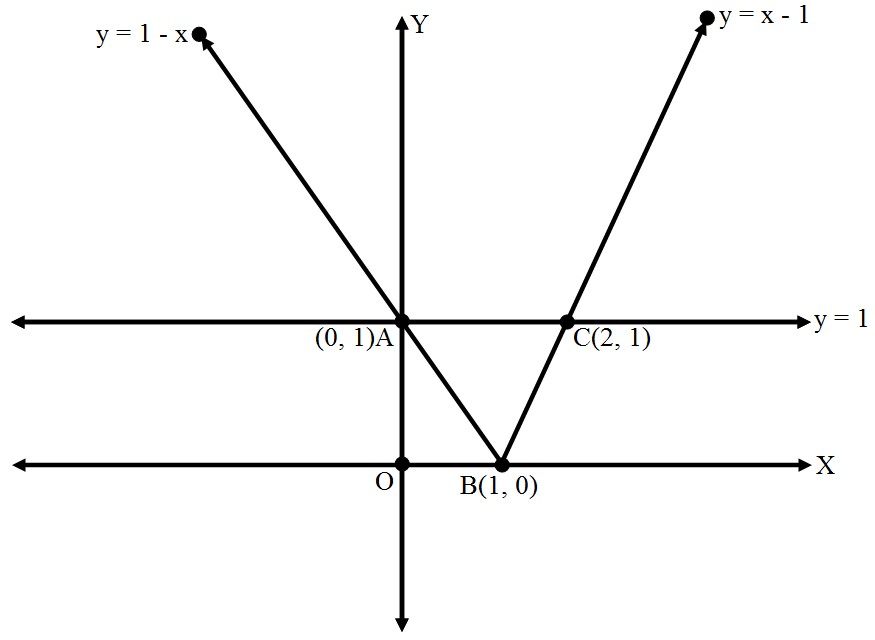
Requried area = Region ABCA
$=\int\limits_{0}^{1}(\text{y}_{1}-\text{y}_{2})\text{ dx}+ \int\limits_{1}^{2}(\text{y}_{1}-\text{y}_{3})\text{ dx}$
$=\int\limits_{0}^{1}(1-1+\text{x})\text{ dx}+ \int\limits_{1}^{2}(1-\text{x}+1)\text{ dx}$
$=\Big(\frac{\text{x}^{2}}{2}\Big)^{1}_{0}+\Big(2\text{x}-\frac{\text{x}^{2}}{2}\Big)^{2}_{1}$
$=\frac{1}{2}+\Big(2-2+\frac{1}{2}\big)$
$\text{A}=1\ \text{sq.}\ \text{units}$ View full question & answer→Question 485 Marks
using interation, find the area of the region bounded by the triangle ABC vertices A, B, C are (-1, 1), (0, 5) and (3, 2) respectivrly.
Answer
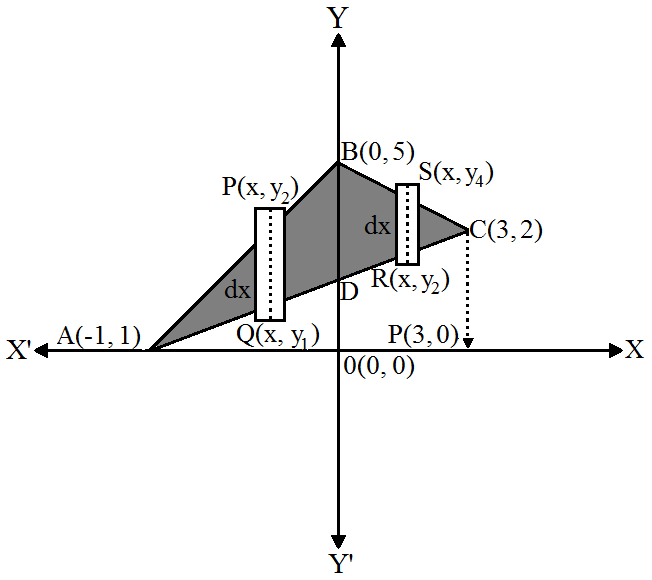 Equation of line AB is $\text{y}-1=\Big(\frac{5-1}{9+1}\Big)(\text{x}-(-1))$
$\Rightarrow\text{y}=4\text{x}+5$
Area under the line AB = area ABDO
$=\int\limits_{-1}^{0} (4\text{x}+5)\text{dx}$
$\Big[4\frac{\text{x}^{2}}{2}+5\text{x}\Big]^{0}_{-1}$
$=0-(2-5)$
⇒ Area ABDO = 3 sq. units ...(i)
Equation of line BC is
$\text{y}-5=\Big(\frac{2-5}{3-0}\Big)$
$\Rightarrow\text{y}=-\text{x}+5$
$=\Big[-\frac{\text{x}^{2}}{2}+5\text{x}\Big]^{3}_{0}$
$=-\frac{9}{2}+15-0$
⇒ Area OBCP $=\frac{21}{2} \ \text{sq.}\ \text{units}\ ...(\text{ii})$
Equation of line CA is
$\text{y}-2=\Big(\frac{2-1}{3-(-1)}\Big)(\text{x}-3)$
$\Rightarrow 4\text{y}=\text{x}+5$
Area under alinr AC = Area ACPA
$\Rightarrow\text{A}=\int\limits_{-1}^{3}\Big[\frac{\text{x}+5}{4}\Big]\text{dx}$
$\Rightarrow\text{A}=\frac{1}{4}\Big[\frac{\text{x}}{2}+5\text{x}\Big]\text{dx}$
$\Rightarrow\text{A}=\frac{1}{4}\Big[\frac{\text{9}}{2}+15-\frac{1}{2}+5\Big]$
Area ACPA $=\frac{24}{2}=6\ \text{sq.}\ \text{units}\ ... (\text{iii})$
Area from (i), (ii) and (iii)
$\Rightarrow\text{A}=\frac{21}{2}-3=\frac{21-6}{2}$
$\frac{15}{2}\ \text{sq.}\ \text{units}$ View full question & answer→Question 495 Marks
Find the area of the region between the circles $x^2 + y^2 = 4$ and $(x - 2)^2 + y^2 = 4$.
Answer
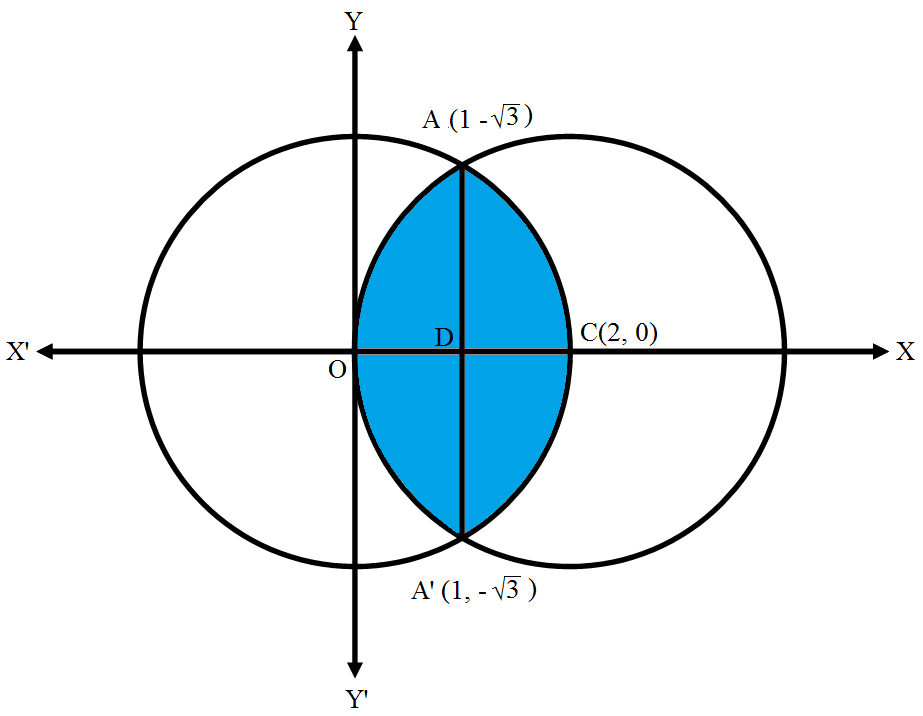
The given circles are,
$x^2 + y^2= 4$ ...(i)
$(x - 2)^2 + y^2= 4$ ...(ii)
Equation (i) represents a parabola with vertex 0 at origin and axis as x-axis and equation (ii) represents a C(2, 0) line parallel to y-axis radius , So the circle and (i), (ii) we have
$(x - 2)^2+ y^2 = x^2 + y^2$
$x^2 - 4x + 4 + y^2 = x^2+ y^2$
x = 1 which given $\text{y}\pm\sqrt{3}$
Thus, the point intersetion of the given circle area,
Requrided area of the OACAO between circle
$=2\bigg(\int\limits_{0}^{1}\text{y}\text{dx}+\int\limits_{1}^{2}\text{y}\text{dx}\bigg) $
$=2\bigg[\int\limits_{0}^{1} \sqrt{4-({\text{x}-2}^{2}})^{2}\text{dx}+\int\limits_{1}^{2}\sqrt{4-\text{x}^{2}}\bigg] $
$=\bigg[(\text{x}-2)\sqrt{4-(\text{x}-2)^{2}}+4\sin^{-1}\Big(\frac{\text{x}-2}{2}\Big)\bigg]^{1}_{0}\\+\bigg[\text{x}\sqrt{4-\text{x}^{2}}+4\sin^{-1}\frac{\text{x}}{2}\bigg]^{2}_{1}$
$=\Big[-\sqrt{3}+4\sin^{-1}\Big(\frac{-1}{2}\Big)-4\sin^{-1}(-1)\Big]\\+\Big[4\sin^{-1}-\sqrt{3}-4\sin^{-1}\frac{1}{2}\Big] $
$=\Big[-\sqrt{3}+4\times\frac{\pi}{6}+4\times\frac{\pi}{2}\Big]+\Big[4\times\frac{\pi}{2}-\sqrt{3}-4\times\frac{\pi}{6}\Big] $
$=\Big[-\sqrt{3}-\frac{2\pi}{3}+2\pi\Big]+\Big[2\pi-\sqrt{3}-\frac{2\pi}{3}\Big] $
$=\frac{8\pi}{3}-2\sqrt{3}\text{ sq.}\ \text{units}$ View full question & answer→Question 505 Marks
Find the area of the region bounded by the ellipse $\frac{\text{x}^2}{4}+\frac{\text{y}^2}{9}=1.$
Answer
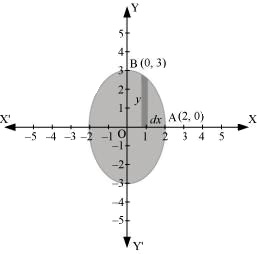 It is given that equation of ellipse is $\frac{\text{x}^2}{4}+\frac{\text{y}^2}{9}=1$
We can see that the ellipse is symmetrical about x-axis and y-axis.
$\therefore$ Area bounded by ellipse = 4 × Area of OAB
$\text{Area of ABCD}=\int\limits^2_0\text{y dx}=\int\limits^2_03\sqrt{1-\frac{\text{x}^2}{4}}\text{dx}$
$=\frac32\int\limits^2_0\sqrt{4-\text{x}^2}\text{dx}$
$=\frac32\Big[\frac{\text{x}}{2}\sqrt{4-\text{x}^2}+\frac42\sin^{-1}\frac{\text{x}}{4}\Big]^2_0$
$=\frac32\Big[\frac{2\pi}{2}\Big]$
$=\frac{3\pi}{2}$
Therefore, the required area bounded by the ellipse = $4\times\frac{3\pi}{2}=6\pi\text{ units}$ View full question & answer→