MCQ 11 Mark
He area of the region bounded by the parabola $y = x^2$ and $y = |x|$ is:
- A
$3$
- B
$\frac{1}{2}$
- ✓
$\frac{1}{3}$
- D
$2$
AnswerCorrect option: C. $\frac{1}{3}$
View full question & answer→MCQ 21 Mark
The area of the region bounded by the curve $x = y^2 - 2$ and $x = y$ is:
- A
$\frac { 9 }{ 4 }$
- B
$9$
- ✓
$\frac { 9 }{ 2 }$
- D
$\frac { 9 }{ 7 }$
AnswerCorrect option: C. $\frac { 9 }{ 2 }$
View full question & answer→MCQ 31 Mark
The area of the ellipse $\frac{\text{x}2}{9}+\frac{\text{y}^2}{4}=1$ in first quadrant is $6\pi\ \text{sq. units}.$The ellipse is rotated about its centre in anti$-$clockwise direction till its major axis coincides with $y-$axis. Now the area of the ellipse in first Quadrant is $\pi\ \text{sq. units}.$
View full question & answer→MCQ 41 Mark
Area bounded by the lines $y = |x| - 2$ and $y = 1 - |x - 1|$ is equal to:
- ✓
$4 \ sq.$ units
- B
$6 \ sq.$ units
- C
$2 \ sq.$ units
- D
$8 \ sq.$ units
AnswerCorrect option: A. $4 \ sq.$ units
View full question & answer→MCQ 51 Mark
Area of the region bounded by $y = |x – 1|$ and $y = 1$ is:
- A
$2\text{ sq.}\text{ units}$
- ✓
$1\text{ sq.}\text{ units}$
- C
$\frac{1}{2}\text{ sq.}\text{ units}$
- D
AnswerCorrect option: B. $1\text{ sq.}\text{ units}$
View full question & answer→MCQ 61 Mark
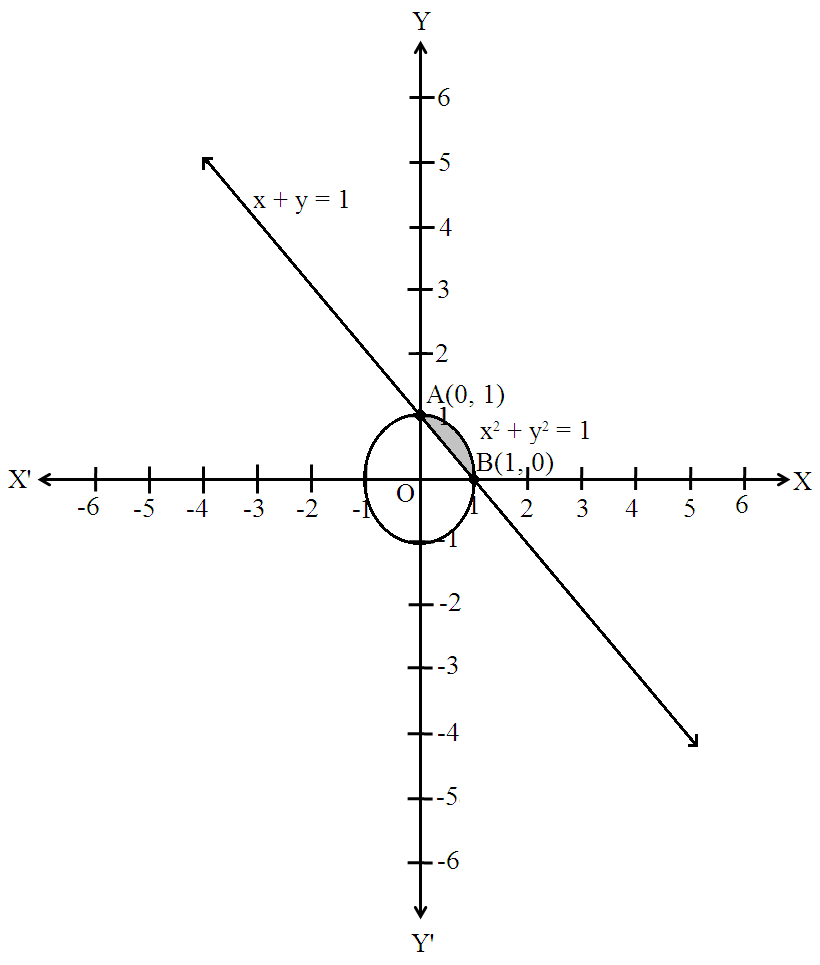
The area of the region $\{(\text{x},\text{y}):\text{x}^2+\text{y}^2\leq1\leq\text{x}+\text{y}\}$ is:
AnswerCorrect option: C. $\frac{\pi}{2}-\frac{1}{2}$
None of the given option is correct.
To find the points of intersection of the line
and the circle substitute $y = 1 - x$ in $x^2 + y^2 = 1$,
we get $A(0, 1)$ and $B(1, 0).$
Therefore, the required area of the shaded region,
$\text{A} = \int\limits^1_0(\text{y}_1-\text{y}_2)\text{dx}$ $\big($Where, $\text{y}_1=\sqrt{1-\text{x}^2}$ and $\text{y}_2=1-\text{x}\big)$
$= \int\limits^1_0\Big[\big(\sqrt{1-\text{x}^{2}}\big)-(1-\text{x})\Big]\text{dx}$
$=\int\limits^1_0\Big(\sqrt{1-\text{x}^2}-1+\text{x}\Big)\text{dx}$
$=\Big[\frac{\text{x}}{2}\sqrt{1-\text{x}^2}+\frac{1}{2}\sin^{-1}(\text{x})-\text{x}+\frac{\text{x}^2}{2}\Big]^1_0$
$=\bigg[\frac{1}{2}\sqrt{1-1^2}+\frac{1}{2}\sin^{-1}(1)-(1)+\frac{(1)^2}{2}\bigg]\\-\bigg[\frac{(0)}{2}\sqrt{1-(0)^2}+\frac{1}{2}\sin^{-1}(0)-(0)+\frac{(0)^2}{2}\bigg]$
$=\Big(\frac{\pi}{4}-\frac{1}{2}\Big)$ square units View full question & answer→MCQ 71 Mark
Choose the correct answer : Smaller area enclosed by the circle $x^2 + y^2 = 4$ and the line $x + y = 2$ is:
AnswerStep $I$. Equation of circle is $x^2 + y^2 = 2^2 ...(i)$
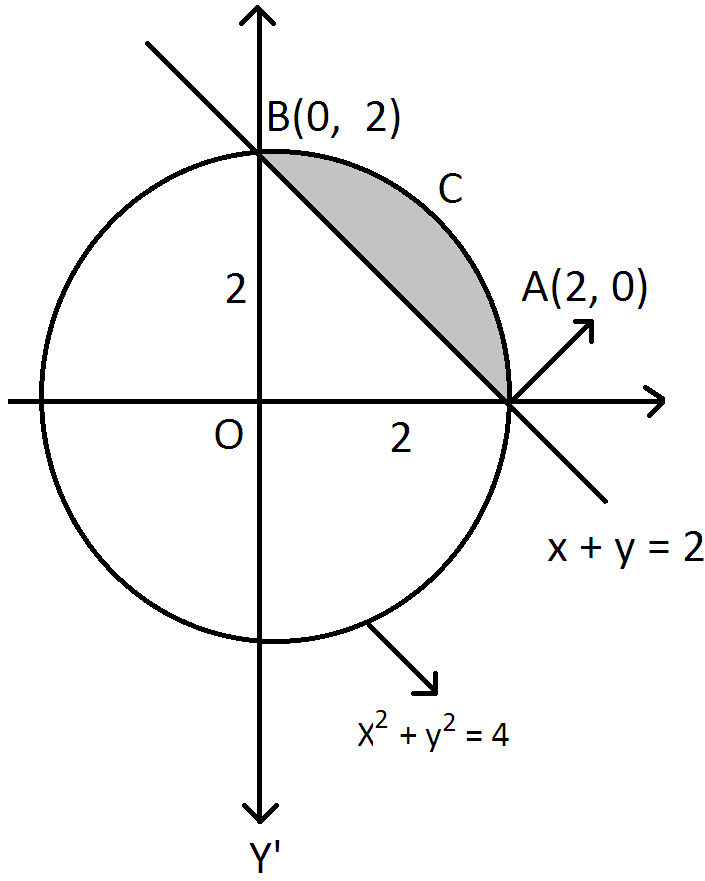
$\Rightarrow\text{y}=\sqrt{2^2-\text{x}^2}\dots(\text{ii})$ Also, equation of the line is $x + y = 2 ...(iii)$ Table of values
Therefore graph of equation $(iii)$ is the straight line joining the points $(0, 2)$ and $(2, 0)$.
Step $II$. From the graph of circle $(i)$ and straight line $(iii),$ it is clear that points of intersections of circle $(i)$ and straight line $(iii)$ are $A(2, 0)$ and $B(0, 2).$
Step $III$. Area $\text{OACB},$ bounded by circle $(i)$ and coordinate axes in first quadrant
$=\Bigg|\int\limits^2_0\text{y dx}\Bigg|=\Bigg|\int\limits^2_0\sqrt{2^2-\text{x}^2}\text{ dx}\Bigg|$
$=\Big(\frac{\text{x}}{2}\sqrt{2^2-\text{x}^2}+\frac{2^2}{2}\sin^{-1}\frac{\text{x}}{2}\Big)^2_0$
$=\Big(\frac22\sqrt{4-4}+2\sin^{-1}1\Big)-\Big(0+2\sin^{-1}0\Big)$
$=0+2\Big(\frac{\pi}{2}\Big)-2(0)=\pi\text{ sq. units}\dots(\text{iv})$
Step $IV$. Area of triangle $\text{OAB},$ bounded by straight line $(iii)$ and coordinate axes
$=\Bigg|\int\limits^2_0\text{y dx}\Bigg|=\Bigg|\int\limits^2_0(2-\text{x})\text{ dx}\Bigg|$
$=\Big(2\text{x}-\frac{\text{x}^2}{2}\Big)^2_0$
$=(4-2)-(0-0)=2\text{ sq. units}\dots(\text{v})$
Step $V$. Required shaded area $=$ Area $\text{OACB}$ given by $(iv) -$ Area of triangle $\text{OAB}$ by $(v)$
$=(\pi-2)\text{ sq. units}$
Therefore, option $(B)$ is correct. View full question & answer→MCQ 81 Mark
The area of the region bounded by the curve $\text{y}=\sqrt{16-\text{x}^2}$ and $x-$axis is:
- ✓
$8\pi\text{ sq.}\text{units}$
- B
$20\pi\text{ sq.}\text{units}$
- C
$16\pi\text{ sq.}\text{units}$
- D
$256\pi\text{ sq.}\text{units}$
AnswerCorrect option: A. $8\pi\text{ sq.}\text{units}$
View full question & answer→MCQ 91 Mark
The area of the triangle formed by the tangent and normal at the point $(1,\sqrt{3})$ on the circle $x^2 + y^2 = 4$ and the $x-$ axis is:
- A
$3\text{ sq.}\text{ units}$
- ✓
$2\sqrt{3}\text{ sq.}\text{ units}$
- C
$3\sqrt{2}\text{ sq.}\text{ units}$
- D
$4\text{ sq.}\text{ units}$
AnswerCorrect option: B. $2\sqrt{3}\text{ sq.}\text{ units}$
$2\sqrt{3}\text{ sq.}\text{ units}$
View full question & answer→MCQ 101 Mark
The area bounded by the curve $2x^2 + y^2 = 2$ is :
- A
$\pi\text{ sq}.\text{units}$
- ✓
$\sqrt{2}\pi\text{ sq}.\text{units}$
- C
$\frac{\pi}{2}\text{sq}.\text{units}$
- D
$2\pi\text{ sq}.\text{units}$
AnswerCorrect option: B. $\sqrt{2}\pi\text{ sq}.\text{units}$
$\sqrt{2}\pi\text{ sq}.\text{units}$
View full question & answer→MCQ 111 Mark
If $\text{y}=2\sin\text{x}+\sin2\text{x}$ for $0≤\text{x}≤2\pi,$ then the area enclosed by the curve and $x-$axis is:
AnswerCorrect option: C. $\text{12 sq. units}$
View full question & answer→MCQ 121 Mark
Choose the correct answer in the following. Area bounded by the curve $y = x^3,$ the $x-$ axis and the ordinates $x = –2$ and $x = 1$ is :
- A
$-9$
- ✓
$-\frac{15}{4}$
- C
$\frac{15}{4}$
- D
$\frac{17}{4}.$
AnswerCorrect option: B. $-\frac{15}{4}$
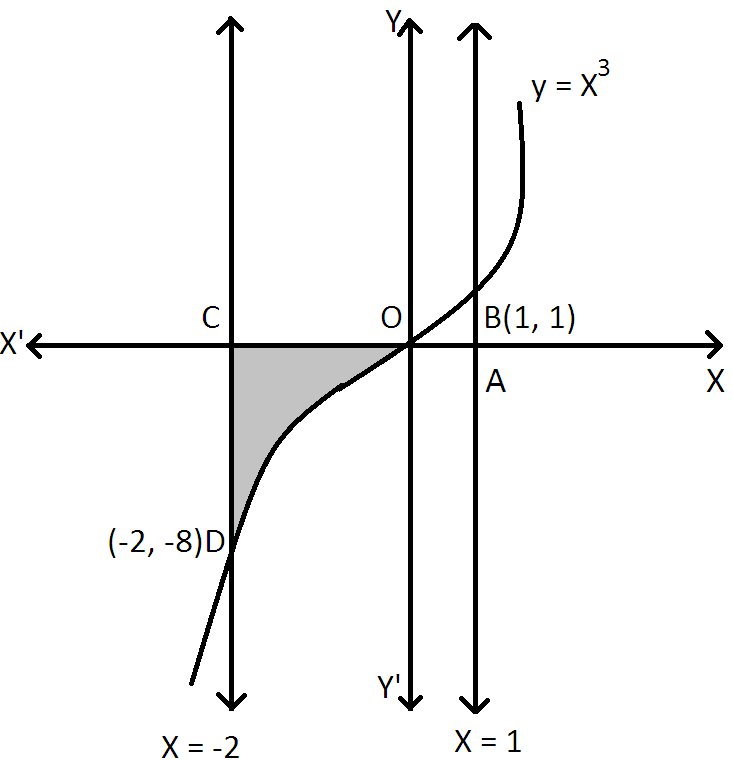
$\text{Required area}=\int\limits^1_{-2}\text{y dx}$
$=\int\limits^1_{-2}\text{x}^3\text{dx}$
$=\Big[\frac{\text{x}^4}{4}\Big]^1_{-2}$
$=\Big[\frac14-\frac{(-2)^4}{4}\Big]$
$=\Big(\frac14-4\Big)=-\frac{15}{4}\text{ units}$
Thus, the correct answer is $B.$ View full question & answer→MCQ 131 Mark
The area bounded by the line $y = 2x - 2, y = -x$ and $x-$axis is given by:
- A
$\frac{9}{2}\text{sq}.\text{units}$
- B
$\frac{43}{6}\text{sq}.\text{units}$
- C
$\frac{35}{6}\text{ sq}.\text{units}$
- ✓
View full question & answer→MCQ 141 Mark
The area bounded by the curve $\text{y}=\log_{\text{e}}\text{x}$ and x-axis and the straight line x = e is:
AnswerCorrect option: B. $1\text{ sq. units}$
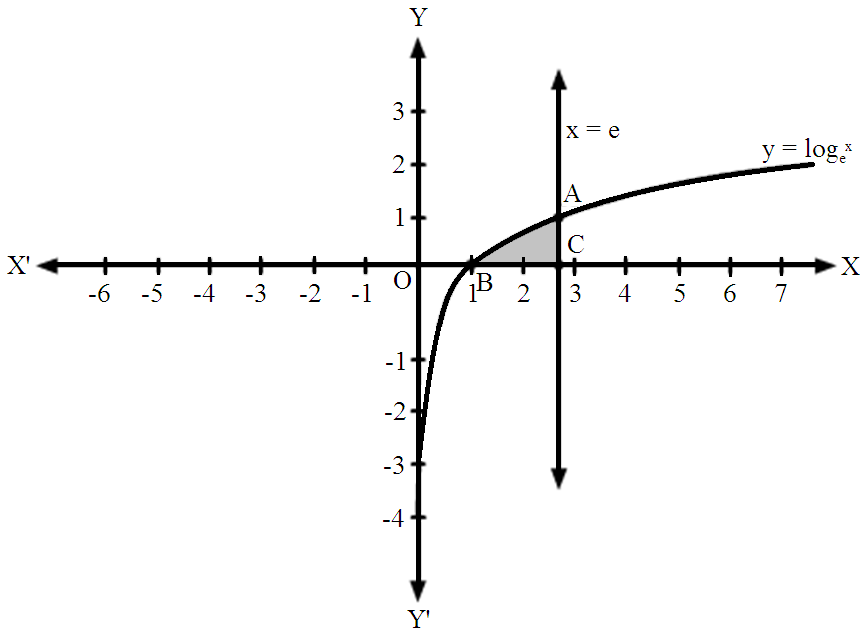
The point of intersection of the curve and the straight line is A(e, 1). Therefore, the area of the required region ABC,
$\text{A} = \int\limits^1_0(\text{x}_1-\text{x}_2)\text{dy}$ $(\text{where}, \text{x}_1 = \text{e}\text { and }\text{x}_2 = \text{e}_{\text{y}})$
$= \int\limits^1_0(\text{e}-\text{e}^{\text{y}})\text{dy}$
$=\big [\text{ey}-\text{e}^{\text{y}}\big]^1_0$
$=\big\{\text{e}(1)-\text{e}^{(1)}\big\} -\big \{\text{e}(0)-\text{e}^{(0)}\big\}$
$= \text{e}-\text{e}+1$
$= 1 \text{ square unit}$ View full question & answer→MCQ 151 Mark
Area bounded by the curve $\text{y}=\cos\text{x}$ between $\text{x}=0$ and $\text{x}=3\frac{\pi}{2}$ is:
- A
$1 \ sq.$ unit
- B
$2 \ sq.$ units
- ✓
$3 \ sq.$ units
- D
$4 \ sq.$ units
AnswerCorrect option: C. $3 \ sq.$ units
View full question & answer→MCQ 161 Mark
The area included between the parabolas $y^2 = 4x$ and $x^2 = 4y$ is:
- A
$\frac{8}{3}\text{sq}\text{ unit}$
- B
$8\text{sq}\text{ unit}$
- ✓
$\frac{16}{3}\text{sq}\text{ unit}$
- D
$12\text{sq}\text{ unit}$
AnswerCorrect option: C. $\frac{16}{3}\text{sq}\text{ unit}$
We know that, the area of region bounded by the parabolas $y^2 = 4ax$ and $= 4by$ is
$=\frac{16}{3}\text{ab}\text{ sq.}\text{ unit.}$
Therefore, $y^2 = 4ax$ and $x^2 = 4y$ is
$=\frac{16}{3}\text{ sq.}\text{ unit.}$
$(\because\text{a}=1,\text{b}=1)$
View full question & answer→MCQ 171 Mark
The area of the region bounded by the ellipse $\frac{\text{x}^2}{25}+\frac{\text{y}^2}{16}=1$ is:
- ✓
$20\pi\text{ sq}.\text{units}$
- B
$20^2\pi\text{ sq}.\text{units}$
- C
$16^2\pi\text{ sq}.\text{units}$
- D
$25\pi\text{ sq}.\text{units}$
AnswerCorrect option: A. $20\pi\text{ sq}.\text{units}$
View full question & answer→MCQ 181 Mark
Area bounded by the curve $y = x^3,$ the $x-$ axis and the ordinates $x = -2$ and $x = 1$ is:
- A
$-9$
- B
$\frac{-15}{4}$
- C
$\frac{15}{4}$
- ✓
$\frac{17}{4}$
AnswerCorrect option: D. $\frac{17}{4}$
$x = -2$ and $x = 1$ intersect the curve $y = x^3$ at $A(-2, -8)$ and $B(1, 1)$ respectively
If $P(x, y_1)$ lies on $OA\ \ O(x, y_2)$ lies on curve $OB$
Then, $y_1 > 0 $
$\Rightarrow |y_1| = y_1$
$\ \ y_2 < 0 $
$\Rightarrow |y_2| = -y_2$
Area of curve bound by the two lines $=$ shaded are $\text{(OADO)}\ +$ shaded area $\text{(OCBO)}$
$= \int\limits^0_{-2}|\text{y}_2|\text{dx}+\int\limits^1_0|\text{y}_1|\text{dx}$
$= \int\limits^0_{-2}-\text{y}_2\text{dx}+\int\limits^1_0\text{y}_1\text{dx}$
$=\int\limits^0_{-2}-(\text{x}^3)\text{dx}+\int\limits^1_0\text{x}^3\text{dx}$
$= \Big[-\frac{\text{x}^4}{4}\Big]^0_{-2}+\Big[\frac{\text{x}^4}{4}\Big]^1_0$
$= 0-\Big(-\frac{16}{4}\Big)+\Big(\frac{1}{4}-0\Big)$
$= 4+\frac{1}{4}$
$=\frac{17}{4}\text{ sq. units}$
View full question & answer→MCQ 191 Mark
Find the area of the region bounded by the curves $y = x^3,$ the line $x = 2, x = 5$ and the $x -$ axis?
- A
$173.50$
- B
$230.25$
- C
$175.35$
- ✓
$152.25$
AnswerCorrect option: D. $152.25$
$\int\limits\text{x}^\text{n}\text{dx}=\frac{\text{x}^\text{n-1}}{\text{n+1}}+\text{c}$
Here, we have to find the area of the region bounded by the curves $y = x^3$, the line $x = 2, x = 5$ and the $x -$ axis
So, the area enclosed by the given curves is given by $\int\limits^3_2\text{x}^3\text{dx}$
As we know that, $\int\limits\text{x}^\text{n}\text{dx}=\frac{\text{x}^\text{n}}{\text{n+1}}+\text{c}$
$\Rightarrow\int\limits^5_2\text{x}^3\text{dx}=\Big[\frac{\text{x}^4}{4}\Big]^5_4$
$\Rightarrow\int\limits^5_2\text{x}^3\text{dx}=\frac{1}{4}(625-16)$
$=152.25$
View full question & answer→MCQ 201 Mark
Area bounded by parabola $y^2 = x$ and straight line $2y = x$ is:
AnswerPoint of intersection is obtained by solving the equation of parabola $y^2 = x$ and equation of line $2y = x,$ we have
$y^2 = x$ and $2y = x$
$\Rightarrow y^2 = 2y$
$\Rightarrow y^2 - 2y = 0$
$\Rightarrow y = 0$ or $y = 2$
$\Rightarrow x = 0$ or $x = 4$
Thus $O(0, 0)$ and $A(4, 2)$ are the points of intersection of the curve and straight line. Area bound by then
$\text{A}=\int\limits_0^4(\text{y}_1-\text{y}_2)\text{ dx}$
$\Big[\text{Where, y}_1 =\sqrt{\text{x}}\text{ and y}_2=\frac{\text{x}}{2}\Big]$
$=\int\limits_0^4\Big(\sqrt{\text{x}}-\frac{\text{x}}{2}\Big)\text{dx}$
$=\Bigg[\frac{\text{x}^\frac{3}{2}}{\frac{3}{2}}-\frac{1}{2}\times\frac{\text{x}^2}{2}\Bigg]_0^4$
$=\Big[\frac{2}{3}\text{x}^\frac{3}{2}-\frac{\text{x}^2}{4}\Big]_0^4$
$=\frac{2}{3}4^\frac{3}{2}-\frac{1}{4}\times4^2-0$
$=\frac{2}{3}\times2^3-\frac{16}{4}$
$=\frac{16}{3}-4$
$=\frac{16-12}{3}$
$=\frac{4}{3}\text{ Sq units}$
View full question & answer→MCQ 211 Mark
The area bounded by the curve $y^2= 8x$ and $x^2 = 8y$ is:
- ✓
$\frac{16}{3}\text{ sq. units}$
- B
$\frac{3}{16}\text{ sq. units}$
- C
$\frac{14}{3}\text{ sq. units}$
- D
$\frac{3}{14}\text{ sq. units}$
AnswerCorrect option: A. $\frac{16}{3}\text{ sq. units}$
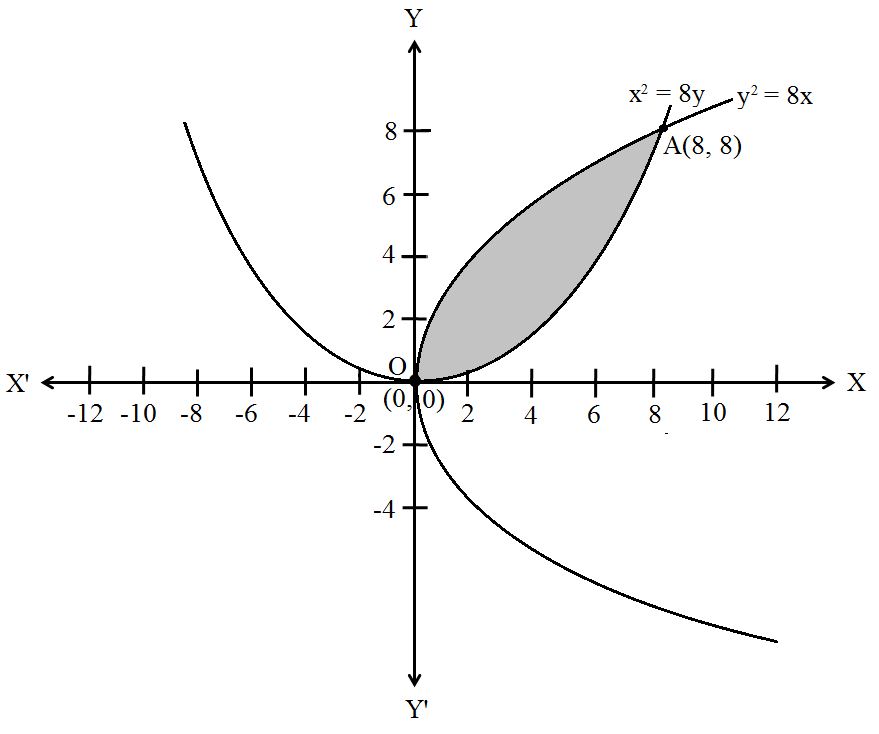
Point of intersection of both the parabolas $y^2 = 8x$ and $x^2 = 8y$ is obtaining by solving the two equations,
$\text{y}^{2} = \text{8x}$ and $\text{x}^{2} = \text{8y}$
$\therefore \frac{\text{y}^{4}}{64} - \text{8y} = 0$
$\Rightarrow \text{y}(\text{y}^{3} - 8^{3}) - 0$
$\Rightarrow \text{y} = 0$ or $\text{y} = 8$
$\Rightarrow \text{x} = 0$ or $\text{x} = 8$
$\therefore O(0, 0)$ and $A(8, 8)$ are the points of intersection.
Area of the shaded region $= \int\limits^{8}_{0} |\text{y}_{2} - \text{y}_{1}| \text{dx}$
$=\int\limits^{8}_{0} (\text{y}_{2} - \text{y}_{1}) \text{dx}$
$=\int\limits^{8}_{0} \big(\sqrt{8\text{x}} - \frac{\text{x}^{2}}{8}\big) \text{dx}$
$= \bigg[\frac{\sqrt{8}}{\frac{3}{2}} \text{x}^{\frac{3}{2}} - \frac{1}{8} \times \frac{\text{x}^{2}}{3}\bigg]^{8}_{0}$
$ = \frac{2}{3} \times \sqrt{8} \times 8^{\frac{3}{2}} - \frac{1}{8} \times \frac{8^{3}}{3} - 0$
$= \frac{2}{3} \times \sqrt{8} \times 8 \sqrt{8} - \frac{8^{2}}{3}$
$= \frac{2}{3} \times 8^{2} - \frac{8^{2}}{3}$
$=\frac{8^{2}}{3} (2 - 1)$
$=\frac{64}{3} \text{sq units}$ View full question & answer→MCQ 221 Mark
The area bounded by the parabola $y^2 = 4ax$ and $x^2 = 4ay$ is:
- A
$\frac{8\text{a}^3}{3}$
- ✓
$\frac{16\text{a}^2}{3}$
- C
$\frac{32\text{a}^2}{3}$
- D
$\frac{64\text{a}^2}{3}$
AnswerCorrect option: B. $\frac{16\text{a}^2}{3}$
To find the point of intersection of the parabola substitute $\text{y} = \frac{\text{x}^{2}}{4\text{a}}$ in $y^2= 4ax$
We get,
$\frac{\text{x}^4}{16\text{a}^{2}}=4\text{ax}$
$\Rightarrow x^4 - 64a^3 x = 0$
$\Rightarrow x(x^3- 64a^3) = 0$
$\Rightarrow x = 0$ or $x = 4a$
$\Rightarrow y = 0$ or $y = 4a$
Therefore, the required area $\text{ABCD},$
$\text{A} =\int\limits^\text{4a}_0(\text{y}_1-\text{y}_2)\text{dx}\Big($Where$, \text{ y}_1 = 2\sqrt{\text{ax}}$ and $\text{ y}_2=\frac{\text{x}^2}{\text{4a}}\Big)$
$= \int\limits^\text{4a}_0\Big(2\sqrt{\text{ax}}-\frac{\text{x}^2}{\text{4a}}\Big)\text{dx}$
$=\bigg[\frac{4\sqrt{\text{a}}}{3}\text{x}^\frac{3}{2}-\frac{\text{x}^{3}}{12\text{a}}\bigg]^\text{4a}_0$
$= \bigg[\frac{4\sqrt{\text{a}}}{3}(\text{4a}^\frac{3}{2})-\frac{(\text{4a})^3}{\text{12a}}\bigg]-\bigg[\frac{4\sqrt{\text{a}}}{3}(0)^\frac{3}{2}-\frac{(0)^3}{\text{12a}}\bigg]$ $$
$= \bigg[\frac{4\sqrt{\text{a}}}{3}\text{8a}^\frac{3}{2}-\frac{64\text{a}^3}{12\text{a}}\bigg]-0$
$= \frac{32\text{a}^2}{3}-\frac{16\text{a}^3}{3}$
$= \frac{16\text{a}^2}{3}$ square units
View full question & answer→MCQ 231 Mark
The area bounded by the curve $x = 3y^2 – 9$ and the line $x = 0, y = 0$ and $y = 1$ is:
- ✓
$8\text{ sq.}\text{units}$
- B
$\frac{8}{3}\text{ sq.}\text{units}$
- C
$\frac{3}{8}\text{ sq.}\text{units}$
- D
$3\text{ sq.}\text{units}$
AnswerCorrect option: A. $8\text{ sq.}\text{units}$
View full question & answer→MCQ 241 Mark
Area lying between the curves $y^2 = 4x$ and $y = 2x$ is:
- A
$\frac{2}{3}$
- ✓
$\frac{1}{3}$
- C
$\frac{1}{4}$
- D
$\frac{3}{4}$
AnswerCorrect option: B. $\frac{1}{3}$
The points of intersection of the straight line and the parabola is obtained by solving the simultaneous equations,
$y^2 = 4x$ and $y = 2x$
$\Rightarrow (2x)^2 = 4x$
$\Rightarrow 4x^2 = 4x$
$\Rightarrow x(x - 1) = 0$
$\Rightarrow x = 0$ or $x = 1$
$\Rightarrow y = 0$ or $y = 2$
Thus, $O(0, 0)$ and $A(1, 2)$ are the points of intersection of the parabola and straight line shaded area is the required area.
Using the horizontal strip method, shaded area
$= \int\limits^2_0|\text{x}_2-\text{x}_1|\text{dy}$
$=\int\limits^2_0\Big[\Big(\frac{\text{y}}{2}\Big)-\Big(\frac{\text{y}^2}{4}\Big)\Big]\text{dy}$
$=\Big[\frac{1}{2}\Big(\frac{\text{y}^2}{2}\Big)-\frac{1}{4}\Big(\frac{\text{y}^3}{3}\Big)\Big]^2_0$
$=\frac{1}{4}(2)^2-\frac{1}{12}(2^3)-0$
$= 1 -\frac{8}{12}$
$= \frac{12-8}{12}$
$=\frac{1}{3}\text{ sq. units}$
View full question & answer→MCQ 251 Mark
The area bounded by the curve $\text{y}=\cos\text{x}$ in one are of the curve is where $=4\text{n}+1,\text{x}\in \text{integer:}$
- A
$2\text{a}$
- ✓
$\frac{1}{\text{a}} $
- C
$\frac{2}{\text{a}}$
- D
$2{\text{a}^2}$
AnswerCorrect option: B. $\frac{1}{\text{a}} $
$=\text{Area} =\int\limits^\frac{\pi}{2}_0\cos\text{ax}\text{ dx}$
$=\Big[\frac{\sin\text{ax}}{\text{x}}\Big]^\frac{\pi}{2}_0$
$=\frac{1}{0}-0=\frac{1}{\text{a}}$
View full question & answer→MCQ 261 Mark
The area bounded by the curve $y^2= 8x,$ the $x-$axis and the lastus rectum is:
- ✓
$\frac{16}{3}$
- B
$\frac{23}{3}$
- C
$\frac{32}{3}$
- D
$\frac{16\sqrt{2}}{3}$
AnswerCorrect option: A. $\frac{16}{3}$
$y^2 = 8x$ represents a parabola opening side ways,
with vertex at $O(0, 0)$ and focus at $B(2, 0)$
Thus $AA\ '$ represents the latus rectum of the parabola.
The points of intersection of the parabola and latus rectum are $A(2, 4)$ and $A\ '(2, -4)$
Area bound by curve $, x-$axis and latus return is the area $\text{OABO},$
The approximating rectangle of with $= dx$ and length $= y$ has area $= y dx,$ and moves from $x = 0$ to
$\text{x} = 2$ area$\text{ OABO}= \int\limits^2_0|\text{y}|\text{dx}$
$= \int\limits^2_0\text{y}\text{ dx} $ $\{\text{y}>0, \Rightarrow|\text{y}|=\text{y}\}$
$= \int\limits^2_0\sqrt{8\text{x}}\text{ dx}$
$= 2\sqrt{2}\int\limits^2_0\sqrt{\text{xdx}}$
$= 2\sqrt{2}\Bigg[\frac{\text{x}^\frac{3}{2}}{\frac{3}{2}}\Bigg]^2_0$
$=2 \sqrt{2}\times \frac{2}{3}\Big(2^\frac{3}{2}-0\Big)$
$= 4 \frac{\sqrt{2}}{3}\times2\sqrt{2}$
$=\frac{16}{3}\text{ sq. units}$
View full question & answer→MCQ 271 Mark
Area of the region bounded by the curve $y^2 = 4x, y-$axis and the line $y = 3$, is:
- A
$2$
- ✓
$\frac{9}{4}$
- C
$\frac{9}{3}$
- D
$\frac{9}{2}$
AnswerCorrect option: B. $\frac{9}{4}$
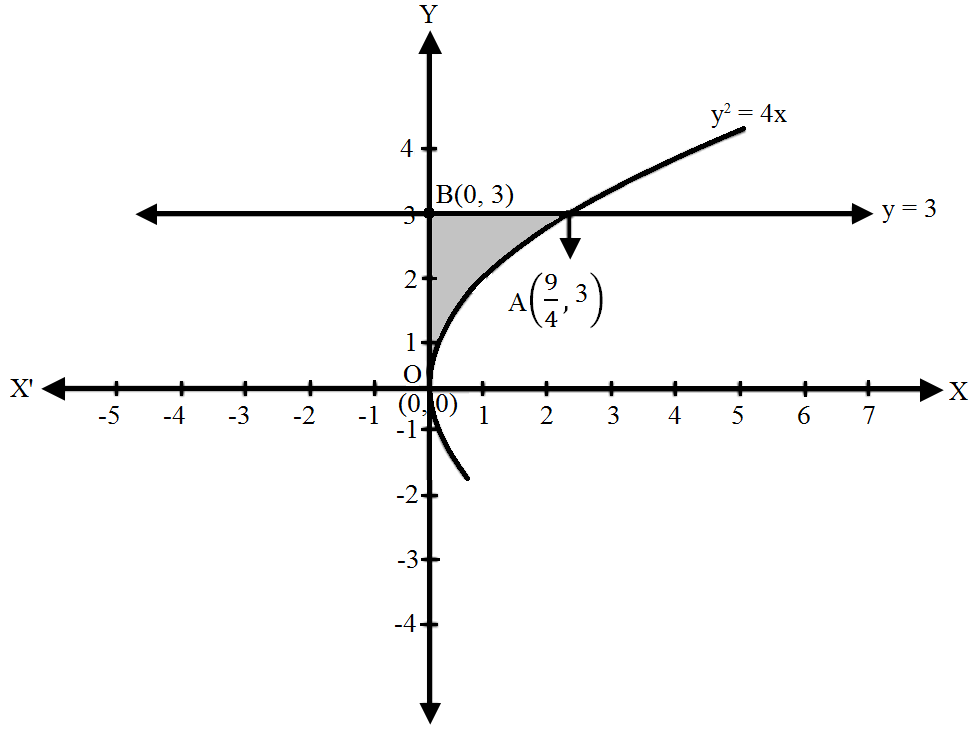
$y^2 = 4x$ represents a parabola with vertex at origin $O(0, 0)$ and symmetric about $+ve\ x-$axis
$y = 3$ is a straight line parallel to the $x-$axis
Point of intersection of the line and the parabola is given by
substituting $y = 3$ in the equation of the parabola
$y^2 = 4x$
$\Rightarrow 3^2 = 4x$
$\Rightarrow\text{x}=\frac{9}{4}$
Thus$, \text{A}=\Big(\frac{9}{4},3\Big)$ is the point of intersection of the parabola and straight line.
Required area is the shaded area $\text{OABO}$
Using the horizontal strip method,
Area $\text{(OABO)}= \int\limits^3_0|\text{x}|\text{ dy}$
$= \int\limits^3_0\frac{\text{y}^2}{4}\text{dy}$
$=\Big[\frac{1}{4}\Big(\frac{\text{y}^2}{3}\Big)\Big]^3_0$
$= \frac{3^3}{12}$
$=\frac{9}{4}\text{ sq. units}$ View full question & answer→MCQ 281 Mark
The area of the region bounded by $y = | x – 1 |$ and $y = 1$ is:
- A
$2$
- ✓
$1$
- C
$\frac{1}{2}$
- D
$\frac{1}{4}$
View full question & answer→MCQ 291 Mark
The area of the region bounded by the curve $\text{y}=\sin\text{x}$ between the ordinates $\text{x}=0,\text{x}=\frac{\pi}{2}$ and the $x-$axis is:
- A
$\text{2 sq. units}$
- B
$\text{4 sq. units}$
- C
$\text{3 sq. units}$
- ✓
$\text{1 sq. unit}$
AnswerCorrect option: D. $\text{1 sq. unit}$
View full question & answer→MCQ 301 Mark
The area bounded by the curve $x^2 = 4y$ and straight line $x = 4y - 2$ is:
- A
$\frac{3}{8}$
- B
$\frac{5}{8}$
- C
$\frac{7}{8}$
- ✓
$\frac{9}{8}$
AnswerCorrect option: D. $\frac{9}{8}$
The area bounded by the curve, $x^2 = 4y$, and line, $x = 4y - 2$, is represented by the shaded area $\text{OBAO}.$
Let $A$ and $B$ be the points of intersection of the line and parabola.
Coordinates of point $A$ are $\Big(-1,\frac{1}{4}\Big)$
Coordinates of point $B$ are $(2,1).$
We draw $AL$ and $BM$ perpendicular to $x-$axis.
It can be observed that, Area $\text{OBAO} =$ Area $\text{OBCO} +$ Area $\text{OACO} ...(1)$
Then, Area $\text{OBCO} =$ Area $\text{OMBC} -$ Area $\text{OMBO}$
$=\int\limits^2_0\frac{\text{x}+2}{4}\text{dx}-\int\limits^2_0\frac{\text{x}^2}{4}\text{dx}$
$=\frac{1}{4}\Big[\frac{\text{x}^2}{2}+2\text{x}\Big]^2_0-\frac{1}{4}\Big[\frac{\text{x}^3}{3}\Big]^2_0$
$=\frac{1}{4}[2+4]-\frac{1}{4}\Big[\frac{8}{3}\Big]$
$=\frac{3}{2}-\frac{2}{3}=\frac{5}{6}$
Similarly, Area $\text{OACO} =$ Area $\text{OLAC} -$ Area $\text{OLAO}$
$=\int\limits^0_{-1}\frac{\text{x}+2}{4}\text{dx}-\int\limits^0_{-1}\frac{\text{x}^2}{4}\text{dx}$
$=\frac{1}{4}\Big[\frac{\text{x}^2}{2}+2\text{x}\Big]^0_{-1}\frac{1}{4}\Big[\frac{\text{x}^3}{3}\Big]^0_{-1}$
$=-\frac{1}{4}\Big[\frac{(-1)^2}{2}+2(-1)\Big]-\Big[-\frac{1}{4}\Big(\frac{(-1)^3}{3}\Big)\Big]$
$=-\frac{1}{4}\Big[\frac{1}{2}-2\Big]-\frac{1}{12}$
$=\frac{1}{2}-\frac{1}{8}-\frac{1}{12}=\frac{7}{24}$
Therefore, required area, $=\Big(\frac{5}{6}+\frac{7}{24}\Big)=\frac{9}{8}\text{ sq}.\text{ units}$
View full question & answer→MCQ 311 Mark
The area bounded by the curve $y = x^4 - 2x^3 + x^2 + 3$ with $x-$axis and ordinates corresponding to the minima of $y$ is:
- A
$1$
- B
$\frac{91}{30}$
- C
$\frac{30}{9}$
- ✓
$4$
Answer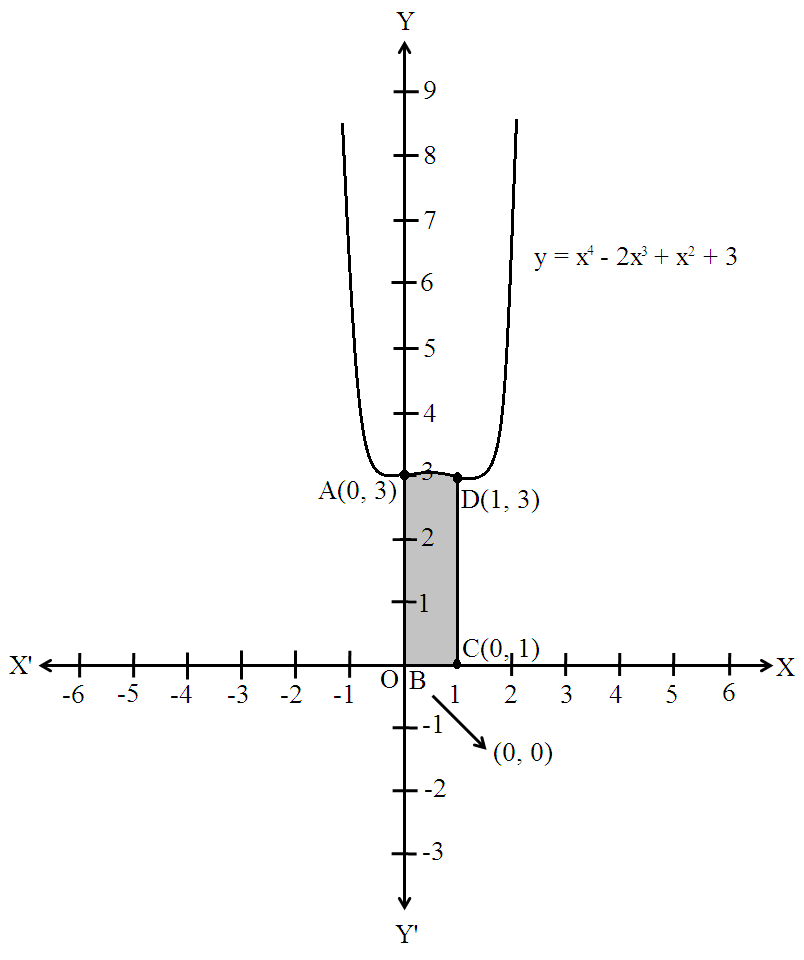
Clearly, from the figure the minimum value of $y$ is $3$ when $x=0$ or $1.$
Therefore, the required area $\text{ABCD},$
$\text{A} = \int\limits^1_0\text{y}\text{ dx} ($Where, $y = x^4 - 2x^3 + x^2 + 3)$
$= \int\limits^1_0(\text{x}^4-2\text{x}^3+\text{x}^2+3)\text{dx}$
$=\bigg[\frac{\text{x}^5}{5}-\frac{2\text{(x})^4}{4}+\frac{\text{x}^3}{3}+3\text{x}\bigg]^1_0$
$=\bigg[\frac{(1)^5}{5}-\frac{2(1)^4}{4}+\frac{(1)^3}{3}+3(1)\bigg]-\bigg[\frac{(0)^5}{5}-\frac{2(0)^4}{4}+\frac{(0)^3}{3}+3(0)\bigg]$
$=\big[\frac{1}{5}-\frac{1}{2}+\frac{1}{3}+3\big]- 0$
$=\frac{6-15+10+90}{3}$
$=\frac{91}{30}\text{ square units}$ View full question & answer→MCQ 321 Mark
The area bounded by $\text{f(x)}=\text{x}^2,0\leq\text{x}\leq1,\text{g(x)}=\text{x}+2,1\leq\text{x}\leq2$ and $x –$ axis is:
- A
$\frac{3}{2}$
- B
$\frac{4}{3}$
- C
$\frac{8}{3}$
- ✓
View full question & answer→MCQ 331 Mark
The ratio of the areas between the curves $\text{y}=\cos\text{x}$ and $\text{y}=\cos2\text{x}$ and x-axis from x = 0 to x = 0 to $\text{x}=\frac{\pi}{3}$
- A
$1:2$
- B
$2:1$
- C
$\sqrt{3}:1$
- ✓
AnswerThe line $\text{x} = \pi3$ meets the curve $\text{y} = \cos\text {x}\text{ at}\text { B}\pi3,12$
Area between the curve y = cos x and x - axis from x = 0 and $\text{x} = 3\pi$ is,
$=\Big[2-\frac{1}{2}-\frac{1}{3}\Big]-\Big[-4-2+\frac{8}{3}\Big]$
$= 2 -\frac{1}{2}-\frac{1}{3}+4+2-\frac{8}{3}$
$=8-\frac{1}{2}-\frac{9}{3}$
$=5-\frac{1}{2}$
$=\frac{9}{2}\text{ square units}$
The line $\text{x}=\frac{\pi}{3}$ meets the curve y = cos 2x at $\text{B}'\pi3, -12$ Area between the curve y = cos 2x and x -axis from x = 0 and $\text{x}=\frac{\pi}{3}$ is,
$= \text{A}_2 = \int\limits^\frac{\pi}{4}_0\text{y}_2\text{ dx}-\int\limits^\frac{\pi}{3}_\frac{\pi}{4}\text{y}_2\text{dx}$ $\big[\text{where}, \text{y}_2 = \cos(2\text{x})\big]$
$=\int\limits^\frac{\pi}{4}_0\cos(2\text{x})\text{dx}-\int\limits^\frac{\pi}{3}_\frac{\pi}{4}\cos(2\text{x})\text{ dx}$
$=\Big[\frac{1}{2}\sin(2\text{x})\Big]^\frac{\pi}{4}_0-\Big[\frac{1}{2}\sin(2\text{x})\Big]^\frac{\pi}{3}_\frac{\pi}{4}$
$=\frac{1}{2}\Big[\sin\Big(\frac{\pi}{2}\Big)-\sin(0)\Big]-\frac{1}{2}\Big[\sin\Big(\frac{2\pi}{3}\Big)-\sin\Big]$
$= \frac{1}{2}-\frac{1}{2}\Big[\frac{\sqrt{3}}{2}-1\Big]$
$= \frac{1}{2}-\frac{\sqrt{3}}{4}+\frac{1}{2}$
$= 1-\frac{\sqrt{3}}{4}$
$=\frac{4-\sqrt{3}}{4}$
Therefore the retios will be
$\text{A}_1:\text{A}_2=\frac{\text{A}_1}{\text{A}_2}=\frac{\frac{\sqrt{3}}{2}}{\frac{4-\sqrt{3}}{4}}=\frac{2\sqrt{3}}{4-\sqrt{3}}$
View full question & answer→MCQ 341 Mark
The area enclosed by the curves $y^2 = x$ and $y = |x|$ is:
- A
$\frac{2}{3}$
- B
$1$
- ✓
$\frac{1}{6}$
- D
$\frac{1}{3}$
AnswerCorrect option: C. $\frac{1}{6}$
Required area $=\text{A}=\int\limits^1_0\big(\sqrt{\text{x}}-\text{x}\big)\text{dx}$
$=\Big[\frac{2}{3}\text{x}^{\frac{3}{2}}-\frac{\text{x}^2}{2}\Big]^1_0$
$=\frac{2}{3}-\frac{1}{2}$
$=\frac{1}{6}$
View full question & answer→MCQ 351 Mark
The area bounded by the curve $\text{y}=\sin\text{x}$ between the ordinates $\text{x}=0,\text{x}=\pi$ and the x-axis is:
- ✓
$2\text{ sq. units}$
- B
$4\text{ sq. units}$
- C
$3\text{ sq. units}$
- D
$1\text{ sq. units}$
AnswerCorrect option: A. $2\text{ sq. units}$
$\text{A}=\int^\limits{\pi}_0\text{y}\text{ dx}$
$=\int^\limits{\pi}_0\sin(\text{x})\text{dx}$
$=\big[-\cos(\text{x})\big]^{\pi}_0$
$= -\cos(\pi)+\cos(0)$
$= 1 + 1$
$= 2 \text{ square units}$
View full question & answer→MCQ 361 Mark
Choose the correct answer from the given four options:
The area of the region bounded by the curve $\text{y}=\sin\text{x}$ between the ordinates x = 0, $\text{x}=\frac{\pi}{2}$ and the x-axis is:
- A
$2\text{ sq. units}$
- B
$4\text{ sq. units}$
- C
$3\text{ sq. units}$
- ✓
$1\text{ sq. units}$
AnswerCorrect option: D. $1\text{ sq. units}$
Area of the region bounded by the curve $\text{y}=\sin\text{x}$ between the ordinates x = 0, $\text{x}=\frac{\pi}{2}$ and the X-axis is
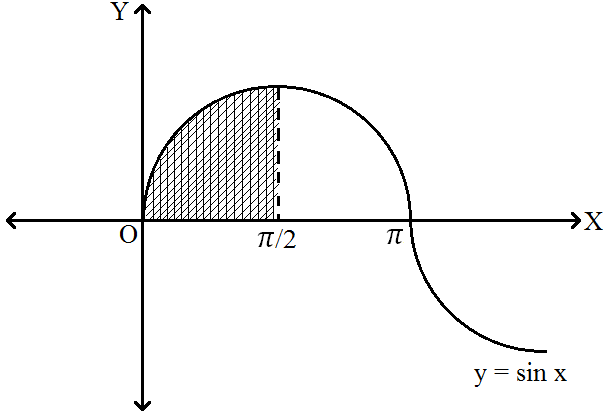
$\text{A}=\int\limits^{\frac{\pi}{2}}_0\sin\text{x dx}$
$=-\Big[\cos\text{x}\Big]^{\frac{\pi}{2}}_0=-\Big[\cos\frac{\pi}{2}-\cos0\Big]$
$=-[0-1]=1\text{ sq. units}$ View full question & answer→MCQ 371 Mark
For the area bounded by the curve $y = ax,$ the line $x = 2$ and $x -$ axis to be $2 \ sq.$ units, the value of a must be equal to:
View full question & answer→MCQ 381 Mark
The area bounded by the curve y = f(x), x-axis, and the ordinates x = 1 and $(\text{b}-1)\sin(3\text{b}+4)$ Then, f(x) is:
AnswerCorrect option: C. $\sin(3\text{x}+4)+3(\text{x}-1)\cos(3\text{x}+4)$
sin (3x + 4) + 3 (x - 1) cos (3x + 4)
y = fx
If A is the area bound by the curve, x-axis, x = 1 and x = b
$\Rightarrow \int\limits^\text{b}_1\text{f}(\text{x})\text{dx}=\big[\text{A}\big]^\text{b}_1 = (\text{b - 1})\sin(3\text{b} + 4)$ {given}
$\Rightarrow \text{f}(\text{x})=\frac{\text{d}}{\text{dx}}((\text{x} - 1)\sin(3\text{x}+ 4))$
$= \sin (3\text{x} + 4)\frac{\text{d}}{\text{dx}}(\text{x} - 1) + (\text{x} - 1)\frac{\text{d}}{\text{dx}}\sin(3\text{x} + 4)$
$= \sin (3\text{x} + 4) + 3(\text{x} - 1)\cos(3\text{x} + 4)$
View full question & answer→MCQ 391 Mark
Area bounded by the curve $\text{y}=\sin\text{x}$ and the x-axis between $\text{x}=0$ and $\text{x}=2\pi$ is:
Answer(d), as $\text{x}=\sin$ is positive in 1st and 2nd quadrant and negative is 3rd and 4th quadrant.
$=\text{Area}=\int\limits^{2\pi}_0\sin\text{x}\text{ dx}$
$=\int\limits^\pi_0\sin\text{x}+\int\limits^{2\pi}_\pi(-\sin\text{x})\text{dx}$
$=4\text{sq}\text{ units}$
View full question & answer→MCQ 401 Mark
The area of the region formed by $\text{x}^2+\text{y}^2-6\text{x}-4\text{y}+12\leq0,\text{ y}\leq\text{x}$ and $\text{x}\leq\frac{5}{2}$
- A
$\frac{\pi}{6}-\frac{\sqrt{3}+1}{8}$
- B
$\frac{\pi}{6}+\frac{\sqrt{3}+1}{8}$
- ✓
$\frac{\pi}{6}-\frac{\sqrt{3}-1}{8}$
- D
AnswerCorrect option: C. $\frac{\pi}{6}-\frac{\sqrt{3}-1}{8}$
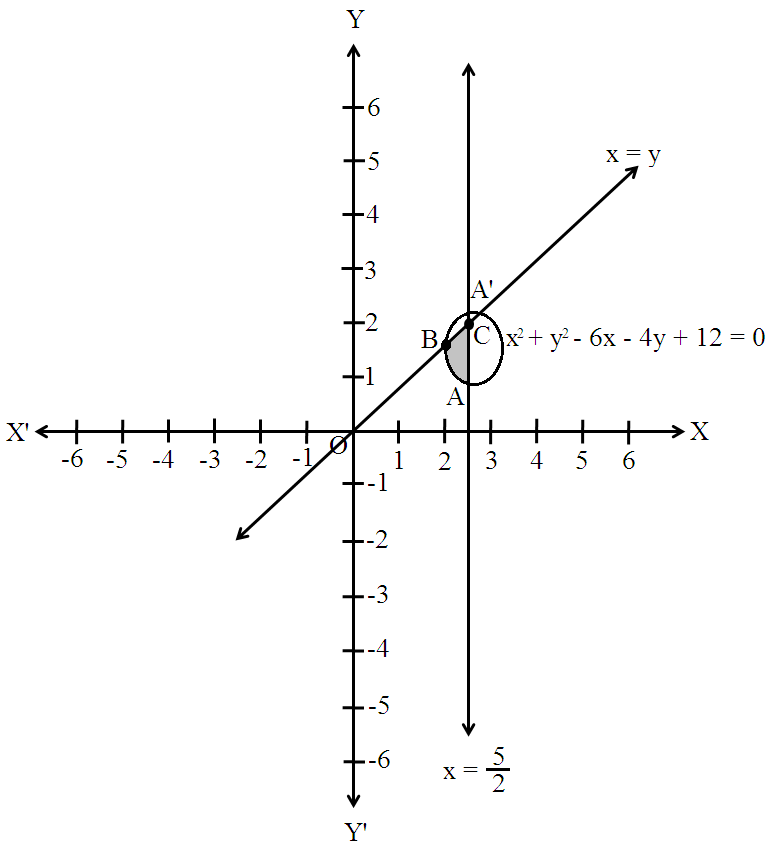
We have,
$\text{x}^{2} + \text{y}^{2}-6\text{x}-4\text{y}+\leq0$
$\text{y}\leq\text{x}$
$\text{x}\leq\frac{5}{2}$
Following are the corresponding equations of the given inequation.
$x^2 + y^2 -6x -4y +12 = 0 ...(i)$
$y = x ...(ii)$
$\text{x} = \frac{5}{2}\ ...(\text{iii})$
Here, $\text{ABC}$ is our required region in which point $A$ is intersection of $(i)$ and $(iii),$ point $B$ is intersection of $(i)$ and $(ii)$ and point $C$ is intersection of $(ii)$ and $(iii)$ By solving $ (i), (ii)$ and $(iii)$ we get the coordinates of $B$ and $C$ as $B = (2, 2) \text{C} = \Big(\frac{5}{2}, \frac{5}{2}\Big)$ Now, the equation of the circle is,
$x^2 + y^2 - 6x - 4y +12 = 0$
$\Rightarrow (x-3)^2 + (y-2)^2 = 1$
$\Rightarrow (y - 2)^2 = 1 - (x - 3)^2$
$\Rightarrow\text{y}-2 = \pm\sqrt{1-(\text{x}-3)^{2}}$
$\Rightarrow\text{y} = \pm\sqrt{1-(\text{x}-3})^{2}+2$
$\Rightarrow\text{y} = \sqrt{1-(\text{x}-3)^{2}}+2 \text{ or }-\sqrt{1-(\text{x}{-3})^{2}}+2$
$\text{y}= \sqrt{1-(\text{x}-3)^{2}}+2$ is not possible,
Therefore $\text {y}= -\sqrt{1-(\text{x}-3)^{2}}+2$
The area of the required region $\text{ABC}$,
$\text{A}= \int\limits^\frac{5}{2}_{2}(\text{y}_2-\text{y}_1)\text{ dx} \big(\text{where},\text{ y}_1 = -\sqrt{1-(\text{x}-3)^2} +2\text{ and}\text{ y}^2 = \text{x}\big)$
$= \int\limits^\frac{5}{2}_{2}\big[\text {x}-\big(-\sqrt{1(\text{x}-3)^{2}}+2\big)\big]\text{dx}$
$= \int^\limits\frac{5}{2}_2\big[\text{x}+\sqrt{1-(\text{x}-3)^{2}}\big]\text{dx}$
$= \bigg[\frac{\text{x}^{2}}{2}+\frac{(\text{x}-3)}{2}\sqrt{1-(\text{x}-3)^{2}}+\frac{1}{2}\sin^{-1}(\text{x}-3)-2\text{x}\bigg]^{\frac{5}{2}}_{2}$
$=\Bigg[\frac{\big(\frac{5}{2}\big)^{2}}{2}+\frac{\frac{5}{2}-3}{2}\sqrt{1-\Big\{\Big(\frac{5}{2}\Big)-3\Big\}^2}+\frac{1}{2}\sin^{-1}=\Big(\frac{5}{2}-3\Big)-2\Big(\frac{5}{2}\Big)\Bigg]\\-\bigg[\frac{2^{2}}{2}+\frac{2-3}{2}\sqrt{1-(2-3)^2}+\frac{1}{2}\sin^{-1}(2-3)-2(2)\bigg]$
$= \bigg[\frac{25}{8}-\frac{1}{4}\sqrt{1-\frac{1}{4}}+\frac{1}{2}\sin^{-1}\Big(-\frac{1}{2}\Big)-5\bigg]\\- \bigg[2-\frac{1}{2}\times0+\frac{1}{2}\sin^{-1}(-1)-4\bigg]$
$= \Big[-\frac{15}{8}-\frac{\sqrt{3}}{8}+\frac{1}{2}\times\Big(-\frac{\pi}{6}\Big)\Big]-\Big[+\frac{1}{2}\times\Big(-\frac{\pi}{2}\Big)-2\Big]$
$= -\frac{15}{8}-\frac{\sqrt{3}}{8}-\frac{\pi}{12}+\frac{\pi}{4}+2$
$=\frac{\pi}{6}-\frac{\sqrt{3}-1}{8}$ View full question & answer→MCQ 411 Mark
Choose the correct answer from the given four options:The area of the region bounded by the curve $x^2 = 4y$ and the straight line $x = 4y - 2$ is:
- A
$\frac{3}{8}\text{ sq. units}$
- B
$\frac{5}{8}\text{ sq. units}$
- C
$\frac{7}{8}\text{ sq. units}$
- ✓
$\frac{9}{8}\text{ sq. units}$
AnswerCorrect option: D. $\frac{9}{8}\text{ sq. units}$
We have parabola $x^2 - 4y$ and the straight line $x = 4y - 2$
Solving we get
$x^2 = x + 2$
$\Rightarrow x^2 - x - 2 = 0$
$\Rightarrow (x - 2)(x + 1) = 0$
$\Rightarrow x = -1, 2$
For $x = -1, \text{y}=\frac{1}{4}$
and for $x = 2, y = 1$
Thus point of intersection are $\Big(-1,\frac{1}{4}\Big)$ and $(2,1)$
Grapha of parabola $x^2 = 4y$ and $x = 4y - 2$ are as show in the following figure.
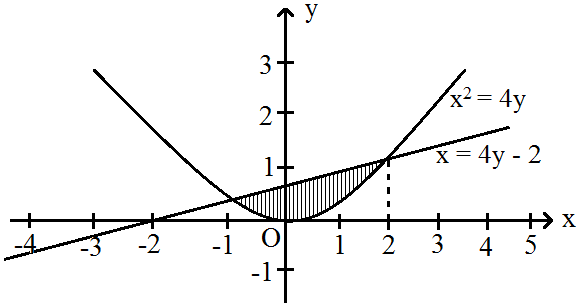
$\therefore$ From the figure, area of shaded region
$\text{A}=\int\limits^2_{-1}\Big(\frac{\text{x}+2}{4}-\frac{\text{x}^2}{4}\Big)\text{dx}$
$=\frac{1}{4}\Big[\frac{\text{x}^2}{2}+2\text{x}-\frac{\text{x}^3}{3}\Big]^2_{-1}$
$=\frac{1}{4}\bigg[\Big(\frac{4}{2}+4-\frac{8}{3}\Big)-\Big(\frac{1}{2}-2+\frac{1}{3}\Big)\bigg]$ $=\frac{1}{4}\bigg[8-\frac{1}{2}-3\bigg]=\frac{9}{8}\text{ sq. units}$ View full question & answer→MCQ 421 Mark
The area bounded by the lines $y = |x – 2|, x = 1, x = 3$ and the $x-$ axis is:
- ✓
$1 \ sq.$ unit
- B
$2 \ sq.$ units
- C
$3 \ sq.$ units
- D
$4 \ sq.$ units
AnswerCorrect option: A. $1 \ sq.$ unit
View full question & answer→MCQ 431 Mark
Choose the correct answer from the given four options:The area of the region bounded by parabola $y^2 = x$ and the straight line $2y = x$ is:
- ✓
$\frac{4}{3}\text{ sq. units}$
- B
$1\text{ sq. units}$
- C
$\frac{2}{3}\text{ sq. units}$
- D
$\frac{1}{3}\text{ sq. units}$
AnswerCorrect option: A. $\frac{4}{3}\text{ sq. units}$
Solving $y^2 = x$ and $2y = x$, we get
$\Big(\frac{\text{x}}{2}\Big)^2=\text{x}$
$\Rightarrow\ \text{x}^2=4^{\frac{3}{2}}$
$\Rightarrow\ \text{x(x}-4)=0$
$\Rightarrow\ \text{x}=4,0$
When $x = 0, y = 0$ and when $x = 4, y = 2$
So, the intersection points are $(0, 0)$ and $(4, 2).$
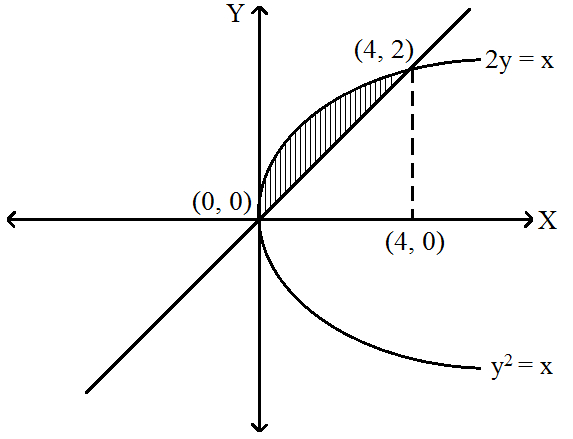
Thus required area of shaded region,
$\text{A}=\int\limits^4_0\Big[\sqrt{\text{x}}-\frac{\text{x}}{2}\Big]\text{dx}$
$=\Bigg[\frac{\text{x}^{\frac{1}{2}+1}}{\frac{1}{2}+1}-\frac{1}{2}\cdot\frac{\text{x}^2}{2}\Bigg]^4_0=\bigg[2\cdot\frac{\text{x}^{\frac{3}{2}}}{3}-\frac{\text{x}^2}{4}\bigg]^4 _0$
$=\frac{2}{3}4^{\frac{3}{2}}-\frac{16}{4}\frac{2}{3}\cdot+\frac{1}{4}\cdot0$
$=\frac{16}{3}-\frac{32}{12}=\frac{48-32}{12}$
$=\frac{16}{12}=\frac{4}{3}\text{ sq. units}$ View full question & answer→MCQ 441 Mark
The area bounded by the lines $y = |x| - 1$ and $y = -|x| + 1$ is:
AnswerCorrect option: B. $\text{2 sq. unit}$
View full question & answer→MCQ 451 Mark
Area of the region bounded by the curve $\text{y}=\cos\text{x}$ between $x = 0$ and $\text{x}=\pi$ is:
- ✓
$2 \ sq$. units
- B
$4 \ sq.$ units
- C
$3 \ sq.$ units
- D
$1 \ sq.$ units
AnswerCorrect option: A. $2 \ sq$. units
View full question & answer→MCQ 461 Mark
The area bounded by the curvey $=\sqrt{\text{x}}$ the line 2y + 3 = x and the x - axis in the first quadrant is:
- ✓
$9$
- B
$\frac{27}{4}$
- C
$36$
- D
$18$
AnswerGiven curves are $\text{y}=\sqrt{\text{x}}$ ...(1)and 2y - x + 3 = 0 ...(2)
Solving (1) and (2), we get
$=\sqrt{2}-(\sqrt{\text{x}})^2+3=0$
$\Rightarrow(\sqrt{\text{x}})^2-2\sqrt{\text{x}}-3=0$
$\Rightarrow(\sqrt{\text{x}}-3)(\sqrt{\text{x}}-3=0$
$\Rightarrow\sqrt{\text{x}}-3$
$\because\sqrt{\text{x}}=-1 \text{ is}\text{ not}\text{ possible}$
$\therefore\text{y}=3$
Hence required area
$=\int\limits^3_0(\text{x}_2-\text{x}_1\text{dy}$
$=\int\limits^3_0((2\text{y}+3)-\text{y}^2)\text{dy}$
$=\Big[\text{y}^2+3\text{y}-\frac{\text{y}^3}{3}\Big]^3_0$
$=9+9-9=9$
View full question & answer→MCQ 471 Mark
The area bounded by the line $y = 2x – 2, y = – x$ and $x-$axis is given by:
- A
$\frac{9}{2}\text{ sq.}\text{ units}$
- B
$\frac{43}{6}\text{ sq.}\text{ units}$
- C
$\frac{35}{6}\text{ sq.}\text{ units}$
- ✓
View full question & answer→MCQ 481 Mark
The area bounded by $y - 1 = |x|, y = 0$ and $|x| =\frac{1}{2}$ will be:
- A
$\frac{3}{4}$
- B
$\frac{3}{2}$
- ✓
$\frac{5}{4}$
- D
AnswerCorrect option: C. $\frac{5}{4}$
View full question & answer→MCQ 491 Mark
Area lying first quadrant and bounded by the circle $x^2 + y^2 = 4$ and the line $x = 0$ and $x = 2,$ is:
- ✓
$\pi$
- B
$\frac{\pi}{2}$
- C
$\frac{\pi}{3}$
- D
$\frac{\pi}{4}$
Answer$x^2 + y^2 = 4$ represents a circle with centre at origion $O(0, 0)$ and radius $2$ units,
cutting the coordinate axis at $A, A\ ', B$ and $B\ ', x =2$
represents a straight line parallel to the $y-$axis,
intersecting the circle at $A(2, 0)x = 0$ respresents the $y-$axis
Area bounded by the circle and the two given lines in the first quadrant is the shaded area $\text{OBCAO}$
Area$\text{(OBCAO)}=\int\limits^2_0|\text{y}|\text{dx}$
$=\int\limits^2_0\sqrt{4-\text{x}^2}\text{dx}$
$=\bigg[\frac{1}{2}\text{x}\sqrt{4-\text{x}^2}+\frac{1}{2}\times4\sin^{-1}\Big(\frac{\text{x}}{2}\Big)\bigg]^2_0$
$= \frac{1}{2}\times2\sqrt{4-2^2}+\frac{1}{2}\times4\sin^{-1}\Big(\frac{2}{2}\Big)-0$
$= 0 + 2 \sin^{-1}(1)$
$= 2\times\frac{\pi}{2}$
$= \pi\text{ sq. units}$
View full question & answer→MCQ 501 Mark
Choose the correct answer from the given four options:
The area of the region bounded by the y-axis, $\text{y}=\cos\text{x}$ and $\text{y}=\sin\text{x},0\leq\text{x}\leq\frac{\pi}{2}$ is:
- A
$\sqrt{2}\text{ sq. units}$
- B
$\big(\sqrt{2}+1)\text{ sq. units}$
- ✓
$\big(\sqrt{2}-1)\text{ sq. units}$
- D
$\big(2\sqrt{2}-1)\text{ sq. units}$
AnswerCorrect option: C. $\big(\sqrt{2}-1)\text{ sq. units}$
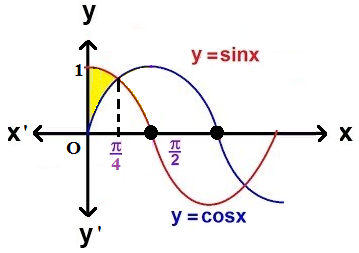
We have, Y-axis i.e., x = 0, $\text{y}=\cos\text{x}$ and $\text{y}=\sin\text{x},$ where $0\leq\text{x}\leq\frac{\pi}{2}$ View full question & answer→MCQ 511 Mark
The area enclosed between the curve $\text{y}=\log_{\text{e}}(\text{x}+\text{e}),\text{x}=\log_\text{e}\Big(\frac{1}{\text{y}}\Big)$ and the $x-$ axis is:
Answer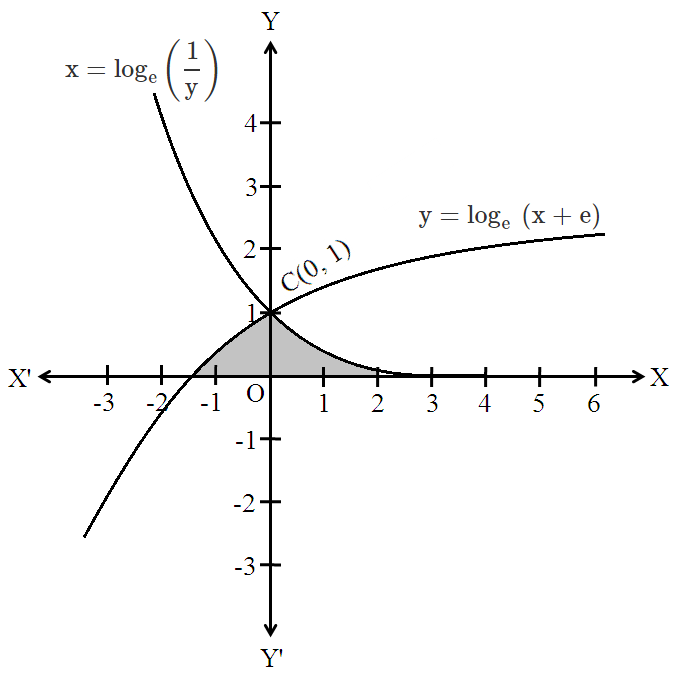
The point of intersection of the curves $\text{y}=\log_{\text{e}}(\text{x}+\text{e})$ and $\text{x}=\log_\text{e}\Big(\frac{1}{\text{y}}\Big) $
$\text{y}=\log_{\text{e}}(\text{x}+\text{e})$
$\Rightarrow\text{x}+\text{e}=\text{e}^{\text{y}}$
$\Rightarrow\text{x}=\text{e}^{\text{y}}-\text{e}$
and $\text{x}_{2} = \log_\text{e}\Big(\frac{1}{\text{y}}\Big)$
Therefore, area of the required region,
$\text{A} = \int\limits^1_0(\text{x}_2-\text{x}_1)\text{ dy} \Big[\text{where}, = \text{x}_1 = \text{e}^{\text{y}}-\text{e}\text{ and }\text{x}_2= \log_\text{e}\Big(\frac{1}{\text{y}}\Big)\Big]$
$\text{A} = \int\limits^1_0\log_\text{e}\Big(\frac{1}{\text{y}}\Big)\text{ dy}-\int\limits^1_0(\text{e}^\text{y}-\text{e})\text{ dy}$
$\text{A}=\int\limits^1_0\log_\text{e}\Big(\frac{1}{\text{y}}\Big)\text{ dy}-\big[\text{e}^{\text{y}}-\text{ey}\big]\ ...(\text{i})$
Let $\text{I} = \int\log_\text{e}\Big(\frac{1}{\text{y}}\Big)\text{dy}$
Putting $\frac{1}{\text{y}}=\text{t}$
Therefore, integral becomes
$\text{I} = \int-\frac{1}{\text{t}^{2}}\log_\text{e}\text{t}\text{ dt} $
$= -\log_\text{e}\text{t}\int\frac{1}{\text{t}^{2}}\text{ dt}-\int\frac{1}{\text{t}}\times\frac{1}{\text{t}}\text{ dt}$
$= \frac{1}{\text{t}}\log_\text{e}\text{t}+\frac{1}{\text{t}}$
$= \text{y}\log_\text{e}\frac{1}{\text{y}}+\text{y}$
Now, $(i)$ becomes
$\text{A} = \Big[\text{y}\log_\text{e}\frac{1}{\text{y}}+\text{y}\Big]^1_0-\big[\text{e}^\text{y}-\text{ey}\big]^1_0$
$=\Big[\text{y}\log_\text{e}\Big(\frac{1}{\text{y}}\Big)+\text{y}-\text{e}^{\text{y}}+\text{ey}\Big]^1_0$
$=\big[\log_\text{e}(1)+1-\text{e}^1+\text{e}(1)\big]-\big[0+0-\text{e}^{(0)}+\text{e}(0)\big]$
$= 2$ View full question & answer→MCQ 521 Mark
Compute the area of the figure bounded by straight lines $x = 0, x = 2$ and the curves $y = 2^x$ and $y = 2x - x^2$:
- ✓
$\frac{3}{\log 2}-\frac{4}{3}$
- B
$\frac{3}{\log 2}+\frac{4}{3}$
- C
$\frac{4}{\log 3}-\frac{4}{3}$
- D
$\frac{4}{\log 2}+\frac{1}{3}$
AnswerCorrect option: A. $\frac{3}{\log 2}-\frac{4}{3}$
$=\int\limits^2_02^\text{x}-2\text{x}+\text{x}^2\text{ dx}$
$=\Big[\frac{2^\text{x}}{\text{In(2)}}+\frac{(\text{x}-3)\text{x}^2}{3}\Big]^2_0$
$=\Big[\frac{4}{\text{In}2}-\frac{4}{3}\Big]-\Big[\frac{1}{\text{In}2}\Big]$
$=\frac{3}{\text{log}\ 2}-\frac{4}{3}$
View full question & answer→MCQ 531 Mark
The area bounded by the curve $y = f(x),$ the $x-$axis and $x = 1$ and $x = b$ is $(b – 1)$ $\sin(3b + 4).$ Then$, f(x)$ is:
AnswerCorrect option: C. $\sin(\text{3x}-4)+3(\text{x}-1).\cos(3\text{x}+4)$
View full question & answer→MCQ 541 Mark
Choose the correct answer:Area of the region bounded by the curve $y^2 = 4x, y-$axis and the line $y = 3$ is:
- A
$2$
- ✓
$\frac94$
- C
$\frac93$
- D
$\frac92.$
AnswerCorrect option: B. $\frac94$
The equation of curve is $y^2 = 4x$
We are to find the area bounded by the curve $y^2 = 4x, y-$axis and the line $y = 3.$
Required area $=\int\limits^3_0\text{x dy}=\int\limits^3_0\frac{\text{y}^2}{4}\text{dy}$
$=\frac14\int\limits^3_0\text{y}^2\text{dy}=\frac14\Big[\frac{\text{y}^3}{3}\Big]^3_0$
$=\frac{1}{12}\Big[\text{y}^3\Big]^3_0=\frac{1}{12}(27-0)$
$=\frac{27}{12}=\frac94$
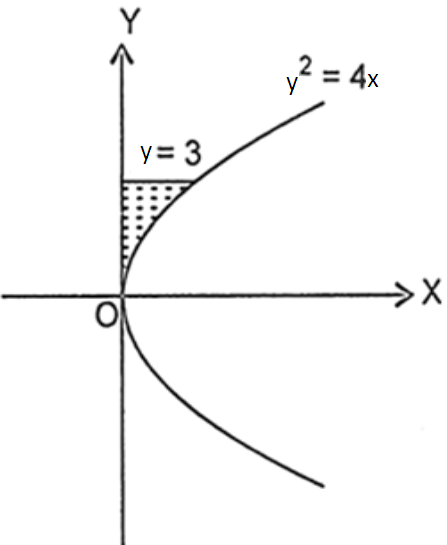
View full question & answer→MCQ 551 Mark
The area of the region bounded by the curve $=2x - x^2$ and the line $y = x$ is $........$ square units:
- ✓
$\frac{1}{6}$
- B
$\frac{1}{2}$
- C
$\frac{1}{3}$
- D
$\frac{7}{6}$
AnswerCorrect option: A. $\frac{1}{6}$
We note that the region bounded by these curves is in the region $x \in [0, 1].$
In this region, the curve $y = x$ lies below the curve $y = 2x - x^2$ So, to
calculate the area of said region, we evaluatie the following integral:
$=\int\limits^1_02\text{x}-\text{x}^2-\text{x}\text{dx}$
$=\int\limits^1_0\text{x}-\text{x}^2\text{dx}$
$=\Big[\frac{\text{x}^2}{2}-\frac{\text{x}^3}{3}\Big]^\text{x=1}_{\text{x=0}}$
$=\frac{1}{2}-\frac{1}{3}=\frac{1}{6}.$
View full question & answer→MCQ 561 Mark
Area of the region bounded by the curve $y = |x + 1| + 1, x = –3, x = 3$ and $y = 0$ is:
- A
$8 \ sq$ units
- ✓
$16 \ sq$ units
- C
$32 \ sq$ units
- D
AnswerCorrect option: B. $16 \ sq$ units
View full question & answer→MCQ 571 Mark
The area $($in $sq.$ units$)$ bounded by the curves $\text{y}=\sqrt{\text{x}},2\text{y}-\text{x}+3=0$ and $x-$axis lying in the first quadrant is:
- ✓
$9$
- B
$36$
- C
$18$
- D
$\frac{27}{4}$
View full question & answer→MCQ 581 Mark
The area common to the parabola $y = 2x^2$ and $y = x^2+ 4$ is:
- A
$\frac{2}{3}\text{ sq. units}$
- B
$\frac{3}{2}\text{ sq. units}$
- ✓
$\frac{32}{3}\text{ sq. units}$
- D
$\frac{3}{32}\text{ sq. units}$
AnswerCorrect option: C. $\frac{32}{3}\text{ sq. units}$
View full question & answer→MCQ 591 Mark
The area of the region bounded by the curve $x^2 = 4y$ and the straight line $x = 4y - 2$ is:
- A
$\frac{3}{8}\ \text{sq}.\text{units}$
- B
$\frac{5}{8}\ \text{sq}.\text{units}$
- C
$\frac{7}{8}\ \text{sq}.\text{units}$
- ✓
$\frac{9}{8}\ \text{sq}.\text{units}$
AnswerCorrect option: D. $\frac{9}{8}\ \text{sq}.\text{units}$
View full question & answer→MCQ 601 Mark
The value of $aa$ for which the area between the curves $y^2 = 4ax$ and $x^2 = 4ay$ is $\text{1 sq.unit,}$ is:
- A
$\sqrt{3}$
- B
$4$
- C
$4\sqrt{3}$
- ✓
$\frac{\sqrt{3}}{4}$
AnswerCorrect option: D. $\frac{\sqrt{3}}{4}$
$=\text{y}^2=4\text{ ax}$
$=\text{y}=\sqrt{4\text{ ax}}$
$=\text{x}^2=4\text{ ax}$
$=\text{y}=\frac{\text{x}^2}{4\text{a}}$
$=$area$=\int\limits^{4\text{a}}_0\sqrt{4\text{a}\text{x}}\text {d}\text{x}-\int\limits^{4\text{a}}_0\frac{\text{x}^2}{4\text{a}}\text{dx}$
$=2\sqrt{\text{a}}\times\frac{2}{3}\text{(x})^\frac{3}{2}\Big]^{4\text{a}}_0-\frac{\text{x}^3}{3(4\text{a})}\Big]^{4\text{a}}_0$
$=\frac{32\text{a}^2}{3}-\frac{16\text{a}^2}{3}$
$=\frac{16\text{a}^2}{3}=1$
$=\text{a}=\frac{\sqrt{3}}{4}$
View full question & answer→MCQ 611 Mark
The area of the region bounded by the ellipse $\frac{\text{x}\ ^2}{25}+\frac{\text{y}^2}{16}=1$ is.
- ✓
$25\pi\text{ sq.}\text{ units}$
- B
$20\pi^2\text{ sq.}\text{ units}$
- C
$16\pi^2\text{ sq.}\text{ units}$
- D
$25\pi\text{ sq.}\text{ units}$
AnswerCorrect option: A. $25\pi\text{ sq.}\text{ units}$
View full question & answer→MCQ 621 Mark
The area under the curve $y = x^4$ and the lines $x = 1, x = 5$ and $x-$axis is:
- A
$\frac{3124}{3}\text{ sq.}\text{ units}$
- B
$\frac{3124}{7}\text{ sq.}\text{ units}$
- ✓
$\frac{3124}{5}\text{ sq.}\text{ units}$
- D
$\frac{3124}{9}\text{ sq.}\text{ units}$
AnswerCorrect option: C. $\frac{3124}{5}\text{ sq.}\text{ units}$
Concept:
The area under the function $y = f(x)$ from $x = a$ to $x = b$ and the $x-$axis is given by the definite integral
$\int\limits^\text{b}_\text{a}\text{f(x)}\text{dx}$
This is for curves that are entirely on the same side of the $x-$axis in the given range.
If the curves are on both sides of the $x-$axis, then we calculate the areas of both sides separately and add them.
Definite integral:
If$\int\text{f(x)}\text{dx}=\text{g(x)}+\text{c},$then
$\int\limits^\text{b}_\text{a}\text{f(x)}\text{dx}=[\text{g(x)}]^\text{b}_\text{a}=\text{g(b)}-\text{g(a)}$
$\int\text{x}^\text{n}\text{dx}=\frac{\text{x}^\text{n+1}}{\text{n+1}}+\text{c} $
Calculation:
$\int\text{x}^4\text{dx}=\frac{\text{x}^5}{5}+\text{c.}$
Using the above concept for area of a curve, we can say that the required area is:
$\text{I}=\int\limits^5_1\text{x}^4\text{dx}$
$=\Big[\frac{\text{x}^5}{5}\Big]^5_1$
$=\frac{5^5}{5}-\frac{1^5}{5}$
$=\frac{3125-1}{5}$
$=\frac{3124}{5}$
View full question & answer→MCQ 631 Mark
The area bounded by the curve $y^2= x$, line $y = 4$ and $y-$axis is:
- A
$\frac{16}{3}\ \text{sq.}\text{units}$
- ✓
$\frac{64}{3}\ \text{sq.}\text{units}$
- C
$7\sqrt{2}\ \text{sq.}\text{units}$
- D
AnswerCorrect option: B. $\frac{64}{3}\ \text{sq.}\text{units}$
View full question & answer→MCQ 641 Mark
The area common to the ellipse $\frac{\text{x}^2}{\text{a}^2}+\frac{\text{y}^2}{\text{b}^2}=1$ and $\frac{\text{x}^2}{\text{b}^2}+\frac{\text{y}^2}{\text{a}^2}=1,0<\text{b}<\text{a}$ is:
- A
$(\text{a}+\text{b})^2\tan^{-1}\frac{\text{b}}{\text{a}}$
- B
$(\text{a}+\text{b})^2\tan^{-1}\frac{\text{a}}{\text{b}}$
- ✓
$4\text{a}+\text{b}\tan^{-1}\frac{\text{b}}{\text{a}}$
- D
$4\text{a}+\text{b}\tan^{-1}\frac{\text{a}}{\text{b}}$
AnswerCorrect option: C. $4\text{a}+\text{b}\tan^{-1}\frac{\text{b}}{\text{a}}$
View full question & answer→MCQ 651 Mark
Area bounded by the curvey $\text{y}=\text{x}+\sin\text{x}$ and its inverse function between the ordinates $\text{x}=0$ and $\text{x}=2\pi$ is:
- A
$8\pi\text{ sqp}.\text{units}$
- B
$4\pi\text{ sq}.\text{units}$
- ✓
$8\pi\text{ sq}.\text{units}$
- D
$3\pi\text{ sq}.\text{units}$
AnswerCorrect option: C. $8\pi\text{ sq}.\text{units}$
Inverse function is the mirror image with respect to y = x
Then area bounded by $\text{x}+\sin\text{x}$ and its inverse function is
$=4\int\limits^\pi_0(\text{x}+\sin\text{x}-\text{x})\text{ dx}=8$
View full question & answer→MCQ 661 Mark
The area enclosed between the graph of $y = x^3$ and the lines $x = 0, y = 1, y = 8$ is:
- ✓
$\frac{45}{4}$
- B
$14$
- C
$7$
- D
AnswerCorrect option: A. $\frac{45}{4}$
View full question & answer→MCQ 671 Mark
Area bounded between the curve $x^2 = y$ and the line $y = 4x$ is:
- ✓
$\frac{32}{3}\text{sq}\text{ unit}$
- B
$\frac{1}{3}\text{sq}\text{ unit}$
- C
$\frac{8}{3}\text{sq}\text{ unit}$
- D
$\frac{16}{3}\text{sq}\text{ unit}$
AnswerCorrect option: A. $\frac{32}{3}\text{sq}\text{ unit}$
Given curves are $x^2 = y$ and $y = 4x$
Intersection points are $(0, 0)$ and $(4, 16)$
$\therefore$ Required area
$=\int\limits^4_0(4\text{x}-\text{x}^2)\text{dx}$
$=\Big[\frac{4\text{x}^2}{2}-\frac{\text{x}^3}{3}\Big]^4_0$
$=\Big[32-\frac{64}{3}\Big]$
$=\frac{32}{3}\text{sq}\text{ unit}$
View full question & answer→MCQ 681 Mark
Area enclosed by the circle $x^2 + y^2 = a^2$ is equal to:
- A
$2\pi\text{a}^2\text{sq.}\text{ units}$
- ✓
$\pi\text{a}^2\text{sq.}\text{ units}$
- C
$2\pi\text{a}\text{ sq.}\text{ units}$
- D
$\pi\text{a}\text{ sq.}\text{ units}$
AnswerCorrect option: B. $\pi\text{a}^2\text{sq.}\text{ units}$
View full question & answer→MCQ 691 Mark
The area of the region bounded by the curves $= xe^x, y = xe^{−x}$ and the line $x=1$ is:
- A
$\frac{4}{\text{e}}$
- B
$\frac{3}{\text{e}}$
- ✓
$\frac{2}{\text{e}}$
- D
$\frac{1}{\text{e}}$
AnswerCorrect option: C. $\frac{2}{\text{e}}$
View full question & answer→MCQ 701 Mark
The area of the region bounded by the parabola $y = x^2 + 1$ and the staight line $x + y = 3$ is given by:
- A
$\frac{45}{7}$
- B
$\frac{25}{4}$
- C
$\frac{\pi}{18}$
- ✓
$\frac{9}{2}$
AnswerCorrect option: D. $\frac{9}{2}$
To find the point of intersection of the parabola
$y = x^2 + 1$ and the line $x + y = 3$
substitute $y = 3 - x$ in $y = x^2 + 13 - x = x^2 + 1$
$\Rightarrow x^2 + x - 2 = 0$
$\Rightarrow (x - 1)(x + 2) = 0$
$\Rightarrow x = 1$ or $x = -2$
$\therefore y = 2$ or $y = 5$
So, we get the points of intersection $A (-2, 5)$ and $C (1, 2).$
Therefore, the required area $\text{ABC},$
$\text{A} = \int\limits^1_{-2}(\text{y}_1-\text{y}_2)\text{dx}$ $\big(\text{Where}, \text{y}_1 = 3-\text{x }\text{and}\text{ y}_2 = \text{x}^2+1\big)$
$=\int\limits^1_{-2}\big[(3-\text{x})-(\text{x}^2+1)\big]\text{dx}$
$=\int\limits^1_{-2}(3-\text{x}-\text{x}^2-1)\text{dx}$
$=\int\limits^1_{-2}\big(2-\text{x}-\text{x}^2\big)\text{dx}$
$= \Big[2\text{x}-\frac{\text{x}^2}{2}-\frac{\text{x}^3}{3}\Big]^1_{-2}$
$=\bigg[2(1)-\frac{(1)^2}{2}-\frac{(1)^3}{3}\bigg]-\bigg[2(-2)-\frac{(-2)^2}{2}-\frac{(-2)^3}{3}\bigg]$
$=\Big[2-\frac{1}{2}-\frac{1}{3}\Big]-\Big[-4-2+\frac{8}{3}\Big]$
$=2-\frac{1}{2}-\frac{1}{3}+4+2-\frac{8}{3}$
$=8-\frac{1}{2}-\frac{9}{3}$
$=5-\frac{1}{2}$
$=\frac{9}{2}\text{ square units}$
View full question & answer→MCQ 711 Mark
The area of the region $\{(\text{x},\text{y}):\text{y}^2\leq4\text{x},4\text{x}^2+4\text{y}^2\leq9\}$ is:
- ✓
$\frac{\sqrt2}{6}+\frac{9\pi}{8}-\frac{9}{4}\sin-1(\frac{1}{5})$
- B
$\frac{\sqrt2}{6}-\frac{9\pi}{8}$
- C
$\frac{9\pi}{8}-\frac{9}{4}\sin-1(\frac{1}{3})$
- D
AnswerCorrect option: A. $\frac{\sqrt2}{6}+\frac{9\pi}{8}-\frac{9}{4}\sin-1(\frac{1}{5})$
View full question & answer→MCQ 721 Mark
The area bounded by $y = x^2$ and $y = 1 - x^2$ is:
- ✓
$\frac{\sqrt{8}}{3}$
- B
$\frac{16}{3}$
- C
$\frac{32}{3}$
- D
$\frac{17}{3}$
AnswerCorrect option: A. $\frac{\sqrt{8}}{3}$
Required are
$=2\Bigg[\int\limits^\frac{1}{\sqrt{2}}_0(1+\text{x}^2)\text{dx}-\int\limits^\frac{1}{\sqrt{2}}_0\text{x}^2\text{dx}\Bigg]$
$=2\Bigg[\text{x}+\frac{\text{x}^3}{3}\Bigg]^\frac{1}{\sqrt{2}}_0-2\Bigg[\frac{\text{x}^3}{3}\Bigg]^\frac{1}{\sqrt{2}}_0$
$=\frac{\sqrt{8}}{3}$
View full question & answer→MCQ 731 Mark
The area bounded by $y = x^2, y = [x+1], \text{x}\leq1$ and the $y -$ axis is:
- A
$\frac{1}{3}$
- ✓
$\frac{2}{3}$
- C
$1$
- D
$\frac{7}{3}$
AnswerCorrect option: B. $\frac{2}{3}$
Required area
$=\int\limits^1_0\sqrt{\text{y}}\text{dx}$
$=\frac{2}{3}$
View full question & answer→MCQ 741 Mark
Area between the parabola $x^2 = 4y$ and line $x = 4y –2$ is:
- A
$\frac{8}{9}$
- B
$\frac{9}{7}$
- C
$\frac{7}{9}$
- ✓
$\frac{9}{8}$
AnswerCorrect option: D. $\frac{9}{8}$
View full question & answer→MCQ 751 Mark
If the curves $y = x^3 + ax$ and $y = bx^2 + c$ pass through the point $(-1, 0)$ and have common tangent line at this point, then the value of $a+b$ is?
AnswerAs the curve pass through the point $P(-1, 0) 0 = a = -1$
$\Rightarrow a = -10 = b +$ Common tangent at this point
$=\frac{\text{dx}}{\text{dx}}=2\text{ bx} $ and $\frac{\text{dy}}{\text{dx}}=3\text{x}^2+\text{a}$
$= 3 - 1 = 2$
$2bx = 2 - 2b =2b $
$= -1a + b = -2$
View full question & answer→MCQ 761 Mark
The area bounded by the curves $\text{y}=\sin\text{x},\text{y}=\cos\text{x}$ y − axes in first quadrant is:
AnswerCorrect option: A. $\sqrt{2}-1$
The area bounded by the curves $\text{y}=\sin\text{x},\text{y}=\cos\text{x}$ y − axes in first quadrant is,
$\text{A}=\int\limits^\frac{\pi}{4}_0(\cos\text{x}-\sin\text{x})\text{dx}$
$=[\sin\text{x}+\cos\text{x}]^\frac{\pi}{4}_0$
$=\Big(\sin\frac{\pi}{4}+\cos\frac{\pi}{4}\Big)-(\sin0+\cos0)$
$=\sqrt{2}-1$
View full question & answer→MCQ 771 Mark
The area bounded by $y –1 = |x|, y = 0$ and $|x| \frac{1}{2}$ will be:
- A
$\frac{3}{4}$
- B
$\frac{3}{2}$
- ✓
$\frac{5}{4}$
- D
AnswerCorrect option: C. $\frac{5}{4}$
View full question & answer→MCQ 781 Mark
Choose the correct answer from the given four options:
The area of the region bounded by the curve x = 2y + 3 and the y lines. y = 1 and y = -1 is:
AnswerCorrect option: C. $6\text{ sq. units}$
Required area, $\text{A}=\int\limits^1_{-1}(2\text{y}+3)\text{dy}$
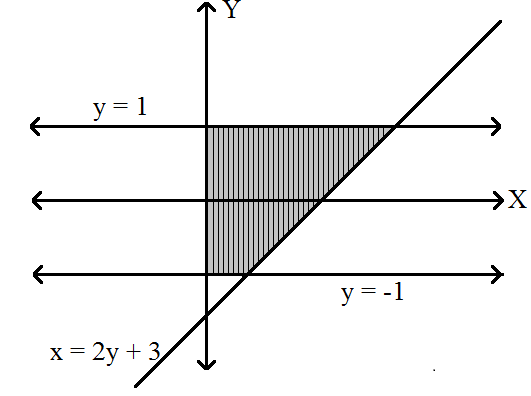
$=\Big[\frac{2\text{y}^2}{2}+3\text{y}\Big]^1_{-1}$
$\Big[\text{y}^2+3\text{y}\Big]^1_{-1}$
$=\big[1+3-1+3\big]$
$=6\text{ sq. units}$ View full question & answer→MCQ 791 Mark
The area bounded by the curve $x^2+ y^2= 1$ in first quadrant is:
- ✓
$\frac{\pi}{4}\ \text{sq.}\text{units}$
- B
$\frac{\pi}{2}\ \text{sq.}\text{units}$
- C
$\frac{\pi}{3}\ \text{sq.}\text{units}$
- D
$\frac{\pi}{6}\ \text{sq.}\text{units}$
AnswerCorrect option: A. $\frac{\pi}{4}\ \text{sq.}\text{units}$
View full question & answer→MCQ 801 Mark
The area bounded by the curve $y = (x + 1)^2, y = (x - 1)^2$ and the line $y = 0$ is:
- A
$\frac{1}{6}$
- ✓
$\frac{2}{3}$
- C
$\frac{1}{4}$
- D
$\frac{1}{3}$
AnswerCorrect option: B. $\frac{2}{3}$
$\text{R.E.F}$ image $\rightarrow y = (x + 1)^2$ is obtained by shifting origin to $(-1, 0)$ in $x^2= y$,
for $y = (x - 1)^2$ Similarly $(1, 0)$ As graph is symmetric about $y -$ axis, area $A$ would be,
$=\text{A}=2\int\limits^1_0(\text{x}-1)^2\text{dx}$
$=2\int\limits^1_0\text{x}^2-2\text{x}+1\text{dx}=2$
$\Big[\text{x}\frac{3}{3}-\text{x}^2+\text{x}\Big]^1_0$
$=2\Big(\frac{1}{3}-1+1\Big)=\frac{2}{3}$
View full question & answer→MCQ 811 Mark
The area bounded by the parabola $y^2= 4ax$, latus rectum and $x-$axis is:
- A
$0$
- ✓
$\frac{4}{3}\text{a}^2$
- C
$\frac{2}{3}\text{a}^2$
- D
$\frac{\text{a}^2}{3}$
AnswerCorrect option: B. $\frac{4}{3}\text{a}^2$
View full question & answer→MCQ 821 Mark
Points of inflexion of the curve $y = x^4 - 6x^3+ 12x^2 + 5x + 7$ are
- A
$(1, 19); (1, 12)$
- ✓
$(1, 19); (2, 33)$
- C
$(1, 2); (2, 1)$
- D
$(1, 7); (2, 6)$
AnswerCorrect option: B. $(1, 19); (2, 33)$
$y = x^4 - 6x^3 + 12x^2 + 5x + 7y(x)$
$= 4x^3 - 18x^2 + 24x + 5y(x)$
$= 12x^2- 36x + 24y(x)$
$= 012x^2 - 36x + 24 = 0x^2 - 3x + 2$
$= 0x^2 - 2x - x + 2$
$= 0x(x - 2) -1(x - 2) = 0(x - 1) -1(x - 2)$
$= 0(x - 1)(x - 2) = 0(x - 1)(x - 2) = 0x = 1, 2$
Inflection point of a function is where the function changes from concave up to concave down or vice $-$ versa $x < 1, f(x) > 01 < x < 2, f(x) < 0x > 2, f(x) > 0$
$\because f(x)$ changes sign
$\therefore$ At $x = 1, 2y = f(x)$ has inflection point At $x = 1, y = f(1) = 19$ At $x = 2, x = f(2) = 33x = 2, y = f(2) = 33$
Point of inflection $(1,19); (2,33)$
View full question & answer→MCQ 831 Mark
Area between the parabolas $y^2 = 4ax$ and $x^2 = 4ay$ is:
- A
$\frac{2}{3}\text{a}^2-5$
- B
$\frac{15}{4}\text{a}^2+5$
- C
$\frac{16}{3}\text{a}^2+2$
- ✓
$\frac{16}{3}\text{a}^2$
AnswerCorrect option: D. $\frac{16}{3}\text{a}^2$
View full question & answer→MCQ 841 Mark
The area bounded by \displaystyle $y = xe^{∣X∣}$ and $|x| = 1$ is:
Answer$=\text{I}=\int\limits^1_{-1}\text{y}\text{dx}$
$=\int\limits^1_{-1}\text{dx}^\text{x}\text{dx}$
$=\int\limits^1_{-1}\text{dx}^\text{-x}\text{dx}+\int\limits^1_0\text{xe}^\text{x}\text{dx}$
$=[-\text{xe}^\text{-x}+\int\text{e}^\text{-x}\text{ dx}]^0_{-1}+[\text{xe}^\text{x}-\int\text{e}^\text{x}\text{dx}]^1_0$
$=[-\text{xe}^\text{-x}-\text{e}^\text{-x}]^0_{-1}+[\text{xe}^\text{x}-\text{e}^\text{x}]^1_0$
$=-1-\text{(e}-\text{e})]+[\text{e}-\text{e}(-1)]=|-1|+|1|$
we take modulus because area can not be negative and this function is symmetry about $y$ axis.
we have to put modulus otherwise area will be zeroso,ans is $2$
View full question & answer→MCQ 851 Mark
Choose the correct answer in the following.
The area bounded by the curve y = x|x|, x-axis and the ordinates x = -1 and x = 1 is given by,
- A
- B
$\frac13$
- ✓
$\frac23$
- D
$\frac43.$
AnswerCorrect option: C. $\frac23$
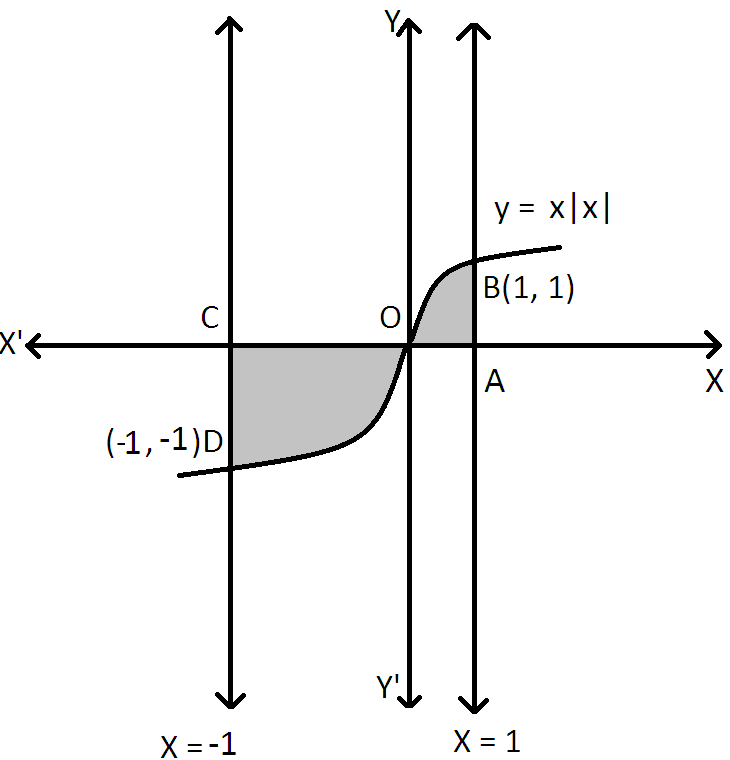
$\text{Required area}=\int\limits^1_0\text{y dx}$
$=\int\limits^1_{-1}\text{x}|\text{x}|\text{dx}$
$=\int\limits^{0}_{-1}\text{x}^2\text{dx}+\int\limits^1_0\text{x}^2\text{dx}$
$=\Big[\frac{\text{x}^3}{3}\Big]^0_{-1}+\Big[\frac{\text{x}^3}{3}\Big]^1_0$
$=-\Big(-\frac13\Big)+\frac13$
$=\frac23\text{ units}$
Thus, the correct answer is C. View full question & answer→MCQ 861 Mark
The area under the curve $y= 2x^3+ 4x^2$ between $x = 2, x = 4$ is:
- ✓
$192.6$
- B
$198.6$
- C
$88.3$
- D
$172.3$
AnswerCorrect option: A. $192.6$
The area under the curve is given as
$=\int\limits^4_2\ 2\text{x}^3+4\text{x}^2\text{ dx}$
$=\int\limits^4_2\ 2\text{x}^3\text{ dx}+4\text{x}^2\text{ dx}$
$=2\frac{\text{x}^4}{4}\Big|^4_2+4\frac{\text{x}^3}{3}\Big|^\frac{2}{4}_2$
$=64\times2-8+\frac{4^4}{3}-\frac{32}{3}$
$=120-\frac{224}{3}=192.6$
View full question & answer→MCQ 871 Mark
The area of the plane region bounded by the curves $x + 2y^2 = 0$ and $x + 3y^2 = 1$ is equal to:
- A
$\frac{5}{3}$
- B
$\frac{1}{3}$
- C
$\frac{2}{3}$
- ✓
$\frac{4}{3}$
AnswerCorrect option: D. $\frac{4}{3}$
View full question & answer→MCQ 881 Mark
The area bounded by curve $y = x^2- 1$ and tangents to it at $(2, 3)$ and $y -$ axis is:
- A
$\frac{8}{3}$
- ✓
$\frac{2}{3}$
- C
$\frac{4}{3}$
- D
$\frac{1}{3}$
AnswerCorrect option: B. $\frac{2}{3}$
$=\text{x}-$axis$:(-1,0)$
$=$Area$=\int\limits^0_{-1}(\text{x}^2-1)\text{dx}$
$=\Big[\frac{\text{x}^3}{3}-\text{x}\Big]^0_{-1}$
$=\Big[\frac{-1}{3}-(-1)\Big]-[0]$
$=-\frac{1}{3}+1$
$=\frac{2}{3}\text{sq}.\text{ units}$
View full question & answer→MCQ 891 Mark
The area of the region enclosed by the lines $y = x, x = e$ and curve $\text{y}=\frac{1}{\text{x}}$ and the positive $x -$ axis is:
- A
$1\text{ sq.}\text{ units}$
- ✓
$\frac{3}{2}\text{ sq.}\text{ units}$
- C
$\frac{5}{2}\text{ sq.}\text{ units}$
- D
$\frac{1}{2}\text{ sq.}\text{ units}$
AnswerCorrect option: B. $\frac{3}{2}\text{ sq.}\text{ units}$
View full question & answer→MCQ 901 Mark
A rea bounded by the circle $x^2 + y^2 = 1$ and the curve $| x | + | y | = 1$ is:
- A
$2\pi$
- ✓
$\pi-2$
- C
$\pi$
- D
$\pi+3$
AnswerCorrect option: B. $\pi-2$
View full question & answer→MCQ 911 Mark
Choose the correct answer from the given four options : The area of the region bounded by the circle $x^2 + y^2 = 1$ is :
- A
$2\pi\text{ sq. units}$
- ✓
$\pi\text{ sq. units}$
- C
$3\pi\text{ sq. units}$
- D
$4\pi\text{ sq. units}$
AnswerCorrect option: B. $\pi\text{ sq. units}$
Here, $x^2 + y^2 = 1^2$ is a circle with centre at $(0, 0)$
$\Rightarrow\ \text{y}^2=1-\text{x}^2$
$\Rightarrow\ \text{y}=\sqrt{1=\text{x}^2}$
Graph for the circle $x^2 + y^2 = 1^2$ is shown below:
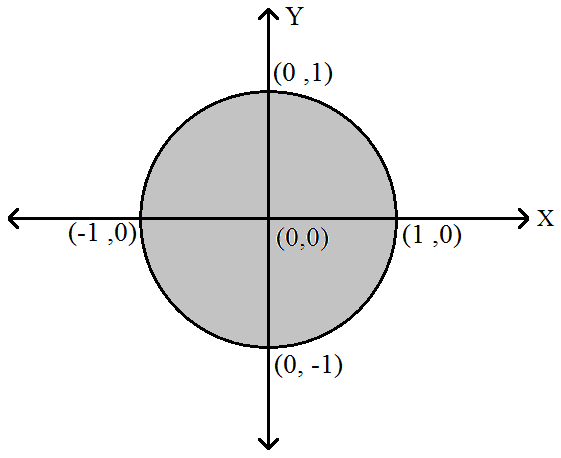
$\therefore$ Area enclosed by circle $=2\int\limits^{1}_{-1}\sqrt{1^2-\text{x}^2}\text{dx}$
$=2.2\int\limits^{1}_{0}\sqrt{1^2-\text{x}^2}\text{dx}$
$=2\cdot2\bigg[\frac{\text{x}}{2}\sqrt{1^2-\text{x}^2}+\frac{1^2}{2}\sin^{-1}\frac{\text{x}}{1}\bigg]^{1}_{0} $
$=4\bigg[\frac{1}{2}\cdot0+\frac{1}{2}\cdot\frac{\pi}{2}-0-\frac{1}{2}\cdot0\bigg] $
$=4\cdot\frac{\pi}{4}=\pi\text{ sq. units} $ View full question & answer→MCQ 921 Mark
Find area bounded by curves $\{(\text{x},\text{y}):\text{y}\geq\text{x}^2$ and ${y}=\text{x}\}$ :
- A
$\frac{5}{3}$
- B
$\frac{1}{2}$
- ✓
$\frac{1}{3}$
- D
$\frac{1}{9}$
AnswerCorrect option: C. $\frac{1}{3}$
$=\text{y}=\text{x}=\{\text{x};\text{x}\geq0-\text{x};\text{x}<0 <0\}\text{p}$ and $Q$ are $x^2 = x$
$= x^2 - x = 0\ x(x - 1) = 0\ x = 0,1Q =1$ similarlyp
$=-\text{A}=\int\limits^1_0\text{x}-\text{x}^2\text{ dx}$
$=\text{A}=\Big[\frac{\text{x}^2}{2}-\frac{\text{x}^3}{3}\Big]^1_0$
$\text{A}=\frac{1}{2}-\frac{1}{3}$
$=\text{A}=\frac{1}{3}$
View full question & answer→MCQ 931 Mark
The area of the region enclosed by the parabola $x^2 = y,$ the line $y = x + 2$ and the $x -$ axis, is:
- A
$\frac{2}{9}$
- ✓
$\frac{9}{2}$
- C
$9$
- D
$2$
AnswerCorrect option: B. $\frac{9}{2}$
$\frac{9}{2}$
View full question & answer→MCQ 941 Mark
Choose the correct answer : Area lying between the curves $y^2 = 4x$ and $y = 2x$ is:
- A
$\frac23$
- ✓
$\frac13$
- C
$\frac14$
- D
$\frac34.$
AnswerCorrect option: B. $\frac13$
Equation of curve $($parabola$)$ is $y^2 = 4x ...(i)$
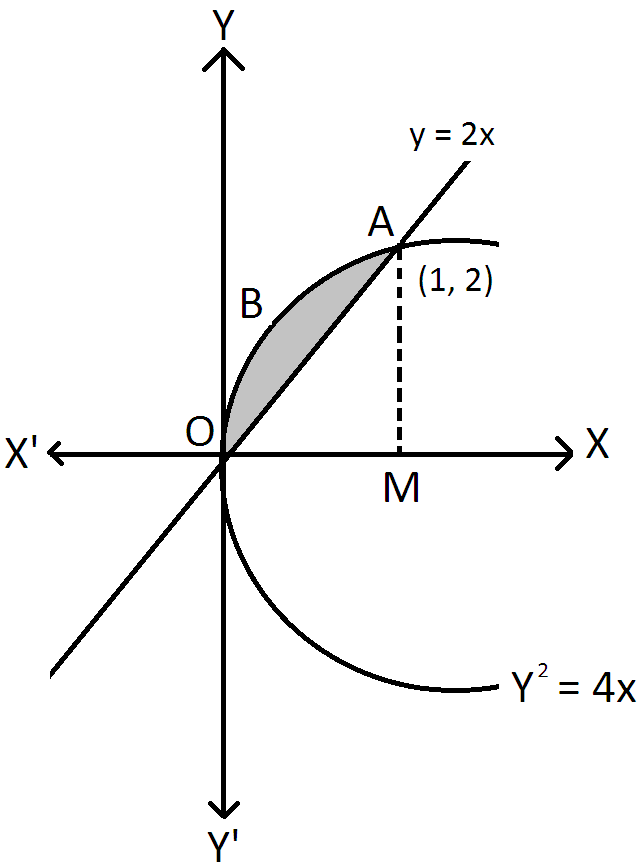
$\Rightarrow\text{y}=2\sqrt{\text{x}}=2\text{x}^{\frac12}...(\text{ii})$
Equation of another curve $($line$)$ is $y = 2x ...(iii)$ Solving eq. $(i)$ and $(iii),$
we get $x = 0$ or $x = 1$ and $y = 0$ or $y = 2$
Therefore, Points of intersections of circle $(i)$ and line $(ii)$ are $O(0, 0)$ and $A(1, 2).$
Now Area $\text{OBAM}=$ Area bounded by parabola $(i)$ and $x-$ axis
$=\Bigg|\int\limits^1_0\text{y dx}\Bigg|=\Bigg|\int\limits^1_02\text{x}^{\frac12}\text{dx}\Bigg|=$ $2\frac{\Big(\text{x}^{\frac32}\Big)^1_0}{\frac32}$
$=\frac43(1-0)=\frac43\dots(\text{iv})$
Also, Area $\Delta\text{ OAM}=$ Area bounded by parabola $(iii) $and $x-$ axis
$=\Bigg|\int\limits^1_0\text{y dx}\Bigg|=\Bigg|\int\limits^1_02\text{x dx}\Bigg|=2\Big(\frac{\text{x}^2}{2}\Big)^1_0 = (1 - 0) = 1 ...(v)$
Now Required shaded area $\text{OBA} =$ Area $\text{OBAM} -$ Area of $\Delta\text{ OAM}$ $=\frac43-1=\frac{4-3}{3}=\frac13\text{ sq. units}$
Therefore, option $(B)$ is correct. View full question & answer→MCQ 951 Mark
Consider the following statements:Statement $I:$ The area bounded by the curve$, \text{y}=\sin\text{x}$ between $\text{x}=0$ and $x = 2p$ is $\text{2 sq. units}.$Statement $II:$ The area bounded by the curve, $\text{y}=2\cos\text{x}$ and the $x-$axis from $\text{x}=0$ to $x = 2p$ is $\text{8 sq. units}.$
- A
Statement $I$ is true
- ✓
Statement $II$ is true
- C
- D
Both statements are false
AnswerCorrect option: B. Statement $II$ is true
View full question & answer→MCQ 961 Mark
The area of the region bounded by the and the lines $x = 2$ and $x = 3.$
- ✓
$\frac{7}{2}\text{ sq}.\text{units}$
- B
$\frac{9}{2}\text{ sq}.\text{units}$
- C
$\frac{11}{2}\text{ sq}.\text{units}$
- D
$\frac{13}{2}\text{ sq}.\text{units}$
AnswerCorrect option: A. $\frac{7}{2}\text{ sq}.\text{units}$
View full question & answer→MCQ 971 Mark
Choose the correct answer in the following : The area of the circle $x^2 + y^2 = 16$ exterior to the parabola $y^2 = 6x$ is:
- A
$\frac43(4\pi-\sqrt3)$
- B
$\frac43(4\pi+\sqrt3)$
- ✓
$\frac43(8\pi-\sqrt3)$
- D
$\frac43(8\pi+\sqrt3).$
AnswerCorrect option: C. $\frac43(8\pi-\sqrt3)$
The given equations are
$x^2 + y^2 = 16 ...(1)$
$y^2 = 6x ...(2)$
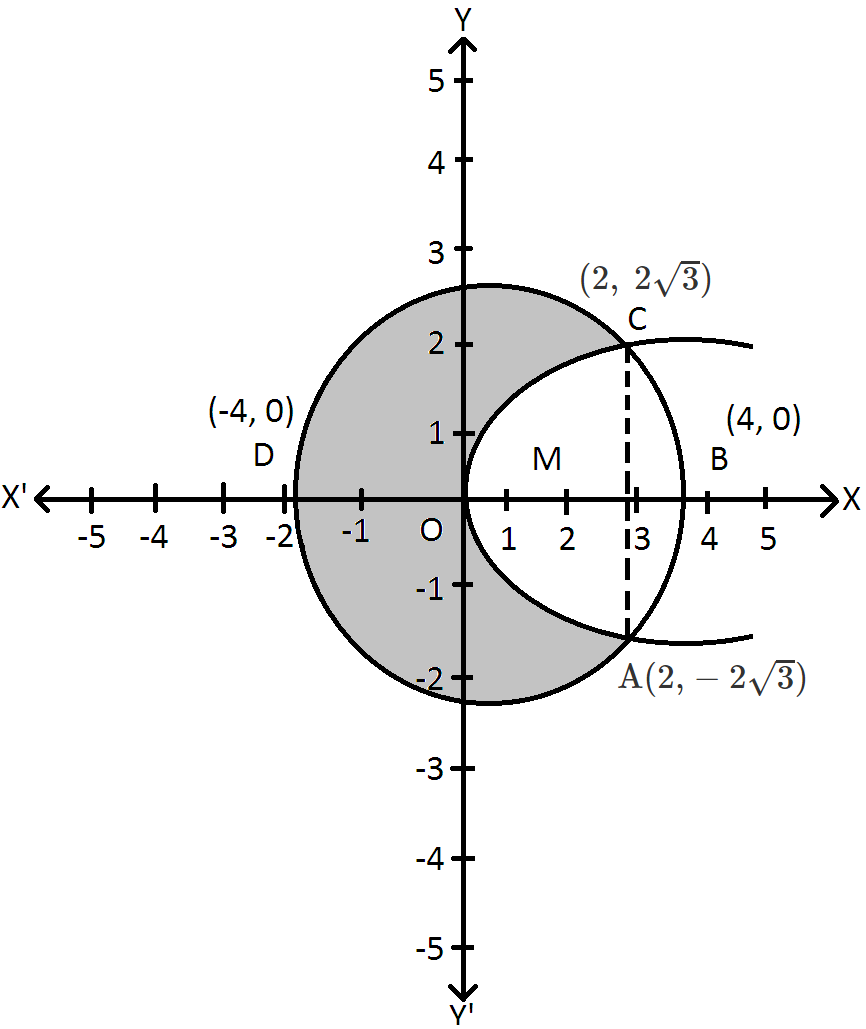
Area bounded by the circle and parabola
$= 2[$Area $\text{(OADO)} \ + $ Area $(\text{ADBA})]$
$=2\bigg[\int\limits^2_0\sqrt{6\text{x}}\text{ dx}+\int\limits^4_2\sqrt{16-\text{x}^2}\text{dx}\bigg]$
$=2\Bigg[\sqrt6\left\{\frac{\text{x}^{\frac32}}{\frac32}\right\}^2_0\Bigg]$ $+2\Big[\frac{\text{x}}{2}\sqrt{16-\text{x}^2}+\frac{16}{2}\sin^{-1}\frac{\text{x}}{4}\Big]^4_2$
$=2\sqrt6\times\frac23\Big[\text{x}^{\frac32}\Big]^2_0 +2\Big[8.\frac{\pi}{2}-\sqrt{16-4}-8\sin^{-1}\Big(\frac12\Big)\Big]$
$=\frac{4\sqrt6}{3}(2\sqrt2)+2\Big[4\pi-\sqrt{12}-8\frac{\pi}{6}\Big]$
$=\frac{16\sqrt3}{3}+8\pi-4\sqrt3-\frac83\pi$
$=\frac43\Big[4\sqrt3+6\pi-3\sqrt3-2\pi\Big]$
$=\frac43\Big[\sqrt3+4\pi\Big]$
$=\frac43\Big[4\pi+\sqrt3\Big]\text{ units}$
Area of circle $= n(r)^2$
$= n(4)^2$
$= 16n$ units
$\therefore$ Required area $=16\pi-\frac43\Big[4\pi+\sqrt3\Big]$
$=\frac43\Big[4\times3\pi-4\pi-\sqrt3\Big]$
$=\frac43\big(8\pi-\sqrt3\big)\text{ units}$
Thus, the correct answer is $C.$ View full question & answer→MCQ 981 Mark
If the area bounded by the x - axis, curve y = f (x) and the lines x = 1, x = b is equal to $\sqrt{\text{b}^2+1}-\sqrt{2}$ for all b > 1, then f(x) is:
AnswerCorrect option: D. $\frac{\text{x}}{\sqrt{1+\text{x}^2}}$
$\text{Atp},\int\limits^\text{b}_1\text{f(x)}\text{ dx}=\sqrt{\text{b}^2+1}-\sqrt{2}\int\limits^\text{b}_1$
$\text{f(x)}\text{ dx}=\Big[\sqrt{\text{x}^2+1}\Big]^\text{b}_1$
$\text{f(x)}=\text{d}(\sqrt{\text{x}^2}+1)$
$\text{f(x)}=\frac{\text{x}}{\sqrt{1+\text{x}^2}}$
View full question & answer→MCQ 991 Mark
The area bounded by the parabola $x = 4 - y^2$ and $y-$ axis, in square units, is:
- A
$\frac{3}{32}$
- ✓
$\frac{32}{3}$
- C
$\frac{33}{2}$
- D
$\frac{16}{3}$
AnswerCorrect option: B. $\frac{32}{3}$
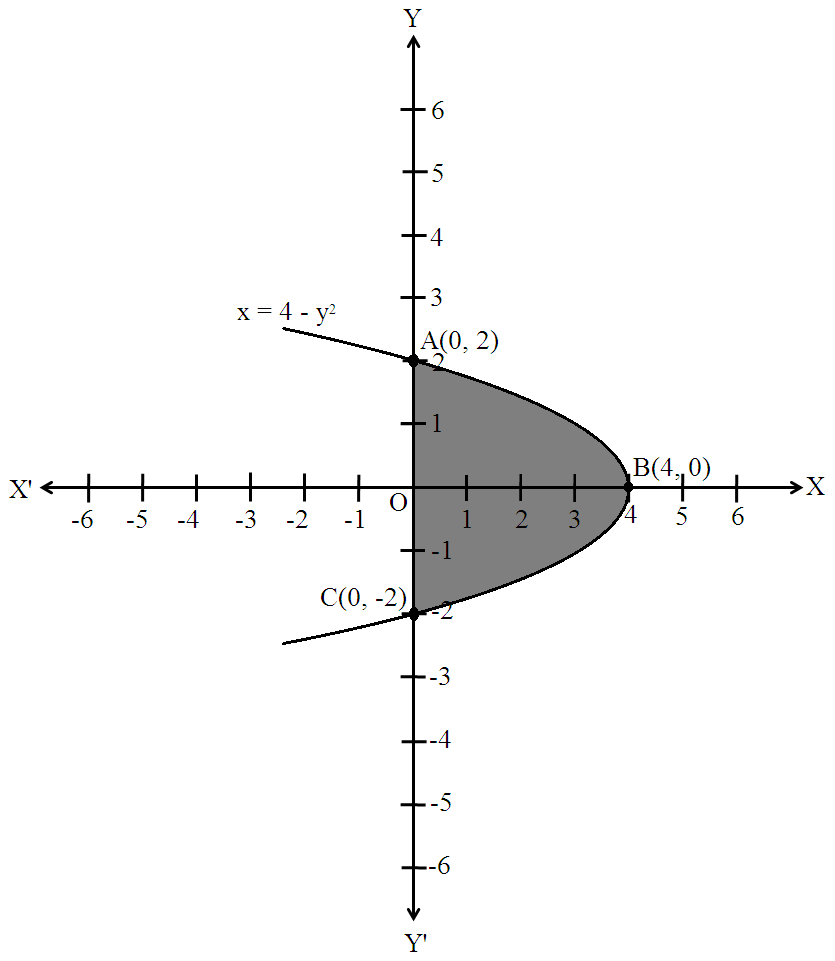
The points of intersection of the parabola and the $y-$ axis are $A(0, 2)$ and $C(0, -2)$.
Therefore, the area of the required region $\text{ABCO},$
$\text{A} = \int\limits^2_{-2}\text{x }\text{dy}$
$= \int\limits^2_{-2}(4-\text{y}^{2})\text{dy}$
$= \Big[4\text{y}-\frac{\text{y}^{3}}{3}\Big]^2_{-2}$
$= \Big[4(2)-\frac{(2)^3}{3}\Big]-\Big[4(2)-\frac{(-2)^3}{3}\Big]$
$= \Big(8-\frac{8}{3}\Big)-\Big(-8+\frac{8}{3}\Big)$
$=8-\frac{8}{3}+8-\frac{8}{3}$
$= 16 -\frac{16}{3}$
$= \frac{32}{3}\text{ square units}$ View full question & answer→MCQ 1001 Mark
Choose the correct answer: Area lying in the first quadrant and bounded by the circle $x^2 + y^2 = 4$ and the lines $x = 0$ and $x = 2$ is:
- ✓
$\pi$
- B
$\frac{\pi}{2}$
- C
$\frac{\pi}{3}$
- D
$\frac{\pi}{4}.$
AnswerThe equation of circle is $x^2 + y^2 = 4$
we are to find the area of the circle lying between the circle lying between the lines $x = 0$ and $x = 2$ in the first quadrant.
Required area $=\int\limits^2_0\text{y dx}$
$=\int\limits^2_0\sqrt{4-\text{x}^2}\text{dx}\ \ [\therefore\text{of}(1)]$
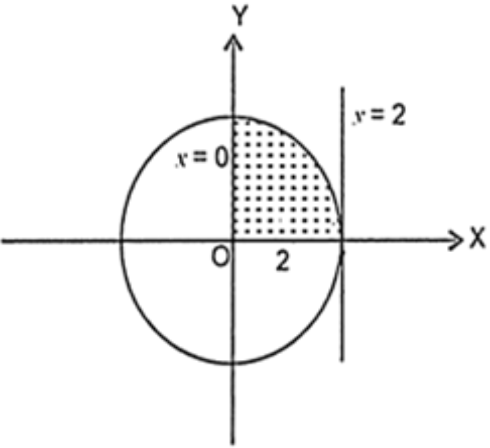
$=\int\limits^2_0\sqrt{(2)^2-\text{x}^2}\text{ dx} =\Big[\frac{\text{x}}{2}\sqrt{(2)^2-\text{x}^2}+\frac{(2)^2}{2}\sin^{-1}\Big(\frac{\text{x}}{2}\Big)\Big]^2_0$
$=\Big[\frac{\text{x}}{2}\sqrt{4-\text{x}^2}+2\sin^{-1}\Big(\frac{\text{x}}{2}\Big)\Big]^2_0$
$=\Big[\frac{\text{2}}{2}\sqrt{4-\text{4}}+2\sin^{-1}\Big(\frac{\text{2}}{2}\Big)\Big]-[0+2\sin^{-1}0]$
$=\Big[0+2\sin^{-1}(1)-[0+2\times0]\Big]$
$=2\sin^{-1}1=2\times\frac{\pi}{2}=\pi$ View full question & answer→MCQ 1011 Mark
Choose the correct answer from the given four options:
Area of the region bounded by the curve $\text{y}\cos\text{x}$ between x = 0 and $\text{x}=\pi$ is:
- ✓
$2\text{ sq. units}$
- B
$4\text{ sq. units}$
- C
$3\text{ sq. units}$
- D
$1\text{ sq. units}$
AnswerCorrect option: A. $2\text{ sq. units}$
Required area enclosed by the curve $\text{y}\cos\text{x},$ and x = 0 and $\text{x}=\pi$
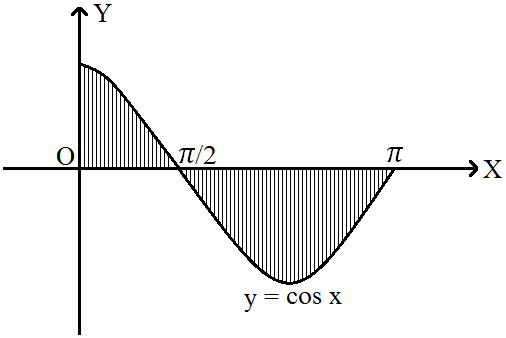
$\text{A}=\int\limits^{\frac{\pi}{2}}_0\cos\text{x dx}\Bigg|\int\limits^\pi_{\frac{\pi}{2}}\cos\text{x dx}\Bigg|$
$=\Big[\sin\frac{\pi}{2}-\sin0\Big]+\Big|\sin\frac{\pi}{2}-\sin\pi\Big|$
$=1+1=2\text{ sq. units}$ View full question & answer→MCQ 1021 Mark
If the area above the $x-$ axis, bounded by the curve $y = 2kx$ and $x = 0,$ and $x = 2$ is $\frac{3}{\log_{\text{e}}2},$ then the value of $k$ is :
- A
$\frac{1}{2}$
- ✓
$1$
- C
$-1$
- D
$2$
AnswerThe area bounded by the curves $y = 2^{kx}, x = 0,$ and $x = 2$ is given by $\int\limits^2_02^\text{kx}\text{dx}.$
It is given that $\int\limits^2_02^{\text{kx}}\text{dx} = \frac{3}{\log_{\text{e}}(2)} $
$\Rightarrow\frac{1}{\text{k}}\bigg[\frac{2^\text{kx}}{\log_e(2)}\bigg]^2_0=\frac{3}{\log_{e}(2)}$
$\Rightarrow\frac{1}{\text{k}}\bigg[\frac{2^\text{k(2)}}{\log_e(2)}-\frac{2^{\text{k(0)}}}{\log_{e}(2)}\bigg]= \frac{3}{\log_{e}(2)}$
$\Rightarrow\frac{1}{\text{k}}\Big(\frac{2^{\text{2k}}}{\log_e(2)}-\frac{1}{\log_e(2)}\Big)= \frac{3}{\log_e(2)}$
$\Rightarrow\frac{1}{\text{k}}(2^{\text{2k}}-1)=3$
$\Rightarrow(2^{\text{2k}}-1)=3\text{k}$
$\Rightarrow2^{\text{2k}}-3\text{k}-1=0$
$\Rightarrow \text{k}= 1$
Clearly, $K = 1$ satisfies the equation.
Hence, $K = 1$
View full question & answer→MCQ 1031 Mark
The area bounded by the curve $x^2 = 4y + 4$ and line $3x + 4y = 0$ is:
- A
$\frac{25}{4}\text{sq}.\text{units}$
- B
$\frac{125}{8}\text{sq}.\text{units} $
- C
$\frac{125}{16}\text{sq}.\text{units}$
- ✓
$\frac{124}{4}\text{sq}.\text{units}$
AnswerCorrect option: D. $\frac{124}{4}\text{sq}.\text{units}$
$\frac{124}{4}\text{sq}.\text{units}$
View full question & answer→MCQ 1041 Mark
Area of the region bounded by the curve $\text{y}=\sqrt{49-\text{x}^2}$ and the x - axis is:
- ✓
$\frac{49}{2}\pi\text{ sq}\text{ units}$
- B
$98\pi\text{ sq}\text{ units}$
- C
$49\pi\text{ sq}\text{ units}$
- D
$240\pi\text{ sq}\text{ units}$
AnswerCorrect option: A. $\frac{49}{2}\pi\text{ sq}\text{ units}$
$=\text{as}\text{ area}\text{ is}\text{ above}\text{ the}\text{ the}\text{x}-\text{axis}$
$\therefore\text{area}=2\int\limits^7_0\sqrt{49-\text{x}^2\text{dx}}$
$=2\Big[\frac{\text{x}}{2}\sqrt{49-\text{x}^2}+\frac{49}{2}\sin^{-1}\frac{\text{x}}{7}\Big]^7_0$
$=2\Big[\Big(\frac{7}{2}\times+\frac{49}{2}\sin^{-1}1\Big)-(0)\Big]$
$=\frac{49}{2}\pi\text{ sq}\text{ units}$
View full question & answer→MCQ 1051 Mark
The line $y = mx$ bisects the area enclosed by lines $\text{x}=0,\text{y}=0$ and $\text{x}=\frac{3}{2}$ and the curve $\text{y}=1+4\text{x}-\text{x}^2.$ Then the value of $m$ is:
- ✓
$\frac{13}{6}$
- B
$\frac{13}{2}$
- C
$\frac{13}{5}$
- D
$\frac{13}{7}$
AnswerCorrect option: A. $\frac{13}{6}$
View full question & answer→MCQ 1061 Mark
The area of the region bounded by the parabola $y = x^2$ and $y = |x|$ is:
- A
$3$
- B
$\frac{1}{2}$
- ✓
$\frac{1}{3}$
- D
$2$
AnswerCorrect option: C. $\frac{1}{3}$
View full question & answer→MCQ 1071 Mark
He area bounded by $y = x^2, x = y^2$ is:
Answer$=\text{y}=\text{x}^2,\text{y}^2=\text{x}$
$\Rightarrow\text{y}=\sqrt{\text{x}}$
The curves intersect at $(0, 0)$ and $(1,1)$ Area between the curves is given by
$=\int\limits^1_0\sqrt{\text{x}}-\text{x}^2\text{dx}$
$=\frac{1}{2}\text{x}^\frac{3}{2}+\frac{\text{x}^3}{3}\Big|^1_0$
$=\frac{2}{3}+\frac{1}{3}=1$
View full question & answer→MCQ 1081 Mark
The area bounded by $y = 2 - x^2$ and $x + y = 0$ is :
AnswerCorrect option: B. $\frac{9}{2}\text{ sq. units}$
$\text{(IMAGE)}$
To find the points of intersection of $x + y = 0$ and $y = 2 - x^2.$ We put $x = -y$ in $y = 2 - x^2,$
We get $y = 2 - y^2$
$\Rightarrow y^2 + y - 2 = 0$
$\Rightarrow y - 1, y + 2 = 0$
$\Rightarrow y = 1, -2$
$\Rightarrow x = -1, 2$
Therefore, the points of intersection are $A(-1, 1)$ and $C(2, -2).$ The area of the required region $\text{ABCD},$
$\text{A} = \int\limits^2_{-1}(\text{y}_1-\text{y}_{2})\text{dx} \ ($Where, $y_1 = 2 - x^2$ and $y_2 = -x)$
$=\int\limits^2_{-1}(2-\text{x}^{2}+\text{x})\text{dx}$
$ = \Big[2\text{x}-\frac{\text{x}^{3}}{3}+\frac{\text{x}^{2}}{2}\Big]^2_{-1}$
$= \bigg\{2(2)-\frac{(2)^{3}}{3}+\frac{(2)^{2}}{2}\bigg\}-\bigg\{2(-1)-\frac{(-1)^{3}}{3}+\frac{(-1)^{2}}{2}\bigg\}$
$= \Big(4-\frac{8}{3}+2\Big)-\Big(-2+\frac{1}{3}+\frac{1}{2}\Big)$
$=6-\frac{8}{3}+2-\frac{1}{3}-\frac{1}{2}$
$= 8 - \frac{9}{3}-\frac{1}{2}$
$= 5 -\frac{1}{2}$
$\frac{9}{2}\text{ sq. units}$
View full question & answer→MCQ 1091 Mark
The area between x-axis and curve $\text{y}=\cos\text{x}$ when $0\leq\text{x}\leq2\pi$ is:
Answer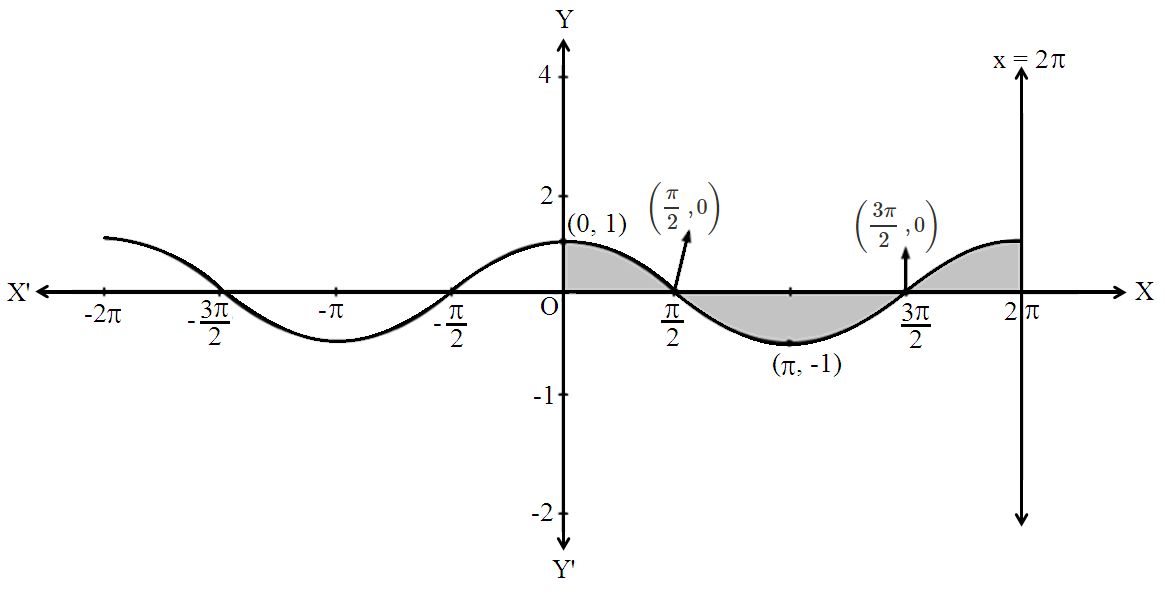
Required shaded area,
$\text{A} = \int\limits^\frac{\pi}{2}_0\cos\text{x}\text{ dx} + \int\limits^\frac{3\pi}{2}_\frac{\pi}{2}(-\cos\text{x})\text{dx} + \int\limits^{2\pi}_\frac{3\pi}{2}\cos\text{x}\text{ dx}$
$= \int\limits^\frac{\pi}{2}_0\cos\text{x}\text{ dx}-\int\limits^\frac{3\pi}{2}_\frac{\pi}{2}\cos\text{x}\text{ dx} + \int\limits^{2\pi}_\frac{3\pi}{2}\cos\text{x}\text{ dx}$
$=\Big[\sin\text{x}\Big]^{\frac{\pi}{2}}_0-\Big[\sin\text{x}\Big]^{\frac{3\pi}{2}}_\frac{\pi}{2}+\Big[\sin\text{x}\Big]^{2\pi}_\frac{3\pi}{2}$
$= \Big[\sin\text{x}\Big]^\frac{\pi}{2}_0-\Big[\sin\text{x}\Big]^\frac{3\pi}{2}_\frac{\pi}{2}+\Big[\sin\text{x}\Big]^{2\pi}_\frac{3\pi}{2}$
$=(1-0)-(-1-1)+\big[0-(-1)\big]$
$=1+2+1$
$=4\text{ sq. units}$ View full question & answer→MCQ 1101 Mark
Find the area above $x-$axis, bounded by the curves $y = 2^{kx}, x = 0$ and $x = 2$:
- ✓
$\frac{4^\text{k}-1}{\text{k}\text{ log}_\text{e}2}$
- B
$\frac{2^\text{k}-1}{2\text{ log}_\text{e}2}$
- C
$\frac{3-\text{k}}{\text{k}\text{ log}_\text{e}2}$
- D
$\frac{-1+3^\text{k}}{2\text{ log}_\text{e}2}$
AnswerCorrect option: A. $\frac{4^\text{k}-1}{\text{k}\text{ log}_\text{e}2}$
View full question & answer→MCQ 1111 Mark
The area of the region bounded by the parabola $(y - 2)^2 = x - 1,$ the tangent to it at the point with the ordinate $3$ and the $x-$ axis is:
Answer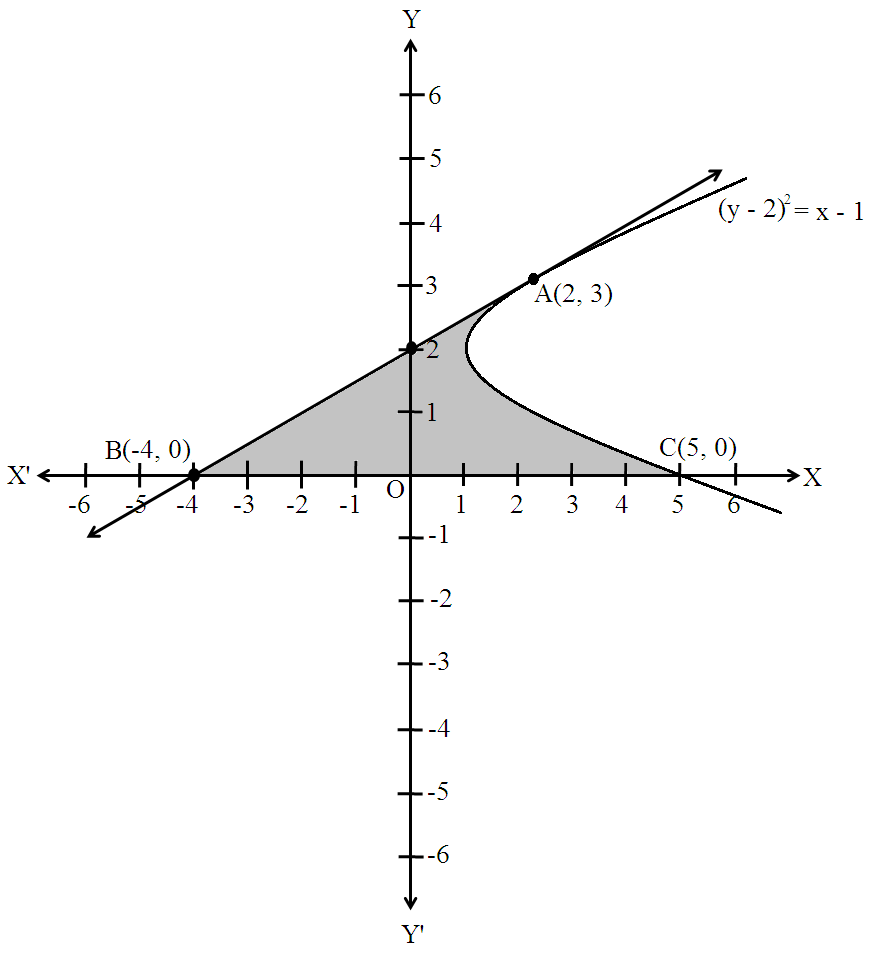
The tangent passes through the point with ordinate $3,$ so substituting $y = 3$ in equation of parabola $(y - 2)^2 = x - 1,$ we get $x = 2$
Therefore, the line touches the parabola at $(2, 3)$
We have,
$(\text{y}-2)^{2} = \text{x}-1$
$\Rightarrow \text{y}-2 = \sqrt{\text{x}-1}$
$\Rightarrow \text{y} = \sqrt{\text{x}-1}+2$
Slope of tangent of parabola at $x = 2$
$\Big[\frac{\text{dy}}{\text{dt}}\Big]_{\text{x}=2}=\Big[\frac{1}{2\sqrt{\text{x}-1}}\Big]_{\text{x}=2}=\frac{1}{2}$
Therefore the equation of the tangent is given as:
$\text{y}-\text{y}_0 = \text{m}(\text{x}-\text{x}_0)$
$\Rightarrow\text{y}-3=\frac{1}{2}(\text{x}-2)$
$\Rightarrow\text{y}=\frac{1}{2}\text{x}+2$
Therefore, area of the required region ABC,
$\text{A} = \int\limits^3_0(\text{x}_1-\text{x}_2)\text{dy}$ $\big[\text{Where}, \text{x}_1=(\text{y}-2)^{2}+1\text{ and}\text{ x}_2=2(\text{y}-2)\big]$
$= \int\limits^3_0(\text{x}_1-\text{x}_2)\text{dy}$
$=\int\limits^3_0(\text{y}-2)^2+1-2(\text{y}-2)\text{dy}$
$= \int\limits^3_0\big[(\text{y}-2)-1\big]^2\text{dy}$
$= \int\limits^3_0\big[\text{y}-3\big]^2\text{dy} $
$= \bigg[\frac{(\text{y}-3)^3}{3}\bigg]^3_0$
$=\bigg[\frac{(3-3)^{3}}{3}\bigg]-\bigg[\frac{(0-3)^3}{3}\bigg]$
$=9$ View full question & answer→MCQ 1121 Mark
The area bounded by the curve $\text{y}^2=16\text{x}$ and line $\text{y}=\text{ mx} $ is $\frac{2}{3},$ then $m$ is equal to:
View full question & answer→MCQ 1131 Mark
The area bounded by the lines $|x| + |y| = 1$ is:
AnswerCorrect option: B. $\text{2 sq. units}$
View full question & answer→MCQ 1141 Mark
Find the area enclosed by the parabola $y^2 = x$ and the line $y + x = 2$ and the $x-$axis:
- A
$\frac{5}{6}\text{ sq.}\text{units}$
- ✓
$\frac{7}{6}\text{ sq.}\text{units}$
- C
$\frac{6}{7}\text{ sq.}\text{units}$
- D
$\frac{4}{7}\text{ sq.}\text{units}$
AnswerCorrect option: B. $\frac{7}{6}\text{ sq.}\text{units}$
View full question & answer→MCQ 1151 Mark
For which of the following values of mm, is the area of the region bounded by the curve $y = x - x^2$, and the line $y = mx$ equals $\frac{9}{2}\text{ sq. unit?}$
AnswerThe two curves meet at $mx = x - x^2$ or $= x^2 = x (1 - m)$
$\Rightarrow x^2 = x - mx$
$\therefore x = 0, 1 - m$
$=\int\limits^{1-\text{m}}_0(\text{y}_1-\text{y}_2)\text{dx}$
$=\Big[(1-\text{m)}\frac{\text{x}^2}{2}-\frac{\text{x}^2}{3}\Big]^{1-\text{m}}_0$
$=\frac{9}{2}(\text{given)}\text{ If}\text{ m}<1$
$=$ or $=(1-\text{m)}^3\Big[\frac{1}{2}-\frac{1}{3}\Big]=\frac{9}{2}$
$=$ or $-(1-\text{m)}^3=-27$
$=$ or $1-\text{m}=-3$
$\Rightarrow\text{m}=4$
View full question & answer→MCQ 1161 Mark
The area of ellipse $\frac{\text{x}^2}{4^2}+\frac{\text{y}^2}{9^2}=1$ is:
- A
$6\pi\text{ sq}.\text{units}$
- B
$\frac{\pi(\text{a}^2+\text{b}^2)}{4}\text{ sq}.\text{units}$
- C
$\pi(\text{a+b})\text{ sq}.\text{units}$
- ✓
View full question & answer→MCQ 1171 Mark
Area between the curve $\text{y}=\cos^2\text{x},x-$axis and ordinates $x = 0$ and $x = p$ in the interval $(0, p)$ is:
- A
$2\pi^3$
- B
$2\pi$
- C
$\pi$
- ✓
$\frac{\pi}{2}$
AnswerCorrect option: D. $\frac{\pi}{2}$
View full question & answer→MCQ 1181 Mark
The area included between the parabolas $y^2 = 4x$ and $x^2 = 4y$ is $($in square units$)$
- A
$\frac{4}{3}$
- B
$\frac{1}{3}$
- ✓
$\frac{16}{3}$
- D
$\frac{8}{3}$
AnswerCorrect option: C. $\frac{16}{3}$
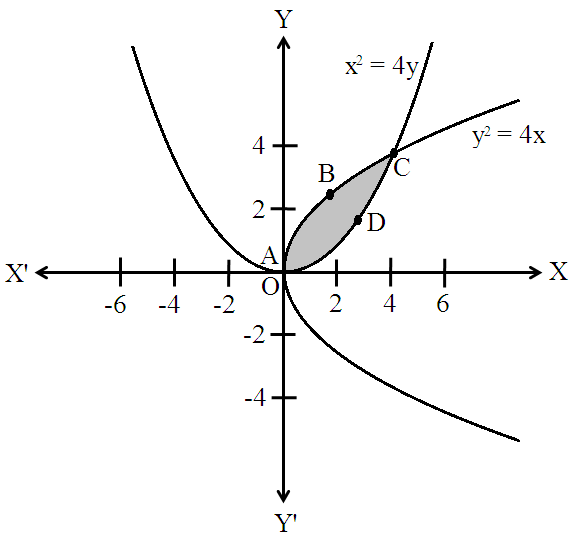
We have, $\text{x} = \frac{\text{y}^{2}}{4}\ ....(1)$
$\text{x}^{2} = 4\text{y}\ ....(2)$
points of intersection of two parabola is given by, $y^24^2 = 4y$
$\Big(\frac{\text{y}^{2}}{4}\Big)^{2} = 4\text{y}$
$\Rightarrow\text{y}^{4} -64\text{y} = 0$
$\Rightarrow\text{y}(\text{y}^{3}-64) = 0$
$\Rightarrow\text{y} = 0, 4$
$\Rightarrow\text{x} = 0, 4$
Therefore, the points of intersection are $A(0, 0)$ and $C(4, 4).$
Therefore, the area of the required region $\text{ABCD},$
$= \int\limits^4_0\Big(2\sqrt{\text{x}}-\frac{\text{x}^{2}}{4}\Big) \text{dx}$
$= \bigg[2\times\frac{2\text{x}^\frac{3}{2}}{3}-\frac{\text{x}^{3}}{12}\bigg]^4_0$
$=\bigg(2\times\frac{2(4)^\frac{3}{2}}{3}-\frac{(4)^{3}}{12}-\frac{(0)^{3}}{12}\bigg)$
$= \big(\frac{32}{3}-\frac{16}{3}\big)-0$
$= \frac{16}{3}\text{ square units}$ View full question & answer→MCQ 1191 Mark
The area bounded by the curve $y = 4x - x^2$ and the $x-$ axis is:
- A
$\frac{30}{7}\text{ sq. units}$
- B
$\frac{31}{7}\text{ sq. units}$
- ✓
$\frac{32}{3}\text{ sq. units}$
- D
$\frac{34}{3}\text{ sq. units}$
AnswerCorrect option: C. $\frac{32}{3}\text{ sq. units}$
Point of intersection of parabola
$y = 4x - x^2$ with $x-$ axis is given by $y = 4x - x^2$ and $y = 0$
Equation of $x$ axis
$\Rightarrow 4x - x^2 = 0$
$\Rightarrow x = 0$ or $x = 4$
$\Rightarrow y = 0, y = 0$
Thus $0 (0, 0)$ and $B (4, 0)$ are points of intersection of parabola and $x -$ axis.
Required shaded area $= \int\limits^4_0(4\text{x}-\text{x}^2)\text{dx}$
$= \Big[2\text{ x}^2-\frac{\text{x}^3}{3}\Big]^4_0$
$= 2\times16-\frac{16}{3}-0$
$=\frac{96-64}{3}$
$=\frac{32}{3}\text{ sq. units}$
View full question & answer→MCQ 1201 Mark
The area of the circle $x^2+ y^2 = 16$ enterior to the parabola $y^2 = 6x$ is :
- A
$\frac{4}{3}\big(4\pi-\sqrt{3}\big)$
- B
$\frac{4}{3}\big(4\pi+\sqrt{3}\big)$
- ✓
$\frac{4}{3}\big(8\pi-\sqrt{3}\big)$
- D
$\frac{4}{3}\big(8\pi+\sqrt{3}\big)$
AnswerCorrect option: C. $\frac{4}{3}\big(8\pi-\sqrt{3}\big)$
Points of intersection of the parabola and the circle is obtained by solving the simultaneous equation
$x^2 + y^2 = 16$ and $y^2 = 6x$
$\Rightarrow x^2 + 6x = 16$
$\Rightarrow x^2 = 6x -16 = 0$
$\Rightarrow (x + 8)(x - 2) = 0$
$⇒ x = 2$ or $x = -8$
$⇒ x = 2$ or $x = -8, x$ can not be $-8$ as in this case it will be the point outside circle.
$\therefore \text{x} = 2$
$\therefore \text{when } \text{x} = 2,\text{ y}=\pm\sqrt{6\times2}=\pm\sqrt{12}=\pm2\sqrt{3}$
$\therefore\text{B}(2, 2\sqrt{3})$ and $\text{ B}'(2,-2\sqrt{3})$ are points of intersection of the parabola and circle.
Required area
$=$ Area $\text{OB'C' A'CBO}$
$=$ area of circle $-$ area $\text{OBAB'O}$ Area of circle with radius $4$
$= \pi\times4^2$
$=16\pi$
Now,
Area $\text{OBAB'O}$
$= 2$ area $\text{OBAO}$
$= 2$ area $\text{OBDO} +$ area $\text{DBAD}$
$= 2\times\Bigg[\int\limits^2_0\sqrt{6\text{x}}\text{dx}+ \int\limits^4_2\sqrt{16-\text{x}^{2}}\Bigg]$
$= 2\times\Bigg\{\Bigg[\sqrt{6}\frac{\text{x}^\frac{3}{2}}{\frac{3}{2}}\Bigg]^2_0+ \Big[\frac{\text{x}}{2}\sqrt{16-\text{x}^2}+\frac{1}{2}\times16\sin^{-1}\Big(\frac{\text{x}}{4}\Big)\Big]^4_2\Bigg\}$
$= 2\times\Big\{\Big(\sqrt{6}\times\frac{2}{3}\times2^\frac{3}{2}-0\Big)+ \Big(\frac{1}{2}4\sqrt{16-(4)^2}\frac{1}{2}\times16\sin^{-1}\frac{4}{4}\\-\frac{2}{2}\sqrt{16-2^2}-\frac{1}{2}\times16\sin^{-1}\frac{2}{4}\Big)\Big\}$
$= 2\times\bigg[\Big(\sqrt{6}\times\frac{2}{3}\times2\sqrt{2}\Big)+0+8\sin^{-1}(1)-\sqrt{12}-8\sin^{-1}\Big(\frac{1}{2}\Big)\bigg]$
$= 2\times \bigg[\frac{8\sqrt{3}}{3}+8\times\frac{\pi}{2}-2\sqrt{3}-8\frac{\pi}{6}\bigg]$
$= 2\bigg\{\frac{8\sqrt{3}-6\sqrt{3}}{3}+8\big(\frac{\pi}{2}-\frac{\pi}{2}\big)\bigg\}$
$= 2\bigg\{\frac{2\sqrt{3}}{3}+8\Big(\frac{2\pi}{6}\Big)\bigg\}$
$= \frac{4\sqrt{3}}{3}+\frac{16\pi}{3}$
View full question & answer→MCQ 1211 Mark
If $A_n$ be the area bounded by the curve $y = (\tan x)^n$ and the lines $x = 0, y = 0$ and $\text{x}=\frac{\pi}{4},$ then for $x > 2$
- ✓
$\text{A}_{\text{n}}+\text{A}_{\text{n}-2}=\frac{1}{\text{n}-1}$
- B
$\text{A}_{\text{n}}+\text{A}_{\text{n}-2}<\frac{1}{\text{n}-1}$
- C
$\text{A}_{\text{n}}-\text{A}_{\text{n}-2}=\frac{1}{\text{n}-1}$
- D
AnswerCorrect option: A. $\text{A}_{\text{n}}+\text{A}_{\text{n}-2}=\frac{1}{\text{n}-1}$
An $=$ Area bounded by the curve $\text{y}=\big\{\tan(\text{x})\big\}^\text{n}=\tan^\text{n}\text{(x)}$ and the lines $x = 0, y = 0,$ and $\text{x}=\frac{\pi}{4}.$
Therefore,
$\text{A}_\text{n}=\int\limits_\text{0}^{\frac{\pi}{4}}\tan^\text{n}\text{(x)}\text{dx}$
$\Rightarrow \text{A}_{\text{n}-2}=\int\limits_\text{0}^{\frac{\pi}{4}}\tan^{\text{n}-2}\text{(x)}\text{dx}$
Comsider, $\text{A}_\text{n}=\int\limits_\text{0}^{\frac{\pi}{4}}\tan^\text{n}\text{(x)}\text{dx}$
$\Rightarrow\ \text{A}_\text{n}=\int\limits_0^{\frac{\pi}{4}}\big\{\tan^{\text{n}-2}(\text{x})\big\}\big\{\tan^2(\text{x})\big\}\text{dx}$
$\Rightarrow\text{A}_\text{n}=\int\limits_0^\frac{\pi}{4}\big\{\tan^{\text{n}-2}(\text{x})\big\}\big\{\sec^2\text{(x)}-1\big\}\text{dx}$
$\Rightarrow\text{A}_\text{n}=\int\limits_0^\frac{\pi}{4}\big\{\tan^{\text{n}-2}\text{(x)} \sec^2(\text{x})-\tan^{\text{n}-2}(\text{x})\big\}\text{dx}$
$\Rightarrow\text{A}_\text{n}=\int\limits_0^{\frac{\pi}{4}}\big\{\tan^{\text{n}-2}\text{(x)}\sec^2(\text{x})\big\}\text{dx}-\int_0^\frac{\pi}{4}\tan^{\text{n}-2}\text{(x)}\text{ dx}$
$\Rightarrow\text{A}_\text{n}+\text{A}_{\text{n}-2}=\int\limits_0^\frac{\pi}{4}\tan^{\text{n}-2}(\text{x})\sec^2\text{(x) dx}$
Now, $\text{A}_\text{n}+\text{A}_{\text{n}+2}=\int\limits_0^\frac{\pi}{4}\tan^{\text{n}-2}\text{(x)}\sec^2(\text{x})\text{dx}$
Let $\text{u}=\tan\text{(x)}$
$\Rightarrow\text{du}=\sec^2\text{x }\text{dx}$
Also, when $x = 0, u = 0$ and when $\text{x}=\frac{\pi}{4},\text{u}=1$
Therefore,
$\text{A}_\text{n}+\text{A}_{\text{n}-2}=\int\limits_0^{\frac{\pi}{4}}\tan^{\text{n}-2}\text{(x)}\sec^2\text{(x) dx}$
$=\int\limits_0^1(\text{u}^{\text{n}-2})\text{du}$
$=\Big[\frac{\text{u}^{\text{n}-1}}{\text{n}-1}\Big]_0^1$
$=\Big[\frac{1}{\text{n}-1}-0\Big]=\frac{1}{\text{n}-1}$
View full question & answer→MCQ 1221 Mark
Area bounded between the parabola $y^2 = 4ax$ and its latus rectum is:
- A
$\frac{1}{3}\text{a }\text{sq}.\text{units}$
- B
$\frac{1}{3}\text{a}^2\text{ sq}.\text{units}$
- C
$\frac{8}{3}\text{a}\text{ sq}.\text{units}$
- ✓
$\frac{8}{3}\text{a}^2\text{ sq}.\text{units}$
AnswerCorrect option: D. $\frac{8}{3}\text{a}^2\text{ sq}.\text{units}$
View full question & answer→MCQ 1231 Mark
Area bounded by the ellipse $\frac{\text{x}^2}{4}+\frac{\text{y}^2}{9}=1$ is.
- ✓
$6\pi\text{ sq.}\text{units}$
- B
$3\pi\text{ sq.}\text{units}$
- C
$12\pi\text{ sq.}\text{units}$
- D
AnswerCorrect option: A. $6\pi\text{ sq.}\text{units}$
View full question & answer→MCQ 1241 Mark
The area $(sq.$ units$)$ bounded by the parabola $y^2 = 4ax$ and the line $x = a$ and $x = 4a$ is:
- A
$\frac{\text{35a}^2}{3}$
- B
$\frac{4\text{a}^2}{3}$
- C
$\frac{7\text{a}^2}{3}$
- ✓
$\frac{56\text{a}^2}{3}$
AnswerCorrect option: D. $\frac{56\text{a}^2}{3}$
View full question & answer→MCQ 1251 Mark
Area bounded by the curve $\text{y}=\cos\text{x}$ between $\text{x}=0$ and $\text{x}=\frac{3\pi}{2}$ is:
- A
$1 \ sq.$ unit
- B
$2 \ sq.$ units
- ✓
$3 \ sq.$ units
- D
$4 \ sq.$ units
AnswerCorrect option: C. $3 \ sq.$ units
View full question & answer→MCQ 1261 Mark
Consider the curves $\text{y}=\sin\text{x}$ and $\text{y}=\cos\text{x}.$ What is the area of the region bounded by the above two curves and the lines $\text{x}=0$ and $\text{x}=\frac{\pi}{4}?$
- ✓
$\sqrt{2}-1$
- B
$\sqrt{2}+1$
- C
$\sqrt{2}$
- D
$2$
AnswerCorrect option: A. $\sqrt{2}-1$
The area enclosed by $\text{y}=\sin\text{x,}\text{ y}=\cos\text{x},\text{ x}=0,\text{x}=\frac{\pi}{4}$ is given by
$=\int\limits^\frac{\pi}{4}_0(\cos\text{x}-\sin\text{x})\text{dx}=\sin\text{x}+\cos\text{x}\Big|^\frac{\pi}{4}_0$
$=\frac{1}{\sqrt{2}}+\frac{1}{\sqrt{2}}-0-=\sqrt{2}-1$
View full question & answer→MCQ 1271 Mark
Find the area of bounded by $\text{y}=\sin\text{x}$ from $\text{x}=\frac{\pi}{4}$ to $\text{x}=\frac{\pi}{2}:$
AnswerCorrect option: A. $\frac{\sqrt{2-1}}{\sqrt2}$
The area bounded is given as
$=\int\limits^\frac{\pi}{2}_\frac{\pi}{4}\sin\text{ x}\text{dx}$
$=\cos\text{ x}\Big|^\frac{\pi}{2}_\frac{\pi}{4}$
$=\cos\frac{\pi}{2}+\cos\frac{\pi}{4}$
$=\frac{\sqrt{2}-1}{\sqrt{2}}$
View full question & answer→MCQ 1281 Mark
The area of the region bounded by the ellipse $\text{x}^\frac{2}{16}+\text{y}^\frac{2}{9}=1$ is:
- ✓
$12\pi$
- B
$3\pi$
- C
$24\pi$
- D
$\pi$
AnswerCorrect option: A. $12\pi$
View full question & answer→MCQ 1291 Mark
Smaller area enclosed by the circle $x^2 + y^2 = 4$ and the line $x + y = 2$ is :
- A
$2(\pi-2)$
- ✓
$\pi-2$
- C
$\pi-1$
- D
$2(\pi+2)$
AnswerCorrect option: B. $\pi-2$
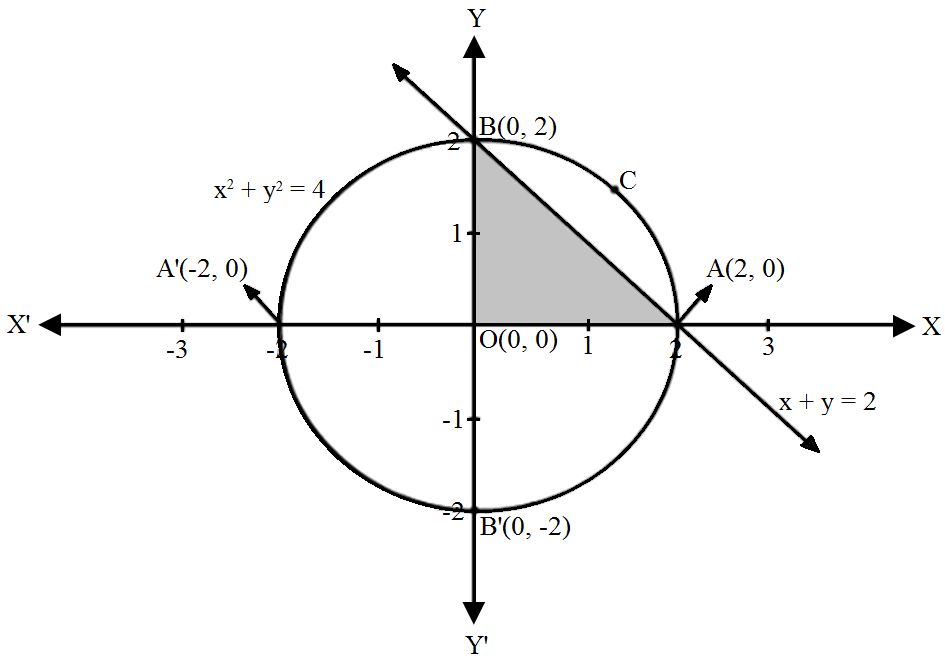
We have, $x^2 + y^2 = 4$ represents a circle with centre at $O(0, 0)$ and radius $2$
$x + y = 2$ represents a straight line cutting the $x-$ axis at $A(2, 0)$ and $y$ axis at $B(0, 2)$
Thus, $A(2, 0)$ and $B(0, 2)$ are also the points of intersection of the straight line and the circle smaller area enclosed by the by the curve and straight line is the shaded area.
shaded area $\text{(ABCA)} =$ area $\text{(OBCA)} - $ area $\text{(OBAO)}$
$=\int\limits^2_0\sqrt{4-\text{x}^2}\text{dx}-\int\limits^2_0(2 - \text{x})\text{dx}$
$\big[\therefore\text{x}^2 + \text{y}^2=4$
$\Rightarrow\text{y}=\sqrt{4-\text{x}^2}\text{ and }\text{x}+\text{y} = 2$
$\Rightarrow\text{y} = 2-\text{x}\big]$
$=\int\limits^2_0\Big[\big(\sqrt{4-\text{x}^2}\big)+\text{x} - 2\Big]$
$= \bigg[\frac{1}{2}\text{x}\sqrt{4-\text{x}^2}+\frac{1}{2}\times4\times\sin^{-1}\Big(\frac{\pi}{2}\Big)+\Big(\frac{\text{x}^2}{2}-2\text{x}\Big)\bigg]^2_0$
$= \frac{1}{2}\times2\sqrt{4-2^2}+2\times\sin^{-1}\Big(\frac{2}{2}\Big)+\Big(\frac{2^2}{2}-2\times2\Big)-0$
$= 0 + 2 \times\frac{\pi}{2}+(2 - 4)$
$= (\pi-2) \text{sq. units}$ View full question & answer→MCQ 1301 Mark
A tangent having slope of $-\frac{4}{3}$ to the ellipse $\frac{\text{x}^2}{18}+\frac{\text{y}^2}{32}=1$ ntersects the major and minor axes at points $A$ and $B$ respectively. If $C$ is the center of the ellipse, then area of the triangle $\text{ABC}$ is:
- A
$12$ sq. units
- ✓
$24$ sq. units
- C
$36$ sq. units
- D
$48$ sq. units
AnswerCorrect option: B. $24$ sq. units
One of the tangents of slope $m$ to the given ellipse is
$=\text{y}=\text{mx}+\sqrt{18\text{m}^2+32}\text{ for}$
$=\text{m}=-\frac{4}{3},\text{we}\text{ have}$
$=\text{y}=-\frac{4}{3}\text{x}+8.$
Then points on the axis where tangents meet are $A(6, 0)$ and $B(0, 8).$
Then area of triangle $\text{ABC}$ is
$=\frac{1}{2}(6)(8)=24\text{ units}.$
View full question & answer→MCQ 1311 Mark
Choose the correct answer from the given four options : Area of the region in the first quadrant enclosed by the $x-$ axis, the line $y = x $ and the circle $x^2 + y^2 = 32$ is:
- A
$16\pi\text{ sq. units}$
- ✓
$4\pi\text{ sq. units}$
- C
$32\pi\text{ sq. units}$
- D
$24\pi\text{ sq. units}$
AnswerCorrect option: B. $4\pi\text{ sq. units}$
We have, $y = 0, y = x$ and the circle $x^2 + y^2 - 3$ in the first quadrant
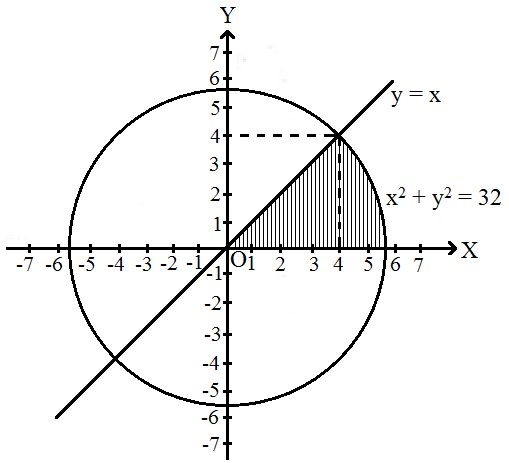
Solving $y = x$ with the circle
$x^2 + x^2 = 32$
$\Rightarrow x^2 = 16$
$\Rightarrow x = 4 ($In first quadrant$)$
When $x = 4, y = 4$
For point of intersection of circle with the $x-$ axis,
Put $y = 0$
$\therefore\ \text{x}^2+0=32$
$\Rightarrow\ \text{x}=\pm4\sqrt{2}$
So, the circle intersects the $x-$ axis at $\big(\pm4\sqrt{2},0\big)$
From the figure, area of shaded region
$\text{A}=\int\limits^4_0\text{x dx}+\int\limits^{4\sqrt{2}}_4\sqrt{(4\sqrt{2})^2-\text{x}^2}\text{ dx}$
$=\Big[\frac{\text{x}^2}{2}\Big]^4_0+\bigg[\frac{\text{x}}{2}\sqrt{(4\sqrt{2})^2-\text{x}^2}+\frac{\big(4\sqrt{2}\big)^2}{2}\sin^{-1}\frac{\text{x}}{4\sqrt{2}}\bigg]^{4\sqrt{2}}_0$
$=\frac{16}{2}+\bigg[0+16\sin^{-1}1-\frac{4}{2}\sqrt{\big(4\sqrt{2}\big)^2-16}-16\sin^{-1}\frac{4}{4\sqrt{2}}\bigg]$
$=8+\bigg[16\cdot\frac{\pi}{2}-2\cdot\sqrt{16}-16\cdot\frac{\pi}{4}\bigg]$
$=8+\big[8\pi-8-4\pi\big]=4\pi\text{ sq. units}$ View full question & answer→MCQ 1321 Mark
Area of triangle whose two vertices formed from the $x-$axis and line $y = 3 - |x|$ is:
View full question & answer→MCQ 1331 Mark
The area enclosed by the curve $\frac{\text{x}^2}{25}+\frac{\text{y}^2}{9}=1$ is:
- A
$10\pi\text{ sq.}\text{units}$
- ✓
$15\pi\text{ sq.}\text{units}$
- C
$5\pi\text{ sq.}\text{units}$
- D
$4\pi\text{ sq.}\text{units}$
AnswerCorrect option: B. $15\pi\text{ sq.}\text{units}$
View full question & answer→MCQ 1341 Mark
The area bounded by the $x -$ axis, the curve $y = f(x)$ and the lines $x = 1, x = b$ is equal to $\sqrt{\text{b}}^2+1-\sqrt{2}$ for all $ b>,$then$\text{ f(x)}\text{ is:}$
AnswerCorrect option: D. $\text{x}\sqrt{\text{x}-1}$
View full question & answer→MCQ 1351 Mark
The area bounded by $= 4ax$ and $y = mx$ is $\frac{\text{a}^2}{3}\text{sq. units}$ then $m:$
AnswerThe two curves $y^2 = 4ax$ and $y = mx$ intersect at
$=\Big(\frac{4\text{a}}{\text{m}^2},\frac{4\text{a}}{\text{m}}\Big)$ and the area enclosed by the two curves are given by
$=\int\limits^\frac{4\text{a}}{\text{m}2}_0\Big(\sqrt{4\text{ax}}-\text{mx}\Big)\text{dx}$
$\therefore\int\limits^\frac{4\text{a}}{\text{m}^2}\Big(\sqrt{4\text{ax}}-\text{mx}\Big)\text{dx}=\frac{\text{a}^2}{3}$
$\Rightarrow\frac{8}{3}.\frac{\text{a}^2}{\text{m}^3}=\frac{\text{a}^2}{3}$
$\Rightarrow\text{m}^3=8$
$\Rightarrow\text{m}=2$
View full question & answer→MCQ 1361 Mark
Area lying between the parabola $y^2 = 4x$ and its latus rectum is:
- A
$\frac{1}{3}\text{ sq.}\text{units}$
- B
$\frac{2}{3}\text{ sq.}\text{units}$
- C
$\frac{5}{3}\text{ sq.}\text{units}$
- ✓
$\frac{8}{3}\text{ sq.}\text{units}$
AnswerCorrect option: D. $\frac{8}{3}\text{ sq.}\text{units}$
View full question & answer→MCQ 1371 Mark
If area bounded by the curves $x = at^2$ and $y = ax^2$ is $1,$ then a $.......$
- A
$\frac{1}{2}$
- B
$\frac{1}{3}$
- ✓
$\frac{1}{\sqrt{3}}$
- D
$1$
AnswerCorrect option: C. $\frac{1}{\sqrt{3}}$
$\text{x}=\text{ay}^2$ and ${ y}=\text{ax}^2$
$\Rightarrow\text{a}^3\text{ x}^3=1$
$\Rightarrow\text{(x},\text{y)}=\Big(\frac{1}{\text{a}},\frac{1}{\text{a}}\Big)$
The area bounded by the curves is computed by:
$=\int\limits^\frac{1}{\text{a}}_0\text{a}\text{x}^2-\sqrt{\frac{\text{x}}{\text{a}}}\text{ dx}=1$
$\Rightarrow\frac{1}{3\text{a}^2}=1$
$\Rightarrow\text{a}=\frac{1}{\sqrt{3}}$
View full question & answer→MCQ 1381 Mark
Area of curve explained in the passage from $0$ to $\frac{\pi}{2}\text{ is:}$
- A
$\frac{1}{3}\text{ sq.}\text{ unit}$
- B
$\frac{1}{2}\text{ sq.}\text{ unit}$
- ✓
$1\text{ sq.}\text{ unit}$
- D
$2\text{ sq.}\text{ units}$
AnswerCorrect option: C. $1\text{ sq.}\text{ unit}$
View full question & answer→MCQ 1391 Mark
The area bounded by the curve $\text{y}=\sec^2\text{x},\text{y}$ and $\text{x}=\frac{\pi}{3}$ is:
- A
$\sqrt{3}\text{ sq.}\text{ units}$
- B
$\sqrt{2}\text{ sq.}\text{ units}$
- ✓
$2\sqrt{3}\text{ sq.}\text{ units}$
- D
AnswerCorrect option: C. $2\sqrt{3}\text{ sq.}\text{ units}$
View full question & answer→MCQ 1401 Mark
The area bounded by the curves $x + 2y^2 = 0$ and $x + 3y^2 = 1$ is:
- A
$1\text{ sq.}\text{units}$
- B
$\frac{1}{3}\text{ sq.}\text{units}$
- C
$\frac{2}{3}\text{ sq.}\text{units}$
- ✓
$\frac{4}{3}\text{ sq.}\text{units}$
AnswerCorrect option: D. $\frac{4}{3}\text{ sq.}\text{units}$
View full question & answer→MCQ 1411 Mark
The area of the region $($in square units$)$ bounded by the curve $x^2 = 4y$, line $x = 2$ and $x-$axis is:
- A
$1$
- ✓
$\frac{2}{3}$
- C
$\frac{4}{3}$
- D
$\frac{8}{3}$
AnswerCorrect option: B. $\frac{2}{3}$
$x^2 = 4y$ and $x= 2$
$\Rightarrow 4 = 4y$
$\Rightarrow y = 1$
$A(2, 1)$ is the point of intersection of curve and straight the
Area of shaded region $\text{OAB} = \int\limits^2_0\text{y}\text{ dx}$
$=\int\limits^2_0\frac{\text{x}^2}{4}\text{ dx}$
$=\Big[\frac{\text{x}^3}{12}\Big]^2_0$
$= \frac{2^3}{12}-0$
$= \frac{2}{3}\text{ square units}$
View full question & answer→MCQ 1421 Mark
Choose the correct answer from the given four options:
The area of the region bounded by the curve $\text{y}=\sqrt{16-\text{x}^2}$ and x-axis is:
AnswerCorrect option: A. $8\text{ sq. units}$
Given equation of curve is $\text{y}=\sqrt{16-\text{x}^2}$ and the equation of line is
X-axis i.e., y = 0
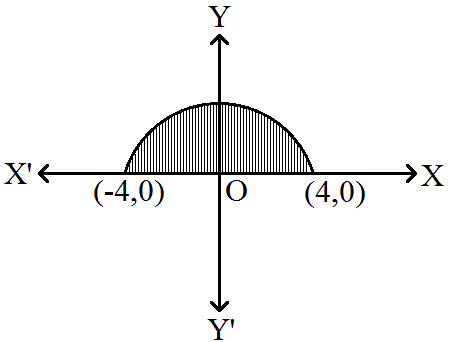
$\therefore\ \sqrt{16-\text{x}^2}=0\ \ \dots(\text{i})$
$\Rightarrow\ 16-\text{x}^2=0$
$\Rightarrow\ \text{x}^2=16$
$\Rightarrow\ \text{x}=\pm4$
So, the intersection points are (4, 0) and (-4, 0).
$\therefore$ Area of curve, $\text{A}=\int\limits^4_{-4}(16-\text{x}^2)^{\frac{1}{2}}\text{dx}$
$=\int\limits^4_{-4}\sqrt{(4^2-\text{x}^2)}\text{dx}$
$=\bigg[\frac{\text{x}}{2}\sqrt{4^2-\text{x}^2}+\frac{4^2}{2}\sin^{-1}\frac{\text{x}}{4}\bigg]^4_{-1}$
$=\bigg[\frac{4}{2}\sqrt{4^2-4^2}+8\sin^{-1}\frac{4}{4}\bigg]-\bigg[-\frac{4}{2}\sqrt{4^2-(-4)^2}+8\sin^{-1}\Big(-\frac{4}{4}\Big)\bigg]$
$=\bigg[2\cdot0+8\cdot\frac{\pi}{2}-0+8\cdot\frac{\pi}{2}\bigg]=8\pi\text{ sq. units}$ View full question & answer→MCQ 1431 Mark
Area between the curves $y = x$ and $y = x^3$ is:
- ✓
$\sqrt{3}\sqrt{2}$
- B
$\frac{1}{2}$
- C
$\frac{2}{\sqrt{2}}$
- D
$\frac{1}{4}$
AnswerCorrect option: A. $\sqrt{3}\sqrt{2}$
View full question & answer→MCQ 1441 Mark
The area of region bounded by curve $\text{y}=\cos2\text{x},$ line $\text{x}=0$ $\text{x}=\frac{\pi}{3}$ is:
- A
$\frac{2-\sqrt{3}}{4}$
- ✓
$\frac{\sqrt{3}}{4}$
- C
$\frac{4-\sqrt{3}}{4}$
- D
$\frac{\sqrt{3}-4}{4}$
AnswerCorrect option: B. $\frac{\sqrt{3}}{4}$
$=\text{y}=\cos2\text{x}\int\limits^\frac{\pi}{3}_0\cos2\text{ xdx}$
$=\frac{1}{2}[\sin2\text{x}]^\frac{\pi}{3}_0$
$=\frac{\sqrt{3}}{4}\text{sq}\text{ units}$
View full question & answer→MCQ 1451 Mark
Area of the region bounded by the curve $\text{y}=\tan\text{x,}$ line $\text{x}=\frac{\pi}{4}$ and the $x-$axis is:
- A
$\log2\text{ sq.}\text{units}$
- ✓
$\frac{1}{2}\log2\text{ sq.}\text{units}$
- C
$\frac{1}{3}\log2\text{ sq.}\text{units}$
- D
$5\log2\text{ sq.}\text{units}$
AnswerCorrect option: B. $\frac{1}{2}\log2\text{ sq.}\text{units}$
View full question & answer→MCQ 1461 Mark
The area of the region bounded by the curve $x = 2y + 3$ and lines $y = 1$ and $y = –1$ is:
- A
$4\text{ sq.}\text{ units}$
- B
$\frac{2}{3}\text{ sq.}\text{ units}$
- ✓
$6\text{ sq.}\text{ units}$
- D
$8\text{ sq.}\text{ units}$
AnswerCorrect option: C. $6\text{ sq.}\text{ units}$
View full question & answer→MCQ 1471 Mark
The area bounded by the curve y = f(x), above the x - axis, between ax = a and x = b is:
- A
$\int\limits^{\text{b}}_{\text{f(a)}}\text{ydy}$
- B
$\int\limits^{\text{fb}}_{\text{(b)}}\text{xdx}$
- C
$\int\limits^{\text{b}}_{\text{a}}\text{xdy}$
- ✓
$\int\limits^{\text{b}}_{\text{a}}\text{ydx}$
AnswerCorrect option: D. $\int\limits^{\text{b}}_{\text{a}}\text{ydx}$
We need to calculate the area bounded by y = f(x) between x = a and x = bx = b
So, we need to find the area of the region inside the curve y = f(x)
having limit points aa to bb and it is given by
$\int\limits^\text{b}_\text{a}=\text{f(x)}\text{ dx}=\int\limits^\text{b}_\text{a}$
View full question & answer→MCQ 1481 Mark
Area enclosed between the curve $y^2(2a - x) = x^3$ and the line $x = 2a$ above $x-$ axis is:
AnswerCorrect option: B. $\frac{3}{2}\pi\text{a}^2$
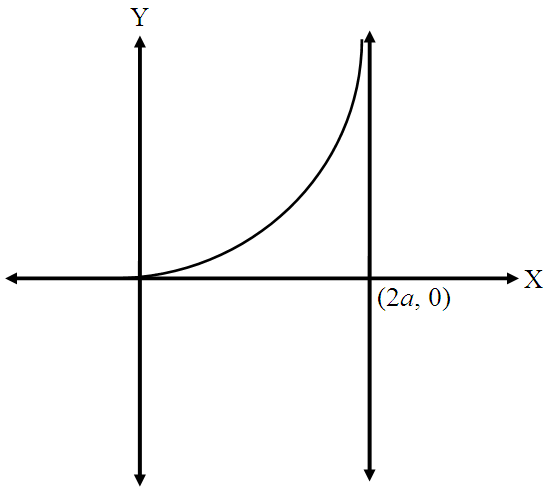
$\text{y}^2 (2\text{a}-\text{x})=\text{x}^3$
$\text{y}= \sqrt\frac{\text{x}^3}{2\text{a}-\text{x}}$
$\text{Let}\text{ x}= 2\text{a}\sin^2\theta$
$\text{dx}=4\text{a}\sin\theta\cos\theta\text{d}\theta$
$\text{Area}=\int\limits^\text{2a}_0\sqrt\frac{\text{x}^3}{2\text{a}-\text{x}}\text{dx}$
$=\int\limits^\frac{\pi}{2}_0\sqrt\frac{(8\text{a}^3)\sin^6\theta}{(2\text{a})\cos^2\theta}.(4\text{a})\sin\theta\cos\theta\text{d}\theta$
$= 8\text{a}^2\int^\frac{\pi}{2}_0\sqrt{\sin^6}\theta\sin\theta\text{d}\theta$
$=8\text{a}^2\Big[\int^\frac{\pi}{2}_0\sin^4\theta\text{d}\theta\Big]$
$= 8\text{a}^2\Big[\int^\frac{\pi}{2}_0\sin^2\theta(1-\cos^2\theta)\text{d}\theta\Big]$
$= 8\text{a}^2\Big[\int^\frac{\pi}{2}_0\frac{(1-\cos2\theta)}{2}\text{d}\theta-\frac{1}{4}\int^\frac{\pi}{2}_0\sin^2\theta\text{d}\theta\Big]$
$= 8\text{a}^2\bigg[\frac{1}{2}[\theta]^\frac{\pi}{2}_0-\Big[\frac{\sin2\theta}{4}\Big]^\frac{\pi}{2}_0\bigg]-\frac{1}{4}\bigg[\int^\frac{\pi}{2}_0\frac{1-\cos4\theta}{2}\text{d}\theta\bigg]$
$= 8\text{a}^2\Big[\Big(\frac{\pi}{4}\Big)-0\Big]-\frac{1}{4}\Big[\frac{\pi}{4}-0\Big]$
$= 8\text{a}^2\Big[\frac{\pi}{4}-\frac{\pi}{16}\Big]$
$=\frac{3}{2}\pi\text{a}^2$ View full question & answer→MCQ 1491 Mark
The area of the region bounded by the curves $y =| x – 2 |, x = 1, x = 3$ and the $x-$axis is:
View full question & answer→MCQ 1501 Mark
Area bounded by the ellipse $\frac{\text{x}^2}{4}+\frac{\text{y}^2}{9}=1$
- ✓
$6\pi\text{ sq}.\text{units}$
- B
$3\pi\text{ sq}.\text{units}$
- C
$12\pi\text{ sq}.\text{units}$
- D
AnswerCorrect option: A. $6\pi\text{ sq}.\text{units}$
View full question & answer→MCQ 1511 Mark
Area of the ellipse $\frac{\text{x}^2}{\text{a}^2}+\frac{\text{y}^2}{\text{b}^2}=1$ is:
- A
$4\pi\text{ ab}\text{ sq}.\text{units} $
- B
$2\pi\text{ ab}\text{ sq}.\text{units} $
- ✓
$\pi\text{ ab}\text{ sq}.\text{units} $
- D
$\frac{\pi\text{ab}}{2}\text{ sq}.\text{units}$
AnswerCorrect option: C. $\pi\text{ ab}\text{ sq}.\text{units} $
View full question & answer→MCQ 1521 Mark
The area bounded by the curve $y = x^2 - 1$ and the straight line $x + y = 3$ is:
- A
$\frac{9}{2}\text{sq}.\text{units}$
- B
$4\text{ sq}.\text{units}$
- C
$\frac{9\sqrt{17}}{6}\text{sq}.\text{units}$
- ✓
$\frac{17\sqrt{17}}{6}\text{sq}.\text{units}$
AnswerCorrect option: D. $\frac{17\sqrt{17}}{6}\text{sq}.\text{units}$
$\frac{17\sqrt{17}}{6}\text{sq}.\text{units}$
View full question & answer→MCQ 1531 Mark
Area of the region between the curves $\text{x}^2+\text{y}^2=\pi,\text{y}=\sin\text{x}$ and $y-$axis in first quadrant is:
- ✓
$\frac{\pi^3-8}{4\text{ sq.}\text{ units}}$
- B
$\frac{\pi^3-4}{4\text{ sq.}\text{ units}}$
- C
$\frac{\pi^3-8}{4\text{ sq.}\text{ units}}$
- D
$\frac{\pi^3-4}{4\text{ sq.}\text{ units}}$
AnswerCorrect option: A. $\frac{\pi^3-8}{4\text{ sq.}\text{ units}}$
View full question & answer→MCQ 1541 Mark
The area bounded by the curve $y = x|x|$ and the ordinates $x = -1$ and $x = 1$ is given by:
- A
$0$
- B
$\frac{1}{3}$
- ✓
$\frac{2}{3}$
- D
$\frac{4}{3}$
AnswerCorrect option: C. $\frac{2}{3}$
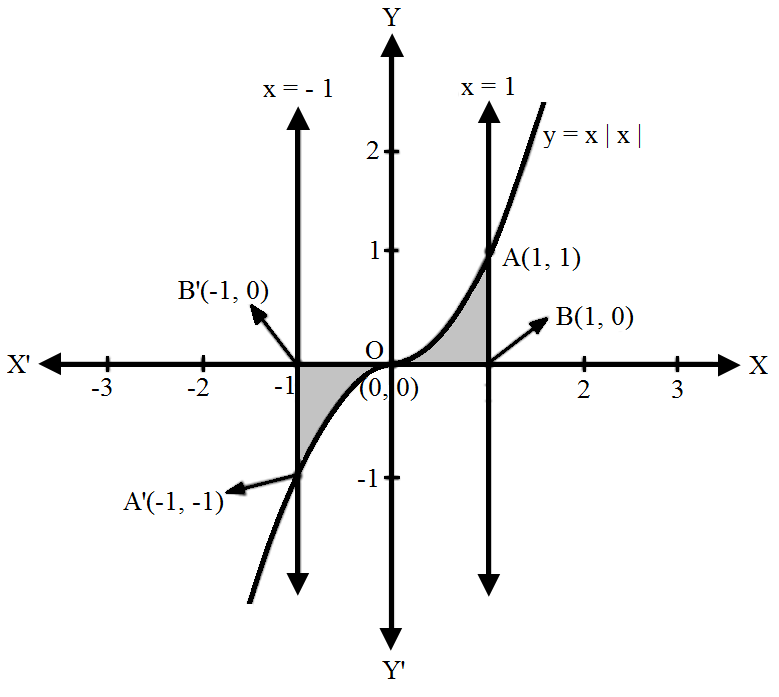
The given equation of the curve is
$y = x|x|$
$\Rightarrow \text{y}= \text{cases} \ \text{x}^2 \text{x} \geq0$
$\text{-x}^2 \text{x} < 0\ \text{cases}$
Now, solving $x = 1$ and $y = x|x|$ we get
$x = 1 \Rightarrow y = 1$
$\Rightarrow A(1, 1)$ is point of intersection of the curve $y = x|x|$ and $x = 1$
Also, solving $x = -1$ and $y = x|x|$ we get
$x = -1$
$ \Rightarrow y = -1$
$\Rightarrow A'(-1, -1)$ is point of intersection of the curve $y = x |x|$ and $x = -1$
If $P(x, y_1), x > 0$ is a point on $y = x|x|$ then $y_1 >0 \Rightarrow |y_1| = y_1$_
And $Q(x, y_2), x < 0$ is a point on $y = x|x|$ then $y_2 < 0 \Rightarrow |y_2| = -y_2$
Required area $=\int\limits^0_{-1}|\text{y}_2|\text{dx}+\int\limits^1_0|\text{y}_1|\text{dx}$
$= \int\limits^0_{-1}-\text{y}_2\text{ dx}+\int\limits^1_0\text{y}_1\text{ dx}$
$= \int\limits^0_{-1}-(-\text{x}^{2})\text{dx}+\int\limits^1_0\text{x}^2\text{ dx}$
$=\int\limits^0_{-1}\text{x}^2\text{dx}+\int\limits^1_0\text{x}^2\text{dx}$
$= \Big[\frac{\text{x}^3}{3}\Big]^0_{-1} +\Big[\frac{\text{x}^3}{3}\Big]^1_0$
$= \bigg[0-\frac{(-1)^3}{3}\bigg]+\Big(\frac{1^3}{3}-0\Big)$
$= \frac{1}{3}+\frac{1}{3}$
$= \frac{2}{3}\text{ sq. units}$ View full question & answer→MCQ 1551 Mark
Area bounded by the curve $\text{y}=\log\text{x}$ and the coordinate axes is:
View full question & answer→MCQ 1561 Mark
Choose the correct answer from the given four options:
The area of the region bounded by the curve y = x + 1 and the lines x = 2 and x = 3 is:
- ✓
$\frac{7}{2}\text{ sq. units}$
- B
$\frac{9}{2}\text{ sq. units}$
- C
$\frac{11}{2}\text{ sq. units}$
- D
$\frac{13}{2}\text{ sq. units}$
AnswerCorrect option: A. $\frac{7}{2}\text{ sq. units}$
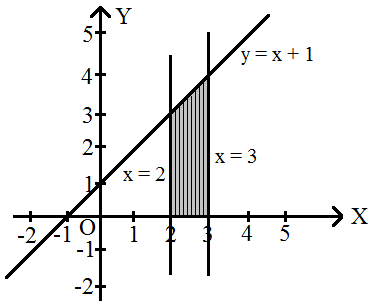
From the figure, are of the shaded region,
$\text{A}=\int\limits^{3}_{2}(\text{x}+1)\text{dx}=\bigg[\frac{\text{x}^2}{2}+\text{x}\bigg]^3_2$ $=\bigg[\frac{9}{2}+3-\frac{4}{2}-2\bigg]=\frac{7}{2}\text{sq. units}$ View full question & answer→MCQ 1571 Mark
The area bounded by the curve $y = x^2 + 4x + 5,$ the axes of coordinates and minimum ordinate is:
- A
$3\frac{2}{3}\text{sq}.\text{ units}$
- ✓
$4\frac{2}{3}\text{sq}.\text{ units}$
- C
$5\frac{2}{3}\text{sq}.\text{ units}$
- D
AnswerCorrect option: B. $4\frac{2}{3}\text{sq}.\text{ units}$
$4\frac{2}{3}\text{sq}.\text{ units}$
View full question & answer→MCQ 1581 Mark
The area of the region bounded by the curve $\text{y}=\sqrt{16-\text{x}^2}$ and $\text{ x}-$axis is:
- ✓
$\text{8p sq. units}$
- B
$\text{20p sq. units}$
- C
$\text{16p sq. units}$
- D
$\text{256p sq. units}$
AnswerCorrect option: A. $\text{8p sq. units}$
View full question & answer→MCQ 1591 Mark
The area of the smaller region bounded by the ellipse $\frac{\text{x}^2}{9}+\frac{\text{y}^2}{4}=1$ and the line $\frac{\text{x}}{3}+\frac{\text{y}}{2}=1$ is:
- ✓
$3(\pi-2)$
- B
$\frac{3}{2\pi}$
- C
$\frac{3}{2}(\pi-2)$
- D
$\frac{2}{3}(\pi-2)$
AnswerCorrect option: A. $3(\pi-2)$
View full question & answer→MCQ 1601 Mark
The area of the region bounded by the curve $x = 2y + 3$ and the lines $y = 1$ and $y = -1$ is:
AnswerCorrect option: C. $\text{6 sq. units}$
View full question & answer→MCQ 1611 Mark
The area bounded by the y-axis, $\text{y}=\cos\text{x}$ and $\text{y}=\sin\text{x}$ when $0\leq\text{x}\leq\frac{\pi}{2}$ is:
- A
$2\big(\sqrt{2}-1\big)$
- ✓
$\sqrt{2}-1$
- C
$\sqrt{2}+1$
- D
$\sqrt{2}$
AnswerCorrect option: B. $\sqrt{2}-1$
Points of intersection is obtained by solving y = sinx and y = cos x
$\therefore\sin\text{x} = \cos \text{x}$
$\Rightarrow \text{x}=\frac{\pi}{4}$
Thus the two functions intesect at $\text{x}=\frac{\pi}{4}$
$\Rightarrow \text{y} = \sin \frac{\pi}{4} =\frac{1}{\sqrt{2}}$
Hence $\text{A}\Big(\frac{\pi}{4},\frac{1}{\sqrt{2}}\Big)$ is the point of intersection.
$\therefore$ Area bound by the curves and the y - axis when $0\leq\text{x}\leq\pi2$
$\text{A} = \int\limits^\frac{1}{\sqrt{2}}_0|\text{x}_1|\text{dy}+\int\limits^1_\frac{1}{\sqrt{2}}|\text{x}_2|\text{dy}$
$=\int\limits^\frac{1}{\sqrt{2}}_0\text{x}_1\text{ dy}+\int\limits^1_\frac{1}{\sqrt{2}}\text{x}_2\text{ dy}$
$= \int\limits^\frac{1}{\sqrt{2}}_0\sin^{-1}\text{y}\text{ dy}+\int\limits^1_\frac{1}{\sqrt{2}}\cos^{-1}\text{y}\text{ dy}$
$= \Big[\text{y}\sin^{-1}\text{y}+\sqrt{1-\text{y}^2}\Big]^\frac{1}{\sqrt{2}}_0+\Big[\text{y}\cos^{-1}\text{y}-\sqrt{1-\text{y}^2}\Big]^1_\frac{1}{\sqrt{2}}$
$= \Big[\frac{1}{\sqrt{2}}\sin^{-1}\frac{1}{\sqrt{2}}+\sqrt{1-\frac{1}{2}}-1\Big]\\+\bigg[1\times\cos^{-1}-0-\frac{1}{\sqrt{2}}\cos^{-1}\frac{1}{\sqrt{2}}+\sqrt{1-\frac{1}{2}}\bigg]$
$= \frac{2}{\sqrt{2}}-1$
$=\big(\sqrt{2}-1\big)\text{sq. units}$
View full question & answer→MCQ 1621 Mark
Choose the correct answer in the following:
The area bounded by the y-axis, y = cos x and y = sin x when $0\leq\text{x}\leq\frac{\pi}{2}$
- A
$2(\sqrt2-1)$
- ✓
$\sqrt2-1$
- C
$\sqrt2+1$
- D
$\sqrt2.$
AnswerCorrect option: B. $\sqrt2-1$
The given equations are
y = cos x ...(1)
And, y = sin x ...(2)
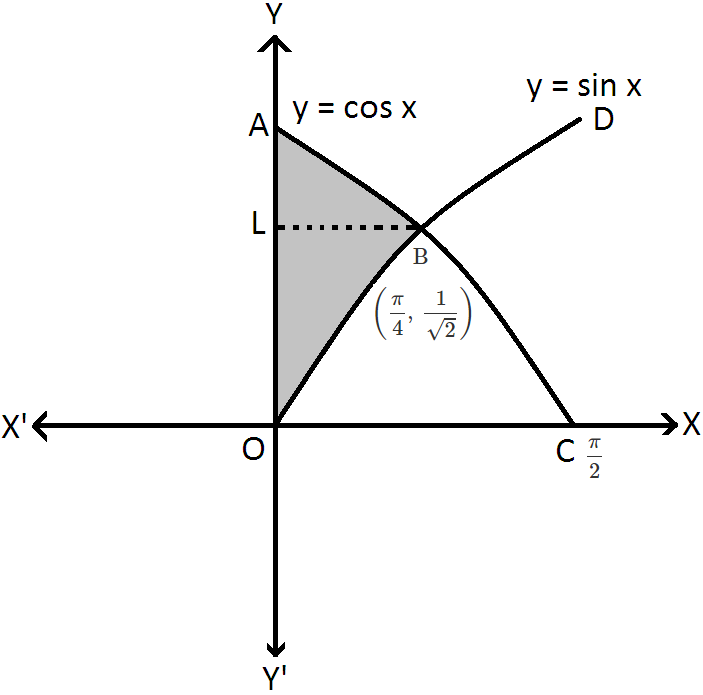
Required area = Area(ABLA) + Area(OBLO)]
$=\int\limits^1_{\frac{1}{\sqrt2}}\text{x dy}+\int\limits^{\frac{1}{\sqrt2}}_0\text{x dy}$
$=\int\limits^1_{\frac{1}{\sqrt2}}\cos^{-1}\text{y dy}+=\int\limits^{\frac{1}{\sqrt2}}_0\sin^{-1}\text{x dy}$
Integrating by parts, we obtain
$=\Big[\text{y}\cos^{-1}\text{y}-\sqrt{1-\text{y}^2}\Big]^1_{\frac{1}{\sqrt2}}$ $+\Big[\text{x}\sin^{-1}\text{x}+\sqrt{1+\text{x}^2}\Big]^{\frac{1}{\sqrt2}}_0$
$=\Big[\cos^{-1}(1)-\frac{1}{\sqrt2}\cos^{-1}\Big(\frac{1}{\sqrt2}\Big)+\sqrt{1-\frac{1}{2}}\ \Big]$ $+\Big[\frac{1}{\sqrt2}\sin^{-1}\Big(\frac{1}{\sqrt2}\Big)+\sqrt{1-\frac12}-1\Big]$
$=\frac{-\pi}{4\sqrt2}+\frac{1}{\sqrt2}+\frac{\pi}{4\sqrt2}+\frac{1}{\sqrt2}-1$
$=\frac{2}{\sqrt2}-1$
$=\sqrt2-1\text{ units}$
Thus, the correct answer is B. View full question & answer→MCQ 1631 Mark
The area bounded by the circles $= 4x^2 + y^2 = 1, x^2 + y^2 = 4$ in the first Quadrant is:
- A
$\frac{\pi}{2}$
- ✓
$\frac{3\pi}{4}$
- C
$3\pi$
- D
$\frac{\pi}{4}$
AnswerCorrect option: B. $\frac{3\pi}{4}$
$x^2+ y^2= 1$ and $x^2 + y^2 = 4$ are concentric circles They form Ring in between them.Area is given by
$=\pi(4-1)=3\pi$
In first Quadrant it is divided by $4$ So, Area is given by
$=\frac{3\pi}{4}$
View full question & answer→MCQ 1641 Mark
Let $f(x) = x^2 - 3x + 2$ then area bounded by the curve $f( ∣x∣ ) ($in square units$)$ and $x -$ axis is:
- A
$\frac{1}{3}$
- B
$\frac{5}{6}$
- ✓
$\frac{5}{3}$
- D
AnswerCorrect option: C. $\frac{5}{3}$
the area bounded by the curve $y = f(x), x -$ axis and $y - $axis be a square units
then area bounded by $f(∣x∣)$ and $x -$ axis be twice of a Shaded Area
$=\int\limits^1_0\text {f(x)}\text{ dx}=\frac{5}{6}\text{sq}.$
units again Graph of $f(∣x∣)$
$\therefore$ Required Area bounded by $f(∣x∣)$
$=\int\limits^1_{-1}\text{f(dx)}=2$
$=\int\limits^1_0\text{f(dx)}=2,\frac{5}{6}$
$=\frac{5}{3}\text{sq}\text{ units}$
View full question & answer→MCQ 1651 Mark
The area of the portion of the circle $x^2 + y^2 = 1$, which lies inside the parabola $y^2 = 1 - x$, is:
- A
$\frac{\pi}{2}-\frac{2}{3}$
- B
$\frac{\pi}{2}+\frac{2}{3}$
- ✓
$\frac{\pi}{2}-\frac{4}{3}$
- D
$\frac{\pi}{2}+\frac{4}{3}$
AnswerCorrect option: C. $\frac{\pi}{2}-\frac{4}{3}$
View full question & answer→MCQ 1661 Mark
Area of the region bounded by rays |x| + y = 1 and X - axis is ___________.
- ✓
$\frac{1}{2}$
- B
$2$
- C
$1$
- D
$\frac{1}{4}$
AnswerCorrect option: A. $\frac{1}{2}$
Given equation can also be written as y = 1 - |x|
point of intersection of the given line are (1, 0) and (0, 1) and (0, 0) will be the third vertices of the triangle formed
thus height and base of this triangle = 1
therefore Area $=1\times1\times\frac{1}{2}$
View full question & answer→MCQ 1671 Mark
The area of the region bounded by the parabola $y = x^2 + 1$ and the straight line $x + y = 3$ is given by:
- A
$\frac{45}{7}\text{sq.}\text{units}$
- B
$\frac{25}{4}\text{sq.}\text{units}$
- C
$\frac{5}{18}\text{sq.}\text{units}$
- ✓
$\frac{9}{2}\text{sq.}\text{units}$
AnswerCorrect option: D. $\frac{9}{2}\text{sq.}\text{units}$
View full question & answer→MCQ 1681 Mark
Choose the correct answer from the given four options:
The area of the region bounded by the ellipse $\frac{\text{x}^2}{25}+\frac{\text{y}^2}{16}=1$ is:
AnswerCorrect option: A. $20\pi\text{ sq. units}$
We have $\frac{\text{x}^2}{5^2}+\frac{\text{y}^2}{4^2}=1,$ which is ellipse with is axis as coordinate axis.
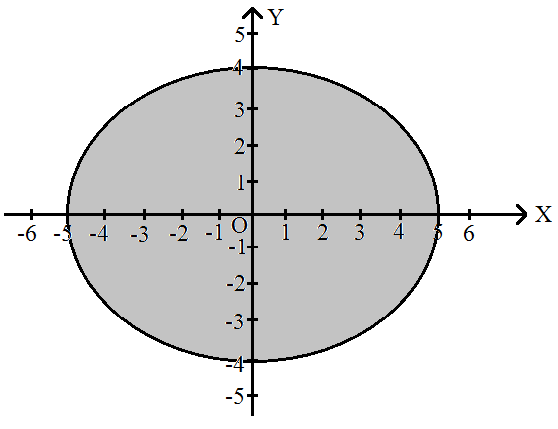
$\frac{\text{y}^2}{4^2}=1-\frac{\text{x}^2}{5^2}$
$\Rightarrow\ \text{y}^2=16\Big(1-\frac{\text{x}^2}{25}\Big) $
$\Rightarrow\ \text{y}=\frac{4}{5}\sqrt{5^2-\text{x}^2}$
From the figure, area of the shaded region
$\text{A}=4\int\limits_{0}^{5}\frac{4}{5}\sqrt{5^2-\text{x}^2}\text{ dx}$
$=\frac{16}{5}\bigg[\frac{\text{x}}{2}\sqrt{5^2-\text{x}^2}+\frac{5^2}{2}\sin^{-1}\frac{\text{x}}{5}\bigg]^{5}_{0} $
$=\frac{16}{5}\bigg[0+\frac{5^2}{2}\sin^{-1}1-0-0\bigg]$ $=\frac{16}{5}.\frac{25}{2}.\frac{\pi}{2}=20\pi\text{ sq. units}$ View full question & answer→MCQ 1691 Mark
Area of the region bounded by the curve x = 2y + 3, the y-axis and between y = -1 and y = 1 is:
- A
$4\text{sq}\text{ units}3$
- B
$\frac{3}{2}\text{sq}\text{ units}$
- ✓
$6\text{sq}\text{ units}$
- D
$8\text{sq}\text{ units}$
AnswerCorrect option: C. $6\text{sq}\text{ units}$
$\text{as}\text{ area}=\int\limits^1_0(2\text{y}+3)\text{dy}$
$=6\text{sq}\text{ units}$
View full question & answer→MCQ 1701 Mark
The area of the region bounded by the line $y = | x - 2 |, x = 1, x = 3$ and $x-$axis is:
- A
$\text{4 sq. units}$
- B
$\text{2 sq. units}$
- C
$\text{3 sq. units}$
- ✓
$\text{1 sq. unit}$
AnswerCorrect option: D. $\text{1 sq. unit}$
View full question & answer→MCQ 1711 Mark
The area bounded by the curve $\text{y}=\frac{3}{2}\sqrt{\text{x}},$ the line $\text{x}=1$ and $x -$ axis is $..........sq.$ units:
View full question & answer→MCQ 1721 Mark
Area of ellips $\frac{\text{x}^2}{\text{a}^2}+\frac{\text{y}^2}{\text{b}^2}=1$ is:
- A
$4\pi\text{ ab}\text{ sq.}\text{ units}$
- B
$2\pi\text{ ab}\text{ sq.}\text{ units}$
- ✓
$\pi\text{ ab}\text{ sq.}\text{ units}$
- D
$\frac{\pi\text{ab}}{2}\text{ sq.}\text{ units}$
AnswerCorrect option: C. $\pi\text{ ab}\text{ sq.}\text{ units}$
View full question & answer→MCQ 1731 Mark
The area $($in $sq.$ units$)$ enclosed between the graph of $y = x^3$ and the lines $x = 0, y = 1, y = 8$ is:
- ✓
$\frac{45}{4}$
- B
$14$
- C
$7$
- D
AnswerCorrect option: A. $\frac{45}{4}$
View full question & answer→MCQ 1741 Mark
What is the area of the triangle bounded by the lines $y = 0, x + y = 0$ and $x = 4?$
- A
$4$ units
- ✓
$8$ units
- C
$12$ units
- D
$16$ units
AnswerCorrect option: B. $8$ units
View full question & answer→